Tuesday, November 25, 2025

Marks on the Calendar: Two Years into Eradication of a People, “So Move on”!

Note: Again, smalltown news, a newspaper that is now as thin as a tissue, once a week, and here we are — a 900 to 1000 word piece by yours truly once a month. This November, some catching up with October’s Banner Books week, and other funky things.

Next month I do a bit of jujitsu, and I was begged to speak, and I both look forward to it and dread it:
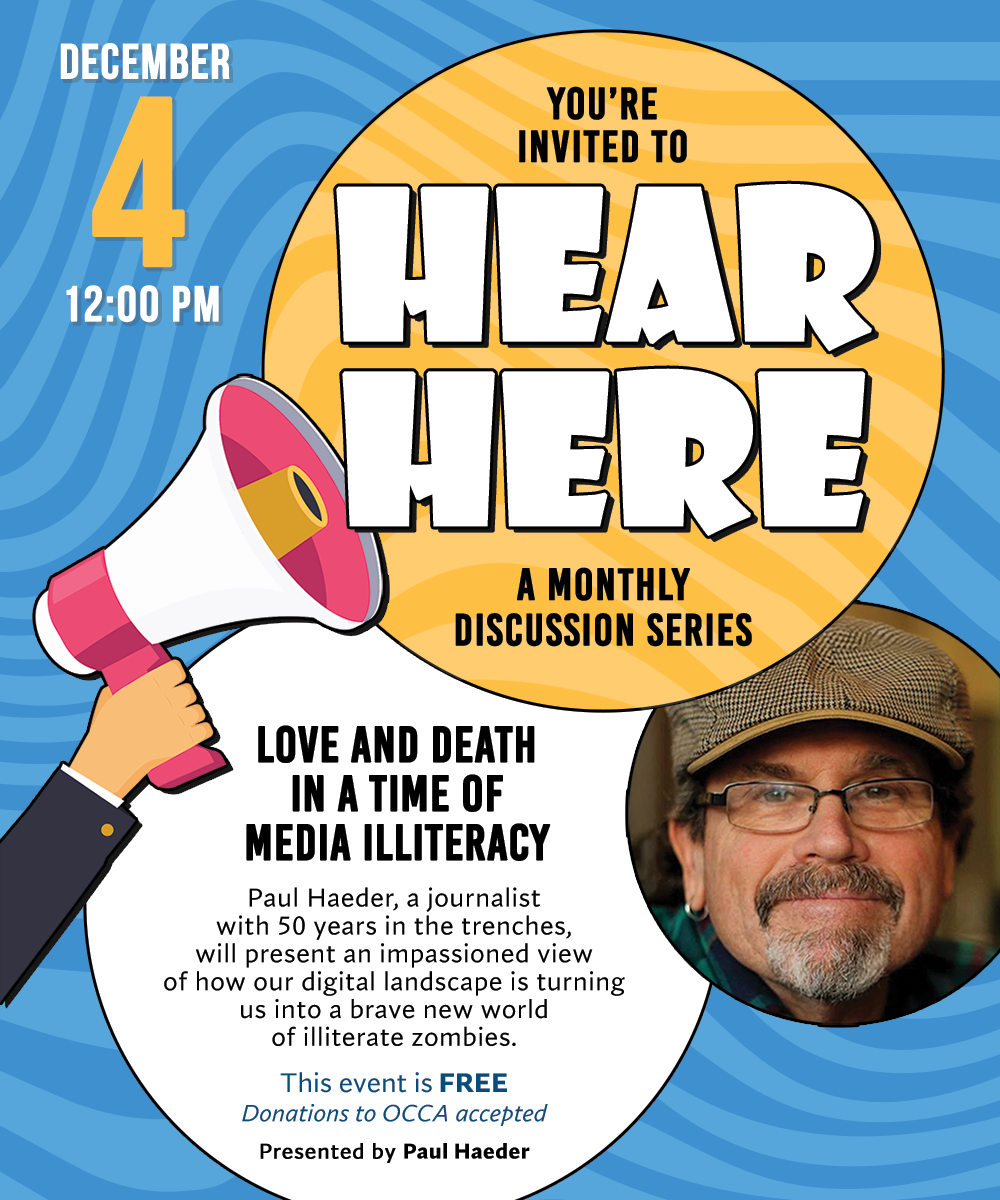
Discussion: Hear Here - Love and Death in a Time of Media Illiteracy with Paul Haeder - Oregon Coast Council for the Arts

I am NEVER in friendly territory, and in most cases, it’s ‘friendly fire’ against me, the messenger and the dude who is anti-authority and is not a sheeple, but again, Haeder does not spell H-A-T-E.

In a week, another Op-Ed runs, twice in a month, and that pisses people off, for sure. So much copy, and why so long, why 956 words? I’m introducing this talk to the wider community, tied to the death of journalism, with a trigger warning and redressing the zombification and infantalilization of AmeriKKKa.

Oh, maybe 60 Power Point slides, a media literacy quiz, and a box full of Project Censored “year in review books on the most censored stories of that respective year” and some Covert Action magazines and Z-Magazines, too.

Public schools across the U.S. saw more than 6,800 book bans in the 2024-25 school year. A new documentary, The Librarians, examines the experiences of school librarians who’ve found themselves on the front lines of a battle against censorship.

Maybe they will make connection between schooling and libraries and media illiteracy? The documentary, The Librarians.

It’s a lot of work, working with democrats, mostly grayhairs, and alas with the Anti-Antisemitism virus hitting may of us, those in the audience do not like the word “genocide” or the concept of “ethnic cleansing” or the very big tent idea of 130 Jewish billionaires and a few million multi-millionaire Jews, well, having that outsized “control of banking and media and tech and AI and war mongering and finance and real estate and, well, governments from her to Sudan to Venezuela, et al.”

Now, this op-ed continues with the bloody lies of, well, Capitalism, big time or small time USA.

Ahh, the banned books week passed (it should be a daily reminder that freedom of speech and thought are illusory in Capitalism). That was October 5 through 11, and you can Google what intense censorship has always occurred in USA and is going on now with the new brownshirts in office.

You can call school and library administrators, school board and library board members, city councilpersons, and your elected representatives to ask them to support the right to read! But most of them are running scared and are completely cowed by their own shadows.

Imagine California, running this House Bill and it passing with the Ray-Ban governor’s signature.

The law no longer references Israel’s war in Gaza, but critics have said it could still have a chilling effect and prevent open discussion on contentious issues in the classroom.

“Teacher discourse on Palestine or the genocide in Gaza will be policed, misrepresented, and reported to the antisemitism coordinator,” Theresa MontaƱo with the California Faculty Association said in a statement.

So, no need to burn books or ban them since K12 students will be policed and brought before boards of inquiry if they dare talk about the  Nakba and how that ethnic cleansing that started in 1948 (earlier, really, but don’t tell our representative Gomberg that!) relates to another passing October critical thinking milestone – Indigenous People’s Day.

That was October 13, and with the fanfare of stormtroopers hitting Portland’s streets and even our own backwater county seeing ICE masked raiders taking a citizen away, forget about finding deep discussion about that day of infamy – celebrating for ONE 24-hour period our own legacy of indigenous culture and wisdom.

The schools might not even be able to put up posters stating the following with this new regime of Stephen Miller and his Homeland Security infecting the great shining city on the hill: “We honor the Native American people for their culture including art and many crafts, their food, their clothing, their grit and endurance, their goodness and influence. According to the U.S. Census Bureau, there are about 4.5 million Native Americans and Alaska Natives in the United States today. That is about 1.5 percent of the population in the United States. There are ten main areas of North America where the Native Americans have lived over the last 2,000 years.”

The jig was up more than 250 years ago, throughout the enslavement of Africans, but recall that we had politician after general after newspaper editor repeating in variations of a theme these racist but highly American statements in regard to our Native People:

  • In 2021, Rick Santorum claimed there was “nothing” in America before colonization and little Native American culture present today.
  • Trump’s boy, Andrew Jackson, signed the Indian Removal Act of 1830, which forced many eastern tribes, such as the Cherokee, Choctaw, and others, off their ancestral lands. This policy led directly to the “Trail of Tears.” Jackson’s own words often framed Native Americans as uncivilized and an obstacle to American progress.
  • “The only good Indian is a dead Indian” is a racist proverb originating from General Philip Sheridan. [Denied by Sheridan — DV Ed]

Maybe schools will allow coursework — now that we have National Day of Remembrance or Sorrow  — to include American Indian scholars questioning the origins of Thanksgiving.

“Almost any portrait that we see of an Indian, he is represented with tomahawk and scalping knife in hand, as if they possessed no other but a barbarous nature. Christian nations might with equal justice be always represented with cannon and ball, swords and pistols,” states Elias Johnson, A Native Tuscarora Chief.

I doubt this book has been banned from public libraries: Let’s Play Indian, is a children’s book by Madye Lee Chastain. It’s  one of countless examples of “playing Indian,” a practice engaged in by outsiders who appropriate, or take on, American Indian identities and cultural ways. Chastain’s main character transforms herself into “a really truly dressed-up painted Indian,” who runs, whoops, and waves her tomahawk.

Forget about K12. I believe OCCC would get pushback if, say, I taught writing and communication including an amazing young Lakota’s Red Nation broadcast Nick Estes is a Lakota activist, writer, and scholar whose work delves into settler-colonialism, indigenous history, and decolonization. He is the author of Our History Is the Future: Standing Rock Versus the Dakota Access Pipeline, and the Long Tradition of Indigenous Resistance. I’d be highlighting Nick’s on-line advocacy for Palestinian liberation, wherein he highlights the ongoing genocide in Gaza by exploring the intersection of the struggles faced by Palestinian and Indigenous peoples in America.

No photo description available.

Drill down into Native American perspectives and unmask almost all myths perpetrated in this country. But as you pass the gravy on Nov. 27, remember it’s not all a bed of pumpkins and cranberries:

CONTENT WARNING / GRAPHIC IMAGE HISTORY YOU NEED TO KNOW. On this day, 158 years ago, December 26, 1862, President "Honest" Abe Lincoln ordered the largest mass execution, 38 Dakota men, where

Federal agents kept the Dakota-Sioux from receiving food and provisions. Accordingly, on the brink of death from starvation, some fought back, resulting in the Dakota War of 1862. In the end, President Lincoln ordered 38 Dakota men to die from hanging, but he too was spinning PR, so he felt that the first Thanksgiving  (1863) offered an opportunity to bridge the hard feelings amongst Natives and the federal government.

“It was propaganda,” Dr. Kelli Mosteller, Citizen Potawatomi Nation’s Cultural Heritage Center director explains. “It was to try and build this event so that you could have a deeper narrative about community building and coming together in shared brotherhood and unity.”

No photo description available.

No photo description available.

So, there was a counter Op-Ed, running two weeks ago, and of course, I ran my own letter to the editor, here:

But they, the readers, the democrat lite or light-headed, they just DO NOT get AmeriKKKa.

Imagine just a month tying into just a few dozen Break Through News reports, such as this one:
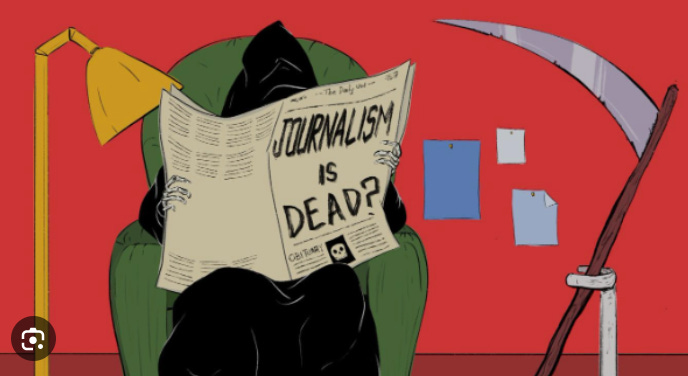
Dear Editor:

So, a long attack on me was published Nov. 12, along with a snarky fucked up letter to the editor also attacking the above “facts.” Opinion piece. Here, just published today, my letter response:

Dear Editor — Recent attacks (Nov. 5 commentary and letter to the editor) on my integrity as a writer and as an educator, plus the inane label of “antisemitism,” just don’t hold water. The thing about going after someone’s credentials and lifework is called ad hominem attack. Kill the messenger is also a term I could deploy with two personal attacks on my Oct. 15 Commentary.

Learning curves are steep in a country of people who have been miseducated, propagandized, and drawn and quartered by an elite media, whether right or left of some imaginary middle.

For real journalism on Gaza and the Jewish genocide, as well as just general news, try Drop Site News (dropsitenews.com). Try heading over to Monthly Review On-Line for deeper analyses of USA the Empire, and its insane and perverted hatred of socialism, as well as its relationship with an apartheid and genocidal state called Israel, the Occupied Land of Palestinians (monthlyreview.org). Then, of course, The Intercept, theintercept.com, will get you more news.

Again, steep learning curves are present when one comes out of K12 and college in this Empire of Chaos, War, Pain, and Terror. Try Tricontinental: Institute for Social Research — thetricontinental.org. I could list five dozen sites here that easily counter the narratives cooked up in the minds of Americans who have been colonized by one-sided narratives and bizarre takes on US and Global history.

Lifetimes of work and research and ground-truthing easily shoot holes into what most Americans and Westerners have come to believe are their “truths.”

Paul Haeder, Waldport

Paul Haeder has been a teacher, social worker, newspaperman, environmental activist, and marginalized muckraker, union organizer. Paul's book, Reimagining Sanity: Voices Beyond the Echo Chamber (2016), looks at 10 years (now going on 17 years) of his writing at Dissident Voice. Read his musings at LA Progressive. Read (purchase) his short story collection, Wide Open Eyes: Surfacing from Vietnam now out, published by Cirque Journal. Here's his Amazon page with more published work AmazonRead other articles by Paul, or visit Paul's website.


FSU oceanographers present new conceptual framework to answer age-old question: What happens to carbon as it sinks through the ocean?


Florida State University
Forrer 

image: 

Heather Forrer, a Ph.D. graduate from the FSU Department of Earth, Ocean and Atmospheric Science.

view more 

Credit: Courtesy of Heather Forrer


Florida State University oceanographers have discovered a significant connection between small-scale microbial processes and ecosystem-wide dynamics, offering new insights into the mechanisms driving marine carbon storage.

Heather Forrer, a Ph.D. graduate from FSU’s Department of Earth, Ocean and Atmospheric Science (EOAS), led new research spanning multiple ocean regions that found upper ocean ecosystem conditions, such as nutrient availability and microbial interactions, play a major role in shaping the composition of carbon-rich particles sinking into the deep ocean. The particles, surprisingly, continued to carry the imprint of surface ecosystem dynamics even at great depths, shaping how carbon is ultimately sequestered. The research was published today in the Proceedings of the National Academy of Sciences

Because the ocean is Earth’s largest active carbon sink, pulling carbon dioxide from the atmosphere and storing it for long periods, understanding these processes has important implications for the global carbon cycle.  

“This work was central to my dissertation, representing years of experimentation, perseverance and collaboration,” said Forrer, who earned a doctorate in oceanography from FSU last year. “It feels like a huge personal milestone and great contribution to the broader field, offering a new approach to longstanding, globally relevant questions.” 

On land, plants absorb carbon dioxide, converting it into organic matter and oxygen through photosynthesis. This same process is performed by tiny, ocean-dwelling plants called phytoplankton, which establish the base of the complex marine food web. The organic matter produced in this system ranges from microscopic particles unable to be seen with the naked eye to particles as thick as a nickel.

“Some of these particles sink from the sunlit surface into the ocean’s depths, effectively removing carbon from the atmosphere and storing it for decades to millennia,” Forrer said. “However, as this organic matter descends, it undergoes complex transformations that have long puzzled scientists. Understanding these changes is critical, as the rate and extent to which they occur determine how long this carbon is locked away.” 

These transformations are driven by microorganisms, or microbes, which influence organic matter’s sinking rate by reshaping or degrading the particles. The research team collected sinking particles from the Gulf, California Current Ecosystem and tropical Indian Ocean to examine molecular changes as they descend into the deep ocean.

MAGLAB RESEARCH
“Heather is an incredibly driven and intelligent early career scientist,” said Michael Stukel, EOAS chair and study co-author. “This publication is crucial to understanding the biological carbon pump and places our department at the vanguard of the field. It also highlights the incredible science that can be done in collaboration with other FSU departments and centers, such as the FSU-headquartered National High Magnetic Field Laboratory, which allowed us to characterize organic matter in sinking particles at a previously unseen level.” 

Using the National MagLab’s advanced ultrahigh-resolution mass spectrometer — which harnesses a powerful magnetic field to identify molecules with extreme precision — the researchers were able to, for the first time, directly compare the molecular composition of sinking particles collected in different ocean regions at different depths. They found that in nutrient-rich regions like California’s upwelling region, where particles are produced and sink quickly, more “fresh” carbon reached greater depths with very little molecular change, suggesting a strong carbon sequestration pathway. By contrast, nutrient-poor regions like the Gulf feature slower-sinking particles, which are more extensively processed by microbes, showing greater molecular changes since formation and contributing less effectively to carbon storage.  

“These topics, as foreign as they may seem, are intimately connected to our everyday lives,” Forrer said. “The air we breathe and Earth’s climate are largely controlled by the ocean and the processes investigated in this publication. By better understanding these fine-scale processes, we can gain a clearer picture of how the ocean functions today and more accurately predict how resilient these marine carbon storage pathways are in a warming world.” 

COLLABORATION AND SUPPORT
In addition to Stukel, co-authors include FSU professor of oceanography and environmental science Robert Spencer; Amy Holt, an FSU alumna and postdoctoral fellow at the University of Alaska Southeast; Sven Kranz, an associate professor of BioSciences at Rice University; Amy McKenna, an analytical chemist with the National MagLab’s Ion Cyclotron Resonance Facility and Colorado State University; and Huan Chen, a National MagLab research faculty member. 

This research was supported by the National Science Foundation-funded California Current Ecosystem Long-Term Ecological Research (CCE LTER) and Bluefin Larvae in Oligotrophic Ocean Foodwebs, Investigation of Nitrogen to Zooplankton (BLOOFINZ-IO) projects and the National Oceanic and Atmospheric Administration’s RESTORE Science Program, named for the Resources and Ecosystems Sustainability, Tourist Opportunities, and Revived Economies of the Gulf States Act and established to support the Gulf ecosystem’s long-term sustainability. 

To learn more about research conducted in FSU’s Department of Earth, Ocean and Atmospheric Science, visit eoas.fsu.edu.

CTD-Niskin rosette devices, which measure conductivity, temperature and depth, were deployed to collect water samples in the Indian Ocean.

Credit

Photo by Heather Forrer

Captured during a research cruise in February 2022, this image depicts a sediment trap device, which was the primary data collection method for this study. 

Credit

Photo by Michael Stukel


Heather Forrer, a Ph.D. graduate from the FSU Department of Earth, Ocean and Atmospheric Science, and her research team employed the FSU-headquartered National High Field Magnetic Laboratory’s advanced ultrahigh-resolution mass spectrometer, or 21T FT-ICR MS, to analyze sinking particles at the molecular level.

Credit

Photo by Heather Forrer


Island-wide field surveys illuminate land-sea connections in Mo‘orea


University of Hawaii at Manoa
Vibrant reef 

image: 

Moorea, French Polynesia, is surrounded by a diverse and vibrant coral reef ecosystem.

view more 

Credit: Christian John


A massive, multi-year scientific expedition led by researchers from the University of California, Santa Barbara and collaborating institutions, including the University of Hawai‘i (UH) at Mānoa, determined that land use on tropical islands can shape water quality in lagoons and that rainfall can be an important mediator for connections between land and lagoon waters. These findings provide vital information for ecosystem stewards facing global reef decline. Their findings were published recently in Limnology and Oceanography.

“This study is pretty groundbreaking in terms of its scale,” said Christian John, lead author of the study and postdoctoral scholar at the University of California, Santa Barbara. “We looked at algal tissue nutrients, water chemistry, and microbial communities at almost 200 sites around the island of Mo‘orea, French Polynesia, and we repeated this sampling over multiple years.”

“The links between land and sea are dynamic and complex, so it’s a topic that has remained elusive to science,” said Mary Donovan, co-author and faculty at the Hawai‘i Institute of Marine Biology in the UH Mānoa School of Ocean and Earth Science and Technology. “It took a dream team to pierce through that complexity. We brought together a group of interdisciplinary thinkers, from students to senior investigators, across at least five major institutions to tackle this immense challenge.”

Understanding the phase shift

Scientists have long been concerned that with an increase in human-associated inputs from land to a coral reef, there is often a "phase shift"—a decline in corals accompanied by an increase in harmful algae. This ecological shift is often linked to excessive nutrients and changes in the microbial community, but the precise connection between land use and coral reef health is poorly understood. 

Through their investigation, the team found that nutrients in the lagoons off Mo‘orea were highest in concentration closer to the island, lower farther offshore, and associated with terrestrial input. 

“This indicates that at least some of the nutrients in Mo‘orea's lagoons are coming from land,” said John. “Additionally, we found that nutrients are higher in lagoon habitats that are downstream of heavily impacted watersheds. This tells us that human activities on land can play a large role in lagoon water quality, which is important for corals, fishes, and all of the other creatures that live in coral reef ecosystems.”

The study also provides evidence that precipitation acts as a key mediator for the connections between land use and lagoon waters, potentially flushing more land-based nutrients to the lagoon and reef systems. This suggests that as climate change alters regional rainfall patterns, the impacts of terrestrial factors on coral reefs may also be affected.

Validating previous sampling approaches

For years, scientists have been using measurements of nutrient concentrations in algae tissue to understand how nutrients vary across a marine ecosystem. When analyzing alage in the recent study, the researchers found that algal nutrients reflected the chemistry of land-based inputs, especially near larger, human-impacted watersheds. 

“This validates our use of this organism as a reliable, long-term bioindicator for nutrient pollution in the ecosystem,” said John. “So, we can be more confident that our nutrient proxy is a good measure of nutrients in the ecosystem.”

Informing stewardship efforts

“Gravity is a unifying force in ecology, and islands are always uphill from the coral reefs that surround them,” said John. “Everything that happens on land has the potential to impact things going on in the ocean.”

Across Pacific Island systems, the flow of nutrients from mountains to the ocean is a central focus for coastal resource management. Targeted strategies, such as reducing polluted runoff, developing buffers along rivers, or actively mitigating soil loss at development sites, can significantly dampen the adverse effects of land use on lagoon water quality.

“The ahupua‘a, land use divisions that connect mauka to makai, are central to watershed management here in Hawai‘i,” said Nyssa Silbiger, co-author and associate professor in the SOEST Department of Oceanography. “Understanding water quality is a fundamental challenge for everyone: it is key to assessing coral reef health and it is inseparable from human health.”

Turbinaria ornata, a spiky macroalga, takes up excess nitrogen from the water column and is a useful proxy for nutrient enrichment

Development projects expose bare soil, which is easily eroded by rain

Credit

Christian John