Operation Honduras Whitewash
January 23, 2026
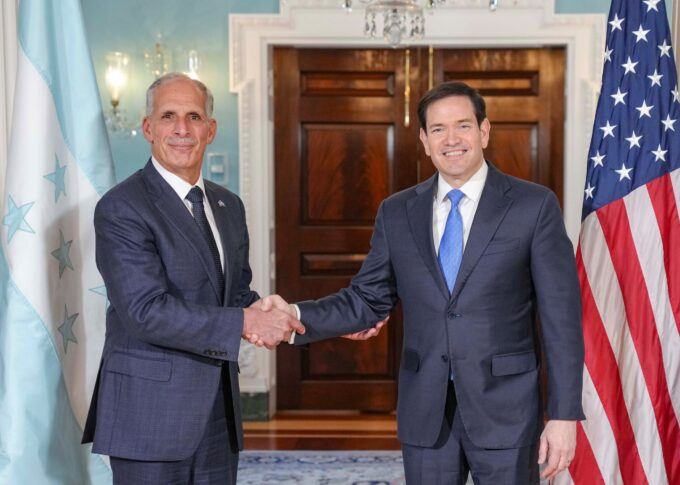
Secretary Marco Rubio meets with Honduran President-Elect Nasry Asfura at the Department of State in Washington, D.C., January 12, 2026. (Official State Department photo by Freddie Everett)
Operation Honduras Whitewash
An illuminating interview between disgraced sex offender and former Republican congressman Matt Gaetz and Honduran Narco-Dictator Juan Orlando Hernández
Since the January 3 U.S. invasion of Venezuela, reporters, politicians and the public have grilled Donald Trump about a glaring contradiction in the war-on-drugs argument used to justify bombing Venezuela and abducting its sitting president. Just a month before the violent capture of Nicolas Maduro and his wife Cilia Flores, Trump pardoned convicted cocaine trafficker and former president of Honduras, Juan Orlando Hernández, sentenced to 45 years by a New York District Court.
After the Honduras pardon and with the Venezuela attack in the wings, the administration already knew the optics on this were not going to be good. Releasing Hernandez caused an immediate uproar. Journalists and members of Congress demanded explanations. Hondurans, in the midst of a hotly contested election, denounced the U.S. move to return a hated dictator to a turbulent political scene. Trump defended the pardon, while Marco Rubio dodged questions, refusing to take a position on yet another of his boss’s seemingly eccentric decisions.
So in early December, the administration and its extreme right allies launched Operation Honduras Whitewash. To lead it, they enlisted none other than Matt Gaetz, the former Republican congressman forced to resign over ethics scandals, to do an exclusive interview with Juan Orlando Hernández, the former Honduran president and prisoner convicted in what the U.S. Justice Department heralded as one of the largest drug, arms and corruption cases in judicial history.
The Dec. 10 interview, at under twenty minutes, merits close examination as a textbook example of spin and a window into Trump’s strategies. It lays bare Orwellian tricks for how to build a false narrative that directly contradicts your previous narrative, the degree of perversion of far-right “family values”, and the long-game rapacity behind Trump’s foreign policy in Latin America.
Setting the Scene
Before going into the geopolitics, it’s important to look carefully at these two men beaming out of One America’s split screen.
The news anchor, professionally coiffed and tanned, smiles confidently. The guest appears dapper, having recently traded prison scrubs for a suit and tie.
The teaser paragraph above the interview reads:
The 38th President of Honduras, Juan Orlando Hernández Alvarado, gives his first exclusive interview to One America News following his pardon by President Donald Trump. Alvarado (sic) had been serving a 45-year sentence for drug-trafficking and related firearms offenses.
Is he a victim of Joe Biden’s lawfare, or is he one of the greatest narco-traffickers of all time? Matt Gaetz finds out.
Everyone who has come to the page knows that the whole point of the interview is to convince the public of the first part of that dichotomy. Never mind that that means erasing years of investigation and undercover work carried out by hundreds of U.S. government officials, including dedicated DEA agents, lawyers and judges, counternarcotics agents, academics, experts and congressional offices of both parties. The point now is to recast the villain as hero.
Gaetz has a tough task before him–to drum up sympathy for a convicted drug and arms trafficker and political strongman responsible for the assassination of at least 38 of his own people in protests after he stole the 2017 election. The network titles the interview “Nowhere to Run”, to aid in portraying Hernández as an innocent victim.
Hernández, called JOH by his initials, has been prepped to present himself as the victim of a Deep State conspiracy orchestrated by the Biden administration. As if the judiciary were not an independent branch of government, JOH claims to have suffered a “wrongful conviction” wrangled through “Biden lawfare”, while thanking Trump repeatedly and obsequiously for correcting this “injustice”.
Gaetz steers the president-turned-felon into confirming the bizarre theory that the New York District court investigated, tried and prosecuted the Honduran politician for drug trafficking and arms possession solely as political punishment for cooperating with the first Trump administration to block migration flows to the U.S.
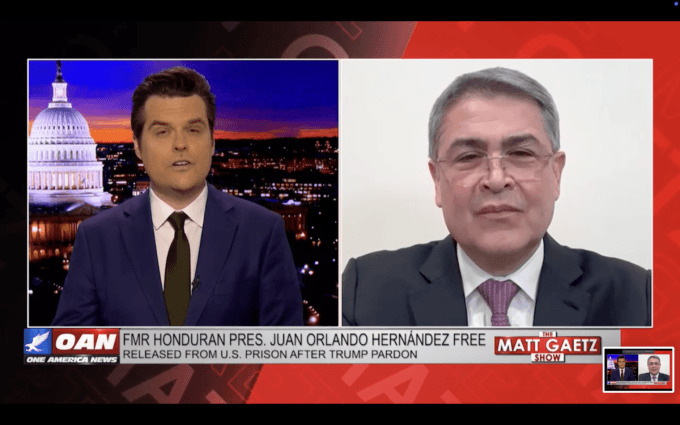
Gaetz frequently resorts to journalistic ventriloquism to do this, like this question:
“So you believe that they were targeting you because you took positions on migration that would not have allowed for open borders and people just moving through Honduras and Nicaragua and El Salvador and Guatemala unchecked? You think it was a consequence of your border policies?”
Hernández, whose English is not good, only has to say yes.
The interview attempts to rewrite history with JOH, steered by Gaetz, suddenly changing role from convicted trafficker to a crusader against drug trafficking. He maligns Honduran former president Mel Zelaya and current president Xiomara Castro, and sidesteps the question of his brother Tony’s 2019 conviction for drug trafficking (and for using the proceeds to finance JOH’s political career).
Gaetz is a mouthpiece at the service of the presidency, so the messaging comes straigtht from the White House.The obvious effort that has gone into Operation Honduras Whitewash raises the question: How does the immediate release and political rehabilitation of Juan Orlando Hernández serve the interests of Donald Trump and his cronies?
The answer is threefold: geopolitical influence, economic gain and dirty money.
Honduras’ Role in Trump’s Imperialist Revival
On Nov. 28, just two days before the Honduran presidential election, Donald Trump posted a messagecalling on Hondurans to vote for the extreme right candidate, Nasry Asfura of the National Party. In a follow-up post he threatened to cut off U.S. aid if Hondurans failed to vote his candidate into office. Then he promised to release former president Juan Orlando Hernández.
The first threat, according to interviews, influenced many who feared collapse if the country were expelled from the U.S. economic orbit. The threat also sparked rumors that if Hondurans did not follow orders and elect Asfura, Trump would cut off remittances. Remittances from the U.S. are the top source of income for the nation and for thousands of Honduran families.
The promise to release JOH, on the other hand, seemed counterintuitive at first. President Xiomara Castro won the last election over Asfura by a landslide, based in part on popular outrage and the slogan “Fuera JOH!” “(JOH Out!”). The vast majority of Hondurans voted precisely to rid the country of corrupt National Party rule. Four years later, National Party followers would undoubtedly celebrate the return of their real leader, but millions of Hondurans had long ago repudiated the convicted criminal and former strongman.
The pardon also seriously discredits the U.S. justice system. For Trump to decide with a stroke of a pen that a years-long investigation and trial was a cover for political persecution was to put many U.S. government officials in a very uncomfortable position. Anne Milgram, the head of the DEA, which did most of the work on the case, stated at the indictment:
“DEA’s multi-year investigation revealed that Juan Orlando Hernandez, the former President of Honduras, was a central figure in one of the largest and most violent cocaine-trafficking conspiracies in the world. Hernandez used drug-trafficking proceeds to finance his political ascent and, once elected President, leveraged the Government of Honduras’ law enforcement, military, and financial resources to further his drug-trafficking scheme.”
The DEA went mute on the pardon of their prize catch, as they eagerly embraced the revival of the drug war that justifies their budget, now focused on Venezuela. In a Jan. 6 interview, Terry Cole, the new DEA head, struggled to justify the overthrow of the Venezuelan president and the kidnapping of Maduro, conflating existing and invented drug cartels in at least four different countries, and spouting a word salad with frequent references to “America First”, “terrorism”, “narcoterrorism”, “poison”, and “drugs” and entirely devoid of evidence or causal links. The Fox News interviewer attempted to get a plausible answer to oft-cited DEA reports that Venezuela does not ship fentanyl or significant amounts of other prohibited drugs to the U.S., but failed. She did not ask about the pardon.
The April 22, 2022, State Department announcement of the extradition of Juan Orlando Hernández to stand trial in the United States details the extensive investigation behind the extradition and charges, citing Justice Department findings. The Department of Justice said at sentencing, “As President of Honduras, Juan Orlando Hernández abused his power to support one of the largest and most violent drug trafficking conspiracies in the world, and the people of Honduras and the United States bore the consequences.”
But now JOH has an important geopolitical role to play that goes well beyond the small nation of Honduras. Honduras is another piece in the plan of the Trump administration and the international extreme right to topple left-leaning governments that defend national sovereignty and control of resources in the U.S. “backyard”–the Western Hemisphere. The Honduras 2021 election of the left-leaning LIBRE Party and break with the U.S.-friendly narcodictatorship was an affront to this plan.
Under the first woman president, Xiomara Castro, Honduras began to undo some of the most egregious attacks on the welfare of its own people. The government rescinded a radical plan for control of Honduran territory and resources by transnational corporations called ZEDEs, which had many U.S. investors drooling and was seen by international investors as a pilot for a future of complete access.
Moreover, Honduras played an active role in building South-South alliances, including the Community of Latin American and Caribbean states (CELAC), which Castro directed during her term. Trump despises the CELAC, a body that meets without the inclusion of the hegemon.
After a month of disputes and irregularities, the Honduran electoral tribunal ratified the election of Trump’s candidate to the presidency. The inauguration is set for January 27. There are many reasons behind the defeat of the left in the Honduran Nov. 30 election, but the road map for the return of the far right with public ties to international drug trafficking is clear. With the spurious election of Asfura, Trump has pocketed the compliant leader he needs and with the pardon of Juan Orlando Hernández, he has the power behind the throne wrapped around his finger.
By itself, Honduras has a minor role, but in the broad plan of establishing hegemony in the Western Hemisphere under the Trump Corollary to the Monroe Doctrine, it is a stepping stone. Having chipped off little Honduras, kidnapped the Venezuelan president, and strangled Cuba, Trump has threatened to pivot his focus (and his guns) to Mexico, Brasil and Colombia.
The second reason for dusting off Juan Orlando Hernandez for action is economic exploitation. Honduras has mining, biodiversity, agricultural and tourism resources that capitalism needs to invest and expand. The ZEDEs, called network states in tech circles and Freedom Cities by Trump, not only hand over those resources to foreign investors, but they also represent the most radical experiment to date in ceding national territory and resources to foreign capitalist interests. Trump and company need to see it succeed in order to replicate the model in other countries.
Hernández and the National Party promoted the Zedes, which include major Trump financiers among high-rolling investors. Trump advisor Roger Stone, also an extreme-right convicted felon and believer in lying, attacking and cheating to win, orchestrated the Hernández pardon to advance oligarchic interests, according to an investigative report in Mother Jones. Indeed, Stone took credit. He had long advocated overturning LIBRE in Honduras, writing in January of 2025: “A well-timed pardon of former President Hernandez by President Trump could be the final death blow to Castro with national elections set to take place later this year. Castro’s regime could be upended and Honduras liberated without firing a single shot or deploying a single troop in what would be a massive strategic victory for U.S. interests in the region.”
The Return to a Narcostate
Finally, although it’s difficult to quantify, illegal drug trafficking has a tremendous impact on global finance. The United States invented the drug war to ensure its ability to control and employ the underground profits it generates. The duo of Asfura and Hernández will restore Honduras as a major trafficking route under the watchful eye of the DEA and the Trump administration. Honduran politicians linked to international cartels will likely pay for the recuperation of their business in the form of kickbacks, investment opportunities and cheap labor and resources for the U.S. government and its corporate cronies.
Historically, the dirty money that the multibillion-dollar illegal drug industry generates is funneled into political campaigns (as revealed in the Tony Hernandez case), conservative organizations and paramilitary groups for counter-insurgency efforts (as seen in the financing of the Nicaraguan Contra). Politicians take huge cuts for looking the other way. The complicity between the cartels and the global oligarchy can be seen on every level, from the daily operation of mines and agribusiness to the global financial system. The Global Financial Integrity report in 2021 found that Honduras under JOH was characterized by “high levels of government corruption, weak institutions and the powerful presence of drug trafficking and organized crime. Honduras is the second poorest country in the hemisphere, yet it has large illicit economies.” It also noted the formal accusations against JOH for “state-sponsored drug trafficking.” Since drug money is largely untraceable, the profits can be used for any number of nefarious activities.
Many Hondurans warn that Trump’s release of Juan Orlando Hernández and the programmed ascension to power of Asfura signify restoring Honduras to its key role as a hub for illegal drug trafficking, especially cocaine from South America to the U.S. market. After the current government of Xiomara Castro managed to reduce homicides by 15%, they fear the violence that accompanies a surge in state-sanctioned illegal drug activity.
The Sordid Story of Matt Gaetz
None of this matters to the Trump administration in the context of his global power play. Few figures reflect the utter lack of democratic principles and basic ethics as vividly as the other man in the interview, Matt Gaetz.
Gaetz’s history is long and convoluted and involves literally thousands of pages related to judicial and congressional investigations into his illegal behavior. However, it can be summarized fairly easily because many of the subplots are irrelevant attempts to distract from the extensive documentation of Gaetz’s habitual abusive and criminal behavior and his hubris in attempting to avoid any consequences for it while climbing the political ladder as a right-wing libertarian politician.
Florida’s 1st District elected Gaetz to the House of Representatives in 2017. Just three years later, in 2020, he was formally accused of sex trafficking and statutory rape. Years of investigation followed. Firsthand testimony came from a close acquaintance of Gaetz, convicted sex trafficker Joel Greenberg, who collaborated with investigators. Other key testimony came from Joseph Ellicott and numerous women–victims of Gaetz and others who witnessed his crimes, which he made little attempt to conceal. Many of the women were deemed “not credible,” as so often happens when women denounce sex crimes against them.
Despite the overwhelming evidence, the Justice Department inexplicably dropped the case in February of 2023. Although hard evidence confirmed the statutory rape charge, the court claimed the sex trafficking charge could not be sufficiently substantiated and halted the entire investigation.
It’s not clear why the trafficking investigation was closed, or why rape and drug charges weren’t pursued separately. Vague pretexts for whatever behind-the-scenes negotiation took place included that Florida has complex laws on statute of limitations, including a 3-year limit for the rape of minors. This is particularly unconscionable considering the psychological impact of rape on children and how they deal with it. In a traditional patriarchal society, this kind of lack of protection for children and women, and impunity for male perpetrators, is all too common.
Although there have been some improvements in the legislation, Florida seems determined to promote and protect powerful male sex offenders through legal loopholes. After the charges, the 1st District re-elected Gaetz twice. While in office, he blocked a law that would prohibit revenge porn and hired a speechwriter closely associated with the White Nationalist movement. Multiple sources reported that Gaetz passed around photos of naked women on the House floor, boasting that he’d had sex with them.
Even after the DOJ desisted, the evidence kept piling up, and the House Ethics Committee decided to reopen its investigation of Gaetz’s behavior. Gaetz resigned from Congress on Nov. 13, 2024, in a failed attempt to keep the House Ethics report from coming out. In the midst of allegations, Trump picked him for Attorney General, but he withdrew as nominee. Less than a month later, the far-right One America News Network, founded by Robert Herring Sr., which apparently has no moral compunctions regarding sex offenders and drug users, hired him as anchor.
In December 2024, the Committee made its report public. The report concludes:
Based on the above, the Committee determined there is substantial evidence that Representative Gaetz violated House Rules and other standards of conduct prohibiting prostitution, statutory rape, illicit drug use, impermissible gifts, special favors or privileges, and obstruction of Congress.
Specifically related to prohibited drug use, the man Donald Trump originally chose to be Attorney General his second term was found to be a habitual illegal drug user:
There is substantial evidence that Representative Gaetz used cocaine, ecstasy, and marijuana. At least two women saw Representative Gaetz using cocaine and ecstasy at different events. Even more women understood him to regularly be using ecstasy.
The Committee report cited at least 20 documented incidents in which Gaetz, publicly the defender of “family values”, paid women for sex or drugs. As amply documented, a Black youth will spend years in prison for smoking a joint, while a powerful white man like Gaetz can flaunt his use of illegal drugs and girls’ bodies and not even be charged.
Considering all the evidence of sex and drug crimes amassed in the Greenberg case, the House Ethics Committee investigation and the aborted Justice Department investigation, the government now has Matt Gaetz in its pocket. Theoretically, it could still move against him at any time–and should, if all U.S. citizens were subject to the same rules.
What this means is that the messaging on his show comes straight from the White House. Politically resuscitating Juan Orlando Hernandez was a Trump mandate and state policy.
Trump’s Hypocritical War on Drugs and the Death It Causes
In the U.S. war on drugs, the rules change at will. Hypocrisy is why it works so well as a vehicle for imperialist aims, repression and resource grabs. The operating principle is simple: Take an almost universal human activity (the use of mind-altering substances), prohibit and criminalize it (with the exception of alcohol), and then apply the draconian laws only to your enemies.
The strategy of social control hypercriminalizes the low-rent segments of the international black market created through prohibition, including foreign producers and certain groups of users in the U.S. It largely ignores the high-rent retail market in the United States.
Nixon’s drug war led immediately to mass incarceration of youth, people of color, and political and sexual dissidents in the U.S. In foreign countries, it has brought bloodshed, U.S. foreign intervention and state violence.
This long view of the war on drugs as a cover, seen alongside the increasingly transparent aims of the Trump administration, reveals that there is no contradiction between pardoning Hernández and bombing Venezuela. Both advance the capitalist and patriarchal interests of Donald Trump and his cronies. Combatting illegal narcotics has never been the issue.
The bogus armed-to-the-teeth drug war, the use of young women’s bodies as a male prerogative, the unilateral claims over sovereign nations—they’re all expressions of a patriarchal mindset that has been allowed to run rampant with the force of the largest economic and military superpower in the world behind it.
Matt Gaetz, Donald Trump, and Juan Orlando Hernández–men like these are defining the future of millions. Checks and balances, counterweights and limits have fallen away. The only factor that they can’t control is the popular resistance stoked by their avarice and brutality and total disdain for law and social norms.
That means the rest of society has a moral responsibility to call out the lies, stand up for the rule of law, and reject the unchecked exploitation of women’s bodies and planetary resources.
We can’t let men like these define the future. Or there won’t be one.
Laura Carlsen, Mexico City-based Director of the international relations think tank, Mira: Feminisms and Democracies.