Thursday, May 06, 2021

GLOBAL WARMING

Melting glacier reveals World War I cave shelter and artifacts

By Jack Guy and Livia Borghese, CNN 6/5/2021

Researchers have recovered a treasure trove of World War I artifacts from a cave shelter in northern Italy revealed by the melting of a glacier.

© Courtesy White War Museum A lantern was among the items to be found in the melted ice.

During the war, the cave shelter housed 20 Austrian soldiers stationed at Mount Scorluzzo on the Alpine front, close to the famous Stelvio Pass, historian Stefano Morosini told CNN Tuesday.

While people knew the shelter existed, researchers were only able to enter it in 2017 as the surrounding glacier had melted, added Morosini, who is scientific coordinator of the heritage project at Stelvio National Park and teaches at the University of Bergamo.© Courtesy White War Museum The cave shelter in northern Italy was accessible to researchers after the surrounding glacier had melted.

Inside they found food, dishes and jackets made from animal skins, among many other items, he said.

The artifacts illustrate the "very poor daily life" of the soldiers, who had to deal with "extreme environmental conditions," said Morosini. Winter temperatures could drop to -40 degrees Celsius (-40 degrees Fahrenheit), he added.© Courtesy White War Museum A variety of items were found, including bottles and tins.

"Soldiers had to fight against the extreme environment, fight against the snow or the avalanches, but also fight against the enemy," Morosini said.

"The artifacts are a representation, like a time machine, of... the extreme conditions of life during the First World War," he said, adding that more items appear in the area every summer as the glacier melts.

"It's a sort of open air museum," said Morosini, who said that five years ago the bodies of two soldiers were found, along with documents that allowed them to be identified and their remains given to their families.

The artifacts from the cave shelter are being preserved and will form part of the collection, due to open in late 2022, at a museum dedicated to World War I in the northern Italian town of Bormio, said Morosini.
© Courtesy White War Museum The cave shelter housed Austrian soldiers stationed at Mount Scorluzzo.

The shelter was occupied in the first days of the war by Austrian troops, who made it completely invisible from the Italian side or from aerial observation, according to a statement from White War Museum, located in Adamello, northern Italy.

It sits at an altitude of 3,094 meters (10,151 feet), just below the peak of Mount Scorluzzo, and excavation work has been carried out each July and August since 2017, removing around 60 cubic meters of ice from the cave.

A total of 300 objects were recovered, including straw mattresses, coins, helmets, ammunition and newspapers.

"The findings in the cave on Mount Scorluzzo give us, after over a hundred years, a slice of life at over 3,000 meters above sea level, where the time stopped on November 3, 1918 when the last Austrian soldier closed the door and rushed downhill," reads the museum's press release.

© Courtesy White War Museum The view of the Stelvio glacier from Mount Scorluzzo.


SELF DEPRACATING HUMOUR 
Russia is 'stealing' the north magnetic pole from Canada

Tristin Hopper 
POSTMEDIA
6/5/2021
© Provided by National Post

It’s popular these days to mourn the passing of American global hegemony. After decades of Pax Americana, the world risks slipping into a new era shaped by emerging powers such as Russia, Iran and China. But amid hand-wringing over the loss of military or economic power, you may not have noticed that NATO just lost one of its lesser known assets: De facto ownership of the mysterious dot to which all of the world’s compasses point.


Watch the latest Everything Should Be Better video or read the transcript below to learn how Russia isn’t just seizing pieces of Eastern Europe these days; it may soon have title to what was previously one of Canada’s proudest cartographic features.

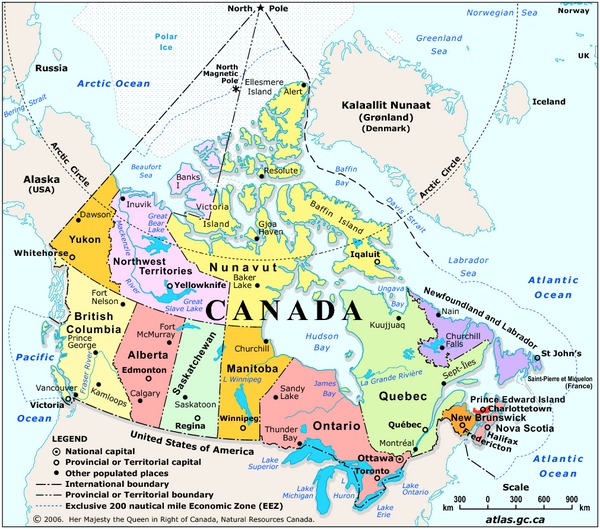
There are a few things you can take pride in as a Canadian. We’re the world’s number one producer of pulses. We’re the world’s largest non-resident constitutional monarchy. And whenever someone pulls out one of these (a compass) it’s pointing right at us. Canada may not technically own the North Pole, but we do own the magnetic north pole: The mysterious dot to which all the world’s compasses point.

Or, at least, we used to. Because I have bone-chilling news for all of you. In recent years, for reasons we don’t fully understand, the Magnetic North Pole has been fleeing the sublime liberty of the Maple Leaf in order to take up residence in Russia.

As of 2020, Magnetic North is right around here: Still in international waters, but clearly making a beeline for Siberia. If it keeps moving at its current pace, roughly 55 kilometres per year, the magnetic pole will make landfall in Russia right around 2050, just in time for Putin’s ninth term as president.
Artist’s impression.

This is quite a black eye for a country that has been home to magnetic north since we can remember, and who proudly puts magnetic north on its official maps.

The first time a human being stood on what they knew to be the magnetic north pole was in 1831. James Clark Ross was looking for Sir John Franklin around the Boothia Peninsula when he found it, and this location of magnetic north would officially become Canadian territory in 1880.

Unlike the actual north pole (which Canada weirdly claims is also ours by publishing maps pretending to own a giant triangle of international waters) magnetic north has always moved around a little bit. The reasons for this aren’t fully understood, but the earth is basically a big ball of liquid rock and metal with a thin crusty part that we all live on. If all that molten planet shifts a bit more vigorously than usual, it moves the magnetic field around.
© Robert Allison/SAS Institute A map by the SAS Institute showing the sharp drift of the north magnetic pole in recent years.

For most of the 20th century, magnetic north only moved about 11 kilometres per year, following a lazy path around the Canadian Arctic archipelago. As recently as 2007, when the guys from Top Gear set out to drive a specially equipped truck to magnetic north, their whole trip from beginning to end was in either Canadian territory or Canadian waters.

But by then, magnetic north had already begun its all-out drive across the Arctic Circle. As to why, NASA thinks climate change might be a reason: The Arctic has lost 278 gigatonnes of ice in the last 20 years, and when you take that much weight off all at once it shouldn’t be completely surprising that it’s freeing up the ground beneath to shift around a bit more freely than usual.

So what’s Canada to do about losing our magnetic pride and joy? Well, if anyone has 278 gigatonnes of ice lying around, that would be helpful. We could experiment with building an extremely large electromagnet in Winnipeg to override the earth’s magnetic field and ensure that the world’s compasses continue to point the correct, Canadian, way.

Or, boycott the compass. If these things are going to insist on pointing at Russia, we make it a point of national honour to dismiss them as the kitschy party tricks they are. Real navigators use GPS and celestial measurements.

Winners don’t use cardinal navigation.

• Email: thopper@postmedia.com | Twitter: TristinHopper

Germany to bring forward climate goals after constitutional court ruling

Government proposes net zero deadline of 2045 instead of 2050, but critics demand actions not numbers

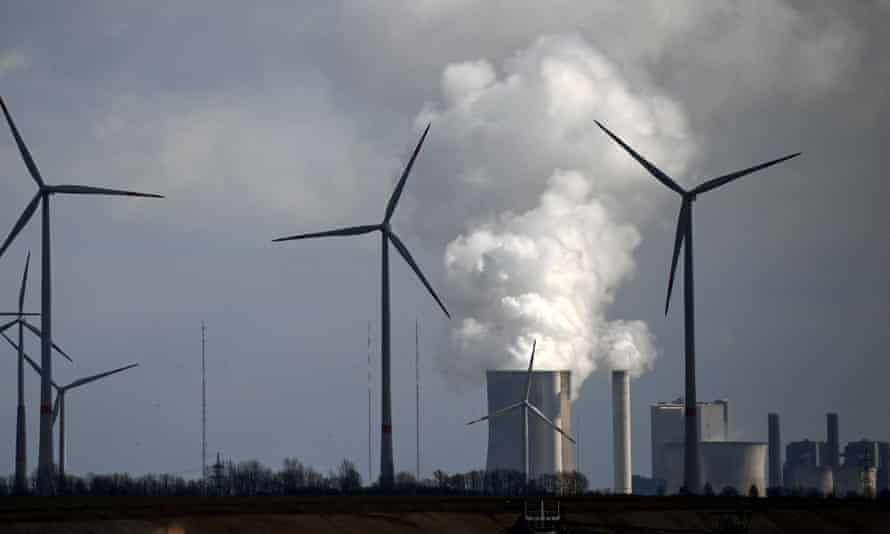
The coal-fired Neurath power station. Coal-powered energy is currently scheduled to be phased out by 2038. Photograph: Ina Fassbender/AFP/Getty Images


Philip Oltermann in Berlin
@philipoltermann
Thu 6 May 2021

Germany’s government is to revise its emission reduction targets after the country’s constitutional court declared the current climate protection measures insufficient, aiming to become greenhouse gas neutral by 2045 rather than 2050.

The finance minister, Olaf Scholz, and the environment minister, Svenja Schulze laid out a legislative proposal on Wednesday to cut emissions by 65% from 1990 levels by 2030. An 88% reduction of carbon emissions is to be reached by 2040.

Germany’s emission levels are currently 40% lower than they were in 1990, meaning it would require a reduction of a further 25 percentage points over the next nine years to meet its next target.

The German cabinet could ratify the proposal from the Social Democrat ministers next week if, as expected, it finds support among its senior coalition partners, Angela Merkel’s Christian Democratic Union.

“We will strengthen our efforts for the year 2030 once more”, the chancellor said, stressing that her government would “do everything to meet the target of climate neutrality by 2045”.

Germany’s coalition government has been surprisingly upbeat about the constitutional court’s announcement last Thursday. Key ministers from both parties have welcomed a ruling that effectively criticises them for jeopardising young people’s freedom by postponing inevitable cuts to greenhouse gas emissions.

The case was brought by young environmental activists, backed by Fridays for Future, Greenpeace, Germany’s Friends of the Earth (BUND) and other NGOs.

The government has not yet explained what concrete measures it will take to meet the new targets, whether by revising its carbon pricing scheme or speeding up the phase-out of coal-powered energy, currently scheduled for 2038.

Targets like ‘net-zero’ won’t solve the climate crisis on their own
Mathew Lawrence


“Matching numbers with actions will require the kind of major effort that this country has seldom seen”, wrote the Süddeutsche Zeitung newspaper. “It could turn the federal republic into an international beacon and help to lessen the worst impacts of the climate crisis. But this coalition government would rather leave it to its successors to work out the details.”

The emissions targets debate comes five months before national elections in Germany on 26 September, and against the backdrop of several polls showing a lead for the Greens.

The ecological party is pushing the outgoing government to double its investment in climate protection measures by €8bn (£7bn) by 2025.

“We’ve got some ambitious targets, that’s a step in the right direction”, said the Greens’ co-leader Robert Habeck on Thursday. “But the key challenge is following up numbers with actions, and in that respect the government isn’t delivering.”

Halbeck, who lost out to his fellow co-leader, Annalena Baerbock, in the race to become his party’s candidate for chancellor, said the Green party would seek a 70% emissions reduction by 2030 and urged the government to expand renewable energy sources, reduce subsidies for coal power and increase the price on greenhouse gas emissions in the transport and building sectors.


#CNNFIRESANTORUM
Santorum's comments on Native Americans don't quiet critics

NEW YORK — CNN analyst Rick Santorum's claim that he misspoke during a recent speech where he said there was “nothing here” when the United States was founded did little to diminish anger against him.
© Provided by The Canadian Press

The National Congress of American Indians on Tuesday renewed calls for CNN to fire the former Pennsylvania senator. The group's president, Fawn Sharp, called Santorum arrogant for comments made to Chris Cuomo on Monday night.

“I was optimistic he would own it, he would recognize it and he would apologize,” Sharp said, “but he did none of those things.”

CNN has not commented on Santorum's initial remarks in an April 23 speech before Young America's Foundation, a conservative youth organization, and did not on Tuesday, either. There's been no indication of a change in status for Santorum, a commentator who was often tasked with giving the Republican point of view during campaign coverage.

When he spoke to the youth group, Santorum said immigrants created a nation based on the Judeo-Christian ethic from a blank slate.

“We birthed a nation from nothing,” he said. “Yes, there were Native Americans, but there isn't much Native American culture in American culture.”

Those comments were swiftly criticized, and Santorum was invited onto Cuomo's prime-time show Monday to explain himself.

Santorum said he “misspoke” in the sense that it wasn't clear that he was speaking in the context of the founding of the United States government.

“People say I'm trying to dismiss what happened to the Native Americans,” he said. “Far from it. The way we treated Native Americans was horrific. It goes against every bone and everything I've ever fought for as a leader in the Congress.”

Cuomo said that what upset people was “beating up the little guy” and that it perpetuated the sense that anyone who wasn't a white Christian — be they gay, Black, Native American or whatever — was somehow considered an “other.”

“You're like me, you're a mutt,” Cuomo told him. “You came here a couple of generations ago. You ain't no Pilgrim, Rick.”

Santorum said he does not try to diminish those who aren't like him.

“Just because I disagree with someone on the issue of marriage doesn't mean that I hate them, or see them as ‘less than,’” he said. “That's what I get accused of, and that's wrong.”

CNN's Don Lemon, who follow Cuomo on the network schedule and often banters with his colleague between the two shows, was visibly angered by Santorum's remarks.

Lemon said he was furious watching the interview in his office and wanted to apologize to viewers who were insulted by it.

“I can't believe the first words out of his mouth weren't ‘I’m sorry, I said something ignorant, I need to learn about the history of this country,'” Lemon said. “No contrition. Didn't talk about, you know, the suffering the Native Americans have had to deal with in this country. Rick Santorum, really? Did he actually think it was a good idea for him to come on television and try to whitewash the whitewash that he whitewashed?”

There was no immediate comment from Santorum to Lemon's remarks.

Sharp said anger against CNN was building in Native American communities and that a petition circulating calling for Santorum's firing has more than 15,000 signatures.

David Bauder, The Associated Press
Giant sequoia found still smoldering after 2020 California wildfire

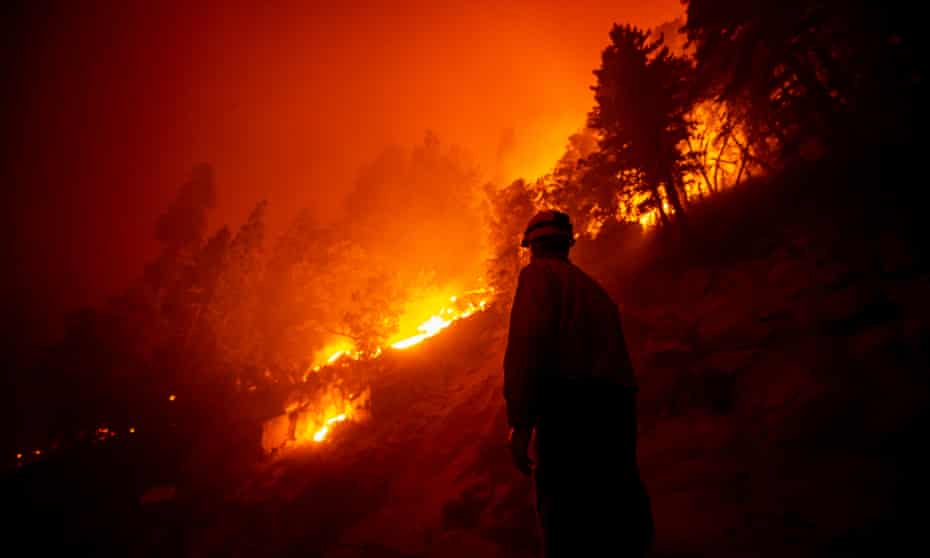
A firefighter checks on the evolution of the Castle Fire as it burns in the Sequoia national forest in September. Photograph: Étienne Laurent/EPA


Charred tree – which may be thousands of years old – looks like chimney spouting smoke in national forest

Jack Herrera in San Francisco
Thu 6 May 2021 

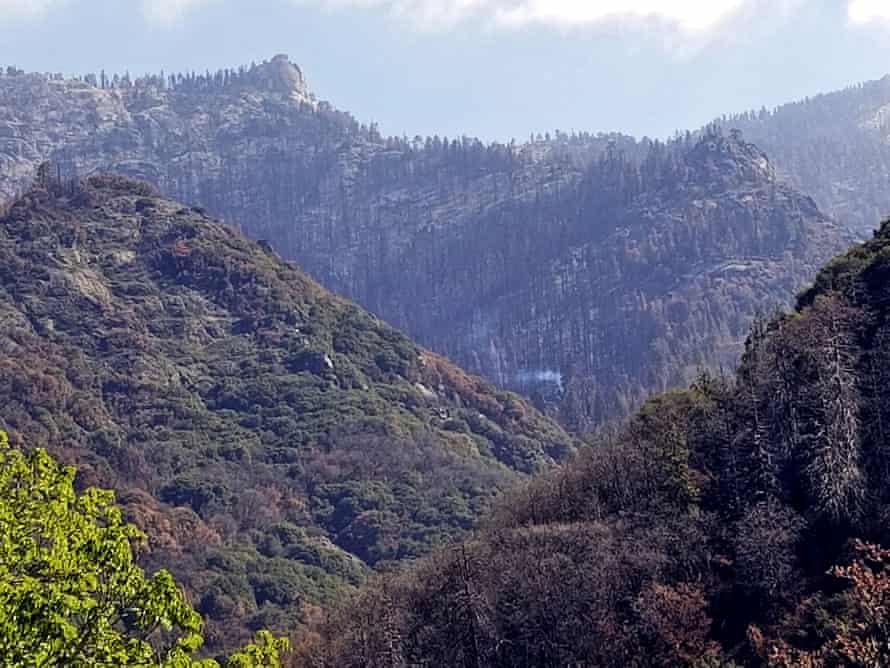
Scientists have discovered a giant sequoia still smoldering in California’s Sequoia national forest, months after wildfires tore through the region last August.

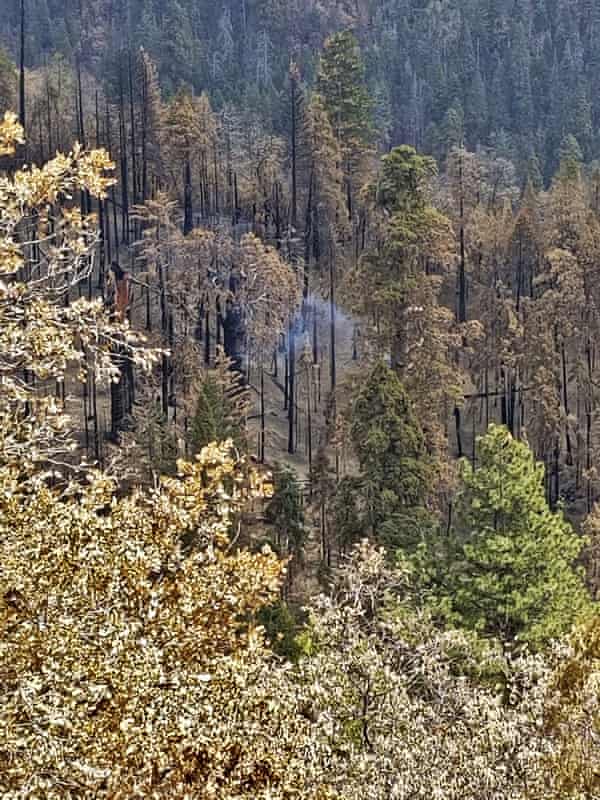
The tree was found, charred but still standing, by researchers in the lower part of the national forest this week. While turning down a sharp switchback on the trail, a member of Sequoia’s fire ecology and research team spotted a plume of smoke in the ravine below. Using a long camera lens, the team tracked the smoke to a single giant sequoia, standing in the burn area from last year’s Castle fire. The enormous tree, which has probably stood for hundreds if not thousands of years, looked like a chimney spouting smoke in the middle of the blackened forest.

In August, lighting struck deep in Sequoia national forest. The resulting Castle fire spread into areas of the Giant Sequoia national monument, home to trees that have stood for over 2,000 years, including “General Sherman”, the largest tree on earth. For weeks the Castle fire burned through 150,000 acres of land, before crews managed to contain the blaze in late December.
The smoldering tree in Sequoia national forest. Photograph: Tony Caprio/AP

Now researchers know that while the flames disappeared, some embers remained smoldering throughout the winter. The fire inside the tree discovered this week was sheltered inside the tree for months, even through the winter’s rain and snowfall.

Mike Theune, fire information officer for Sequoia and Kings Canyon national parks, said it was not wholly unusual for some patches of ember to remain burning months after a fire dies down. The inside of a tree, like the interior of a wood-burning stove, can provide an oxygen-rich shelter for a fire to survive. However, the fact that a Sequoia is still giving off smoke after an entire winter of rain and snow could be testament to California’s exceptionally dry winter: after precious little snowfall over the last two winters, most of the state is entering extreme drought conditions.

“The vegetation – the fuels – are dry,” Theune said. “They don’t have the high moisture content that [could prevent fire].” Elsewhere in the state, experts have warned that the unprecedented dryness of California’s diverse flora could lead to an early and devastating fire season this year.
Advertisement


“The fact areas are still smoldering and smoking from the 2020 Castle fire demonstrates how dry the park is,” Leif Mathiesen, the assistant fire management officer for Sequoia and Kings Canyon, said in a statement. “With the low amount of snowfall and rain this year, there may be additional discoveries as spring transitions into summer.”

While last year’s fires claimed thousands of acres of land, Theune said it was important to remember that many of the sequoias in California’s Sierra Nevada mountains have stood for thousands of years and have survived millennia of forest fires and droughts.


Parts of California see May red flag fire warning for first time since 2014

Read more


“But at the same time, we are seeing the impacts of climate change, high fire severity, and long-term extended drought periods,” Theune said.

Sequoias have a complex relationship with fire. For much of the20th century, foresters worked to prevent fires within the nationally protected land, hoping to defend the ancient tree. Then, in the early 1960s and 1970s, researchers working the park made a startling discovery: in areas where fires had burned, young sequoia saplings flourished, even as the forest floor elsewhere in the park remained barren of new trees. That observation led to the discovery that giant sequoias depend on fire to release their seeds.

Because of sequoias’ need for fire, California fire officials working out of Sequoia national forest were some of the earliest proponents of prescribed burns – among California government officials, that is. Intentional, controlled burns have been practiced by Indigenous people in California for thousands of years as a form of land husbandry. In the 60s and 70s, officials in Sequoia intentionally lit fires in controlled areas, and low-intensity fires created by lighting strikes were allowed to burn.
Smoke rises from the forest. Photograph: Tony Caprio/AP

Theune has stood in the forest during one of these prescribed burns. As the heat from the flames on the forest floor reached the trees’ branches, the sequoia’s cones, protected by a sticky resin shell, melted and opened. From the treetops, hundreds of small seeds, each the size of a pinky nail, floated to the ground below, where the fire had left the floor rich with new nutrients.


As California begins to more actively pursue prescribed burns as a way to manage forest fires, Theune says there are lessons to be learned from ecologists in Sequoia national forest. One of the main instructions: low-intensity fires can be regenerative and prevent more devastating blazes. But high intensity, out-of-control fires are harmful for forests – as evidenced by the recently discovered smoldering sequoia, which stands in a patch of dead and blackened trees.

The sorts of high-intensity blazes California hopes to prevent are being fueled largely by two interlinked phenomena: the climate crisis and increasing human development. California is becoming warmer and drier, which creates enormous risks in the state’s sprawling cities and towns, where vegetation and other fuels have been allowed to build up unabated – and where power lines and residents hold the potential to release perilous sparks.

Ruby Bridges: the six-year-old who defied a mob and desegregated her school


Ruby Bridges with an escort of US deputy marshals leaves school in November 1960. Photograph: anonymous/AP
Black lives

In 1960, she walked past hateful protesters to become the first Black child at a Louisiana school – and was then taught alone for a year. She discusses fear, forbearance and her fight for a better future

by Steve Rose

Thu 6 May 2021 10.00 BST

This year, Ruby Bridges saw some newly discovered video footage of her six-year-old self and was terrified for her. The footage was from 14 November 1960, a day that shaped the course of Bridges’ life and – it is no exaggeration to say – American history. Not that she was aware of it at the time. On that day she became the first Black child to attend an all-white primary school in Louisiana.

Looking at images of Bridges’ first day at William Frantz elementary school in New Orleans, she is a study in vulnerability: a tiny girl in her smart new uniform, with white socks and white ribbons in her hair, flanked by four huge federal agents in suits. Awaiting her at the school gates was a phalanx of rabidly hostile protesters, mostly white parents and children, plus photographers and reporters. They yelled names and racial slurs, chanted, and waved placards. One sign read: “All I want for Christmas is a clean white school.” One woman held up a miniature coffin with a black doll in it. It has become one of the defining images of the civil rights movement, popularised even further by Norman Rockwell’s recreation of it in his 1964 painting The Problem We All Live With.

The confrontation was expected. Three months before Bridges was born, the US supreme court had issued its landmark Brown v Board of Education ruling, outlawing segregation in schools nationwide. Six years later, though, states in the south were stubbornly refusing to act upon it. When nine African American children enrolled at the Little Rock school in Arkansas in 1957, it had caused an uproar. President Eisenhower had to call in federal troops to escort the children through a national guard blockade ordered by the governor. Three years later it was Louisiana’s turn. Bridges was one of six Black children to pass a test to gain access to formerly all-white schools. But two of the children dropped out and three went, on the same day, to a different school. So Bridges was all on her own.

Ruby Bridges: ‘I cannot even fathom me now, today, sending my child into an environment like that.’ Photograph: Thomas Dumont

Many have read resolve or defiance into Bridges’ demeanour that day, but the explanation is far simpler. “I was really not aware that I was going into a white school,” she says. “My parents never explained it to me. I stumbled into crowds of people, and living here in New Orleans, being accustomed to Mardi Gras, the huge celebration that takes place in the city every year, I really thought that’s what it was that day. There was no need for me to be afraid of that.”

Watching the footage of that day 60 years later, Bridges’ reaction was very different. “It was just mind-blowing, horrifying,” she says. “I had feelings that I’d never had before … And I thought to myself: ‘I cannot even fathom me now, today, as a parent and grandparent, sending my child into an environment like that.’”

Bridges, 66, can understand her own parents’ actions, though. They grew up as sharecroppers (poor tenant farmers) in rural Mississippi in the pre-civil rights era before moving to New Orleans in 1958. “They were not allowed to go to school every day,” she says. “Neither one of them had a formal education. If it was time for them to get the crops in, or to work, school was a luxury; that was something they couldn’t do. So they really wanted opportunities for their children that they were not allowed to have.”

Bridges’ parents paid a high price for their decision. Her mother, who had been the chief advocate for her attending the white school, lost her job as a domestic worker. Her father, a Korean war veteran who worked as a service-station attendant, also lost his job on account of the Bridges’ newfound notoriety. The National Association for the Advancement of Colored People (NAACP), which had played a big part in Bridges’ case, advised him not to go out and look for work, for his own safety. “That in itself caused a lot of tension,” she says, “because I’m the oldest of eight, and at that point he was no longer able to provide for his family. So they were solely dependent on donations and people that would help them.” The local corner store refused to serve them. Even her sharecropper grandparents were made to move from their farm in Mississippi. Her parents eventually separated. “I remember writing a letter to Santa Claus and asking him to give my father’s job back, and that he didn’t have a job because I was going to the school. So I guess somehow I did feel some blame for it.”
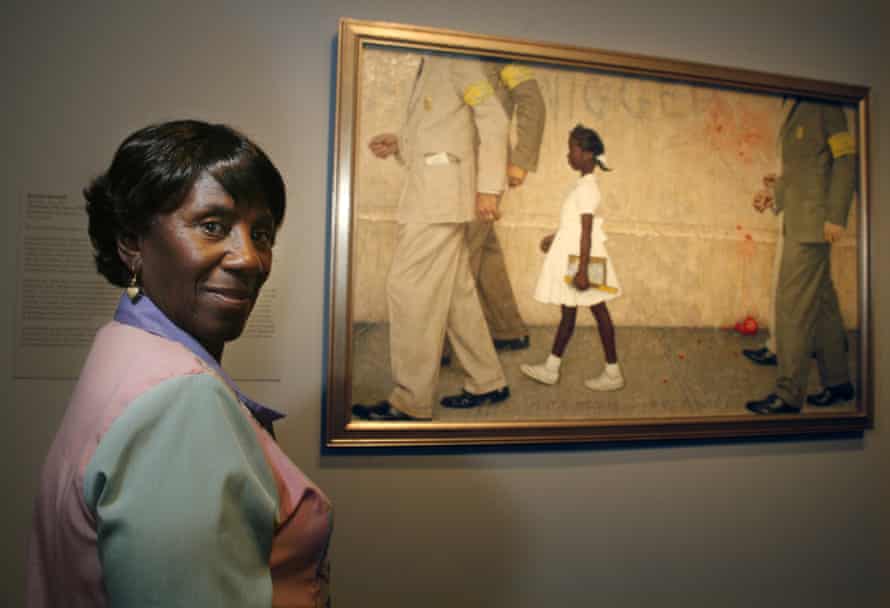
Ruby’s mother, Lucille, next to the Norman Rockwell painting The Problem We All Live With. Photograph: Steve Ueckert/AP

Life at her new school was no easier for Bridges. For the first year, she needed federal protection every day since protesters were always at the school gates, including the woman with the doll in a coffin. “That I used to have nightmares about,” she says. “I would dream that the coffin was flying around my bedroom at night.” Bridges had to bring her own lunch every day for fear of being poisoned. The white parents all withdrew their children from the school, and the staff refused to teach Bridges, except for one teacher: Barbara Henry, who had come from Boston. For the first year, Henry taught Bridges alone, just the two of them in the classroom. “We knew we had to be there for each other,” says Bridges.

Bridges had another ally outside the school: Robert Coles, a white child psychiatrist who had witnessed the scenes outside the school, and volunteered to support her and her family, visiting the home on a weekly basis. Coles went on to establish a career studying the effects of desegregation on schoolchildren. It later emerged that it was one of his relatives who had sent Bridges her smart school clothes, which her family could never have afforded.

Things changed gradually. Over the course of that first year, a few white parents let their children back into the school. At first they were kept separate from Bridges. “The principal, who was part of the opposition, would take the kids and she would hide them, so that they would never come in contact with me.” Towards the end of the first year, however, on Henry’s insistence, Bridges was finally allowed to be part of a small class with other six-year-olds. “A little boy then said to me: ‘My mom said not to play with you because you’re a nigger,’” Bridges recalls. “And the minute he said that, it was like everything came together. All the little pieces that I’d been collecting in my mind all fit, and I then understood: the reason why there’s no kids here is because of me, and the colour of my skin. That’s why I can’t go to recess. And it’s not Mardi Gras. It all sort of came together: a very rude awakening. I often say today that really was my first introduction to racism.”

It was also an insight into the origins of racism, she later realised. “The way that I was brought up, if my parents had said: ‘Don’t play with him – he’s white, he’s Asian, he’s Hispanic, he’s Indian, he’s whatever – I would not have played with him.” The little boy wasn’t being knowingly racist towards her; he was simply explaining why he couldn’t play with her. “Which leads me to my point that racism is learned behaviour. We pass it on to our kids, and it continues from one generation to the next. That moment proved that to me.”
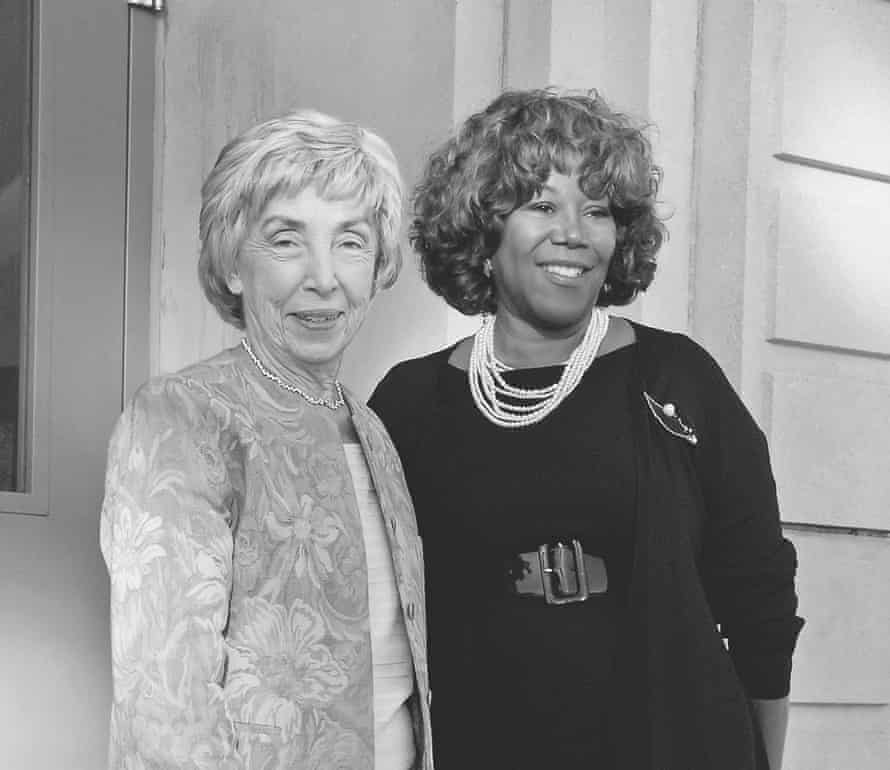
Bridges with Barbara Henry at the unveiling of a statue in Ruby’s honour at William Frantz elementary school in 2014. Photograph: Courtesy of Ruby Bridges

By the time Bridges returned to the school for the second year, the furore had pretty much died down. There were no protests, she was in a normal-sized class with other children, predominantly white but with a few more African Americans. The overall situation had improved, although Bridges was upset that Henry had left the school (they have remained lifelong friends). Thanks to Henry’s teaching, Bridges spoke with a strong Boston accent, for which she was criticised by her teacher – one of those who had refused to teach her the year before. Every year, though, more and more Black students came to the school. By the time she moved on, high schools had been desegregated for nearly a decade, although Black and white pupils still did not mix. The south’s racist legacy was still close to the surface: her high school was named after a former Confederate general, Francis T Nicholls. Its sports teams were named the Rebels, and had a Confederate flag on their badge, which the Black students fought to change. (The school was renamed Frederick Douglass high school in the 1990s, and its teams are now the Bobcats.)

Bridges says she did not have much of a career plan when she finished school. “I was really more focused on how to get out of Louisiana. I knew that there was something more than what I was exposed to right there in my community.” She first applied for jobs as a flight attendant, then became a travel agent for American Express for 15 years, during which time she got to travel the world.

By her mid-30s, Bridges had satisfied her wanderlust and was married (to Malcolm Hall, in 1984) with four sons. But she felt restless. “I was asking myself: ‘What am I doing? Am I doing something really meaningful?’ I really wanted to know what my purpose was in life.” In 1993, Bridges’ brother was shot dead on a New Orleans street. For a time she cared for his four daughters, who also attended William Frantz elementary school. Then in 1995, Coles, now a Harvard professor, published his children’s book The Story of Ruby Bridges, which brought her back into the public eye. People in New Orleans had never really talked about her story, Bridges explains, in the same way that, for years, people in Dallas didn’t talk about the Kennedy assassination. “You have to understand, we didn’t have Black History Month during that time. It wasn’t like I could pick up a textbook and open it up and read about myself.” Bridges helped promote Coles’ book, talking in schools across the US. It became a bestseller. A few years later, Disney made a biopic of Bridges, on which she acted as a consultant. “I think everybody started to realise that me, Ruby Bridges, was actually the same little girl as in the Norman Rockwell painting.”

Bridges in 2013 with Charles Burks, one of the marshals who escorted her to school. Photograph: Michael Conroy/AP

The proceeds from the book helped Bridges set up her foundation. Bringing her nieces back to William Frantz, she noticed the lack of after-school arts programmes, so set up her own. She continued touring schools across the country telling her story and promoting cultural understanding. (She recently had a new book published, This Is Your Time, retelling her story for today’s young people.) Then, in 2005, Hurricane Katrina struck New Orleans and the school was badly damaged. There were plans to tear it down. “I felt like if anybody was to save the school, it would be me,” she says. Bridges successfully campaigned to have the school put on the National Register of Historic Places, which freed funds to restore and expand it. “So now it has been reopened. Kids are back in the seats. And I’m really proud of the fact that I had something to do with that.” A statue of Bridges stands in the courtyard.

It was not until much later in life that Bridges became aware of Rockwell’s painting of her. It is not a faithful recreation of the scene (if anything it is closer to John Steinbeck’s eyewitness account in his 1962 book Travels With Charley in Search of America) but in contrast to Rockwell’s earlier cheery Americana, it captures the anger and drama: the N-word and “KKK” are scrawled across the wall behind Bridges, along with a splattered tomato.

Bridges on a visit to schoolchildren in Canada. 
Photograph: Rene Johnston/Toronto Star/Getty Images

When Barack Obama became president, Bridges suggested the painting be hung in the White House to commemorate the 40th anniversary of the event. Obama agreed, and invited Bridges and her family to its unveiling. He gave her a big hug. “It was a very powerful moment,” she says. “As we embraced, I saw people in the room tearing up and realised that it wasn’t just about he and I meeting; it was about those moments in time that came together. And all of those sacrifices in between he and I. He then turned to me and said: ‘You know, it’s fair to say that if it had not been for this moment, for you all, I might not be here today.’ That in itself is just a stark reminder of how all of us are standing on someone else’s shoulders. Someone else that opened the door and paved the way. And so we have to understand that we cannot give up the fight, whether we see the fruits of our labour or not. You have a responsibility to open the door to keep this moving forward.”

Ironically, and dishearteningly for Bridges, today William Frantz’s pupils are 100% Black. The white population had already begun moving out in the mid-60s, she explains, partly because of damage done by Hurricane Betsy, in 1965, but also in response to the changing demographics of the district. Today it is one of the poorest in the city, with relatively high crime rates. It is not just New Orleans: “white flight” has effectively resulted in a form of re-segregation in schools across the US.


Bridges sees this as the next battle: “Just as those people felt like it was unfair, and worked so hard during the civil rights movement to have those laws changed, we have to do that all over again. And we have to, first and foremost, see the importance of it. Because we’re faced with such division in our country, but where does that start? It starts very young. So I believe that it’s important, just like Dr King did, that our kids have an opportunity to learn about one another: to grow together, play together, learn together. The most time that kids spend away from home is in school, so our schools have to be integrated. And I know that there are arguments on both sides about that, but we’re never going to become the United States of America unless we, the people, are united.”

This Is Your Time by Ruby Bridges is published by One.
UK
Plans for 50% funding cut to arts subjects at universities ‘catastrophic’

Artists and musicians speak out against proposal by education secretary and Office for Students

A consultation by the Office for Students (OfS) and education secretary Gavin Williamson said arts subjects were not ‘strategic priorities’. Photograph: Wiktor Szymanowicz/REX/Shutterstock


Lanre Bakare Arts and culture correspondent
THE GUARDIAN
Thu 6 May 2021 

Artists and musicians have accused the government of neglecting the country’s “cultural national health” by pursuing a “catastrophic” 50% funding cut to arts subjects at universities, which could come into effect from this autumn.

A consultation by the Office for Students (OfS) and education secretary Gavin Williamson suggested halving the amount spent on “high cost” higher education arts subjects in England – including music, dance, drama, performing arts and archaeology – which it said were not “strategic priorities”.

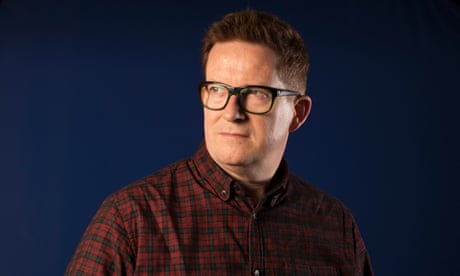
Jarvis Cocker, singer and former Pulp frontman, said the plans were “astounding” and would put off those from lower socio-economic backgrounds and leave arts subjects as the preserve of wealthy domestic and foreign students.

Cocker said: ‘It always seems to be that it’s art education that seems to be this expendable thing, as if it’s not important.’ Photograph: Dave J Hogan/Getty Images

He said: “I think it will really just put off people from a certain background and that’s a pity because it’s about mixing with people with different ideas, and then you get this cross pollination of stuff that makes things happen.”

Under the plan spending for non-prioritised subjects will be cut from £36m to £19m, with the savings being redirected to other areas such as nursing and computing.

Institutions that will miss out include the University of the Arts London, which includes Central Saint Martins – where Cocker attended in the late 80s – and will lose almost £4m under the new proposals. “It always seems to be that it’s art education that seems to be this expendable thing, as if it’s not important, and it is,” added Cocker.

Es Devlin, the set designer who has worked with Kanye West and Sam Mendes, and who also studied at UAL, said: “We know we need to train doctors and nurses in order to maintain our physical national health. Equally, we need to train artists, musicians, designers in order to maintain our cultural national health.”

The Musicians’ Union said that students, employers and lecturers had been kept out of the conversation, and with a public consultation closing on 6 May after starting in late March the sector has only a few days to “justify its existence”.

Chris Walters, the MU’s national organiser for education, told the Guardian that the proposed cuts would completely transform arts and music education in UK higher education.

“The cuts will be catastrophic for most music provision at university level, affecting the financial viability of music courses and training for the next generation of musicians,” he said.

Music was worth £5.8bn to the UK economy in 2019, which depends on properly funded university provision. The UK’s world-leading status in music and the arts could be in serious jeopardy from these cuts.”

A Department for Education spokesperson said the proposed reforms would only affect a small proportion of the income of higher education institutions, with the consultation including input from teachers and other voices from the sector.


Matthew Bourne: dance isn’t ‘taken as seriously as I’d thought’


“Our proposed reforms only affect the additional funding allocated towards some creative subjects, and are designed to target taxpayers’ money towards the subjects which support the skills this country needs to build back better,” the spokesperson added.

Other musicians said the move was at odds with the government’s own “levelling up” agenda, while it was derided as “pathetic, shortsighted [and] miserable” by Matthew Herbert.

The MU added that although the consultation recommends making a small number of courses exempt from the cuts, such as for orchestral string players, it was “bizarre” to overlook the contribution that other music makes to the UK economy.

There is now a petition to stop the planned cuts with its founder, the Public Campaign for the Arts, calling the proposals “an attack on the future of UK arts, the creative potential of the next generation”.


Guardian 200

MAY 6, 2021
A series to mark the Guardian's 2021 bicentennial, highlighting where we came from, where we are going, and the impact we have had on the world

Giant wood moth: ‘very heavy’ insect rarely seen by humans spotted at Australian school

Mammoth moth which can have 25cm wingspan found by builders working on Queensland primary school

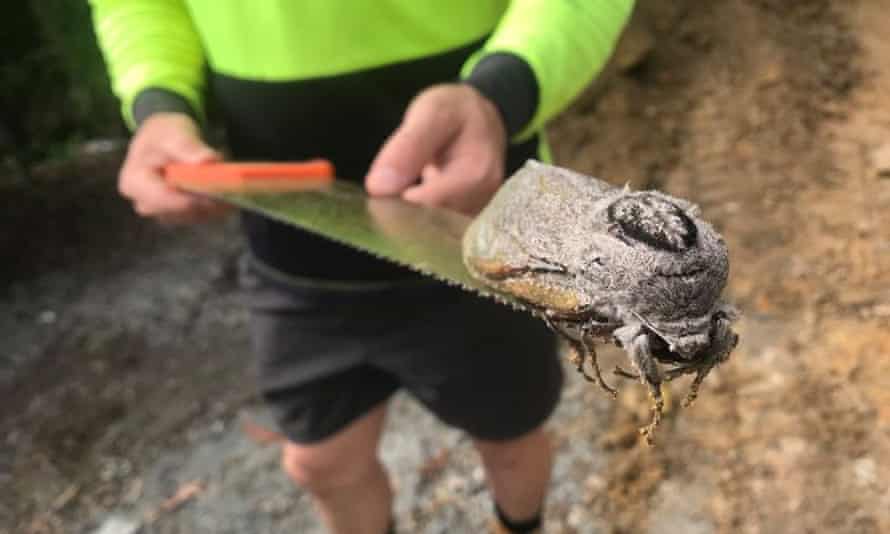
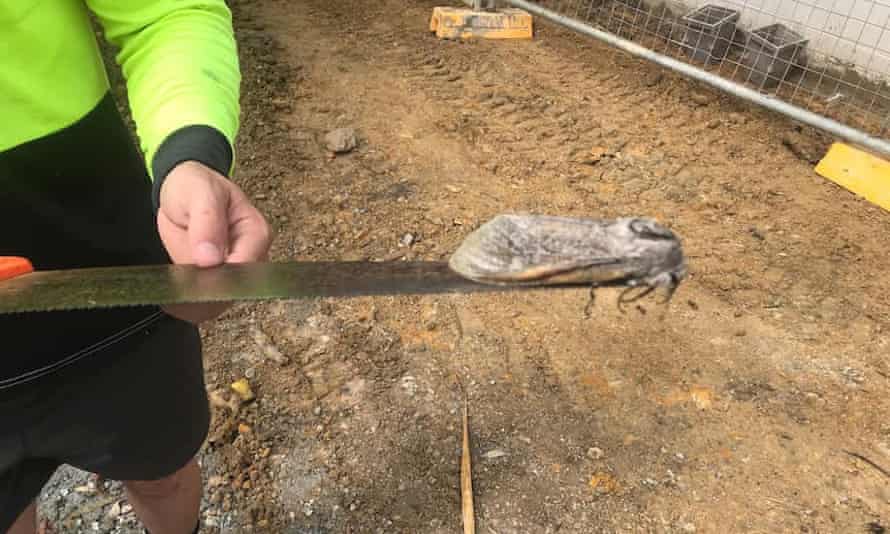
A giant wood moth was found at Mount Cotton state school in Queensland by builders. While not uncommon they are rarely seen by humans in Australia. Photograph: Mount Cotton state school/Facebook


Lisa Cox
Wed 5 May 2021 

A giant moth with a wingspan measuring up to 25cm has been found at a Queensland school next to a rainforest.

Builders found the giant wood moth, the heaviest moth in the world, while constructing new classrooms at Mount Cotton state school.

Giant wood moths are found along the Queensland and New South Wales coast, according to the Queensland Museum. Females can weigh up to 30 grams and have a wingspan of up to 25cm. Males are half that size.

They have an extremely short life cycle with adults living only a matter of days. They die after mating and laying eggs.


Scientists sound alarm about Australia’s 26 most endangered butterflies

Read more


The school’s principal, Meagan Steward, said the moth was “an amazing find”.

Steward said due to the school’s location it was not unusual to find a range of animals on the grounds such as bush turkeys, wallabies, koalas, ducks, the occasional snake and once a turtle in the library. “A giant wood moth was not something we had seen before,” she said on Wednesday.
Giant wood moths are found along the Queensland and NSW coast. Females can weigh up to 30 grams and have a wingspan of up to 25cm. Photograph: Mount Cotton state school/Facebook

The initial ABC news report and photos of the moth generated so much media interest the school was forced to direct questions about the moth to the Queensland education department.

Chris Lambkin, the curator of entomology at the Queensland Museum, said giant wood moths, or Endoxyla cinera, could be found from coastal Queensland down to southern NSW. While not uncommon they were rarely seen by humans, she said.

Lambkin said this was likely due to several factors including the adult moths’ short life span and the fact most people lived in urban areas where the invertebrate was not found.

“The female moths also don’t fly very well,” she said.

“So most people, if they do see one, it has emerged as an adult and crawled up a tree trunk or a fence post and is waiting for the male to come along. Normally people don’t see them with their wings spread out so you don’t realise just how big they are but if you actually lift them up they’re very heavy.”

As small caterpillars, the invertebrates have purple and white banding and bore into the trunks of smooth-barked eucalypts in parks and gardens. They lose the banding as they grow into larger grubs.


‘Certainly life-threatening’: 80-year-old Australian survives 30-minute boat ride with tiger snake


Lambkin said the adult female moths don’t feed and live on fats stored as larvae while feeding inside the tree trunk.

“The first time we see them is when they’re over 2.5cm long and thick as a lead pencil,” she said.

The entomologist said little was known about the first year of the larval stage, which lasts for about three years. The adult female moths can be up to 15cm long.

There are about 60 species of wood moth in Australia, according to the Queensland Museum, but not all are as large as the giant wood moth and not all feed on eucalypts.

The builders took a photo of their find before returning the moth to the rainforest.

The year 4-5 class in the new building was asked to develop a creative writing concept after being shown a picture of the moth and decided to write about a moth invasion. “The students wrote some very creative, imaginative pieces of writing – including Mrs Wilson getting eaten by the giant wood moth,” Steward said.

Death toll in Indonesian power plant landslide rises to 10
AFP  6/5/2021

The death toll from a landslide at a hydroelectric dam project on Indonesia's Sumatra island has risen to 10, an official said Thursday, as authorities called off a week-long search for victims.

© Oktafianus Authorities have called off a hunt for victims after the death toll from a landslide at a hydroelectric dam project on Indonesia's Sumatra island rose to 10

A landslide triggered by heavy rains struck the Chinese-backed Batang Toru hydropower plant on Thursday last week, burying an estimated 13 people.


Employees were checking on the area over concerns that heavy rains could trigger landslides when the disaster struck.

At least two children are among the victims. The body of a Chinese employee of the plant was identified on Wednesday.

Another Chinese employee narrowly escaped as he fled the scene.

Local disaster mitigation agency head Hotmatua Rambe told AFP the search for the victims had ended after unearthing 10 bodies. Three victims remain missing

The Batang Toru hydropower project -- part of China's trillion-dollar Belt and Road infrastructure project -- has raised opposition as it is built in an area of rainforest that is the only known habitat of the endangered Tapanuli orangutan.

Fatal landslides and flash floods are common across the country during the rainy season.

Last month, more than 200 people were killed in a cluster of far-eastern islands and neighbouring Timor Leste as Tropical Cyclone Seroja turned small communities into wastelands of mud and uprooted trees.

Indonesia's disaster agency estimates 125 million people -- nearly half of the country's population -- live in areas at risk of landslides.

The disasters are often caused by deforestation and poor mitigation planning, according to environmentalists.

KENNEY MAKES THE UK PRESS
‘Are we in trouble?
Absolutely’: Alberta battles worst Covid
 rate in North America

Leyland Cecco in Toronto 6/5/2021

In an open field outside the prairie town of Bowden, Alberta, hundreds of people braved chilly winds and the threat of spring rain to attend their first rodeo in more than a year.

For the unmasked attendees cheering on as riders clung into bucking horses, the gathering this weekend must have seemed like a long-awaited return to normality.

But the province is currently battling the worst coronavirus outbreak in North America: this week, Alberta had an active case rate of 534 per 100,000 – more than double the country’s average, and one of the worst in the world.


And the illegal “No More Lockdowns Rodeo Rally” highlighted the challenges officials face in containing a brutal third wave in a province long averse to perceived governmental overreach.

Related: 'A precarious point': Covid cases surge in Canada's Prairies after relaxed approach

On Wednesday, the province became the first in Canada to offer the Pfizer vaccine to residents aged over 12, beginning next week, a day after premier Jason Kenney announced online schooling, increased fines for lockdown violations, and the closure of some businesses in areas with high case rates.
© Photograph: Canadian Press/REX/Shutterstock Supporters of a church that was charged with refusing to follow Covid guidelines at a protest near Edmonton in April. Alberta’s case rate is double the country’s average.

“We will not permit our healthcare system to be overwhelmed. We must not and we will not force our doctors and nurses to decide who gets care and who doesn’t,” Kenney said during a televised address on Tuesday.

Police are reviewing the rodeo, but local reports suggest that no officers were dispatched to break up the event, and it is unclear if any organizers or attendees had received fines for breaking the province’s rules, which limit outdoor gatherings to 10 people.

“The reason we are at this critical stage of the pandemic in Alberta, with record high daily case counts and intensive care numbers, is precisely because, for whatever reason, too many Albertans are ignoring the rules we have in place,” Kenney told reporter on Monday, adding that it was “astounding” that more than a year into the pandemic, many in the province believe the virus is a hoax or government conspiracy.

One recent poll found that 75% of Albertans believed the premier was doing a bad job of handling the pandemic – but a portion of that displeasure came from groups who feel Kenney has gone too far.

Even though the conservative leader has been wary to implement aggressive restrictions seen in other provinces Kenney has faced insurrection from within his own party, with 16 lawmakers recently publishing a letter criticizing restrictions on retail and dining.

But an unwillingness to bring in strict measures has led to a “predictable and preventable” new surge in cases, said Joe Vipond, an emergency room doctor in Calgary.

“The science was clear from the beginning. If we didn’t aim for ‘Covid zero’ and if we started to relax our restrictions in the face of variants, this is where we would end up,” said Vipond. “It was always a fool’s errand to try and vaccinate our way out of a third wave. It’s just not mathematically possible.”

With the province’s ICUs filling up, officials have said they have prepared plans to ration care if the number of patients outstrips the hospital capacity.

“I don’t care how robust your systems are, I don’t care how great your training processes are. There is no system in the world that can out-expand the exponential growth of Covid,” said Vipond. “Are we in trouble? Absolutely.”

For more wary residents, frustrations over those who ignore scientific advice are part of daily life.

On the same day as the rodeo, Amanda, a nurse who lives in the Calgary, celebrated her son’s first birthday by waving to family gathered outside their window.

Related: Tweaked Moderna vaccine ‘neutralises Covid variants in trials’

Days earlier, the nurse and her husband were told there were outbreaks in both her son’s daycare and her daughter’s class, dashing any hopes she could safely see family.

“My dad got really choked up. He’s a proud grandparent and not being able to hug his own grandkids is just so hard,” she said. “We have so many things to celebrate, new babies in the family and retirements, and we can’t we can’t do anything.”

On Tuesday, she and her family tested positive for the virus.

As a healthcare worker, she recognizes that a worsening situation could mean she’s redeployed to more dangerous work.

“Being in healthcare, I see the effects that people’s actions have on our patients,” she said. “I think people are frustrated, and doing whatever they want. And I don’t think things are gonna get better.”

Even with new restrictions in place, critics worry the measures might not be enough and aggressive case growth in the coming weeks is already baked in.

“For somebody who went into medicine with a view to protecting life and health of my fellow citizens, the hardest part about this is knowing that every single illness that we see now, every single death is a preventable one,” said Vipond.

“Unless something dramatically changes with the numbers, it’s hard to imagine how we get out of this without a healthcare disaster on our hands.”
Google 'arguably violated' labor law when it fired employees involved in unionizing, says NLRB chief
mcoulter@businessinsider.com (Martin Coulter) 6/5/2021

The National Labor Relations Board has said Google "arguably violated" US labor laws when it fired three employees involved in unionizing. REUTERS/Stephen Lam

Google 'arguably violated' labor laws when it fired employees involved in unionizing activity.

NLRB chief Peter Sung Ohr accused the tech giant of 'unlawfully discharging' three ex-Googlers.

But Google insists the company remains 'very confident' in its legal position.


Google "arguably violated" US labor laws when it fired three employees involved in unionizing activity, the acting head of the National Labor Relations Board (NLRB) has said.


Peter Sung Ohr's comments mark the latest twist in the long-running fallout between Google execs and employees, and may underscore a more pro-labor approach at the agency under President Biden.

Google suffered backlash after firing five activist workers in the space of a month towards the end of 2019. Laurence Berland, Paul Duke, Rebecca Rivers, and Sophie Waldman became known as the "Thanksgiving Four" after the company sacked them around the holiday season, alleging they had leaked company information in violation of its policies, an allegation all of them deny.

The four were subsequently joined by Kathryn Spiers, who had created an internal pop-up notification for employees telling them they had a right to "participate in protected concerted activities" before being fired in December 2019.

The ex-Googlers subsequently filed complaints via the NLRB, alleging that Google terminated their contracts in an attempt to crush unionization efforts.

In 2020, under the Trump administration, then NLRB leader Peter Robb accused Google of illegally firing Berland and Spiers, but rejected the other three's claims.

In a new letter seen by Bloomberg, however, the agency's new acting chief Ohr said that Google had "arguably violated" federal labor laws by "unlawfully discharging" .

As a result, Bloomberg reports that the NLRB is now considering amending its original complaint to include Duke, Rivers, and Waldman, unless Google settles out of court.

In a statement shared with the site, a Google spokesperson said, "Our thorough investigation found the individuals were involved in systematic searches for other employees' materials and work, including distributing confidential business and client information."

They added: "As the hearing on these matters moves forward, we're very confident in our decision and legal position."

Insider approached Google and the NLRB for further comment.

‘There are so many hurdles.’ Indian scientists plead with government to unlock COVID-19 data


People wait in line to receive the COVID-19 vaccine in Mumbai, India, on 29 April. AP PHOTO/RAJANISH KAKADE

By Priyanka PullaMay. 4, 2021 , 12:10 PM

Reporting for this story was supported by a journalism grant from the Thakur Family Foundation, which has not influenced the contents of this report.

Indian researchers say they urgently need better access to data collected by government agencies to help them understand and fight the country’s devastating second pandemic wave. An open letter published on 29 April that has 740 signatories so far asks the government for access to databases on COVID-19 testing and genomic sequencing and urges it to remove other obstacles to research.

“There are currently so many hurdles and so much paperwork around accessing these data,” says Partha Pratim Majumder, a genetic epidemiologist at the National Institute of Biomedical Genomics in West Bengal and one of letter’s signers.
Related


The Office of the Principal Scientific Adviser to the Government of India, K. VijayRaghavan, released a note the next day acknowledging the problems and promising to increase access. “Our broader research community needs to be much more facilitated by our research agencies,” the letter said. But some scientists are skeptical that the situation will improve quickly; the note was low on details and previous requests for data from government agencies have often gone unanswered, they say. Why the Indian government is so reticent to share data is unclear.

The government has collected detailed data on some aspects of the pandemic. For example, the Indian Council of Medical Research (ICMR), the country’s top medical research agency, captures demographic details such as age, location, and health status of everyone who submits a sample for a COVID-19 test. The data could help answer key questions, such as whether people with certain concurrent illnesses are more likely to have worse outcomes and whether vaccines are working, says Gagandeep Kang, a public health microbiologist at the Christian Medical College, Vellore, who also signed the letter. “Lots of people want to know, for instance, what mortality is by location, and whether it differs between rural and urban areas,” she says. “This speaks to the kind of care people are getting.”

But so far, scientists say, ICMR and other government agencies have dragged their feet on responding to requests for access. That has forced several groups building computer models of the epidemic to rely on public domain data, which are aggregated by state but lack granular details such as breakdowns by district, age, or gender, says L. S. Shashidhara, a developmental biologist at the Indian Institute of Science Education and Research, Pune. Even modeling groups advising the Indian government on its COVID-19 response policy often don’t have these data, Shashidhara says.

Scientists also want access to more viral genome sequences generated by the Indian SARS-CoV-2 Consortium on Genomics (INSACOG). Established in December 2020, the consortium’s stated goal is to sequence 5% of all new SARS-CoV-2 cases in the country, which is important to keep up with the spread of new virus variants. INSACOG has had a slow start, with just over 15,000 samples sequenced by late April, out of about 5.9 million new cases India has seen since January. And just 6200 sequences—fewer than half—have been deposited in GISAID, an international database, during this period.

In February, INSACOG identified a variant, later christened B.1.617, which was growing in frequency in Maharashtra at a time when that state was experiencing a massive outbreak. B.1.617 has spread to several other countries, including the United Kingdom and the United States. But INSACOG has yet to share its analyses of whether the variant is more transmissible or more virulent. “We need multiple pairs of eyes need to look at this data, instead of just one,” Majumder says.

The authors also ask the government to remove obstacles that prevent INSACOG from stepping up the sequencing pace. INSACOG scientists currently have to jump through several bureaucratic hoops to import reagents, plastics, and other key materials. The measures, designed to protect Indian industry, are ill-advised during the coronavirus surge, says Rakesh Mishra, a genomicist at Hyderabad’s Centre for Cellular and Molecular Biology, one of 10 INSACOG labs. “It’s like taking a blanket away from a person in winter because the blanket is imported,” he says.

The note released by VijayRaghavan’s office says government agencies “will immediately highlight mechanisms of research access to already available datasets and put in place access to new datasets as they are formed.” It also says the government will remove import bottlenecks and INSACOG will involve more teams in data analysis, bioinformatics, and decision-making.

Although some scientists welcomed the quick response, others say the letter is too little, too late. “The note only says that government agencies will facilitate data access,” Majumder says. “The question is: when? Time is of the essence. And promises made in the past by important government functionaries have often not been fulfilled on time.”
As clock ticks down on Enbridge's Line 5, anxiety grows in Sarnia and Michigan

Enbridge vows to defy order that comes into force next week in move lawyers say will make case more difficult to argue in courts

Author of the article: Geoffrey Morgan
Publishing date:May 05, 2021 • 

A signpost marks the presence of Enbridge's Line 5 pipeline, which Michigan Governor Gretchen Whitmer ordered shut down in May 2021, in Sarnia, Ont. PHOTO BY CARLOS OSORIO/REUTERS

CALGARY — For Mike Bradley, the mayor of Sarnia, the impending shutdown of a pipeline that supplies fuel to his city’s biggest employers has been “hovering” for seven months.

That anxiety has been steadily building ahead of a deadline this month imposed by Michigan Governor Gretchen Whitmer for Enbridge Inc. to shut down its Line 5 pipeline, which crosses through Michigan, where it delivers more than half of the state’s propane needs, en route to deliver oil to Ontario, Ohio and Pennsylvania.

In November, Whitmer cancelled the easement that allows Enbridge’s pipeline to pass under the straits and provided a deadline of May 12 to shut the line down. Enbridge, for its part, has vowed to defy the order that comes into force next week in a move that lawyers say will make its case more difficult to argue in state and federal courts.

The two sides are currently in mediation and there is the potential that this fight turns into a national dispute between Canada and the U.S., leaving communities like Sarnia largely powerless in an entrenched environmental fight that could imperil thousands of existing jobs.

The Ontario government believes 4,900 jobs in Sarnia, a city of 71,500, are in jeopardy if the line is shut down next week, but Bradley said there’s a broader economic impact in his city.

“Anytime there’s uncertainty about the source of what drives a particular economy, it does have an impact when you’re trying to recruit companies and industries into the area,” he said. “When you’re in the economic development game, you’re always trying to eliminate anything that could be an impediment and the longer this goes on, the more of that anxiety is there.”


Whitmer’s Democratic administration has attempted to shut the line down twice previously on environmental grounds because the pipeline runs under the Straits of Mackinac, which divides Lake Huron and Lake Michigan. Whitmer has also opposed an Enbridge plan to bore a tunnel under the straits, encase the tunnel in concrete and put a replacement for the 65-year-old pipeline through the tunnel.

The urgency of the situation has led to the formation of a House of Commons committee in Canada, a flurry of diplomatic calls and meetings between Ottawa and Washington, D.C., advertising campaigns in Ontario and Michigan as well as legal filings, some of which are due in U.S. federal court on May 11, the day before Line 5 is required to shut down.

Experts say the fight over Line 5 is also indicative of a broader and evolving fight over oil and gas pipelines in North America. Previously, pipeline opponents would vigorously fight new pipeline proposals — like the Keystone XL pipeline project — and in the process deal a major blow to the growth aspirations of upstream oil and gas companies. Now, the fight has moved from new pipelines to existing ones including Line 5 and the Dakota Access Pipeline and the effect of targeting existing pipelines is that more people and more industries are affected, even outside of the oil and gas industry.

“This is a natural evolution of the anti-pipeline movement,” said James Coleman, associate professor of law at Southern Methodist University Dedman School of Law in Dallas, adding that politicians have been willing to shut down existing pipelines particularly when there is a repair, replacement or new easement needed.


This is a natural evolution of the anti-pipeline movement
JAMES COLEMAN, ASSOCIATE PROFESSOR OF LAW, SOUTHERN METHODIST UNIVERSITY DEDMAN SCHOOL OF LAW

“Frankly, it has gotten much harder to build pipelines over time. Sometimes people say that means we don’t need increased capacity but what it also means is we don’t shut down old pipelines,” Coleman said.

Alberta Energy Minister Sonya Savage said the Line 5 pipeline dispute, as well as the Dakota Access Pipeline, are some of the first examples of groups opposed to oil and gas development targeting existing pipelines and their efforts to shut the lines down “hurts people,” in addition to the oil and gas industry.

“People can understand it, they can relate to it, whereas a future pipeline doesn’t impact them in the same way and it doesn’t resonate with people in the way they live their life everyday,” Savage said.

In Michigan, home to the Big Three automakers, the Michigan Manufacturers Association said in a letter supporting Enbridge and Line 5, that the supply of energy “underpins all aspects of manufacturing.” The association threw its weight behind the pipeline, saying its members drive the state’s economy and provide jobs for 628,800 residents and 20 per cent of the state’s GDP.

“Energy costs affect not just the manufacturing process but also the transportation of raw materials to our manufacturing facilities and finished products made in Michigan to their markets within Michigan and beyond,” Caroline Liethen, the association’s director of environmental and regulatory policy, said in a letter to the Michigan Public Service Commission on April 12.

United Auto Workers members leave the Fiat Chrysler Automobiles Warren Truck Plant in Warren, Michigan. PHOTO BY GREGORY SHAMUS/GETTY IMAGES FILES

She added that “energy costs are also a major contributing factor in Michigan’s ability to retain a strong, globally competitive manufacturing sector and attract new investment by manufacturers looking to site new facilities.”

Industry groups in Michigan opposed to the shutdown of the line have launched TV, radio, billboard and social media advertising campaign “to explain just how vital this piece of infrastructure is,” said Derek Dalling, executive director of the Michigan Propane Gas Association.

Michigan is the largest consuming market for propane in the U.S. and Dalling said his association’s member companies are preparing contingency plans in case the line is shut down, including looking for truck drivers that would go as far afield as Indiana and New England to source propane and investing in new railway infrastructure.

“If Line 5 were to go down, by our calculations, we are the smallest piece of the fuels that go through Line 5,” Dalling said, adding that small piece accounts for 55 per cent of all propane demand in Michigan. “Our small piece does account for over 400 million gallons per year diverted from Line 5. That would be almost 10,000 propane rail cars to account for what’s going through Line 5,” he said in an interview with the Financial Post.

In an effort to avoid the line shutting down, Minister Savage has been working with her counterparts in Ontario and Saskatchewan as well as federal Natural Resources Minister Seamus O’Regan to coordinate a legal response to the impending shut down of the line. Alberta has also recruited its Washington, D.C. envoy James Rajotte to make the case for Line 5 in the U.S. Capitol.

O’Regan has also raised the issue directly with U.S. Energy Secretary Jennifer Granholm, while Kirsten Hillman, Canada’s ambassador to the U.S., has met with Governor Whitmer to discuss the issue.

“As the minister has repeatedly made clear, the continued safe operation of Line 5 is vital for energy security on both sides of the border,” said Ian Cameron, spokesperson for O’Regan.

Legal experts contacted by the Financial Post say the best case scenario for Canada is to reach a diplomatic resolution to the problem, but the federal government does have additional legal options including recourse to the 1977 Transit Pipelines Treaty between the two countries if diplomatic talks fail.

The treaty states that “no public authority in the territory of either party shall institute any measures… which are intended to, or which would have the effect of, impeding, diverting, redirecting or interfering with in any way the transmission of hydrocarbon in transit.”

Calgary-based Enbridge, which owns and operates Line 5 and also plans to bore a tunnel underneath the Straits of Mackinac to encase a replacement for the pipeline, references the treaty in its legal filings opposing Michigan’s demands to shut the line down.

“We argued that the state is prohibited from interfering with the operation of an international pipeline, like Line 5, because that operation is a matter reserved for the federal government,” Enbridge spokesperson Tracie Kenyon said in an emailed statement
.
A tank farm at the Enbridge pipelines terminal in Sarnia. 
PHOTO BY PAUL MORDEN/THE OBSERVER/POSTMEDIA NETWORK FILES

“We will not stop operating the pipeline unless we are ordered by a court or our regulator to do so, which we view as highly unlikely,” Kenyon said.

Enbridge is currently in mediation with Michigan over the issue, but lawyers in the U.S. do not expect a negotiated solution to the problem.

“That judge orders mediation in every case — always,” said Margrethe Kearney, Grand Rapids, Michigan-based senior attorney at the Environmental Law and Policy Centre, adding that the likelihood of an agreement is lower than if Enbridge and Michigan had embarked on mediation on their own initiative.

Kearney’s group is opposed to Line 5 and the replacement project and she argues that there are exceptions in the 1977 treaty that would allow Michigan to demand the pipeline cease operations.

Article 4 of the treaty also notes that the transit pipeline will be subject to regulations by the “appropriate governmental authorities,” including on pipeline safety, technical pipeline construction and operation standards and environmental protection. Kearney said she questions whether the treaty applies to Line 5 in this situation.

In addition, she said Enbridge’s plan to continue operating the pipeline despite the state government’s order to shut the line down will hurt the company’s ability to argue that it is a responsible pipeline operator.

“I have represented a lot of very large companies and I never advised them to ignore a government order. It never, in the long run, was the right way to go,” she said. “I think it’s a very risky and dangerous thing that Enbridge is doing by refusing to comply with the state’s order.”

I think it’s a very risky and dangerous thing that Enbridge 
is doing by refusing to comply with the state’s order
MARGRETHE KEARNEY, SENIOR ATTORNEY, ENVIRONMENTAL LAW AND POLICY CENTRE

For Ottawa, invoking the treaty would set off a round of arbitration with U.S. President Joe Biden’s administration, which has so far shown some antipathy towards Canadian pipelines carrying oilsands crude into the U.S., as evidenced by his cancellation of the Keystone XL project on his first day in office.

“Typically, in a situation like this, the government would expect that the company would be taking the lead in exhausting all of its legal options,” said Sander Duncanson, partner in Calgary at Osler, Hosking & Harcourt LLP.

“Once you’re into a dispute mechanism, you’re acknowledging that there is now a formal legal dispute between the two countries and I can imagine that the federal government would prefer not to do that if they can avoid it,” Duncanson said.

Despite the cancellation of Keystone XL, legal experts say the Biden administration has taken a more nuanced approach to existing pipelines and has even taken the Trump’s administration position in court to support two separate pipelines through the U.S., which are the Dakota Access Pipeline and the PennEast Pipeline through Pennsylvania.

Enbridge owns a stake in both of those pipeline projects.

A protest against the Dakota Access pipeline in California, in 2016. 
PHOTO BY LUCY NICHOLSON/REUTERS FILES

“The Biden administration did not reverse the Trump position that was filed in that court case and so I saw that as a positive development,” said Mark Warner, principal at MAAW Law in Toronto.

Though Biden has taken a softer, more nuanced stance on existing pipelines in the U.S., Warner said that forcing the U.S. government into arbitration over the Line 5 issue could have the unintended consequence of forcing the president into a corner.

“I think it is a threat,” Warner said of the potential invocation of the treaty. “If you’re going to make a threat, you better be prepared to live with it.”

In Sarnia, Mayor Bradley said he believes the Line 5 dispute has highlighted the need for Canadian governments to safeguard existing trade with the U.S.

Bradley said the ad-hoc House of Commons committee dealing with this issue should be turned into a permanent standing committee and Canadian diplomats need to take lessons from the Line 5 event to prepare for potential future trade challenges.

“Do we want to get into trying to stop trade in certain sectors? I don’t think so,” Bradley said, noting that if the Line 5 precedent is allowed to stand, there could be other parts of the Canadian economy targeted in the future, whether in Ontario or in other provinces.

“This issue won’t go away with just a solution on Line 5,” Bradley said