POSTMODERN FEUDALISM
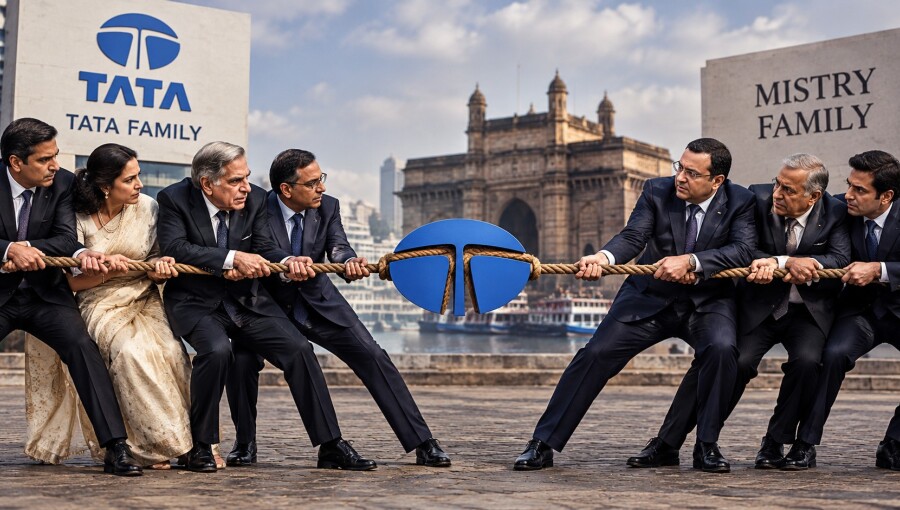
India’s largest and oldest conglomerate, Tata Group, is engaged in a dispute with its own holding company and promoter Tata Sons.
Tata Sons is itself in a tussle with its largest shareholder an entity called Tata Trusts over three separate but related issues, the reappointment of the Chairman of Tata Sons, the extent of the powers of Tata Trusts’s nominated directors on the board of Tata Sons and Tata Sons’ prospects of becoming a publicly listed company on Indian stock exchanges.
At its core the ongoing dispute is a tussle over the now decade-long and messy decoupling between the Tata family and the Mistry family which are both stakeholders under the broader Tata conglomerate umbrella.
While it has been brewing for a while, the dispute came to a boil with India’s central bank the Reserve Bank of India (RBI) on September 11 2026 rejecting Tata Sons' plea to give up its registration as a Core Investment Company (CIC).
Tata Sons operates as an upper layer Non Banking Financial Company (NBFC) and is thus regulated by the RBI, which has directed it to be listed as a publicly traded entity which will then bring it under the separate regulatory framework of the Securities and Exchange Board of India (SEBI) as well.
Tata Sons’ board led by the incumbent Chairman N. Chandrasekaran has been planning to comply with the RBI’s public listing regulatory requirement. However, that will require the consent of all shareholders of the company.
Tata Sons' largest single shareholder the Shapoorji Pallonji Group has also been pushing for the public listing as it has been trying to decouple from the Tata umbrella and realise monetisable value for its 18.37% stake.
The Shapoorji Pallonji Group and the Mistry family at its head used to be staunch allies and partners of the Tatas stretching back to the 1930s in what was then British India. However, that camaraderie purportedly came crashing down in 2021 when former Tata Sons Chairman Cyrus Mistry was removed over his handling of unprofitable but prestigious projects linked to the then Tata family patriarch Sir Ratan Tata.
Ratan Tata and his half brother Noel Tata likely saw some of those projects as key to his and the Tata family’s legacy - including producing what was at the time the world’s cheapest car, the Tata Nano and Tata Steel Europe. The Mystry family also has familial bonds with the Tatas, as Aloo Mistry the elder sister of Cyrus Mistry is married to Noel Tata.
Between 2016-2021 the first leg of the dispute ultimately ended in a legal battle which reached the Supreme Court of India which saw the Tatas ultimately able to wrestle back the chairmanship of Tata Sons with Sir Ratan Tata temporarily resuming the role he had vacated for Cyrus Mistry in 2012.
Cyrus Mistry was thus removed in 2016, and the board continued to serve under Sir Ratan Tata until the incumbent N. Chandrasekaran was finally appointed as a replacement in 2017.
Both Sir Ratan Tata and Cyrus Mistry have since passed away but the dispute still continues in the board rooms of those concerned.
Purely on numbers, Tata Trusts which is a group of non-profit philanthropic entities based in Mumbai owns around 66% of Tata Sons.
Around 13% of Tata Sons is also owned by various Tata Group companies in which Tata Trusts doesn’t directly have any ownership and these companies have their own separate governing boards, promoters, and other structures as applicable. Setting aside the roughly 18.37% stake owned by the Mistry family and their Shapoorji Pallonji Group, this still leaves a 2.63% share which is believed to be owned by others, mainly Tata family members as individuals and their own separate structures.
However, while Tata Sons does hold varying sized stakes in almost all Tata Group companies, its largest shareholder Tata Trusts doesn’t directly dictate policy in their day-to-day affairs, which illustrates the typical level of corporate obfuscation in the control dynamics of the group. One lever of control that Tata Trusts does maintain over Tata Sons though is its right to nominate one third of its directors according to the Articles of Association (AoA) of Tata Sons.
As of September 2026 this has translated into Noel Tata and Venu Srinivasan the Chairman and Vice Chairman of Tata Trusts being two of the six members on the board of Tata Sons. Furthermore, the AoA of Tata Sons grants the two Tata Trusts nominated directors “special voting provisions” as recognised by the Supreme Court of India in the 2021 case.
This means that no majority vote can be passed by a simple majority motion by the Tata Sons board if the two directors don’t also vote in favour of it, thus giving them what is essentially a veto over the board’s decision making.
According to a Hindustan Times report, in a September 17 2026 board meeting the incumbent Chairman of Tata Sons N. Chandrasekaran’s term was renewed for another five years. This ran contrary to an announcement Chandrasekaran himself had announced in August 2026, in that he would not seek a renewal after his term ends on February 20, 2027.
Reportedly Noel Tata, one of the two nominated directors with the veto voted against Chandrasekaran’s renewal. Noel’s fellow veto holding nominated director Venu Srinivasan and the other board members of Tata Sons voting, instead backed the motion with Chandrasekaran recusing himself entirely.
Noel Tata is likely trying to preserve as much of the original legacy of his clan as possible, and according to a report in the local Economic Times is also ready to explore alternatives for Tata Sons, including splitting it, instead of listing it on public stock exchanges as the rest of the board and the Mistry family want.
As it stands, while the general image of the Tata family is one of respected nationalist industrialists in India, it is not without a degree of controversy especially dating back to the time of the British Raj.
According to the book Why Empires Fall: Rome, America, and the Future of the West by Peter Heather and John Rapely, published by Yale University Press, after the British had secured control of many Chinese ports in the First Opium war in 1842, Nusserwanji Tata “had grand ambitions of shipping opium from the Indian region of Malwa into Chinese markets.”
In a later report by India Today, this ambition translated into Tata family members running businesses trading British Indian cotton and opium in exchange for Chinese tea, silks and porcelain, with the opium in question then being smuggled into China where the narcotic was officially banned by the ruling Qing Dynasty.
In post independence India too the Tata conglomerate thrived and even had minor frictions with the elected government of the day. The most iconic example of this was at the time of the nationalisation of the Tata Group’s airline into Air India by then Indian Prime Minister Indira Gandhi in 1953, even if the airline ultimately returned to the Tata Group in 2021 as the Government of India auctioned it off.
How the dispute ultimately plays out, and if the Tata family can preserve its carefully cultivated image of responsible Indian industrialists, will no doubt determine how the family and its legacy are viewed by the next generation.

No comments:
Post a Comment