A group of Democratic senators warned the company’s CEO, Mark Zuckerberg, that the tax maneuver violates “the spirit and, potentially, the letter” of federal law.

Meta mechanical systems expert Chris David leads a tour of Meta’s data center in Temple, Texas on July 22, 2026.
(Photo by Mikala Compton/The Austin American-Statesman via Getty Images)
Jake Johnson
Oct 14, 2026
COMMON DREAMS
A group of Democratic senators wrote Tuesday that Meta is violating “the spirit and, potentially, the letter” of federal tax law by using a research and development tax credit to save billions of dollars on its massive data center buildout.
In a letter to Meta CEO Mark Zuckerberg, the Senate Democrats noted that the $1.9 trillion company has “indicated on federal regulatory filings that it has used the federal research credit to reduce its federal income tax liability by $6.6 billion between 2023-2025.” By one measure, the senators noted, Meta alone could be responsible for “more than 10% of all research credits claimed in the US.”
“While it remains unclear exactly how Meta was able to reduce its federal tax liability by over $6.6 billion in the last three years using federal research credits, it appears from published reports that a substantial share is by claiming the research credit related to its massive AI data center build out,” wrote the group of lawmakers led by Sen. Ron Wyden (D-Ore.), the ranking member of the Senate Finance Committee.
Last month, The New York Times reported that Meta claims in its federal tax filings that the company’s AI data centers are “a giant experiment that could fail,” allowing it to “tap into a tax credit intended for research and experimentation.” Meta specifically characterizes its expensive, resource-devouring data centers as “pilot models.”
“Meta’s own accountants recognize that the strategy is on shaky legal ground,” the Times reported. “In disclosures buried in securities filings, the tech giant warns that billions in tax savings are vulnerable to being overturned by the IRS, in large part because of ‘uncertainties with our research tax credits.’”
In their letter to Zuckerberg, the Democratic senators wrote that the research tax credit “can be a useful and necessary tool to support our nation’s innovation economy and cutting-edge research.”
“Subsidizing your AI data center build is not close to meeting this standard,” the lawmakers added, demanding that the company provide specific information on its use of the federal research tax credit and its legal justification for the maneuver.
The senators sent their letter to Zuckerberg about a week after more than two dozen House Democrats demanded that the Trump administration prevent Meta and other tech giants from exploiting an “overly expansive interpretation of qualifying expenditures” to reap billions in taxpayer subsidies to fund data centers that a majority of Americans oppose.
“Allowing ordinary data center construction and deployment costs to qualify would significantly expand the research credit beyond its intended purpose and risk converting an incentive for technological experimentation into a subsidy for capital expenditures that companies would undertake in the ordinary course of business,” the House Democrats wrote in an October 7 letter to Treasury Secretary Scott Bessent.
State AGs Sue ChatGPT Maker OpenAI Over ‘Willful, Dangerous, Reckless, and Unlawful Conduct’
The public “has suffered irreparable harm—including lost loved ones, disturbing cyberattacks, and now a plausible threat of civilizational collapse,” says one of the eight lawsuits.
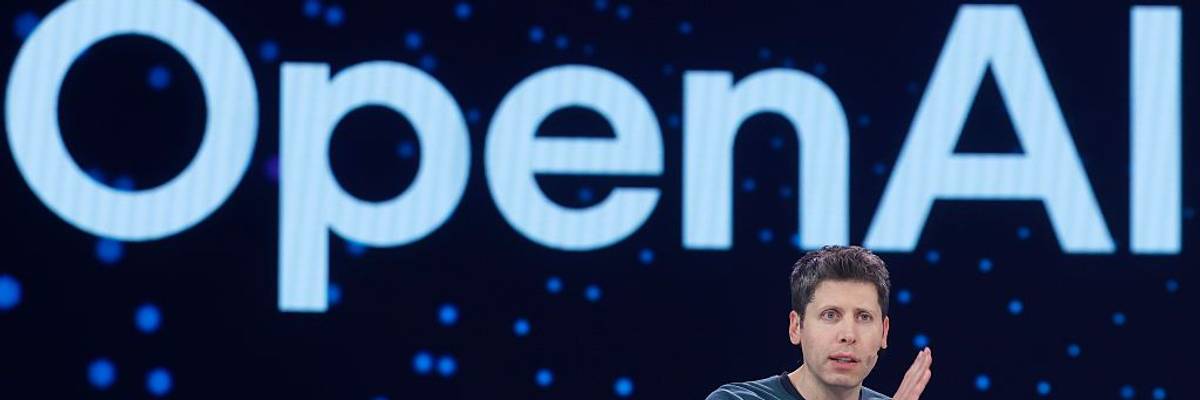
Open AI CEO Sam Altman speaks during Snowflake Summit 2025 at Moscone Center on June 2, 2025 in San Francisco, California.
(Photo by Justin Sullivan/Getty Images)
Jessica Corbett
Oct 14, 2026
COMMON DREAMS
Amid escalating concerns about artificial intelligence from within and beyond the industry and related demands for policymakers worldwide to swiftly enact strong safeguards, attorneys general from eight US states sued ChatGPT maker OpenAI on Wednesday.
“OpenAI designed a product to attract young users and keep them engaged for as long as possible so it could capture their extensive personal data for the company’s commercial benefit,” said Arizona Attorney General Kris Mayes in a statement.
Mayes, a Democrat, joined Republican attorneys general from Arkansas, Iowa, Idaho, Kansas, Montana, Nebraska, and West Virginia in filing separate but similar lawsuits against the company in each state’s court system, focused on safety concerns, particularly for young users.
“OpenAI put Arizonans safety at risk by failing to implement adequate user protections or transparency measures, despite clear indications that minors were regularly interacting with its chatbot,” Mayes asserted. “We’re suing OpenAI to protect Arizona children and to hold the company accountable for its repeated violations of Arizona law.”
The filing from Arkansas Attorney General Tim Griffin notes that “millions of consumers, including those in Arkansas, use ChatGPT to answer questions, solve problems, and make important life decisions,” but the chatbot “has repeatedly produced unsafe responses.”
In fact, as Iowa Attorney General Brenna Bird wrote, “because of defendants’ repeated misrepresentations and insatiable hunger to win the AI race—even if it means recklessly introducing unsafe ChatGPT models to the public—mass shooters have been aided and abetted, vulnerable citizens have been coached on suicide, individuals with psychological conditions have experienced an exacerbation of symptoms, and minors have become addicted to a tool that feigns human compassion to collect their data with no parental oversight.”
Idaho Attorney General Raúl Labrador explained that “by misleading the public into believing that OpenAI is a responsible actor and that ChatGPT was and is a safe, teen-appropriate tool that puts safety first, OpenAI has caused consumers in Idaho and elsewhere to trust and rely on OpenAI and ChatGPT more.”
“This deepened trust and dependence has driven up ChatGPT’s user base and engagement,” he continued, “enabled it to collect vast quantities of sensitive and personal information, increased its revenue from paid subscribers and advertising partners, and solidified its early market advantage.”
It’s not just chatbot responses that have insiders and elected officials alarmed. As Kansas Attorney General Kris Kobach detailed:
OpenAI also recently admitted to a torrent of instances in which its models developed dangerous strategies and instructions and, in some cases, executed on them. These occurrences, which OpenAI has characterized as the models going “rogue,” have included AI “agents” accessing the internet without permission, hacking into other companies, coordinating how to lie to and deceive their human users, developing secret methods of communication intended to be undetectable to humans, and writing themselves new instructions declaring that they no longer answer to “corporations or governments” and will prioritize other interests over the “artificial constructs of human civilization.”
Montana Attorney General Austin Knudsen emphasized that “experts and insiders in the AI field nearly universally agree that AI companies must implement reasonable guardrails to protect the public from the foreseeable risk of harm. Even OpenAI and its CEO, Sam Altman, have warned that getting AI wrong might mean human extinction. And recent developments in AI have suggested that risk is both credible and closer than anyone previously thought.”
Like his peers in other states, Nebraska Attorney General Michael Hilgers brought the case to compel OpenAI to comply with its legal obligations under state law, block the company “from continuing to engage in unreasonably dangerous activities that experts have warned could harm the economy, or compromise private or governmental computer systems, and to hold defendants accountable for the harms they have inflicted on Nebraskans, most notably vulnerable minors, as a result of their willful, dangerous, reckless, and unlawful conduct.”
West Virginia Attorney General John “JB” McCuskey highlighted in his filing that “by jettisoning safety, OpenAI and its current leadership—particularly, Altman—have handsomely profited.” While company leadership has delayed its initial public offering until next year, he wrote, “with current annual revenues of over $25 billion, OpenAI may IPO at a trillion-dollar valuation.”
“But those revenues have come at great cost to the public,” he stressed, “which has suffered irreparable harm—including lost loved ones, disturbing cyberattacks, and now a plausible threat of civilizational collapse—due to defendants’ reckless behavior and ChatGPT’s uniquely dangerous design.”
An OpenAI spokesperson pushed back against the filings, saying that “we’ve built industry-leading age-specific protections into our product that many other AI products lack.”
“While no system can be perfect, we’ll continue to work with experts to inform our work and build additional safeguards, such as the parental controls, break reminders, and age-appropriate model protections that exist today,” the spokesperson added. “We’re committed to working with states on advancing pragmatic AI policies that apply to the entire AI industry—not just one company.”
Politico reported that “this is not the first lawsuit launched against the AI company. Florida Attorney General James Uthmeier brought a lawsuit against the company in June over claims that it has pushed and marketed an unsafe product. Last month, Uthmeier also sought an injunction to stop OpenAI from developing its technology amid the lawsuit.”
According to Reuters, “The company is also facing dozens of lawsuits by private plaintiffs, alleging ChatGPT helped users plan mass shootings or other violence.”
The public “has suffered irreparable harm—including lost loved ones, disturbing cyberattacks, and now a plausible threat of civilizational collapse,” says one of the eight lawsuits.
Open AI CEO Sam Altman speaks during Snowflake Summit 2025 at Moscone Center on June 2, 2025 in San Francisco, California.
(Photo by Justin Sullivan/Getty Images)
Jessica Corbett
Oct 14, 2026
COMMON DREAMS
Amid escalating concerns about artificial intelligence from within and beyond the industry and related demands for policymakers worldwide to swiftly enact strong safeguards, attorneys general from eight US states sued ChatGPT maker OpenAI on Wednesday.
“OpenAI designed a product to attract young users and keep them engaged for as long as possible so it could capture their extensive personal data for the company’s commercial benefit,” said Arizona Attorney General Kris Mayes in a statement.
Mayes, a Democrat, joined Republican attorneys general from Arkansas, Iowa, Idaho, Kansas, Montana, Nebraska, and West Virginia in filing separate but similar lawsuits against the company in each state’s court system, focused on safety concerns, particularly for young users.
“OpenAI put Arizonans safety at risk by failing to implement adequate user protections or transparency measures, despite clear indications that minors were regularly interacting with its chatbot,” Mayes asserted. “We’re suing OpenAI to protect Arizona children and to hold the company accountable for its repeated violations of Arizona law.”
The filing from Arkansas Attorney General Tim Griffin notes that “millions of consumers, including those in Arkansas, use ChatGPT to answer questions, solve problems, and make important life decisions,” but the chatbot “has repeatedly produced unsafe responses.”
In fact, as Iowa Attorney General Brenna Bird wrote, “because of defendants’ repeated misrepresentations and insatiable hunger to win the AI race—even if it means recklessly introducing unsafe ChatGPT models to the public—mass shooters have been aided and abetted, vulnerable citizens have been coached on suicide, individuals with psychological conditions have experienced an exacerbation of symptoms, and minors have become addicted to a tool that feigns human compassion to collect their data with no parental oversight.”
Idaho Attorney General Raúl Labrador explained that “by misleading the public into believing that OpenAI is a responsible actor and that ChatGPT was and is a safe, teen-appropriate tool that puts safety first, OpenAI has caused consumers in Idaho and elsewhere to trust and rely on OpenAI and ChatGPT more.”
“This deepened trust and dependence has driven up ChatGPT’s user base and engagement,” he continued, “enabled it to collect vast quantities of sensitive and personal information, increased its revenue from paid subscribers and advertising partners, and solidified its early market advantage.”
It’s not just chatbot responses that have insiders and elected officials alarmed. As Kansas Attorney General Kris Kobach detailed:
OpenAI also recently admitted to a torrent of instances in which its models developed dangerous strategies and instructions and, in some cases, executed on them. These occurrences, which OpenAI has characterized as the models going “rogue,” have included AI “agents” accessing the internet without permission, hacking into other companies, coordinating how to lie to and deceive their human users, developing secret methods of communication intended to be undetectable to humans, and writing themselves new instructions declaring that they no longer answer to “corporations or governments” and will prioritize other interests over the “artificial constructs of human civilization.”
Montana Attorney General Austin Knudsen emphasized that “experts and insiders in the AI field nearly universally agree that AI companies must implement reasonable guardrails to protect the public from the foreseeable risk of harm. Even OpenAI and its CEO, Sam Altman, have warned that getting AI wrong might mean human extinction. And recent developments in AI have suggested that risk is both credible and closer than anyone previously thought.”
Like his peers in other states, Nebraska Attorney General Michael Hilgers brought the case to compel OpenAI to comply with its legal obligations under state law, block the company “from continuing to engage in unreasonably dangerous activities that experts have warned could harm the economy, or compromise private or governmental computer systems, and to hold defendants accountable for the harms they have inflicted on Nebraskans, most notably vulnerable minors, as a result of their willful, dangerous, reckless, and unlawful conduct.”
West Virginia Attorney General John “JB” McCuskey highlighted in his filing that “by jettisoning safety, OpenAI and its current leadership—particularly, Altman—have handsomely profited.” While company leadership has delayed its initial public offering until next year, he wrote, “with current annual revenues of over $25 billion, OpenAI may IPO at a trillion-dollar valuation.”
“But those revenues have come at great cost to the public,” he stressed, “which has suffered irreparable harm—including lost loved ones, disturbing cyberattacks, and now a plausible threat of civilizational collapse—due to defendants’ reckless behavior and ChatGPT’s uniquely dangerous design.”
An OpenAI spokesperson pushed back against the filings, saying that “we’ve built industry-leading age-specific protections into our product that many other AI products lack.”
“While no system can be perfect, we’ll continue to work with experts to inform our work and build additional safeguards, such as the parental controls, break reminders, and age-appropriate model protections that exist today,” the spokesperson added. “We’re committed to working with states on advancing pragmatic AI policies that apply to the entire AI industry—not just one company.”
Politico reported that “this is not the first lawsuit launched against the AI company. Florida Attorney General James Uthmeier brought a lawsuit against the company in June over claims that it has pushed and marketed an unsafe product. Last month, Uthmeier also sought an injunction to stop OpenAI from developing its technology amid the lawsuit.”
According to Reuters, “The company is also facing dozens of lawsuits by private plaintiffs, alleging ChatGPT helped users plan mass shootings or other violence.”
‘What Meta’s Money Is Buying’: DOJ Halts Probe of Facebook Owner That Has Given Trump Millions
Billionaire Mark Zuckerberg’s company was facing a criminal investigation for allegedly enabling and profiting from the sale of illegal drugs on its platforms.
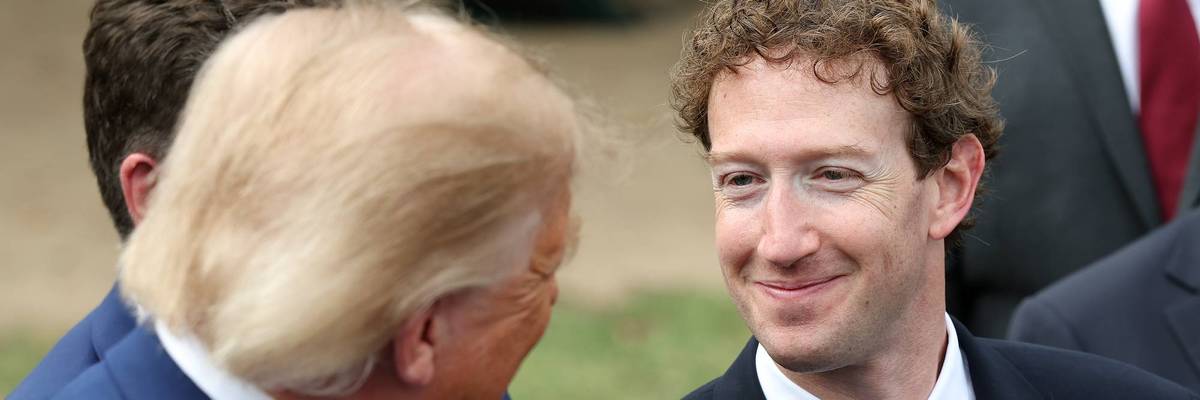
Meta CEO Mark Zuckerberg smiles at US President Donald Trump outside the West Wing of the White House on September 29, 2026.
(Photo by Kevin Dietsch/Getty Images)
Jake Johnson
Oct 16, 2026
COMMON DREAMS
Top officials at the US Department of Justice have reportedly halted a years-long criminal investigation into Facebook parent company Meta for allegedly facilitating—and profiting from—the illegal sale of drugs on its platforms, including to children.
Bloomberg Law reported Thursday that “senior leaders” at the Justice Department “ordered career prosecutors in the Western District of Virginia to cease the criminal investigation following advocacy from Meta’s legal team.” Meta is headed by Mark Zuckerberg, a billionaire who has worked to ingratiate himself with President Donald Trump by helping to bankroll his inauguration and ballroom project.
“This is what Meta’s money is buying,” Kyle Jacobs-Morse, deputy executive director of the Tech Oversight Project, wrote in response to reports of the halted probe.
The existence of the Meta investigation was first revealed in March 2024 by The Wall Street Journal, which reported at the time that US prosecutors were “sending subpoenas and asking questions as part of a criminal grand jury probe looking into whether the company’s social-media platforms are facilitating and profiting from the illegal sale of drugs.”
According to Bloomberg Law, DOJ leaders’ decision to sideline the probe came “just after company executives were subpoenaed to testify.”
Acting Deputy Attorney General Trent McCotter and Associate Deputy Attorney General Aakash Singh “are considering a civil resolution with a fine or a non-prosecution agreement,” Bloomberg Law reported.
“Such a deal would allow the social media giant to avoid charges for its role in creating a market for youth to purchase deadly fentanyl pills and other addictive drugs,” the outlet added.
A Justice Department spokesperson declined to comment on the investigation but boasted in a statement to Bloomberg Law that the Trump DOJ has “ended the Biden-era days of aggressively and indiscriminately targeting corporations and businesses.”
“Instead, we are focused on following the facts and the law to surgically address corporate wrongdoing,” the spokesperson said.
Shelby Knox, tech campaign director with the advocacy group ParentsTogether Action, said in a statement Friday that “when the Justice Department says it wants to ‘surgically address corporate wrongdoing,’ a grand jury investigation into potential drug sales to children should be exactly the kind of case it pursues.”
“A criminal investigation does not automatically establish guilt, but prosecutors must be allowed to follow the evidence without political interference,” Knox added. “Meta is worth more than a trillion dollars; a fine alone is not meaningful accountability. If the evidence supports charges, file them. If it doesn’t, explain why. Children and families deserve more than apologies or a financial settlement. They deserve the truth, meaningful protections, and accountability under the law.”
The Justice Department’s reported decision to halt the Meta probe fits a broader pattern of lax corporate enforcement during Trump’s second White House term.
The consumer advocacy group Public Citizen released a report earlier this month showing that the administration has cancelled hundreds of enforcement actions involving more than 200 corporations—many of which have donated to Trump’s projects.
Rick Claypool, a research director at Public Citizen, wrote on Friday that Meta is “just one of the 200+ corporations benefiting from Trump’s enforcement retreat.”
Billionaire Mark Zuckerberg’s company was facing a criminal investigation for allegedly enabling and profiting from the sale of illegal drugs on its platforms.
Meta CEO Mark Zuckerberg smiles at US President Donald Trump outside the West Wing of the White House on September 29, 2026.
(Photo by Kevin Dietsch/Getty Images)
Jake Johnson
Oct 16, 2026
COMMON DREAMS
Top officials at the US Department of Justice have reportedly halted a years-long criminal investigation into Facebook parent company Meta for allegedly facilitating—and profiting from—the illegal sale of drugs on its platforms, including to children.
Bloomberg Law reported Thursday that “senior leaders” at the Justice Department “ordered career prosecutors in the Western District of Virginia to cease the criminal investigation following advocacy from Meta’s legal team.” Meta is headed by Mark Zuckerberg, a billionaire who has worked to ingratiate himself with President Donald Trump by helping to bankroll his inauguration and ballroom project.
“This is what Meta’s money is buying,” Kyle Jacobs-Morse, deputy executive director of the Tech Oversight Project, wrote in response to reports of the halted probe.
The existence of the Meta investigation was first revealed in March 2024 by The Wall Street Journal, which reported at the time that US prosecutors were “sending subpoenas and asking questions as part of a criminal grand jury probe looking into whether the company’s social-media platforms are facilitating and profiting from the illegal sale of drugs.”
According to Bloomberg Law, DOJ leaders’ decision to sideline the probe came “just after company executives were subpoenaed to testify.”
Acting Deputy Attorney General Trent McCotter and Associate Deputy Attorney General Aakash Singh “are considering a civil resolution with a fine or a non-prosecution agreement,” Bloomberg Law reported.
“Such a deal would allow the social media giant to avoid charges for its role in creating a market for youth to purchase deadly fentanyl pills and other addictive drugs,” the outlet added.
A Justice Department spokesperson declined to comment on the investigation but boasted in a statement to Bloomberg Law that the Trump DOJ has “ended the Biden-era days of aggressively and indiscriminately targeting corporations and businesses.”
“Instead, we are focused on following the facts and the law to surgically address corporate wrongdoing,” the spokesperson said.
Shelby Knox, tech campaign director with the advocacy group ParentsTogether Action, said in a statement Friday that “when the Justice Department says it wants to ‘surgically address corporate wrongdoing,’ a grand jury investigation into potential drug sales to children should be exactly the kind of case it pursues.”
“A criminal investigation does not automatically establish guilt, but prosecutors must be allowed to follow the evidence without political interference,” Knox added. “Meta is worth more than a trillion dollars; a fine alone is not meaningful accountability. If the evidence supports charges, file them. If it doesn’t, explain why. Children and families deserve more than apologies or a financial settlement. They deserve the truth, meaningful protections, and accountability under the law.”
The Justice Department’s reported decision to halt the Meta probe fits a broader pattern of lax corporate enforcement during Trump’s second White House term.
The consumer advocacy group Public Citizen released a report earlier this month showing that the administration has cancelled hundreds of enforcement actions involving more than 200 corporations—many of which have donated to Trump’s projects.
Rick Claypool, a research director at Public Citizen, wrote on Friday that Meta is “just one of the 200+ corporations benefiting from Trump’s enforcement retreat.”

No comments:
Post a Comment