Deja vu: New Siberian lab leak leaves Trump officials scrambling
(REUTERS)
Let’s accept that very little information has been revealed about at least one death, and perhaps two, of workers at a Russian plague lab in Siberia that killed within 24 hours of exposure. The death or deaths have been reportedly linked to some form of pneumonic plague.
Isn’t the next logical question what is being done to quarantine the reported disease and to revisit U.S. preparations for what seems like inevitable travel-borne communicable illness.
Amid all the fuss still being stirred over responses to Covid, including the endless campaign of Republican senators and Donald Trump to find some reason to prosecute virologist Anthony Fauci for his role in directing Covid response, one might think there would be just a tad more concern about the appearance of a “plague.”
Apart from all else, this apparently involved a lab leak of the sort critics repeatedly suggested caused the escape of the Covid menace, late recognition of a public contagion, and all sorts of presidential dismissals by Donald Trump about the seriousness of a pandemic that ended shutting the country. In this case, there are undisputed reports that Health Secretary Robert F. Kennedy Jr. approved funding for research in the very lab about diseases among foxes, the parallel to Fauci’s investment in trying to understand species-crossing contagion.
All that has been disclosed formally so far is that a 28-year-old woman working at a Russian plague lab was exposed to “some sort of plague” and died within 48 hours. Maybe there was a second death. Russian authorities are reportedly monitoring and quarantining the people with whom the woman came into contact. Her death has been reportedly linked to some form of the pneumonic plague.
U.S. Response
Trump last week asserted that U.S. officials did not believe that a Russian lab worker’s reported death was linked to a bioweapon or biological weapons research. “We’re going to find out soon enough, but we don’t think so,” Trump told reporters, adding that he was planning a call soon with Russian leader Vladimir Putin over the matter.
Trump said that Russian officials had reassured their U.S. counterparts that the situation was being contained. The president acknowledged some similarities to how Chinese officials in early 2020 initially claimed they had contained the covid-19 virus before it caused a global pandemic.
World Health Organization officials — Trump has cut ties between the U.S. and WHO — said they still do not know what pathogen caused the first worker’s fatal illness, which pathogens Russian laboratories tested for or why authorities placed roughly 200 contacts under quarantine or medical observation. Without those answers, officials said, they cannot fully assess the public health risk.
The Centers for Disease Control and Prevention (CDC) said it has established measures to “identify and assess” any travelers from the Russian region where a possible plague case was reported, again counting on halting travelers who rarely come directly from Siberia to the U.S., but rather go to international stops in between, including Istanbul. The CDC said only 200 travelers from the region arrive in the U.S. each year.
The White House has shut down its pandemic response units, fearing association with Covid shutdowns as politically toxic.
One Russian news report said that the technician “allegedly broke a test tube containing the pneumonic plague pathogen” on Sept. 25, that she soon fell ill and died in a local hospital. Pneumonic plague is almost always fatal when untreated, but many patients recover with a prompt course of antibiotics. The incubation period for this type of plague is up to six or seven days. And, we know that Kennedy has canceled much of the CDC’s ability to track communicable disease and to issue warnings.
The Kennedy Research
According to an investigation by animal testing watchdog White Coat Waste, which claims it was the first to raise questions about Covid escaping the Chinese lab thought to be a possible origin for Covid, Kennedy has overseen nearly $800,000 in federal funding for a research project involving a Russian laboratory with ties to the Siberian facility at the center of a suspected plague outbreak.
It’s of interest by itself, of course, but more directly because it so parallels the exact arguments that selected Republican senators and the administration have pursued against Fauci.
The National Institutes of Health awarded $779,689 to the University of Illinois Urbana-Champaign in 2025 and 2026 for research conducted in partnership with Russia’s state-run Institute of Cytology and Genetics.
Federal records obtained by the group and reported on Wednesday show that the project received $389,943 in July 2025 and another $389,746 in September 2026. The NIH-funded research was to examines the genetic underpinnings of social behavior using foxes raised at a Siberian breeding facility. According to documents, Russian researchers euthanize the animals and transport biological samples to the United States for analysis.
In 2022, Joe Biden’s administration ordered a winddown federally supported scientific partnerships with Russian government institutions following Moscow’s invasion of Ukraine.
Nervous yet?
##

Terry H. Schwadron retired as a senior editor at The New York Times, Deputy Managing Editor at The Los Angeles Times and leadership jobs at The Providence (RI) Journal-Bulletin. He was part of a Pulitzer Gold Medal team in Los Angeles, and his team part of several Pulitzers in New York.
(REUTERS)
October 13, 2026
ALTERNET
Let’s accept that very little information has been revealed about at least one death, and perhaps two, of workers at a Russian plague lab in Siberia that killed within 24 hours of exposure. The death or deaths have been reportedly linked to some form of pneumonic plague.
Isn’t the next logical question what is being done to quarantine the reported disease and to revisit U.S. preparations for what seems like inevitable travel-borne communicable illness.
Amid all the fuss still being stirred over responses to Covid, including the endless campaign of Republican senators and Donald Trump to find some reason to prosecute virologist Anthony Fauci for his role in directing Covid response, one might think there would be just a tad more concern about the appearance of a “plague.”
Apart from all else, this apparently involved a lab leak of the sort critics repeatedly suggested caused the escape of the Covid menace, late recognition of a public contagion, and all sorts of presidential dismissals by Donald Trump about the seriousness of a pandemic that ended shutting the country. In this case, there are undisputed reports that Health Secretary Robert F. Kennedy Jr. approved funding for research in the very lab about diseases among foxes, the parallel to Fauci’s investment in trying to understand species-crossing contagion.
All that has been disclosed formally so far is that a 28-year-old woman working at a Russian plague lab was exposed to “some sort of plague” and died within 48 hours. Maybe there was a second death. Russian authorities are reportedly monitoring and quarantining the people with whom the woman came into contact. Her death has been reportedly linked to some form of the pneumonic plague.
U.S. Response
Trump last week asserted that U.S. officials did not believe that a Russian lab worker’s reported death was linked to a bioweapon or biological weapons research. “We’re going to find out soon enough, but we don’t think so,” Trump told reporters, adding that he was planning a call soon with Russian leader Vladimir Putin over the matter.
Trump said that Russian officials had reassured their U.S. counterparts that the situation was being contained. The president acknowledged some similarities to how Chinese officials in early 2020 initially claimed they had contained the covid-19 virus before it caused a global pandemic.
World Health Organization officials — Trump has cut ties between the U.S. and WHO — said they still do not know what pathogen caused the first worker’s fatal illness, which pathogens Russian laboratories tested for or why authorities placed roughly 200 contacts under quarantine or medical observation. Without those answers, officials said, they cannot fully assess the public health risk.
The Centers for Disease Control and Prevention (CDC) said it has established measures to “identify and assess” any travelers from the Russian region where a possible plague case was reported, again counting on halting travelers who rarely come directly from Siberia to the U.S., but rather go to international stops in between, including Istanbul. The CDC said only 200 travelers from the region arrive in the U.S. each year.
The White House has shut down its pandemic response units, fearing association with Covid shutdowns as politically toxic.
One Russian news report said that the technician “allegedly broke a test tube containing the pneumonic plague pathogen” on Sept. 25, that she soon fell ill and died in a local hospital. Pneumonic plague is almost always fatal when untreated, but many patients recover with a prompt course of antibiotics. The incubation period for this type of plague is up to six or seven days. And, we know that Kennedy has canceled much of the CDC’s ability to track communicable disease and to issue warnings.
The Kennedy Research
According to an investigation by animal testing watchdog White Coat Waste, which claims it was the first to raise questions about Covid escaping the Chinese lab thought to be a possible origin for Covid, Kennedy has overseen nearly $800,000 in federal funding for a research project involving a Russian laboratory with ties to the Siberian facility at the center of a suspected plague outbreak.
It’s of interest by itself, of course, but more directly because it so parallels the exact arguments that selected Republican senators and the administration have pursued against Fauci.
The National Institutes of Health awarded $779,689 to the University of Illinois Urbana-Champaign in 2025 and 2026 for research conducted in partnership with Russia’s state-run Institute of Cytology and Genetics.
Federal records obtained by the group and reported on Wednesday show that the project received $389,943 in July 2025 and another $389,746 in September 2026. The NIH-funded research was to examines the genetic underpinnings of social behavior using foxes raised at a Siberian breeding facility. According to documents, Russian researchers euthanize the animals and transport biological samples to the United States for analysis.
In 2022, Joe Biden’s administration ordered a winddown federally supported scientific partnerships with Russian government institutions following Moscow’s invasion of Ukraine.
Nervous yet?
##
Terry H. Schwadron retired as a senior editor at The New York Times, Deputy Managing Editor at The Los Angeles Times and leadership jobs at The Providence (RI) Journal-Bulletin. He was part of a Pulitzer Gold Medal team in Los Angeles, and his team part of several Pulitzers in New York.
Recent reports that a young woman working in a Russian biolab became ill and died echo Annie Jacobsen’s new book, Biological War: A Scenario. How concerned should we be?
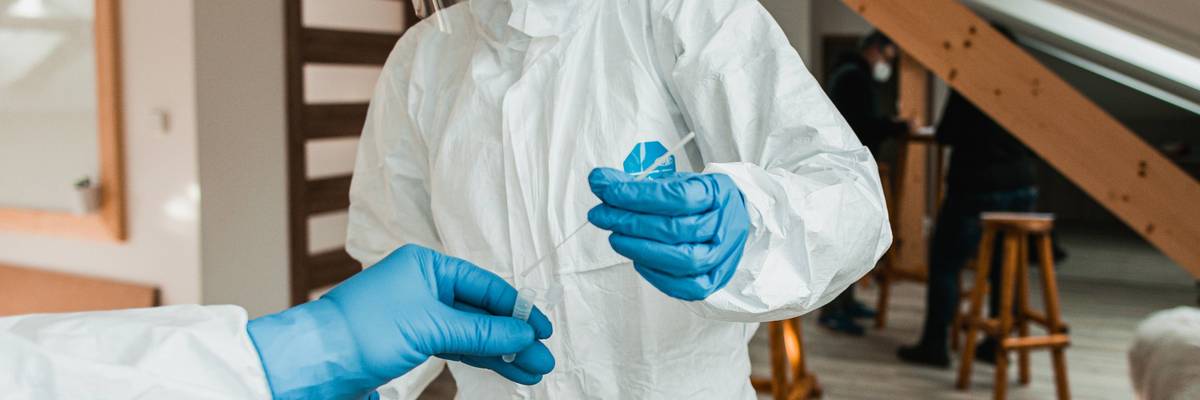
A person wears a white bio hazard suit and blue gloves.
(Photo by Jan Kopřiva on Unsplash)
Connie Peck
Oct 17, 2026
Common Dreams
A few months ago, I ordered a pre-publication copy of Annie Jacobsen’s new non-fiction book, Biological War: A Scenario, which followed on from her excellent book, Nuclear War: A Scenario—not because I enjoy reading about existential risks, but because I’m an information seeker and feel that it’s important to stay informed. But when it arrived a few weeks later, in spite of having written an opinion piece about her nuclear book, entitled, “Why We Avoid Thinking About Nuclear War—and Why We Shouldn’t,“ after seeing the frightening cover illustration of men in hazmat suits, I stashed it on the bookshelf of my study rather than reading it—for the same reasons I discussed in my earlier piece: I didn’t want to know!
But after the recent reports of a biolab accident in Russia, I retrieved it from the bookshelf and read it in two days.
The “scenario“ in the book is that of a ”biological weapons lab accident,“ where a scientist working to modify pneumonic plague into a deadly biological weapon experiences remorse and tries to destroy it. But the small fire he lights causes an explosion that propels the Yersinia pestis bacteria (which causes the plague) into the atmosphere. In the process, he becomes infected with his weaponized pneumonic plague, although he doesn’t yet know it.
Although most of us cannot directly influence negotiations about strengthening the BWC, there are things that we can do to support such efforts and to lessen the increasingly grave dangers that confront us.
The next morning, he goes to an Orthodox church to confess where, by coughing in the midst of confession, he infects the priest, as well as the next person in line—a pre-med foreign exchange student, who is back in this small Russian town visiting family—before returning to the US shortly thereafter, where he is studying and doing volunteer work with homeless people. The student subsequently infects scores on Skid Row, who, in turn, infect the first responders who come to help them and, ultimately, the whole city of Los Angeles.
Following his confession, the scientist goes into the woods to shoot himself but collapses from the symptoms of plague. He is found by men on an international hunting trip, who administer mouth-to-mouth resuscitation and carry him back to their hunting lodge, where he is collected by officials. After dining together, using the same sauna and steam bath, and driving to the airport in the same van, seven of the hunters board flights to six of the world’s seven continents, while another goes off on a sea cruise—spreading pneumonic plague on their flights and sea voyage—and ultimately around the world.
In the real-world scenario, reported on October 2, Darya Shipilova, a 28-year old laboratory technician working in an “Anti-Plague Institute” in Irkutsk, Siberia died, according to Russian officials, of “a pneumonia of unknown etiology.“ A Russian news agency reported that she had broken a test tube containing live bacteria of the pneumonic plague pathogen, leading to widespread speculation that she had, indeed, died of pneumonic plague.
These concerns were reinforced by reports that Russian health authorities imposed sweeping quarantine restrictions on the lab where she worked, the hospital where she died, and other nearby hospitals. Neighbors also reported that workers in protective suits and gas masks repeatedly disinfected the building where she lived, telling residents that it was “for cockroaches,” although the building has no cockroaches. More recently, Russia’s health agency asserted that the plague was not detected in follow-up tests of “thousands of people in the region.”
The overall opacity (a familiar playbook for crises in Russia) of Russian public health officials in responding to urgent requests for more information from the World Health Organization, the US, and other governments led to considerable disquiet around the world.
When asked if her death was related to a bioweapon, President Donald Trump responded, not very reassuringly, “We don’t think so.” He also acknowledged the similarities in how Chinese officials handled Covid-19 before it became a global pandemic: “China didn’t say much, and Russia is not saying much either.”
The Biological Weapons Convention Was Supposed to Prevent This, Then Came the Secret Soviet Biological Weapons Program
The 1925 Geneva Protocol banned the use of biological weapons, but not their development or possession. Although ratified by a number of countries in the 1920s and 30s, it wasn’t ratified by the US until 1975.
After 27 years of a US biological weapons program, President Richard Nixon unexpectedly announced on November 25, 1969 that the US would unilaterally end its offensive biological weapons program, stating, “The United States shall renounce the use of lethal biological agents and weapons, and all other methods of biological warfare… [and] confine its biological research to defensive measures such as immunization and safety measures.” Over the next years, US biological weapons stocks were destroyed with the process completed in May 1972.
Subsequently, the United Nations Conference on Disarmament negotiated “The Biological Weapons Convention” (BWC), the first multilateral treaty to ban an entire class of weapons of mass destruction. It was opened for signature on April 10, 1972 and signed by the US, Great Britain, and the Soviet Union the same day. It entered into force on March 26, 1975. Currently, it has 189 State Parties and four Signatory States, with only four States outside the Convention.
Because it was the first of its kind, however, the BWC lacked the important monitoring and verification procedures that were later included in the Chemical Weapons Convention. There are no mandatory verified declarations of biological facilities or activities; no inspections or site visits to verify compliance; no international organization to oversee implementation; and no penalties for non-compliance, although complaints can be made to the UN Security Council (which are subject to veto by any of the five Permanent Members). Only four staff are involved in its tiny Implementation Support Unit, compared with over 500 for the Chemical Weapons Convention.
In spite of the Soviet Union becoming a signatory to the BWC in 1972, the USSR continued to covertly develop and produce offensive biological weapons in what became the world’s largest and most sophisticated biological weapons program, with 40-50 biological research facilities scattered around the country, employing 65,000 people. The aim was to create “exotic biological weapons using techniques made possible by recombinant DNA.” Recombinant DNA, also called genetic engineering, involves joining the DNA from two entirely different species to make new pathogens.
Not detecting this vast biological weapons program was one of the biggest intelligence failures of the Cold War as it was totally unknown in the West until 1989, when a Soviet scientist, Vladimir Pasechnik, defected, shocking the British Intelligence Services and the CIA with details of the massive program and its deadly stockpiles. They learned that the Soviets had “genetically engineered a strain of Yersinia pestis to resist antibiotics” and had also stockpiled vast volumes of other deadly pathogens in the labs’ freezers, such as smallpox, anthrax, ebola, Marburg virus disease, and many others—all weaponized to kill populations in the most diabolical manner.
The terrifying extent of this biowarfare program was later confirmed by other defecting Soviet scientists, especially after the collapse of the Soviet Union in 1991. In January 1992, Boris Yeltsin admitted that he knew about the program and pledged to close down the institutes, retire their directors, and ask for international inspections. But the two generals he appointed to carry out this mission resisted his orders. In 1992, a Trilateral Agreement was signed by Russia with the United States and the United Kingdom “promising to end biological weapons programs and convert facilities to benevolent purposes, but compliance with the agreement—and the fate of the former Soviet bio-agents and facilities—is still mostly undocumented.”
The State Department’s 2025 compliance report states: “The United States assesses that Russia maintains an offensive biological warfare program and is in violation of its obligations under Article I and II of the BWC… Key military biological facilities associated with the Soviet offensive program remain, inaccessible and not transparent, nearly 30 years after Yeltsin’s decree.”
A few months ago, I ordered a pre-publication copy of Annie Jacobsen’s new non-fiction book, Biological War: A Scenario, which followed on from her excellent book, Nuclear War: A Scenario—not because I enjoy reading about existential risks, but because I’m an information seeker and feel that it’s important to stay informed. But when it arrived a few weeks later, in spite of having written an opinion piece about her nuclear book, entitled, “Why We Avoid Thinking About Nuclear War—and Why We Shouldn’t,“ after seeing the frightening cover illustration of men in hazmat suits, I stashed it on the bookshelf of my study rather than reading it—for the same reasons I discussed in my earlier piece: I didn’t want to know!
But after the recent reports of a biolab accident in Russia, I retrieved it from the bookshelf and read it in two days.
The “scenario“ in the book is that of a ”biological weapons lab accident,“ where a scientist working to modify pneumonic plague into a deadly biological weapon experiences remorse and tries to destroy it. But the small fire he lights causes an explosion that propels the Yersinia pestis bacteria (which causes the plague) into the atmosphere. In the process, he becomes infected with his weaponized pneumonic plague, although he doesn’t yet know it.
Although most of us cannot directly influence negotiations about strengthening the BWC, there are things that we can do to support such efforts and to lessen the increasingly grave dangers that confront us.
The next morning, he goes to an Orthodox church to confess where, by coughing in the midst of confession, he infects the priest, as well as the next person in line—a pre-med foreign exchange student, who is back in this small Russian town visiting family—before returning to the US shortly thereafter, where he is studying and doing volunteer work with homeless people. The student subsequently infects scores on Skid Row, who, in turn, infect the first responders who come to help them and, ultimately, the whole city of Los Angeles.
Following his confession, the scientist goes into the woods to shoot himself but collapses from the symptoms of plague. He is found by men on an international hunting trip, who administer mouth-to-mouth resuscitation and carry him back to their hunting lodge, where he is collected by officials. After dining together, using the same sauna and steam bath, and driving to the airport in the same van, seven of the hunters board flights to six of the world’s seven continents, while another goes off on a sea cruise—spreading pneumonic plague on their flights and sea voyage—and ultimately around the world.
In the real-world scenario, reported on October 2, Darya Shipilova, a 28-year old laboratory technician working in an “Anti-Plague Institute” in Irkutsk, Siberia died, according to Russian officials, of “a pneumonia of unknown etiology.“ A Russian news agency reported that she had broken a test tube containing live bacteria of the pneumonic plague pathogen, leading to widespread speculation that she had, indeed, died of pneumonic plague.
These concerns were reinforced by reports that Russian health authorities imposed sweeping quarantine restrictions on the lab where she worked, the hospital where she died, and other nearby hospitals. Neighbors also reported that workers in protective suits and gas masks repeatedly disinfected the building where she lived, telling residents that it was “for cockroaches,” although the building has no cockroaches. More recently, Russia’s health agency asserted that the plague was not detected in follow-up tests of “thousands of people in the region.”
The overall opacity (a familiar playbook for crises in Russia) of Russian public health officials in responding to urgent requests for more information from the World Health Organization, the US, and other governments led to considerable disquiet around the world.
When asked if her death was related to a bioweapon, President Donald Trump responded, not very reassuringly, “We don’t think so.” He also acknowledged the similarities in how Chinese officials handled Covid-19 before it became a global pandemic: “China didn’t say much, and Russia is not saying much either.”
The Biological Weapons Convention Was Supposed to Prevent This, Then Came the Secret Soviet Biological Weapons Program
The 1925 Geneva Protocol banned the use of biological weapons, but not their development or possession. Although ratified by a number of countries in the 1920s and 30s, it wasn’t ratified by the US until 1975.
After 27 years of a US biological weapons program, President Richard Nixon unexpectedly announced on November 25, 1969 that the US would unilaterally end its offensive biological weapons program, stating, “The United States shall renounce the use of lethal biological agents and weapons, and all other methods of biological warfare… [and] confine its biological research to defensive measures such as immunization and safety measures.” Over the next years, US biological weapons stocks were destroyed with the process completed in May 1972.
Subsequently, the United Nations Conference on Disarmament negotiated “The Biological Weapons Convention” (BWC), the first multilateral treaty to ban an entire class of weapons of mass destruction. It was opened for signature on April 10, 1972 and signed by the US, Great Britain, and the Soviet Union the same day. It entered into force on March 26, 1975. Currently, it has 189 State Parties and four Signatory States, with only four States outside the Convention.
Because it was the first of its kind, however, the BWC lacked the important monitoring and verification procedures that were later included in the Chemical Weapons Convention. There are no mandatory verified declarations of biological facilities or activities; no inspections or site visits to verify compliance; no international organization to oversee implementation; and no penalties for non-compliance, although complaints can be made to the UN Security Council (which are subject to veto by any of the five Permanent Members). Only four staff are involved in its tiny Implementation Support Unit, compared with over 500 for the Chemical Weapons Convention.
In spite of the Soviet Union becoming a signatory to the BWC in 1972, the USSR continued to covertly develop and produce offensive biological weapons in what became the world’s largest and most sophisticated biological weapons program, with 40-50 biological research facilities scattered around the country, employing 65,000 people. The aim was to create “exotic biological weapons using techniques made possible by recombinant DNA.” Recombinant DNA, also called genetic engineering, involves joining the DNA from two entirely different species to make new pathogens.
Not detecting this vast biological weapons program was one of the biggest intelligence failures of the Cold War as it was totally unknown in the West until 1989, when a Soviet scientist, Vladimir Pasechnik, defected, shocking the British Intelligence Services and the CIA with details of the massive program and its deadly stockpiles. They learned that the Soviets had “genetically engineered a strain of Yersinia pestis to resist antibiotics” and had also stockpiled vast volumes of other deadly pathogens in the labs’ freezers, such as smallpox, anthrax, ebola, Marburg virus disease, and many others—all weaponized to kill populations in the most diabolical manner.
The terrifying extent of this biowarfare program was later confirmed by other defecting Soviet scientists, especially after the collapse of the Soviet Union in 1991. In January 1992, Boris Yeltsin admitted that he knew about the program and pledged to close down the institutes, retire their directors, and ask for international inspections. But the two generals he appointed to carry out this mission resisted his orders. In 1992, a Trilateral Agreement was signed by Russia with the United States and the United Kingdom “promising to end biological weapons programs and convert facilities to benevolent purposes, but compliance with the agreement—and the fate of the former Soviet bio-agents and facilities—is still mostly undocumented.”
The State Department’s 2025 compliance report states: “The United States assesses that Russia maintains an offensive biological warfare program and is in violation of its obligations under Article I and II of the BWC… Key military biological facilities associated with the Soviet offensive program remain, inaccessible and not transparent, nearly 30 years after Yeltsin’s decree.”
Jacobsen’s Book Is Based on the Secret Soviet Biological Weapons Program
The latter part of Jacobsen’s book deals with the breakdown of law and order, as mass death and panic take hold and cause chaos. Ultimately, the president deploys the Insurrection Act, whereby military forces attempt to establish martial law for the first time in American history. Just as they are about to release the strategic national stockpiles of medicine, scientists at the US Army Medical Research Institute of Infectious Disease receive their first bacterial specimens (from the infected hunter who landed in Dallas and died in a local hospital). Microbiologists in biocontainment suits examine the specimens, and plague cultures are grown and used to test for antibiotic resistance in small animals. Simultaneously, microbiologists extract DNA from the specimen and feed it into a high-speed sequencing machine to get a genetic fingerprint of the pathogen.
What they discover is appalling—the organism has been bioengineered and “looks alarmingly like a 21st century version of something Russian scientists worked on during the Soviet-era secret biological weapons programs.” It is a combination of two pathogens, one concealed within another, referred to as a “bobby-trap bio-weapon,“ whereby, after a person becomes infected with pneumonic plague and takes antibiotics as soon as possible under the assumption they will be cured, the antibiotics trigger the chimera weapon’s bobby-trap mechanism—in this fictional case, the Venezuelan equine encephalitis gene which has been covertly spliced into the Yersinia pestis genome to cause acute neurological symptoms and death. As a result, there is no cure.
As Annie Jacobsen declares:
The book is not meant to create unnecessary fear. It is meant to make clear what is now possible, and what is at stake. The tools to engineer life are advancing faster than the rules that govern them. This gap is where existential danger lives. The point is not panic; the point is pressure. To demand guardrails, oversight, and accountability before the science outruns our ability to control it. Before we set something irreversible in motion.
Although the real-life situation in Siberia will hopefully not turn out to be the same as in Annie Jacobsen’s book, it should cause us to take notice.
Attempts to Improve the Biological Weapons Convention
Serious attempts have been made in the past to strengthen the BWC but without success. An Ad Hoc Group labored from 1995 to 2001 to create a protocol where states would submit declarations of treaty-relevant facilities and activities to an international body that would conduct routine on-site visits, as well as challenge inspections of suspect facilities and activities. But the draft was rejected by the US under President George W. Bush, who argued that it could harm US national security. Nothing more happened for many years.
Another attempt is currently underway, although progress is slow. A Biological and Toxin Weapons Convention Working Group was established at the 2022 BWC Review Conference and has been working steadily over the last four years to come up with the text of draft recommendations before the 2027 BWC Review Conference. At their August meeting this year, 90.6% of the text had been agreed, although fundamental disagreements over verification frameworks, transfer controls, and funding remain—and tensions are high.
The chair of the Working Group has highlighted the urgency, arguing that the sudden convergence of artificial intelligence and biology is “creating new security challenges,” warning that a gap “may emerge between these rapidly advancing capabilities and our collective ability to understand their governance and prevent their misuse.”
What We Can Do
Although most of us cannot directly influence negotiations about strengthening the BWC, there are things that we can do to support such efforts and to lessen the increasingly grave dangers that confront us.
We can be sure to vote in the upcoming midterms for Democratic candidates, who have been more likely to support regulatory controls in Congress, as well as multilaterally. We can support these candidates with financial contributions and by working on their campaigns to ensure that they get elected, since time is short. Once elected, we can strive to persuade them to urgently implement appropriate policies.
After all, who wants human extinction? Presumably, none of us—no matter how jaded we may have become.
We can educate ourselves about the threats by reading widely, including Jacobsen’s excellent books, as well as opinion pieces on the subject, such as ones I’ve written on AI and nuclear weapons. We can do online research to identify, join, financially support, and work with others in public advocacy organizations against threats that are of particular concern to us. We can attend protest rallies and discuss our concerns with friends, encouraging them to also become active, so that we can develop a large public constituency to combat these extreme dangers.
Just a couple of days ago, on October 11, The Lancet Commission on 21st Century Global Threats to Health highlighted 17 major threats to human health over the next 75 years, asserting that, “Malicious use of AI, including bioweapons, and nuclear conflict with nuclear famine [caused by nuclear winter] carry risks of extinction in the next 75 years.” There are so many existential dangers to confront that it can sometimes feel overwhelming and lead us to a state of helplessness when what we need, instead, is a pro-active approach that will foster resourcefulness.
By facing up to our natural tendency to avoid frightening information and by confronting our fears head-on, we can gain a true sense of self-efficacy and social responsibility. In this way, we can save those we love; ensure that future generations thrive; preserve the rich cultural heritage we have created; protect the magnificent array of other species on Earth; and safeguard our beautiful, one-of-a-kind planet—from all of these truly insane and, frankly, evil machinations—often designed by normal people, who have been seduced by competitive processes; rationales that “everyone is doing it”; lucrative remuneration; lapse of conscience; and bad ideas into creating conditions for the most dystopian futures imaginable.
As Gareth Evans, former Australian foreign minister, former president and CEO of the International Crisis Group, and co-chair of the Commission on Nuclear Proliferation and Disarmament has recently commented with regard to the nuclear threat, “It is up to those of us who passionately believe in both the possibility and necessity of a nuclear weapon free world, however disappointed and frustrated we may be right now, to get out there and continue to campaign our hearts out for it.” I suggest that we extend his call to action to all the existential threats we face. After all, who wants human extinction? Presumably, none of us—no matter how jaded we may have become. We must assume responsibility for the continuation of our kind and choose human survival.
Our work is licensed under Creative Commons (CC BY-NC-ND 3.0). Feel free to republish and share widely.
Connie Peck
Dr. Connie Peck is the founder of the United Nations Institute for Training and Research Programme in Peacemaking and Conflict Prevention—the first training program in negotiation and mediation for senior UN staff and diplomats (now in its 33rd year). She is the author of a number of books and numerous articles and book chapters on conflict resolution and the nuclear threat.
Full Bio >

No comments:
Post a Comment