Showing posts sorted by relevance for query BURQA. Sort by date Show all posts

Saturday, January 29, 2022

Rising settler violence against Palestinians in Burqa reignites struggle over land

Residents of the West Bank village have been fighting to reclaim their land since 1978 when Israel confiscated it to establish the Homesh settlement


Mushir Seif, a Palestinian resident of Burqa, has been for decades denied access to his land which is only 10 minutes away by foot (MEE/Atef Daglas)

By Atef Daglas in Nablus, 
Occupied Palestine
Published date: 29 January 2022

Perched atop the roof of his home in Burqa village north of Nablus in the occupied West Bank stands Mushir Seif, gazing across the Mount of al-Zuhur at his land, now swallowed up by the Israeli settlement of Homesh.

The land is only 800 meters away from him, and 10 minutes away by foot, yet for over four decades he’s been denied access to it.

Seif and his 6,000 fellow Burqa residents have not been able to reclaim or plant anywhere in the 45 dunams (45,000 square metres) of their land that have been confiscated by Israel since 1978 when Homesh was established.


Israel uses settler violence as 'tool' to take Palestinian land: B'Tselem
Read More »

With a mixture of sadness and bitterness, Seif told Middle East Eye of the pain he and his fellow villagers have felt for decades due to the settler presence on the land - with the tacit support of the Israeli army - and the persistent feeling of insecurity caused by settler violence.

“It was an ambush by the settlers,” Seif told MEE about one near-fatal attack that he and other villagers came under last November.

“The army was conspicuously absent and did not come even after the attack,” he added.

The incident Seif referred to happened on 15 November when a group of Burqa residents was on their way to visit their stolen land. When they arrived, Homesh settlers shot at them, assaulted them with sharp objects, and destroyed Seif’s car. At least six farmers were seriously injured.

The November assault was not an isolated incident. Palestinians in Burqa fear that settlers are ramping up violence to create a new reality on the ground and force the government to give them the land.

Attacks increased particularly after the killing of an Israeli settler by Palestinian gunmen in December near Homesh, bringing the decade-long fight over land in Burqa back into the spotlight.

Struggle through the generations

The plight of Palestinians in Burqa started in 1978 when Israel confiscated 1,050 dunams from Mounts al-Zuhur and al-Qubaybat in the village to establish a military base.

The military outpost was soon transformed into what is known as the Homesh settlement, whose radius of control extends to 4,000 dunams.

In 2005, the Israeli government under Ariel Sharon evacuated settlers from Homesh, along with settlers in the Gaza Strip and five other settlements and military bases near Jenin, as part of its unilateral disengagement plan.

Since then, the army has closed off the area for the Palestinians that owned the land while settlers continued to come back to maintain their presence, establishing a makeshift yeshiva, or religious seminary, in contravention of Israeli law.


From 1978 up to the present day, the tussle between settlers and the Palestinians who own the land has been ongoing, a struggle passed down from grandparents to grandchildren.

Such is the case of the family of Yousef Hajji, known as Abu Saleh, who was expelled by the army while tilling the land 44 years ago. Abu Saleh passed away in 2005 aged 91 before he could return to his property.

His son Fathallah, 72, faced a similar situation a few years ago when he tried to plant trees on the land and was expelled by Israel. Now, the same fate has befallen his grandson, Nasser, who was wounded in the settler attack in November.

Standing beside his son, Nasser, as he received treatment for his wounds at the Rafidia Surgical Hospital in Nablus, Fathallah told MEE that Nasser had gone with dozens of his fellow villagers to visit and plant the land.

The visit was arranged to comply with a request by the Israeli High Court, which asked for proof that demonstrates the villagers' inability to access the land due to settler attacks.

'When we were ambushed, the settlers attacked us from behind and from the front, and the army was nowhere to be found' - Munir Qadus, Yesh Din

Settlers and the army had testified in front of the court saying farmers do not ever visit the land and hence cannot lay claim to it.

The attack was not the first of its kind in Burqa, Fathallah said, but it was the most violent.

About 50 settlers had been lying in wait for them and attacked them with sharp objects once they approached the land.

Munir Qadus, a field researcher with the Israeli human rights organisation Yesh Din, was one of those assaulted on the day when his phone was broken and his glasses were lost.

“We waited for over 15 minutes for the army to arrive to secure the entrance of the farmers to their lands, despite the security coordination from the side of the Palestinian Authority (PA),” Qadus told MEE.

“When we were ambushed, the settlers attacked us from behind and from the front, and the army was nowhere to be found.”

About 50 similar settler attacks were documented in 2020 alone, Qadus said, which included beatings, attacks on homes, and stone-throwing against Palestinians passing by in their cars.


Court orders ignored

In 2013, after many lawsuits filed by the farmers, the Israeli High Court ruled that Homesh was a private Palestinian landholding belonging to its farmers and that an Israeli presence there was not permissible.

In breach of the court order, settlers maintained a de facto outpost on the lands.

Burqa residents have been able to enter their lands at times since 2018, but only fleetingly and without planting anything.

On the rare occasion that they could plant certain trees on the lands through aid and charitable organisations, settlers would promptly uproot them and fill the water-wells with rocks.
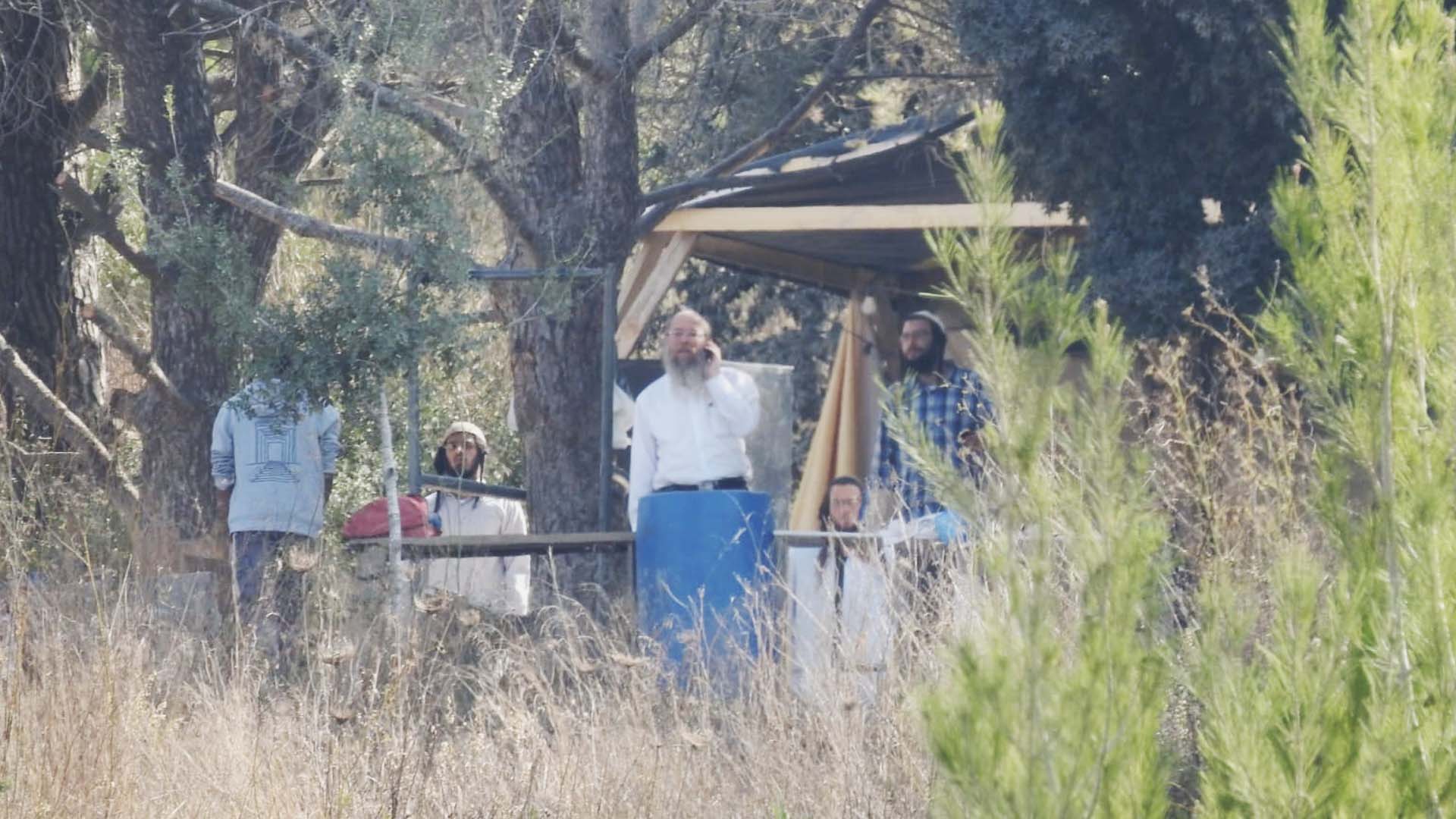
Settlers in Homesh pictured in November, the same month a group of Palestinians were ambushed and assaulted (Provided/Munir Qadus)

Jehad Salah, former head of the Burqa Village Council, told MEE that the only reasonable explanation for the settlers’ continuing presence in Homesh is the implicit approval of the army and government.

Qadus accuses the government and the army of negligence in implementing the law, asserting that neither the settlers nor the army abide by the court order, which is the highest legal body in Israel.

“They think that all of the land is Israeli land,” Qadus said.


Israel: Settler attacks on Palestinian olive harvest 'most dangerous in years'
Read More »

Settler attacks on Palestinians across the occupied West Bank have seen an “alarming” rise in 2021, UN human rights experts said in a statement last year.

“We are witnessing the highest recorded levels of violence in recent years and more severe incidents,” the statement said.

According to UN figures, 370 settler attacks led to damage to property in 2021 and a further 126 assaults caused casualties.

At the same time, settlement building has tripled from the previous year, with the approval of the construction of 4,000 new units, according to Khalil al-Tafkaji, Palestinian expert on settlement and director of the map unit at the Centre for Arab Studies in Jerusalem.

Both authorised and unauthorised Israeli settlements on occupied Palestinian land are considered illegal under international law.
'We will not leave the mountain'

Following the shooting near Homesh that left one settler dead and two wounded on 16 December, settlers unleashed a wave of attacks that have affected most of the village’s residents.

Dozens of houses have been assaulted and their windows and doors broken, threatening the lives of many villagers. Gravestones were not spared the onslaught and many of them were vandalised and defaced.

Saddam Salah, an anti-settlement activist in Burqa who regularly documents the violations on his camera, says at least 30 houses in Burqa were attacked in the three weeks after the December shooting. Settlers also used live bullets while attacking Palestinian homes, he said.

The situation has been exacerbated by the army’s crackdown on the village.

Military checkpoints have been erected around Burqa and its entrances have been blocked, leaving some neighbourhoods completely sectioned off and isolated.

A resurgence of popular resistance has emerged in Burqa in recent weeks and there have been protests against the deplorable conditions perpetrated by the army and the settlers.
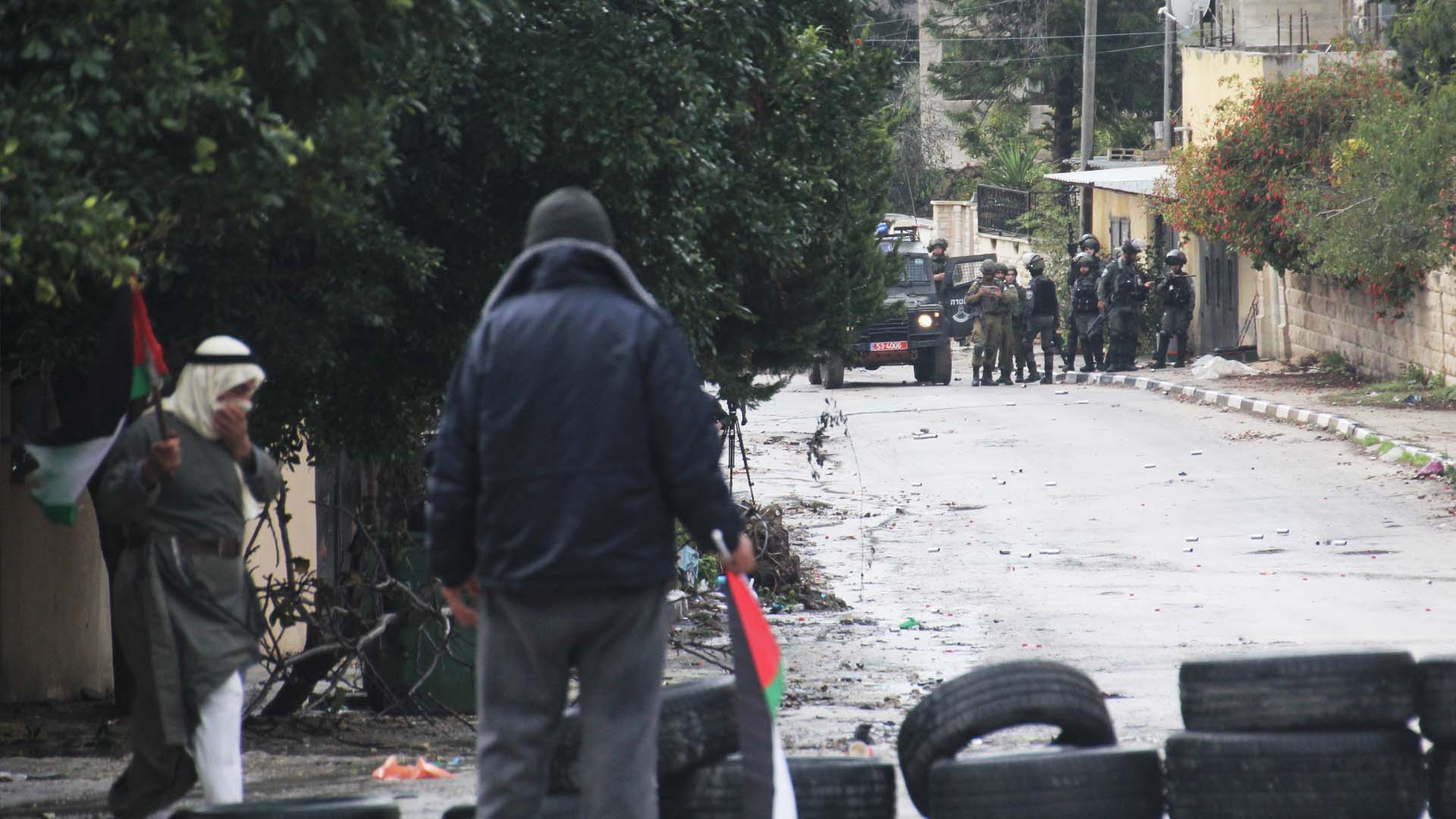
Palestinians in Burqa are rising up against the attacks and incursions by the army and the settlers
 (MEE/Atef Daglas)

At least eight Palestinians have been injured by live bullets in demonstrations against the Israeli assaults, and hundreds more by rubber-coated steel bullets and tear gas.

Despite the soaring tensions in Homesh, the settlers continue their calls to “climb the mountain [of Homesh],” refusing to give up their position, citing religious reasons.

But the people of Burqa, the rightful owners of the land, promise that they will not remain silent.

With their oft-repeated slogan, “we will not leave the mountain,” they have created a counter popular resistance movement, alongside nearby villages of Beita and Kufr Qaddum, promising to protect their land and push back against turning Homesh into an Israeli settlement once more.

Thursday, January 02, 2025

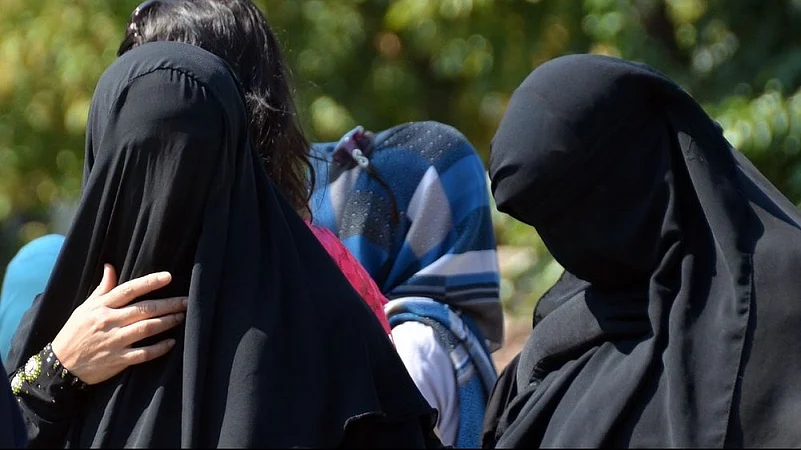
Swiss ‘Burqa Ban’: Why Face Covering Is Prohibited In Switzerland Beginning January 1

The ban came about after a referendum held in 2021, in which Swiss citizens narrowly voted in favor of prohibiting face coverings in public, including the burqa and niqab worn by some Muslim women. The final tally was 51.2 percent in favor versus 48.8 percent opposed.

Outlook Web Desk
Updated on: 1 January 20
25


Representative image

In Switzerland, the law prohibiting facial coverings has officially come into effect beginning January 1, 2025. The law known as the “burqa ban,” restricts face covering in public – including wearing the burqa or niqab which is commonly worn by Muslim women. Those who violate this law will be charged with fines of up to 1,000 Swiss francs (Rs 94,651.06).

What is exactly banned under this new law?

The new law specifically bans the covering of the nose, mouth, and eyes in both public spaces and private buildings accessible to the public. However, there are some exceptions – the ban does not apply to facial coverings worn for health reasons, such as medical masks or during cold weather; and coverings are permitted in places of worship, for artistic performances, or in advertising.

The ban also makes room for personal protection in cases where face covering is necessary for freedom of expression or assembly, as long as public order is maintained, and the responsible authorities approve such instances.

The facial coverings, notably, are still allowed on planes and in diplomatic or consular premises, as well as in certain sacred sites.


Why did Switzerland ban face coverings?

The ban came about after a referendum held in 2021, in which Swiss citizens narrowly voted in favor of prohibiting face coverings in public, including the burqa and niqab worn by some Muslim women. The final tally was 51.2 percent in favor versus 48.8 percent opposed.

The proposal was proposed by the right-wing Swiss People’s Party (SVP), which campaigned with slogans such as “Stop extremism.” Although the proposal did not explicitly target Islam, it has been widely perceived as a response to Islamic face coverings.

The Swiss government itself opposed the ban, arguing that it was not the role of the state to dictate what individuals, especially women, wear.

The ban's primary objective is to address what proponents argue is a symbol of extremism and a potential security risk.

Controversy over the ban proposal

Human rights groups, including Amnesty International, have sharply criticized the measure. Amnesty called the ban “a dangerous policy that violates women’s rights, including their right to freedom of expression and religion.” Critics argue that the ban disproportionately affects Muslim women, many of whom choose to wear the niqab or burqa as an expression of faith or personal conviction.


Research from the University of Lucerne revealed that the actual number of women in Switzerland who wear the burqa is negligible, with around 30 women reported to wear the niqab. Muslims make up about 5 percent of Switzerland’s population of 8.6 million, with the majority of Muslim residents hailing from countries like Turkey, Bosnia, and Kosovo.

Despite the relatively low number of people directly affected, the law's passage has ignited a broader debate about religious freedom, the rights of women, and cultural integration in the country.

Sunday, September 26, 2021

Burqa isn’t choice
Published September 26, 2021 - 

The writer is a lawyer based in London.


SEVERAL years ago, when I started working as a lawyer in Karachi, as I was walking to my office inside a large building, which housed several offices, a man from an adjacent office, who looked like he could be my father’s age, stopped me and said, “Beta, dupatta kidhar hai?”

“It’s none of your business whether I wear a dupatta or not,” I retorted, and he backed down apologising. However, the incident stuck with me. The idea that a complete stranger could tell me what to wear wasn’t alien to me. I had grown up in Saudi Arabia, where an entire brigade of men called the mutawa, were tasked with going around town to check how many strands of hair were showing from women’s hijabs and admonish them and their next-of-kin males accordingly.

However, when I am told that women choose to wear a hijab, niqab or burqa, I find the notion completely fanciful. Some may certainly be choosing it, but a large number are not. Particularly those who live in Muslim-majority countries, where free choice has never been part of our ethos.

In Pakistan, for instance, isn’t it quite common for parents to decide who their children should marry or which profession they should pursue?

Free choice has never been part of our ethos
.

One hundred per cent free choice doesn’t exist anywhere in the world, as there are always some norms and bounds that society dictates. For instance, nudity isn’t considered acceptable in public places and a University of California, Berkeley, student who attempted it back in 1992 was promptly arrested. Nevertheless, the amount of leeway one is given in choosing one’s life path, activities, and indeed dress is far more restrictive in our societies than it is in Western ones.

A cousin who moved from the US to UAE once told me that she had more freedom organising and attending Islamic religious lectures (dars) in the US than she did in the UAE, where the subject was strictly regulated by the state.

One only has to compare university campuses in Western countries with those in Pakistan to find how much freedom young adults have in terms of how freely they can come and go from campus or organise for a political cause. Many girls will tell you their dads do not allow them to wear sleeveless shirts or dance at functions where both men and women are present, while boys may be told that they need to marry off their sisters before they can think of marrying themselves.

So free choice plays very little role in our culture and society. This then brings us to the question — why do women wear the hijab, niqab or burqa? Primarily, it is because they are told that this is what their religion requires of them. But also, some young girls have told me that wearing a hijab leads to less familial constraint on their comings and goings, as male family members feel they have become religious and hence doubt them less. Others feel the extra clothing may fend off unwanted stares and advances.

One girl I recently spoke to told me that she wore a burqa when she went to study in China, thinking that it will make her safer as this is what she had been conditioned to believe in Pakistan. However, after a while she realised that the burqa was attracting undue attention in China and yet not serving the purpose it was supposed to. She said she soon realised that women in China were generally safe without wearing the burqa so she too took it off.

So the crux of the matter is making women feel safe in a public space. The questions to ask are: in societies where a large number of women are veiling, are women safe to walk on the streets alone? Are they safe at bus stops or driving cars alone or are they participating fully in public life? Or are they holding back, still fearful of unwanted advances from men, and yet not realising their potential?

I must add here that the hijab, a head covering alone, does not constrain women from doing most things that women without a hijab can do, but a niqab and burqa certainly do. They make public interface much more difficult. How many of us would be comfortable with a doctor or a nurse or a lawyer who veils her face? The idea of the face veil is to relegate women to a position where they have minimal public space.

This is not only detrimental for women but society at large. Emphasis on veiling often leads to calls for segregation of the sexes, which simply isn’t feasible in most real-life work situations. Saudi Arabia has learned this as it tries to diversify its economy and has reversed stricter veiling policies it promoted earlier.

As the Taliban take hold of Afghanistan and impose harsh conditions on women, it is more important than ever for other Muslim countries to speak out against such regressive interpretations of our religion, which are incompatible with modernity.

The writer is a lawyer based in London.
Twitter: @ayeshaijazkhan
Published in Dawn, September 26th, 2021

Wednesday, January 26, 2022

ZIONIST TERRORISM
At a West Bank outpost, Israeli settlers flaunt their power

By JOSEPH KRAUSS

1 of 8

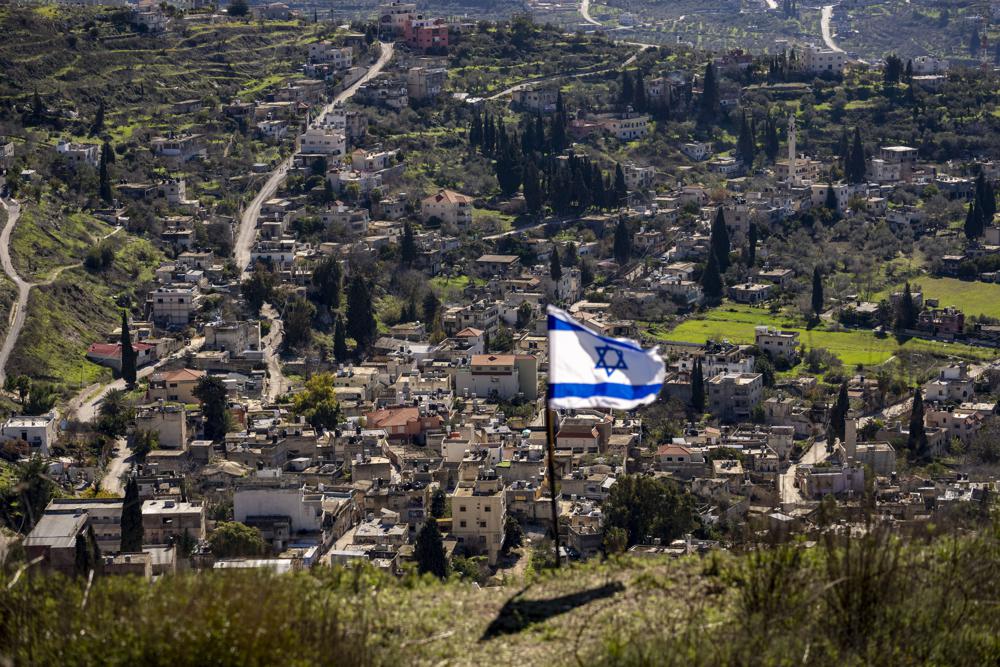
The Palestinian village of Burqa is seen as an Israeli flag is placed in the Jewish West Bank outpost of Homesh, Monday, Jan. 17, 2022. Palestinian residents of Burqa say the settlers' continued presence in Homesh, which was officially dismantled in 2005, makes it difficult to access their land and move safely in and out of their village.
 (AP Photo/Ariel Schalit)

A damaged young olive tree belonging to Palestinians lies on the ground after it was vandalized by Israeli settlers near the West Bank village of Burqa, north of Nablus, Friday, Jan. 21, 2022. 
(AP Photo/Nasser Nasser)

BURQA, West Bank (AP) — The Jewish settlement of Homesh, built on privately owned Palestinian land deep inside the occupied West Bank, was dismantled in 2005 and cannot be rebuilt.

At least, that’s what Israeli law says.

But when a group of settlers drove up to the site last week, they were waved through army checkpoints that were closed to Palestinian vehicles and arrived at a cluster of tents on the windy hilltop. There, dozens of settlers were studying in a makeshift yeshiva, or religious school.

Empty wine bottles and bags of trash stood out for collection, the remains of a holiday feast attended by hundreds of settlers the night before and documented on social media.

The settlers’ ability to maintain a presence at Homesh, guarded by a detachment of Israeli soldiers, is a vivid display of the power of the settler movement nearly 55 years after Israel captured the West Bank in the 1967 Mideast war.

Their strength has also been on display in a wave of attacks against Palestinians and Israeli peace activists in recent months, many in plain view of Israeli soldiers, who appear unable or unwilling to stop them, despite Israeli officials’ promises to maintain law and order. The worst of the violence has been linked to hard-line settler outposts like Homesh.

That Israeli authorities have not cleared Homesh — which under Israeli law is blatantly illegal — makes it nearly impossible to imagine the removal of any of Israel’s 130 officially authorized settlements as part of any future peace deal. Nearly 500,000 settlers now live in those settlements, as well as dozens of unauthorized outposts like Homesh.

The Palestinians view the settlements as the main obstacle to any two-state solution to the century-old conflict, and most countries view them as a violation of international law. But in an increasingly hawkish Israel, the settlers enjoy wide support.

“We are privileged, thank God, to live here and study Torah, and we shall continue to do so with God’s help,” said Rabbi Menachem Ben Shachar, a teacher at the yeshiva.

“The people of Israel need to hold onto Homesh, to study Torah here and in every other place in the Land of Israel,” he said, using a biblical term for what is today Israel and the West Bank.

Israel dismantled the settlement in 2005 as part of its withdrawal from the Gaza Strip, and the law prohibits Israeli citizens from entering the area. Israel’s Supreme Court has acknowledged that the land belongs to Palestinians from the nearby village of Burqa.

But the settlers have repeatedly returned, setting up tents and other structures on the foundations of former homes, now overgrown with weeds.

The army has demolished the structures on several occasions, but more often tolerates their presence. The Jan. 16 party was just the latest in a series of marches, political rallies and other gatherings held at the site over the years, some attended by Israeli lawmakers.

The Israeli military said in a statement that it did not approve the event and took steps to prevent civilians from reaching the area, including setting up checkpoints. The settlers appear to have walked around them. The military declined to discuss the larger issues around Homesh, and a government spokeswoman declined to comment.

The killing of a yeshiva student by a Palestinian gunman near the outpost last month has become a rallying cry for the settlers, who say evacuating Homesh now would amount to appeasing terrorism. But the survival of the outpost after 16 years is rooted in a deeper shift in Israel that makes it nearly impossible to rein in even the settlers’ most brazen activities.

Israel’s parliament is dominated by parties that support the settlers. The current government, a fragile coalition reliant on factions from across the political spectrum, knows that any major confrontation with the settlers could spell its demise. Prime Minister Naftali Bennett is a former settler leader and is opposed to Palestinian statehood.

The consequences are felt by Palestinians in Burqa and surrounding villages.

Over the weekend, masked settlers descended on another village in the northern West Bank, attacked a group of Palestinians and Israeli peace activists with stones and clubs, and set a car on fire. Israel’s public security minister, Omer Barlev, called the attackers “terrorists” but said police have struggled to catch them because they flee before authorities arrive.

The owners of the land where Homesh was built risk being attacked by settlers if they try to access it. Yesh Din, an Israeli rights group that represents the residents of Burqa in court, has documented at least 20 attacks and seven incidents of property damage since 2017.

A 15-year-old Palestinian said he was kidnapped and tortured by settlers in August. Six farmers were hospitalized after settlers attacked them with metal batons and stones in November, according to B’Tselem, another Israeli rights group.

Ben Shachar, the teacher at the yeshiva, said farmers should coordinate their entry with the Israeli military. He said he’s open to dialogue with “any Arab who accepts that the Land of Israel belongs to the Jewish people,” but that terrorism is “part of the DNA of Arab society.”

Yesh Din is currently petitioning the Supreme Court on behalf of the Palestinians, hoping it will pressure authorities to remove the outpost and allow them to access their land.

“It’s a funny petition, right?” said Lior Amihai, the director of Yesh Din. “We have a petition to enable Palestinians to enter their land, but according to the law they (already) have access to their land.”

Ghalib Hajah, who was born and raised in Burqa and now runs a prosperous construction firm inside Israel, is putting the finishing touches on what he had hoped would be a quiet country home for him and his wife. The balconies look out over rolling hills and olive terraces.

The day after the yeshiva student was killed, a group of settlers pelted Hajah’s house with stones, shattering several of the newly installed windows as well as tiles from Italy stacked outside. Others smashed gravestones in the village cemetery.

“I hid inside, like a thief in my own house,” he said. “It’s not the first time they’ve been here ... Before you leave your house, you have to see whether there are settlers outside. They block the roads, they throw stones at cars.”

He and other residents say settlers have attacked the village on more than a dozen occasions in recent years, with the army appearing powerless to stop them.

Instead, he has turned his new home into a fortress, with cameras mounted on the roof and heavy aluminum shutters on all windows and doors.

“There’s no stability here,” he said.

___

Associated Press Writer Alon Bernstein contributed to this report.


Saturday, January 22, 2022

Afghan NGO women 'threatened with shooting' for not wearing burqa


More women are wearing the burqa since the Taliban's return to power even though there is no official national policy on it (AFP/Javed TANVEER)

Fri, January 21, 2022, 6:13 AM·2 min read

The Taliban's religious police have threatened to shoot women NGO workers in a northwestern province of Afghanistan if they do not wear the all-covering burqa, two staff members told AFP.

The rights of Afghans -- particularly women and girls -- have been increasingly curtailed since the Taliban returned to power in August after ousting the US-backed government.

Women are being squeezed from public life and largely barred from government jobs, while most secondary schools for girls are shut.


Two international NGO workers in rural Badghis province told AFP that the local branch of the feared Ministry for the Promotion of Virtue and Prevention of Vice met with aid groups on Sunday.

"They told us... if women staff come to the office without wearing the burqa, they will shoot them," one said, asking not to be named for safety reasons.

Women must also be accompanied to work by a male guardian, he added.

A second NGO source confirmed the warnings.

"They also said they will come to every office without prior notice to check the rules are being followed," he told AFP.

A notice to NGOs seen by AFP did not mention the threat of shooting, but did order women to cover up.

Women in deeply conservative Afghanistan generally cover their hair with scarves anyway, while the burqa –- mandatory under the Taliban's first regime, from 1996 to 2001 –- is still widely worn, particularly outside the capital Kabul.

Desperate for international recognition to unlock frozen assets, the Taliban have largely refrained from issuing national policies that provoke outrage abroad.

Provincial officials, however, have issued various guidelines and edicts based on local interpretations of Islamic law and Afghan custom.

In the capital on Friday, the Taliban staged a demonstration with around 300 men, who chanted "We want Sharia law".

Holding posters of women wearing full coverings, the crowd accused women's rights activists who have taken to the streets of being "mercenaries".

Earlier this month, posters were slapped on cafes and shops in Kabul ordering Afghan women to cover up, illustrated with an image of the burqa.

Women are banned from appearing in television dramas and must be accompanied by a male guardian on journeys between towns and cities.

Small and scattered protests have broken out demanding women's rights, which had improved slightly over the past 20 years in the patriarchal Muslim nation.

However, several activists told AFP they had gone into hiding in the capital this week after a series of raids led to the arrests of three women.

eb-ecl/leg

Tuesday, September 14, 2021

An 'equal rights for women' Met Gala outfit can't hide US politician Carolyn Maloney's biased feminism

She once wore a burqa in the House of Representatives to argue in favour of the invasion of Afghanistan.

IMAGES STAFF
DESK REPORT


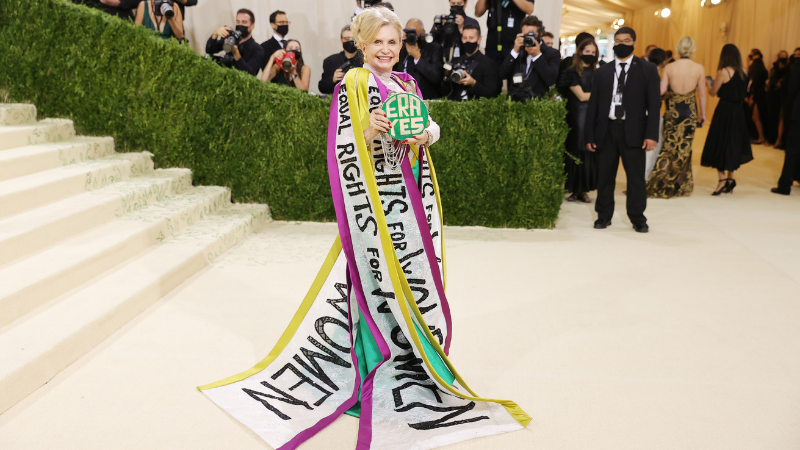
American politician and NY Representative Carolyn Maloney was praised after attending the 2021 Met Gala fundraiser in a dress that had 'equal rights for women' written on it. However, many people aren't impressed with her because they remember when Maloney used her position of power to propagate negative stereotypes about Muslim women in the wake of 9/11.

Maloney showed up at the 2021 Met Gala wearing a dress emblazoned with the words 'equal rights for women' on it. Her dress also included purple, white and gold; colours used by suffragette groups who fought for women's rights, including the right to vote, in the West. Maloney's dress was a call for the passing of the Equal Rights Amendment, a proposed amendment to the US constitution that will ensure equal rights for all American citizens regardless of their gender.

"Across the country, women’s rights are under attack," Maloney posted on Twitter along with a picture of her dress. "I have long used fashion as a force for change. As the Met Costume Institute reopens with their inaugural exhibit celebrating American designers, I am calling for the certification of the Equal Rights Amendment so women can be equal once and for all," she wrote

While Maloney's look was widely praised on social media, one Twitter user took the opportunity to remind netizens about a damning speech Maloney gave in the United States House of Representatives in 2001 shortly after the September 11 attack on the World Trade Centre. "'I have long used fashion as a force for change,' says the member of Congress who dressed up in a burqa to deliver a speech in support of the invasion of Afghanistan," the user tweeted.

The user shared a clip of the speech Maloney delivered while wearing the burqa. "I salute the Bush administration for balancing war with compassion. For dropping food as well as bombs. Even in war we are showing a regard for human life and human rights," she said.

The politician faced severe backlash against the stunt. US entrepreneur and activist Rana Abdelhamid said Maloney's speech fed into a negative narrative against Muslim women. "I was 9 years old when I watched my Congresswoman wear a burqa in Congress to justify the invasion of Afghanistan," she tweeted. "For the rest of my life, I knew that as a Muslim woman my identity would be weaponised to justify American wars."

Abdelhamid's comment came in the wake of US' military withdrawal from Afghanistan nearly 20 years after it had invaded the country in the wake of the 9/11 attacks

According to a local US channel NY1, Maloney defended wearing the burqa, arguing sometimes “you have to be dramatic” to raise awareness about an issue. "I was making a point," she said.

If you want to truly use fashion for your political activism, learn to be more respectful, Representative Maloney. You can make your point without using religious garments as a tool of illustration. We too believe in equal rights for women, but that doesn't mean that we mock the burqa or other garments that are often worn for religious purposes.


Thursday, June 01, 2023

Settler attacks on Palestinians in West Bank leave man in critical condition and draw US condemnation  ABOUT TIME

By Abeer Salman and Hadas Gold, CNN
 Sat May 27, 2023

Israeli police take security measures at the town of Mugayyir in Ramallah, West Bank on May 26, 2023.
Issam Rimawi/Anadolu Agency/Getty Images

JerusalemCNN —

Israeli settler attacks on Palestinians in the West Bank Friday left a man in critical condition and drew international condemnation, including from the US.

Settlers on Friday attacked local farmers and set cars and farms alight near the villages of Turmosayia and Al Mughayyer north of Ramallah, eyewitnesses told CNN and local journalists.

One man remains in critical condition in the hospital on Saturday, having been shot in the head, according to the Palestinian Ministry of Health. Eight others were injured.

“We are deeply concerned by the rising trend of extremist settler violence, including reports of attacks against Palestinians in homes and farms in which they have lived for decades,” the US State Department said in a statement. “We unequivocally condemn all acts of extremist violence, whether Israeli or Palestinian.”


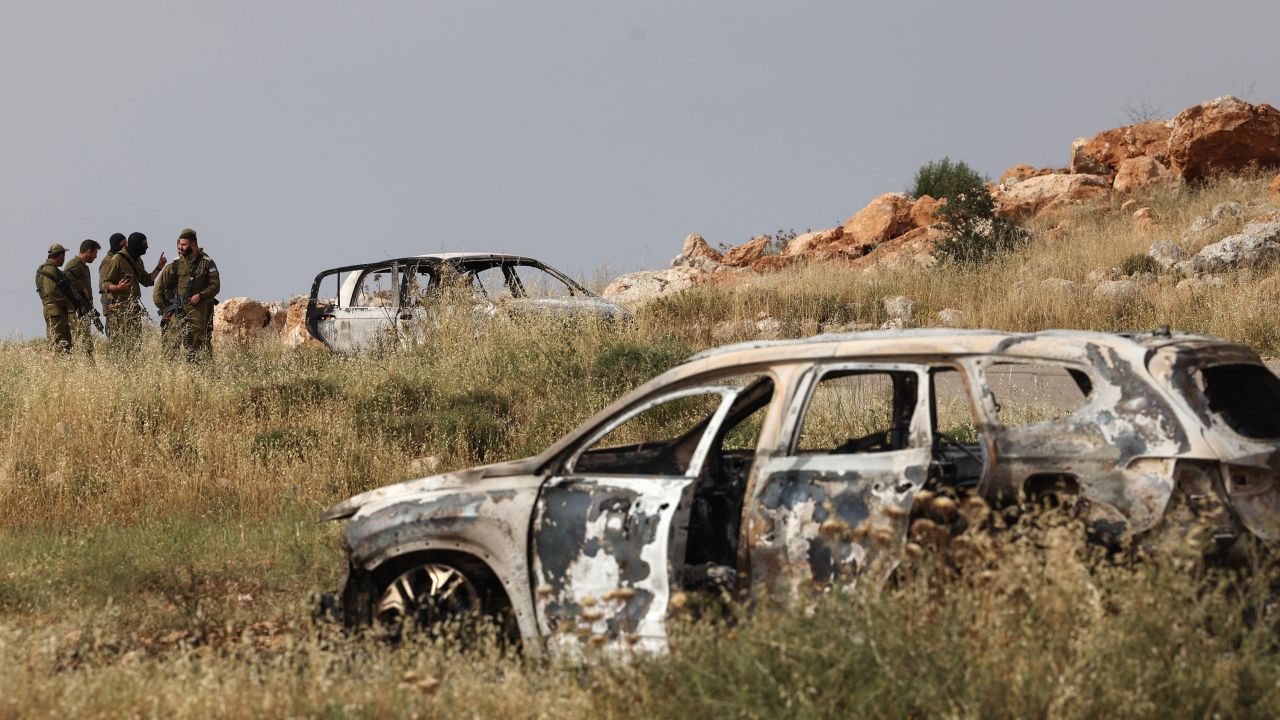
Israeli soldiers stand next to a car, reportedly burnt by Israeli settlers, in the village of Al-Mughayer, east of the occupied West Bank city of Ramallah on May 26, 2023.
Ahmad Gharabli/AFP/Getty Images

In a statement to CNN, the Israel Defense Forces (IDF) – which enforces security in the Israeli-occupied West Bank – acknowledged that Palestinian cars were set alight and said Israeli security forces attempted to disperse “the confrontation.”

But the IDF also blamed both sides for the incident and said both Israelis and Palestinians were injured. “A violent confrontation was instigated in the Shilo Valley, involving Palestinians and Israeli civilians,” the IDF said. “The confrontation involved mutual stone-hurling and Israeli civilians firing into the air.”

Speaking with Israeli Army Radio, an unnamed Israeli security official said that the Israeli government would work to bring the perpetrators “to justice.”

“These are a handful of criminals who are agitating the area, harming security and bringing a bad name to the entire settlement in Judea and Samaria,” the official said, using the biblical name that some Israeli Jews use to refer to the West Bank.

The European Union diplomatic mission to the Palestinians called on the Israeli government to “take decisive steps to ensure accountability and protect the Palestinian civilian population.”

The US State Department also condemned a reported attempted stabbing Friday of an Israeli in a settlement south of Hebron, also in the West Bank. The alleged assailant in that incident, 28-year-old Alaa Khalil Qaisiyah, was shot dead.

CHUTZPAH

Pictures| IOF Force Palestinian Family to Demolish Their House, Pay Fine

Pictures| IOF Force Palestinian Family to Demolish Their House, Pay fine
M.S | DOP - 

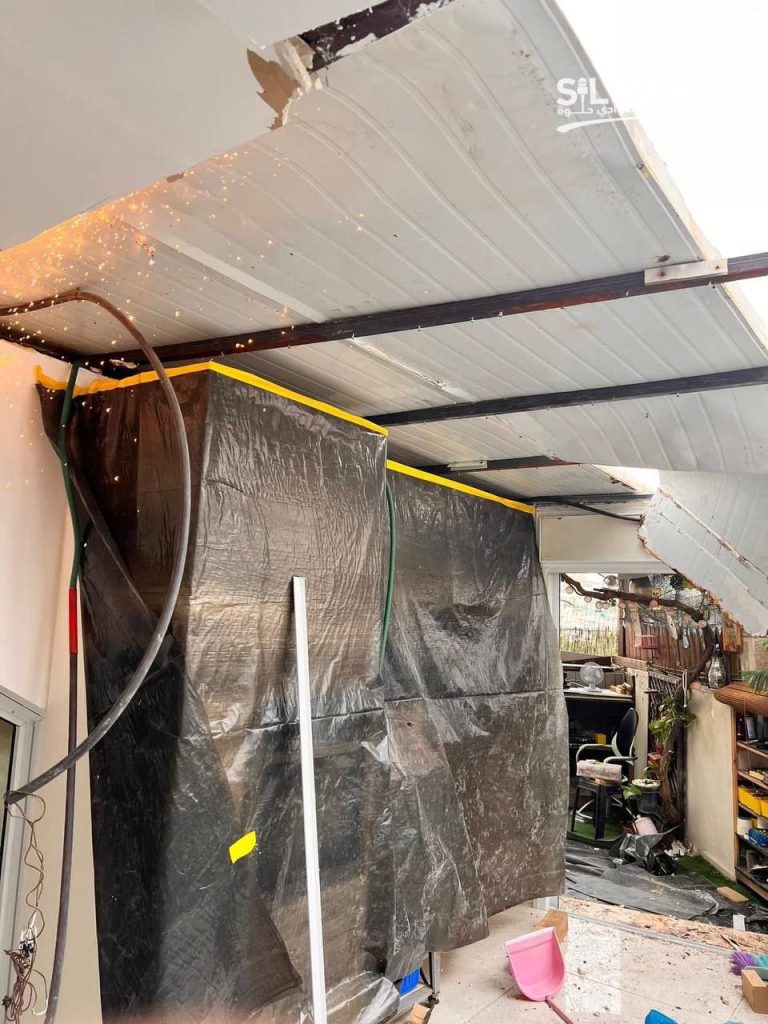
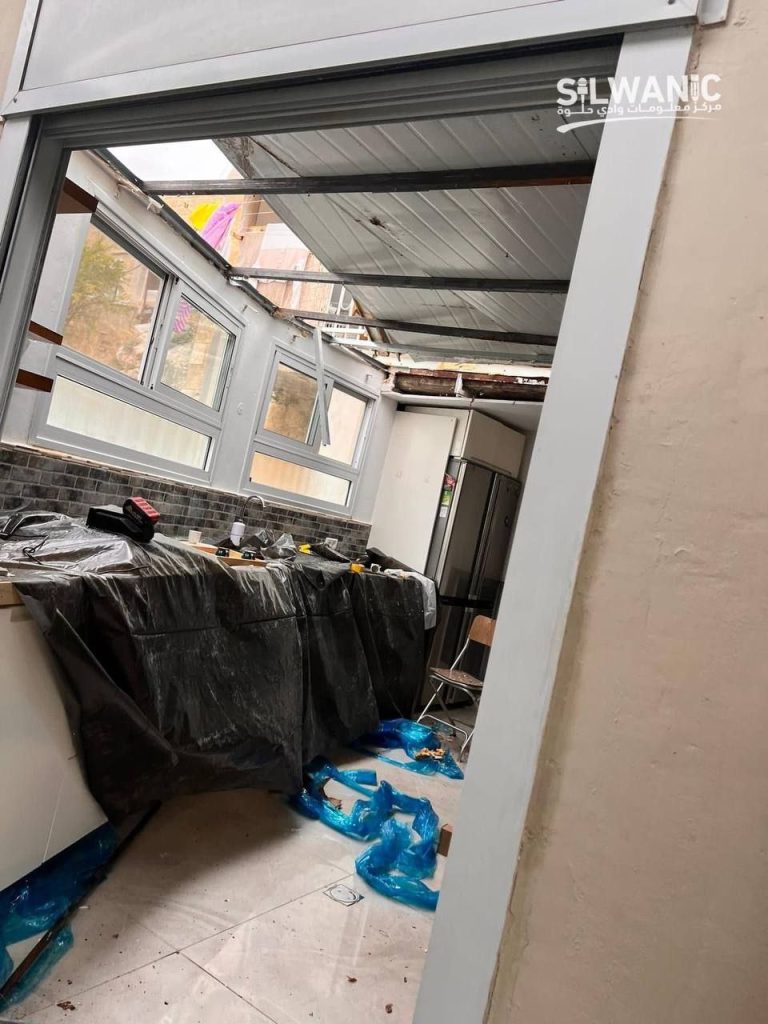
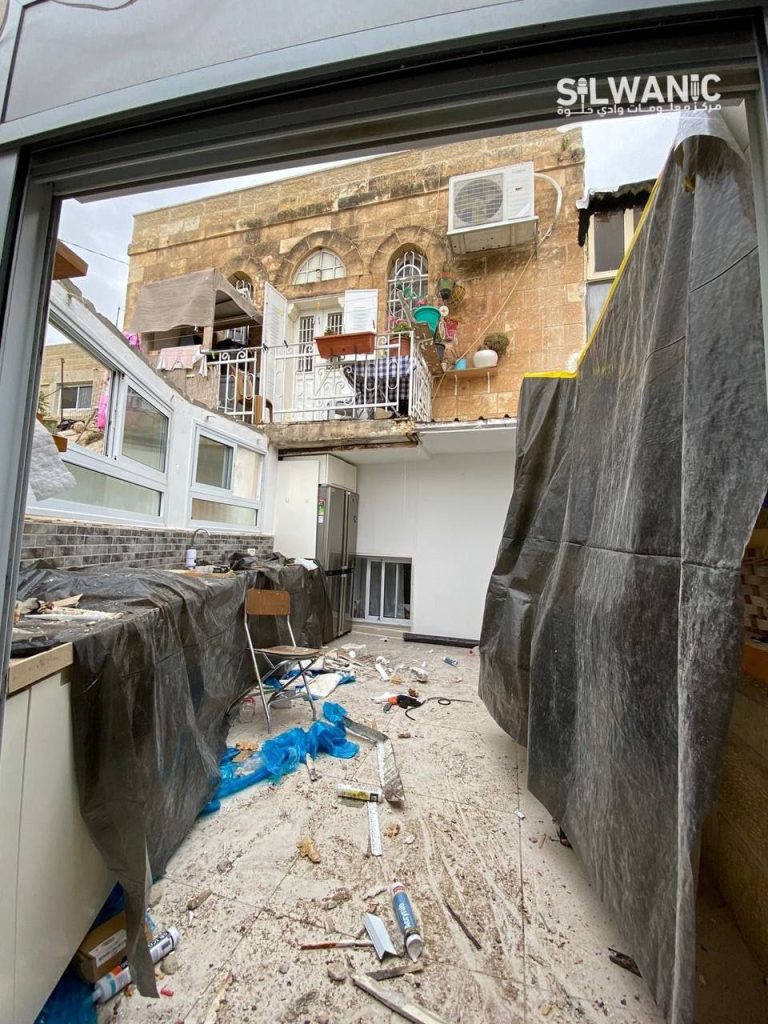
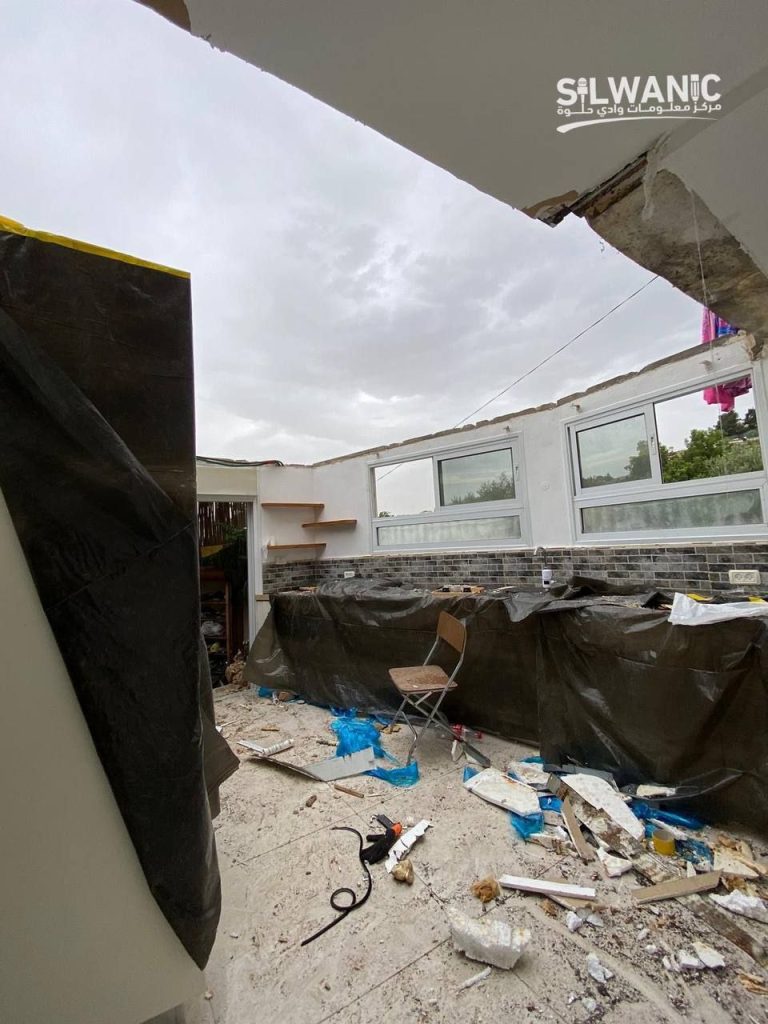
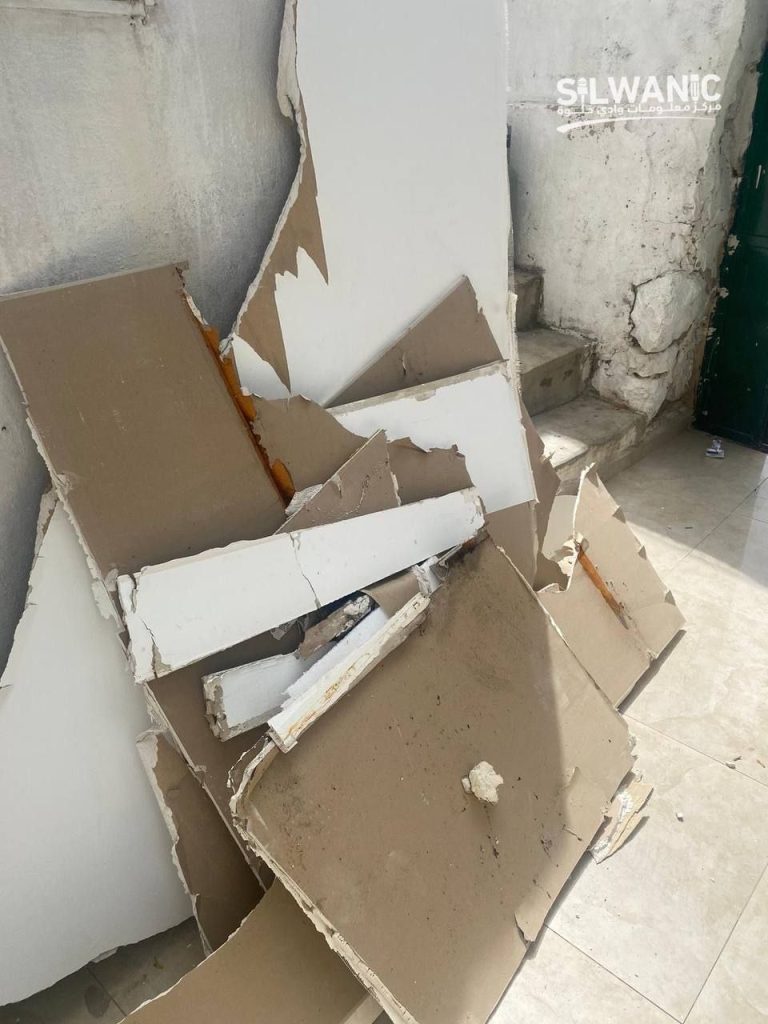
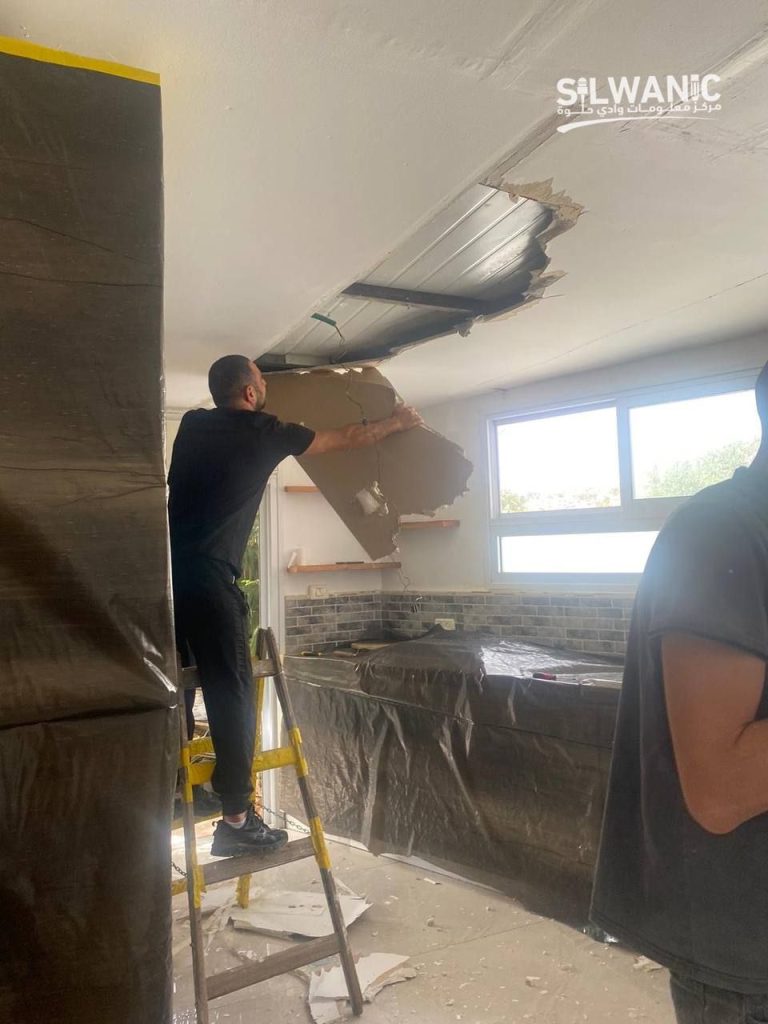
Israeli occupation forces (IOF) forced Saturday, May 27, 2023, a Palestinian family to self-demolish a part of their home in occupied Jerusalem and pay a fine.

Local Palestinian sources reported that Israeli forces forced the Jeruslamite Shaludi family to demolish the roof of the kitchen in their house and pay a fine of 5,000 shekels (1350$).


Settlers burn Palestinian village, deliver Israel’s arsonist agenda


Maureen Clare Murphy 

The Electronic Intifada

27 May 2023   

A broken window at a home in Burqa village, near the northern West Bank city of Nablus, after it was attacked by settlers, 25 May. Mohammed NasserAPA images

spike in fatalities, increased settler attacks against Palestinian communities, moves to further restrict the political rights of Palestinians on both sides of the Green Line, a revival of the assassination of Palestinian faction leaders: five months into its existence, Benjamin Netanyahu’s coalition government, however fragile and fractious, is delivering on its hard-line agenda.

None of these policies are new, of course. But with Israel’s most openly extremist government yet, and third states providing for an environment of near total impunity, the situation on the ground for Palestinians has become ever more dangerous.

This week, the Israeli government passed a budget that, in the words of Al Jazeera, “solidifies the ruling coalition’s religious, pro-settlement agenda” for the next two years.

After weeks of negotiations, the budget was passed after a promise of $68 million was made to Itamar Ben-Gvir’s extreme-right Jewish Power party for settlements in the Naqab and Galilee regions – areas in Israel populated by Palestinians.

As the Associated Press reports, the budget also allocates “nearly $4 billion in discretionary funds, much of it for ultra-Orthodox and pro-settler parties.”

This will allow “hard-line pro-settler parties to promote pet projects through the ministries they control.”

It emboldens figures like Bezalel Smotrich, Israel’s finance minister, who has ordered the government to prepare for the doubling of the number of settlers in the West Bank, presenting his plans as a “core mission” for the present government.


Settlers set fire to village

On Thursday, settlers in the northern West Bank began leveling land ahead of construction in Homesh, an outpost near the northern West Bank city of Nablus built on privately owned land belonging to Palestinians in Burqa village.

The land leveling commenced one day after settlers accompanied by soldiers invaded Burqa, burning several homes. The Israeli anti-settlement group Peace Now said on Thursday that the groundwork “is the direct result of the pogrom that took place yesterday … yet again, a clear example of a criminal government serving the settlers.”


Earlier on Wednesday, diplomats visited Burqa to “learn about the injustice and danger the villagers face at the hands of violent settlers from Homesh,” according to Yesh Din, an Israeli human rights group. The attack on Burqa following the diplomats’ visit was seen as a reprisal by Homesh settlers who have enacted violence against nearby Palestinian communities for years.

Such visits, led by the European Union, have become a ritual in which diplomats stage photo-ops feigning solidarity with Palestinians while their governments continue to offer Israel unconditional support and political cover for its crimes.

As the latest visit to Burqa underscores, these visits do absolutely nothing to protect Palestinians.

Violent friction


Homesh, first built as a military base on land belonging to Palestinians in Burqa in 1978, was evacuated in 2005 as part of then-Prime Minister Ariel Sharon’s unilateral withdrawal from Gaza.

As Oren Ziv writes for +972 Magazine, “the Israeli logic behind originally dismantling Homesh … was that it was an isolated community surrounded by Palestinian villages and cities which required more resources than it was strategically worth.”

Despite the withdrawal nearly 20 years ago, settlers maintained a presence at the outpost, causing violent friction between Palestinians and Israeli settlers.

Ziv adds that between 2017 and 2021, the Israeli human rights group Yesh Din, which petitioned Israel’s high court on behalf of Palestinian residents, “documented 27 settler attacks in the Homesh area, including both physical bodily violence and property damage.”

In August 2021, settlers from Homesh abducted and tortured a 15-year-old Palestinian boy, hitting him with their car and tying him to the vehicle before beating him and roping him to a tree in an isolated area, where they “sprayed him with pepper spray, electrocuted him, and then burned him with the car’s cigarette lighter,” according to +972 Magazine.

Rampaging settlers terrorized Qaryut, a nearby Palestinian village, after a settler was shot and killed in late 2021 while driving away from a religious school that continued to operate in Homesh.

Palestinians in communities near Homesh have also been killed and injured by the Israeli military. In March 2022, Ahmad Hikmat Seif, 23, succumbed to injuries sustained during a protest in solidarity with Palestinian prisoners in Burqa.

Dozens of Palestinians were injured by rubber-coated bullets and tear gas fired by the military in April last year, when thousands of Jews, including several Israeli lawmakers, among them Smotrich, marched to Homesh.

The Tel Aviv daily Haaretz notes that following the killing of the settler in late 2021, Homesh “effectively [became] a fortified army base,” with some 80 soldiers guarding 30 settlers.

In March this year, Israel’s parliament paved the way to formally recognize Homesh, along with several other outposts, despite opposition by the Biden administration in Washington, which says that a settlement at the site between Nablus and Jenin would prevent a contiguous Palestinian state.

Israel insists that it is moving Homesh from private land to what it says is state land – in other words, land that is de facto annexed in violation of international law. Israeli officials admitted to their US counterparts that the move “was in response to domestic political constraints and to prevent Netanyahu’s radical right-wing coalition partners from destabilizing the government,” the online publication Axios reported.

Haaretz observes that the supposedly “state-owned plots are not contiguous and surrounded by Palestinian-owned land.”

Thus, even if the Homesh religious school “is moved to state-owned land, the Palestinians are not expected to be able to get access to their land” and the relocation “would risk greater friction between the two sides than has been the case so far.”

Farmers attacked near Ramallah


Following their ineffectual visit, European diplomats condemned the settler attack on Burqa this week, as well as a similar assault on Palestinian farmers near Ramallah on Friday.

During Friday’s attack, a Palestinian man was shot in the head and seriously injured, according to WAFA, the official Palestinian news agency.

Under the protection of Israeli troops, settlers burned several vehicles belonging to farmers as well as 270 bales of hay.


The United Nations meanwhile protested the forced evacuation of the Palestinian herding community of Ein Samiya near Ramallah.

“These families are not leaving by choice; the Israeli authorities have repeatedly demolished homes and other structures they own and have threatened to destroy their only school,” Yvonne Helle, the UN’s acting humanitarian coordinator for the West Bank and Gaza, said on Thursday.

“At the same time, land available for the grazing of livestock has decreased due to settlement expansion and both children and adults have been subjected to settler violence,” Helle added.

“We are witnessing the tragic consequences of long standing Israeli practices and settler violence.”

Nearly 30 Palestinian families left the rural village, their home for more than 40 years, “after months of escalating Israeli violence,” Basel Adra reported for +972 Magazine.

“Residents say they were compelled to leave after a fierce spate of violence over the previous five days, during which settlers attacked them at night, blocked the roads to the village, and threw stones at the old homes,” according to Adra.

“The mental toll of the attacks, especially on the children, was the decisive factor in the residents’ choice to destroy the village and move away.”

While worsened in recent days, settler harassment and physical violence against Palestinians in Ein Samiya predates the current Israeli government.

“Before this, settlers would come at night, parking their cars at the entrance to the village. They blocked us from getting in or out, and they beat anyone who walked on the road,” Hazem Ka’abneh, a resident of Ein Samiya, told +972 Magazine.

Israel denied residents building permits and destroyed homes when villagers would construct them anyways. Palestinians in Ein Samiya were not connected to basic services like water and electricity, unlike Jews living in nearby settlement outposts unauthorized by the Israeli government.

As Francesca Albanese, the UN special rapporteur on human rights in the West Bank and Gaza Strip, stated on Thursday, the West Bank “continues to be vandalized, torched, robbed inch by inch, its people brutalized day after day.”

And the arsonists heading the Israeli government are fueling the fire, working in tandem with the settlers to push Palestinians off of their land.

Sunday, May 08, 2022

Taliban divisions deepen as Afghan women defy veil edict

By KATHY GANNON
TODAY

1 of 6
A woman wearing a burka and her children walk in front of their house in Kabul, Afghanistan, Sunday, May 8, 2022. Afghan women are furious and fearful over a recent decree by the country's Taliban leaders that reinstated the burqa and similar outfits as mandatory for them in public. But some are defying the strict interpretation of Islamic dress codes, venturing out with less restrictive versions than that which the Taliban demanded — outfits that only reveal their eyes. (AP Photo/Ebrahim Noroozi)

KABUL, Afghanistan (AP) — Arooza was furious and afraid, keeping her eyes open for Taliban on patrol as she and a friend shopped Sunday in Kabul’s Macroyan neighborhood.

The math teacher was fearful her large shawl, wrapped tight around her head, and sweeping pale brown coat would not satisfy the latest decree by the country’s religiously driven Taliban government. After all, more than just her eyes were showing. Her face was visible.

Arooza, who asked to be identified by just one name to avoid attracting attention, wasn’t wearing the all-encompassing burqa preferred by the Taliban, who on Saturday issued a new dress code for women appearing in public. The edict said only a woman’s eyes should be visible.

The decree by the Taliban’s hardline leader Hibaitullah Akhunzada even suggested women shouldn’t leave their homes unless necessary and outlines a series of punishments for male relatives of women violating the code.


It was a major blow to the rights of women in Afghanistan, who for two decades had been living with relative freedom before the Taliban takeover last August — when U.S. and other foreign forces withdrew in the chaotic end to a 20-year war.

A reclusive leader, Akhunzada rarely travels outside southern Kandahar, the traditional Taliban heartland. He favors the harsh elements of the group’s previous time in power, in the 1990s, when girls and women were largely barred from school, work and public life.

Like Taliban founder Mullah Mohammad Omar, Akhunzada imposes a strict brand of Islam that marries religion with ancient tribal traditions, often blurring the two.

Akhunzada has taken tribal village traditions where girls often marry at puberty, and rarely leave their homes, and called it a religious demand, analysts say.

The Taliban have been divided between pragmatists and hardliners, as they struggle to transition from an insurgency to a governing body. Meanwhile, their government has been dealing with a worsening economic crisis. And Taliban efforts to win recognition and aid from Western nations have floundered, largely because they have not formed a more representative government, and restricted the rights of girls and women.

Until now, hardliners and pragmatists in the movement have avoided open confrontation.


A burqa-clad woman and her child wait behind fences in Kabul, Afghanistan, on September 17, 2009. The Taliban has ruled that all women in the country must now wear the full-body covering. 
File Photo by Mohammad Kheirkhah/UPI | License Photo

Yet divisions were deepened in March, on the eve of the new school year, when Akhunzada issued a last-minute decision that girls should not be allowed to go to school after completing the sixth grade. In the weeks ahead of the start of the school year, senior Taliban officials had told journalists all girls would be allowed back in school. Akhunzada asserted that allowing the older girls back to school violated Islamic principles.

A prominent Afghan who meets the leadership and is familiar with their internal squabbles said that a senior Cabinet minister expressed his outrage over Akhunzada’s views at a recent leadership meeting. He spoke on condition of anonymity to speak freely.

Torek Farhadi, a former government adviser, said he believes Taliban leaders have opted not to spar in public because they fear any perception of divisions could undermine their rule.

“The leadership does not see eye to eye on a number of matters but they all know that if they don’t keep it together, everything might fall apart,” Farhadi said. “In that case, they might start clashes with each other.”

“For that reason, the elders have decided to put up with each other, including when it comes to non-agreeable decisions which are costing them a lot of uproar inside Afghanistan and internationally,” Farhadi added.

Some of the more pragmatic leaders appear to be looking for quiet workarounds that will soften the hard-line decrees. Since March, there has been a growing chorus, even among the most powerful Taliban leaders, to return older girls to school while quietly ignoring other repressive edicts.

Earlier this month, Anas Haqqani, the younger brother of Sirajuddin, who heads the powerful Haqqani network, told a conference in the eastern city of Khost that girls are entitled to education and that they would soon return to school — though he didn’t say when. He also said that women had a role in building the nation.

“You will receive very good news that will make everyone very happy... this problem will be resolved in the following days,” Haqqani said at the time.

In the Afghan capital of Kabul on Sunday, women wore the customary conservative Muslim dress. Most wore a traditional hijab, consisting of a headscarf and long robe or coat, but few covered their faces, as directed by the Taliban leader a day earlier. Those wearing a burqa, a head-to-toe garment that covers the face and hides the eyes behind netting were in the minority.

“Women in Afghanistan wear the hijab, and many wear the burqa, but this isn’t about hijab, this is about the Taliban wanting to make all women disappear,” said Shabana, who wore bright gold bangles beneath her flowing black coat, her hair hidden behind a black head scarf with sequins. “This is about the Taliban wanting to make us invisible.”

Arooza said the Taliban rulers are driving Afghans to leave their country. “Why should I stay here if they don’t want to give us our human rights? We are human,” she said.

Several women stopped to talk. They all challenged the latest edict.

“We don’t want to live in a prison,” said Parveen, who like the other women wanted only to give one name.

“These edicts attempt to erase a whole gender and generation of Afghans who grew up dreaming of a better world,” said Obaidullah Baheer, a visiting scholar at New York’s New School and former lecturer at the American University in Afghanistan.

“It pushes families to leave the country by any means necessary. It also fuels grievances that would eventually spill over into large-scale mobilization against the Taliban,” he said.

After decades of war, Baheer said it wouldn’t have taken much on the Taliban’s part to make Afghans content with their rule “an opportunity that the Taliban are wasting fast.”

Afghanistan’s Taliban order women to cover up head to toe

By KATHY GANNON
yesterday

1 of 9
Afghan women wait to receive food rations distributed by a Saudi humanitarian aid group, in Kabul, Afghanistan, Monday, April 25, 2022. Afghanistan’s Taliban rulers on Saturday, May 7, ordered all Afghan women to wear head-to-toe clothing in public, a sharp hard-line pivot that confirmed the worst fears of rights activists and was bound to further complicate Taliban dealings with an already distrustful international community. 
(AP Photo/Ebrahim Noroozi)


KABUL, Afghanistan (AP) — Afghanistan’s Taliban rulers on Saturday ordered all Afghan women to wear head-to-toe clothing in public — a sharp, hard-line pivot that confirmed the worst fears of rights activists and was bound to further complicate Taliban dealings with an already distrustful international community.

The decree says that women should leave the home only when necessary, and that male relatives would face punishment — starting with a summons and escalating up to court hearings and jail time — for women’s dress code violations.

It was the latest in a series of repressive edicts issued by the Taliban leadership, not all of which have been implemented. Last month, for example, the Taliban forbade women to travel alone, but after a day of opposition, that has since been silently ignored.

On Sunday in the capital, Kabul, many women on the street were wearing the same large shawls as before. Women also arrived unaccompanied at Kabul International Airport, while in the city women boarded small buses alone.

The United Nations Assistance Mission in Afghanistan said it was deeply concerned with what appeared to be a formal directive that would be implemented and enforced, adding that it would seek clarifications from the Taliban about the decision.

“This decision contradicts numerous assurances regarding respect for and protection of all Afghans’ human rights, including those of women and girls, that had been provided to the international community by Taliban representatives during discussions and negotiations over the past decade,” it said in a statement.

The decree, which calls for women to only show their eyes and recommends they wear the head-to-toe burqa, evoked similar restrictions on women during the Taliban’s previous rule between 1996 and 2001.

“We want our sisters to live with dignity and safety,” said Khalid Hanafi, acting minister for the Taliban’s vice and virtue ministry.

The Taliban previously decided against reopening schools to girls above grade 6, reneging on an earlier promise and opting to appease their hard-line base at the expense of further alienating the international community. But this decree does not have widespread support among a leadership that’s divided between pragmatists and the hard-liners.


An Afghan burqa-clad woman makes her way through graves at a cemetery next to the Khwaja 'Abd Allah Ansari shrine in Herat, Afghanistan, on August 12, 2009. 
File Photo by Mohammad Kheirkhah/UPI | License Photo

That decision disrupted efforts by the Taliban to win recognition from potential international donors at a time when the country is mired in a worsening humanitarian crisis.

“For all dignified Afghan women wearing Hijab is necessary and the best Hijab is chadori (the head-to-toe burqa) which is part of our tradition and is respectful,” said Shir Mohammad, an official from the vice and virtue ministry in a statement.

“Those women who are not too old or young must cover their face, except the eyes,” he said. “Islamic principles and Islamic ideology are more important to us than anything else.”

Senior Afghanistan researcher Heather Barr of Human Rights Watch urged the international community to put coordinated pressure on the Taliban.

“(It is) far past time for a serious and strategic response to the Taliban’s escalating assault on women’s rights,” she wrote on Twitter.

The Taliban were ousted in 2001 by a U.S.-led coalition for harboring al-Qaida leader Osama bin Laden and returned to power in the waning days of America’s chaotic departure last year.

The White House National Security Council condemned the Taliban’s Saturday decree and urged them to reverse it.

“We are discussing this with other countries and partners. The legitimacy and support that the Taliban seeks from the international community depend entirely on their conduct, specifically their ability to back stated commitments with actions,” it said in a statement.

Since taking power last August, the Taliban leadership has been squabbling among themselves as they struggle to transition from war to governing. It has pit hard-liners against the more pragmatic among them.

A spokeswoman from Pangea, an Italian non-governmental organization that has assisted women for years in Afghanistan, said the new decree would be particularly difficult for them to swallow since they had lived in relative freedom until the Taliban takeover.

“In the last 20 years, they have had the awareness of human rights, and in the span of a few months have lost them,” Silvia Redigolo said by telephone. “It’s dramatic to (now) have a life that doesn’t exist.”

Infuriating many Afghans is the knowledge that many of the Taliban of the younger generation, like Sirajuddin Haqqani, are educating their girls in Pakistan, while in Afghanistan women and girls have been targeted by their repressive edicts since taking power. Haqqani is a U.N.-designated terrorist and head of the Haqqani network, which has been blamed for some of the deadliest attacks during the 20-year U.S.-led invasion.

Girls have been banned from school beyond grade 6 in most of the country since the Taliban’s return. Universities opened earlier this year in much of the country, but since taking power the Taliban edicts have been erratic. While a handful of provinces continued to provide education to all, most provinces closed educational institutions for girls and women.

The religiously driven Taliban administration fears that going forward with enrolling girls beyond the the sixth grade could alienate their rural base, Hashmi said.

In Kabul, private schools and universities have operated uninterrupted.

_____

Associated Press writer Rahim Faiez in Islamabad, Thomas Strong in Washington and Frances D’Emilio in Rome contributed to this report