SPACE/COSMOS
.jpg)
CHIME/FRB’s injection of 587,367 synthetic bursts into the live pipeline is cited as the right way to map what is missed; a SETI lunar-soil search is praised for reporting no technosignature while stating what the method could have found.
The ask is a published selection record—software version, recovery rates, weak coverage, rejected samples, and a trail from raw data to claim—so a null result is a coverage map, not proof of absence.
Astronomy is entering an era in which software decides which signals become candidates, which become noise, and which receive scarce follow-up time. The selection function of that software should be treated as part of the measurement.
September offered a useful glimpse of where astronomy is heading. A Nature Astronomy study used fast radio bursts to probe how matter clusters across the universe. Caltech described future arrays that could detect tens of thousands of FRBs, turning brief radio flashes into precision tools for cosmology. The same week, the SETI Institute highlighted a proposal to search lunar soil for microscopic technosignatures with modern materials analysis and AI-assisted imaging.
These projects ask very different scientific questions. They share a methodological problem. The more discovery depends on automated filtering, classification, reconstruction, and prioritization, the more the software becomes part of the measuring instrument.
At modern data volumes, an algorithm increasingly does more than accelerate what a scientist would otherwise inspect by hand. It determines which observations reach human attention at all.
The NSF-DOE Vera C. Rubin Observatory makes the scale visible. Rubin expects to generate about seven million alerts per night. Those alerts flow to community brokers that filter, cross-match, classify, and prioritize events, often using machine learning. No research team can inspect the entire stream manually. The broker is therefore more than a convenience layer. For many scientific programs, it is part of the route by which the observable sky becomes the studied sky.
Astronomy should respond by treating an algorithmic selection function as a scientific result in its own right.
What the pipeline misses can change the science
Fast radio bursts show why. A catalog records the events an instrument and its software detected under particular observing conditions, rather than a neutral inventory of everything that occurred in the sky. If broad, faint, scattered, or otherwise unusual bursts are less likely to survive the pipeline, conclusions about the underlying FRB population can inherit that bias.
The CHIME/FRB collaboration has moved in the right direction. Work using its second catalog has employed 587,367 synthetic bursts injected into the live search pipeline to estimate how detection probability changes across observable properties. The resulting selection function is part of the evidence needed to move from “these are the bursts we detected” to “this is what the burst population may actually look like.”
The importance grows as FRBs become tools for questions far beyond their own origin. If researchers use them to infer the distribution of matter, constrain astrophysical feedback, or eventually sharpen cosmological parameters, the pipeline’s blind spots can propagate into claims about the universe itself.
A major pipeline revision should therefore publish more than an accuracy score. It should state which signal families were used in testing, where recovery is weak, how candidate acceptance changed from the previous version, and which observations were removed before a scientist ever saw them.
Synthetic injections are especially useful because they test the complete path from input to detection. Their limits matter as well: every simulation contains assumptions chosen by its designers, and an unfamiliar physical event may violate them. Surveys should also preserve a strategically sampled set of low-scoring or rejected observations for independent inspection. Otherwise, the mechanism built to find the unexpected can be calibrated mainly on examples of what researchers already know how to imagine.
A null result also needs a coverage map
Technosignature research makes the same issue visible from the opposite direction. A search can find nothing convincing and still produce valuable science. The value depends on being able to say what the search was capable of finding.
The new lunar proposal is careful on this point: the researchers report no evidence of extraterrestrial technology and present the work as a framework for making a new class of search testable. That discipline should become standard across AI-assisted searches for unusual signals.
A classifier that assigns low probability to every candidate does not establish that the searched phenomenon is absent. A null result becomes informative when it is paired with a coverage statement: what target population was examined, what sizes or signal strengths were detectable, what backgrounds can mimic the signature, which assumptions control sensitivity, and where the analysis loses discrimination.
This is particularly important in technosignature science because the hypothesis space is unusually broad. Radio emission, infrared waste heat, artifacts, atmospheric chemistry, and microscopic engineered materials test different possibilities. Failure to find one selected signature should narrow that hypothesis, not silently become a statement about the absence of technology in general.
Preserve the measurement trail
Selection is only one part of the problem. Scientific AI can also correct detector response, remove noise, reconstruct missing values, reject observations, and transform raw measurements into cleaner products. Those operations can be useful while making the route from measurement to conclusion harder to inspect.
Every consequential AI-assisted result should therefore retain a recoverable measurement trail: the relevant original observations, calibration state, software and model versions, processing steps, thresholds, exclusions, and places where information was reconstructed rather than directly measured.
The principle is consistent with the FAIR data stewardship framework, which extends reproducibility concerns beyond a final dataset to the tools and workflows needed to understand and reuse it. The practical goal is simple. Another qualified researcher should be able to identify which parts of a result came from the instrument, which came from the transformation, and which assumptions materially affect the conclusion.
Independent reviewers also need intermediate products. A final image can look persuasive even when a threshold, calibration revision, or exclusion rule changes the interpretation. If access to the essential evidence is limited by data volume, proprietary constraints, or security, the answer should be proportionate preservation and controlled review. The strength of the public claim should follow the evidence that can actually be inspected.
Publish the algorithmic selection record
A workable reform can avoid archiving every rejected byte forever while still creating a standard scientific record for the parts of the pipeline that can change what researchers are allowed to see.
For major AI-assisted surveys, that record should include the software and model version, the tested operating domain, recovery rates from synthetic injections or other challenge tests, known regions of weak coverage, representative rejected cases, changes in selection behavior after updates, and the uncertainty or assumptions that most strongly affect the final inference.
For high-profile null results, add a compact coverage map describing what the experiment could and could not have detected. For discovery claims, preserve enough intermediate evidence for an independent team to test whether the feature survives reasonable changes in calibration and processing.
These requirements make the algorithm’s scientific influence visible without pretending to make it infallible.
Astronomy has always calibrated its instruments. A detector’s sensitivity, noise, field of view, and response curve belong in the interpretation because they determine what can be measured. As machine learning becomes part of detection and triage, its selection behavior deserves the same status.
The next major discovery may come from an event that an algorithm ranks highly. It may also come from a class of events the algorithm has been quietly pushing aside. Science should be prepared for both possibilities.
The algorithm is now part of the telescope. Its blind spots belong in the published evidence.
About Burak Oktenli
Burak Oktenli holds an MBA and a Master of Professional Studies in Applied Intelligence from Georgetown University. His research addresses the governance of authority in autonomous and AI-enabled systems, and his writing has appeared at the Modern War Institute at West Point, RUSI, RealClearDefense, RealClearMarkets, and Geopolitical Monitor. He is the author of Authority Architectures for Autonomous Systems, a ten-volume series on how authority in autonomous systems is delegated, monitored and recovered, at authority-architecture.me.
View all posts by Burak Oktenli →

Poland's Creotech Instruments, the country's largest space mission integrator, released the first Earth observation images captured by its Mikroglob-1 satellite on October 5, sending its Warsaw-listed shares up 8.2% on the day.
The satellite, operating as part of the Mikroglob Satellite Earth Observation System (SSOZ), was developed under a contract with Poland's Armament Agency and was launched into orbit on July 7, 2026. The released imagery includes images of Los Angeles International Airport, the Los Angeles metropolitan area, New Orleans Airport, and the city of Dalian in China.
"The first images represent an important milestone for us, as this is the first time we can publicly present data acquired by a satellite that forms part of the Earth Observation System we are building. The system enables both detailed observation of individual objects and the acquisition of data covering much larger areas," said CEO Grzegorz Brona.
Brona also highlighted the satellite's ability to capture imagery across different spectral ranges, including near-infrared, which provides additional information about the characteristics of the observed terrain.
"Mikroglob demonstrates that domestic solutions can combine high imaging detail, flexibility in the use of data, and the ability to carry out tasks that are important from a security and defence perspective. The next stages of the project will further increase these capabilities as the entire constellation is developed," he said.
The presented images were captured during the satellite's acceptance phase.
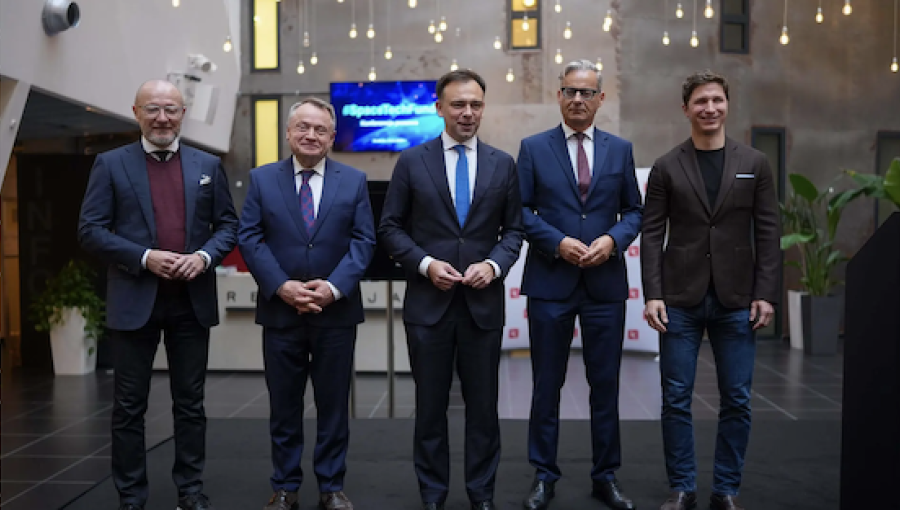
Poland's state development institution Bank Gospodarstwa Krajowego (BGK) said on October 6 it would allocate PLN500mn (€114.4mn) to investments in high-growth space technology companies through a new vehicle, the Vinci Space Tech Fund.
The fund will offer financing of between PLN10mn and PLN100mn per company, with a portfolio expected to ultimately comprise 15-20 firms. Investments will primarily target Polish companies, though the fund's strategy does not exclude European companies with their core operations in Poland.
"Today, technology is not just about the economy and innovation — it is also about Poland's security. In the space sector, we now see solutions that enable us to respond more quickly to threats, better protect critical infrastructure, support energy security, and monitor the situation within our territory and in the surrounding area. That is why investment in the space sector is, at the same time, an investment in Poland's modern economy and competitiveness," said Andrzej Domański, minister of economy and finance and the fund's originator.
Satellite reconnaissance specialist ICEYE, described as a global leader in its field, is to serve as the fund's strategic partner, contributing expertise in scaling a global business. Further strategic partners include the Kraków Technology Park, the Ministry of Development and Technology, and the Polish Space Agency.
The fund's strategy covers six key investment areas: satellites, optics and Earth observation; satellite communications; electronics and photonics; rockets and propulsion; and data and artificial intelligence.
The Vinci Space Tech Fund will be the third vehicle managed by Vinci, bringing BGK's total committed capital across the three funds to PLN1.6bn. Vinci has to date invested in two space technology companies: ICEYE and Sybilla Technologies.

No comments:
Post a Comment