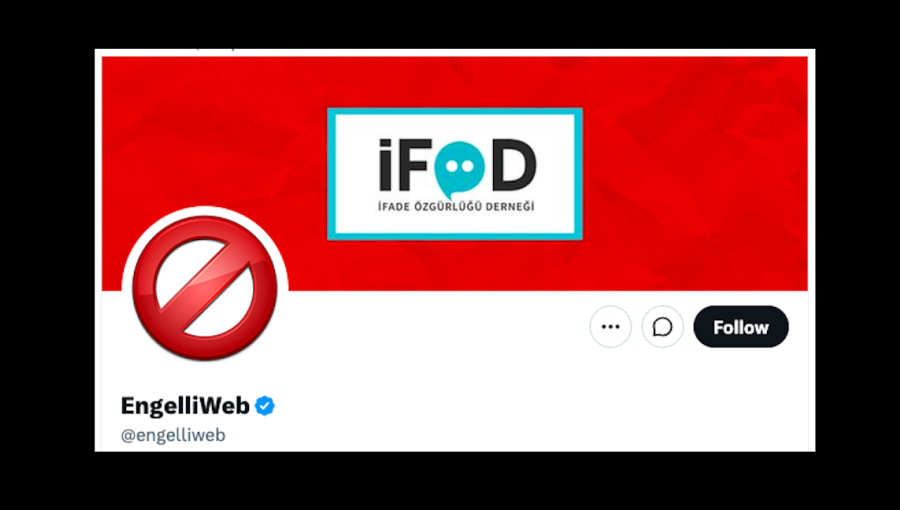
Turkey’s campaign against online dissent reached a grim milestone this week as authorities blocked access to EngelliWeb, the country’s number one digital rights watchdog in tracking state censorship.
Social media platform X (formerly Twitter) made EngelliWeb’s account (@engelliweb) invisible to users inside Turkey on October 1 after receiving an order from the Cybersecurity Presidency (SGB), the Freedom of Expression Association (IFOD), which operates EngelliWeb, said on October 2.
On October 4, IFOD said that its own X account (@ifadeorgtr) was now also blocked. The association added that it was yet to identify any ruling or directive behind the blocking of both accounts.
The directives, as usual in such censorship pursued by the country’s Erdogan administration, were based on Article 8/A of Turkey’s Internet Act No. 5651, a controversial provision that grants administrative bodies broad powers in removing content or blocking access to content on the grounds of national security and public order.
The blocking of EngelliWeb amounts to another interesting development in a recent wave of what free-speech advocates describe as unprecedented digital repression. In the face of the sheer amount of censorship pursued in recent weeks in Turkey, it would be fair to refer to a “tsunami” of account blockages.
Data released by IFOD reveals that authorities ordered the blocking of at least 1,270 X accounts during September alone, with X complying in geo-blocking roughly 90% of the accounts in Turkey. The single-month tally eclipses the total number of accounts targeted under Article 8/A in all of 2025, when 995 accounts were restricted.
"The September figures demonstrate that a structural flaw in the law has mutated into a mass censorship apparatus," IFOD said in its statement.
The sweeping purge has reached far beyond political activists, impacting prominent journalists, independent news outlets, academics and financial analysts. Among those restricted are economists, including the academic Veysel Ulusoy, in addition to independent media such as major news portal T24, Kisa Dalga and soL Haber. Human rights groups including Amnesty International Turkey and the We Will Stop Femicide Platform have also been targeted.
All in all, the affected accounts have an aggregate audience of more than 35mn followers. Seventy of the restricted profiles possess follower counts exceeding 100,000.
The clampdown has relied heavily on wide-scope court rulings issued with minimal public documentation. In one instance, an Istanbul magistrate’s court ordered the blocking of access to materials of 73 institutions and individuals, with 179 separate web addresses caught in the net. The court order cited boilerplate legal texts and provided no detailed justification for the moves it permits.
The main website and social media account of T24 were blocked after a prosecutor alleged 118 articles it published in the past year threatened "Turkish family structure".
X has routinely complied with legal orders to restrict accounts within Turkey’s borders, rather than risk facing bandwidth throttling or total access bans. Such a fate has previously befallen rival platforms operating in the country.
The owners of blocked accounts quickly open new accounts, but X then blocks these accounts. Local journalists generally have reserve accounts shared via their profiles. They jump to these fallback options when their accounts are barred.

No comments:
Post a Comment