This Month in Accelerating Trump Fascism

It’s hard to keep up with the fascism that is unfolding as the Trump MAGA regime and party bid to consolidate a new form of governance atop the United States. Below I attempt to catch readers up with some of the more relevant developments in the Trump fascist project this month. .
“We’re Not Going to Lose an Election for 100 Years”
Let’s start with a chilling speech Trump gave two weeks ago at Mount Rushmore, one night before the 250th anniversary of the United States’ Declaration of Independence. The following passage deserves special mention:
“There is now a resurgence of the communist menace in our land…You can be loyal to Karl Marx, or you can be loyal to America. You can be a communist, or you can be a patriot. You cannot be both…We’re [going to] send them into exile. We will send them quickly away,.. We can only lose the midterms if we …are foolish…But if we terminate the filibuster …and immediately vote for the Save America Act, then we will not lose an election for 100 years. We do that, we’re not going to lose an election for 100 years…The Communist Party is made up of illegal immigrants, criminals, and everybody that doesn’t want to work.”
Trump here essentially called the openly capitalist and imperialist Democrats “The Communist Party” and equated the prospects of the Democrats winning the midterm elections this fall with the supposed menace of the US “becom[ing] a communist country.” He wants one party – his MAGA fascist Amerikaner party – to rule the country without serious contestation “for 100 years.”
The “SAVE America Act” is a draconian voter identification and suppression bill premised on the fascist Big Lie of massive fraudulent noncitizen voting.
An Evidence-Free Rant to the Nation on the “Deep State” Conspiracy to Rig Elections Against MAGA
Trump made another pitch for the SAVE Act in a wild address to the nation last week. In a clear bid to sow doubt about the outcomes of the 2026 midterm elections or perhaps to justify cancelling those elections, Trump went on television to make thoroughly unconvincing and unsubstantiated claims about noncitizen voting, Chinese interference in the 2020 election, and a “deep state” conspiracy to hide evidence of that alleged meddling. None of the heavily redacted and “declassified” information he cited provides any serious basis for his charges. Trump then threatened three television networks (NBC, ABC, and CNN) with the cancellation of their broadcast licenses because they refused to grant him.
Rubio’s Paranoid Global Conference About the Mythical Epidemic of Left-Wing Terrorism
Virulent and paranoid anti-communism, a hallmark component of fascist ideology, was prominently featured in an unhinged lecture that Stephen “We Are the Storm” Miller gave last week to representatives from 67 nations called to Washington. The delegates from across the world were summoned by US Secretary of State Marco Rubio to discuss the supposed global menace of “leftist political terrorism.” In a series of deranged speeches, Miller, Rubio, Commerce Secretary Scott Bennett and other top Trump administration officials called the political left a “terrorist” threat and pledged to use all the tools at their disposal to obliterate left-wing groups. Rubio brought up the actions of the Weather Underground and the Red Army Faction more than half a century ago to supposedly to preposterously invoke a new specter of bloody, radical Left extremism. Miller claimed without evidence that the nation and world are plagued by epidemic “left-wing violence” and labelled leftists and left-wing organizations as “enemies of civilization” and a “cancer” that will “destroy society” if not taken down. Miller even took aim at “anyone who supports” left causes, accusing US institutions of being “soft” when it comes to cracking down on “left-wing beliefs.” Adopting a “future crime” perspective, Miller called on true Americans to work with the Trump regime to target left people to “prevent a threat from occurring.”
The purpose of Rubio’s conference, deeply consistent with the legacies of Mussolini, Hitler, Franco, and Joe McCarthy is to spark a global war of repression on people with “left-wing beliefs.” As Reich-Wing Watch noted: “This playbook isn’t new. After the 1933 Reichstag fire, Hitler blamed Communists and declared: ‘we must crush out this murderous pest with an iron fist.’ Cancer. Pest. Terrorists. Root them out. We’ve read this script before, and we know how it ends.”
The Trump regime’s conference speakers naturally made no mention of the well-established fact that the lion’s share of political violence in the United States is committed by the far-right.
Trump Countermands the Suspension of Extrajudicial Traffic Stop Executions
Then there was Trump’s rapid overturning last week of the Department of Homeland Security’s decision to suspend ICE traffic stops after ICE killed two legally resident Latino men – Lorenzo Salgado Araujo in Houston on July 7 and Joan Sebastián Durán Guerrero in Maine on July 13. Both men were murdered in cold blood while driving their vehicles by ICE thugs. Both were unarmed. Neither of them was the intended target of the operation that killed them. In both cases the masked killers wore no body cameras to record the incidents and ICE tried to justify the murders by claiming without evidence that the victims had tried to run down federal agents. Civil rights groups have properly described both shootings as “extrajudicial executions.”
The killings sparked angry protests that received national media attention, leading the DHS to send out a memo directing agents to temporarily stop pulling people over. Trump countermanded this order in less than 24 hours. In a statement demanding that ICE keep making the lethal stops, Trump failed to mention either of the deaths.
A Trump Truth Social post proclaimed, “we must be strong…we CANNOT give up one of I.C.E.’s most important and effective Crime Fighting tools, THE TRAFFIC STOP!” Trump insisted that efforts to hold ICE accountable are the nefarious work of “Radical Left Dumocrats…I.C.E., go back and do your very important job,” he posted. “Keep those Crime Stat Records coming!”
(Neither Lorenzo Salgado Araujo nor Joan Sebastián Durán Guerrero had any criminal record. Both were hard-working fathers with legal US residence. Mr. Araujo worked 32 years in construction, putting three sons through college. Mr. Guerrero was handcuffed after being shot in the head in front of his three-year-old daughter.)
“More Bloodshed Unless They Shut Their Mouth”
Right after Trump’s reinstatement of murderous traffic stops, Trump’s fascist “Border Czar” Tom Homan blamed ICE’s and public extrajudicial executions of Araujo and Guerrero on Democratic Party criticism of terrorist ICE raids. “It all goes back to the Dems who want to continually attack ICE and tell people to evade them and tell people don’t comply, tell people to resist, and tell people ICE isn’t a real law enforcement agency…There’s going to be more bloodshed unless they shut their mouth and let ICE enforce the laws that they enacted,” Homan told Fatherland (FOX) News. Department of Homeland Security director Markwayne Mullen added that “were turning up the heat on the streets,” boasting that “we’ve empowered our law enforcement to do their job.”
Hiring Dangerous Abusers to do the Job of Terrorizing and Murdering Our Immigrant Siblings
It has been reported that Guerrero’s ICE murderer has a long history of mental illness and domestic violence that his ex-wife tried to warn his former employers (including the US Army) about. This is an indication of the kind of people DHS is rushing into service in their effort to rapidly fill to do the Trump-Miller regime’s “job” of sweeping millions of our immigrant brothers and sisters into deadly concentration camps.
Calling a Lone Wolf Terrorist an “Anti-Ice Rioter”
Last Monday, Andrew Arabaka, a mentally ill US military veteran opposed to ICE, threw an incendiary device at 26 Federal Plaza in Manhattan, home to a leading ICE immigration court. Trump’s fascist FBI has subsequently described Arabaka as an “anti-ICE rioter,” adding that “26 Federal Plaza has long been a target of extremists, or terrorists.” The FBI’s conflation of Arabaka’s lone-wolf terrorist act with the ongoing exercise of free speech and public assembly rights against the mass deportation terror campaign is part of a deepening Trump fascist crackdown on dissent and “the left.”
A Threat to “Exile” Leftists
Consistent with Rubio’s recent wild claim that the “civilized world” is under attack by “left wing terrorism,” and with Trump’s July 3rd threat to send communists into “exile,” Trump’s fascist Department of [in]Justice last week undertook its first ever application to the never before-used Alien Terrorist Removal Court. This obscure body permits the regime to rapidly and secretly deport anyone it deems an “alien terrorist” threat. The criteria for determining if someone is an “alien terrorist” is undefined, with the power to designate people that way granted to Trump’s Secretary of State or Attorney General.
The threat to “exile” dissidents should not be laughed off. The Trump47 regime has already violated international law by deporting people to black box torture camps in remote nations. And the tyrant-in-chief has previously threatened to deport political rivals. Leading up to the 2025 New York City mayoral election, Mein Trumpf threatened to “arrest Zohran Mamdani,” strip him of his citizenship, and “to deport him…As President of the United States,” Trump said, “I’m not going to let this Communist Lunatic destroy New York.” Never mind that the subsequently elected Mamdani is a reformist social democrat who ran on a platform of making New York more affordable for working- and middle-class people.
Hauling in Journalists.
Two weeks ago, Trump ordered his Justice Department (currently headed by his personal J6 attorney Todd “I’m His Lawyer” Blanche) to undertake the nakedly repressive step of delivering subpoenas to the personal homes of New York Times journalists who reported on security problems with the new Air Force One plane that Trump corruptly accepted from the nation of Qatar. The Trump regime is trying to compel the reporters to divulge their sources before a grand jury. The message to news personnel is clear: reporting findings the Dear Leader doesn’t like can put you at risk of arrest and incarceration. “The appearance of Federal law enforcement agents on the doorstep of news reporters should shock the conscience of any American who believes in the Constitution and the press freedom it protects,” David McCraw, senior vice president and deputy general counsel for the Times, said in a statement.
Blowing Off the War Powers Resolution
We are now in the third week of the Trump fascist regime’s resumed war on Iran. This abjectly criminal, brazenly imperialist war has been restarted by the deranged US president in open defiance of a June 24 joint Congressional Resolution directing Trump to remove US forces from hostilities with Iran. The Senate’s vote for this measure marked the first time that both chambers of Congress have approved a concurrent resolution instructing a president to end a military action since the War Powers Resolution of 1973 was enacted.
For what its’ worth the US Constitution reserves to Congress the power to declare war. Trump responded to the resolution with fury, convening a closed-door Capitol meeting in which he lambasted Republican senators for even allowing the vote to take place.
Threatening New Epic War Crimes and the International Criminal Court
Trump this week has threatened collective punishment against the people of Iran in response to the death of three US soldiers in his criminal war on that nation. Earlier this week, he vowed to “punish Iran” for the deaths of three US soldiers, saying Tehran would pay “many times over.” Trump said the US would strike bridges and power plants in Iran if the Iranian military did not stop targeting ships in the Strait of Hormuz. “Any time the Islamic Republic of Iran shoots at a ship” in the strait, Trump warned on social media, U.S. forces will hit the sites, including in or near Tehran, a city of ten million people. Deliberate strikes on civilian infrastructure and collective punishment are major war crimes under international law.
That the Trump regime’s fascist war on the rule of law applies to international we well as domestic law was seen yet again in bold fashion in a blistering Rubio attack on the International Criminal Court (ICC) published in the Wall Street Journal last week. Rubio claimed that the ICC threatens “US soldiers, police officers, Border Patrol agents and elected leaders” under international laws that “we neither consent to nor control.” Calling the ICC “an intolerable threat to US sovereignty,” The State Department mentioned things will do to target the ICC: pressuring allies to resist ICC attempts to prosecute Americans, travel bans on ICC officials, and increased sanctions on the court. Rubio pledged the United States to an effort “to dismantle the ICC brick by brick” – a truly chilling statement.
For the record, the ICC rules in accord with established international law on four international crimes of which the Trump regime and previous US administrations are richly guilty: genocide, aggression, crimes against humanity and war crimes. International law is universally applicable to all states; no country can choose to violate or ignore them. That is intolerable to the American Empire and the America First Trump regime, reflecting the takeover of the US government by a fascist section of the ruling class ready to abandon all pretense of legality abroad as well as at home, has just expressed its desire to crush the ICC out of existence.
“The Iron Laws of the World”
For some pre-July 2026 context for this fascist imperialism, we should recall for er forget what Trump’s top political and policy advisor, the open fascist Stephen “We are the Storm” Miller, said after Trump ordered the military seizure of Venezuela’s sovereign head of state last January. “We live in a world,” Miller intoned, “in which you can talk all you want about international niceties and everything else, but we live in a world, in the real world … that is governed by strength, that is governed by force, that is governed by power. These are the iron laws of the world that have existed since the beginning of time.”
The War on Iran and the War on Elections
We should bear in mind what the highly unpopular US president’s restart of his illegal and unpopular war on Iran means for the mid-term elections that the Democrats are naively hoping will contain Trump. Since everyone knows it will send gas and other prices back up, as is happening, the resumed attacks offers another among many signals that Trump aims to win the coming midterm elections through massive federal interference, perhaps even cancellation, not by anything remotely like normal campaign appeals to voters’ interests, At the same time, a state of war is richly congruent with designs to declare a state of emergency meant to cancel the midterms or refuse to honor their outcomes.
“The Enemy Within”: Never Forget What Was Said in Quantico Last September
Some more recent historical context seems appropriate here. We should also never forget what Trump and his fascist Pentagon chief Pete Hegseth said to 800 top military officers they brought from across the American Empire to Quantico, Virginia, last September 30.. Hegseth instructed the commanders that US forces must not let their mission of ruling the world through “maximum lethality” be hampered by what Hegseth called “politically correct and overbearing rules of engagement.”
Trump told the assembled flag officers in Quantico that the nation’s top adversary is “the enemy within,” concentrated in “radical Left” and nonwhite cities that Trump said should be used as “training grounds” for foreign wars. “We’re under invasion from within,” Trump intoned, “no different than a foreign enemy, but more difficult in many ways because they don’t wear uniforms. At least when they’re wearing a uniform, you can take them out.” The invaders are to be found in cities “run by radical left Democrats… San Francisco, New York, Chicago, Los Angeles; we’re going to straighten them out one by one.” This is a job for the US military, said the depraved commander-in-chief: “A major part for some of the people in this room. That’s a war, too. A war from within.”
Trump wants this war against “the enemy within” fought with Hegseth’s testosterone-fueled rules of engagement, emphasizing a “warrior ethos” and “maximum lethality over tepid legality” (Hegseth’s phrase). Trump told the military leaders a timeworn imperialist story about a protester spitting in a soldier’s face and the soldier remaining passive “though he wants to knock the hell out of the person. If it’s OK with you, generals and admirals, I’ve taken that off. I say, they spit, we hit. Is that OK? I think so.”
Testosterone Pete
In other news last week, Trump’s “Secretary of War,” the open Christian white nationalist Pete Hegseth channeled the hyper-masculinism at the heart of fascism by ordering that the military will now test its soldiers for testosterone levels. Hegseth is concerned that the American “warrior class” (his term) is not demonstrating enough manliness to performs its core tasks: “kill people and break things for a living” and “unleash overwhelming and punishing violence on the enemy” (Hegseth in Quantico last year).
“I Saw Everything. You Did Not Need to Kill Him. You Have No Respect for Human Life.”
This is fascism. And so in its own way is the flat-out racist police state public extrajudicial execution of young Black man in Madison, Wisconsin two days ago. Watch a video of this terrible act here:
https://www.facebook.com/share/r/1Bd9pxNVNo/
After a white officer shoots the victim three times, a woman can be heard screaming, “I SAW EVERYTHING! I SAW EVERYTHING! YOU DID NOT NEED TO KILL HIM! YOU DID NOT NEED TO KILL HIM! YOU HAVE NO RESPECT FOR HUMAN LIFE.!”
The unfortunate tendency in these cases is for the issue to be kept local. That is a mistake. The ongoing racist police murder of Black people, young Black males especially, is a national epidemic that the genocidally white supremacist Trump fascist regime will make no effort to halt. This and many other racist police state hits that occur all too regularly across the United States ought to lead to national protests that merge with the anti-ICE protests and link further to a rising call for the removal of the Trump fascist regime before it’s too late to block the consolidation of fascist rule in the world’s most powerful and lethal nation – a deadly prospect for all humanity.
If You Conclude He’s Mentally Unbalanced, You’re Probably Right
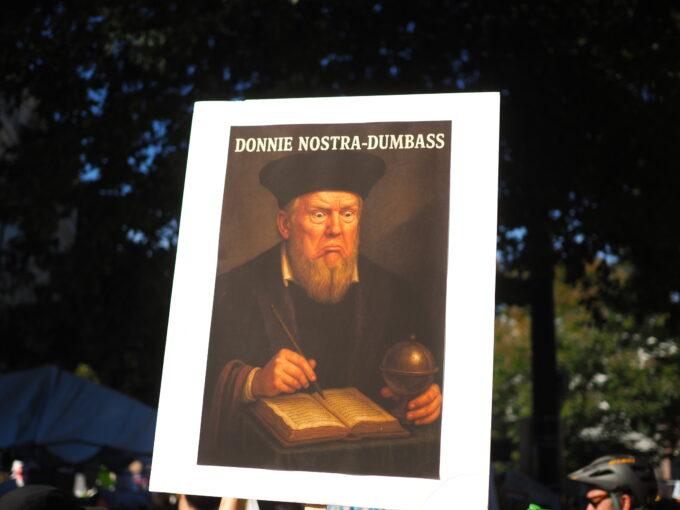
Photograph by Nathaniel St. Clair
Under Federal Rules of Evidence (FRE) 702 and 703, for evidentiary purposes at trial, lay people ordinarily cannot not offer medical, mental health or psychiatric opinions.[i] These sorts of opinions must be based upon expert testimony.[ii]
That said, however, there are certain human behaviors and conditions that, under Federal Rule of Evidence 701, a competent layperson may provide opinions on certain subjects expressly permitted by rule, statute, or case law. This sort of opinion testimony must be based upon the witness’ perceptions, personal observations, and must result from firsthand knowledge. In these circumstances the court may allow a lay witness to testify as to: a person’s identity; a person’s sanity; a person’s state of mind, demeanor, mood, or intent; the identification of handwriting; a person’s intoxication or sobriety; property ownership; a person’s health, sickness, or injury; a person’s mental condition; speed, distance, and size; and; the value of a witness’s property.[iii]
By way of example how this works, Wilbur Smith, ordinary citizen, may testify that he saw John Doe standing on the street corner, wearing a tinfoil hat, waving a toy lightsaber, and screaming that the pigeons were disguised aliens attacking the city. Based on what he observed, Smith may testify that Doe was acting crazy, out of his mind, and that he appeared to be mentally ill. Smith, however, may not testify that Doe was suffering from paranoid schizophrenia; that opinion requires the testimony of an expert such as an examining psychiatrist or other professional person.
And, that brings up another rule that plays into all this—the Goldwater Rule: The American Psychiatric Association maintains a traditional rule that prohibits members from diagnosing public figures without a personal examination. To avoid this rule, doctors commenting on the mental status of public figures argue that they are not making a definitive personal diagnosis, but are instead providing a behavioral “dangerousness assessment”.[iv]
So, to sum up, each of us ordinary citizens, based on our personal observations, can offer our own opinions and conclusions about a number of human behaviors and conditions, including another person’s sanity, state of mind, and mental condition. Unless we’re trained mental health experts, we can’t offer opinions or conclusions on any disease or condition that might cause another’s person sanity, state of mind or mental condition. In short, at least under the referenced evidentiary rules, the vast majority of us are observers and reporters, not examining diagnosticians.
All of that brings us to President Donald J. Trump’s mental status. Because, from the beginning of his first term, he displayed temperament, decision-making, and behaviors so at odds with what was considered as presidential norms and conduct, members of the public, the press and Congress questioned Mr. Trump’s mental health and his fitness to serve as President. In fact, in April of 2017, 28 members of Congress introduced legislation seeking to use the 25th Amendment to allow for a formal, nonpartisan determination of Mr. Trump’s mental fitness to serve.
Aside from the input from mental health experts there continued to be, and continues now, public discussion of diagnosable conditions that might be affecting the President’s mental health. It has been widely accepted that, despite the Goldwater rule, at a minimum, the President suffers from narcissistic personality disorder.[v]
Indeed, in their book The Much More Dangerous Case of Donald Trump:[vi] 40 non-examining psychiatrists and mental health experts catalog Mr. Trump’s cognitive deficits and mental health aberrations These include, according to the World Mental Health Coalition’s (WMHC) website, the following “Objectively observable signs of serious medical concern:”
+ Marked deterioration in cognitive functioning, evidenced by disorganized and tangential speech, rambling digressions, factual confusions, unexplained sudden changes of course in strategic matters, both national and international, episodes of apparent somnolence during critical public proceedings.
+ Grandiose and delusional beliefs, including assertions of infallibility, imagery of himself as Pope suggestive of a divine mission, being a mythical warrior hero, depicting himself as combat pilot—dropping feces on civilians, and claims that his decision-making authority is unlimited—with no need to consider domestic and international laws and constrained only by his “own morality.”
+ Severely impaired judgment and impulse control, reflected in reckless threats of violence, advocacy of lethal force against civilians, encouragement of extrajudicial actions by armed supporters, repeated threats and often actions—judicial, prosecutorial, police, military, and by invoking emergency powers—against political opponents and others who disagree with him.
+ Significant loss of self-control (disinhibition) and getting stuck on the same thoughts or actions, unable to let go or move on (perseveration), including seemingly compulsive, manic-like late-night communications—e.g., 150 social media posts in one night—fixation on perceived enemies, persecutory ideas, and prolonged, disproportionate attacks on specific individuals and institutions.
+ Escalating violence that threatens national and global stability. As Commander-in-Chief of our military—more than 5000 nuclear warheads in inter-continental missile silos, on submarines, and in bombers around the world, are ready for launch solely upon his order, and no one now has the authority to countermand his order.
Again, according to WHMC website, the conclusion of these professionals is chilling:
It is our professional opinion that the behaviors of Donald Trump, tragically, are neither momentary lapses nor political theater. It is our professional opinion that they reflect a rapidly worsening, reality-untethered, increasingly dangerous decline. If we were called upon under the 25th Amendment to judge the President’s present ability to discharge the duties of his office, we would have to conclude that he lacks the capacity to do so. For the reasons cited above, emphasizing that he presents a clear and present danger to our country and to the world, it is our expert opinion that Donald J. Trump is mentally unfit to be the President of the United States, and that steps to remove him from office must be undertaken with the greatest urgency, with vital responsibilities on the shoulders of those in positions of leadership.
We can add to the above Mr. Trump going to war with Iran without Congressional authorization and with a direct military and defense cost to the American public of between $80 and $100 billion dollars and indirect economic cost (e.g. energy and groceries) of $132 billion (about $1,100 per household). And to accomplish what? The Strait of Hormuz is on again/off again closed, increasing the cost of gasoline and diesel, and the US is in a worse position with Iran now than it was under 2015 agreement with Iran that was negotiated by the Obama administration, known as the Joint Comprehensive Plan of Action, or JCPOA (an agreement which Mr. Trump tore up). [vii]
While one could describe example upon example of Mr. Trump’s mental and cognitive failures[viii], suffice to say that following the news, social media, and viewing the President’s daily behavior, speech, decisions, and performance, each of us ordinary citizens can form an opinion as to his sanity, state of mind, and mental condition—irrespective of what actual illness, disease or condition, if any, that underlies these.
And Mr. Trump’s mental state is not improving; it seems to be getting worse. Congress must find the courage act. No other president in modern history as acted as President Trump has.
Long story short, if you ordinary citizens conclude Mr. Trump is mentally unbalanced, you’re probably right: He is.
Notes.
[i] https://www.law.cornell.edu/rules/fre/rule_701
[ii] https://www.law.cornell.edu/rules/fre/rule_702: https://www.law.cornell.edu/rules/fre/rule_703
[iii] https://www.findlaw.com/criminal/criminal-procedure/the-lay-opinion-rule.html
[iv] https://www.psychologytoday.com/us/basics/goldwater-rule
[v] https://www.psychologytoday.com/us/basics/goldwater-rule
[vi] Published in 2025 by the World Mental Health Coalition; https://worldmhc.org/ Available in bookstores and by on-line book sellers.
[vii] https://www.cfr.org/articles/was-it-worth-it-the-true-cost-of-trumps-iran-war; https://www.theguardian.com/us-news/2026/jun/19/barack-obama-us-is-worse-off-war-with-iran; https://mail.google.com/mail/u/0/?ogbl#inbox/FMfcgzQhVNdCqznghPGjrZzkCXQxCtdL
[viii]See:https://www.cnn.com/2026/07/08/politics/fact-check-trump-nato-press-conference?iid=cnn_buildContentRecirc_end_recirc&recs_exp=up-next-article-end&tenant_id=related.en;https://www.cnn.com/2026/07/12/politics/trump-gaffes-recap-nato; https://heathercoxrichardson.substack.com/p/july-8-2026;https://bandyxlee.substack.com/p/trumps-mental-decline-is-alarmingim
Under Trump, the Buck Stops Nowhere
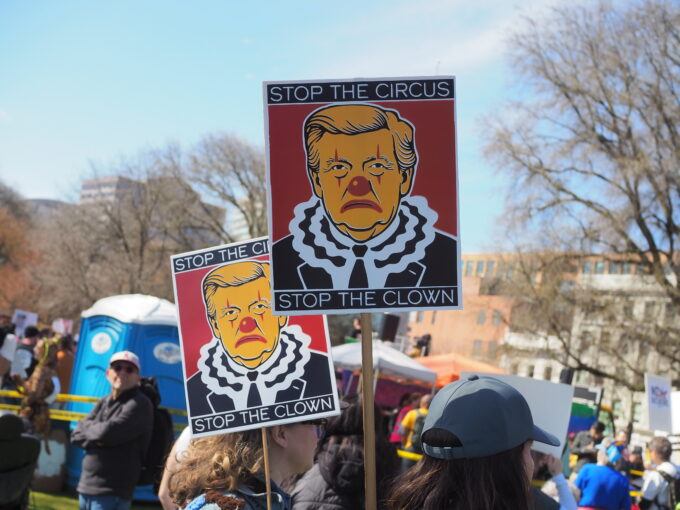
Photograph by Nathaniel St. Clair
Having burned through billions of dollars and depleted critical munitions stockpiles, the Pentagon is running out of money.
Our money.
According to the Washington Post, the Pentagon is facing an urgent budget shortfall caused largely by the Iran war, with some critical funding accounts expected to run dry within weeks. Training, maintenance and other military priorities are reportedly being squeezed as the government struggles to sustain Trump’s escalating conflict.
Once again, the government is looking to the American people for a taxpayer-funded bailout—this time to the tune of $67 billion.
Nor is the $67 billion emergency infusion the end of it.
Trump’s fiscal year 2027 budget calls for an unprecedented $1.5 trillion in national-defense spending—a staggering increase that would pour still more money into a military apparatus that cannot account honestly for the costs of its current war, maintain its existing priorities, or keep from returning to taxpayers for another bailout.
The problem is not simply how much the war machine consumes. It is how little accountability accompanies that spending.
The government can launch a war, exhaust military resources, conceal its full costs, and return to Congress for billions more without anyone responsible being required to admit error, change course, or answer for the lives lost.
That is becoming a familiar pattern under Donald Trump.
He makes the decisions—others absorb the consequences.
He launches the war—the troops make the sacrifices, and taxpayers inherit the bill.
The Iran war is not merely another example of government waste, although the cost is already staggering. The war has already cost an estimated $80 to $100 billion, not counting its long-term economic impact, future veteran expenses, or the cost of repairing damaged military bases. Analysts estimate that the broader toll on American households could eventually reach as much as $1,000 per household.
Yet the true cost cannot be measured in dollars alone.
American service members are dying in a war Trump started without meaningful congressional authorization, without a credible plan for ending it, and without an honest accounting of what it will cost.
The Pentagon is draining resources from training, maintenance and weapons programs to keep the conflict going. Congress is being asked to supply billions more. And the American people—already struggling under the weight of debt, inflation and economic uncertainty—are expected to pay without question.
This is government without accountability.
When Trump’s decisions cost American lives, deplete military stockpiles and burn through billions of taxpayer dollars, the bill never finds its way to him. It finds its way to us, while Trump remains conspicuously insulated from the human and financial consequences of his own decisions.
That insulation from consequence is matched by a swaggering display of bluster and bravado that passes for leadership within the Trump administration.
Take Pete Hegseth, the self-styled “Secretary of War,” who speaks less like a civilian entrusted with the grave responsibility of war and peace than a character delivering an action-movie threat.
“If you kill Americans, we will hunt you down,” Hegseth warned.
The Trump administration has embraced that threat as a statement of national resolve: anyone who kills an American will be hunted down and made to pay.
Unless, of course, the Americans are killed by their own government.
Unless they are service members sent to die in a preemptive war the president started without constitutional authority and cannot seem to end.
Unless they are shot by immigration agents or police officers conditioned to treat fear, resistance and the mere presence of a weapon as a license to kill.
Unless they die in government custody.
Unless they become casualties of public-health safeguards weakened by mass firings, budget cuts, political interference and administrative incompetence.
In those cases, no one is hunted down, no one in power is made to pay, and no one is held responsible.
This is the double standard that passes for justice in the American Police State.
For decades, presidents of both parties have expanded executive power, surrendered constitutional checks, protected government agents from meaningful accountability and conditioned the public to accept official violence as the unavoidable price of security.
Trump inherited that machinery.
He has also embraced its deadliest powers, accelerated its abuses and made the elimination of accountability a governing principle.
The Iran war is merely the latest—and most visible—example.
American service members are dying in a war that is not making America safer, no matter what Trump insists to the contrary.
Seventeen American service members have reportedly been killed in the war, while more than 400 have been injured. Rather than treating those deaths as evidence of the terrible costs and strategic failures of his war, Trump has used them to justify further escalation, warning that Iran will “pay many times over” for every American life lost.
Yet the Iran war is only one front in the government’s longstanding war on accountability.
The same culture of impunity that shields presidents from responsibility for unconstitutional wars also protects government agents from meaningful scrutiny when raids, detentions and uses of force result in injury or death.
Trump did not create this system.
Police militarization, qualified immunity, aggressive federal enforcement and institutional self-protection were firmly entrenched long before he returned to office.
What Trump has done is intensify those tendencies, remove restraints, reward aggression and treat demands for accountability as attacks on law enforcement itself.
The pattern is the same whether the harm occurs on a battlefield, during an immigration raid, in a police encounter or through the failure of an institution charged with protecting the public.
The names and political parties change. The machinery of impunity remains.
What distinguishes Trump is not that he created this machinery but the brazenness with which he uses it. He treats oversight as obstruction, criticism as disloyalty, constitutional restraints as inconveniences, and public office as a vehicle for private power and profit.
Under Trump, the buck stops nowhere.
No one in power pays a personal price. No one admits fault. No one resigns. No one is prosecuted. No one is held accountable.
Likewise, in the American Police State, those in power are protected. Those without power bear the consequences.
And the machinery of government moves on without accountability.
As I make clear in my book Battlefield America: The War on the American People and its fictional counterpart The Erik Blair Diaries, that is how the American Police State gets away with murder.
