Saturday, October 24, 2026


Climate change stopped the next ice age


2000 years ago, remnants of a once-vast Arctic ice sheet began growing again, marking the start of a new glacial period—what we commonly call an ice age—But by the 1960s, global warming had raised summer temperatures enough to reverse that growth


Columbia Climate School


Two thousand years ago, the Arctic remnants of a once-vast ice sheet started to grow again. It was the beginning of a new glacial period, more conversationally known as the next ice age—but by the 1960s, summer temperatures were already so high that the ice sheet started to shrink. In other words, global warming ended a period of glaciation that had already begun.

"It was just getting started, everything was normal, the next glaciation was about to happen—and yet it stopped,” says Nicolás Young, a geochemist at the Lamont-Doherty Earth Observatory, part of the Columbia Climate School. “It’s a very powerful example of how we have jolted the system.”

In a new study published in the journal Science, Young, fellow Lamont geochemist Joerg Schaefer and their colleagues describe their research on the Laurentide Ice Sheet, and his colleagues describe their research on the Laurentide Ice Sheet, which covered much of Canada and the northern United States from about 95,000 to 20,000 years ago. At its largest, it stretched from above the Arctic Circle to Illinois, and in places the ice was over two miles thick.

The last vestige of the Laurentide still survives as the Barnes Ice Cap, now a Delaware-sized ice cap located on central Baffin Island in the Canadian territory of Nunavut. “People always say that it disappeared, but that’s not true,” says Young. And while it’s known that the Laurentide has repeatedly expanded and retreated across North America since widespread, continental-scale glaciation began about 2.6 million years ago, Young’s team wanted to know whether it had ever shrunk even smaller than it is now and then regrown. 

(A note on terminology: Techincally we are still living in an ice age–the Late Cenozoic Ice Age–which started about 34 million years ago. Within it, colder glacial periods alternate with warmer interglacial ones, including the one we live in now. What people casually call an “ice age” is usually a glacial period. The last glacial period ended about 11,700 years ago.)

Reconstructing glacial histories is always difficult, and especially so when trying to reconstruct moments of maximum contraction and initial re-expansion: Apart from the challenge of identifying the origin point, whatever geological clues are left on the landscape tend to be scoured away as glaciers regrow. The cradle of the Laurentide, however, is a special case.

The Barnes Ice Cap is frozen directly to its underlying bedrock. Unlike most glaciers it does not slide, and thus preserves the vegetation that grew at earlier times when the glacier was small and was subsequently entombed by its expansion. Vegetation exposed since the glacier started retreating in 1960 can be sampled, allowing scientists to determine its age by analyzing traces of carbon-14, a harmlessly radioactive form of atmospheric carbon that collects in organisms while they live and breaks down at predictable rates after they die.

"If you do this enough times, you can actually develop a timeline of that ice margin systematically advancing over plants. You're actually tracking the expansion of that ice margin,” says Young.

By combining analyses of vegetation preserved beneath the Barnes Ice Cap and smaller recently-melted ice caps in the region, the researchers pieced together a climate history. The Laurentide reached its minimum dimensions about 3,000 years ago, then started re-expanding about 2,000 years ago when the climate became cold enough for ice to accumulate.

The researchers argue that this inflection point should be considered the beginning of Earth’s next glacial period. This interpretation challenges prevailing ideas about when glacial periods begin. Previous model-based studies have suggested that the next glaciation would not begin for thousands or even tens of thousands of years. Young and his colleagues argue that the first renewed growth of an ice sheet should count as the beginning, rather than waiting until enormous continental ice sheets have formed.

The findings are also a coda for climate scientists who in the 1970s made the controversial claim that a new ice age was imminent. “It actually was happening,” Young says. “They couldn't quite prove it, but now we sort of have the evidence.” It would have taken thousands of years for the cooling to be noticeable, and about 30,000 years for the Laurentide to regain its continent-sprawling mass, but the next glaciation had started, says Young.

By the 1960s Earth’s climate had warmed enough that the Barnes Ice Cap lost more ice in the summer than it added in winter. The next glaciation fizzled out. According to models of the glacier’s future, it will melt completely within the next few centuries. “That will be the true very last remains of the Laurentide, disappearing for good,” Young says.

Its disappearance could change the dynamics of future glaciations and ice ages. The Laurentide served as a glacial nucleation point when Earth’s climate cooled, as its frigid mass created self-sustaining feedbacks that caused more ice to grow on it. Scientists can’t say when the next glaciation might occur in a world with elevated freenhouse gas concentrations. But if continental ice sheets eventually begin growing again, they may have to do so without the last surviving remnant of the Laurentide.

"What has been an extremely natural and predictable phenomenon is now gone,” says Young.


Marine heatwaves suppress nutrient use, reproductive flexibility in humpback whales


University of Hawaii at Manoa

A humpback whale and calf

image: 

A humpback whale and calf in NOAA's Hawaiian Islands Humpback Whale National Marine Sanctuary. Scientists estimate that up to 12,000 whales — more than half of the North Pacific humpback population — return to Hawaiian waters from November through May to breed, calve, and nurse their young.

view more 

Credit: NOAA’s Hawaiian Islands Humpback Whale National Marine Sanctuary


A new study led by University of Hawai‘i (UH) at Mānoa researchers reveals how extreme ocean warming disrupts whale metabolism, nutrition, and reproductive success and what the developing 2026-2027 El Niño could mean next. As climate change drives increasingly intense marine heatwaves, scientists are uncovering how these extreme warming events disrupt the biology of humpback whales. 

Earlier reports from NOAA, academic researchers, and regional monitoring programs documented troubling symptoms during the 2014–2016 Pacific marine heatwave, known as the Blob: fewer humpback whale sightings in Hawai‘i and Alaska, declines in calf numbers, and widespread signs of nutritional stress. Until now, the physiological mechanisms behind these population‑level changes remained unclear. The study, published in iScience, provides the missing link.

“These findings give us a window into how whales actually cope with extreme environmental stress,” said lead author Ching-Tsun Chang, a former graduate student in the Department of Oceanography at the UH Mānoa School of Ocean and Earth Science and Technology and now an assistant professor at National Sun Yat-sen University, Taiwan. “We’ve known from previous reports that humpback whales declined in number and body condition during the Blob. What we show here is the physiological story behind those patterns: how whales adjust their metabolism, how nutrient use shifts, and how reproduction may be compromised.”

How whales coped internally

To understand how whales responded physiologically, researchers analyzed nearly eight years of biochemical records preserved in the baleen of stranded female humpbacks from Hawai‘i. Baleen grows continuously, creating a natural timeline of metabolic signals. 

“Baleen is an extraordinary archive,” said co‑author Kristi West, Director of the UH Health and Stranding Lab and associate researcher in Human Nutrition, Food and Animal Sciences at the UH Mānoa College of Tropical Agriculture and Human Resilience. “It lets us reconstruct an animal’s nutritional and reproductive history with fine detail. By pairing these biochemical records with bioenergetic models, we can finally see how climate extremes ripple through a whale’s body.”

Using compound‑specific isotope analysis of amino acids paired with bioenergetic models, which are computer models that estimate how animals use and allocate energy, the team reconstructed how whales routed nutrients and mobilized energy reserves before, during, and after the heatwave.

The results reveal the physiological mechanisms behind previously observed declines. During the heatwave, whales essentially “powered down”, slowing their metabolism to stretch limited food supplies. This lack of nutrition made early pregnancy harder to maintain, even if whales became pregnant. Additionally, one whale’s decades-long history shows the cumulative toll of environmental change, with its baleen preserving a five‑year record of how shifting ocean conditions affected its body late in life.

Vulnerability to 2026–2027 El Niño and climate

Capital breeders are animals that rely on energy stored during feeding seasons to fuel migration, pregnancy, and lactation. When feeding seasons are disrupted—as during marine heatwaves—these species have limited ability to compensate.

The new findings arrive as the Pacific enters a developing 2026–2027 El Niño, which is expected to be one of the strongest on record bringing unusually warm conditions across the North Pacific. Seasonal forecasts from international climate centers project widespread surface ocean warming that could reduce prey availability in key humpback whale foraging regions. While this event is distinct from the 2014–2016 Blob, the anticipated warming highlights why understanding whale physiological responses to extreme environmental stress is increasingly important. 

“As marine heatwaves become more frequent, capital‑breeding species like humpback whales may face increasing challenges in a rapidly warming ocean,” said Brian Popp, co-author and professor of Earth Sciences in the UH Mānoa SOEST. “Understanding these physiological responses is essential for anticipating how populations will fare in the decades ahead.”

Researcher sampling baleen

Cody Clifton, co-author and recent graduate of the UH Mānoa, College of Tropical Agriculture and Human Resilience, collects samples for hormonal and stable isotope analyses from a humpback whale baleen plate.

Credit

University of Hawai‘i at Mānoa


A new cycle of struggles has begun in Portugal

Wednesday 21 October 2026, by José Soeiro, Maria Manuel Rola


At the end of last June, the left and the labour movement in Portugal secured an unlikely victory: the government’s proposed labour reform, which would have overhauled the Labour Code from top to bottom, was defeated in parliament. Public pressure was so intense – with two general strikes, dozens of protests and a campaign that rallied the majority of public opinion against the government’s violently regressive agenda – that the far right, fearful of the electoral consequences of seeing its support for such a thoroughly unpopular proposal through to the end, changed its position and ultimately joined forces with the left to vote down the government’s labour reform package.

This struggle ushered in a new cycle of confidence for the popular movement.

The government, which holds a minority in parliament, put labour issues on hold and sought to change the subject. It ensured that the PS abstained on the draft state budget, on the one hand, and, on the other, reached an agreement with the far right on a new rental law which, in practice, virtually eliminates any rights for tenants.

A two-month delay in paying rent can lead to eviction. There is no longer a cap on deposits for renting a property. The number of months’ rent a tenant must pay in advance when signing a tenancy agreement has been increased to three. The 2 per cent cap on rent increases has been removed. With this proposal, the rental market – which is used by those unable to buy a home – becomes even more cut-throat, in the eurozone country where house prices have risen the most, where only 2 per cent of housing is social housing, where the rent per square metre has doubled over the last five years, where, on average, people spend 50 per cent of their income on rent for legally registered tenancies alone (that is to say, it is even worse if we take the informal market into account), and where the poverty rate rises from around 15 per cent to 27 per cent when housing costs are factored in.

The rising cost of living, including fuel prices, and the approval (albeit without a final vote yet) of the tenancy law have created the conditions for a new cycle of protests.

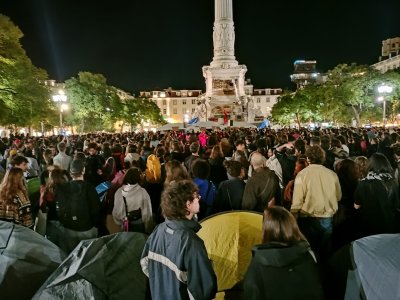
On 10 October, a coalition of various groups and associations, called ‘Não Dá Mais’ (‘We Can’t Take It Anymore’), organised demonstrations against the rising cost of living in five cities, attended by several thousand people. In the city of Porto, which has the greatest impact in the north of the country, this demonstration coincided with two other protests – in support of Palestine and to safeguard an old market (the Bulhão), which is highly symbolic for the city – and was followed by a call, inspired by events in Spain and the wave of outrage over Maricarmen’s death, to set up a tent camp at the end of the rally, occupying the square where it had taken place.

On the first night, around 30 tents were pitched and remained in place. On the second night, there were more than 50. The camp was going to be cleared by the council at the end of the second night. The activists used social media to call for a new demonstration at the same location, with the aim of deciding, at an open-air public assembly, whether to resume the sit-in. On that same day, the Mayor declared that he would be “absolutely uncompromising” if the square were to be occupied with tents again. But not even that deterred the organisers of the camp, who set it up once more, with more people and more support.

At 3 am, with no journalists left in the square, the Government and the City Council, acting in concert, ordered a brutal police charge against a few dozen peaceful activists who had spent the night in that square. Curiously, this was on the very same day that, 20 years ago, a movement had begun to occupy the municipal theatre located in the same square.

The mobile phone videos shocked public opinion and the city. That very same day, thousands of people flocked to the square in outrage, in a massive demonstration that also made its way to the entrance of the city hall. Not only did the movement explode, but it also began to spark reactions in other cities and a huge wave of solidarity.

Not even the attempts by the Government and some commentators to stigmatise and blame the activists for having ‘provoked the police’ had any effect.

For the past ten days, the square has been constantly filled with thousands of people in the late afternoon and evening, with cultural events and workshops, whilst the organisers manage the day-to-day running of catering, security and cleaning. A new camp also sprang up in Lisbon last weekend, and in Coimbra. At the trade union demonstration called by the CGTP (Portugal’s largest trade union confederation) against the rising cost of living on the 17th, trade union organisations and the ‘campers’ converged, forming a crowd of diverse ages and social backgrounds, which returned to the square in Porto. That same evening, the Porto camp was re-established with thousands of people, and several hundred spending the night there. A new cycle of protests has begun and will reach its next major national milestone on 14 November with a national demonstration.

At present, it is impossible to predict how the movement will develop. The issue of housing, however, is already at the centre of public debate, even as the government attempts to refocus the debate on ‘violence’ or the legitimacy of occupying a public space with tents. Progress has been made, notably during the demonstrations on 17 October, in developing a convergence between the housing protests and the trade union mobilisations. The political parties are under pressure to provide answers regarding the housing crisis, and the far right is already beginning to backtrack on its commitments regarding the new tenancy law, which may thus be defeated by popular mobilisation, as happened with the Government’s labour reform package. There is also discussion as to what effect the Spanish general strike will have on the timetable and repertoire of struggles in Portugal. Undoubtedly, the inertia has been shaken off and we are facing a new cycle of collective action, with significant youth participation, which is already fostering a new collective consciousness and may have lasting effects on the reorganisation of the popular movement and the balance of power in the country.

20 October 2026

Translated by International Viewpoint.

ILLEGAL SETTLEMENT COPS

Netanyahu vows to ‘destroy’ Hebron after 2 soldiers killed in ‘terrorist attack’

Israel’s Prime Minister Benjamin Netanyahu on Friday vowed to “destroy” the Palestinian city of Hebron in the occupied West Bank after two Israeli soldiers were killed at a military checkpoint there. The two gunmen were also killed in the “terrorist attack”, the army said.


Issued on: 23/10/2026 
By: FRANCE 24
Video by: 
Kethevane GORJESTANI

Cover image: Israeli soldiers gather at the scene of a shooting attack at a junction near Hebron in the occupied West Bank on October 23, 2026. © Mahmoud Illean, AP
05:27


Israeli Prime Minister Benjamin Netanyahu said on Friday Israel would lock down Hebron in the occupied West Bank, ​go house to house and demolish homes after the Israeli military said Palestinian attackers killed two soldiers at a military checkpoint near the city.

The Israeli military said it had killed two attackers, and another three ​soldiers had ‌been lightly wounded in the attack.

“We will act to destroy this place, ⁠to change it completely,” Netanyahu said in a statement after the attack.


A Reuters reporter documented Israeli bulldozers beginning to demolish homes in Hebron near ‌the site of the shooting. Local residents said the homes had no connection ⁠to the attackers.

The demolitions began after Israeli Finance Minister Bezalel Smotrich said on social media that he had ordered the immediate demolition of Palestinian buildings near the attack site.

Netanyahu ​also said he would launch a large-scale military operation in the West Bank, ‌where Israeli forces regularly raid Palestinian cities and towns.

Israel’s far-right National Security Minister Itamar Ben-Gvir called for the dismantling of the Palestinian Authority and for all Palestinians in the West Bank to be banned from travelling ‌by road.

The violence took place before an Israeli election next week in which Netanyahu and his right-wing coalition have campaigned for expanding Israeli ​settlements and against the formation of a Palestinian state.

Netanyahu and Israeli Defense Minister Israel Katz both compared the Hebron operation to the mass demolitions Israel carried out in Palestinian refugee camps in 2025, ​expelling tens of thousands of people.

Human Rights Watch later issued a report saying the mass expulsions amounted ​to war crimes and crimes against humanity.

Israel said in response ​to the report that it needed to demolish civilian infrastructure so that it could not be exploited by militants. It did not say when ​residents could return.

The Hebron attack comes in an atmosphere of increasing tension in the West Bank as Israeli settler violence has surged in recent weeks.

In his speech following the attack, Netanyahu praised Israeli settlers in the West Bank, calling them “heroic” and saying they were “standing in the breach”.

Netanyahu has presided over a rapid expansion ⁠of settlements. UN bodies and most countries deem Israel’s settlements on land occupied in war illegal under international law regarding military occupations. ⁠Israel rejects this, viewing ​the territory as disputed rather than occupied.

(FRANCE 24 with Reuters)

Israel

“The solution will not come from the Israeli elections but from external pressure”

Friday 23 October 2026, by Editors l’Anticapitaliste


The NPA-A newspaper, l’Anticapitaliste spoke to Nadav, an activist with Tsedek! – a Jewish decolonial collective – ahead of the Israeli general election on 27 October 2026.

Can we expect anything from these elections in terms of Palestinian rights?

Frankly, no. The Palestinian question had already been buried. Today, it’s a race to the bottom to see who can be the most against a Palestinian state. I’m not even talking about rights, freedom or resistance: simply about two states, as set out in the Oslo Accords.

A video sums it up: a presenter asks eight representatives from the main political lists – from both Netanyahu’s bloc and the opposition – whether they support a Palestinian state. All reply ‘no’: we will do everything to prevent it. Several accuse their opponents of supporting it in order to discredit them.

Today, it’s a race to see who can be the strongest against a Palestinian state.

They all share the same consensus on settlement activity, ‘Judaisation’ and Gaza. Only Yaïr Golan’s Democrats, formed from the merger of Meretz and the Labour Party, say that it might one day be worth considering, but that after 7 October, it would be handing them a gift. The unified list of the so-called Arab parties, comprising Palestinians from 1948, speaks of a Palestinian state. But within the Jewish Zionist camp, no one presents it as a condition for peace any longer. Even close allies on the centre or the Zionist left say that 7 October has ‘opened their eyes’: there is no question of granting this reward to the Palestinians.

What, then, distinguishes the two blocs?

The usual divisions within Israeli society, now exacerbated. What is new is the inquiry into 7 October. Netanyahu shifts the blame onto the army for what he considers the most violent pogrom since the Holocaust; the opposition holds him responsible. Gadi Eisenkot, his main rival, promises an independent inquiry.

The other issue, which is rallying support among the secular and liberal sections of society, is the conscription of the ultra-Orthodox. Netanyahu wants to maintain their exemption; his opponents want everyone to serve in the armed forces.

The common thread between the two is the army, with its hyper-militarist rhetoric: Eisenkot is a former Chief of the General Staff, and all parties highlight their military experience. The ultra-Orthodox, who do not serve, make a convenient scapegoat. You cannot maintain a settlement without a highly developed army.

The opposition longs for the days when the army functioned better, when ‘we were left to our own devices’ and when the world didn’t hate us. During the protests against judicial reform, a reservist pilot from the liberal elite said, in essence: to continue bombing children, we need absolute trust in our institutions, in the Supreme Court. Because — and I’ll add this myself — they protect Israel from international sanctions. Once the system is discredited, soldiers and commanders risk prosecution for war crimes abroad. They want to carry on as before, whilst saving face.

And what about the social and economic issues? The ‘rule of law’—with plenty of quotation marks?

They’re conspicuous by their absence. Everything revolves around Netanyahu and security. The Supreme Court, which had sparked mass protests, has taken a back seat. The opposition says: let’s get rid of Netanyahu, and we’ll see what happens afterwards. That does not constitute a political programme.

The anti-Netanyahu bloc has no other agenda regarding the Palestinians and differs little on many other issues

How does the election work?

A single round, using proportional representation. Where it turns into a ‘Game of Thrones’ scenario is that any votes below 3.25 per cent are discarded. Hence the alliances to clear the threshold, or the micro-parties that siphon off votes to remove them from the count, or withdraw after reaching an agreement. Polls suggest the blocs are virtually neck and neck. Without a new government, Netanyahu remains at the head of a caretaker government.

And what of the United Arab List?

It brings together Ta’al, Hadash – which grew out of the Communist Party – and Balad to clear the threshold. Some anti-Netanyahu lists would agree to govern with them, whilst others refuse: Liberman, a secular ultra-nationalist, will never associate with ‘terrorists’. This weakens the opposition.

Balad was disqualified following a motion tabled by Ben Gvir; the disqualification was lifted on condition that its chairman and lead candidate, Sami Abu Shehadeh, withdrew, which he did. The most left-wing party in the Zionist opposition bloc – that of Yair Golan, a former soldier who has called for Gaza to be starved – voted in favour of this motion.

So would it be a mistake to portray the anti-Netanyahu bloc as being to his left?

Exactly. It is ‘to his left’ only because it is anti-Netanyahu. It has no other policy regarding the Palestinians and differs little on many other issues. It is unclear what policy Eisenkot would pursue: some on his list might well be found among Smotrich’s, Ben Gvir’s or the Likud’s supporters; there are also religious Zionists. Even if they oust Netanyahu, the situation will not change.
For Palestinians, this government has been a disaster, but that will not end with a different government

Netanyahu remains neck and neck with Eisenkot. Backed by Trump, he highlights his so-called successes in Lebanon and Iran, where, according to him, the war is not over and where he alone can continue it.

For Palestinians from ’48, the West Bank and Gaza, this government has been a disaster: colonisation, annexation, violence, torture in prisons – everything has been taken up a notch. But this will not stop with a different government. It is unclear what alliances will emerge from the ballot box. We may see elements of his government in a new majority, or people sharing the same ideology.

And what of the peace camp? For a moment, we thought Standing Together would stand for election.

This election shows that what we in France imagined to be the peace camp — a vast illusion — is dead. Standing Together formed itself into a party. Its activists gained visibility during the genocide through their humanitarian actions, by offering Palestinians from ’48 a secure channel to send aid to Gaza, despite the repression, and by speaking out about crime within so-called Israeli Arab society, which nobody takes seriously. But it was something of a bubble, and they failed to reach the threshold required to stand for election. The United Arab List shut the door on them: their leaders come from a split within Hadash.

On the Zionist side, the Golan Democrats are projected to win six or seven seats: an extremely meagre haul for the alliance between the Labour Party, which has governed for decades, and Meretz.
And so much the better. Perhaps people will come to realise that there is no alternative to anti-Zionism – to the end of the State of Israel – if rights and justice are to be achieved in Palestine. This will not come about through a two-state solution, nor through negotiations with chiefs of staff, nor through a response from within, nor through elections. The solution will come from external pressure.

22 October 2026

Translated by International Viewpoint from l’Anticapitaliste.