Showing posts sorted by date for query SCHRODINGERS CAT. Sort by relevance Show all posts

Saturday, March 14, 2026


The Inner Cabinet and the Outer Media


“One thing was certain, that the white kitten had had nothing to do with it — it was the black kitten’s fault entirely.” Lewis Carroll, Through the Looking-Glass


PRE SCHRODINGERS CAT


Anyone who is not sick at heart and raging over the slaughter of over 165 young Iranian girls at a school by the American-Israeli monsters waging war on Iran is depraved and evil. It sickens me to state something so obvious, but I am afraid it is true that many are not distraught by the news. A nod to “how terrible” and on with the war is a common response for those who even know about it, not just because of moral indifference, but because of the acceleration of digital news reporting that disappears today before it has become tomorrow. The young girls are forgotten with each passing day in the U.S. and Israel – but not in Iran. For war criminals Trump and Netanyahu, the death of those children is a joy on the way to further slaughter of the innocent.

On the other hand, there are many in this functionally illiterate U.S.A., with its functionally illiterate president, who have probably never heard of this war crime. And U.S.-Israeli war crimes are so common that they come and go like ripples on a stream, like a scroll through a “smart phone.” Little penetrates the propaganda bubble, and when it does, it is quickly replaced by the illusion that once these bad guys are swept out of office, these wars will end because our good guys will return in the game of musical chairs to make all copacetic. Peace will reign, as in Iraq, Libya, Syria, Ukraine, Gaza, etc.

I repeat a question I have asked before, but to what avail, I know not: Why do Americans think the United States has 750+ military bases in over 80 countriessupported by a bipartisan consensus? The answer is blatant except for idiots and those willfully blind, and there are plenty of both.

The United States is an imperial warfare state, and these bases exist to wage wars around the world, as the U.S. has done.  End of story.

The Jeffrey Epstein Files release, aside from diverting the public’s attention from Iran, Ukraine, etc., has caused many people to contemplate how certain rich and connected people conspire behind the scenes for nefarious sexual purposes, but also to manipulate financial and political matters. To the most naïve, the naming of so many prominent people – university presidents, politicians, bankers, et al. – in this criminal club is very surprising.

Yet, more perversely, the Epstein long-running serial (not the reality for the victims of the sexual abuse) is entertainment in Neil Postman’s sense of Amusing Ourselves to Death, the title of his prescient 1985 book wherein he argued television had redefined the modern sense of reality, truth, and intelligence; had achieved the status of myth, “a way of thinking so deeply embedded in our consciousness that it is invisible”; that had turned everything into entertainment. Narcoticized by their technological obsession, he argued, people were losing themselves in a fantasy world of unending diversions, as television news was becoming entertainment and all a show, the business of show business. In Postman’s words: “Americans are the best entertained and quite likely the least well-informed people in the Western World.” Facts, data, and the delusive “news of the day” were abundant, but all in the fragmented and pseudo context of televised amusement.

One can only scream in accord when contemplating today’s digital internet Screen Society in which mini-televisions accompany people everywhere in the form of cell phones, keeping them constantly entertained with pointillistic nanosecond “news” catered to their personal tastes and devoid of any context.

While the inner workings of the imperial ruling class might not usually involve as much sexual abuse as the Epstein Serial, or what the journalist Pepe Escobar calls “the Epstein Syndicate,” its members have long conspired to control their wealth, power, and political domination of the masses. Waging wars, globalizing their control (which began in earnest circa 1985), and filling the coffers of the military-industrial complex they own are prime goals. Many of these vile creatures, of course, in their hubris, thinking they are in full control, have entered a trap of international espionage and sexual blackmail, as is evident in the Epstein case, where the presumed controllers are the controlled.

Despite their wealth and power, their little boy minds and sexual avidities have drawn them to “pleasure islands” where they have been exposed as jackasses braying their little boy innocence. They thought Epstein and his intelligence handlers in Israel, Britain, and the U.S were offering them deeper access to the Syndicate’s Inner Cabinet, but they failed to see the trap doors. Yet now that the Epstein “scandal” has received partial exposure, aside from the few that must be sacrificed to appease the public, most skate and profit mightily. It’s an old game of propaganda as a palimpsest.

Just the other day, I had coffee with a friend whose family ties to these imperial ruling class criminals go back more than a century. We discussed his life as a dissident within his wealthy family’s connections to the CIA, the Rockefellers, Morgans, Harvard, the Kennedy assassinations, the industrial corporations essential to the warfare state and massive profits (G.E., General Dynamics, Lockheed, etc.), Wall Street, the banks, corporate media, Big Tech, and so on ad infinitum. Many details of a gross world of privilege, betrayal, and endless lies, where all the insiders know and associate with each other despite different political parties; what, if you were a sensitive child with a conscience, would repulse you, as it did my friend.

We could call it the Old School Wasp Ruling Class, except that old is new, and White Anglo Saxon was never just that, but connected early on to Zionism and its wealthy supporters in and out of government, here and in Israel. Endless connections that most people alive today know nothing about. The hypocrisy involved is appalling and staggering.

The moneyed elite’s hatred for ordinary people is extreme, and their use of the word “democracy” to cover their crimes is routine. Their proclivities have been inculcated in them within the unreal bubble of filthy lucre and its cultural trappings by their parents and reinforced by those toadies who kiss their asses for access to their worlds of ease and glitz. The same is true for the new billionaires who have recently joined the club and are surrounded by sycophants and tongue-hangers.

One of the saddest realities of political life is the way people are fooled again and again by the propaganda these people and their media at the entertainment circuses that they own, and that pass lies for news feed them. That it is the same slop, dished out endlessly by different media cooks, means nothing. The conservative media simply shout for war and more war, while the liberals play both sides (anti-war and pro-war) against the middle in a hypocritical manner to support the wars that the U.S. wages endlessly. The most insidious garbage is swallowed by those who consider themselves “intellectuals” and highly educated.

When my friend mentioned one of his parents’ famous associates, Walter Lippmann, who would stay at their home when he was young, I was reminded of Edward Bernays and others who laid the foundations for today’s mind control. Lippmann, a prominent journalist termed the “Father of Modern Journalism,” and Bernays, the so-called “Father of Public Relations,” were two heavyweight insiders who, beginning in the 1920s, laid the groundwork for U.S. government and corporate propaganda as it exists today. Their work extended into the 1970s. Bernays, the paradigm for the propagandist on the inside, and Lippmann, the model for the slick journalist on the outside, each worked his side of the invisible fence.

The conscious and intelligent manipulation of the organized habits and opinions of the masses is an important element in democratic society. Those who manipulate this unseen mechanism of society constitute an invisible government which is the true ruling power of our country. . . .
     We are governed, our minds are molded, our tastes formed, our ideas suggested, largely by men we have never heard of. Our invisible governors are, in many cases, unaware of the identity of their fellow members in the inner cabinet. (my emphasis)

Edward Bernays penned those words in 1928 to open his book, Propaganda. They perfectly summarize the truth of how the U.S. is ruled.

Bernays was Sigmund Freud’s double nephew (his mother was Freud’s sister, and his father was Freud’s wife’s brother). He was born in Vienna, Austria, but his family moved to New York when he was very young. He worked as a propagandist for the U.S. government during World War I. He coined the term “the engineering of consent,” and for many decades worked behind the scenes for the major corporations (General Electric, the American Tobacco Company, United Fruit, etc.), politicians, and the U.S. government to manipulate the public’s mind – e.g. convincing women to smoke by calling cigarettes “torches of [women’s] freedom” and helping the CIA in its 1954 coup in Guatemala against the democratically elected President Jacobo Árbenz, and so much more. He was a master shadowy manipulator and anti-democrat who served the interests of the imperial ruling class and was highly respected by it for his techniques of propaganda and mind control that rendered reality “virtual” in the service of power.

Lippmann, while considered a journalist and public intellectual, and who, unlike Bernays who worked almost exclusively behind the scenes as a member of the “inner cabinet,” labored for “the inner cabinet” mostly from the outside-in through his newspaper columns. In books that the average newspaper reader didn’t read, he advocated a similar elitist credo to Bernays, advocating that the government use symbols and movies to prevent the public from independent thought and to control them emotionally. In an early book, Drift and Mastery: An Attempt to Diagnose the Current Unrest (1914), whose words could have been written today by snide elitists, the CIA and its assets (and have in similar words), he wrote:

The sense of conspiracy and secret scheming [among the public] which transpires is almost uncanny. ‘Big Business,’ and its ruthless tentacles, have become the material for the feverish fantasy of illiterate thousands thrown out of kilter by the rack and strain of modern life. It is possible to work yourself into a state where the world seems a conspiracy and your daily going is beset with an alert and tingling sense of labyrinthine evil. Everything askew – all the frictions of life are readily ascribed to a deliberate evil intelligence, and men like Morgan and Rockefeller take on attributes of omnipotence, that ten minutes of cold sanity would reduce to barbarous myth.

Both Lippmann and Bernays thought of ordinary people as nasty creatures that had to be controlled through lies and deception. They were pioneers of the inside-outside technique of propaganda, which has long been used by the government and its media allies to confound ordinary people. By inside-outside, I mean that for propaganda to be effective, those using it need to have many working secretly to develop and exercise techniques of deception like Bernays and the CIA, and public media figures like Lippmann, who reinforce the lies but in a seemingly “reasonable” way from the outside. The latter group is employed by large media companies that are either owned outright by the very rich or by massive international media monopolies. The CIA and other American intelligence agencies secretly develop propaganda techniques and have their people placed within all departments of the government (see Understanding Special Operations123 ff.) and throughout the mass media to work the public from the outside. Of course, as is evident from the Israeli genocide in Gaza and its joint evil war with the U.S. against Iran, Israel and its Mossad play a large part in this as well, not only influencing Trump and the U.S. Congress, but also much of the U.S. government and media, where they have placed many assets.

A homely basketball analogy is apt for describing how the propaganda game is played: One successful basketball strategy, known as “Inside-Out,” is to have players drive to the basket to begin the game, which forces the defense to contract near the basket, in turn opening up scoring opportunities from the outside. It is simple but effective, depending, of course, on the players’ ability to shoot and make some baskets.

Enter Trump, who seems to be and may be clinically insane or just plain evil like his Israeli counterpart, Netanyahu, and who, on the face of it, seems to contradict much of this inside-out approach to controlling the masses. Like a bull escaped from a pen, he just bellows threats and wages wars at home and abroad, seemingly not caring whether or not he convinces the population that his actions are just and in their interest. It’s as if he is announcing to all who voted for him that they were fools to believe for a moment that he wouldn’t start any new wars and would end America’s “endless wars,” and to those who didn’t vote for him, “Fuck you, too.”

In the past, presidents felt compelled to try to justify through propaganda the wars and coups they waged, from Vietnam to Iraq to Libya, etc. No matter how obvious their lies, like Colin Powell holding up a little vial to show how Iraq had weapons of mass destruction (which he later said was a mistake and not a lie to cover his complicity), they told them and used all the propaganda at their disposal to make them sound true, having “journalist” friends and assets provide justifications. Trump seemingly doesn’t care.

Some say it is because he is a complete anomaly and managed to become president twice by some strange twist of fate. If that is so, it would be the first and second time in modern history that it happened. A man with no political experience, a comical reality TV joke, a bombastic fat party boy with weird dyed hair who talks like a version of an East Coast Valley Girl, a womanizer, a very wealthy New York real estate wheeler and dealer, etc. gets the votes of middle Americans who are losing their farms and factory jobs and are angry at the government. All sorts of explanations have been given for this “anomaly,” except that it was not one, except in appearance.

Before Trump was first elected in 2016, it was accepted that one could never be elected president of the U.S. unless one checked off a list of boxes approved by the inner controllers of the Democratic and Republican parties. Independent or small party candidates like Ross Perot, Ralph Nader, and Jesse Jackson were never given a real chance but were viewed as spoilers. In 2000, Trump entered the primaries seeking the Reform Party’s nomination but dropped out. He had no chance, even if he had won it, and he knew it. Then came sixteen years of burnishing his establishment credentials. So by 2016, and then again in 2020 and 2024, he was the Republican Party’s nominee, clearly a member of the establishment’s two-party club that had (and has) a lock on the presidency. He was an insider.

So if this insider is no longer following the traditional propaganda script of inside/outside, it is highly likely that those who control the political parties for the imperial ruling class have invented a new technique of mind control to serve their purposes. Since more and more people are starting to question the conventional propaganda as U.S. society cracks up, a new technique must be added to the old – a turning of things inside-out and further out, so to speak. Give Trump free range to say and do the most outlandish things, the things that many have come to suspect were previously said only by the hidden manipulators like Bernays and the CIA, and one side of the western “free press/media” will rip him for his grotesquely brazen mouth and actions, while the other will praise him. The latter will claim that he has finally liberated the country, while the former will rip him as a maniac. Both, however, are owned by the same imperial ruling class that might disagree over tactics but not U.S. long-term strategy, and knowing Trump got elected because he is a political insider, which they must deny, will be satisfied that the masses are confused, angry, and divided, and therefore more easily controlled.

They call it “transparency,” and no one has to answer the question of why, under Republican and Democratic presidents, the U.S. has 750+ military bases in over 80 countries all around the world from which they have been waging wars for many decades, some of which have recently been attacked by Iran, after the U.S./Israel waged the current savage war of aggression against it in a continuation of The Great Game.

Orwell called it Doublethink in Nineteen Eighty-Four:

To know and not to know, to be conscious of complete truthfulness while telling carefully constructed lies, to hold simultaneously two opinions which cancelled out, knowing them to be contradictory and believing in both of them, to use logic against logic, to repudiate morality while laying claim to it, to believe that democracy was impossible and that the Party was the guardian of democracy, to forget whatever it was necessary to forget, then to draw it back into memory again at the moment when it was needed, and then promptly to forget it again: and above all, to apply the same process to the process itself — that was the ultimate subtlety: consciously to induce unconsciousness, and then, once again, to become unconscious of the act of hypnosis you had just performed. Even to understand the word ‘doublethink’ involved the use of doublethink.

Yes, we are through the looking-glass, but even Alice finally woke up before it was too late.

Edward Curtin: Sociologist, researcher, poet, essayist, journalist, novelist....writer - beyond a cage of categories. His new book is At the Lost and Found: Personal & Political Dispatches of Resistance and Hope (Clarity Press). Read other articles by Edward, or visit Edward's website.

Wednesday, July 30, 2025

 SCHRODINGERS CAT

Famous double-slit experiment holds up when stripped to its quantum essentials


MIT physicists confirm that, like Superman, light has two identities that are impossible to see at once


Massachusetts Institute of Technology

Atomic Double Slit 

image: 

Schematic of the MIT experiment: Two single atoms floating in a vacuum chamber are illuminated by a laser beam and act as the two slits. The interference of the scattered light is recorded with a highly sensitive camera depicted as a screen. Incoherent light appears as background and implies that the photon has acted as a particle passing only through one slit.

view more 

Credit: Courtesy of Wolfgang Ketterle, Vitaly Fedoseev, Hanzhen Lin, Yu-Kun Lu, Yoo Kyung Lee, and Jiahao Lyu


MIT physicists have performed an idealized version of one of the most famous experiments in quantum physics. Their findings demonstrate, with atomic-level precision, the dual yet evasive nature of light. They also happen to confirm that Albert Einstein was wrong about this particular quantum scenario. 

The experiment in question is the double-slit experiment, which was first performed in 1801 by the British scholar Thomas Young to show how light behaves as a wave. Today, with the formulation of quantum mechanics, the double-slit experiment is now known for its surprisingly simple demonstration of a head-scratching reality: that light exists as both a particle and a wave. Stranger still, this duality cannot be simultaneously observed. Seeing light in the form of particles instantly obscures its wave-like nature, and vice versa. 

The original experiment involved shining a beam of light through two parallel slits in a screen and observing the pattern that formed on a second, faraway screen. One might expect to see two overlapping spots of light, which would imply that light exists as particles, a.k.a. photons, like paintballs that follow a direct path. But instead, the light produces alternating bright and dark stripes on the screen, in an interference pattern similar to what happens when two ripples in a pond meet. This suggests light behaves as a wave. Even weirder, when one tries to measure which slit the light is traveling through, the light suddenly behaves as particles and the interference pattern disappears. 

The double-slit experiment is taught today in most high school physics classes as a simple way to illustrate the fundamental principle of quantum mechanics: that all physical objects, including light, are simultaneously particles and waves. 

Nearly a century ago, the experiment was at the center of a friendly debate between physicists Albert Einstein and Niels Bohr. In 1927, Einstein argued that a photon particle should pass through just one of the two slits and in the process generate a slight force on that slit, like a bird rustling a leaf as it flies by. He proposed that one could detect such a force while also observing an interference pattern, thereby catching light’s particle and wave nature at the same time. In response, Bohr applied the quantum mechanical uncertainty principle and showed that the detection of the photon’s path would wash out the interference pattern.

Scientists have since carried out multiple versions of the double-slit experiment, and they have all, to various degrees, confirmed the validity of the quantum theory formulated by Bohr. Now, MIT physicists have performed the most “idealized” version of the double-slit experiment to date. Their version strips down the experiment to its quantum essentials. They used individual atoms as slits, and used weak beams of light so that each atom scattered at most one photon. By preparing the atoms in different quantum states, they were able to modify what information the atoms obtained about the path of the photons. The researchers thus confirmed the predictions of quantum theory: The more information was obtained about the path (i.e. the particle nature) of light, the lower the visibility of the interference pattern was.   

They demonstrated what Einstein got wrong. Whenever an atom is “rustled” by a passing photon, the wave interference is diminished. 

“Einstein and Bohr would have never thought that this is possible, to perform such an experiment with single atoms and single photons,” says Wolfgang Ketterle, the John D. MacArthur Professor of Physics and leader of the MIT team. “What we have done is an idealized Gedanken experiment.” 

Their results appear in the journal Physical Review Letters. Ketterle’s MIT co-authors include first author Vitaly Fedoseev, Hanzhen Lin, Yu-Kun Lu, Yoo Kyung Lee, and Jiahao Lyu, who all are affiliated with MIT’s Department of Physics, the Research Laboratory of Electronics, and the MIT-Harvard Center for Ultracold Atoms.

Cold confinement

Ketterle’s group at MIT experiments with atoms and molecules that they super-cool to temperatures just above absolute zero and arrange in configurations that they confine with laser light. Within these ultracold, carefully tuned clouds, exotic phenomena that only occur at the quantum, single-atom scale can emerge. 

In a recent experiment, the team was investigating a seemingly unrelated question, studying how light scattering can reveal the properties of materials built from ultracold atoms.  

“We realized we can quantify the degree to which this scattering process is like a particle or a wave, and we quickly realized we can apply this new method to realize this famous experiment in a very idealized way,” Fedoseev says. 

In their new study, the team worked with more than 10,000 atoms, which they cooled to microkelvin temperatures. They used an array of laser beams to arrange the frozen atoms into an evenly spaced, crystal-like lattice configuration. In this arrangement, each atom is far enough away from any other atom that each can effectively be considered a single, isolated and identical atom. And 10,000 such atoms can produce a signal that is more easily detected, compared to a single atom or two. 

The group reasoned that with this arrangement, they might shine a weak beam of light through the atoms and observe how a single photon scatters off two adjacent atoms, as a wave or a particle. This would be similar to how, in the original double-slit experiment, light passes through two slits. 

“What we have done can be regarded as a new variant to the double-slit experiment,” Ketterle says. “These single atoms are like the smallest slits you could possibly build.”

Tuning fuzz

Working at the level of single photons required repeating the experiment many times and using an ultrasensitive detector to record the pattern of light scattered off the atoms. From the intensity of the detected light, the researchers could directly infer whether the light behaved as a particle or a wave.

They were particularly interested in the situation where half the photons they sent in behaved as waves, and half behaved as particles. They achieved this by using a method to tune the probability that a photon will appear as a wave versus a particle, by adjusting an atom’s “fuzziness,” or the certainty of its location. In their experiment, each of the 10,000 atoms is held in place by laser light that can be adjusted to tighten or loosen the light’s hold. The more loosely an atom is held, the fuzzier, or more “spatially extensive,” it appears. The fuzzier atom rustles more easily and records the path of the photon. Therefore, in tuning up an atom’s fuzziness, researchers can increase the probability that a photon will exhibit particle-like behavior. Their observations were in full agreement with the theoretical description.

Springs away

In their experiment, the group tested Einstein’s idea about how to detect the path of the photon. Conceptually, if each slit were cut into an extremely thin sheet of paper that was suspended in the air by a spring, a photon passing through one slit should shake the corresponding spring by a certain degree that would be a signal of the photon’s particle nature. In previous realizations of the double slit experiment, physicists have incorporated such a spring-like ingredient, and the spring played a major role in describing the photon’s dual nature. 

But Ketterle and his colleagues were able to perform the experiment without the proverbial springs. The team’s cloud of atoms is initially held in place by laser light, similar to Einstein’s conception of a slit suspended by a spring. The researchers reasoned that if they were to do away with their “spring,” and observe exactly the same phenomenon, then it would show that the spring has no effect on a photon’s wave/particle duality. 

This, too, was what they found. Over multiple runs, they turned off the spring-like laser holding the atoms in place and then quickly took a measurement in a millionth of a second,  before the atoms became more fuzzy and eventually fell down due to gravity. In this tiny amount of time, the atoms were effectively floating in free space. In this spring-free scenario, the team observed the same phenomenon: A photon’s wave and particle nature could not be observed simultaneously. 

“In many descriptions, the springs play a major role. But we show, no, the springs do not matter here; what matters is only the fuzziness of the atoms,” Fedoseev says. “Therefore,  one has to use a more profound description, which uses quantum correlations between photons and atoms.”

The researchers note that the year 2025 has been declared by the United Nations as the International Year of Quantum Science and Technology, celebrating the formulation of quantum mechanics 100 years ago. The discussion between Bohr and Einstein about the double-slit experiment took place only two years later. 

“It’s a wonderful coincidence that we could help clarify this historic controversy in the same year we celebrate quantum physics,” says co-author Lee.

This work was supported, in part, by the National Science Foundation, the U.S. Department of Defense, and the Gordon and Betty Moore Foundation.

###

Written by Jennifer Chu, MIT News

Paper: “Coherent and incoherent light scattering by single-atom wavepackets”

https://journals.aps.org/prl/abstract/10.1103/zwhd-1k2t

Wednesday, January 15, 2025

SCHRODINGERS CAT

This metaphorical cat is both dead and alive – and it will help quantum engineers detect computing errors


University of New South Wales
Cat on sofa 

image: 

This metaphorical cat has seven lives.

view more 

Credit: UNSW Sydney


UNSW engineers have demonstrated a well-known quantum thought experiment in the real world. Their findings deliver a new and more robust way to perform quantum computations – and they have important implications for error correction, one of the biggest obstacles standing between them and a working quantum computer.

Quantum mechanics has puzzled scientists and philosophers for more than a century. One of the most famous quantum thought experiments is that of the “Schrödinger’s cat” – a cat whose life or death depends on the decay of a radioactive atom.

According to quantum mechanics, unless the atom is directly observed, it must be considered to be in a superposition – that is, being in multiple states at the same time – of decayed and not decayed. This leads to the troubling conclusion that the cat is in a superposition of dead and alive.

“No one has ever seen an actual cat in a state of being both dead and alive at the same time, but people use the Schrödinger’s cat metaphor to describe a superposition of quantum states that differ by a large amount,” says UNSW Professor Andrea Morello, leader of the team that conducted the research, published recently in the journal Nature Physics.

Atomic cat

For this research paper, Prof. Morello’s team used an atom of antimony, which is much more complex than standard ‘qubits’, or quantum building blocks.

“In our work, the ‘cat’ is an atom of antimony,” says Xi Yu, lead author of the paper.

“Antimony is a heavy atom, which possesses a large nuclear spin, meaning a large magnetic dipole. The spin of antimony can take eight different directions, instead of just two. This may not seem much, but in fact it completely changes the behaviour of the system. A superposition of the antimony spin pointing in opposite directions is not just a superposition of ‘up’ and ‘down’, because there are multiple quantum states separating the two branches of the superposition.”

This has profound consequences for scientists working on building a quantum computer using the nuclear spin of an atom as the basic building block.

“Normally, people use a quantum bit, or ‘qubit’ – an object described by only two quantum states – as the basic unit of quantum information,” says co-author Benjamin Wilhelm.

“If the qubit is a spin, we can call ‘spin down’ the ‘0’ state, and ‘spin up’ the ‘1’ state. But if the direction of the spin suddenly changes, we have immediately a logical error: 0 turns to 1 or vice versa, in just one go. This is why quantum information is so fragile.”

But in the antimony atom that has eight different spin directions, if the ‘0’ is encoded as a ‘dead cat’, and the ‘1’ as an ‘alive cat’, a single error is not enough to scramble the quantum code.

“As the proverb goes, a cat has nine lives. One little scratch is not enough to kill it. Our metaphorical ‘cat’ has seven lives: it would take seven consecutive errors to turn the ‘0’ into a ‘1’! This is the sense in which the superposition of antimony spin states in opposite directions is ‘macroscopic’ – because it’s happening on a larger scale, and realises a Schrödinger cat,” explains Yu.

Scalable technology

The antimony cat is embedded inside a silicon quantum chip, similar to the ones we have in our computers and mobile phones, but adapted to give access to the quantum state of a single atom. The chip was fabricated by UNSW’s Dr Danielle Holmes, while the atom of antimony was inserted in the chip by colleagues at the University of Melbourne.

“By hosting the atomic ‘Schrödinger cat’ inside a silicon chip, we gain an exquisite control over its quantum state – or, if you wish, over its life and death,” says Dr Holmes.

“Moreover, hosting the ‘cat’ in silicon means that, in the long term, this technology can be scaled up using similar methods as those we already adopt to build the computer chips we have today.”

The significance of this breakthrough is that it opens the door to a new way to perform quantum computations. The information is still encoded in binary code, ‘0’ or ‘1’, but there is more ‘room for error’ between the logical codes.

“A single, or even a few errors, do not immediately scramble the information,” Prof. Morello says.

“If an error occurs, we detect it straight away, and we can correct it before further errors accumulate. To continue the ‘Schrödinger cat’ metaphor, it’s as if we saw our cat coming home with a big scratch on his face. He’s far from dead, but we know that he got into a fight; we can go and find who caused the fight, before it happens again and our cat gets further injuries.”

The demonstration of quantum error detection and correction – a ‘Holy Grail’ in quantum computing – is the next milestone that the team will address.

The work was the result of a vast international collaboration. Several authors from UNSW Sydney, plus colleagues at the University of Melbourne, fabricated and operated the quantum devices. Theory collaborators in the USA, at Sandia National Laboratories and NASA Ames, and Canada, at the University of Calgary, provided precious ideas on how to create the cat, and how to assess its complicated quantum state.

“This work is a wonderful example of open-borders collaboration between world-leading teams with complementary expertise,” says Prof. Morello.

ENDS

This explainer video is available for media to embed in their stories.

Left to right: UNSW researchers Benjamin Wilhelm, Xi Yu, Prof Andrea Morello, Dr Danielle Holmes

Credit

UNSW Sydney

Saturday, September 28, 2024

SCHRODINGERS NASRALLAH


Reuters: Hezbollah leader Hassan Nasrallah alive after Israeli airstrikes

By Fidel Rahmati
- September 28, 2024


Following a heavy airstrike by Israeli warplanes on Hezbollah’s headquarters in the suburbs of Beirut, Reuters, citing a source close to Hezbollah, reported that Hassan Nasrallah, the group’s Secretary-General, is alive.

Israeli media reported that the target of the Israeli airstrike in southern Beirut was Hezbollah’s Secretary-General.

The Israeli army announced on Friday that it had attacked Hezbollah’s main headquarters in southern Lebanon.

Fox News, quoting Israeli sources, confirmed that the target of the Israeli airstrike on Hezbollah’s command center was Hassan Nasrallah.

Al-Arabiya reported that Israel bombed the Dahiyeh area in the southern suburbs of Beirut, with at least ten strikes carried out in the area within minutes.

A Hezbollah official stated that six buildings were completely destroyed in the Israeli airstrike.

Daniel Hagari, the Israeli army spokesperson, said in a televised statement that Hezbollah’s central command is located deep within civilian areas.

Security sources in Lebanon confirmed that the attack targeted an area usually occupied by senior Hezbollah officials.

Reuters reported that this was the heaviest attack in Beirut during the year-long conflict between Hezbollah and Israel.

Tasnim News Agency, affiliated with Iran’s Islamic Revolutionary Guard Corps, cited security sources reporting that “Hassan Nasrallah is in a safe location.”

This attack coincided with Israeli Prime Minister Benjamin Netanyahu’s speech at the United Nations General Assembly.

Netanyahu referred to Hezbollah as “the essence of global terrorist organizations” and added, “We will continue to weaken Hezbollah until we achieve our goal. We are committed to eliminating the curse of terrorism that affects the entire world.”


Israel attack on Lebanon: Hezbollah chief Hassan Nasrallah killed in Beirut strike

The IDF has confirmed that they have killed the Hezbollah chief in airstrikes


Published: September 28, 2024 
An image grab taken from Hezbollah's Al Manar TV shows the Lebanese militant group's chief Hassan Nasrallah.Image Credit: AFP


Dubai: The Israel Defense Forces (IDF) has reportedly confirmed they have killed Hezbollah leader Hassan Nasrallah in airstrikes that targeted Southern Suburbs of Beirut last night.

"Hassan Nasrallah is dead," military spokesman Lieutenant Colonel Nadav Shoshani announced on X. Military spokesman Captain David Avraham also confirmed to AFP that the Hezbollah chief had been "eliminated" following strikes Friday on the Lebanese capital.

Contact lost

A source close to Lebanon's Hezbollah group said Saturday contact had been lost since last evening with chief Hassan Nasrallah, after Israel said it had "eliminated" him in a strike on the group's southern Beirut bastion.

"Contact with Sayyed Hassan Nasrallah has been lost since Friday evening," said the source, requesting anonymity to discuss sensitive matters. He did not confirm whether Nasrallah had been killed.

Ali Karki also killed

The strikes, carried out late Friday night, also reportedly killed senior Hezbollah commander Ali Karki, alongside other key figures in the group.

The confirmation followed initial reports from Israeli media that Israel’s security services had conclusive proof of Nasrallah’s death during a major assassination operation.

How it happened

The airstrikes targeted Hezbollah’s central military headquarters, located in a heavily fortified underground facility beneath a residential building in the Dahieh district of Beirut, a stronghold of the militant group.

The IDF's statement noted that the attack was based on intelligence from Israel's Mossad and was launched while Hezbollah’s leadership was inside the headquarters coordinating operations.

Nasrallah, who led Hezbollah for 32 years, was the principal architect behind the group’s military and terrorist activities, which included attacks on Israeli civilians and soldiers, as well as operations abroad.

Nasrallah, a 64-year-old Shiite cleric, took control of Hezbollah in 1992 after his predecessor, Abbas Al Musawi, was assassinated by Israeli forces.

Under Nasrallah’s leadership, Hezbollah became not only a dominant political party in Lebanon but also an entity with a robust military presence, wielding significant influence across the region.

Nasrallah’s tenure included leading the fight against Israel’s occupation of southern Lebanon, ultimately forcing Israeli forces to withdraw in 2000 without a peace treaty.

The airstrikes and subsequent confirmation of Nasrallah’s death come amid heightened tensions between Israel and Hezbollah, as well as growing concerns about the potential for broader conflict in the region.

The IDF emphasized that Nasrallah, throughout his leadership, was directly responsible for orchestrating thousands of terrorist acts and the deaths of countless Israeli civilians and soldiers.


Strikes continue


The Israeli military said it struck dozens of Hezbollah targets on Saturday in eastern and southern Lebanon, as the Lebanese armed group fired rockets into northern Israel.

Saturday morning's wave of Israeli strikes followed intense overnight bombardment targeting Hezbollah's southern Beirut stronghold, the site of a massive Israeli attack on Friday that flattened several residential buildings.

"The IAF (air force) conducted extensive strikes on dozens of terror targets belonging to the Hezbollah terrorist organisation in the area of Beqaa (east) and in different areas of southern Lebanon," the military said in a statement.

Air raid sirens sounded across northern Israel early on Saturday, warning of a barrage of rockets being fired from across the border.


Israel takes on Iran by neutralising Hassan Nasrallah

By Shishir Gupta
Sep 28, 2024 03:40 PM IST

That the Israelis caught Nasrallah unawares in his Beirut bunker last night shows the level of precise actionable intelligence and deadly targeting


The targeted assassination of Hezbollah’s terrorist in-chief Hassan Nasrallah by Israeli Air Force after neutralising top Radwan force commanders, pager explosions and walkie-talkie explosions within the Iran-backed Shia groups shows deep penetration of Israeli agencies inside the Lebanon-based Islamist group.
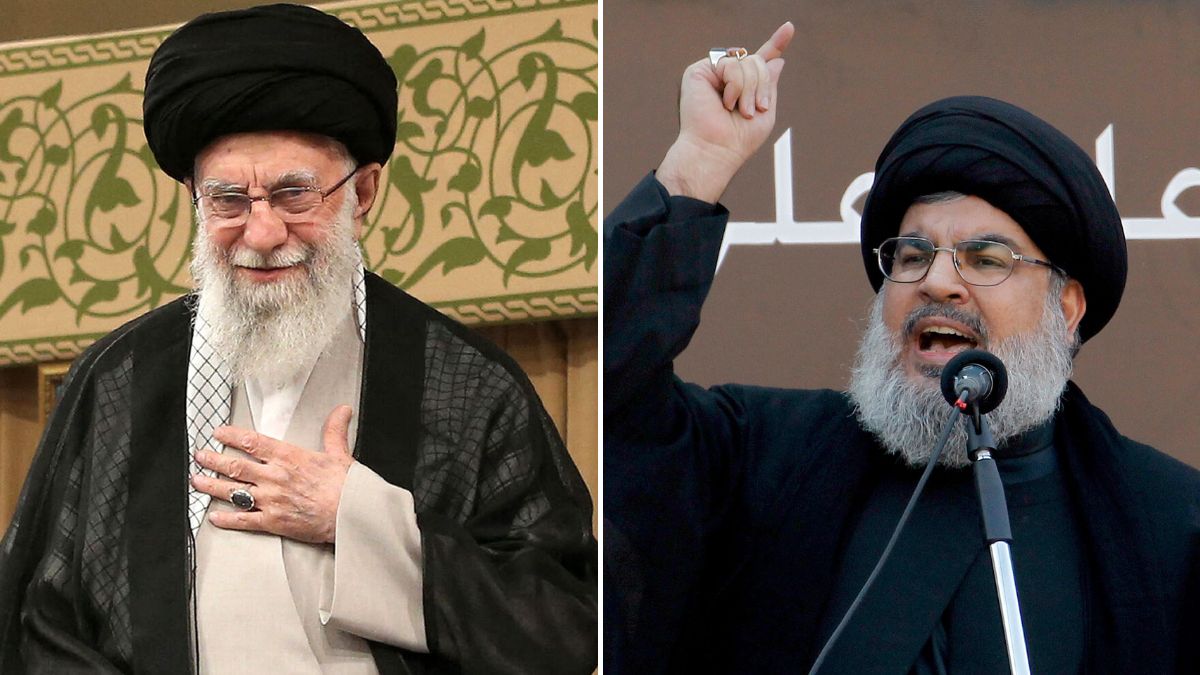
Iranian leader Al Khamenei with killed Hezbollah's Hassan Nasrallah and assassinated IRGC head Qassem Suleimani

Sixty-four-year-old Nasrallah was the principal cat’s paw of Ayatollahs of Iran as he ran the brutal Islamic group for the past three decades, taking on the powerful Israelis head-on during the occupation of southern Lebanon and then 2006 land war which ended in a stalemate.
That the Israelis caught Nasrallah unawares in his Beirut bunker last night shows the level of precise actionable intelligence and deadly targeting through laser-guided concrete penetrating bombs by the Israeli Air Force.

Presently, the majority of the population in north and central Israel are hiding in bomb shelters fearing Hezbollah and Iran retaliation post-killing of Nasrallah.
Hassan Nasrullah was favourite of Ayatollah Khamenei

Although Iran has been using Shia Houthis, Sunni Hamas, and Shia Kaitab Hezbollah in Iraq, Nasrallah, and his Lebanon-based group is the closest to the Iranian clergy and its strong arm—the QUDS force.

The killing of Nasrallah along with the deaths of senior commanders since the pagers exploded must be a serious setback for Tehran as the son of a vegetable seller was a favourite of Ayatollah Khomeini.

It was Khomeini’s 1979 Iranian revolution that radicalized the Hezbollah cadre and made them into fighters after taking training from Islamic Revolutionary Guard Corps of Iran. Hezbollah supported Syrian dictator Bashar al-Assad and virtually captured the once-Christian Lebanon.

Nasrallah ran afoul with Israel after Hezbollah launched rocket attacks into the north of Jew nation in support of Hamas post-October 7 massacre. In a span of two months, Israel has severely degraded Hezbollah’s fighting capabilities after killing top commanders like Fuad Shukr and Ibrahim Aqil in targeted strikes.

The losses of top and middle-level Hezbollah commanders will make it very difficult for Iran to appoint the successor of Nasrallah as even his deputy has been taken out by Tel Aviv.

Just like Hamas, Hezbollah is an ideology that cannot die despite its top leader being exterminated. The Israeli borders with Lebanon and Gaza will remain hot and so will be the skies with missiles being fired by Houthis in Yemen. The death of Nasrallah may trigger a strong retaliation from Iran but the missile capabilities of Tehran are limited in range and effectiveness.

After taking out Hamas’ Ismail Haniyeh in Tehran, Nasrallah in Lebanon, Israel has taken the fight to Iran. The ball is now in Ali Khamenei’s court as his credibility is at stake.


Iran Supreme Leader next? Tehran moves Ayatollah Khamenei to secure spot after IDF says Hezbollah chief killed

After declaring Hezbollah chief Hassan Nasrallah dead, Israeli army chief said, 'Anyone who threatens the citizens of Israel – we will know how to reach them'

Web Desk Updated: September 28, 2024 15:21 IST
Iran's Supreme Leader Ayatollah Ali Khamenei was moved to a secure location after Israel announced the death of Hezbollah chief Hassan Nasrallah | AFP

Iran Supreme Leader Ayatollah Ali Khamenei has been moved to safer place within the country and security has been beefed up after Israeli military said Tehran-backed Hezbollah chief Hassan Nasrallah was killed in the Beirut strike, said a report.

The sources quoted by Reuters said Iran was in constant touch with Hezbollah to decide on its next move.

ALSO READ: Hezbollah chief Hassan Nasrallah DEAD in Beirut strike, claims IDF


Iran's move comes after Israeli army chief said the IDF has not emptied its "toolbox" with Nasrallah's assassination. Chief of the General Staff Herzi Halevi said "the message is simple: Anyone who threatens the citizens of Israel – we will know how to reach them."

Hezbollah leadership was meeting at their undrground headquarters in south Beirut when the Israeli military launched its precision attack.

Hezbollah is yet confirm if Nasrallah has been killed. Earlier, a spokesperson of the group said the Hezbollah chief was fine and not in the targeted location.

Reports also said Nasrallah's daughter Zainab Nasrallah, Hezbollah missile unit commander Muhammad Ali Ismail and his deputy Hossein Ahmed Ismail were also killed in IDF strikes.

Israel had activated three batallions of reserve soldiers amid recent attacks in Lebanon.


ANALYSIS

Strikes on Beirut’s southern suburbs, the fate of Nasrallah: how to explain Hezbollah’s silence

The party's media continues its coverage of the war as if nothing has happened.


OLJ / By Salah HIJAZI, 28 September 2024


Protesters in Tehran hold up photos of Hezbollah leader Hassan Nasrallah following the Israeli strike on the southern suburbs on Friday, September 27, 2024. Photo credit: ATTA KENARE / AFP


The Israeli army announced on Saturday that it had succeeded in assassinating, in a lethal strike on the southern suburbs of Beirut the day before, the all-powerful secretary-general of Hezbollah, Hassan Nasrallah. An event whose shockwaves are likely to be felt across the region, as Nasrallah was a key figure in the pro-Iranian axis. He is sometimes even described as the number two in this camp, behind Supreme Leader Ali Khamenei.

During the night from Friday to Saturday, the southern suburb, a Hezbollah stronghold and densely populated area, was bombarded throughout the night. But on Hezbollah’s side, it’s radio silence. The party's media,such as its al-Manar channel or the al-Ahed website, do not mention Israeli allegations about this assassination or the uncertainty about Hassan Nasrallah's fate.

On the contrary, these two outlets continue their coverage of the war as if nothing had happened. Similarly, the party's official communication channels simply announce the various operations it is conducting against Israel. A resounding silence that raises many questions.

What we know


After the violent Israeli strike on Friday against the southern suburbs of Beirut, which, according to Tel Aviv, targeted the party's headquarters, sources close to Hezbollah told Reuters that the organization had lost contact with its leader. At the same time, other party insiders, such as journalist Faisal Abdel Sater, claimed that Hassan Nasrallah was still alive. The next day, the Israelis announced they had evidence of the "success" of their operation, which Hezbollah has not commented on.


The hypotheses

Hezbollah's silence regarding the fate of its secretary-general could simply be due to the fact that the party itself does not know if Hassan Nasrallah has survived the strike or not. This is reminiscent of the assassination by Israel of the chief of staff of the organization, Fouad Chukur, last August. It took a day for his body to be found and his death confirmed. In the meantime, contradictory information was constantly circulating.

Hezbollah has all the more reason to refrain from making statements on the subject since Nasrallah has developed, over his years at the head of the powerful Shiite organization, an almost divine image in the eyes of his most loyal supporters. Announcing uncertainty about his fate, or even his death, could cause panic and mobilization in the streets, especially in Shiite regions that have been continuously bombarded by the Israeli army since Friday evening.

Another hypothesis that circulates, particularly in circles close to the organization, is that Hassan Nasrallah is still alive, and his silence is therefore a tool of "psychological warfare" against Israel. These circles particularly recall the July 2006 war, during which Hassan Nasrallah broke a three-day silence with a speech. He announced, live, a missile strike on an Israeli warship deployed in Lebanese waters. "Watch it burn," he exclaimed, in a speech forever etched in history.

A third hypothesis can be put forward: that the party is completely overwhelmed by events. If the death of its leader is confirmed, the entire command would have been decapitated. Hezbollah is probably awaiting instructions from its Iranian patron before reacting. But on Tehran's side too, there is radio silence.


Nasrallah led Hezbollah through decades of conflict with Israel

Updated / Saturday, 28 Sep 2024 
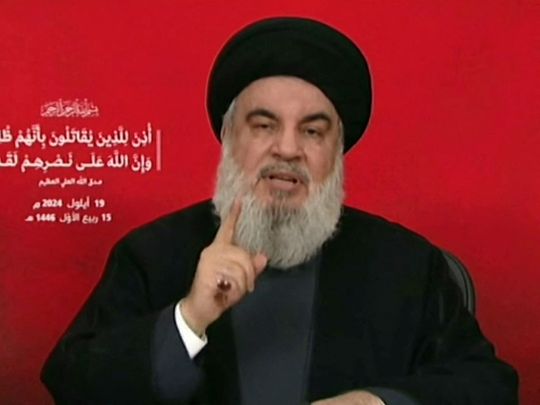
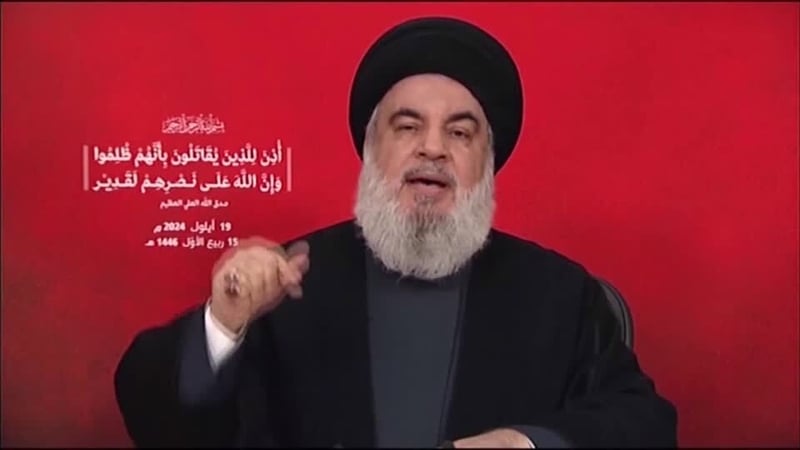
Hassan Nasrallah's most recent speech broadcast on 19 September

Lebanon's Sayyed Hassan Nasrallah, who Israel said it has killed, led Hezbollah through decades of conflict with Israel, overseeing its transformation into a military force with regional sway and becoming one of the most prominent Arab figures in generations - with Iranian backing.

The Iran-backed Hezbollah has yet to issue any statement on the status of Nasrallah, who led the group for 32 years.

The Israeli military said it had killed Nasrallah in an airstrike on the group's central headquarters in the southern suburbs of Beirut a day earlier.

The Israeli military "eliminated ... Hassan Nasrallah, leader of the Hezbollah terrorist organisation," Israeli army spokesperson Avichay Adraee wrote in a statement on X.

Among supporters, Nasrallah was lauded for standing up to Israel and defying the United States.

To enemies, he was head of a terrorist organisation and a proxy for Iran's Shi'ite Islamist theocracy in its tussle for influence in the Middle East.

His regional influence was on display over nearly a year of conflict ignited by the Gaza war, as Hezbollah entered the fray by firing on Israel from southern Lebanon in support of its Palestinian ally Hamas, and Yemeni and Iraqi groups followed suit, operating under the umbrella of "The Axis of Resistance".

"We are facing a great battle," Nasrallah said in an 1 August speech at the funeral of Hezbollah's top military commander, Fuad Shukr, who was killed in an Israeli strike on the Hezbollah-controlled southern suburbs of Beirut.

Yet when thousands of Hezbollah members were injured and dozens killed, when their communications devices exploded in an apparent Israeli attack last week, that battle began to turn against his group.

Responding to the attacks on Hezbollah's communications network in a 19 September speech, Nasrallah vowed to punish Israel.

"This is a reckoning that will come, its nature, its size, how and where? This is certainly what we will keep to ourselves and in the narrowest circle even within ourselves," he said.

He had not given a broadcast address since then.
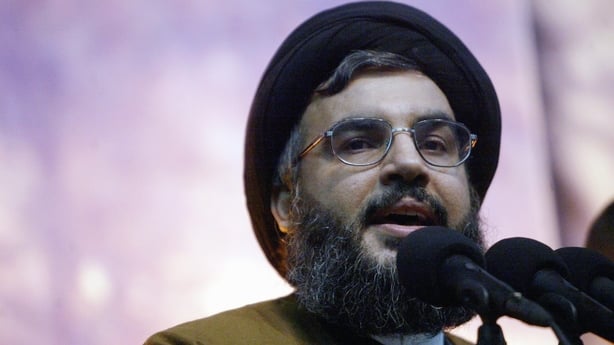
Hassan Nasrallah speaking in Beirut in 2004

Israel has meanwhile dramatically escalated its attacks, killing several senior Hezbollah commanders in targeted strikes and unleashing a massive bombardment in Hezbollah-controlled areas of Lebanon, which has killed hundreds of people.

Recognised even by his enemies as a skilled orator, Nasrallah's speeches were followed by friend and foe alike.

Wearing the black turban of a sayyed, or a descendent of the Prophet Mohammad, Nasrallah used his addresses to rally Hezbollah's base but also to deliver carefully calibrated threats, often wagging his finger as he does so.

He became secretary general of Hezbollah in 1992 aged just 35, the public face of a once shadowy group founded by Iran's Revolutionary Guards in 1982 to fight Israeli occupation forces.

Israel killed his predecessor, Sayyed Abbas al-Musawi, in a helicopter attack. Nasrallah led Hezbollah when its guerrillas finally drove Israeli forces from southern Lebanon in 2000, ending an 18-year occupation.

'Divine victory'

Conflict with Israel largely defined his leadership. He declared "Divine Victory" in 2006 after Hezbollah waged 34 days of war with Israel, winning the respect of many ordinary Arabs who had grown up watching Israel defeat their armies.

But he became an increasingly divisive figure in Lebanon and the wider Arab world as Hezbollah's area of operations widened to Syria and beyond, reflecting an intensifying conflict between Shi'ite Iran and US-allied Sunni Arab monarchies in the Gulf.

While Nasrallah painted Hezbollah's engagement in Syria - where it fought in support of President Bashar al-Assad during the civil war - as a campaign against jihadists, critics accused the group of becoming part of a regional sectarian conflict.

At home, Nasrallah's critics said Hezbollah's regional adventurism imposed an unbearable price on Lebanon, leading once friendly Gulf Arabs to shun the country - a factor that contributed to its 2019 financial collapse.

In the years following the 2006 war, Nasrallah walked a tightrope over a new conflict with Israel, hoarding Iranian rockets in a carefully measured contest of threat and counter threat.

The Gaza war, ignited by the 7 October Hamas attack on Israel, prompted Hezbollah's worst conflict with Israel since 2006, costing the group hundreds of its fighters including top commanders.

After years of entanglements elsewhere, the conflict put renewed focus on Hezbollah's historic struggle with Israel.

"We are here paying the price for our front of support for Gaza, and for the Palestinian people, and our adoption of the Palestinian cause," Nasrallah said in the 1 August speech.

Nasrallah grew up in Beirut's impoverished Karantina district. His family hail from Bazouriyeh, a village in the Lebanon's predominantly Shi'ite south which today forms Hezbollah's political heartland.

He was part of a generation of young Lebanese Shi'ites whose political outlook was shaped by Iran's 1979 Islamic Revolution.

Before leading the group, he used to spend nights with frontline guerrillas fighting Israel's occupying army. His teenage son, Hadi, died in battle in 1997, a loss that gave him legitimacy among his core Shi'ite constituency in Lebanon.

Hassan Nasrallah's son Hadi was killed in battle in 1997

Powerful enemies

He had a track record of threatening powerful enemies.

As regional tensions escalated after the eruption of the Gaza war, Nasrallah issued a thinly veiled warning to US warships in the Mediterranean, telling them: "We have prepared for the fleets with which you threaten us."

In 2020, Nasrallah vowed that US soldiers would leave the region in coffins after Iranian general Qassem Soleimani was killed in a US drone strike in Iraq.

He expressed fierce opposition to Saudi Arabia over its armed intervention in Yemen, where, with US and other allied support, Riyadh sought to roll back the Iran-aligned Houthis.

As regional tensions rose in 2019 following an attack on Saudi oil facilities, he said Saudi Arabia and the United Arab Emirates should halt the Yemen war to protect themselves.

"Don't bet on a war against Iran because they will destroy you," he said in a message directed at Riyadh.
On Nasrallah's watch, Hezbollah has also clashed with adversaries at home in Lebanon.

In 2008, he accused the Lebanese government - backed at the time by the West and Saudi Arabia - of declaring war by moving to ban his group's internal communication network. Nasrallah vowed to "cut off the hand" that tried to dismantle it.

It prompted four days of civil war pitting Hezbollah against Sunni and Druze fighters, and the Shi'ite group to take over half the capital Beirut.

He strongly denied any Hezbollah involvement in the 2005 assassination of former Prime Minister Rafik al-Hariri, after a UN-backed tribunal indicted four members of the group.

Nasrallah rejected the tribunal - which in 2020 eventually convicted three of them in absentia over the assassination - as a tool in the hands of Hezbollah's enemies.