It’s possible that I shall make an ass of myself. But in that case one can always get out of it with a little dialectic. I have, of course, so worded my proposition as to be right either way (K.Marx, Letter to F.Engels on the Indian Mutiny)
Saturday, June 27, 2026
TRICKY DICK FANBOY
'Where'd you go to school?' JD Vance raked over the coals after 'stupid' Nixon comment
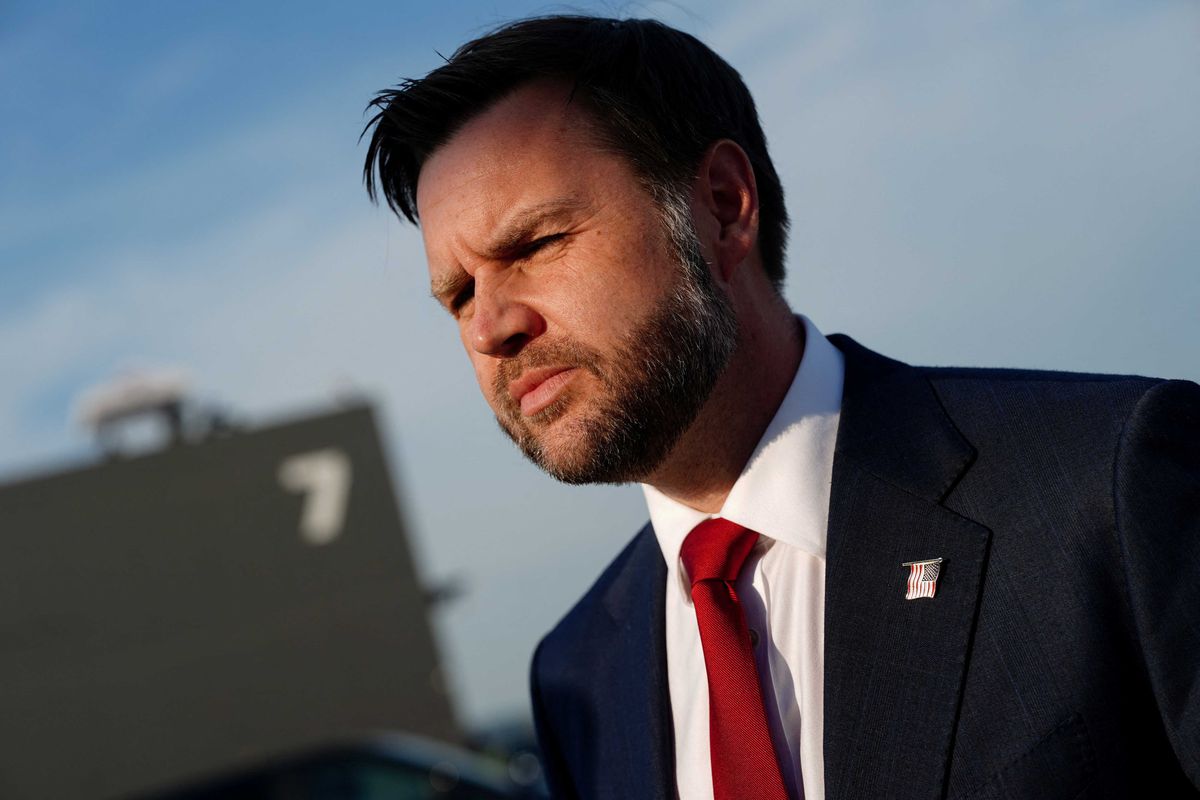
U.S. Vice President JD Vance before boarding Air Force Two, after the U.S. and Iran held high-level talks at the Lake Lucerne Summit, at Emmen Military Air Base, Emmen, Switzerland, June 22, 2026. REUTERS/Nathan Howard/Pool
Comments made by Vice President JD Vance at the Richard Nixon Library on Thursday earned him a thrashing on MS NOW after he blamed Nixon’s Watergate scandal on the “deep state.”
As “Morning Joe” co-host bluntly observed, Nixon's use of the FBI, CIA and Washington insiders — which brought down his presidency — was the very definition of the ”deep state.”
After sharing a clip of Vance, who is on the road promoting his new book “Communion,” telling his hosts, “If you look at the story of how the deep state took down Richard Nixon, it’s not all that different from what the same groups of people, the same institutions tried to do to Donald Trump in the first Trump administration,” Scarborough had enough.
“No, no, don't clap,” he exclaimed. “I mean, because, listen, I know he, I know he didn't go to a southern state school like me, but what he's saying is ahistoric, what he's saying is stupid. You can say a lot of things about Richard Nixon from 1946 through 1973, you can talk about opening of China, you can talk about the creation of the EPA, you can talk about a ton with Russia, you can talk about how we use China to counterbalance Russia with that triangulation you can talk about just again how he was one of the more significant political figures of his time, but to say that? That is defining deviancy down, and that's trying to say, ‘Listen, what we're doing now, you know it's not bad.”
“That deep state comment? So stupid. Where did you go to school, man? Where did you go to school? Like, did you really get a degree from Yale?” the clearly exasperated Scarborough later asked.
Defense of Nixon’s Watergate Crimes Is JD Vance ‘Telling on Himself,’ Say Critics
“He’s insinuating that his own regime has so normalized corruption and lawlessness that past corruption and lawbreaking schemes now seem minor.” US Vice President JD Vance speaks during an event at the Richard Nixon Presidential Library & Museum on June 25, 2026, in Yorba Linda, California. (Photo by Jeff Gritchen/MediaNews Group/Orange County Register via Getty Images)
At an event for the Richard Nixon Foundation on Thursday, Vice President JD Vance suggested that if the 37th president’s Watergate scandal had happened today, it would barely make the news, let alone destroy a presidency.
But his critics say that’s only because President Donald Trump has totally “normalized” corruption.
During a speech at the Nixon Presidential Library in Yorba Linda, California, Vance celebrated that the “historical legacy” of Tricky Dick, whose name has functioned as a shorthand for presidential lawlessness since his resignation in 1974, “is enjoying a bit of a renaissance, and, I think, deservedly so.”
“If Watergate happened tomorrow, it would be like a 12-hour news story,” Vance said. “The idea that it would have taken down a presidency is crazy.”
He said the way the “deep state took down Richard Nixon” was “not all that different from what the same groups of people, the same institutions tried to do to Donald Trump in the first Trump administration.”
Vance also said he personally identified with Nixon: “Young senator, vice president, writes a bestselling book, is hated by the media. It kinda sounds like JD Vance,” he said. “I’ve always liked Richard Nixon.”
The vice president was correct that, as Trump adopts a similar philosophy of boundless executive authority, there is a concerted effort among Republicans to rehabilitate the image of Nixon—who infamously declared in a 1977 interview with David Frost that “if the president does it, that means it’s not illegal.”
Christopher Rufo, an intellectual architect of crusades by the so-called “New Right” against liberal cultural institutions, in 2023 cast Nixon’s presidency as “a blueprint for counterrevolution—the last hope for restoring the American republic,” praising his efforts to use lawfare to destroy left-wing groups.
Vivek Ramaswamy, a 2024 Republican presidential candidate who is now running for governor of Ohio, has called for a “revival of Nixonian realism” in foreign policy, citing his “unapologetic American nationalism” and hyperfocus on US interests at the expense of moral concerns.
During a speech at the National Conservatism Conference in 2021, Vance himself cited Nixon’s declaration that “the professors are the enemy” to say that the next Republican president would need to “honestly and aggressively attack the universities in this country.”
Some critics described Vance’s downplaying of Watergate’s severity on Thursday as a sign of historical ignorance or willful deception.
“Let’s remember what Nixon actually did,” said Rep. Mike Levin (D-Calif.). “Operatives tied to his reelection campaign broke into the Democratic National Committee headquarters to plant listening devices. Then Nixon personally orchestrated the cover-up. The ‘smoking gun’ tape caught him ordering the CIA to shut down the FBI’s investigation.”
“Nixon weaponized the IRS and FBI against his political enemies, authorized burglaries of private citizens, and fired the special prosecutor investigating him in what is called the Saturday Night Massacre,” continued Levin. “When the Supreme Court ordered him to release the tapes, the vote was unanimous. Even his most loyal defenders walked away once they heard his own words.”
“JD Vance works for the most corrupt president in American history,” Levin said. “So of course he wants you to believe Watergate was nothing.”
Political scientist and author Michael McFaul suggested that Vance was not aware of how bad he sounded.
The fact that Watergate would probably be a mere blip, McFaul said, “is a tragic indictment of [Vance’s] administration,” and it’s “amazing to me that’s not obvious to him.”
Others saw it not as a feint from Vance, but as a boast about everything the Trump administration has gotten away with.
“'We do a Watergate twice a day’ is a crazy way to confess your own corruption,” said Rep. Jim McGovern (D-Mass.) in response to Vance’s comments.
“Vance is telling on himself,” said The Lever editor-in-chief, David Sirota. “He’s insinuating that his own regime has so normalized corruption and lawlessness that past corruption and lawbreaking schemes now seem minor.”
John Culver, a retired CIA analyst, said that Vance is “right” that Watergate would no longer register with the public today, “but not for the reasons he thinks.”
He blamed modern corporate-controlled media for numbing the public to outrageous political scandals that would have once enveloped a presidency.
Washington Post owner Jeff Bezos “would have fired” Bob Woodward and Carl Bernstein, the journalists who broke the Watergate scandal, “a year earlier,” Culver said. “The [New York Times] journos would save it for their book.”
He said, “Trump has a Watergate-scale scandal every month, and media billionaires distract, distract, distract.”
Bolton attorney tears apart Trump in blistering statement after client's guilty plea
Former White House national security adviser John Bolton in Greenbelt, Maryland, U.S., October 17, 2025. REUTERS/Leah Milli
On Friday morning, June 26, former National Security Adviser John Bolton entered a guilty plea to illegally retaining classified information related to his work in the first Trump administration. But Bolton's attorney, that same morning, gave a scathing opinion of the indictment.
Lowell, according to journalist Scott MacFarlane, said, in his statement, "Ambassador Bolton did what real leaders do. He took responsibility for a mistake he made, thereby saving the government resources to pursue a case that could expose additional sensitive information. By contrast, President Trump thumbed his nose at the classified information laws, took actual classified documents to his Florida mansion, interfered with the investigation of that conduct, and has never accepted any accountability for his conduct. Ambassador Bolton, whose offense was only keeping a diary which contained classified information, kept a record to preserve history, but Donald Trump kept secrets to serve himself."
According to NBC News reporters Owen Hayes and Rebecca Shabad, Bolton "faces a prison sentence of up to 60 months and has agreed to pay $2.25 million, prosecutors said. He is set to be sentenced October 28."
Hayes and Shabad note, "Bolton described the national security information that he retained as an electronic diary entry that he shared with two members of his family. Bolton was originally indicted in October 2025, charged with eight counts of transmission of national defense information and 10 counts of retention of national defense information. He pleaded not guilty to the charges and faced up to 10 years in prison, a $250,000 fine per count, and three years of special release."
The NBC News reporters point out that in 2025, Lowell said of the case against Bolton, "The underlying facts in this case were investigated and resolved years ago. These charges stem from portions of Amb. Bolton's personal diaries over his 45-year career — records that are unclassified, shared only with his immediate family, and known to the FBI as far back as 2021."
Hayes and Shabad report, "Last fall, Bolton was the third Trump critic to be indicted by the Justice Department, which also charged New York Attorney General Letitia James and former FBI Director James Comey in separate cases on charges of mortgage fraud and lying to Congress, respectively. After a federal judge dismissed the charges against James, the DOJ twice failed to re-indict her."
Amid Warnings of Atrocities in Sudan, Van Hollen Says Senate ‘Missed Opportunity’ to Cut Off Arms to UAE “The United States shouldn’t just be talking about ending the slaughter in Sudan,” the senator said. “We should actually be using our leverage.”
US Sen. Chris Van Hollen (D-MD) questions US Secretary of State Marco Rubio as he testifies during a Senate Foreign Relations Committee hearing in the Dirksen Senate Office Building on June 2, 2026 in Washington, DC. (Photo by Anna Moneymaker/Getty Images)
After the US State Department warned earlier this week of imminent “atrocities” by Sudan’s Rapid Support Forces, Sen. Chris Van Hollen on Tuesday criticized the US Senate for missing a recent opportunity to cut off weapons to the United Arab Emirates, which has supplied the genocidal paramilitary group.
On Monday, the State Department warned that RSF forces were massing near the city of El-Obeid and could commit “mass atrocities” against civilians if allowed to take the city.
“The belligerents must uphold their obligations under international humanitarian law to protect civilians and ensure that those seeking safety can do so without fear or obstruction,” the department said.
The statement echoed concerns expressed last week by a coalition of states at the United NationsHuman Rights Council (UNHRC), which said that roughly 500,000 civilians, including more than 100,000 displaced people, could be at risk of violence if RSF escalated its assault.
UN human rights experts have said RSF’s October offensive in Darfur bore the “hallmarks of genocide,” with more than 6,000 people killed and numerous civilians tortured, raped, and starved during a three-day rampage across the city of El-Fasher.
But while Trump’s State Department has sanctioned some entities accused of supplying fighters for the RSF, the Monday statement made no mention of the UAE, which rights groups point out is the group’s principal foreign backer.
A report issued last year by Van Hollen (D-Md.) and Rep. Sara Jacobs (D-Calif.) found that the UAE was continuing to provide weapons to the RSF despite telling the US that it was not.
Following previous failed attempts at pushing Congress to impose an arms embargo on Sudan through standalone legislation, Van Hollen attempted to do so again last week by tacking a pair of amendments onto the bipartisan PEACE in Sudan Act, which requires the State Department to assess designating armed Sudanese groups as terrorists and allows Trump to impose optional sanctions on foreign actors funding the war, but stopped short of introducing any hard leverage.
At a markup session for the Senate Foreign Relations Committee last week, Van Hollen introduced an amendment banning the US from selling or transferring military equipment to the UAE as long as it continues supporting the RSF. The amendment failed in a 15-7 vote, with four Democrats—Sens. Jeanne Shaheen (NH), Chris Coons (Del.), Tammy Duckworth (Ill.), and Jacky Rosen (Nev.)—joining every Republican on the committee, aside from Sen. Rand Paul (Ky.), in opposition.
A second amendment, which did not single out the UAE specifically but restricted arms sales to any country arming either side of the conflict, also failed 13-9, but received support from Shaheen and Rosen.
Coons said he’d have “enthusiastically” supported the amendment, but voted no because he believed it would “bring down” the broader Sudan bill in a GOP-controlled Senate. Duckworth did not explain her reasoning for voting no.
In light of the State Department’s warning this week about RSF’s march toward El-Obeid, Van Hollen told a Drop Site News reporter on Tuesday that he believed the no vote on his amendments “was a missed opportunity.”
“The United States shouldn’t just be talking about ending the slaughter in Sudan. We should actually be using our leverage,” he said.
Noting that Trump likely would not support a restriction on arms to the UAE given his extensive financial entanglements with the Emiratis and his previous policy of fast-tracking weapons to the country without any strings attached, Van Hollen said his goal was simply to “keep the pressure on.”
He said, “We need to keep showing the hypocrisy of the Trump administration policy, where they claim they want to do something but refuse to take some of the basic actions we can take as a country.”
The Fight Against AI Data Centers Is the Newest Frontier of Global Class Warfare
AI is deepening worldwide webs of accumulation, ushering in new class and power relations.
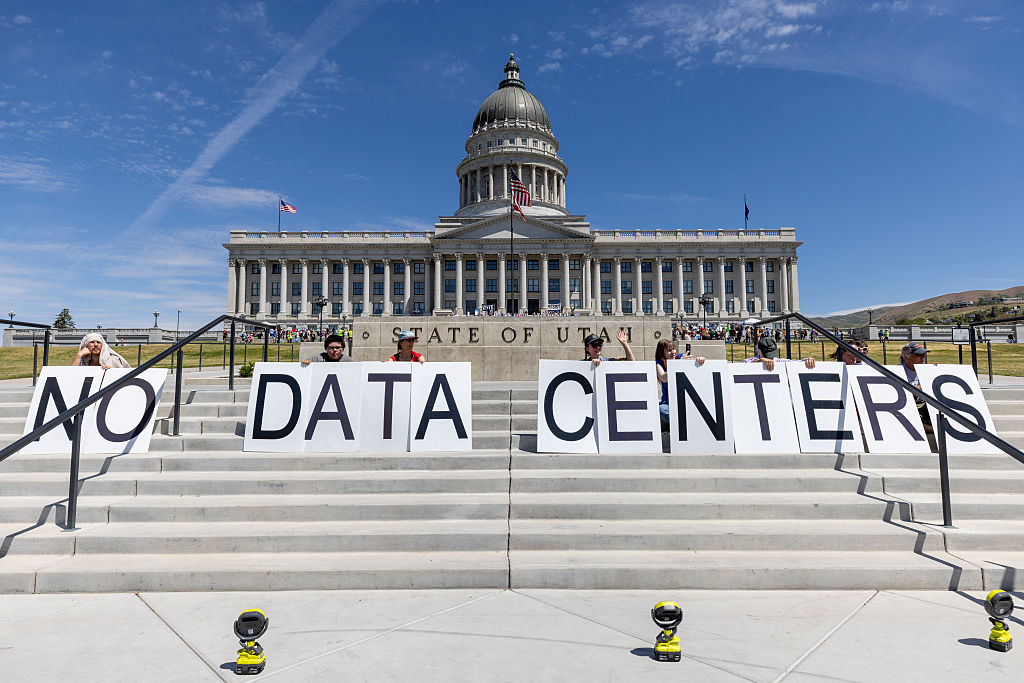
Demonstrators take part in a protest at the Utah State Capitol to oppose the construction of the Stratos data center in Box Elder County on May 23, 2026, in Salt Lake City, Utah.Natalie Behring / Getty Images
The relentless drive by Big Tech corporations to expand data center construction to every continent has sparked a growing movement of mass resistance. From the United States to Ireland, from Chile to Malaysia, grassroots communities are protesting water depletion, soaring utility bills, air and noise pollution, and environmental destruction. Behind the data center boom is the artificial intelligence (AI) revolution. The amount of capital and energy needed to supply AI training and compute power is skyrocketing. The massive increase in compute power in turn requires monumental amounts of electricity along with water for cooling computers. This tsunamic shift in energy requirements has led to a global grab for land on which to locate data centers, energy sources to fuel these centers, and the rare earth and other critical minerals that AI technologies require.
The data center boom has spared no continent. New hyperscale data centers cost more than $100 billion; generate upward of one gigawatt, equivalent to an average nuclear power plant; and sprawl across thousands of acres. China and the United States are experiencing the fastest growth in data centers and investment is also flowing outward from both countries and from Europe to new regions. Southeast Asia is experiencing an unprecedented data center boom, with major hubs in Malaysia, Thailand, Vietnam, the Philippines, Indonesia, and Singapore. Latin America is experiencing its own expansion, mirroring that of Southeast Asia, with hubs in Mexico, Brazil, Chile, Colombia, and Peru, with submarine cables linking hubs to global circuits.
Africa is going through a similar construction boom, with major hubs in South Africa, Kenya, Nigeria, and Morocco. Data centers are proliferating in the Middle East, driven by the availability of cheap land, abundant fossil fuel, and billions of investable dollars in sovereign wealth funds. Saudi Arabia’s $40 billon fund made it the largest investor worldwide in AI in 2024. Both it and the United Arab Emirates announced that year that they would launch $100 billion investment plans for data centers, researchers, and other AI ventures. In the words of OpenAI CEO Sam Altman, “I do guess that a lot of the world gets covered in data centers over time.”
A data center under construction in the U.S. state of Utah gives an idea of the gargantuan dimensions of these mega-investments. Once completed, it will cover twice as much land as the island of Manhattan, require more power than the entire state of Utah uses, and suck in a vast amount of water in the drought-stricken area. A recent United Nations Report projects that by 2030, global AI development will annually demand 945 terawatt-hours of electricity and 9.3 trillion liters of water — equivalent to the water needs of 1.3 billion people — threatening to aggravate shortages and drought. In the United States, about two-thirds of upcoming data centers are set to be built in places that have been among the driest in the country over the past year. Of 809 planned data centers, 517 are in locations that have been in drought conditions throughout the past year.
Pax Silica and the AI Capital Complex
A data center under construction in the U.S. state of Utah gives an idea of the gargantuan dimensions of these mega-investments. Once completed, it will cover twice as much land as the island of Manhattan.
AI is deepening worldwide webs of accumulation, bringing about new class and power relations, and promising to have a transformative effect around the globe. It is fast becoming a general-purpose technology — meaning that, like electricity or the internet, it spreads throughout all branches of the economy and society and becomes built into everything. Nearly 100 percent of U.S. economic growth in 2025 came from investment in digital technologies. To give an idea of the meteoric rise of AI-driven technologies to the very core of the global economy, adjusted annual private fixed investment in these technologies in the United States alone jumped from $17 billion in 1970, to $65 billion in 1980, to $175 billion in 1990, $496 billion in 2000, topped $800 billion in 2020, and then reached $1.5 trillion by early 2026. Worldwide, AI spending was forecast to total $2.5 trillion in 2026, a 44 percent increase over 2025. To put this in perspective, the expansion of AI infrastructure in 2025 represented nearly three percent of the entire global GDP.
Use of AI is also skyrocketing around the world. In 2024, 78 percent of organizations surveyed by Stanford University’s Human-Centered Artificial Intelligence center reported using AI, compared to 55 percent just a year earlier (the percentage using generative AI jumped from 33 to 71 in this same period). China showed the highest rate of growth in the use of AI — 27 percent — from 2023 to 2024. This growing dependence on AI is not limited to the core countries of the world capitalist system. The 78 percent figure is global. The figure was 72 percent in Asia-Pacific, 80 percent in Europe, 82 percent in North America, 75 percent in China, and 77 percent in what the Stanford report refers to as “developing markets,” including India, the Middle East and North Africa, and Central and South America.
The new AI-driven technologies mediate the gamut of human interactions. Many corporations, states, political, military institutions, schools, and hospitals are now dependent on these technologies to function. This dependence of our global economy and society on these technologies gives big tech corporations and the billionaires, financiers, and warlords who control them enormous structural power over states and peoples. A vast expansion of data centers to feed the computational needs of AI underpins this emerging AI capital power bloc. This new ruling class is cohering as a triangulated bloc of transnational capital that brings together the giant tech companies, transnational finance capital, and the military-industrial-repression complex — to put this another way, the bloc brings together Silicon Valley, Wall Street, and the Pentagon.
The AI revolution has greatly enhanced the class power of the transnational capitalist class over the global working class and its structural power over capitalist states. In his final farewell address to the nation on January 14, 2025, outgoing U.S. President Joe Biden warned of a “tech industrial complex” and of a new “oligarchy taking shape” through the “dangerous concentration of power in the hands of a very few ultra-wealthy people” — a warning that reenacted president Dwight Eisenhower’s famous 1961 final address on the dangers of the “unwarranted influence of the military-industrial complex.”
The U.S. State Department has referred to the new AI dispensation as Pax Silica. “If the twentieth century ran on oil and steel, the twenty-first century runs on compute and the minerals that feed it,” declared U.S. Under Secretary of State for Economic Affairs Jacob Helberg in December 2025. Pax Silica involves developing “global supply chains” that are to drive “historic opportunity and demand for energy, critical minerals, manufacturing, technological hardware, infrastructure, and new markets not yet invented.” In the first year of its second term, the Trump government undertook a sweeping deregulation of AI and promised to promote a vast expansion of data centers.
Led by the new hegemonic capital complex, the transnational capitalist class has unleashed a predatory round of digitally driven expansion around the world, pivoting toward more extreme forms of extractivist accumulation as it seizes land, energy, and mineral resources to fuel the demands of AI technology and data centers. This is the big picture behind the global maelstrom, from Venezuela to Iran, from the Congolese and Sudanese civil wars to Washington’s Greenland grab to ICE terrorism in U.S. cities.
Data centers in Ireland rely heavily on fossil fuels, are driving up energy prices, and are projected to add as much as $850 to household utility bills over the next decade.
AI in the hands of the transnational capitalist class is an instrument of class warfare against the global working and popular classes. AI accelerates the process whereby labor is deskilled, made precarious, and expelled through algorithmic restructuring of the labor process and outright automation. The flip side of the jobs apocalypse this will induce is the degradation and immiseration of those workers still required, including the data workers themselves who are reduced to itinerant laborers. One report tracked down the workers who powered OpenAI’s popular AI chatbot, ChatGPT. It found that the wages were so miserable that a number of them could not afford housing and were homeless.
Warfare, social control, and repression are also being digitalized and automated. Global AI supply chains span everything from mineral extraction to manufacturing to data center operation. Each step along the way involves the displacement of communities, the exploitation of labor, and the repression of resistance. Big tech has sought to embed itself in military and security agencies around the world. The AI state is a warfare state with enhanced capacity to surveil and control. The whole thrust of capital investment and accumulation worldwide is shifting to advanced AI-driven militarization. Communities Fight Back Against the Data Center Takeover
Seen in this light, escalating resistance worldwide to the data center construction boom constitutes working class struggle from below. As the “Silicon Valley of Europe,” Ireland has grabbed global attention for its growing mass movement against the data center invasion. The country has one of the largest clusters of data centers in the world. Dozens of centers in Dublin alone suck in more electricity that all urban homes combined in the country, accounting now for over 20 percent of the country’s electricity supply. A report by Friends of the Earth found that data centers in Ireland rely heavily on fossil fuels, are driving up energy prices, and are projected to add up to nearly $740 to household utility bills over the next decade.
In the United States, 7 out of every 10 people oppose having data centers located in their communities.
In Mexico, residents near a Microsoft data center say that, since the plant opened in 2024, power cuts have become more frequent and water outages can last for weeks, affecting schools and hospitals. In Chile, activists shut down Google’s expansion plans in 2024. In the Netherlands, protests blocked access to a construction site for Microsoft’s planned facility this month. In Malaysia, citizens in the state of Johor launched the country’s first data center protest, demanding compensation for dust and noise pollution. Similar protests have taken place in the United Kingdom, Brazil, Spain, Australia, and throughout the United States as a global movement comes into being to push back against the billionaire tech oligarchs.
In the United States, 7 out of every 10 people oppose having data centers located in their communities. The backlash has led, as of June 2026, to over 100 proposed moratoriums on new data center construction at the local, county, state, and national level. At commencement ceremonies on U.S. university campuses graduates now boo their commencement speakers as soon as they mention AI. In May 2026, a group of leading activists, journalists, scholars, and researchers launched the AI Resist List, a publicly accessible global database that documents resistance against the AI capital takeover. The ruling class is taking notice. There is growing evidence that police departments and other state security and intelligence agencies are surveilling and even preparing to criminalize data center critics. State Ownership and the Future of AI
In March, Sen. Bernie Sanders and Rep. Alexandria Ocasio-Cortez introduced the AI Data Center Moratorium Act, legislation that would enact a “reasonable pause” to the development of AI “to ensure the safety of humanity.” Sanders also called for the public to take a 50 percent ownership stake in AI companies. In early June, Sanders met with OpenAI CEO Sam Altman, at the latter’s request, to discuss the Senator’s proposal. Altman agreed that there should be some measure of public participation but he made clear he did not support Sander’s 50 percent threshold, which would deprive technology corporations of controlling shares.
However, these kinds of public ownership arrangements can operate as a mechanism to subsidize capital just as they can function to impose constraints on capital’s prerogatives, depending on the nature of the arrangement. Thus far, the state has intervened in the private sector less to regulate than to guide and shore up the development of digitally based accumulation and the war economy, suggesting that the emerging Pax Silica world order requires certain forms of state capitalism.
In early 2026, the U.S. government committed an initial $10 billion to acquiring equity stakes in private companies from the AI capital complex, including semiconductor company Intel, the military firm L3Harris Missile Solutions, and rare earth mining companies MP Materials and USA Rare Earth, among others. In addition, the White House issued an executive order to “revitalize the defense industrial base” that obliges private contractors with the federal government to prove they are prioritizing “warfighter capability and readiness.” Senate legislation later codified the order, requiring contractors to submit “qualified defense investment plans.” Whether public AI ownership in the United States would function to bolster capital’s power or force capital to be more responsive to the working class depends on how mounting class and popular struggles play out.
This article is licensed under Creative Commons (CC BY-NC-ND 4.0), and you are free to share and republish under the terms of the license.
AI Is Changing Work—Our Unemployment Insurance System Must Change With It
A functional unemployment insurance system for today’s economy would cover more workers, including part-time, gig, and temporary workers, and would provide benefits that actually allow families to survive while searching for new work.
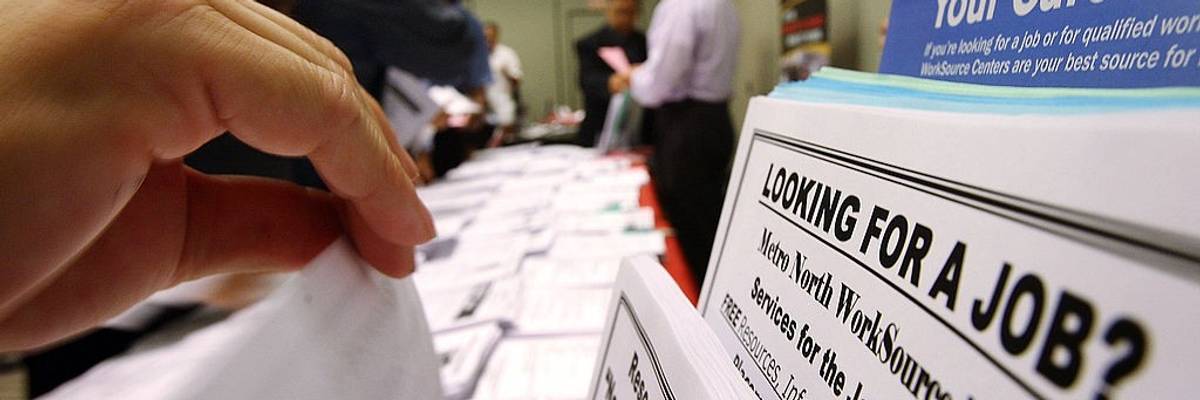
Job seekers look over job opening fliers at the WorkSource exhibit, a collaborative effort by governmental agencies to offer jobs and job training resources at the Greater Los Angeles Career Expo at the Pasadena Convention Center on May 14, 2009 in Pasadena, California. (Photo by David McNew/Getty Images)
For millions of workers, the conversation about artificial intelligence and the future of work is no longer theoretical. It is already showing up in layoffs, hiring freezes, shrinking departments, and growing anxiety about whether the paycheck families rely on today will still exist tomorrow.
But the most important question is not simply which jobs AI will eliminate. It is whether workers will have any real support when those jobs disappear.
While policymakers, executives, and economists debate which industries will thrive and which occupations will disappear in the age of AI, working Americans are focused on more immediate concerns: paying rent, affording groceries, covering childcare, and figuring out how they would support their families if their income suddenly vanished.
Workers are right to worry, because the system meant to help them through job loss is already failing to meet this moment.
While we may not be able to control every change AI will bring, we can decide whether workers will face those changes alone.
America’s unemployment insurance system was built for a different era entirely, one in which AI was nonexistent. It was built for an era that assumed stable full-time employment, long-term employer relationships, and relatively predictable layoffs. Today’s economy looks nothing like that.
Millions of workers now move between part-time jobs, contract work, temporary positions, caregiving responsibilities, and periods outside the workforce entirely. But unemployment insurance rules still exclude many of those workers from receiving help when they need it most.
Today, only about 1 in 4 unemployed workers receive unemployment benefits nationwide. In some states, fewer than 13% received support at all. And even when workers do qualify, benefits are often too low and too short-lived to keep families financially stable while they search for new work.
The result of this broken system is families scrambling to avoid financial free fall: draining savings accounts, falling behind on rent, or taking the first low-paying jobs they can find because they can’t afford to wait for something better.
That disconnect is already visible. While the number of unemployed workers has climbed sharply over the past year, unemployment claims have remained relatively flat—not because people are unaffected, but because so many workers are locked out of a system that no longer reflects the realities of modern work.
The first wave of AI disruption is already here. As adoption of these technologies increases, more workers will cycle between jobs, more families will navigate periods of unemployment, and more people will be forced to rebuild after losing work through no fault of their own.
And those burdens will not fall equally. Women—especially Black women, who are disproportionately represented in clerical and administrative jobs—are among the workers most vulnerable to displacement. Workers of color already face persistently higher unemployment rates because of structural inequities in the labor market. Yet when they lose work, they are significantly less likely to receive unemployment benefits and the economic stability those benefits are supposed to provide.
These are graduates who were told that if they worked hard, earned a degree, and applied themselves, they would find stability and opportunity. Instead, many are entering a labor market defined by uncertainty and shrinking opportunities, all while facing a weakening safety net.
That is why modernizing our unemployment systems must be part of the AI conversation.
A functional unemployment insurance system for today’s economy would cover more workers, including part-time, gig, and temporary workers. It would provide benefits that actually allow families to survive while searching for new work. It would make it easier, not harder, for eligible workers to receive support. And it would actually be prepared to withstand economic downturns.
Unemployment insurance should be understood for what it truly is: economic infrastructure.
Just as roads and bridges help goods move through the economy, unemployment insurance helps people move through economic change without falling into crisis. A strong UI system gives people the stability to search for good jobs instead of being pushed into the first low-wage position available. It stabilizes families, communities, and local businesses during periods of disruption.
The age of stable employment is fading. More workers will inevitably face periods of transition, disruption, and job loss in the years ahead.
While we may not be able to control every change AI will bring, we can decide whether workers will face those changes alone. Modernizing unemployment insurance is not simply a matter of compassion. It is a matter of economic readiness.
Our work is licensed under Creative Commons (CC BY-NC-ND 3.0). Feel free to republish and share widely.
Rebecca Dixon Rebecca Dixon is the president and CEO of the National Employment Law Project. Full Bio >
Fearing Mass Job Loss, Working-Class US Voters Believe Government Must Act to Prevent Economic Disaster
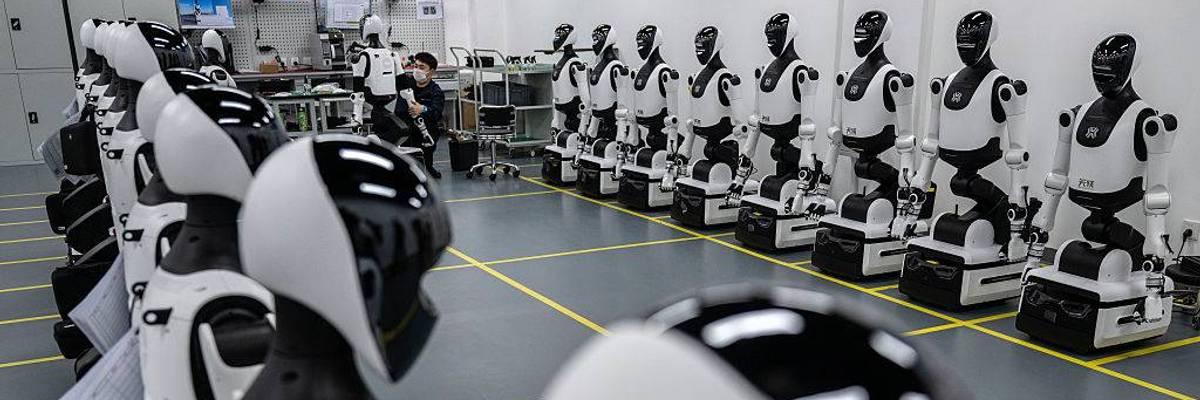
The findings of a new poll could bolster the case made by many progressive politicians about the need to vigorously regulate the AI industry. Humanoid robots are seen lined up as an engineer works on a robot in the production facility of X-Humanoid on March 20, 2026 in Beijing, China. (Photo by Kevin Frayer/Getty Images)
A poll commissioned by Working Families Power reveals deep anxiety among US workers about the impacts of artificial intelligence, as well as support for the government intervening to prevent potential mass unemployment.
The survey of just over 2,500 working-class American voters, conducted by Justice Research Group, finds that 73% said they were worried that AI would lead to job losses in the US, while 62% said they were concerned that AI would personally affect them or people close to them.
Workers expect that AI will negatively impact a broad number of industries, with majorities saying it will hurt truckers and delivery drivers; retail and service workers; writers, designers, and other creative workers; and office and administrative workers, according to the poll. Pluralities, meanwhile, expect AI to hurt teachers, education workers, and healthcare support workers.
With so many workers fearing massive jobs losses due to AI, they also support major government interventions to alleviate the harms caused by the technology.
Overall, 84% of those surveyed support free training or education for all workers displaced by AI, while 79% support rules to force companies to share AI productivity gains with their workers in the former of higher pay, stronger benefits, and shorter hours.
Even the least popular policy idea presented in the poll—taxing large companies that replace workers with AI and using the money to create a worker unemployment fund—received 69% support among US workers.
The poll’s findings could bolster the case made by many progressive politicians about the need to vigorously regulate the AI industry to prevent it from hurting working-class Americans.
Sen. Bernie Sanders (I-Vt.) and Rep. Alexandria Ocasio-Cortez (D-NY) earlier this year introduced a bill that would impose a nationwide moratorium on AI data center construction “until strong national safeguards are in place to protect workers, consumers, and communities, defend privacy and civil rights, and ensure these technologies do not harm our environment.”
Sen. Elizabeth Warren (D-Mass.) and Rep. Greg Casar (D-Texas) last month proposed a tax on the use of AI to pay for jobs programs for affected workers.
Gen Z fury boils over as Trump’s economy destroys summer jobs
“Up and Up” writer Rachel Janfaza covers younger voter concerns and Gen Z issues — and Gen Z is definitely having issues with President Donald Trump’s economy this summer.
“It’s no secret that the job market for Gen Z is bleak,” wrote Janfaza. “That’s true for recent high school and college grads looking for entry-level work. But it’s also increasingly the case for students looking for summer opportunities to make some cash and stack their pre-professional resume.”
Janfaza pointed out that summer hiring for teens is expected to fall (from 801,000 teen jobs gained last summer to 790,000 this summer, according to reports after last year’s eight decade low.
“That would be the worst summer hiring total for teens since the Bureau of Labor Statistics started keeping track in 1948,” said Janfaza, which mixes horribly with the rise in young people looking for extra work in the gig economy by taking shifts on apps like Uber.
When asking young adults in the Gen Z community about their summer plans in Trump’s awful job market, they had little good to say about the prospects of retail, waitressing, and corporate internships.
“I do not have a job this summer,” said a 20-year-old student from Pennsylvania, who also said the most recent situation she felt least confident was when is “applying for jobs that I may not have the proper experience for and feeling like I am behind in life.”
“No,” said an 18-year-old in Arizona, who also said his biggest financial pinch is tuition.
“I don’t have a job this summer,” said a 19-year-old student in Miami, Florida, who also complained that gas and food prices are a financial concern.
“The through line was that those without a job weren’t in that situation from a lack of trying. But the reality of a summer without work is affecting their finances and their own sense of self-confidence,” wrote Jafanza, who added that beyond the obvious financial strain and emotional toll, the job market is increasingly becoming a political issue for potential young voters.
“Asked the biggest political issue leading up to the midterms, the 20-year-old from Pennsylvania who’s waitressing at two separate restaurants said: “The cost of everything, people can’t find jobs, can’t afford housing, and can’t afford to put food on the table.”
“Summer jobs are a right of passage — one that boosts confidence, cultivates independence, and builds resiliency,” said Janfaza. “They also, of course, help students save up for college or pay their way through it. In arming fewer young adults with these opportunities, we’re not only bleeding that professional experience, but cultivating frustration from members of a generation desperately searching for it.”
Joshua Byers, 26, told the Post: "I feel betrayed. I don't know why we are fighting (in Iran) if we have never been attacked.”
‘Stupid, Costly, and Deadly’: Trump Spent At Least $11 Billion Paying Government Workers Not to Work
“Donald Trump has often spoken about... making the government more efficient. Yet his massive federal layoffs and resignation programs have been the epitome of inefficiency.”
A report released by government watchdog Public Citizen on Wednesday estimates that the federal government has blown billions of dollars paying former federal workers to not do their jobs.
According to Public Citizen, nearly 140,000 members of the federal workforce have taken part in the Trump administration’s Deferred Resignation Program (DRP), which in turn has paid them at least $11 billion in exchange for not working.
Citing data from the Office of Personnel Management (OPM), the report calculates that “paying federal employees in the DRP not to work cost between $11.1 billion and $15.1 billion through March 2026,” which would be enough money to pay for 3.6 billion school lunches, a full year of daycare for more than 837,000 children, or the combined annual salaries of 149,000 public school teachers.
The report finds that “the costs of paying federal workers not to work” will only rise over the next year.
“Since the beginning of 2026, several agencies have offered new rounds of the Deferred Resignation Program permitting federal employees to stop working, but to stay on the federal payroll through September 2026,” the report states, “adding even more to the burgeoning financial cost of this billion-dollar resignation program.”
The report emphasizes that there will be additional “massive costs on society” that will come from having a gutted federal workforce that aren’t captured by its $11 billion estimate.
One obvious area where staff losses will cost the government money will be in lower tax collection, given that staffing at the Internal Revenue Services (IRS) fell by 25% over a four-month period last year.
“The Budget Lab at Yale University estimated that a 22% reduction in IRS staffing levels would result in a $197.7 billion loss over a 10-year period,” the report notes, “the overwhelming majority of which will come from top earners who will escape paying what they owe.”
Other critical government departments to see significant staff losses thanks to the DRP include the Department of Defense, which has lost 48,000 workers; the Department of Treasury, which has 23,000 fewer workers; and the Department of Agriculture, with a loss of more than 14,000 employees.
“Donald Trump has often spoken about cutting waste and making the government more efficient,” the report concludes. “Yet his massive federal layoffs and resignation programs have been the epitome of inefficiency and have resulted in billions of dollars in wasted federal funds.”
Douglas Pasternak, Public Citizen researcher and author of the report, said that “the Trump administration’s efforts to shrink the federal government have been stupid, costly, and deadly,” and pointed to other negative impacts of the layoffs in addition to the costs of paying people to not work.
“Multiple agencies had to rehire those who took part in this program because Trump officials realized how vital they were to managing critical national programs,” Pasternak said. “Even worse is the work left undone by the coerced departure of these workers, costing billions of dollars and putting untold numbers of lives at risk as the federal government fails to perform crucial functions.”
US News Outlet Sues Trump Admin Over Refusal to Release ‘Secret List of Activists’
“The government is not allowed to selectively hide information about its actions that impact protected First Amendment activity,” said a member of the legal team representing The Intercept in its legal challenge.
US Department of Homeland Security agents face off against protesters outside the Immigration and Customs Enforcement processing facility in Broadview, Illinois, on September 27, 2025. (Photo by Jacek Boczarski/Anadolu via Getty Images)
The progressive US media outlet The Intercept filed a lawsuit on Wednesday seeking to compel the Trump administration to hand over documents related to claims by federal officials of a secret database used to track protesters and others dubiously deemed “domestic terrorists.”
The Intercept is asking the US District Court for the Southern District of New York to force the Department of Homeland Security (DHS) to release material sought via a Freedom of Information Act (FOIA) request it filed on February 23.
“It’s not illegal to monitor the activity of immigration agents inside your community,” Intercept editor-in-chief Ben Muessig said on Wednesday. “What is illegal is the US government’s secret list of activists—and its refusal to turn over information about that database to the American public.”
The Intercept’s FOIA request came amid mounting evidence that, “by using photos, video, license plates, hotel check-in information, and more to create a database of lawful protestors, the government may be taking concerning action affecting the rights of those exercising their First Amendment rights,” as plaintiff’s counsel Democracy Forward noted in a statement announcing the lawsuit.
The Intercept’s complaint cites a video posted on social media on January 23 that shows a federal immigration agent telling a legal observer in Maine during a protest against the deadly US Immigration and Customs Enforcement (ICE) anti-immigrant crackdown that “we have a nice little database, and now you’re considered a domestic terrorist.”
According to the lawsuit: In a court hearing regarding immigration enforcement actions in Minnesota, attorneys for the state of Minnesota reportedly included an exhibit of a recording of a federal agent saying, “Well, this person is gonna have a hard time traveling from now on” after taking a photo of an ICE observer’s license plate. The press has reported that “a memo sent earlier this month to agents temporarily assigned to the city asked them to ‘capture all images, license plates, identifications, and general information on hotels, agitators, protestors, etc., so we can capture it all in one consolidated form.’”
Democracy Forward noted that “in a separate court case, a civilian observing ICE submitted a declaration stating that her [Transportation Security Administration] PreCheck and Global Entry were revoked three days after an encounter with immigration enforcement officials.”
“Additionally, at least one prominent supporter of transgender rights has reportedly had her Global Entry and US passport canceled in the past few months,” the group added.
Not included in the lawsuit are remarks made by White House “border czar” Tom Homan during a January interview with Fox News, during which he said that he aimed to “create a database where those people that are arrested for interference, impeding, and assault” and “make them famous.”
Democracy Forward president and CEO Skye Perryman said Wednesday, “The government is not allowed to selectively hide information about its actions that impact protected First Amendment activity.”
“The surveillance and retaliation being reported would be egregious violations of core constitutional principles,” she added, “and we are honored to represent a storied news organization as it fights to demand the public have access to the information we need to protect our democracy.”
Trump DOJ’s Use of Subpoenas Against Journalists Is ‘Straight Out of the Dictator’s Playbook’: Press Freedom Group
“The potential of the government intruding into the newsgathering process is even greater when you are in the grand jury than it is for a subpoena for documents,” said one press freedom advocate.
The US Department of Justice’s attempt to compel journalists to testify before a grand jury is drawing blowback from a top press freedom group, which is accusing President Donald Trump’s administration of behaving like an authoritarian regime.
According to a Tuesday report in The New York Times, the DOJ earlier this month issued subpoenas for national security reporters at The Washington Post and The Wall Street Journal related to national security leaks.
Subpoenas against both news organizations were withdrawn after they issued legal challenges in sealed filings.
“The Justice Department had sought information from three reporters at The Journal about an article detailing how top officials warned... Trump of the risks of a major military campaign against Iran,” reported the Times. “It also sought information from a reporter at The Post, Ellen Nakashima, about reporting related to US military action in Venezuela.”
As the Times noted, it is highly uncommon for government investigators to subpoena journalists when they are probing national security leaks, as such actions are generally seen as having a chilling effect on reporters’ ability to gather information.
After the details of the subpoenas and news of their withdrawal broke, Reporters Without Borders slammed the Trump DOJ for hitting a “new low” in its attempt to “suppress information from the American people.”
“Subpoenaing journalists to appear before a grand jury under the guise of ‘national security’ is straight out of the dictator’s playbook,” the group said. “Fortunately, in the United States, newsrooms are fighting back and winning.”
A Tuesday CNN report claimed that Trump had personally pushed acting Attorney General Todd Blanche to subpoena the journalists, going so far as to hand Blanche “a sticky note—with the word ‘Treason’ written in Sharpie—placed atop a stack of printed articles.”
CNN also reported that both the Post and the Journal “remain on guard against the possibility that the subpoenas will be reissued in the future.”
A spokesperson for the Post ripped the Trump DOJ for issuing “an unwarranted subpoena of our reporter,” which the newspaper described as “a clear violation of constitutionally guaranteed press freedom.”
“We will continue to stand fully behind the journalism of The Washington Post,” the spokesperson added, “and fight all efforts by any administration that violate our First Amendment rights.”
Gabe Rottman, vice president of policy at Reporters Committee for Freedom of the Press, said in an interview with the Post that issuing grand jury subpoenas to reporters puts core First Amendment rights at risk because “once you are up in front of the grand jury, the testimony can go in many different ways and can inquire into stories that are unrelated to the underlying investigation.”
“The potential of the government intruding into the newsgathering process is even greater when you are in the grand jury than it is for a subpoena for documents,” Rottman added.
‘Hands Off Public Media!’ Thousands March, Workers Strike in Czechia Over Right-Wing Attack
“The media don’t belong to politicians. They belong to us all and we won’t allow them to be stolen from us.”
Employees of Czech Radio and Czech Television announce the one-day strike at a press conference last week in Prague. (Photograph: Martin Divíšek/EPA)
Public media journalists and staff are on a 24-hour strike in Czechia on Monday, just a day after thousands of people marched in Prague against attacks by the right-wing government on the nation’s public broadcasting system.
Gathered outside the public television offices in Prague, those gathered Sunday shouted “Hand off public media!” as they railed against reforms proposed by the government of billionaire Prime Minister Andrej Babiš, a far-right ideologue compared to US President Donald Trump and Hungary’s former Prime Minister Viktor Orbán.
The right-wing reforms, approved by the Babiš cabinet last week, would eviscerate the annual budgets for both public radio and television programming by 15% next year—bringing them back to 2008 levels by cutting a combined €57 million—while also changing the funding mechanism going forward. Instead of funds generated through fees paid by individuals, households, and businesses, the annual budgets would now come from government allocations, which critics of the changes say would give the ruling party more influence over content.
“The media don’t belong to politicians,” Mikulas Minar, an organizer with the group behind the protest movement—dubbed the Million Moments for Democracy—told Deutsche Welle on Sunday. “They belong to us all and we won’t allow them to be stolen from us.”
The fight over the countries public media system, “is not just about money,” reports The Guardian.
“The reforms have been prepared without consultation and without guarantees for the independence of public service media,” Pavla Kubálková, a member of Czech Television’s strike committee, told the newspaper. “A large part of society remembers what the news looked like when politicians chose the content before 1989. We don’t want to go back there.”
On Monday, the striking workersformed a symbolic human chain around the Czech public radio offices in Prague.
Protesters ended their march at the public broadcaster's headquarters in Prague on Sunday, June 21, 2026. (Image: Ondrej Deml/CTK/picture alliance)
“What matters most to us is preserving independence and the direct relationship between Czech Television and its viewers,” added Kubálková, warning against increased political pressure on the public broadcasters from the state.
As the Guardian reports, those concerns, “were reinforced last week when Josef Nerušil, an MP for the far-right Freedom and Direct Democracy (SPD) party, which is part of the governing coalition, appeared to suggest that changes to funding should eventually lead to greater scrutiny of what public broadcasters air.”
“The point is to change the funding,” Nerušil told Czech Radio. “But if we’re talking about what public service media should broadcast, then of course, in a further step, we want to get to a broader discussion.”
Nerušil admitted the aim was “to control not only the financial side but also the content side,” as he accused the broadcasters of political bias in their coverage.
The workers on strike and the people in the street, said Kubálková, should signal to the government that the people of Czechia are ready for a fight.
“The employees of both broadcasters are ready to defend their service to citizens, and we are determined to continue with even more vigorous protests,” she said. “We will do everything we can to defend public service media in their current form.”









.JPG)