It’s possible that I shall make an ass of myself. But in that case one can always get out of it with a little dialectic. I have, of course, so worded my proposition as to be right either way (K.Marx, Letter to F.Engels on the Indian Mutiny)
Saturday, June 27, 2026
More Than 5 Million People Have Lost Health Coverage Under Trump-GOP Law
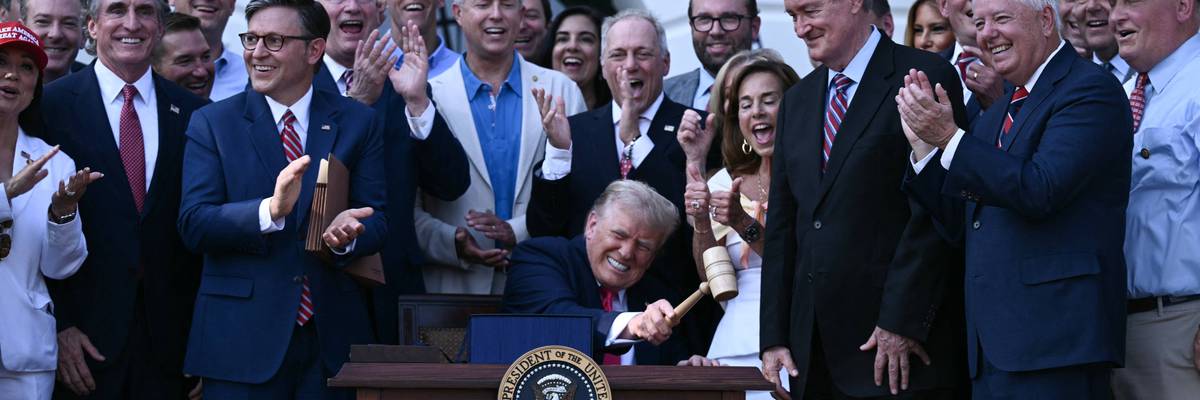
According to a new report, the crisis is “only going to get worse.” US President Donald Trump bangs a gavel after signing the One Big Beautiful Bill Act at the White House in Washington, DC, on July 4, 2025. (Photo by Brendan Smialowski/Pool/AFP)
Not even a year after President Donald Trump signed the largest healthcare cuts in US history into law, around five million Americans have lost insurance coverage, according to a report out Monday from Protect Our Care, which predicted that the crisis was “only going to get worse.”
The massive budget and tax legislation passed by Republicans last July, known as the One Big Beautiful Bill Act, slashed nearly $1 trillion from Medicaid and the Children’s Health Insurance Program (CHIP) over the next decade while introducing tax breaks that are expected to hand an additional $1 trillion to the richest 1% of Americans.
“Five million and counting. That’s the human toll of the spiraling Republican healthcare affordability crisis,” said Protect Our Care president Brad Woodhouse. “Just one year after Trump and congressional Republicans made the largest cuts to healthcare in history to fund tax breaks for billionaires and big corporations on Wall Street, millions have lost the care they depended on to stay alive and healthy.”
Citing the most recent data from the Centers for Medicare and Medicaid Services (CMS) and state agencies, the report found that the number of Americans enrolled in Medicaid and CHIP had fallen to just 76.9 million, down from 80.8 million a year before—a decline of more than 3.8 million people.
Another 1.2 million are also estimated to have lost coverage due to the massive spike in premiums after Republicans voted not to renew tax credits for consumers under the Affordable Care Act (ACA) that lowered costs for Americans who purchased coverage through ACA marketplaces.
During open enrollment in 2025, 24.3 million Americans selected insurance plans through the ACA. This year, as the average premium was projected to more than double on average, the number of Americans enrolled through the ACA fell to just 23.1 million—a drop of nearly 1.2 million.
The millions of other families still enrolled in insurance through the ACA exchanges saw an average increase of $780, and according to KFF, it’s only been that low because many families have opted to switch to cheaper, less comprehensive plans.
The loss of insurance coverage “is only a small piece of the puzzle,” Woodhouse said.
“Millions more are making impossible choices every day to keep their coverage, including skipping rent or cutting back on groceries so they can see a doctor,” he said. “Their pain and suffering are incalculable.”
The report said the coverage losses over the first year are “just the beginning” and that “millions more will lose coverage once deeper cuts go into effect.”
The full slate of changes to Medicaid from the GOP bill has not yet been enacted. Next year, many adult recipients will be required to submit proof that they are doing at least 80 hours of work or other qualifying activity each month in order to maintain benefits, which the nonpartisan Congressional Budget Office (CBO) estimated could increase the uninsured population by 5.3 million by 2034.
Another paperwork hurdle, the requirement that certain Medicaid expansion enrollees prove their eligibility every six months, is expected to result in another 700,000 people becoming uninsured by 2034.
In total, CBO analyses estimate that over the next decade, roughly 15 million Americans would lose their insurance coverage as a result of the legislation.
“These are our neighbors, our friends, our loved ones. These are small business owners and farmers. These are seniors. Veterans. Moms,” Woodhouse said. “These are millions of working people now scrambling to find insulin pumps, taking thousands out of retirement just to see a doctor for that cough that’s not getting better, or, worse, not getting care at all.”
With healthcare costs now a top concern among voters—66% of whom said they were worried about affording it, according to a KFF poll in January—cuts to healthcare spending appear to be a glaring liability for Republicans entering the midterm elections.
Another KFF poll from April found that 37% of voters said they trusted Democrats to address healthcare costs, while just 26% said they trusted Republicans. Meanwhile, 67% of voters said they disapproved of the Trump administration’s handling of healthcare costs.
“Every single day, the affordability crisis mounts, and more Americans will find themselves joining the five million struggling to keep up with skyrocketing healthcare costs,” Woodhouse said. “The American people won’t forget this betrayal in November.”
Democrats have seized on Monday’s report as part of their election pitch, including Rep. Greg Landsman, who faces a competitive reelection fight in Ohio’s 1st Congressional District.
He wrote on social media Tuesday that Republicans “cut healthcare by nearly a trillion to pay for tax cuts for the super wealthy... five million people no longer have healthcare.”
“The healthcare crisis in America is dominating the lives of millions, and will soon dominate all of our lives,” he said. “We need a new Congress to restore people’s healthcare and to end this crisis. There is no other way.”
While Kicking Millions Off Healthcare, GOP Holds ‘Sham Hearing’ on Medicaid Fraud “If Republicans are really interested in looking into waste, fraud, and abuse, they should look no further than the actions of Trump and his administration.” Workers protest Republican Medicaid cuts near the US Capitol building on June 23, 2025 in Washington, DC. (Photo by Joe Raedle/Getty Images)
Congressional Democrats and healthcare justice advocates on Thursday accused Republicans of trying to divert attention away from their destructive cuts to Medicaid—and the resulting large-scale loss of insurance coverage—by convening a hearing on purportedly “rampant” fraud in the program that provides care to tens of millions of low-income Americans.
Rep. Frank Pallone Jr. (D-NJ), the top Democrat on the House Energy and Commerce Committee, noted in his scathing opening remarks at the hearing that Republicans have “repeatedly insisted” they are only interested in fighting fraud and abuse of taxpayer dollars, even as their unprecedented Medicaid cuts strip healthcare from millions of people across the US, including many children.
“You cannot cut healthcare by $1 trillion and not impact millions of people’s healthcare,” said Pallone, pointing to a report published earlier this week estimating that more than 5 million Americans have lost health insurance since President Donald Trump signed the GOP’s massive budget package into law last summer.
“If Republicans are really interested in looking into waste, fraud, and abuse, they should look no further than the actions of Trump and his administration,” Pallone continued, pointing to the illegal and costly war of choice in Iran as just one example. “Playing politics with Americans’ healthcare is cruel and dangerous. Unfortunately, that is what we are repeatedly seeing from Republicans here in Washington.”
The advocacy group Protect Our Care decried the GOP’s “sham hearing” and said Republicans are “pointing fingers at everyone but themselves.”
“Let’s be clear about who the real fraudsters are: not the senior rationing insulin, not the mom skipping the emergency room, and not the family choosing between groceries and seeing a doctor,” said Brad Woodhouse, the group’s president. “It’s Republicans ripping away healthcare from millions with one hand and signing tax breaks to billionaires and big corporations with the other.”
“They’ve decided that if they simply say they’re eliminating fraud in Medicaid, then they can get away with eliminating Medicaid. They are wrong.”
Thursday’s hearing featured testimony from the state Medicaid directors of California, Minnesota, New York, and Ohio, each of whom said they are committed to fighting fraud in their systems. Experts say most Medicaid fraud is committed by providers, not ordinary patients bilking the program.
In recent months, the Trump administration has launched investigations into the Medicaid programs of several states, including California, Minnesota, and New York—probes that officials in those Democratic-controlled states say are politically motivated and based on exaggerated claims of fraud.
In April, the Centers for Medicare & Medicaid Services—led by Mehmet Oz—admitted that it grossly overstated the number of New Yorkers who received personal care services under the state’s Medicaid program last year.
“Oz claimed that New York’s Medicaid program last year provided some 5 million people with personal care services, which assist people in need with basic activities like bathing, grooming, and meal preparation. That would add up to nearly three-fourths of the state’s 6.8 million Medicaid enrollees,” The Associated Press reported. “The real number of New Yorkers who used those services last year was about 450,000, or between 6% and 7% of total enrollees, CMS spokesman Chris Krepich told the AP.”
Republicans have repeatedly cited “waste, fraud, and abuse” as reasons to target and slash federal Medicaid spending. But according to one analysis, just seven of the 24 Medicaid provisions in the 2025 Republican budget law specifically target waste, fraud, and abuse in the program. Overall, the GOP law will cut federal Medicaid spending by roughly $900 billion over the next decade.
In the coming months, Republicans are expected to pursue another budget reconciliation package that they say would crack down on “fraud” in Medicaid—a seeming admission that the 2025 budget law didn’t accomplish the GOP’s stated objective.
“As Republicans try to figure out a way to pay for President Trump’s reckless war of choice with Iran through another partisan reconciliation bill, they are reportedly considering even more cuts to Medicaid,” Pallone said Thursday. “More than 70 million Americans who are disabled or chronically ill, elderly, or children rely on Medicaid for their healthcare.”
“The Trump administration and Republicans in Congress continue to find ways to endanger or take away that care,” Pallone added. “They’ve decided that if they simply say they’re eliminating fraud in Medicaid, then they can get away with eliminating Medicaid. They are wrong.”
Alan Greenspan, Longtime Fed Chair and Ayn Rand Disciple, Meets Ultimate ‘Invisible Hand’ “For decades, he preached that the self-interest of the predator was the invisible hand of the common good,” Yanis Varoufakis said after the man who led the US central bank under four presidents died aged 100.
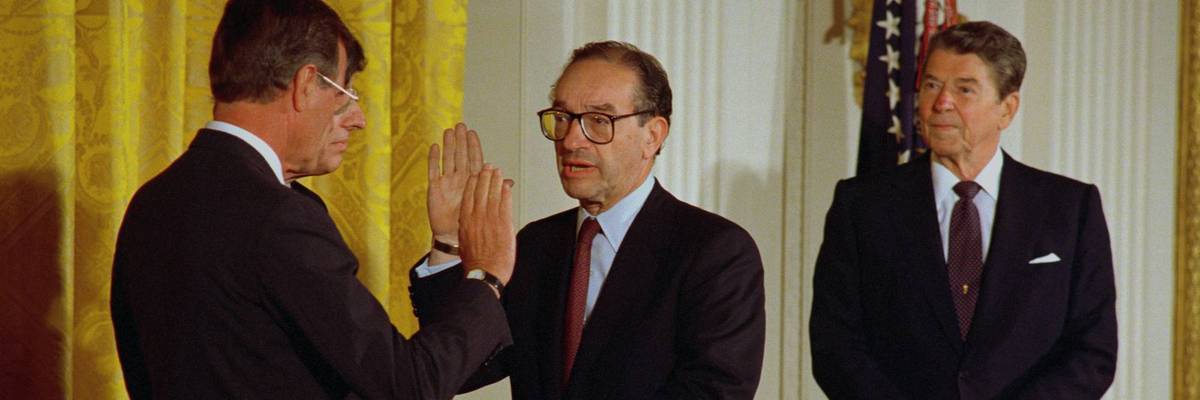
Then-US Vice President George H.W. Bush (left) administers the oath to Federal Reserve Chair Alan Greenspan as President Ronald Reagan looks on, in the White House in Washington, DC on August 11, 1987. (Photo by Getty Images)
Alan Greenspan, whose policies during nearly 20 years as US Federal Reserve chair fueled soaring economic inequality and helped create the conditions for multiple economic crashes, died Monday at age 100 after a long battle with Parkinson’s disease.
While many corporate media outlets published hagiographic obituaries lionizing the “Maestro” who presided over nearly two decades of low inflation, rising stock prices, and American economic confidence, critics focused on Greenspan’s role in promoting dangerous deregulation and “easy money” policies that inflated financial bubbles, with sometimes disastrous results.
Robert Reich—who served as US labor secretary under President Bill Clinton during all of Greenspan’s tenure—called him “in many ways the most powerful person in America” during that era.
“If any single person was responsible for the financial crisis of 2008, it was Greenspan.”
“He maintained an iron grip over the Fed, and almost single-handedly decided on interest rates,” Reich wrote. “He essentially fired George H. W. Bush by raising interest rates so high (ostensibly to ward off the inflation then threatening the economy) that the economy took a dive, and voters blamed Bush. This was enough to convince my boss, Bill Clinton, to do exactly what Greenspan wanted—which was to reduce the federal budget deficit and thereby destroy much of the agenda Clinton ran on (and I helped create).”
“I don’t want to speak ill of anyone who has passed. Greenspan was an extremely charming, intelligent, and thoughtful man,” Reich added. “But the truth must be told: If any single person was responsible for the financial crisis of 2008, it was Greenspan. That crisis—the worst collapse since 1929, which led to the worst recession in decades, in which millions of Americans lost their jobs, savings, and even their homes—resulted from the deregulation of Wall Street that Greenspan advocated.”
Former Greek Finance Minister Yanis Varoufakiswrote on X: “His epitaph? A singular, glorious confession, ‘I found a flaw in my model of the world.’ A flaw, he said, as though it were a leaky pipe, not a total collapse of the intellectual architecture that anointed him Oracle. For decades, he preached that the self-interest of the predator was the invisible hand of the common good.
“Then, in 2008, the beast devoured the table, and to his credit, he blinked, admitting that his entire worldview—the one that central bankers canonized and the world swallowed—was a fairy tale for rentiers,” Varoufakis added. “He did not, of course, admit to culpability. That would require a moral compass, a device notably absent from his Ayn Randian toolbelt. No, he merely noted the flaw, as a meteorologist might note a gust of wind, and returned to his well-earned silence.”
Born 10 miles from Wall Street in Manhattan’s Washington Heights during one of the most infamous economic bubbles of all time, Greenspan was a protégé of libertarian writer and philosopher Ayn Rand and was influenced by the Atlas Shrugged author’s moral defense of capitalism, her fierce advocacy of deregulation, and her insidious insistence that self-interest was socially beneficial.
Their relationship cooled as Greenspan embraced more mainstream economic policies despised by Rand and gradually became a leading steward of the very sort of state-shepherded system she deeply distrusted.
After heading President Gerald Ford’s Council of Economic Advisers, Greenspan was appointed chair of the Fed by President Ronald Reagan in 1987. He would remain in the post well into George W. Bush’s second term.
Greenspan generally favored low interest rates, especially after crises like the 1987 stock market crash, the 1998 Long-Term Capital Management crisis, and the 2001 recession. His fame grew after he suggested that the economy might be experiencing a tech-driven “productivity miracle,” language that many investors took as validation that traditional valuation limits were obsolete.
Staunch devotion to low interest rates by Greenspan’s Fed boosted stock prices and real estate values under “easy money” policies. Many investors came to believe that the Fed would intervene aggressively whenever markets fell sharply—the so-called “Greenspan Put.”
However, since ownership of financial assets (and the firms that sell and promote them) is concentrated among the wealthy, it was the rich who benefited most from Greenspan’s polices. When bubbles burst, as they did after the dot-com boom that ended in early 2000 and during the 2008 global financial crisis, the rich bounced back thanks to their diversified portfolios and bailouts, while middle- and lower-income households were wiped out through asset devaluation, foreclosures, and job losses.
“It is no exaggeration to say the global financial crisis of 2008 had an enormous and lasting impact on American life and the way ordinary people view elites,” New York Times global economic correspondent Peter S. Goodman said on social media. “It is also no exaggeration to say that Alan Greenspan has as much responsibility for the crisis as an individual can.”
“For those not old enough to remember, it is difficult to state his aura during his time of greatest influence,” Goodman continued. “When he told Americans that they should buy houses and use variable-rate mortgages to do it, they listened. Much is made of his econ jargon-laden vernacular that went over the heads of nearly all listeners.”
“That was central to the mystique,” he added. “When he went to the Hill and spoke to Congress, most people had no idea what he was talking about but assumed that smarter kids did. And so his quasi-religious faith in the efficiency of markets as the ultimate insurance against risk went unchallenged and became dogma, and the risks kept building."
THE REAL DEEP STATE
Heritage Foundation Brags That Trump Has Implemented More Than Half of Project 2025
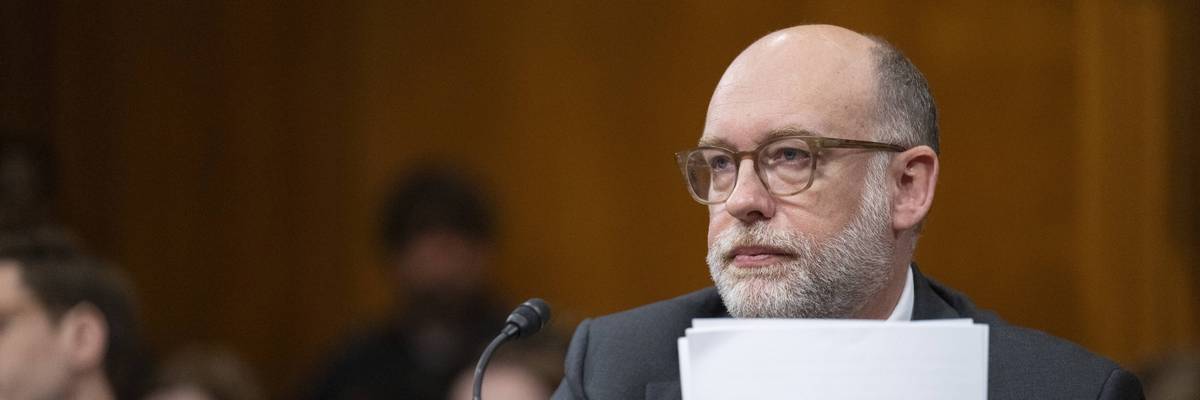
“These actions will have devastating consequences for workers, the environment, public health, and the rights of millions of Americans,” warned progressive groups tracking the far-right agenda’s implementation. Russell Vought, director of the Office of Management and Budget speaks during a Senate hearing on April 16, 2026 in Washington, DC. (Photo by Roberto Schmidt/Getty Images)
The right-wingHeritage Foundation boasted in a fundraising email on Tuesday that US President Donald Trump’s administration has implemented more than half of the policy proposals laid out in the group’s Project 2025 agenda, a sweeping conservative governance plan that Trump repeatedly claimed to know nothing about during his campaign for a second White House term.
The Heritage Foundation’s email, first reported by Bloomberg, stated that 53% of Project 2025 is now federal policy, pointing to the administration’s dismantling of the US Agency for International Development and broader attack on “diversity, equity, and inclusion policies” as examples. The group emphasized that its work is far from finished, declaring that “in this special 250th anniversary year, we must work to implement all of Heritage’s policy recommendations to ensure another 250 years of American greatness.”
Heritage’s estimate that the Trump administration—which includes Project 2025 chief architect Russell Vought, the head of the White House budget office—has enacted 53% of Project 2025’s proposals aligns precisely with a tracker maintained by the Center for Progressive Reform and Governing for Impact. The groups warned that “these actions will have devastating consequences for workers, the environment, public health, and the rights of millions of Americans.”
The tracker, last updated in February, shows that the Trump White House had by that point implemented 283 of the 532 policy actions recommended by Project 2025 via executive order—from the dismantling of the Education Department to halting federal grants for environmental organizations to stripping civil service protections from federal workers.
That the Trump administration’s policy actions mirror those recommended by Project 2025 should not be entirely surprising, given that the agenda broadly reflects the conservative movement’s priorities. But Project 2025’s creators have publicly taken credit for the White House’s moves.
“This is exactly the work we set out to do,” Paul Dans, who worked in the first Trump administration and oversaw Project 2025’s creation, told CNN last year as the administration’s early actions mirrored the right-wing agenda. “We wanted to make sure the president was ready to hit the ground running on day one. The rapidity and the depth of what they’ve rolled out this quickly is a testament to the work done in Project 2025.”
Watchdog Warns Crypto Bill Could Be Major Tax Giveaway to Ultrarich—Including Trump Family
“The cryptocurrency industry has facilitated the Trump family’s corruption at every turn. Lawmakers should be wary of creating new tax loopholes to benefit the Trump family and their donors in the crypto industry.”
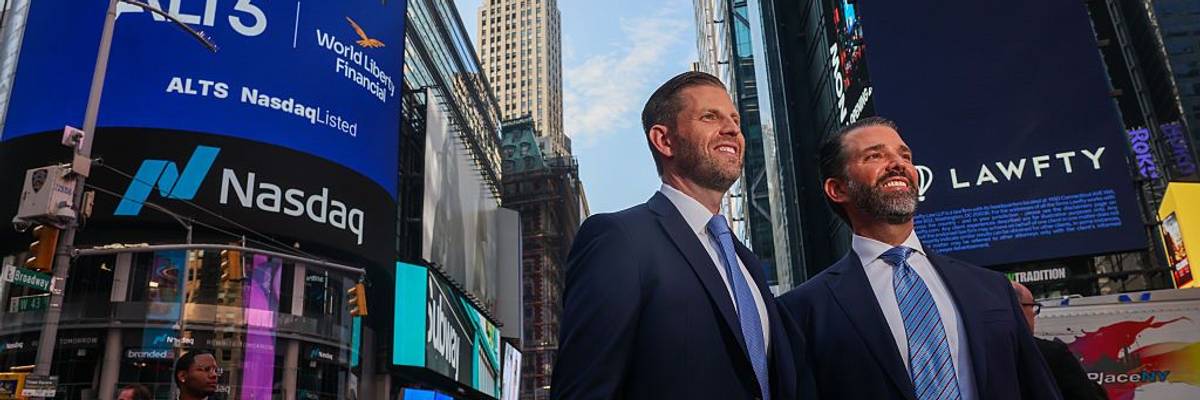
Eric Trump and Donald Trump Jr. outside of NASDAQ in Times Square on August 13, 2025. (Photo by Spencer Platt/Getty Images)
A government watchdog is warning that new cryptocurrency policies being considered in the House of Representatives would be a major boon to the ultrawealthy, including President Donald Trump’s family.
In an analysis published on Monday, the Revolving Door Project (RDP) highlighted new crypto-related tax bills being discussed in the House Ways and Means Committee, including one that “would create a functional subsidy for cryptocurrency firms by allowing them to defer taxes owed on their mined coins indefinitely and without interest, so long as the firms do not sell the coins.”
This would allow coin owners to raise money by borrowing against these assets without having paid a cent of taxes on them, the analysis explains, which could be particularly beneficial for Trump’s two eldest sons.
“Eric and Donald Trump Jr. reportedly hold a 20% stake in the bitcoin mining firm American Bitcoin, which mined 817 bitcoin in Q1 of 2026 alone,” RDP writes. “At current prices, this represents a value of more than $50 million, while the company has stated that it already intends to hold assets it mines. If passed, this loophole could mean millions of dollars in taxes owed by the Trump sons’ firm could be deferred endlessly.”
RDP also published a list of crypto donations to lawmakers on the House Ways and Means Committee. Rep. Steven Horsford (D-Nev.) has received nearly $2 million in support from the industry since 2023, more than any other committee member.
Other top recipients of crypto cash include Reps. Tom Suozzi (D-NY), Jimmy Gomez (D-Calif.), Adrian Smith (R-Neb.), and Jason Smith (R-Mo.), chairman of the committee.
Jeff Hauser, executive director of RDP, said that the bills currently under consideration in the House are essentially a return on the crypto industry’s investment in political campaigns.
“The cryptocurrency industry believes it is owed massive tax loopholes and functional subsidies,” said Hauser, “because it has bought the president, paid for his ballroom project, and has funded dozens of congressional campaigns. The lack of campaign finance reform is the principal reason that the ludicrously corrupt Trump family is set to enjoy yet another tax loophole to exploit.”
Timi Iwayemi, assistant director at RDP, said that “the cryptocurrency industry has facilitated the Trump family’s corruption at every turn,” while warning members of Congress against doing the industry’s bidding.
“Lawmakers should be wary of creating new tax loopholes to benefit the Trump family and their donors in the crypto industry,” said Iwayemi. “Rewarding this behavior will embolden the crypto industry and other corporate lobbies eager to seize on our elected representatives’ prioritization of donor interests at public expense.”
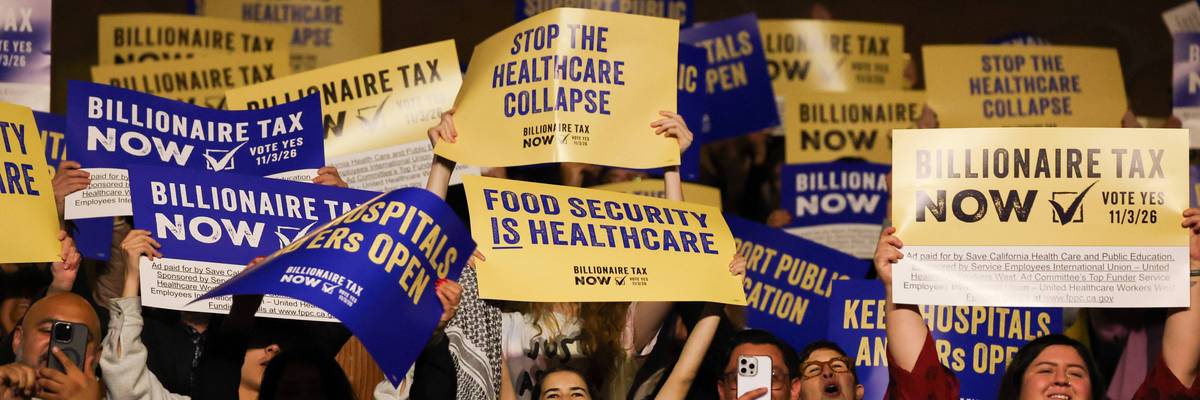
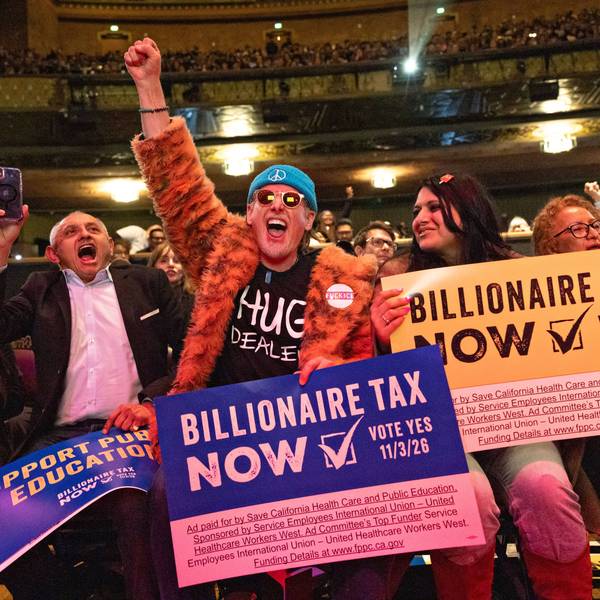
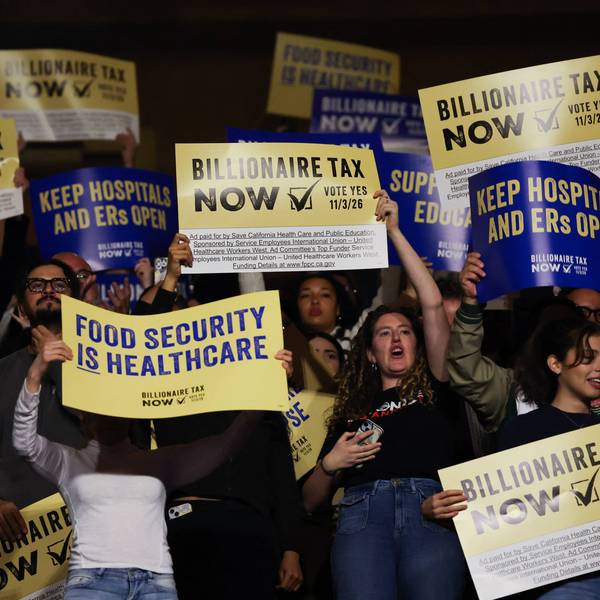
‘We Intend to Win’: California Billionaire Tax Officially Certified for November Ballot “The fact that the ultra-wealthy and billionaire-backed politicians like Gov. Newsom nearly succeeded in killing it is the single best argument for why we need to tax billionaires in the first place.” Attendees cheer during an event supporting the California Billionaire Tax Act in Los Angeles on February 18, 2026. (Photo by Patrick T. Fallon/AFP via Getty Images)
Organizers said late Thursday that a proposed one-time wealth tax on California billionaires has been certified to appear on state ballots in November, advancing despite efforts by Democratic Gov. Gavin Newsom and billionaire-funded groups to tank the measure ahead of the June 25 deadline.
“Today we’re making it clear that we aren’t backing down–the billionaire tax will be on the ballot this November, and we intend to win,” said Debru Carthan, a radiologic technologist and spokesperson for Billionaire Tax Now, the healthcare union-led coalition leading the ballot initiative.
If approved by California voters, the proposal would tax billionaires’ wealth at a rate of 5%, raising an estimated $100 billion to shore up the state’s healthcare system amid devastating federal cuts to Medicaid. Revenue from the tax would also be used for food aid and education, according to the initiative’s text.
Last week, organizers offered to withdraw their proposal if Newsom agreed to push a 2% tax on billionaire wealth in California’s Legislature. Newsom, who is widely seen as a 2028 presidential hopeful, rejected the compromise and privately told a major Democratic donor that he was confident the billionaire tax would not appear on California’s ballot in November.
Organizers emphasized Thursday that despite Newsom’s opposition and fearmongering from billionaires and other opponents, the proposed tax is popular among California voters, who are facing an affordability crisis as the wealthiest see their fortunes soar. From 2023 to 2025, the wealth of California billionaires surged by 144%, according to a recent paper co-authored by leading economists.
“Voters consistently support the billionaire tax by large, double-digit margins, and the growing campaign has brought on thousands of volunteers,” organizers said in a statement. “Supporters of the measure submitted over 1.6 million signatures, more than double the number needed to secure a spot on the general election ballot.”
To succeed, proponents of the billionaire tax must secure enough votes to pass their initiative while also defeating separate ballot measures that would effectively cancel out the wealth levy. One of the competing initiatives was pushed by a group bankrolled by Google co-founder Sergey Brin, who has spent tens of millions of dollars trying to defeat the billionaire tax and who left California in late 2025 to avoid the potential levy.
Igor Volsky, director of the Tax the Greedy Billionaires campaign, said in a statement that “when billionaires can erase democratic initiatives that threaten their fortunes, they have too much power.”
“The fact that the ultra-wealthy and billionaire-backed politicians like Gov. Newsom nearly succeeded in killing it is the single best argument for why we need to tax billionaires in the first place,” Volsky added.
US Rep. Ro Khanna (D-Calif.), a vocal supporter of the proposed billionaire wealth tax, said Thursday that “this issue couldn’t be more simple.”
“There are 250 billionaires in a state of 40 million people,” said Khanna. “What we’re saying is, tax these 250 billionaires so that millions of Californians can have healthcare.”
‘Thinking He Can Fool Everyone,’ Newsom Backs One Billionaires Tax But Not Another
“The misdirect here is that Newsom is opposing a WEALTH tax on billionaires in his own state and insisting he supports a new national INCOME tax on billionaires. But billionaires make money off non-income sources.”
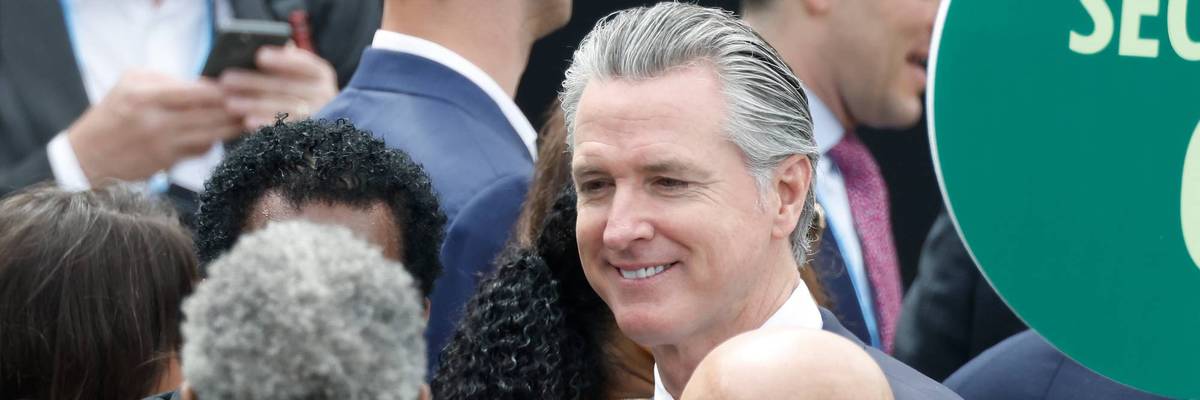
California Gov. Gavin Newsom (D) attends the dedication ceremony for the opening of the Barack Obama Presidential Center, in John Lewis Plaza, on June 18, 2026 in Chicago, Illinois. (Photo by Taylor Hill/Getty Images)
Critics say that Democratic California Gov. Gavin Newsom is trying to trick voters with his new plan for a national billionaire income tax, while simultaneously opposing a tax on billionaire wealth in his own state.
Along with a coterie of wealthy donors, Newsom has long stressed that he is adamantly opposed to the statewide plan to institute a one-time 5% tax on the total wealth of those in the state with more than $1 billion to fund healthcare, education, and food assistance programs, which has been spearheaded by the Service Employees International Union-United Healthcare Workers West (SEIU-UHW).
But a day after the measure was certified to appear on voters’ ballots, Newsom—who is expected to run for president in 2028 and face an electorate that is angrier than ever about the outsized wealth and power of the billionaire class—unveiled a new national proposal that, at least on the surface, seems to hit many of the same populist notes as the one in California.
“Last night, it became certain that a wealth tax would be placed on the November ballot in California. I’m voting no,” he explained in a Substack post, in which he rehashed many of his previous objections—including the factually dubious idea that a wealth tax would supposedly lead to mass capital flight from the state. He also said the plan to spend most of the revenue on healthcare neglects other needs like housing, childcare, and public safety.
As an alternative, he proposed what he referred to as “a national billionaires’ tax. A true minimum tax on billionaires and those with a net worth of over $100 million.”
When counting unrealized wealth gains as income, America’s richest billionaires actually pay lower effective tax rates than the average American. A 2025 paper from the National Bureau of Economic Research (NBER) estimated that the richest 400 Americans paid about 24% of total income in taxes from 2018-20, compared with 30% for the public as a whole.
“That system is the result of decades of loopholes written by lobbyists and upheld by politicians who knew exactly who they worked for,” Newsom said. “The wealthy have their own private tax code full of loopholes and exemptions that most people have never heard of, and they’re counting on politicians in Washington to maintain it and keep quiet.”
Referencing an idea from the Obama era, Newsom described his plan as “a modern Buffett Rule—that ensures the people at the very top pay at least the tax rate their own workers pay.”
While he did not elaborate on what rate he’d plan to charge the wealthiest Americans, the original 2012 Buffett Rule would have required that millionaires pay a minimum effective tax rate of 30% of their adjusted gross income (AGI), which includes things like capital gains and other sources of income that are normally taxed at lower rates.
While Newsom had borrowed the “billionaire tax” branding of California’s popular proposal, critics pointed out that he was proposing something vastly weaker.
“Read his Substack post carefully,” implored Lever editor-in-chief David Sirota in a social mediapost. “He’s talking about income taxes and closing a few loopholes, but not a national version of the WEALTH tax on the ballot in California.”
“The misdirect here is that Newsom is opposing a WEALTH tax on billionaires in his own state and insisting he supports a new national INCOME tax on billionaires,” Sirota said. “But billionaires make money off non-income sources.”
Gabriel Zucman, a French economist who has championed the wealth tax measure in California, has said this critical distinction between wealth and income is the reason why a wealth tax in California is needed to begin with.
“California’s billionaires now hold $2.3 trillion in wealth—equivalent to roughly half of California’s [gross domestic product] and about 10% of US GDP,” he said. “One might assume that such immense wealth translates into equally enormous tax payments. It doesn’t.”
Citing a NBER working paper from last month, Zucman pointed out that “California’s [top four] billionaires pay only 0.07% of their wealth each year in California income tax” while billionaires as a whole represent “barely 0.2% of the state’s total tax revenue,” meaning that they “contribute a negligible amount to the state that made them rich.”
He noted that Google co-founders Sergey Brin and Larry Page—who have publicly opposed the billionaire’s tax and, in Brin’s case, spent tens of millions of dollars trying to stop it—reported no taxable income in 2019, 2020, and 2023 because all of their wealth was held in company stock. Since they didn’t sell any stock during those years, they had no capital gains and therefore owed no income tax.
In the meantime, Zucman noted, “their fortunes have increased by more than $400 billion” since 2019.
Rep. Ro Khanna (D-Calif.)—another potential 2028 presidential candidate who introduced his own federal billionaire wealth tax legislation in March with Sen. Bernie Sanders (I-Vt.)—has vocally questioned Newsom’s opposition to the ballot measure in California.
“Why would you want to side with 250 billionaires over the working class in California?” he asked earlier this week on a podcast hosted by Sirota. “The only reason, in my view, to not be taxing them is because you care about these 250 people’s contributions to the political system.”
Sirota speculated that Newsom’s motivation behind co-opting and watering down the “billionaire tax” concept was much the same.
He said, “This is Newsom thinking he can fool everyone and going to bat for billionaire donors who could fund his presidential campaign.”
‘The World Is Watching’: Top Economist Rips Newsom for Working to Tank Billionaire Wealth Tax
“You have chosen to protect California’s billionaires at the expense of Californians’ health,” said Gabriel Zucman.
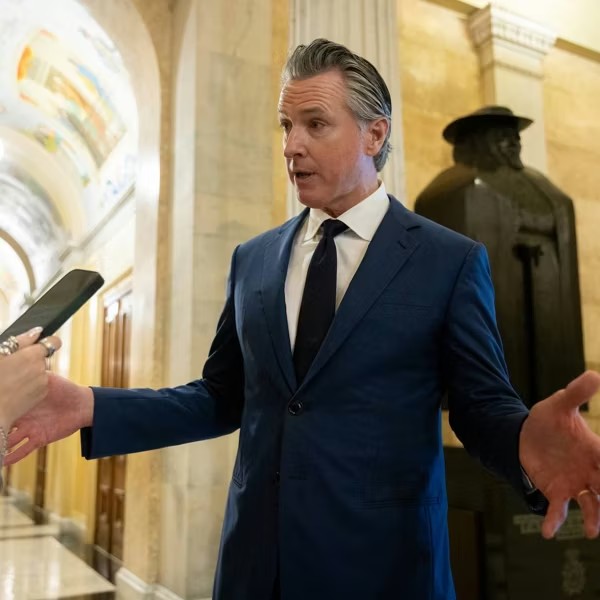
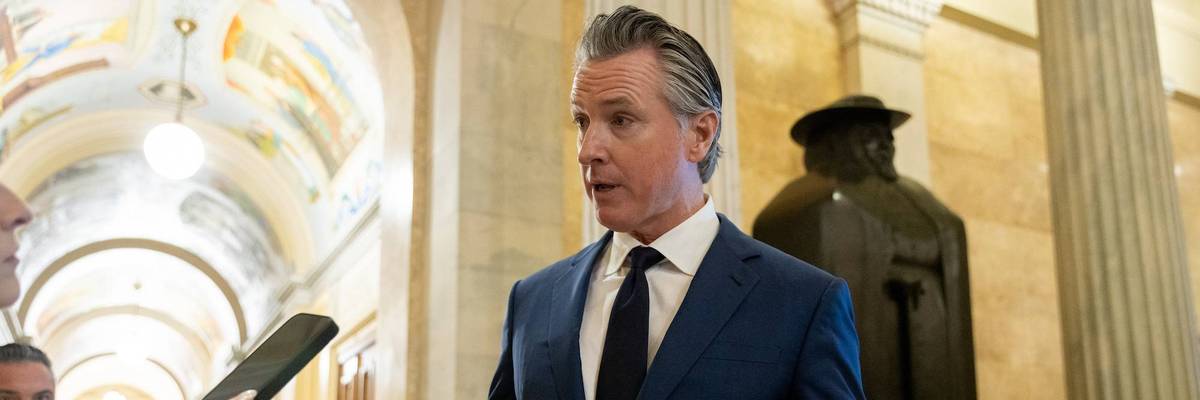
California Gov. Gavin Newsom speaks to reporters inside the US Capitol in Washington, DC on May 20, 2026. (Photo by Nathan Posner/Anadolu via Getty Images)
A world-renowned economist and expert on wealth inequality castigated California Gov. Gavin Newsom on Monday for working to kill a proposed tax on billionaire fortunes in the Golden State, warning that the Democratic leader and likely 2028 candidate appears bent on handing President Donald Trump “an unexpected ideological and political victory.”
Gabriel Zucman, a research professor of economics at the University of California, Berkeley, pointed to a recent Bloomberg story detailing Newsom’s “last-ditch pressure campaign” to prevent a healthcare union-led initiative from appearing on California voters’ ballots in November. Last week, organizers announced that they had collected the number of signatures required to get the initiative—a one-time, 5% tax on the wealth of California billionaires—on the ballot ahead of the June 25 deadline.
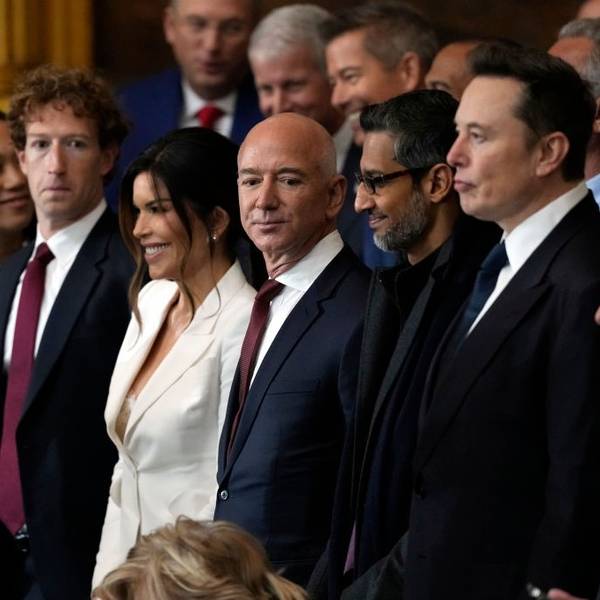
In a lengthy thread posted to X on Monday, Zucman wrote that he is “shocked” by Newsom’s “efforts to defend Peter Thiel and Mark Zuckerberg at the expense of Californians’ health,” referring to two of the state’s most prominent billionaires. Thiel has donated millions to an industry group looking to defeat the ballot initiative, which would use revenue from the wealth tax to offset the impacts of federal Medicaid cuts approved last year by Trump and congressional Republicans.
“Yet you are now devoting all your energy to preventing this ballot initiative from taking place and denying Californians the opportunity to express their democratic will this November,” Zucman wrote. “You have chosen to protect California’s billionaires at the expense of Californians’ health.”
By stridently opposing the proposed billionaire tax in California, the economist warned, Newsom is lending credence to “familiar conservative arguments against taxing great fortunes: the threat of capital flight, tax avoidance, harm to growth, etc.”
“Instead of reinforcing these arguments, you could have chosen to challenge them. Take the risk of tax flight, a classic objection. It is effectively nonexistent,” Zucman wrote. “Beyond the ideological victory you risk handing Trump, you may also be giving him a political victory.”
Politically, Zucman warned Newsom that his opposition to the proposed wealth tax—which has proven extremely popular among likely Democratic voters—risks giving Trump and his right-wing allies a political victory by blunting momentum for a wealth tax not only in California, but beyond as well.
“If the ‘Yes’ prevails, California’s tax could quickly inspire similar efforts in other states,” Zucman argued. “Ultimately, that process could pave the way for a federal tax on extreme wealth. This is precisely what happened more than a century ago with the progressive income tax.”
“The world is watching,” the economist added. “In the struggle between democracy and oligarchy, one must choose a side. I hope you will choose ours.”
Zucman has been outspoken in support of the proposed wealth tax in California, writing in The New York Times’ op-ed pages last month alongside fellow economist Emmanuel Saez that the proposed levy would “be tiny relative to billionaires’ recent wealth gains.”
“In the past three years alone, the total wealth of California’s billionaires grew by a staggering 144%, to over $2 trillion,” the economists wrote. “Critics of the ballot measure have voiced concerns that even a small number of billionaires leaving the state would lead to lower state tax revenues overall. Their math doesn’t add up. California’s billionaires currently pay such a low tax rate that even if all of them left the state, it would take 25 years for the loss of their tax payments under the current set of rules to surpass the amount the state would raise if the one-time tax succeeds this fall.”
“Defending 200 billionaires at the expense of the millions of Californians who will lose healthcare absent the passage of a billionaire tax is not a tenable position for the governor or the state of California.”
Last week, organizers of the wealth tax initiative offered to withdraw its proposal if Newsom threw his support behind legislation imposing a 2% tax on California’s billionaires—a compromise plan that the governor swiftly rejected.
“The governor supports making the wealthiest Americans pay their fair share, but this poorly designed state-only measure will defund teachers, schools, clinics, and public safety,” said Newsom spokesperson Tara Gallegos. “Changing the tax rate doesn’t change this measure’s fundamental flaws that harm working Californians.”
Suzanne Jimenez, chief of staff for the Service Employees International Union-United Healthcare Workers West—the union leading the ballot initiative—hit back, accusing Newsom’s office of “engaging in Trump-like misinformation tactics, which is sad and indefensible.”
“The billionaire tax explicitly funds clinics, hospitals, schools, teachers, and food assistance to the tune of billions,” Jimenez said in an emailed statement. “All objective reports have shown that the wealth tax raises billions to fund healthcare, education, and food assistance—and the revenue that will be raised far surpasses any potential income tax erosion—in no small part because billionaires pay very little relative income tax.”
“Defending 200 billionaires at the expense of the millions of Californians who will lose healthcare absent the passage of a billionaire tax is not a tenable position for the governor or the state of California,” Jimenez added.
Evangelicals are looking for an exit from Trump's 'cult of personality': journalist
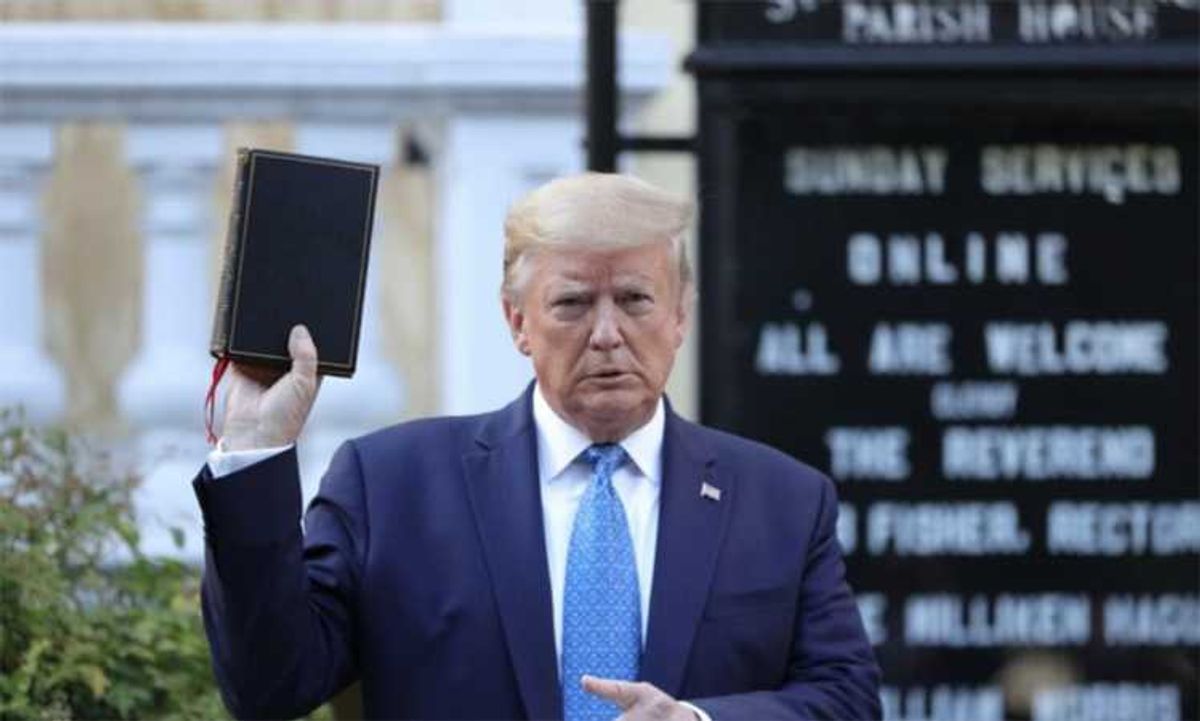
U.S. President Donald Trump holds up a Bible during a photo opportunity in front of St. John's Episcopal Church in the midst of ongoing protests over racial inequality in the wake of the death of George Floyd while in Minneapolis police custody, outside the White House in Washington, U.S., June 1, 2020. REUTERS/Tom Brenner
With Donald Trump expected to meet with evangelical leaders on Friday, The Atlantic’s McKay Coppins claimed on MS NOW on Friday that they may already be looking past him since he's a “lame duck.”
Speaking with “Money Power Politics,” host Stephanie Ruhle, Coppins, who has written extensively on the intersection between religion and politics, claimed Trump’s “act” has been wearing thin within the Christian community.
“Donald Trump delivered on a lot of the big issues that social conservatives cared about, but Donald Trump is now entering his lame-duck stage and he hates to hear us talk about that,” Coppins reported before elaborating, “That's the kind of thing that you know gnaws at him: the idea that he is fading in relevance.”
“But he is,“ he asserted. “Evangelicals are looking to the future and they're starting to wonder, ‘Do we have to keep supporting everything he does? Do we have to, you know, be zealous adherents to this cult of personality?'”
“Maybe not and you see, you know, you noted some of the issues that are dividing evangelicals, certainly the war in Iran is a big one,” he added. “We saw Tucker Carlson recently say that he's leaving the GOP over the war in Iran. Now I would not say Tucker Carlson is this really important evangelical, but he has a lot of evangelical fans, a lot of listeners to his podcast. But also, I think, look. Donald Trump wears thin after a while. For evangelicals, immigration and refugee issues have actually been deceptively divisive.”
'Trump wears thin after a while': Evangelicals bail on lame-duck president
As the latest polls show plunging support for President Donald Trump among evangelical Christians — the group that has remained most loyal to him through three elections — experts say it’s because a growing number of them are beginning to question his “cult of personality” and asking themselves whether they “have to keep supporting everything he does.”
As Stephanie Ruhle of MSNOW reports, “Evangelicals have stood with Donald Trump through thick and thin,” with over 80 percent voting for him in all three presidential races. Most have even stuck with him through his fight with the Pope. But now, “his hold on the group may be starting to slip. A recent poll from Reuters shows his approval rating with evangelicals is now 52 percent. Back in August the number was 61 percent.” Just before the war with Iran, it was 69 percent. In March 2025, it was even higher at 82 percent. In other words, Trump has seen a dramatic collapse among one of his most essential support groups.
According to Ruhle’s guest, journalist McKay Coppins, who has spent 15 years reporting on the evangelical movement, in order to understand this erosion, you have to look at how evangelicals have evolved to accommodate Trump’s decidedly un-Christian-like behavior.
“There are a couple of things that have changed in the last decade or so of evangelical politics,” says McKay. “When I first started covering them, they were all about family values, character, moral leadership. It was like the white noise of social conservative politics. You would hear the same stuff over and over again. When Donald Trump arrived on the scene, that started to change, and for obvious reason, Donald Trump is very clearly not a moral exemplar, not a Christian example. And so the rhetoric started to pivot. For conservative Christians who wanted to justify their support for him, they started to talk more about populism, cultural issues, about grievance, about political power. And for a while that relationship worked pretty well.”
As long as Trump continued to deliver on conservative social issues, explains McKay, that bargain held. “But Donald Trump is now entering his lame-duck stage, and he hates to hear us talk about that. That's the kind of thing that gnaws at him: the idea that he is fading in relevance. But he is, and evangelicals are looking to the future, and they're starting to wonder: Do we have to keep supporting everything he does? Do we have to be zealous in our adherence to this cult of personality? Maybe not.”
According to McKay, evangelicals have become frustrated with Trump over a number of issues, such as the war with Iran and questions surrounding immigration and refugees. Many Christian ministries in places like Texas, Florida, and Tennessee have long provided assistance to refugees, and Trump’s violent deportation program is “alienating to a lot of evangelicals.”
And for others, concludes McKay, the issue may simply be that “Donald Trump wears thin after a while.”
More Republican Catholics choose Trump over the Pope
U.S. President Donald Trump looks on as he attends Markwayne Mullin's swearing-in as Department of Homeland Security (DHS) Secretary, at the White House in Washington, D.C., U.S., March 24, 2026. REUTERS Evan Vucci
A new poll from the Pew Research Center found that not only do more Republican Catholics side with President Donald Trump over the Pope, but their numbers are growing.
In the poll released Thursday, it was revealed that 39 percent of Catholics who identify as or lean Republican think Pope Leo XIV has been “too critical of the Trump administration,” while just 32 percent think President Donald Trump has been “too critical of Leo.” 28 percent agreed both that “Leo has been too critical of Trump but Trump hasn’t been too critical of Leo,” while only 21 percent said “Trump has been too critical of Leo but Leo hasn’t been too critical of Trump.” In other words, Trump has a roughly 7 percent advantage.
What’s more, the same poll showed that conservative Catholic unfavorability toward the Pontiff is on the rise. When the same poll was taken in August 2025, the Pope was deemed unfavorable by a mere 6 percent. Today, that’s up to 22 percent as his favorability has sunk from 84 percent to 72 percent.
According to Pew, “The survey was conducted from May 26 to June 1, in the wake of public tension between Leo and President Donald Trump over the conflict in Iran and other matters. In April, Leo spoke out against war and blamed it on unnamed leaders having a 'delusion of omnipotence.' Trump criticized Leo on social media, saying the pope was 'WEAK on Crime, and terrible for Foreign Policy.'"
While Republican Catholics tend to side with Trump, that opinion did not reflect with Catholics as a whole, particularly Democrats. As Pew explains, “U.S. Catholics are split. While 19 percent say Leo has been too critical of the Trump administration, 16 percent say he hasn’t been critical enough. Another 35 percent say Leo is striking the right balance, and 30 percent say they are not sure, have no opinion or have never heard of Leo. By contrast, when asked about Trump’s approach to Pope Leo, far more Catholics say Trump has been too critical of Leo (51 percent) than say he hasn’t been critical enough (4 percent) or is striking the right balance (14 percent).”
Overall, the Pope has a 78 approval rating among all Catholics. That number is largely driven by Catholic Democrats and independents who lean Democrat, who are far more likely to say Trump has been too critical of Pope Leo than say Leo has been too critical of Trump (70 percent vs. 3 percent)... The balance of opinion among Catholic Democrats is fairly one-sided: 68 percent say Trump has been too critical of Leo but that Leo hasn’t been overly critical of Trump.”
The poll comes out amidst a surprising shift in tone in Pope-Trump relations. Following news of the peace deal with Iran, Leo posted, “I welcome with satisfaction the reaching of an agreement between the Islamic Republic of Iran and the United States of America, which will be signed on Friday, as an encouraging result of patient work in dialogue and negotiation. I hope that the agreement may help strengthen mutual trust, security, and stability in the Middle East, promoting paths of dialogue and cooperation among peoples.” Trump shared the Pope’s statement to Truth Social without comment.
Backlash as Texas Approves ‘Unconstitutional’ Mandatory Bible Lessons in Public Schools
“That’s government-sponsored religious favoritism—and the First Amendment strictly forbids it,” said one critic.
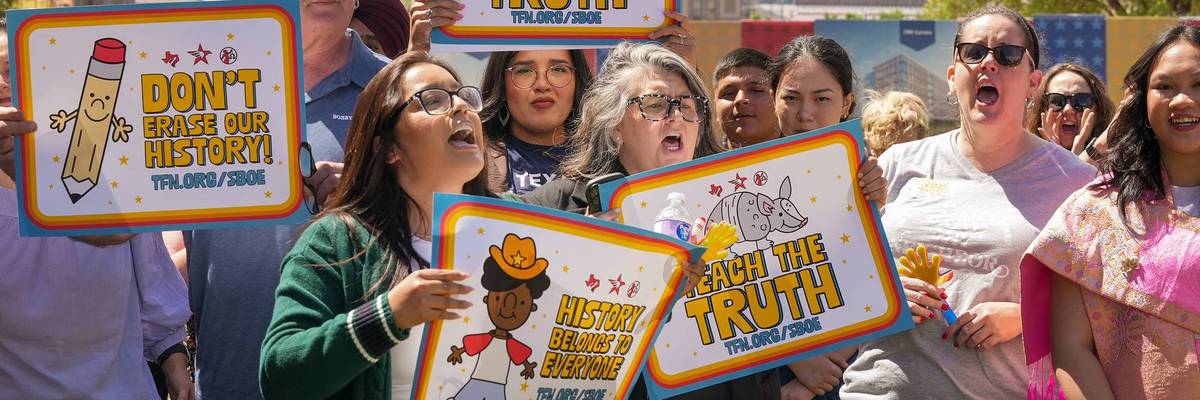
Demonstrators hold signs reading “Teach the truth” and “Don’t erase our history” during a rally on the Capitol Mall in Austin, Texas on April 7, 2026. (Photo by Jay Janner/The Austin American-Statesman via Getty Images)
As education officials in Texas ban hundreds of books that run afoul of their interpretation of Christian morality, the State Board of Education on Friday approved a required reading list that forces the state’s more than 5 million public school students to read from the Bible.
The Republican-controlled SBOE voted 9-5 with one abstention to approve the list, which includes passages from the Book of Exodus as well as the Shepherd’s Psalm and the myths of Adam and Eve and David and Goliath.
“We’re going to stop watering down American history. We’re going to teach the truth. Our nation was founded as a Christian nation, and Texas is a Christian state,” Republican board member Brandon Hall—who is also a youth pastor at Cavalry Baptist Church in Springtown—said during a Thursday press conference in Austin.
Evelyn Brooks, the only Republican SBOE member to vote against the required reading list, told CNN on Friday that she believes the board’s move is “unconstitutional.”
“Teachers need to have their autonomy,” she said. “They’ve been selecting books for decades.”
In 2023, Texas’ Republican-controlled Legislature passed HB 1605, which mandated the creation of a K-12 required reading list and directed the Texas Education Agency to develop state-owned textbooks. Those texts, called Bluebonnet Learning, contain lessons on Christianity starting in kindergarten. The SBOE approved Bluebonnet Learning as an optional curriculum in late 2024 and is currently working to correct thousands of errors in the curriculum at a cost of over $8 million to Texas taxpayers.
The SBOE action comes amid a legal battle over SB 10, a law signed last year by Republican Texas Gov. Greg Abbott that requires public elementary and secondary schools to display the Ten Commandments in every classroom. US District Judge Fred Biery, an appointee of former President Bill Clinton, subsequently issued a preliminary injunction blocking the law. Texas families also sued to block the legislation. However, Republican Texas Attorney General Ken Paxton—who is running for US Senate—demanded that schools comply with the law.
Public schools “exist to educate students with diverse faith backgrounds, as well as those who adhere to no faith doctrine,” the Freedom From Religion Foundation (FFRF) said Friday. “Public schools are not Sunday schools, and elected officials have no business using state power to elevate one religion above all others. A required reading list that overwhelmingly favors Christian texts while excluding the writings and literary traditions of other faiths, not to mention the perspectives of millions of nonreligious Americans, sends an unmistakable message about who belongs and who does not.”
FFRF co-president Annie Laurie Gaylor asserted that “a mandatory public school reading list should never function as a Bible lesson.”
“Texas is telling millions of children that one religion deserves the government’s seal of approval, while everyone else is an afterthought,” she added. “That’s government-sponsored religious favoritism—and the First Amendment strictly forbids it.”
Rabbi Joshua Fixler at Congregation Emanu El in Houston told CNN Friday that “this list is full of Christian texts that are inappropriate for public school classrooms.”
“As a rabbi and a parent of Jewish kids, I think it is vital that this board make a distinction between teaching about religion and teaching religion,” he added. “This list will force teachers to cross that line.”
Fort Worth high school teacher Chanea Bond told The Associated Press on Friday that the SBOE’s required reading list is “very old and very white.”
“It is very narrow and does not represent what classrooms in Texas look like,” she said. “Going through most of high school without ever having much value put into voices that sound like yours kind of sends a message that your voices aren’t valuable.”

.JPG)


.jpg)