Showing posts sorted by relevance for query Antikythera. Sort by date Show all posts

Wednesday, April 26, 2023

The Promethean Antikythera Computer of Greek Civilization
 
APRIL 25, 2023
 APRIL 25, 2023
A picture containing text, sign, device, compass Description automatically generated

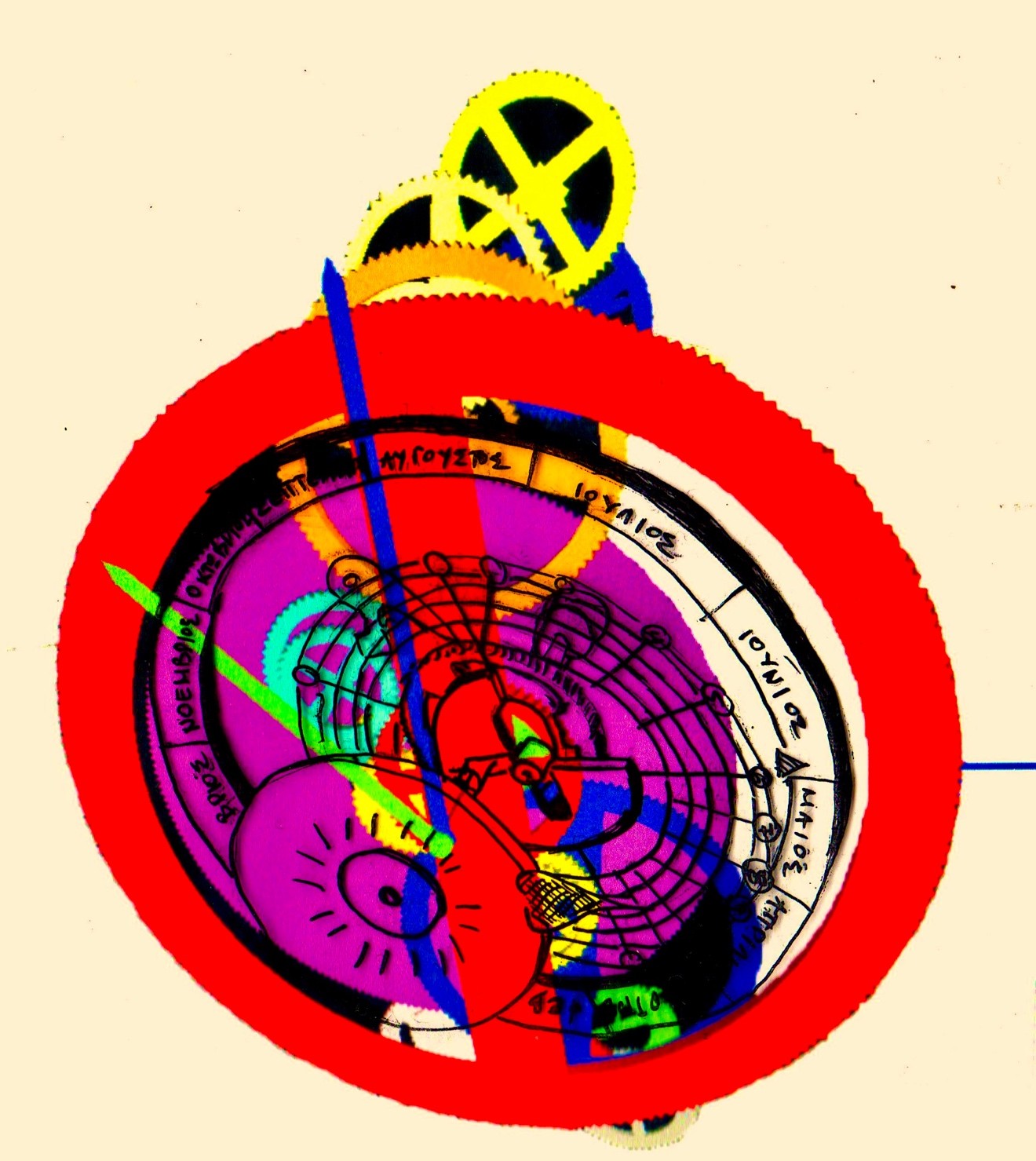
Painting of the Antikythera Mechanism by the Greek mathematician Dionysios Kriaris. One sees the Cosmos, the front of the computer, and the back with the black spirals of the 19-year Metonic calendar and the 18-year predictive Saros dial. Courtesy Kriaris

Overview

Suppose you could travel back in time to the third century BCE, and visit Alexandria, the capital city of the Greek kingdom of Egypt. Arguably it was the most enlightened, wealthy, and powerful of all the Greek states that flourished after the death of Alexander the Great.

Alexandria was famous for: its Mouseion, university- institute of advanced studies, and the Great Library which was the repository of all the collected wisdom and knowledge of the Greek and Mediterranean world. The Great Library was rather as if you had merged Cambridge, with Harvard, MIT, and the Library of Congress. Among its collections one could find the works of epic poets like Homer and Hesiod, tragic poets like Aeschylos, Sophocles, and Euripides, historians like Herodotos and Thucydides, as well as philosophers like Thales, Anaximander, Pythagoras, Plato, Aristotle, and scientists like Demokritos, Hippokrates, Alkmaion of Croton, Aristarchos of Samos, Eratosthenes, Euclid, Archimedes, Hipparchos, Geminos, Ptolemaios and Galen.

However, if you were to travel forward in time to visit Alexandria 800 years later, in the fifth century of our era, you would find no trace of the Great Library of Alexandria, nor of its sister Mouseion-university. Both had been destroyed by Christian religious zealots. In 415 of our era, a mob of Christian monks told the world that Christianity had no need of the Greeks, nor of their philosophy, science, or literature. To drive home their point, they publicly murdered and tore limb from limb Hypatia, the mathematician and philosopher who headed a leading school of philosophy in Alexandria.

In the 6th century, Justinian, the Christian Emperor of the Eastern Roman empire (Medieval Greece), closed and suppressed the Platonic Academy in Athens, which had existed for more than 900 years. These attacks upon the culture of ancient Greece heralded an enveloping wave of darkness and ignorance for both East and West. This anti-intellectual, Christian fanaticism plunged Europe into the Dark Ages, for almost a thousand years.

These officially sanctioned attacks on Greek philosophy and science gave Christian monks a license to destroy and obliterate treasures of science, including some of the works of Archimedes, the mathematical and engineering genius of the 3rd century BCE. The monks literally scraped the ink from the parchment pages of Archimedes’ scientific texts and then re-filled the erased pages with the texts of religious hymns.

It happened.
Modern dramas with ancient Greek science

In 1998, an American paid $ 2 million for a 769-year-old Christian prayer book known as a palimpsest (a manuscript from which the original text had been scraped-off and which had then been used again). Christian prayer-texts were superimposed over the erased scripts of three works of Archimedes. The slim hope of revealing the lost thoughts of Archimedes was the sole reason why the philanthropist was willing to pay a vast sum of money for the ‘ghost’ of a vanished book.

In 2005, seven years after the Archimedes palimpsest surfaced in New York, an even greater drama was unfolding in the basement of the National Museum of Archaeology in Athens. A team of Greek, British and American scientists and engineers had been struggling to “decode” the secrets of an ancient Greek astronomical device: the “Antikythera Mechanism.” This ancient astronomical computer had been raised from the waters of the tiny Aegean island of Antikythera by sponge divers in 1900. However, in 1900, the technology which could probe the innermost workings of this eroded and encrusted lump of metal did not exist.

Meanwhile, Greek, and foreign scientists kept photographing and handling the fragile surviving fragments of the ancient device. This precipitated the break-up of the mechanism to some 82 fragments.

Front and back sides of the 7 largest and most important fragments of the Antikythera computer. Fragment A is the governing part of the device, enclosing 27 of the surviving 30 gears. Some of those gears are visible on the back side of Fragment A. The back side of Fragment B shows the spirals of the 235-month 19-year Metonic calendar. Courtesy Tom Malzbender and Hewlett Packard.

The early twentieth-century investigators of the Antikythera device also played a guessing game, calling it different names and proposing wrong explanations of its origins and functions. In general, they were reluctant to admit it was part of Hellenic culture. Derek de Solla Price, a British physicist and historian of science and professor at Yale, rejected those doubts and documented in his 1974 seminal report, Gears from the Greeks, that the Antikythera computer was “a singular artifact, the oldest existing relic of scientific technology.” It took another 30 years or so of technological advances before science was able to confirm and advance Price’s findings.

Using microfocus X-ray computed tomography (X-ray CT) and polynomial texture mapping (PTM), belonging to British and American companies, scientists were shocked to discover an interior mechanism of meshed toothed gears, which pointed to a sophisticated and complex mathematical instrument. From the nearly invisible inscriptions engraved on the front and back plates of the bronze device, the experts estimated that the computer was probably manufactured in the 2nd century BCE. In other words, it was over 2,200 years old.
A picture containing text Description automatically generated

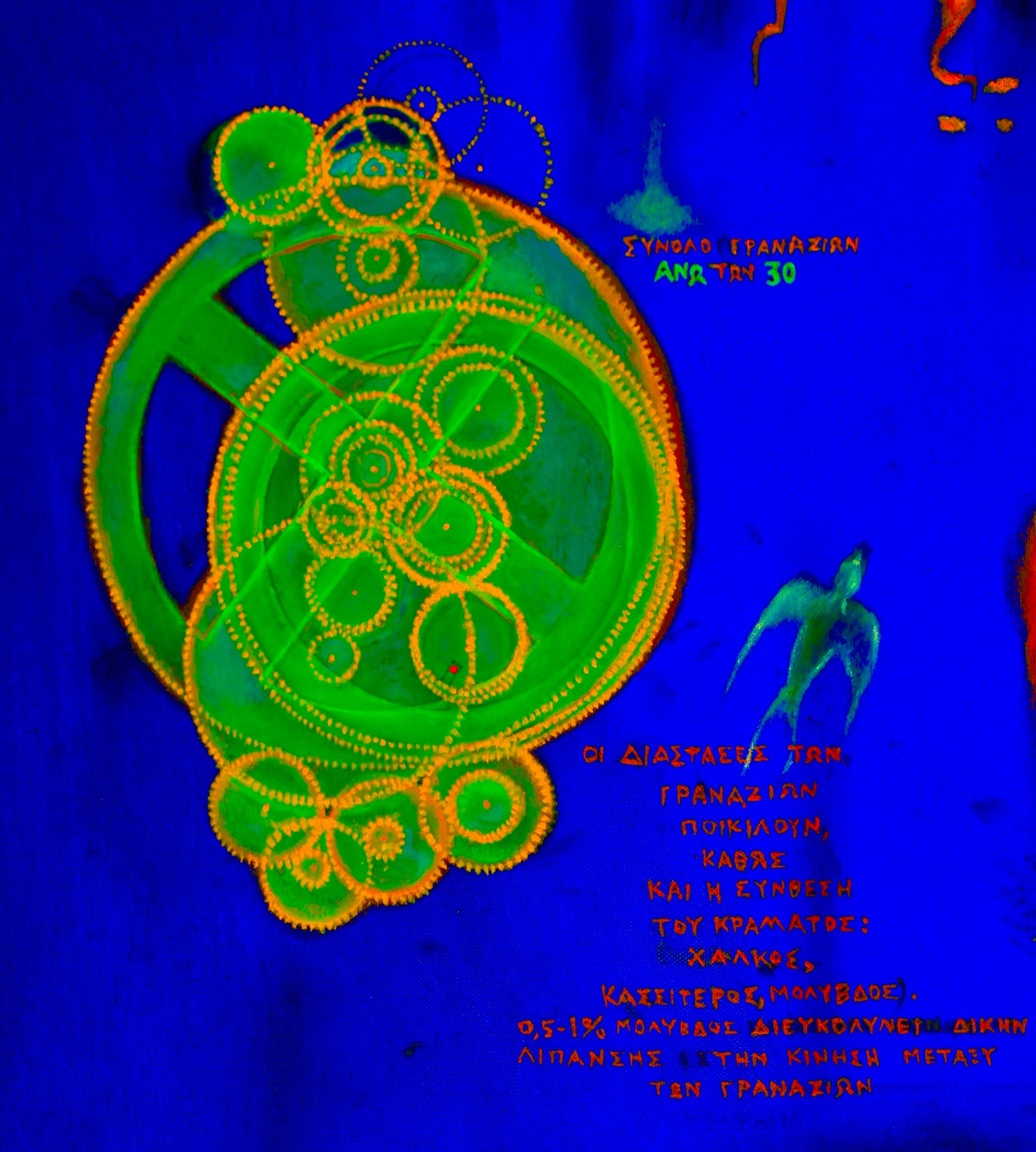
The gears in the interior of the bronze Antikythera astronomical computer. Most of these surviving gears are inside Fragment A. Painting by the Greek artist Evi Sarantea. Courtesy Sarantea.

How can the sale of a Medieval Christian prayer book, (a palimpsest written over the works of Archimedes), possibly be linked to the x-ray investigation of the Antikythera device? In fact, they are parallel threads of the same narrative, which illuminate the fate of Greek science and civilization.

What happened to the advanced work of scientists like Archimedes during the Dark Ages?

Did the ancient Greeks really develop a sophisticated science and technology more than 2,000 years ago? Moreover, if they did achieve such levels of complexity, is the Antikythera Mechanism the product of those same advanced technologies?

Greek computer of genius

My research for writing my book on the Antikythera Mechanism, reveals that the ancient Greeks did indeed develop an advanced science and advanced metal fabrication technologies, which enabled them to build the Antikythera machine. This is extremely important because, to date some classical scholars and scientists have labored under the illusion that modern science is largely the product of post 15th century European thought. They forget that without the mathematical physics of Archimedes Galileo might have been a priest of barber but not a famous physicist. Moreover, they believe that the Greeks never developed technology, much less the advanced technologies needed to construct a mechanical computer and universe, such as the Antikythera Mechanism. In fact, some of the enemies of Hellenic civilization say the Antikythera Mechanism is a time machine, the handiwork of extraterrestrial astronauts.

This propaganda against the Greeks fits nicely with the hubris of scientists dismissing Greek achievements. They say, modern science has taken us to the moon. How can the ancient Greeks possibly be compared to us, they ask. The Greeks fought their wars with bows and arrows, did they not? We have ICBMs, satellite guided predator drones and nuclear weapons. Why should we care if the Greeks ever developed advanced technology?
Why the Greeks?

“We are all Greeks.” These were the heartfelt words of the English poet Percy Bysshe Shelley in 1821: “Our laws, our literature, our religion, our arts, have their roots in Greece.”[1] Shelley was one of many Philhellenes who fought alongside the Greeks during the War of Independence, in the heroic struggle to expel the Turkish occupiers of their homeland.

Jacob Burckhardt, the famous Swiss cultural historian, was grateful to the Greeks for laying the foundations of Western culture, enabling men to become civilized. He said in 1872 that the Europeans see the world through the eyes of the Greeks and to abandon them would be to accept their own decline.[2]

In 1948, the English poet W. H. Auden suggested that the people of the West owe their very existence to the Greeks. He said the Greeks taught us to think about thinking, that is, to ask questions. Without the Greeks, he said, “we would never have become fully conscious, which is to say that we would never have become, for better or worse, fully human.”[3]

In the late 1950s, E. J. Dijksterhuis, Dutch historian of mathematics and natural sciences, said that any inquiry on the origins of present-day knowledge inevitably leads us back to Hellas, especially in mathematics and natural sciences.[4]

And in 1999, the English scholar and historian, Charles Freeman, argued that the Greeks “provided the chromosomes of Western civilization.”[5]

These scholars are right. The Greeks are us. Greek science made the Antikythera astronomical computer. The Greeks thought of science and technology existed mainly for the good of society as well as for understanding nature.

Computer of heavens and Earth

The Antikythera Mechanism was not merely a bauble for the elite to educate themselves about the heavens. It was the workhorse of an evolving technology which provided knowledge about the heavens, connecting the Greeks to Nature, their culture. and the gods.

The Antikythera computer illuminates the relevance of Greek thought and engineering to our own times. Our computer-based society is undoubtedly built on the marvels of high technology. However, if technology is not used for the ‘public good’ it can undermine society rather than being a benefit to it, as we see in the current misplaced excitement about Artificial Intelligence.

Galen, the Greek medical genius of the 2nd century of our era and the greatest physician after Hippocrates, put it bluntly. If wealth is put before virtue, he said, it spoils and corrupts science.[6] In marked contrast, the Antikythera device came into being to serve the public good. It brought the heavens nearer to Earth and into human understanding. It served as an accurate calendar of human events and a calendar of the celestial universe, a moving map of the constellations and a mirror of nature and the heavens.

We admire the ancient Greeks for their invention of Democracy. We celebrate their unsurpassed achievements in providing us with the foundations of: literature, epic poetry, theater, architecture, mathematics, geometry, astronomy, and the Olympic Games.

Greek foundations of modern science

It is the fact that the Greeks, laid the foundations of modern science, the ultimate touchstone of knowledge and power, that makes them so important to us. That is why the discovery of a vandalized book of Archimedes was big news and the decoding of a 2200-year-old Greek computer has been of extraordinary importance.

The Antikythera discovery was undoubtedly the key to unlocking a better understanding of ancient Greek science. This ancient computer gives us profound new insights into the science and philosophy of ancient Greece that has reshaped our conception of the origins of Western science. Moreover, on a purely human level, the story of the discovery of the computer, the researchers and scholars who unraveled its secrets is a compelling drama in its own right. Why did Modern Greek scientists wait a century and the initiative of foreign scientists before they embarked on the decoding of this ancient computer? Could it be that the state of Greece could not afford the research? Indebted Greece has been looted by foreigners, so it could not even think of the importance of the Antikythera computer. But the few Greek scientists that grasped the significance of the ancient device value it much more than their British and American colleagues.

Laptop predictive computer

A picture containing text Description automatically generated

An additional view of the interlocking toothed gears of the Antikythera computer. Modified by Alexander Nicaise of the Skeptical Inquirer. Courtesy Nicaise.

The complicated set of interlocking cogs and wheels of the Antikythera Mechanism were governed by a differential gear. Ιn itself this was a technological marvel of enormous importance. It could accurately predict the phases of the Moon. Throughout the twentieth century and for almost two decades of the twenty-first century, archaeologists, scientists, and historians of science struggled to unlock the true nature of this ancient computer. Finally after the new discoveries of Derek de Solla Price in 1974 and again those discoveries of 2005, the picture is clear.

The Antikythera device played the role of a mechanical universe. In fact, it was a predictive mechanical universe in itself, carrying out the predictive legacy of the Titan god Prometheus (forethought). It predicted eclipses of the Sun and the Moon. It computed the motions and positions of the planets. It provided an accurate calendar for farmers, who were concerned over when to sow and harvests. It enabled priests to make sacrifices to the gods at the correct season, that is, when the gods expected the offerings.

The Antikythera computer also tracked the Panhellenic religious and athletic festivals like the Olympics. It was powered by a simple manual crank. Yet, for all its simplicity, this portable (laptop) astronomical device was a product of an advanced science and technology. Its triumph was to unite the heavens and the Earth, to illuminate the workings of the Cosmos for human inspection and to provide practical knowledge that enriched the lives of its users.

A picture containing indoor, metal Description automatically generated

An early reproduction of the Antikythera Mechanism by Dionysios Kriaris. The front or Cosmos does not include the planets, but it shows a golden sphere of the Sun at the center and a smaller sphere depicting a phase of the Moon. This Cosmos is surrounded by two spherical zones, the outside representing the 365-day year calendar. The inside circle is the Zodiac of 12 constellations. Behind the Cosmos, we see the upper spiral of the 19-year Metonic calendar. The lower spiral is the 18-year predictive Saros dial. Courtesy Kriaris.

This sophisticated predictive machine embodied the scientific method and philosophy of Aristotle (fourth century BCE), the mathematics of Archimedes (third century BCE), the engineering of Ktesibios and Archimedes (third century BCE), and the mathematical astronomy of Hipparchos (second century BCE). It was Hellenic civilization in miniature.

Notes

1. The Complete Poems of Percy Bysshe Shelley (New York: The Modern Library, 1994) 501. ↑

2. Jacob Burckhardt, The Greeks and Greek Civilization, tr. Sheila Stern, ed. Oswyn Murray (New York: St. Martin Press, 1998) 12. ↑

3. W.H. Auden, Forewords and Afterwords, ed. Edward Mendelson (New York: Random House, 1973) 32. ↑

4. E. J. Dijksterhuis, “The Origins of Classical Mechanics from Aristotle to Newton” in Critical Problems in the History of Science, ed. Marshall Clagett (Madison, WI: University of Wisconsin Press, 1969) 164. ↑

5. Charles Freeman, The Greek Achievement (New York: Penguin Books, 2000) 434. ↑

6. Galen, The Best Doctor is also a Philosopher 57-61, in Selected Works, tr. P. N. Singer (New York: Oxford University Press, 1997). ↑

Evaggelos Vallianatos is a historian and environmental strategist, who worked at the US Environmental Protection Agency for 25 years. He is the author of seven books, including the latest book, The Antikythera Mechanism.

Saturday, March 13, 2021

Scientists may have the answer to the ancient mystery of the Antikythera mechanism, after more than a century

National Post Staff 3/12/2021


For more than 100 years, scientists have deliberated the mystery behind the ancient Antikythera mechanism, a 2,000 year old Greek astronomical calculator with the ability to exhibit the movement of the universe, including five known planets and predict the phases of the moon and the solar and lunar eclipses.
© Provided by National Post A digital model of how the calculator may have looked and worked in the first century B.C.

Currently only a third of the device — often defined as the world’s first analogue computer — remains in a collection of 82 battered fragments, including 30 corroded bronze gearwheels, further baffling scholars.


Researchers also don’t know why the Antikythera mechanism was built. It could have been a toy, or a teaching tool, they posited.

“Although metal is precious, and so would have been recycled, it is odd that nothing remotely similar has been found or dug up,” Wojcik said. “If they had the tech to make the Antikythera mechanism, why did they not extend this tech to devising other machines, such as clocks?”

However researchers at the University College of London believe they may have finally cracked the code and hope to prove it by building a replica using modern machinery to test their theory. “We believe that our reconstruction fits all the evidence that scientists have gleaned from the extant remains to date,” Adam Wojcik, a materials scientist at UCL, told The Guardian .

If their theory is correct, then they hope to rebuild the mechanism using a technique from antiquity, they wrote in a paper published by science journal Nature .

The calculator first came to light in 1901 after it was recovered by sponge divers looking for treasures within an archaic ship sunken off the coast of Antikythera, a Greek island. Scholars believe the ship sank during a storm in the first century BC while passing between Crete and the Peloponnese while en route to Rome from Asia Minor.

The device is heavily corroded, but scholars examining it noticed several inscriptions on the mechanism, which provide a kind of user’s manual to operating the calculator. It also included more than 30 bronze gearwheels connected to dials and pointers.

The team believe that the device may have displayed the movement of the sun, moon and the planets Mercury, Venus, Mars, Jupiter and Saturn on concentric rings. However, as the calculator assumes that the sun and planets revolve around the Earth, the planets’ paths are much more difficult to recreate than if the Sun was at the centre.

They also propose adding a hypothetical feature, called the ‘Dragon Hand’ that indicates when eclipses would happen, to replace a similar hand once used by the clock. “The way that the Saros Dial on the Back Plate predicts eclipses essentially involves the lunar nodes , but they are not described in the extant inscriptions,” the paper reads. Lunar nodes are where the Moon’s orbit intersects that of the Earth.

The UCL team wrote that it drew on the works of previous scholars and engineers to reconstruct the mechanism, particularly that of Michael Wright.

Wright, a former mechanical engineer at the Science Museum of London, was instrumental in figuring out how most of the mechanism work, enough to build a working replica. Drawing on his work, researchers used inscriptions on the mechanism and a mathematical method described by Parmenides, an ancient Greek philosopher, to design gear arrangements to move planets and other bodies correctly.

Their solution allows nearly all of the mechanism’s gearwheels to fit within a space only 25 mm deep.

Though hopeful, it isn’t clear whether the new model could accurate replicate the workings of the calculator. For one, the concentric rings that constitute the calculator’s display would have to rotate on a set of nested, hollow axles, and researchers aren’t sure how ancient Greeks would have made the mechanism possible without a modern-day lathe (a machining tool used to shape or rotate metal and wood).

“The concentric tubes at the core of the planetarium are where my faith in Greek tech falters, and where the model might also falter,” said Wojcik. “Lathes would be the way today, but we can’t assume they had those for metal.”

Experts recreate a mechanical Cosmos for the world's first computer


UNIVERSITY COLLEGE LONDON

Research News

Researchers at UCL have solved a major piece of the puzzle that makes up the ancient Greek astronomical calculator known as the Antikythera Mechanism, a hand-powered mechanical device that was used to predict astronomical events.

Known to many as the world's first analogue computer, the Antikythera Mechanism is the most complex piece of engineering to have survived from the ancient world. The 2,000-year-old device was used to predict the positions of the Sun, Moon and the planets as well as lunar and solar eclipses.

Published in Scientific Reports, the paper from the multidisciplinary UCL Antikythera Research Team reveals a new display of the ancient Greek order of the Universe (Cosmos), within a complex gearing system at the front of the Mechanism.

Lead author Professor Tony Freeth (UCL Mechanical Engineering) explained: "Ours is the first model that conforms to all the physical evidence and matches the descriptions in the scientific inscriptions engraved on the Mechanism itself.

"The Sun, Moon and planets are displayed in an impressive tour de force of ancient Greek brilliance."

The Antikythera Mechanism has generated both fascination and intense controversy since its discovery in a Roman-era shipwreck in 1901 by Greek sponge divers near the small Mediterranean island of Antikythera.

The astronomical calculator is a bronze device that consists of a complex combination of 30 surviving bronze gears used to predict astronomical events, including eclipses, phases of the moon, positions of the planets and even dates of the Olympics.

Whilst great progress has been made over the last century to understand how it worked, studies in 2005 using 3D X-rays and surface imaging enabled researchers to show how the Mechanism predicted eclipses and calculated the variable motion of the Moon.

However, until now, a full understanding of the gearing system at the front of the device has eluded the best efforts of researchers. Only about a third of the Mechanism has survived, and is split into 82 fragments - creating a daunting challenge for the UCL team.

The biggest surviving fragment, known as Fragment A, displays features of bearings, pillars and a block. Another, known as Fragment D, features an unexplained disk, 63-tooth gear and plate.

Previous research had used X-ray data from 2005 to reveal thousands of text characters hidden inside the fragments, unread for nearly 2,000 years. Inscriptions on the back cover include a description of the cosmos display, with the planets moving on rings and indicated by marker beads. It was this display that the team worked to reconstruct.

Two critical numbers in the X-rays of the front cover, of 462 years and 442 years, accurately represent cycles of Venus and Saturn respectively. When observed from Earth, the planets' cycles sometimes reverse their motions against the stars. Experts must track these variable cycles over long time-periods in order to predict their positions.

"The classic astronomy of the first millennium BC originated in Babylon, but nothing in this astronomy suggested how the ancient Greeks found the highly accurate 462-year cycle for Venus and 442-year cycle for Saturn," explained PhD candidate and UCL Antikythera Research Team member Aris Dacanalis.

Using an ancient Greek mathematical method described by the philosopher Parmenides, the UCL team not only explained how the cycles for Venus and Saturn were derived but also managed to recover the cycles of all the other planets, where the evidence was missing.

PhD candidate and team member David Higgon explained: "After considerable struggle, we managed to match the evidence in Fragments A and D to a mechanism for Venus, which exactly models its 462-year planetary period relation, with the 63-tooth gear playing a crucial role."

Professor Freeth added: "The team then created innovative mechanisms for all of the planets that would calculate the new advanced astronomical cycles and minimize the number of gears in the whole system, so that they would fit into the tight spaces available."

"This is a key theoretical advance on how the Cosmos was constructed in the Mechanism," added co-author, Dr Adam Wojcik (UCL Mechanical Engineering). "Now we must prove its feasibility by making it with ancient techniques. A particular challenge will be the system of nested tubes that carried the astronomical outputs."

###

The discovery brings the research team a step closer to understanding the full capabilities of the Antikythera Mechanism and how accurately it was able to predict astronomical events. The device is kept at the National Archaeological Museum in Athens.

The UCL Antikythera Research Team is supported by the A.G. Leventis Foundation, Charles Frodsham & Co. and the Worshipful Company of Clockmakers.

The team is led by Dr Adam Wojcik and made up of Professor Tony Freeth, Professor Lindsay MacDonald (UCL CEGE), Dr Myrto Georgakopoulou (UCL Qatar) and PhD candidates David Higgon and Aris Dacanalis (both UCL Mechanical Engineering).

Thursday, July 11, 2024

Gravitational Wave Experts Discover 'Remarkable' Ancient Computer's Secrets
Story by Jess Thomson •

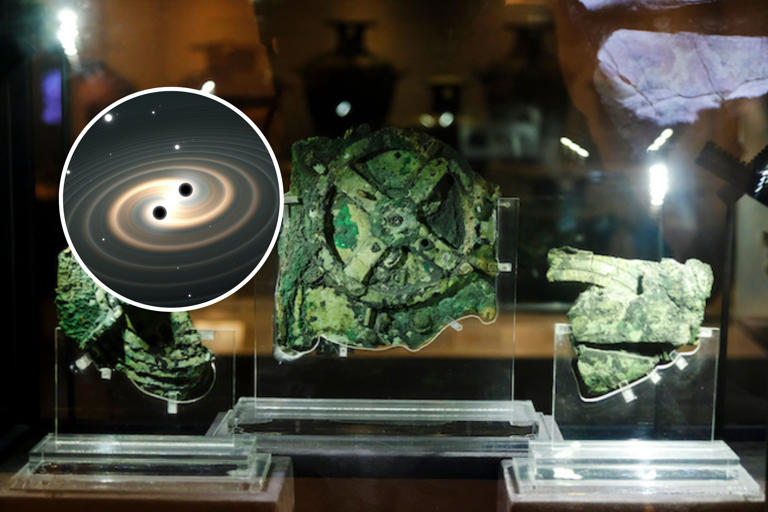
Image of the Antikythera Mechanism (main) and gravitational waves (inset). The same statistical analysis used to study gravitational waves was used to predict the number of holes on a broken ring of the mechanism.
© ISTOCK / GETTY IMAGES PLUS / University of Glasgow

Special techniques used to study ripples in the universe may have helped researchers solve an ancient mystery.

Statistical modeling methods that were developed to study gravitational waves have been used to predict the structure of a broken section of a millennia-old artifact, according to a new paper in The Horological Journal.

These techniques allowed researchers to tell how many holes there were in one of the broken rings of the Antikythera mechanism, the ancient computer featured in Indiana Jones and the Dial of Destiny.

The Antikythera mechanism is an ancient Greek analog device dating back to between 100 and 200 BC that is considered the world's first known computer. Discovered in 1901 in a shipwreck off the coast of the Greek island of Antikythera, the device is thought to have been used to predict astronomical positions and eclipses for calendrical and astrological purposes.

The mechanism is composed of a complex system of bronze gears and dials housed in a wooden case. It has 30 gears, which is an incredibly sophisticated design for its time.

Its complexity suggests that the ancient Greeks had developed advanced knowledge of gear-based technology, far more advanced than previously thought for that era.


Related video: Gravitational Waves Create A 'Cosmic Symphony' That Scientists Are Tuning Into (Space)   Duration 3:41   View on Watch


Modern imaging techniques, such as X-ray computed tomography, have been used to study the internal structure and functions of the mechanism. It has slowly become apparent that it was used to calculate the locations of the planets, predict eclipses, and track the months and years.

Thanks to X-ray imagery in 2020, one of the device's rings was discovered to have regularly spaced holes. Because the ring was broken, it wasn't clear how many rings it had originally, but researchers estimated between 347 and 367.

According to the new paper, the ring is likely to have had 354 holes, corresponding to the moon's cycle. According to their calculations, the ring having 354 holes is hundreds of times more likely than having 360 holes.

"We present a new analysis of the positions of holes beneath the calendar ring of the Antikythera Mechanism," the researchers wrote in the paper. "We significantly refine their estimate for the number of holes that were present in the full ring. Our 68 percent-credible estimate for this number, taking account of all the data, is 355.24 [plus or minus about 1.4].

"If holes adjacent to fractures are removed from the analysis, our estimate becomes 354.08. A ring of 360 holes is strongly disfavoured, and one of 365 holes is not plausible, given our model assumptions."

This mystery was solved using similar statistical modeling techniques as those used to study gravitational waves, which are ripples in the fabric of spacetime created by the movement of massive objects traveling outward from the source.

"Towards the end of last year, a colleague pointed to me to data acquired by YouTuber Chris Budiselic, who was looking to make a replica of the calendar ring and was investigating ways to determine just how many holes it contained," paper co-author Graham Woan, a professor at the University of Glasgow School of Physics & Astronomy, said in a statement.

"It struck me as an interesting problem, and one that I thought I might be able to solve in a different way during the Christmas holidays, so I set about using some statistical techniques to answer the question."

After using this technique, the scientists discovered the number of holes was likely 354 or 355.

"Previous studies had suggested that the calendar ring was likely to have tracked the lunar calendar, but the dual techniques we've applied in this piece of work greatly increase the likelihood that this was the case," co-author Joseph Bayley, also a researcher at the University of Glasgow, said in the statement.

"It's given me a new appreciation for the Antikythera mechanism and the work and care that Greek craftspeople put into making it – the precision of the holes' positioning would have required highly accurate measurement techniques and an incredibly steady hand to punch them."

While we will never truly know how many holes the ring actually had, the analysis gives pretty strong evidence for there having been 354.

"It's a neat symmetry that we've adapted techniques we use to study the universe today to understand more about a mechanism that helped people keep track of the heavens nearly two millennia ago," Woan said.

"We hope that our findings about the Antikythera mechanism, although less supernaturally spectacular than those made by Indiana Jones, will help deepen our understanding of how this remarkable device was made and used by the Greeks."

Monday, July 20, 2026


Antikythera mechanism: Greek computer that predicted eclipses 2,000 years ago

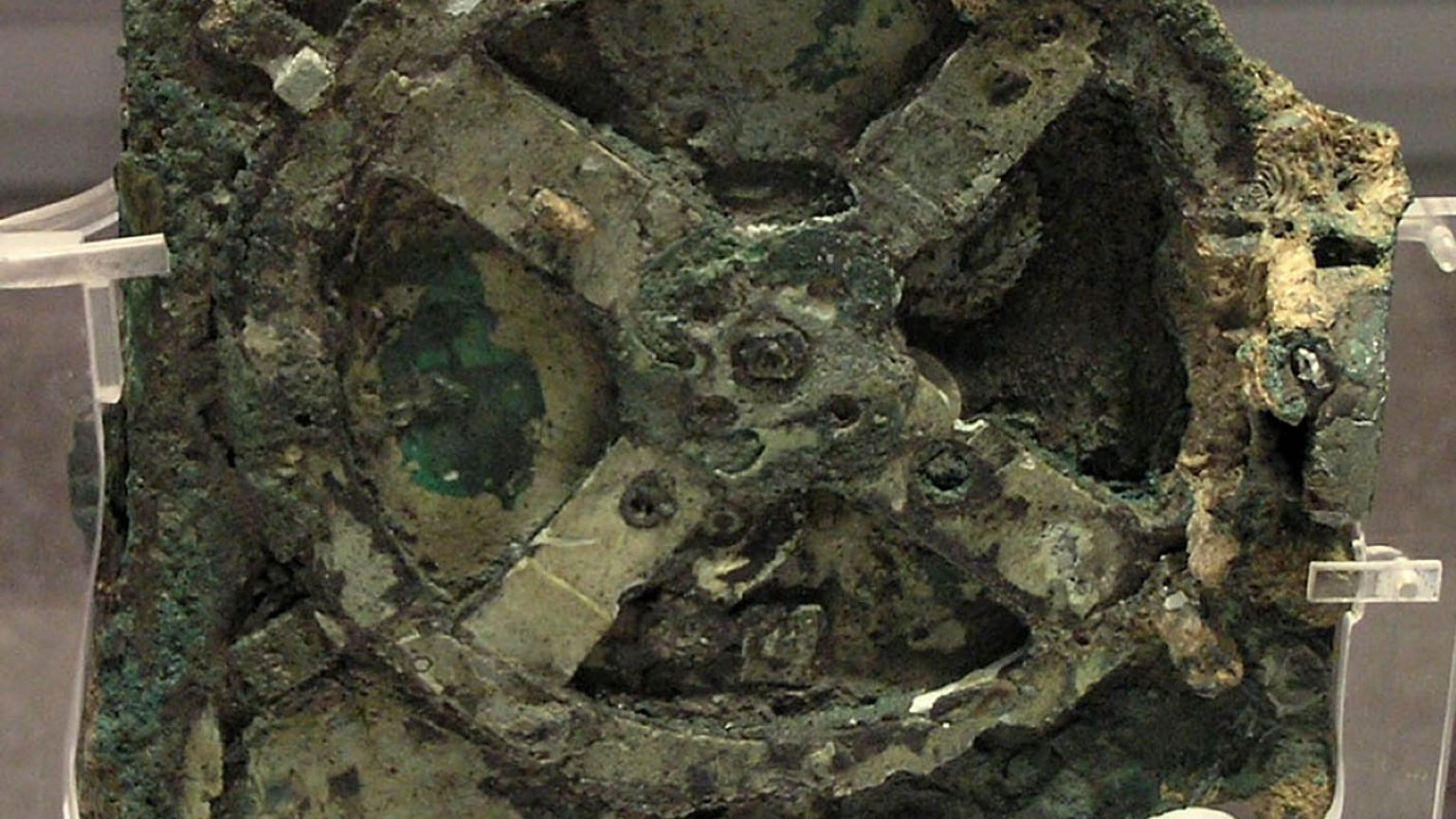
Main fragment of the Antikythera mechanism.
Copyright Wikicommons

By Cristian Caraballo
Published on

A shipwreck off the Greek island Antikythera revealed in 1901 a bronze mechanism over 2,000 years old that tracked lunar and solar cycles and eclipses, now seen as the first analogue computer.

In 1901, a group of sponge divers came across, off the Greek island of Antikythera, the remains of a Roman shipwreck. Amid amphorae and statues they found a corroded block of bronze and wood which, for years, no one quite knew how to interpret. In time it would become one of the most closely studied objects in archaeology: a geared mechanism dated to between 150 and 100 BCE, designed to calculate astronomical positions and predict eclipses.

A shipwreck hiding more than it seemed

The artefact is now kept in the National Archaeological Museum of Athens, and its dating places its manufacture in the late 2nd or early 1st century BCE, coinciding with the sinking of the ship that was carrying it.

One of the most widely cited hypotheses, set out in the Antikythera Mechanism Research Project, points to an origin linked to the Corinthian colonies, possibly Syracuse, and therefore to the school of Archimedes, although its exact authorship remains unconfirmed.

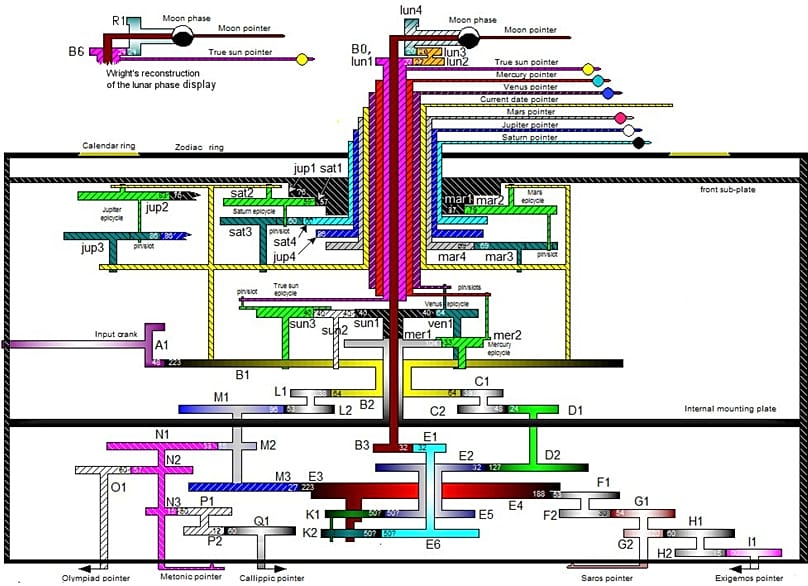
The device incorporated more than 30 hand-operated bronze gears that modelled the cycles of the Moon, the Sun and the known planets, and used an epicyclic gearing system, similar to a modern differential, to compensate for orbital irregularities.

On the front, a small sphere, half white and half black, rotated to show the exact lunar phase. On the back, at least four dials represented the Metonic cycle, the Saros cycle, the calendar of panhellenic sporting games and the exeligmos, used to refine eclipse predictions.

Decades of X‑rays to crack a mystery...

Deciphering those pieces, fragmented and corroded by the sea, took decades. In 1959, physicist Derek de Solla Price began studying the 82 recovered fragments; later, together with Greek nuclear physicist Charalampos Karakalos, he captured the first X‑ray and gamma‑ray images of the mechanism’s interior. This revealed 27 gear wheels, some with as many as 127 and 235 teeth, a level of precision that astonished the scientific community and in 2017 led Google to dedicate a doodle to it as the first mechanical computer in history.

Image of the graphic
Image of the graphic SkoreKeep

...that actually worked?

Not everything is certain. Several subsequent studies by Tony Freeth and Alexander Jones, which simulated the mechanism, found that its indicator for the position of Mars could be off by as much as 38 degrees, a margin of error which the researchers attribute not to manufacturing defects but to the limits of Greek astronomy itself at the time.

A more recent study goes further and suggests that even the smallest manufacturing error could have caused the mechanism to jam or slip, reopening the question of whether the machine ever became fully functional or whether, in practice, it was more cumbersome than useful.

Interest in the mechanism has not faded. Replicas on various scales have been built around the world for educational purposes, such as Mexico’s Monumental Antikythera Mechanism project, designed to train a new generation of physicists and engineers.

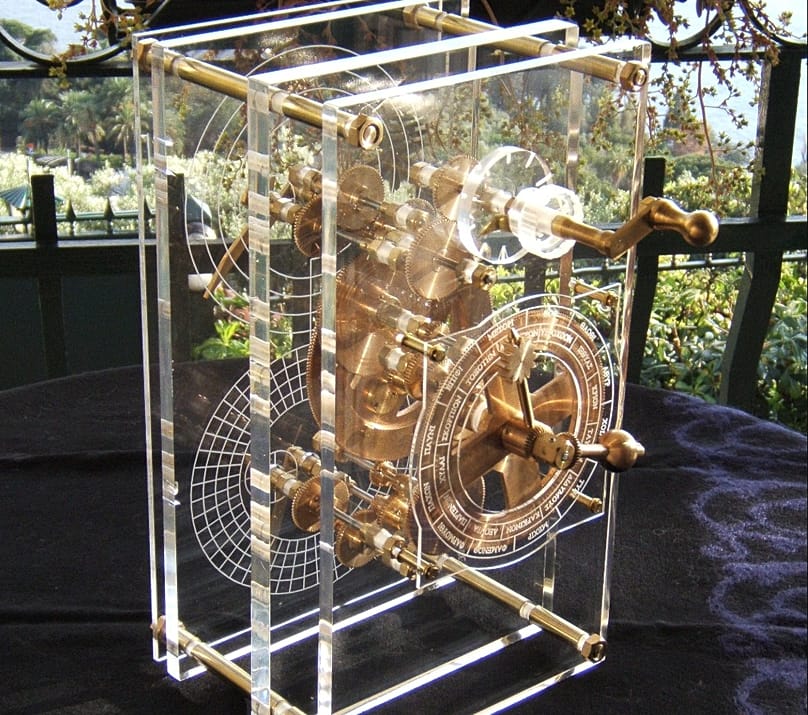
2007 model
2007 model I. Mogi

Its driving force, researcher Raúl Pérez Enríquez, sums up the enduring fascination with the artefact like this: "It is the universe of the ancient world seen from a new perspective, with the Earth at the centre and the planets revolving around it, just as the Greeks imagined it more than two millennia ago."

Monday, July 31, 2023


Famed Antikythera Shipwreck Yields New Treasures

Antikythera excavation
Courtesy University of Geneva

PUBLISHED JUL 30, 2023 11:24 PM BY THE MARITIME EXECUTIVE


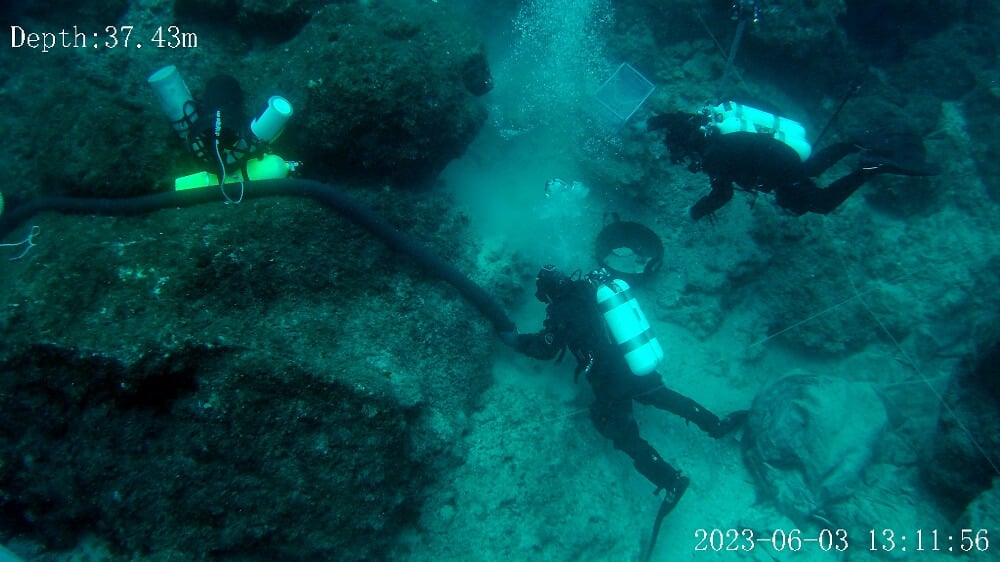
The ancient wreck of Antikythera has been under investigation for more than 120 years, and the work to uncover its secrets continues. An international team of archaeologists, divers, engineers and physical and natural scientists recently visited the wreck, and for this season the researchers reported progress in learning more about the site's structure, the wreck itself and its cargo of ancient luxury goods.  

The Antikythera wreck dates back to the first century BCE, and it is perhaps the most important ancient shipwreck ever found off the coast of Greece. It was discovered off the island of the same name in 1900, and over the years it has yielded up many treasures - like the bronze Antikythera Ephebe statue, a collection of luxury pottery, and one of the most famed finds of any archaeological site, the Antikythera Mechanism. This geared "computer" was designed to track the date and important recurring events, including solar and lunar eclipses. Nothing else like it appeared in the historical record for another 1,500 years. 

The goal of this year's excavation was to better understand the circumstances surrounding the sinking of the vessel. The team examined the wreck's positioning, its possible route and its cargo. All the finds were documented in a digital map system, which contains all known discoveries from the lost vessel dating back to the first excavation in 1900. 

Images courtesy University of Geneva

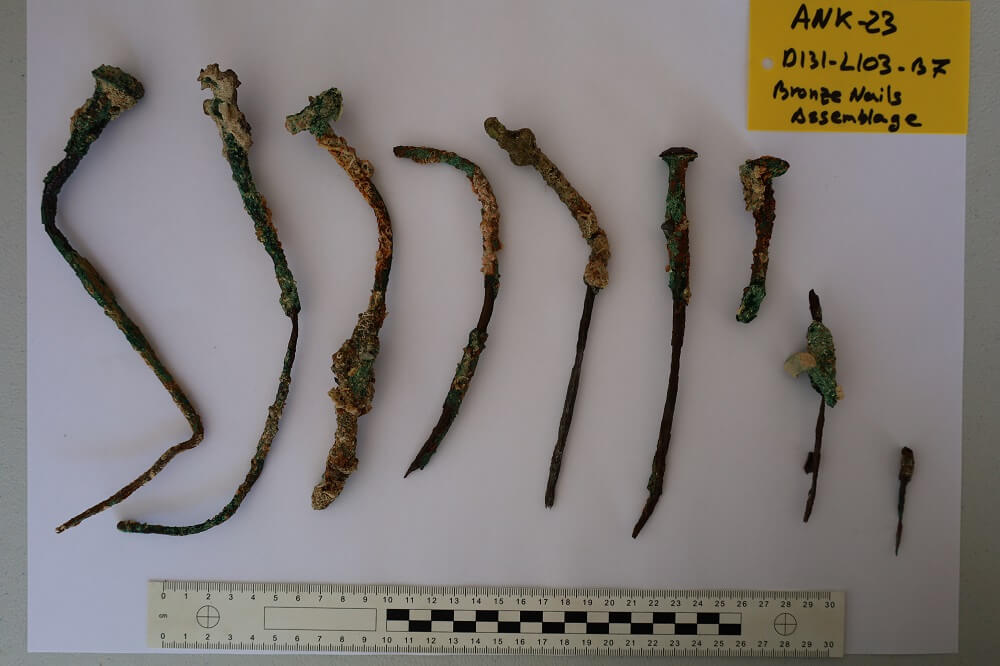
The work focused on the area at the eastern edge of the shipwreck site, where last year parts of large marble statues were found after the removal boulders. The team discovered the bones of at least one victim of the wreck, along with artifacts typical of the site: fragments of marble statues, pottery, glassware and copper alloy, lead and pieces of the ship's wooden structure. Among the marble fragments discovered, one likely belongs to the head from a statue of Herakles, which was found during last year's excavations. 

The team found another discovery in more recent sediment layers: fragments of ceramics from a later era, suggesting the presence of another shipwreck from early Byzantine times. 

The excavation work was led by a team from the University of Geneva (UNIGE) and the Ephorate of Antiquities of Piraeus. The work has support from the Aikaterini Laskaridis Foundation - founded by prominent Greek shipowner Panos Laskaridis - along with watchmaker Hublot and the Nereus Research Foundation.

Sunday, October 11, 2026

Two-Thirds of the World’s First Computer Is Still Missing Beneath the Sea

Darren Orf
Wed, October 7, 2026 
POP MECH


Getty Images


Here's what you'll learn when you read this story:

More than 125 years ago, sponge divers discovered the wreck of a Greek ship laden with jewels, coins, bronze and marble statues, and a strange mechanism now thought to be the world's first computer.


Named for the nearby island where the sponge divers first discovered the object, the Antikythera mechanism largely remains a mystery to the mathematicians, clockmakers, metallurgists, astrophysicists, and underwater archaeologists who have studied it.

Despite great interest from researchers, just one-third of the shoebox-sized device has been recovered from the sea.


It was in the spring of 1900 that a group of waylaid sponge divers first stumbled upon a lost Greek ship after taking refuge on the island of Antikythera during a storm. When the storm subsided, the divers, who shared one brass diving helmet strapped to the ship with ropes, began plying the waters along the island's eastern edge. One diver, Elias Stadiatis, pulled sharply on his rope. When he reached the surface, Stadiatis frantically described a scene of carnage—rotting corpses of women and horses strewn across the seafloor. The ship's captain, Dimitrios Kontos, dove down to see for himself.

One of the divers—most reports say Kontos—later resurfaced with a bronze arm, part of a lost masterwork of antiquity. By complete chance, these divers had discovered the world's richest shipwreck and inadvertently became history's first underwater archaeologists.

When the divers, now employed by the Greek government, returned months later, excavating the site proved difficult. This part of the Aegean was frequently besieged by tumultuous waves. Furious storms were common, and the shipwreck had settled at a 45-degree angle, perilously close to the same rocky cliffs that likely ended its voyage two millennia prior. Some 300 years after the wreck, a rockslide had further entombed the vessel.

But even in these challenging conditions, the divers exhumed dozens of containers called amphorae—what Foley describes as the 55-gallon drums of the ancient world—along with perfume jars, glass bowls, jewels, coins, and many of those "corpses," which turned out to be not-so-spooky bronze and marble statues. The divers could only stay submerged for about 10 minutes, Foley explains, and likely spent only a few minutes on the seafloor. The divers worked with rudimentary kit by today's standards yet still somehow rigged up sculptures so they could be pulled from the water depths. "What they did was almost superhuman," he says.

Foley's own memories of diving at the island of Antikythera—he visited the site and its surrounding waters once or twice every year between 2011 and 2017 and estimates that he's spent around 87 hours beneath the waves—contain two juxtaposing truths about the Aegean: It's one of the most beautiful marine environments in the world and it's very challenging to study.

During an expedition in September 2014, Foley and his colleagues—experts from the Hellenic Ministry of Culture and Sports's Ephorate of Underwater Antiquities (EUA) and the Australian Centre for Field Robotics—planned to spend a week mapping the wreck with autonomous underwater vehicles (AUVs). They also had a crew of divers, armed with rebreathers and metal detectors, ready to scan the seafloor for ancient artifacts. Then they would debut a piece of heavy-duty diving equipment called the exosuit—picture a cross between Tony Stark's Iron Man suit and the Michelin Man—into which divers could climb and explore depths too deep for scuba.

Foley and his team managed to get only four days of diving in and used the bulbous exosuit twice before the sky grew dark and strong winds rolled in.

Though rough weather scuttled their plans, they were still able to generate a three-millimeter-resolution map of the shipwreck and managed to recover an impressive collection of artifacts. On subsequent dive trips, he and his team uncovered more sculptures, a mysterious 100-kilogram lead weapon known as "the dolphin," a nearly complete human skeleton, and a peculiar mechanism thought to be an ancient astronomical calendar and one of the earliest progenitors of the modern computer. Today, we call it the Antikythera mechanism.

Foley recalls peering over the cliff face on a particularly stormy day during that 2014 expedition, watching with awe as waves pummeled the shore near the site of the wreck: "It gave me a really good indication of what the conditions may have been like the night or day when this ship sank."

Over the decades, experts have tried to piece together what exactly happened to this ship all those centuries ago. While some details shift among varying narratives of the ship's fateful journey, the end result remains the same: At some point in the middle of the first century B.C.E., the Antikythera mechanism, thought to be the world's first computer, came to rest in the salty sediments of the Aegean. Since then, mathematicians, clockmakers, metallurgists, astrophysicists, and underwater archaeologists have tried to make sense of this fragmented, corroded, and maddening amalgamation of gears, pins, and dials.

For two millennia, the mechanism lay untouched in its watery tomb more than 100 feet below the waves as time slowly trickled by, giving way to the birth of empires, the collapse into the Dark Ages, the rise of theocratic kingdoms, the foundation of nation-states, and the arrival of modern science.

It's a wonder the mechanism survived at all, given the conditions it faced in the ocean. "If you go into many of the archaeological museums in Europe, all of the fabulous bronze sculptures primarily come from shipwrecks or from sites underwater," Foley explains. At the time of antiquity, bronze was valuable. And because it was malleable, it could be easily repurposed. "You might make a statue of a Greek god, but once that religion goes out of fashion…you can melt [the statue] down and make church bells or artillery gun barrels," he says.

But 2,000 years underwater didn't do the Antikythera mechanism many favors. Seawater rich with salts and other chemical compounds reacted with the high amount of copper in the bronze mechanism, slowly corroding it and replacing it with a green-hued rock known as atacamite. Over time, silt and sand accumulated between the gear wheels, which eventually solidified into hunks of lumpy rock. Bits of wood found among the fragments suggest the mechanism was housed in an ornate wooden frame.

The device is almost as famous for its incompleteness as it is for its complexity. Now housed at the National Archaeological Museum in Athens, Greece, only one-third of the roughly shoebox-sized mechanism, spread across 82 fragments of varying sizes, has been found. The rest has been lost to the sea.

More than a century later, the discoveries—and controversies—surrounding one of the most incredible archaeological finds in human history are only growing.


Wednesday, July 01, 2026

The Delusion of AI-American Centaurs


 June 30, 2026

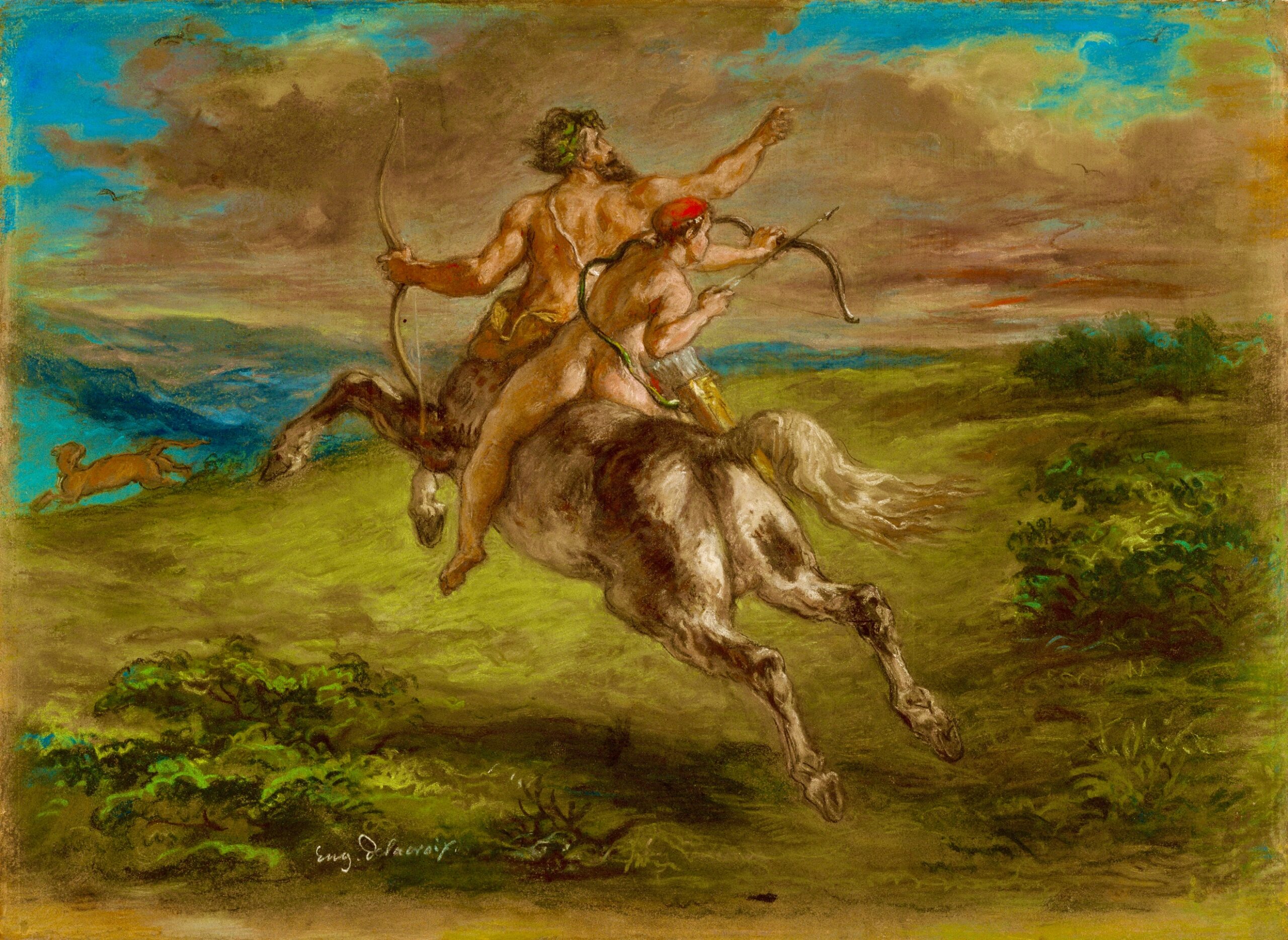
Young Achilles riding the man-horse super centaur Cheiron. “The Education of Achilles by Cheiron.” Painting by Eugene Delacroix, French, 1862. Getty Museum. Wikipedia. Public Domain.

Prologue

I have always been skeptical of the viability and potential benefits of AI technologies. This is because they are primarily war technologies, masquerading in the deceptive cover of intelligence. But they have nothing to do with intelligence, a human virtue of distinguishing good from evil, beautiful from ugly and justice from injustice. AI technologies can never incorporate human intelligence. They are mechanical triggers / devices following human instructions. In fact, I see the evolution of these technologies into more lethal war weapons and war-related consequences, as well as deceptive but profitable devices like iPhones, computers and other machines – here in America and other societies. Unless these AI machines are checked, regulated and, the weaponized versions phased out, anarchy, authoritarianism and destruction will strike humans, civilization and the planet. Why? Because man and machines don’t mix. But if they become scrambled eggs, watch out for monsters.

Centaurs in ancient Greece

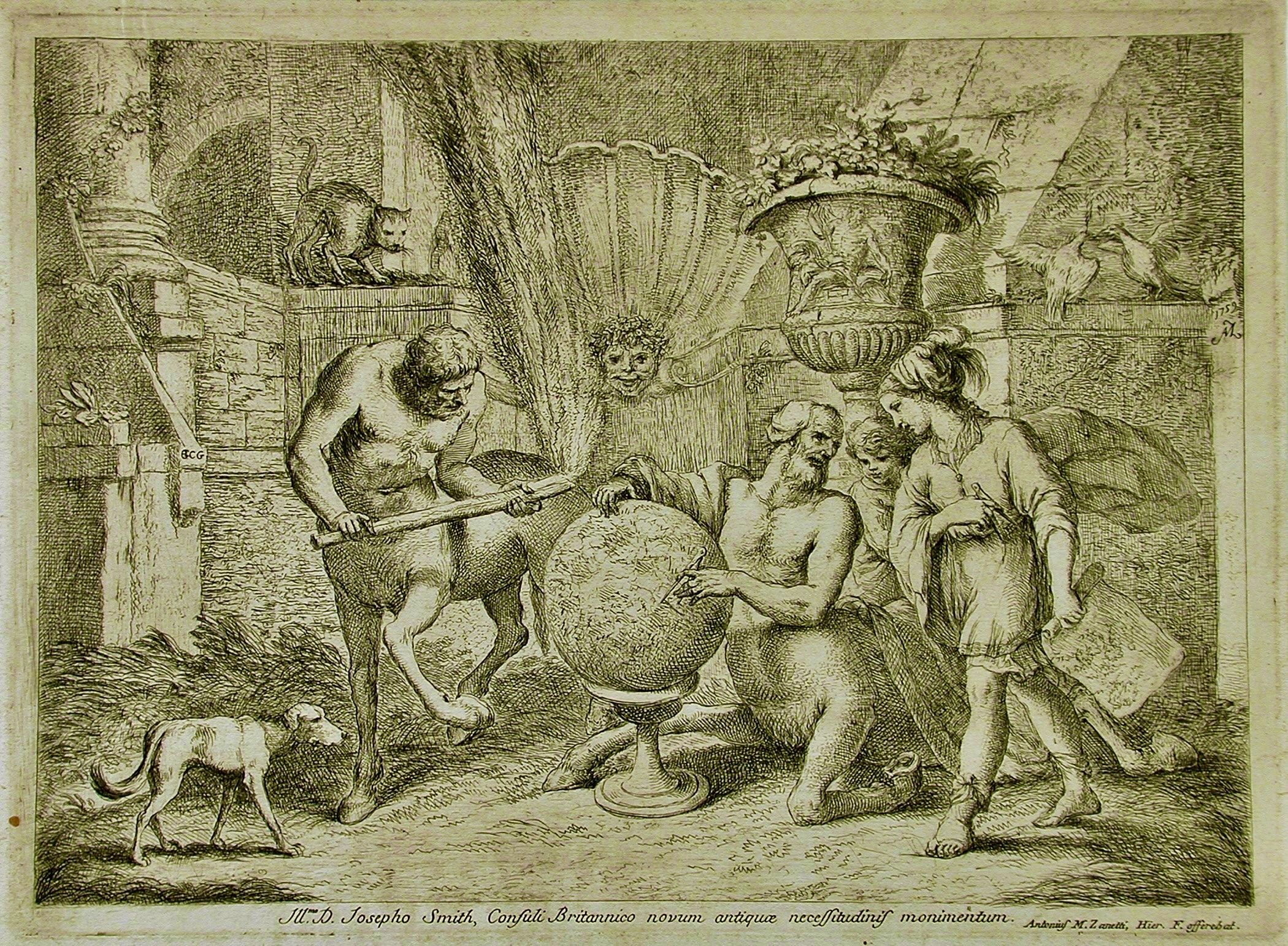
Gaetano Zompini,“The Centaur Cheiron Teaching Geography to the Young Achilles.” 1759. LACMA. Wikipedia Commons. Public Domain.

The ancient Greeks opened human minds to the pleasures of intelligence, science, technology, ethics and civilization. They also experimented (in their mythology and literature) with the invention of human animals: Centaurs (piercing bulls, man-horses), Satyrs (humans with the tail and feet of goats and followers of Dionysos), Minotaur (man with the head of a bull) and other hybrid non-human monsters like Chimera (lion, goat, snake) – and other less known monsters.

One of the centaurs named Cheiron was an exception to the untamed, uncivilized and wild centaurs. He lived on Mount Pelion in Thessaly. He was the immortal son of the pre-Olympian god Cronos and the sea nymph Philyra. He had the reputation of possessing broad knowledge of the Cosmos and Greek society. He was also a healer. He was, in addition, a renowned teacher. Achilles, the great Greek hero of the Trojan War in late 13th century BCE became his pupil. Other young men followed on the footsteps of Achilles and studied under the centaur Cheiron. One of the most distinguished was Jason who, a generation after the Trojan War, in late 13th century BCE, led 50 Argonauts, most of them sons of gods, all the way from Iolkos, Thessaly, to Kolchis, or, in modern times, Georgia. Kolchis was in the easternmost region of Euxinos Pontos or Black Sea. The King of Kolchis was Aietes, son of the god Sun Helios. Aietes suspected the visiting Argonauts and planned to kill them. He started his hostilities by demanding that Jason would take a fire-spitting bull to sow a field with teeth of dragons. Warriors would sprout from the teeth of dragons. Jason would have to fight and kill those earth-born warriors. Jason did all those astonishing tasks successfully. He had the assistance and knowledge and magic of the king’s daughter, Medeia. Thanks to Aphrodite and her son Eros, Medeia was helplessly in love with Jason. Medeia gave Jason drugs that made him invulnerable to the flames and power of the bulls. Medeia was a priestess of a Kolchian goddess, Hekate. She was well-versed in magic and drugs. Add to those superhuman efforts the affection of Hera, wife of Zeus, and love goddess Aphrodite to Jason, and the story had an auspicious ending. The Argonauts returned to Hellas with the Golden Fleece, as well as precious metallurgical knowledge.

This story of adventure, exploration, heroism, passionate love, and divine relationships with humans almost normalized the human-horse Centaur Cheiron, the exceptional and divine teacher of Greek heroes.

These stories of the rare symbiosis of ancient Greeks with one centaur on Mount Pelion in Thessaly did not have a continuity. Herakles, son of Zeus and a superhero, accidentally shot a poison arrow against Cheiron. But Cheiron, being immortal, could not die. He sided with Prometheus then punished by Zeus for giving his Greek grandchildren the flame of knowledge. Zeus put Cheron among the stars, making him the constellation Sagittarius.

US-AI mythical centaurs

Despite these Greek myths, there are American tech enthusiasts in 2026 who seriously contemplate their own mythical realm: a massive ruling class of 8 billion humans being served and “educated” by a trillion AI human-centaur robots.

Antikythera, an AI thinktank in Los Angeles, California, boasts of its priorities in “planetary computation and evolution of intelligence.” Here’s its mythical thinking in its own words:

“Imagine,” it said in an email inviting proposals, “a world with 8 billion human minds and a trillion non-human, human-level AI minds. With such ratios, what is a “society”?

“Agentworld [a research unit of Antikythera] treats the proliferation of AI agents as an anthropological condition as much as a technological one. As [AI] agents become more capable of communication, delegation, coordination, and adaptation at scale, hybrid human-AI societies can no longer be understood as simple aggregates of humans plus tools. They become entangled populations of human and non-human intelligences, co-producing new forms of language, hierarchy, dependency, exchange, and environment.”

In other words, the Antikythera planetary computation “thinktank” experts no longer value democracy, American society and civilization. They are drunk with the wine of AI money and tech robots, making coffee or fighting wars, pretending to imitate and compete with human intelligence. Those delusions trigger scheming and even thinking how to create or “entangle” AI-human zombie resembling the Greek mythological centaurs – a hybrid of human and horses –one of which, son of Titan god Cronos, Cheiron, became teacher of Achilles, Jason and other Greek heroes. The Antikythera AI tech experts, oblivious to Greek history, are determined to probably exceed the Greek model of Cheiron. They are planning no less than “composing the medium-term future of centaur human-AI societies.”

Epilogue

This is science fiction going mad. It is nonsense. Their nightmare would not even work in a totalitarian state. Imagine the audacity and hubris. To think of bringing to life hybrids of humans and machines in the form of AI-powered centaurs? Mechanical horsemen run wild and armed to the teeth? But do these tech experts have any clues of Greek history and mythology, out of which emerged the centaurs and chimeras? Plato and Aristotle taught that moderation was a governing virtue, σωφροσύνη. Ancient Greeks also were well aware not to violate the principle of μηδέν άγαν: not to be extreme in anything. They slayed their own monsters.

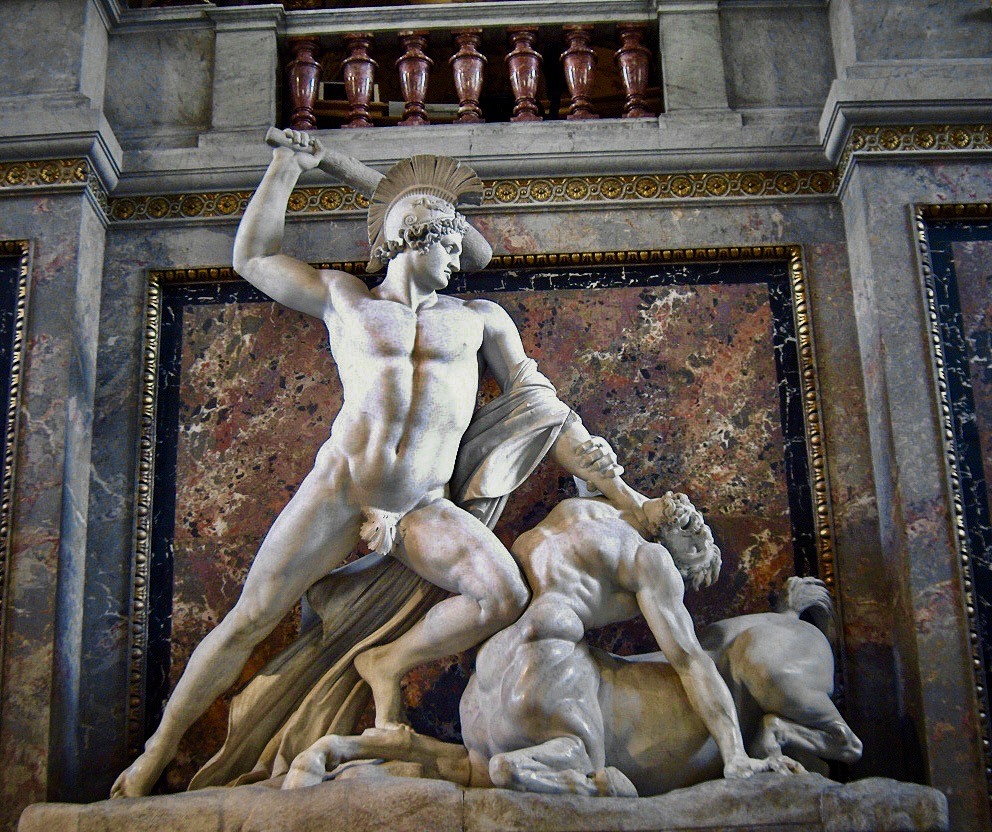
Antonio Canova, “Theseus Defeats the Centaur,” 1805. Kunsthistorisches Museum, Vienna. Wikipedia Commons. Public Domain.

We should do the same: phase out AI monsters like those contemplated by the Antikythera thinktank of Los Angeles. Otherwise, the money-rich but intelligence-poor plutocrats will take over the government and establish a real political nightmare of entangled humans and machines.

Evaggelos Vallianatos, Ph.D., is a historian and ecological-political theorist. He studied zoology and history, Greek and European, at the University of Illinois and Wisconsin. He did postdoctoral studies in the history of science at Harvard. He worked on Capitol Hill and the US Environmental Protection Agency; taught at several universities, and authored hundreds of articles and several books, including Poison Spring (2014), The Antikythera Mechanism (2021), Freedom (2025) and Earth on Fire: Brewing Plagues and Climate Chaos in Our Backyards (World Scientific, 2026).