Showing posts sorted by relevance for query KASHMIR. Sort by date Show all posts

Tuesday, December 21, 2021

#KASHMIR IS #INDIA'S #GAZA
India and Pakistan fought 3 wars over Kashmir – here’s why international law and US help can’t solve this territorial dispute


An armed conflict in Kashmir has thwarted all attempts to solve it for three quarters of a century.

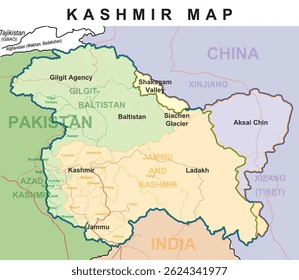
Kashmir, an 85,806-square-mile valley between the snowcapped Himalaya and Karakoram mountain ranges, is a contested region between India, Pakistan and China. Both India and Pakistan lay claim to all of Kashmir, but each administers only part of it.
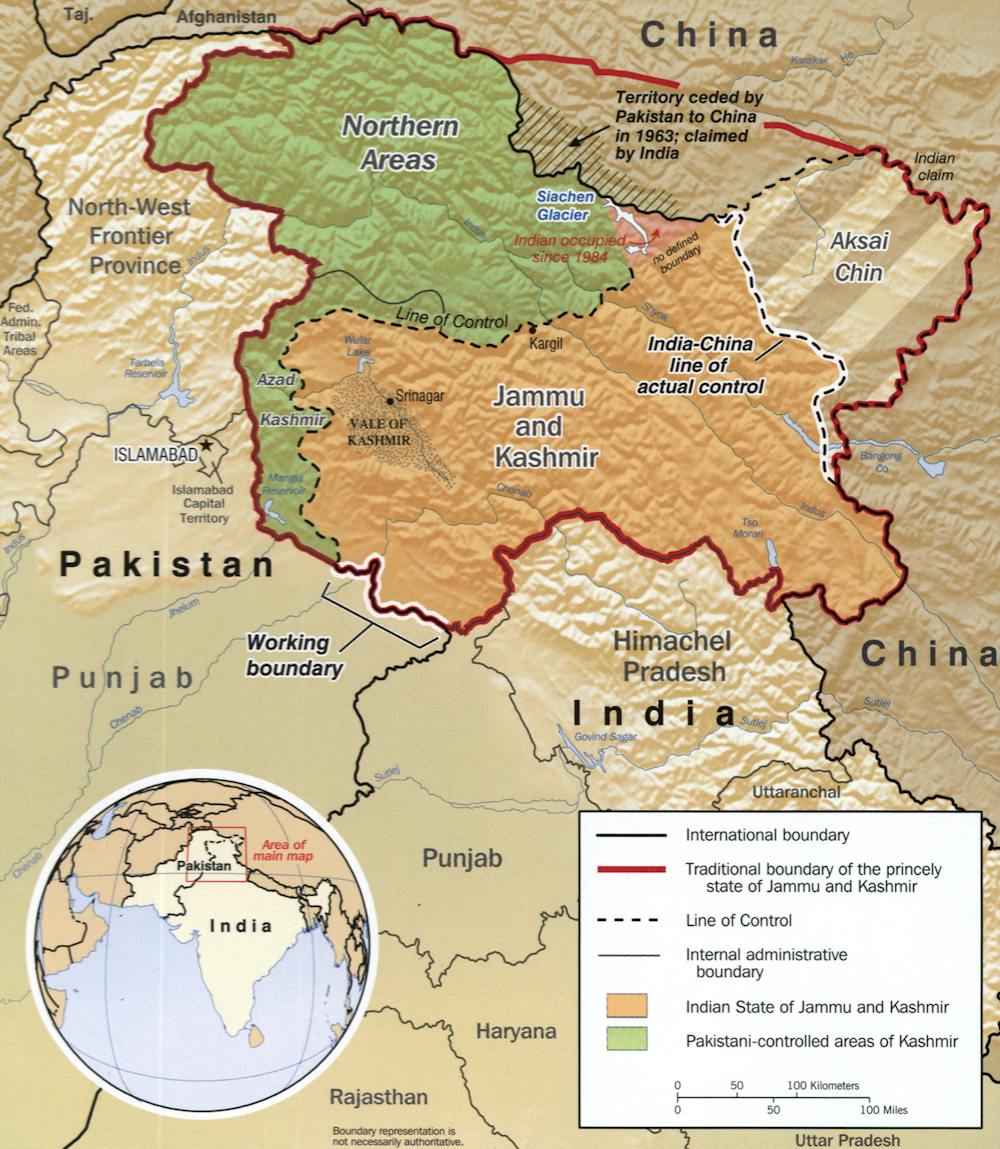

Map of Kashmir. Central Intelligence Agency, Washington, 2002, Public domain, via Wikimedia Commons

During the British rule of India, Kashmir was a feudal state with its own regional ruler. In 1947, the Kashmiri ruler, Maharaja Hari Singh, agreed that his kingdom would join India under certain conditions. Kashmir would retain political and economic sovereignty, while its defense and external affairs would be dealt with by India.

But Pakistan, newly created by the British, laid claim to a majority-Muslim part of Kashmir along its border. India and Pakistan fought the first of three major wars over Kashmir in 1947. It resulted in the creation of a United Nations-brokered “ceasefire line” that divided Indian and Pakistani territory. The line went right through Kashmir.

Get your news from people who know what they’re talking about.Sign up for newsletter

Despite the establishment of that border, presently known as the “Line of Control,” two more wars over Kashmir followed, in 1965 and 1999. An estimated 20,000 people died in these three wars.

International law, a set of rules and regulations created after World War II to govern all the world’s nation-states, is supposed to resolve territorial disputes like Kashmir. Such disputes are mainly dealt with by the International Court of Justice, a United Nations tribunal that rules on contested borders and war crimes.

Yet international law has repeatedly failed to resolve the Kashmir conflict, as my research on Kashmir and international law shows.

International law fails in Kashmir

The U.N. has made many failed attempts to restore dialogue after fighting between India and Pakistan over Kashmir, which today is home to a diverse population of 13.7 million Muslims, Hindus and people of other faiths.

In 1949, the U.N. sent a peacekeeping mission to both countries. U.N. peace missions were not as robust as its peacekeeping operations are today, and international troops proved unable to protect the sanctity of the borders between India and Pakistan.

In 1958, the Graham Commission, led by a U.N.-designated mediator, Frank Graham, recommended to the U.N. Security Council that India and Pakistan agree to demilitarize in Kashmir and hold a referendum to decide the status of the territory.

India rejected that plan, and both India and Pakistan disagreed on how many troops would remain along their border in Kashmir if they did demilitarize. Another war broke out in 1965.

In 1999, India and Pakistan battled along the Line of Control in the Kargil district of Kashmir, leading the United States to intervene diplomatically, siding with India.

Since then, official U.S. policy has been to prevent further escalation in the dispute. The U.S. government has offered several times to facilitate a mediation process over the contested territory.

The latest U.S. president to make that offer was Donald Trump after conflict erupted in Kashmir in 2019. The effort went nowhere.

Why international law falls short


Why is the Kashmir conflict too politically difficult for a internationally brokered compromise?
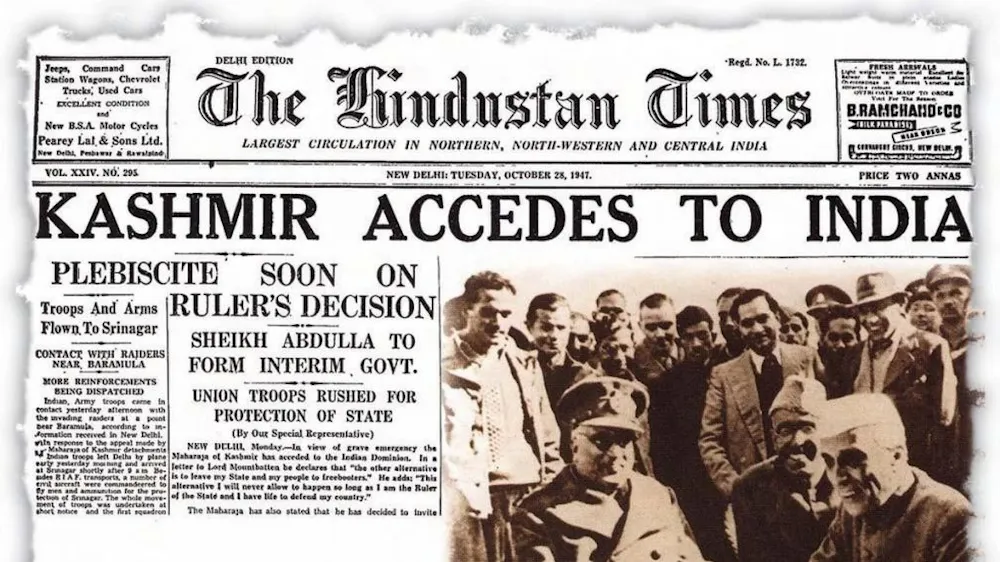

The maharaja of Kashmir agreed to join India in 1947.

For one, India and Pakistan don’t even agree on whether international law applies in Kashmir. While Pakistan considers the Kashmir conflict an international dispute, India says it is a “bilateral issue” and an “internal matter.”

India’s stance narrows the purview of international law. For example, regional organizations like the South Asian Association for Regional Cooperation cannot intervene on the Kashmir issue – by convening a regional dialogue, for example – because its charter prohibits involvement in “bilateral and contentious issues.”

But India’s claim that Kashmir is Indian territory is hotly debated.

In 2019, the Indian government abolished the 1954 law that gave Kashmir autonomous status and militarily occupied the territory. At least 500,000 Indian troops are in Kashmir today.

Pakistan’s government denounced the move as “illegal,” and many Kashmiris on both sides of the Line of Control say India violated its 1947 accession deal with Maharaja Singh.

The U.N. still officially considers Kashmir a disputed area. But India has held firm that Kashmir is part of India, under central government control, worsening already bad relations between India and Pakistan.

Military coups and terror


Another obstacle to peace between the two nations: Pakistan’s military.

In 1953, Indian Prime Minister Jawaharlal Nehru and Pakistani Prime Minister Mohammad Ali Bogra agreed in principle to resolve the Kashmir problem through a U.N. mediation or with an International Court of Justice proceeding.

That never happened, because the Pakistani military overthrew Ali Bogra in 1955.

Several more Pakistani military regimes have interrupted Pakistani democracy since then. India believes these non-democratic regimes lack credibility to negotiate with it. And, generally, Pakistan’s military governments have preferred the battlefield over political dialogue.

Terrorism is another critical factor making the Kashmir situation more complex. Several radical Islamist groups, including Lashkar-e-Toiba and Jaish-e-Mohammed, operate in Kashmir, based primarily on the Pakistani side.

Since the late 1980s the terrorist groups have conducted targeted strikes and attacks on Indian government and military facilities, leading the Indian military to retaliate in Pakistani territory. Pakistan then alleges that India has breached the borderline, defying international treaties like the 1972 Simla Agreement to conduct its anti-terror attacks.
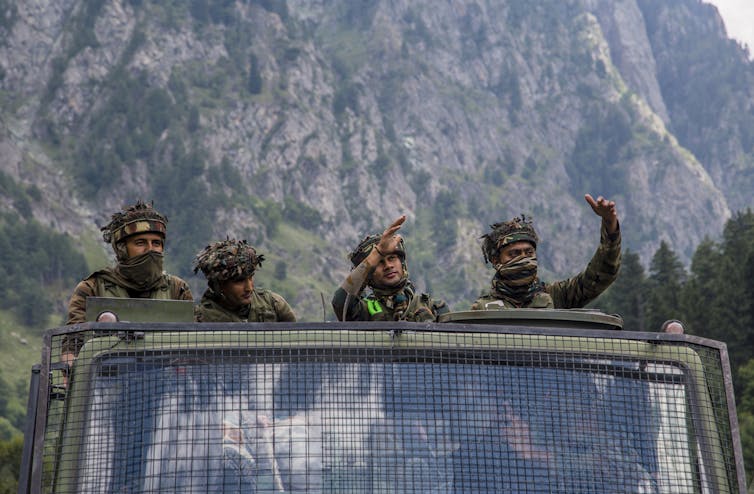
India has increased its military presence in Kashmir to at least 500,000 troops. 

Intractable struggles

In many cases, treaties and international court decisions cannot be enforced. There is no international police force to help implement international law.

If a country ignores an International Court of Justice ruling, the other party in that court case may have recourse to the Security Council, which can pressure or even sanction a nation to comply with international law.

But that rarely happens, as such resolution processes are highly political and any permanent Security Council member can veto them.

And when conflicting parties are more inclined to view a conflict through the lens of domestic law – as India views Kashmir and Israel views the Palestinian territories – they can argue that international law simply does not apply.

Kashmir is not the only contested territory where international law has failed.


The Israeli-Palestinian conflict over the Gaza and West Bank territories is another example. For decades, both the U.N. and the United States have repeatedly and unsuccessfully intervened there in an effort to establish mutually acceptable borderlines and bring peace.

International law has grown and strengthened since its creation in the 1940s, but there are still many problems it cannot solve.

Author
Bulbul Ahmed
Assistant Professor, Department of International Relations, Faculty of Security and Strategic Studies, Bangladesh University of Professionals

Saturday, February 06, 2021

Pakistani PM urges Kashmir referendum, 
talks with India

MUNIR AHMED
Fri., February 5, 2021,

1/4
Pakistan Kashmir
Supporters of the Pakistani religious group Jamaat-e-Islami chant anti India slogans during a rally to mark Kashmir Solidarity Day in Lahore, Pakistan, Friday, Feb. 5, 2021. Pakistan's political and military leadership on Friday marked the annual Day of Solidarity with Kashmir, vowing to continue political support for those living in the Indian-controlled part of Kashmir and for a solution to the disputed region's status in accordance with U.N. resolutions. (AP Photo/K.M. Chaudary)

2/4

Pakistan Kashmir
Supporters of the Pakistani religious group Jamaat-e-Islami participate in a rally to mark Kashmir Solidarity Day in Lahore, Pakistan, Friday, Feb. 5, 2021. Pakistan's political and military leadership on Friday marked the annual Day of Solidarity with Kashmir, vowing to continue political support for those living in the Indian-controlled part of Kashmir and for a solution to the disputed region's status in accordance with U.N. resolutions. (AP Photo/K.M. Chaudary)

3/4

Pakistan Kashmir
Children participate in a rally organized by a Pakistani religious group Jamaat-e-Islami to mark Kashmir Solidarity Day in Lahore, Pakistan, Friday, Feb. 5, 2021. Pakistan's political and military leadership on Friday marked the annual Day of Solidarity with Kashmir, vowing to continue political support for those living in the Indian-controlled part of Kashmir and for a solution to the disputed region's status in accordance with U.N. resolutions. (AP Photo/K.M. Chaudary)


4/4

Pakistan Kashmir
Supporters of the Pakistani religious group Jamaat-e-Islami participate in a rally to mark Kashmir Solidarity Day in Lahore, Pakistan, Friday, Feb. 5, 2021. Pakistan's political and military leadership on Friday marked the annual Day of Solidarity with Kashmir, vowing to continue political support for those living in the Indian-controlled part of Kashmir and for a solution to the disputed region's status in accordance with U.N. resolutions. (AP Photo/K.M. Chaudary)


ISLAMABAD (AP) — Pakistan will allow people in the Pakistan-administered section of divided Kashmir to decide whether they wanted to join Pakistan or prefer to remain independent in a future referendum on the disputed Himalayan region, the prime minister said Friday.

Imran Khan spoke at a rally in the town of Kotli in the Pakistan-administered Kashmir as the country marked the annual Day of Solidarity with Kashmir.

“God willing, Pakistan will give the right to Kashmiri people to decide whether they want to remain independent or become part of Pakistan," Khan said.

Khan expressed readiness to talk to his Indian counterpart, Narendra Modi, if he reverses steps taken by New Delhi in 2019 by changing the special status of Kashmir, which is split between Pakistan and India and claimed by both in its entirety.

At the time, relation between Pakistan and India were strained over New Delhi's move to divide the Indian-administered part of the Muslim-majority Kashmir into two federally governed territories — Jammu and Kashmir, and Ladakh — touching off anger on both sides of the frontier.

Khan assailed India's Hindu nationalist government over the action, calling India a state sponsor of hatred and prejudice against Islam. Since then, Pakistan has refused to hold talks with India, saying Modi must first restore the original status of the Indian-administered Kashmir.

Earlier, Shibli Faraz, Pakistan’s information minister, told The Associated Press that Islamabad would resume talks with India when Modi's government agrees to a Kashmir referendum in accordance with U.N. resolutions.

In southwestern Pakistan, at least 16 people were wounded when an unknown assailant threw a hand grenade at people standing along a road minutes after a pro-Kashmir rally passed through the area, local police chief Wazir Ali Marri said. No one claimed responsibility for the attack, which took place in the district of Sibi in Baluchistan province. The restive province has been the scene of a low-level insurgency by separatists demanding a greater share of local natural gas and mineral resources.

Also in Baluchistan, later Friday, a bomb went off near a government office in the city of Quetta, the provincial capital, killing at least two people and wounding five, police said. No one immediately claimed responsibility for the bombing, which took place near the office of the deputy commissioner.

In Kashmir, Pakistan has long pushed for the right to self-determination under a U.N. resolution passed in 1948, which called for a referendum on whether Kashmiris wanted to merge with Pakistan or India.

The future of Muslim-majority Kashmir was left unresolved at the end of British colonial rule in 1947, when the Indian subcontinent was divided into predominantly Hindu India and mainly Muslim Pakistan.

India and Pakistan have fought two of their three wars over Kashmir since gaining independence from British rule in 1947. In 2019, a car bombing in Indian-controlled Kashmir killed 40 Indian soldiers and brought the nuclear-armed rivals to the brink of war.

India has an estimated 700,000 soldiers in its part of Kashmir, fighting nearly a dozen rebel groups since 1989. In many areas, the region has the feel of an occupied country, with soldiers in full combat gear patrolling streets and frisking civilians. More than 68,000 people, most of them civilians, have been killed in the conflict.

Also Friday, the Pakistani military took foreign media on a tour of a border village in Pakistan-administered Kashmir to demonstrate damage by Indian fire. Residents in the area accuse India of deliberately targeting civilians, a charge India denies.

The two sides regularly trade fire in violation of the 2003 cease-fire agreement across the Line of Control, which separates the two sectors of Kashmir. Civilians are often caught in the crossfire, with dozens killed every year in the violence.

Most of the people who live along the boundary line have either lost family members or relatives in recent decades.

___

Associated Press writers Abdul Sattar in Quetta, Pakistan, and Muhammad Yousaf from Bhimber, Pakistan, contributed to this report.

Sunday, April 24, 2022

#KASHMIR IS #INDIA'S #GAZA
Demonstrations in AJK as Indian PM Modi’s visit to IoK observed as 'black day'

Published April 24, 2022 - Updated about 3 hours ago
Protesters take part in a demonstration in Muzaffarabad against the visit of Prime Minister Narendra Modi to the disputed Jammu and Kashmir region, April 24. — AFP

A "black day" was observed and anti-India demonstrations were held in Azad Jammu and Kashmir on Sunday as Indian Prime Minister Narendra Modi visited occupied Jammu and Kashmir in what was his first visit to the disputed territory since New Delhi revoked special status nearly three years ago.

New Delhi nullified the area's special status in August 2019, when authorities arrested thousands and imposed the world's longest internet shutdown, seeking to forestall local opposition to the move.

Tight security was in place for Modi's appearance at Palli village in Jammu, the Hindu-majority southern part of the territory, which celebrated New Delhi's introduction of direct rule as a defence against Kashmir's freedom movement.


Sunday's event marked Panchayati Raj, a day that commemorates grassroots democracy — although occupied Kashmir has been without an elected regional government since 2018.

There was a complete shutdown in occupied Kashmir, the official Pakistani press agency APP reported. The call for the strike was given by the All-Parties Hurriyat Conference.

In Azad Kashmir, demonstrations were held on the call of AJK Prime Minister Sardar Tanveer Ilyas yesterday.

Today, a large "black day" protest rally was held in the capital Muzaffarabad and led by AJK minister Khawaja Farooq Ahmed and representatives of other political parties. The rally started from Burhan Wani Chowk and ended at Ghari Pin Chowk. Apart from banners with anti-India and pro-independence slogans, the participants also held black flags and chanted slogans against Modi.

Addressing the participants on the occasion, Khawaja Farooq Ahmed said the protesters wanted to convince the international community through demonstrations that Kashmiris never recognised the Indian occupation and the arrival of a person like Modi — whose "hands are stained with the blood of innocent Kashmiris" — in any part of the territory was a "highly undesirable" thing for them.

He called on the international community, especially the United States and the United Kingdom, to sever their relations with India, as they had done with Russia over the war in Ukraine. He lamented the "double standards" of the international community in the case of Kashmiris.

Ahmed said that the UN and the international community should press India to give Kashmiris their right to self-determination. He said that India-occupied Kashmir was under a continuous curfew in which people's livelihoods were being destroyed under a "premeditated plan" so that they could not raise voices against India.

He also expressed gratitude to the institutions and people of Pakistan for always supporting Kashmiris.

Ahmed said that the day was not far when Kashmiris would become independent and a part of Pakistan.

Mushaal Hussein Malik, the wife of Jammu Kashmir Liberation Front chairman Yasin Malik, said that Modi's visit was "nothing but a cruel joke with the Kashmiri people", according to APP.

She vowed that the brave people of Kashmir would observe a complete shutdown on Modi's visit to give a clear message to him as well as to the world that Kashmiris would not accept brutal subjugation anymore.

At the end of the rally, prayers were offered for the independence of the occupied territory.
Tight security in Jammu

Indian authorities deployed troops and police personnel across the occupied territory, particularly in the Jammu region, as security measures ahead of Modi’s visit.

According to state-run APP, Indian personnel conducted random checking of vehicles and frisked passengers at checkpoints which mushroomed on the roads of all major cities and towns as well as the Srinagar-Jammu highway.

Indian police and troops used CCTV cameras to keep a watch on the movement of people. Sharpshooters were also deployed at high rise buildings while drone cameras and sniffer dogs were included in service. Indian police seized scores of bikes from different areas of Srinagar.

Black day to be observed on Modi’s visit to occupied Kashmir: AJK PM

Published April 24, 2022
Azad Kashmir Prime Minister Sardar Tanveer Ilyas addresses a press conference at the Kashmir House in Islamabad on Saturday. — APP

ISLAMABAD: Kashmiris on both sides of the Line of Control (LoC) will observe black day today (Sunday) when Indian Prime Minister Narendra Modi undertakes his first visit to occupied Kashmir.

This was announced by Azad Kashmir (AJK) Prime Minister Sardar Tanveer Ilyas while speaking at a crowded press conference at the Kashmir House.

This was Tanveer Ilyas’ first press conference in the capital after assuming the office of the Azad Jammu and Kashmir prime minister.

Convener All Parties Hurriyat Conference-Azad Kashmir chapter (APHC) Farooq Rehmani and members of the AJK legislative assembly were also present on the occasion.

Mr Ilyas said protest demonstrations would be held and rallies taken out in Azad Kashmir as well as India-held Kashmir.

Protests, rallies to be taken out in Azad Kashmir, India-held Kashmir

He said Modi could not hoodwink the world by visiting occupied Kashmir in the presence of 800,000 Indian troops.

Terming Modi the ‘biggest terrorist’ and ‘killer of Kashmiris’, the AJK premier said his Hindutva ideology posed a serious threat to peace in the region and beyond, urging the United Nations to play its due role in resolving the lingering Kashmir dispute peacefully.

He said it was high time that the international community, particularly the UN, came forward in a big way to resolve the Kashmir dispute which was the main cause of unrest in the region.

The dire situation in occupied Kashmir merits immediate attention of the United Nations, Mr Ilyas said, adding that Kashmiris wanted the right to self-determination and did not want to be with India.

Referring to the enforced disappearances and killings of youth in fake encounters, the AJK premier said thousands of unmarked mass graves spread all across the territory spoke volumes about the systematic genocide of Kashmiris at the hands of India’s occupation machinery.

“At a time when Kashmiris stand deprived even of the inconsequential rights of governance due to stripping of the special status of their state, when the Indian occupation forces have stepped up the worst ever atrocities, Modi’s visit amounts to rubbing salt into the wounds of Kashmiris,” he said.

In fact, he said, the visit was part of the BJP government’s ploy to hoodwink the international community and create a false impression that “all is well in Kashmir”.

Paying rich tributes to veteran Hurriyat leader Syed Ali Gilani, PM Ilyas said Gilani was the voice of Pakistan.

Speaking on the occasion, Hurriyat leader Mohammad Farooq Rahmani said: “Indian army is killing Kashmiris the way Hitler committed mass killings in Germany and Israel massacred the Palestinians.”

Published in Dawn, April 24th, 2022

Violence erupts ahead of Modi visit to contested Jammu and Kashmir


Indian paramilitary soldiers walk near site of gunfight at a village near Srinagar, the summer capital of Indian Kashmir, on Friday. 
Photo by Farooq Khan/EPA-EFE

April 23 (UPI) -- Violence has erupted near an Indian army base in Jammu ahead of Prime Minister Narendra Modi's scheduled visit to the disputed Kashmir region on Sunday, reports said.

Modi is expected to hold his first public rally in Kashmir since 2019, when the government revoked the disputed region's special autonomous status, according to the Spanish news agency EFE.

Jammu and Kashmir, administered by India as a union territory, is a bifurcated subregion of the larger Kashmir region contested by Pakistan and India since 1947.

The Muslim-majority territory is separated from the Pakistani-administered territories of Azad Kashmir and Gilgit-Baltistan by the Line of Control, which serves as an unofficial border along the ceasefire lines from the end of the India-Pakistan War of 1971.

Sardar Tanveer Ilyas, prime minister of the Kashmir region controlled by Pakistan, said during a press conference in Islamabad Saturday Kashmiris on both sides of Line of Control would observe "Black Day" during Modi's visit to Jammu, Pakistan Today reported.

India and Pakistan each typically commemorate an annual "Black Day" in October to remember the start of the conflict over Kashmir in 1947.

Ilyas accused Indian security forces of the "extrajudicial executions" of thousands of Kashmiris and claimed India was settling Hindus in Kashmir to "disturb the ratio of population."

Dilbag Singh, the police chief in the India-controlled Jammu and Kashmir territory, said Friday that a "suicide squad" from the Kashmir-focused Jaish-e-Mohammed militant group had killed at least one security personnel and injured nine others, the Times of India reported.

Jaish-e-Mohammed has been described as a terrorist organization by the Combating Terrorism Center at West Point, which said such groups "that aspire to be active in Indian-controlled Kashmir remain a concern."

Singh said the group had "planned a major attack" in Jammu ahead of Modi's visit to "sabotage" the event, which was thwarted.

In a separate gunfight, Indian security forces killed four militants in the northern Baramulla district of the Kashmir Valley, police said. Five security personnel were killed during the incident.

Pakistan has accused India of "the worst form of state terrorism" and a "disregard for international human rights and humanitarian laws" during previous "Black Day" commemorations.

Thursday, March 07, 2024

Indian PM Modi visits disputed Kashmir for the first time in five years

Visiting the Muslim-majority Kashmir Valley for the first time since 2019, Modi said that Kashmir's development was a priority for India as it sits like a crown in the country's north
.


REUTERS

Schools were shut and exams postponed as thousands of government employees gathered for Modi's meeting. / Photo: Reuters

Indian Prime Minister Narendra Modi has made a historic visit to the disputed region of Kashmir, marking his first trip to the territory in five years.

The Muslim-majority region is administered by India and Pakistan in parts and claimed by both in full. A small portion is also held by China.

The region has been a contentious point of contention for decades, with periodic escalations leading to military confrontations and diplomatic strains.

Thursday's visit comes against the backdrop of India's recent actions, such as the abrogation of Article 370 in 2019, altering the special status of Kashmir.

The Himalayan region has been transformed and integrated with the rest of India, Modi has claimed, crediting the change to his government's contentious decision to revoke its special status.


Visiting the Muslim-majority Kashmir Valley for the first time since 2019 — the year the status was revoked — Modi said that Kashmir's development was a priority for India as it sits like a crown in the country's north.

"This new Jammu-Kashmir has the courage to overcome any challenge," Modi told thousands of people attending a public meeting at a stadium in Srinagar, the region's summer capital, amid tight security.

"The country is seeing these smiling faces of yours ... (and) feeling relieved to see you all happy."


'Awaiting for decades'

Modi's visit to a region roiled for decades by violence comes weeks before general elections in which he will seek a rare third term.

Although his Hindu nationalist Bharatiya Janata Party (BJP) is not a key player in Kashmir, the visit is seen as a signal to its voters that the party has fulfilled a core promise to end Kashmir's special status.

"This is the new Jammu and Kashmir we had been awaiting for decades," Modi added, listing achievements and investments made during the last five years.


Exams postponed for Modi's visit

Armed security personnel guarded downtown areas of Srinagar, commandos in boats patrolled its scenic Dal Lake, and the use of drones was banned. Schools were shut and exams postponed as thousands of government employees gathered for the meeting.

Modi has said Kashmir's special status allowed it a measure of administrative autonomy that held back its development and his government has unveiled several investment and infrastructure projects.

Kashmiri politicians who opposed revocation of special status criticised Modi's visit.

"This visit is only meant to ... drum up support amongst the BJP's core constituency in the rest of India for the upcoming parliament elections," Mehbooba Mufti, a former chief minister and former BJP ally, posted on social network X.


India PM Modi praises Kashmir transformation on first visit in 5 years

New Delhi, Mar 7 (EFE).- India’s Prime Minister Narendra Modi said on Thursday that Kashmir has undergone a significant transformation and experienced freedom since the Indian government revoked its special semi-autonomous status five years ago.

Modi made the remarks during his first visit to the Indian-administered region since the contentious withdrawal of its semi-autonomous status nearly five years ago.

“This is the new Jammu Kashmir that we had been waiting for decades,” Modi said, addressing a packed stadium in Srinagar.

The Hindu nationalist leader said that the revocation has granted freedom and opened up “new opportunities” for the residents of Kashmir to pursue their “dreams.”

On Aug. 5, 2019, the Indian parliament abolished Article 370 of the constitution, which had granted semi-autonomous status to the state of Jammu and Kashmir, and allowed it to enact laws and have its own constitution, among other provisions.

The decision, bringing Kashmir under the direct administration of New Delhi, also resulted in unprecedented restrictions in the region, including an extended 18-month internet shutdown, to forestall protests and revolts.

Modi attended Thursday’s gathering under tight security measures, with security forces maintaining a vigilant presence around the stadium and nearby areas.

Over the past few days, thousands of armed police and paramilitary forces were deployed on the main roads of Srinagar, conducting door-to-door searches and random checks of pedestrians and vehicles across the region.

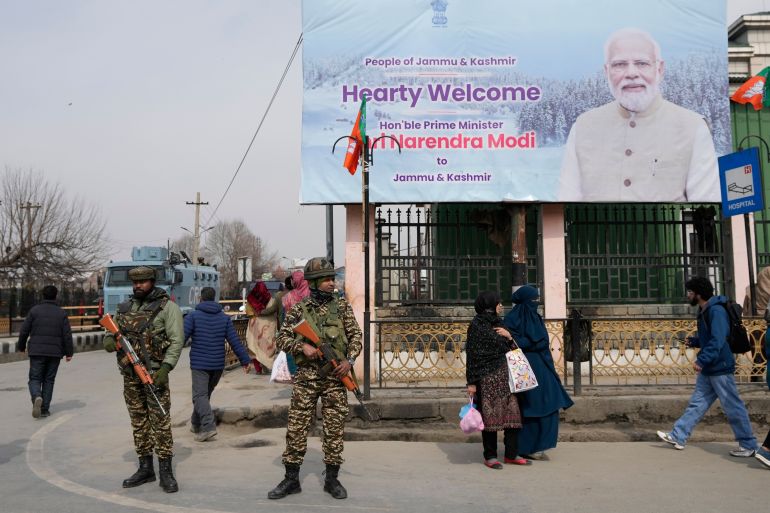
The city also underwent an intense facelift, adorned with thousands of posters and flags of Modi’s party, the Bharatiya Janata Party (BJP), displayed throughout the city.

Modi’s visit to the Muslim-majority region comes ahead of the Indian general elections, expected between April and May, where he is seeking a third consecutive term.

During the visit, schools were closed, and employees from at least 10 government departments were instructed to attend the prime minister’s rally, official sources told EFE.

Modi also inaugurated several projects worth $169 million to boost the Himalayan region’s tourism sector.

The picturesque territory has been a longstanding point of contention between India and Pakistan since their partition in 1947.

India has consistently accused Pakistan of supporting “terrorism” and insurgency in Kashmir, a charge Islamabad vehemently denies. EFE

sa-hbc/bks/ks


Indian PM Modi visits Kashmir for first time since special status revoked

Modi-Kashmir

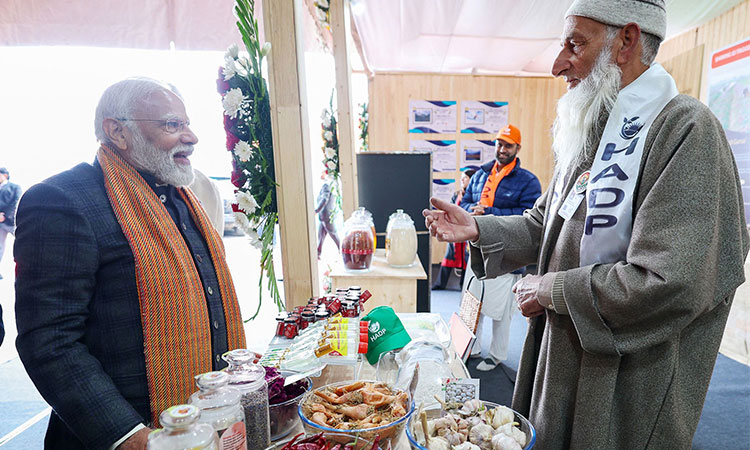
Narendra Modi (L) during an exhibition ahead of the ‘Viksit Bharat Viksit Jammu Kashmir’ at the Bakshi stadium in Srinagar on Thursday. AFP

Indian Prime Minister Narendra Modi on Thursday made his first official visit to Kashmir's main city since New Delhi stripped the region of semi-autonomy and took direct control of it in 2019.

Addressing a crowd in a soccer stadium in Srinagar, Modi announced development projects, and said previous governments had misled people over the region's now-scrapped special status.

"The success story of Jammu and Kashmir will be the center of attraction for the world," he said, saying that the region has prospered since the 2019 move. "I have always said that the hard work I am doing is to win your hearts. I will work towards winning your hearts further,” Modi told the crowd.

Modi and his party have accused Kashmir’s pro-India parties of being corrupt, misleading Kashmiris and promoting separatism in the region. Kashmiri politicians, who say their special status was a constitutional guarantee, have called Modi divisive and anti-minority.

Thousands of armed paramilitary troops and police in flak jackets maintained extra vigilance across the Kashmir Valley. Modi’s two previous visits to Kashmir after its status was changed were to the Hindu-dominated city of Jammu.

Modi did not mention plans to hold elections in the region or to restore its statehood, both demanded by Kashmir's pro-India political parties. The last election for the regional legislature were held in 2014, but the government elected then was dismissed in 2018.

In 2019, Modi’s Hindu-nationalist government revoked the region’s semi-autonomous status, annulled its separate constitution, split the area into two federal territories — Ladakh and Jammu-Kashmir — and removed inherited protections on land and jobs. The Muslim-majority region is now run by unelected government officials and bureaucrats.

India's powerful home minister, Amit Shah, has repeatedly promised that the region would be regain statehood after elections.

In December, India’s Supreme Court upheld the 2019 decision and asked the government to conduct state polls by September.

HEAVY SECURITY

Ahead of Modi’s visit to Srinagar, government forces laid razor wires and erected checkpoints on roads leading to the venue. They randomly frisked residents and searched vehicles, while navy commandos in motorboats patrolled the Jhelum River that snakes through the city.

Authorities ordered thousands of government employees, including teachers, to attend the meeting, and most schools in the city were closed for the day.

Thursday’s event is seen as part of Modi’s campaign ahead of national elections scheduled in April and May.

Kashmiri politicians who opposed revocation of special status criticised Modi's visit. "This visit is only meant to ... drum up support amongst the BJP's core constituency in the rest of India for the upcoming parliament elections," Mehbooba Mufti, a former chief minister and former BJP ally, posted on social network X.

Associated Press


EXPLAINER
India’s Modi visits Kashmir: How has the region changed since 2019?

Here’s a look at Narendra Modi’s government policies and how they have affected Kashmir since the region’s semi-autonomous status was taken away.


Published On 7 Mar 2024

Indian Prime Minister Narendra Modi on Thursday made his first visit to Kashmir since his government’s controversial 2019 decision to scrap the region’s special semi-autonomous status.

Addressing a crowd at a football stadium in the region’s largest city, Srinagar, Modi claimed that the removal of Article 370, which granted a measure of autonomy to Indian-administered Jammu and Kashmir, had ushered in development and peace.

“I am working hard to win your hearts, and my attempt to keep winning your hearts will continue,” Modi said even as the region was placed under a security blanket, with thousands of soldiers and paramilitary forces deployed and new checkpoints set up.

The 2019 decision was hailed by the Hindu nationalist movement that Modi represents, but was met with anger in Kashmir – one of India’s only two Muslim-majority regions – which has seen a decades-long armed rebellion against Indian rule.

Since then, Modi has visited Hindu-majority Jammu region, but has stayed away from Kashmir, until now, on the eve of the 2024 national elections.

Modi and his government have claimed that the scrapping of Article 370, and their subsequent policies in Kashmir, have helped transform the region for the better.

Here’s a look at key changes brought to Kashmir by Modi’s government since 2019:

Special status under Article 370 removed


Article 370, which was enshrined in India’s constitution signifying Kashmir’s unique relationship with New Delhi, granted the Himalayan region a large measure of autonomy: Kashmir had its own constitution and flag, it could make its own laws in all matters except finance, defence, foreign affairs and communications.

Until 1965, the Indian-administered region had its own prime minister under whom property and domicile laws were passed to protect the interests and territorial rights of the region’s Indigenous people.

However, successive Indian governments watered down the autonomy, leaving the region, in some cases, with fewer powers than other states in India’s federal structure. The region had become heavily militarised after armed rebellion erupted in the late 1980s.

The 2019 revocation of Article 370 resulted in the loss of Kashmir’s flag, criminal code and constitutional guarantees. Several Indian states have laws in place to protect the tribal and Indigenous populations. Kashmir no longer does.

In December 2023, the Indian Supreme Court upheld the 2019 decision. Kashmir has been a major source of conflict between India and its neighbour, Pakistan, for more than 75 years. Both countries claim Kashmir in its entirety but govern only a portion of it.

Indian-administrated Kashmir bifurcated into two


Indian-administered Jammu and Kashmir was bifurcated into two regions – Jammu and Kashmir in the west and Ladakh in the east. Neither region has statehood any more, as a consequence of the Modi government’s 2019 decisions.

Both are governed directly from New Delhi.

But people have expressed their grievances against their lack of democratic rights, with Ladakh too seeing frequent protests for more political rights and authority in local governance.

No elections for state legislature

The two new regions – Jammu and Kashmir, and Ladakh – have been without a state legislature since 2019. The last state elections were held in 2014 – the year Modi first came to power.

In December 2020, the first local elections took place to elect 280 members of District Development Councils (DDC) across Indian-administered Kashmir’s 20 districts. The DDC members, however, do not have the power to amend or introduce laws.

There have also been elections to fill seats in the village councils, also called panchayat, and municipal bodies, but they have very limited power, with the region ruled by New Delhi’s representative and bureaucrats.

India’s Supreme Court in December ordered the government to hold local elections by September 30, 2024.

Kashmir’s pro-India political parties have been demanding that elections be held in the region.

Modi and his government, however, have not indicated when they will hold the elections.


Clampdown on free speech

In the wake of the 2019 decision, New Delhi cracked down on rights activists and local politicians, imposed sweeping restrictions on free speech and shutting down the internet for months. Authorities used “antiterror” laws to arrest Kashmiri activists and journalists.

Human rights groups, including United Nations agencies, have criticised New Delhi for its rights violations in Kashmir.

On Friday, Kashmiri journalist Aasif Sultan was rearrested under an “antiterror” law days after his release from prison after five years. Sultan, the former editor of the now defunct Kashmir Narrator magazine, was arrested in 2018 for “harbouring militants”. His family has denied the allegations.

In November 2021, prominent Kashmiri activist, Khurram Parvez was arrested under the Unlawful Activities (Prevention) Act (UAPA). Kashmiri journalist Irfan Mehraj, who was previously associated with Parvez’s human rights organisation, was also arrested. UN experts and Amnesty International have condemned the arrest of Parvez and called for his release.

Journalist Fahad Shah, the editor of independent news portal Kashmir Walla, was released in November 2023 after more than 600 days of confinement under the “antiterror” law.

Journalist Sajad Gul was arrested in January 2022 under the stringent Public Safety Act (PSA), which allows the detention of an individual without trial for six months.

A global report on internet censorship in 2022 found that Kashmir experienced more internet shutdowns and restrictions than any other region in the world.

Lack of protection for local communities

The Indian government also removed Article 35A of the Indian Constitution, which barred outsiders from permanently settling, buying land and holding local government jobs in the Muslim-majority region.

Other Indian states such as Himachal Pradesh, Uttarakhand, Jharkhand and Odisha continue to safeguard the property rights of local residents, mostly tribal or Indigenous people.

Non-Kashmiris can now buy property in the region. This has prompted fears that the Modi government is trying to engineer a demographic shift in the Muslim-majority region.

These fears were further fuelled by a new domicile law for Indian citizens that the Indian Ministry of Home Affairs introduced in April 2020.

Under the domicile law, those who have lived in the Indian-administered region for 15 years, or have studied for seven years and appeared in secondary or high school-leaving examinations in educational institutions located in the region, are eligible to become permanent residents. Children of government officials who have served for 10 years in the region are also granted domicile status.

This law too has made Kashmiris fearful of permanent settlement by outsiders, including the family members of Indian security forces. Leaders from Modi’s Bharatiya Janata Party have rejected that there are attempts to alter the demographics of the region.

Indigenous communities in Kashmir, and Ladakh are also affected by environmental damage and an influx of tourists. Kashmir’s Dal Lake is choked with sewage and its farmers suffer as a result of illegal river mining, and Ladakh is struggling to mitigate flooding and landslides.

Attempt at delimitation in Kashmir


The New Delhi-run local authorities have also redrawn assembly constituencies that many Kashmiris fear are aimed at the democratic marginalisation of Muslims.

A delimitation commission is assigning more legislative seats to the Hindu-majority Jammu region – where the BJP has wide support – than Kashmir Valley, despite the latter having a higher population. The total seats from Jammu region are expected to rise to 43 from 37, but only by one in Kashmir – to 47 from the existing 46, in effect changing the balance of power within the legislature.
Armed attacks continue in Indian-administered Kashmir

Modi’s ruling BJP government has said that Article 370 was abrogated to wipe out “terrorism” in the region and it has claimed that its policies have improved the security of the region.

However, armed attacks have continued in the region, causing deaths among civilians, security forces and rebels. Since 2021, attacks against Indian soldiers in districts like Rajouri and Poonch in the Jammu region have increased.

Ajai Sahni, the executive director of the Institute for Conflict Management in New Delhi told Al Jazeera in December 2023 that most of the recent killings of security forces took place in army-initiated operations. “I don’t believe that normalcy has returned after Article 370 abrogation,” said Sahni.

The South Asia Terrorism Portal (SATP) reported that the incidence of killing in the Indian-administered Kashmir went from 135 in 2019 to 140 in 2020 and further rose to 153 in 2021. While the number of incidents dropped to 72 in 2023, 33 security forces were killed in the year compared with 30 in 2022, where 151 incidents took place.


SOURCE: AL JAZEERA


Friday, July 31, 2026

Oppose repression of mass uprising in Pakistan-administered Jammu Kashmir

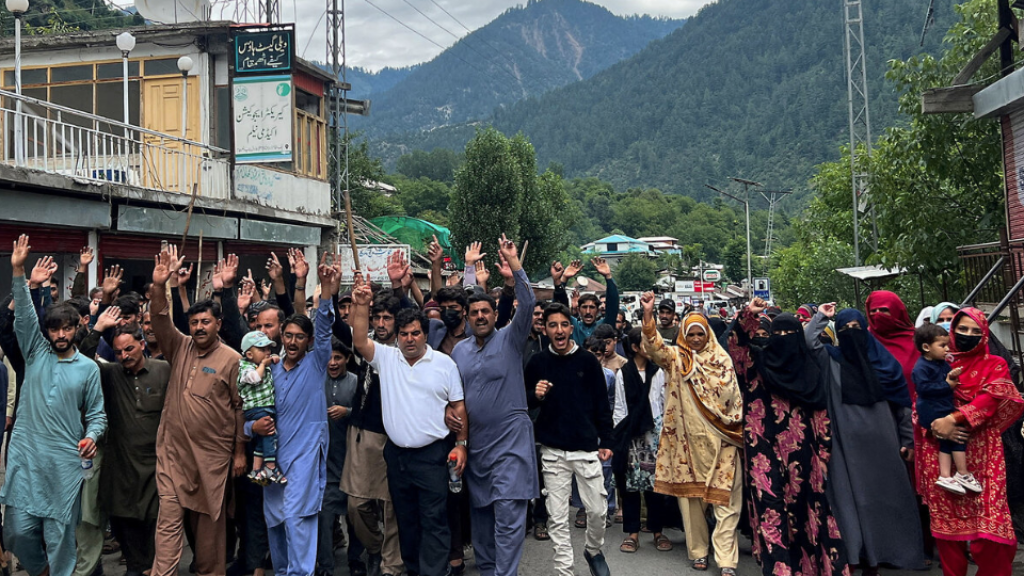
Jammu Kashmir protest July 21

In one of the most brutal attacks on an unarmed rally, Pakistani rangers and police killed at least 18 Kashmiris, and left dozens injured, on July 28.

The direct firing by state forces on demonstrators was without any provocation. Participants of the Long March to Kashmir capital Muzafarabad were camping for over a month in the outskirts of Rawalakot, one of the main cities in Pakistani-controlled Jammu Kashmir.

Thousands joined the call of the Jammu Kashmir Joint Awami Action Committee (JAAC), a non-partisan civil society mass organisation who had led earlier mass campaigns for lowering electricity prices.

This time they were asking for election reforms to enable real representation for Kashmiris. They were demanding an end to the 12 seats for Muhajirs (migrants) Kashmiris settled in Pakistan. These seats were mainly a political gimmick used to form governments in Jammu Kashmir.

JAC was banned after lengthy negotiations with them by the state ministers that failed. The JAAC was deemed a terrorist organisation linked to India, and its main leaders as agents of India’s RAW [Research and Analysis Wing foreign intelligence agency]. Most of the main leaders were arrested. A curfew was imposed in Rawalakot, the main centre of resistance to state repression.

However, in one of the most glaring examples of mass awakening, the whole Kashmir was almost shut down on the call of JAAC. No shops opened and there was no internet or people in the streets. JAAC had become the real representative of Kashmiris.

The government wanted to go ahead with the scheduled July 27 general elections. However, a mass boycott of the whole process meant very small numbers of people voted.

The same day, JAAC announced its Long March to Muzafarabad, which was fired upon and attacked with tear gas.

One of the main characteristics of this mass movement for civil and political rights was the participation of women, who came in thousands every day to the sit-in outside Rawalkot for over a month. They brought food for participants and ensured the sit-in could continue.

Never has such a brave mass movement been witnessed in this region as the one currently unfolding in Pakistani-controlled Jammu Kashmir. More than 50 protesters have been killed by state forces since the movement started a month ago.

The Long March has started again from Rawlakot where, despite the bloodshed, participants were able to enter the city despite the security forces’ barriers.

Solidarity from international labour and civil society movements is urgently needed. Please condemn the deaths and repression by sending protest letters to Pakistan embassies. Please raise the issue wherever possible. The death of innocent Kashmiris should not go unheard.

The names of the July 28 martyrs are listed below.

1. Naeem Butt – Kotli, Pakistan-administered Jammu Kashmir

2. Usman Nazir – Rawalakot, Pakistan-administered Jammu Kashmir

3. Nisar Ahmed – Baloch, Pakistan-administered Jammu Kashmir

4. Kashif Yaqoob – Rawalakot, Pakistan-administered JammuKashmir

5. Sardar Fida Hussain – Tatrinote, Pakistan-administered Jammu Kashmir

6. Muzammil – Ali Sojal, Pakistan-administered JammuKashmir

7. Basit Shah – Hajira, Pakistan-administered Jammu Kashmir

8. Fahim Afzal – Chhota Gala, Rawalakot, Pakistan-administered Jammu Kashmir

9. Kamran Mushtaq – Panakha, S/o Mushtaq, Hajira, Pakistan-administered Jammu Kashmir

10. Zargham Khalil – Darek, Rawalakot, Pakistan-administered Jammu Kashmir

11. Saqib Hanif – Reerh Bann, Rawalakot, Pakistan-administered Jammu Kashmir

12. Saqib Ishaq – Numb, Gawara, Palandri, Pakistan-administered Jammu Kashmir

13. Areej Asghar – Tatta Pani, Pakistan-administered Jammu Kashmir

14. Usman Gul – Darek Dhok, Rawalakot, Pakistan-administered Jammu Kashmir

15. Jaffar Pehlwan – Tatrinote, Pakistan-administered Jammu Kashmir

16. Nisar Shaheen – Pakho, Narbai, Pakistan-administered Jammu Kashmir

17. Ali Hussain – Khari Sharif, Mirpur, Pakistan-administered Jammu Kashmir

18. Khawaja Abrar Latif Dar – Khurshidabad, Haveli, Pakistan-administered Jammu Kashmir

Deaths in Pakistani controlled Kashmir


Thursday 30 July 2026, by Farooq Sulehria, Farooq Tariq


Farooq Sulehria made this podcast for Struggle TV about events in Kashmir. International Viewpoint brings you the transcript. Farooq Tariq wrote on the same subject, his article follows. An appeal for solidarity has already been published “Jammu-Kashmir progressive organisations call for global solidarity”.

I’m doing this program with a very heavy heart. Yesterday in Rawalakot, another twenty one people were killed. This is second time in almost seven weeks that Rawalakot has been the site of another massacre.

Earlier, on the night, between 6 and 7 June, the security forces fired on a peaceful sit in in Rawalakot. And at least ten people were killed at that time. What is going on in Kashmir has largely been ignored in global media. Not only global media. Even the Pakistani mainstream media is either not covering it or is simply busy doing an ugly propaganda against an Intifada-like movement which has gripped Pakistani controlled Jammu and Kashmir.

I perhaps need to offer a bit of context to an international audience listening to this podcast. Well, there was a long march announced by Joint Awami Action Committee (or Joint People’s Action Committee), which is an organizational form of a huge social movement that has gripped this region of Jammu and Kashmir in about three years.

This was third time that they had announced a long march from Mirpur, which is an important town in one corner of the Jammu and Kashmir. And they were supposed to march on Muzaffarabad, the capital of Jammu and Kashmir. Jammu and Kashmir is an autonomous region. In a way, it is not part of Pakistan. It is not integrated into Pakistan the way India has integrated the occupied part of Jammu and Kashmir that India controls.

Jammu and Kashmir under Pakistani control, has its own parliament, own prime minister, own Supreme Court and elections were supposed to be held on 27 July, yesterday. The first round of elections was held in fact, yesterday, and it was largely boycotted. There were hardly any voters turning out to vote anyway.

Ahead of these elections, the Joint Action Committee had announced a long march on Muzaffarabad, and the key demand was to rescind twelve seats reserved for the refugees. The refugees from Indian held Jammu and Kashmir, who migrated to Pakistan and were settled in Pakistan for last about eighty years. There are twelve seats reserved for them now. The problem was: through these reserved seats. Islamabad, the capital of Pakistan. Or, you know, the Pakistani state, would control the election system and form a government of their choice in Muzaffarabad. So there was this demand by Joint Awami Action Committee to eliminate these seats, to end these reserved quotas for refugees, so that a genuine government that represents the people of Jammu and Kashmir, in Pakistani controlled Kashmir, can form a government of their choice. Ahead of this Long March, which was supposed to begin on 9 June, the security forces tried to kidnap one of the key leaders, Umar Nazir. Kashmiri, who comes from Rawalakot and Rawalakot, has been the hub of this movement. That’s where this movement started and was translated into an organizational form called Joint Awami Action Committee.

This Joint Awami Action Committee has a core committee. It has almost thirty three core members, and they represent all parts of Jammu and Kashmir. That is to say, Pakistani controlled Jammu and Kashmir. Every district has a branch of Joint Awami Action Committee. These people are elected by the by the residents of that area. The attempt to kidnap Umar Nazir Kashmiri outside of Rawalakot on 5 June, actually led to the killing of his close associate, Shahzeb, his close comrade. He was killed, a young man in his early thirties, and Umar Nazir Kashmiri himself was injured in the police firing. The residents of Rawalakot started a sit in with the dead body of Shahzeb outside of the local military hospital, and next night, the security forces, fired live ammunition on the agitators. And at least ten or twelve people were killed in the incident. This really agitated the entire region. And despite the atmosphere of fear, the Long March was started from Mirpur and on its way to Rawalakot, which is halfway Muzaffarabad, the long march was fired upon yet again, and at least five people were killed. And according to different accounts, seven people were killed. Well, this long march arrived, Rawalakot. Meantime, Rawalakot was under curfew and the whole region was under the siege, the state of Pakistan stopped the trucks bringing food for the region.

This is a landlocked region. Every food item, medicine, everything comes through. Pakistan. Internet shutdown has been imposed. It has largely been imposed ever since fifth or sixth of June, especially in Rawalakot region. It is very difficult to communicate with people. Even mobile services were disconnected, shut down. Anyhow, when this Long March arrived, Rawalakot, they started a sit in, a huge sit in which went on for over fifty days. In fact fifty three days until 26 July.

The security forces yet again attacked the sit in at least two times or three times. Some deaths occurred. So far, at least over seventy people have been killed in state violence from, you know, 5, 6 June to yesterday. But yesterday was the most violent day. At least, twenty one people, as I said earlier, have been killed.

Yesterday, the sit in which started its march yet again entered the city of Rawalakot, which was under curfew. Hundreds and hundreds of people. I do not have confirmed figure, but at least fifty to sixty thousand people were marching in the processions. From different sides, they entered the town. They wanted to end the siege of the town, curfew in the town and live ammunition was fired on the marchers. The violence continues. I’m doing this podcast at a time when I’m receiving more unsettling news from Mirpur, where a small protest demonstration was held to protest against the killings in Rawalakot yesterday.

More violence is feared, according to the reports that are pouring in. The security forces are still shelling at the the protesters, there is firing. There is use of tear gas. And the protesters, they are holding their ground. They refuse to budge. And they promise to continue their march on Muzaffarabad. I think by the end of this day, many people are fearing more deaths. This is a kind of very sad situation. And, even bigger tragedy is the fact that, this incident has been and the entire movement, which is in fact very promising, very progressive from many viewpoints, has been ignored internationally.

Now, the urgent appeal is to show solidarity, to speak about this ongoing Movement. The State of Pakistan should show restraint. Progressive forces all over the world should send protest and should show solidarity with this movement. Hopefully we expect that there will be some sort of dialogue process. And this violence will come to an end. Some of the key demands should be met. Even if Joint Action Committee has watered down its demands, the state is not listening them. The state is bent upon crushing this movement. State is bent upon showing zero tolerance, as they call it, for the movement. I will try to update you later this evening or maybe tomorrow morning. Let’s hope things de-escalate.

28 July 2026


Deaths in Pakistani controlled Kashmir

Farooq Tariq

Last night, on 27th July, in one of most brutal attack on an unarmed rally, Pakistani rangers and police have killed at least 19 Kashmiris, Dozens were injured.

This direct firing by state forces on the demonstrators was without any provocation. The participants of the long march to Kashmir capital Muzafarabad were camping for over a month in the outskirts of Rawalakot, one of main city of Pakistani controlled Kashmir.

They were in thousands who came on the call of Jammu Kashmir Joint Awami Action Committee, a non partisan civil society mass organisation who had led earlier mass campaigns for lowering of electricity prices.

This time they were asking election reforms which enable Kashmiris for real representation. They were demanding an end of 12 seats for Muhajirs (migrants) Kashmiris settled in Pakistan. These seats were mainly a political gimmick used to form the governments in Kashmir.

JAC was banned after lengthy negotiations with them by the state ministers that failed. The JAC was termed as a terrorist organisation linked to India and main leaders as Indian RAW agents. Most of the main leaders were arrested. A curfew was imposed in Rawalakot, the main centre of resistence to state repression.

However, in one of most glaring example of mass awakening, whole Kashmir was almost shut down on the call of JAC, no shops opened and no internet and no people in the streets. JAC had become the real representative of Kashmiris.

The Government wanted to go ahead with the scheduled general elections on 27th July 2026. It did go for general elections with a mass boycott of the whole process and very small numbers of people voting.

The same day, on 27th July, JAC had announced the long march to Muzafarabad, which was met with direct firing and tear gas.

One of the main characteristics of this mass movement for civil and political rights was the participation of women who came in thousands every day at the sit in outside Rawalkot for over a month. They brought food for the
Participants of the sit in and did all efforts that could help to continue the sit in.

Never ever such a brave mass movement is witnessed by this region as this one from Pakistani controlled Kashmir. Over 50 have been killed by the state forces since the movement started a month ago. Now around 20 more last night.

The long march will start again today from Rawlakot where despite the bloodshed, the participants were able to enter the city and break the barriers of the state to stop them.

This is to demand solidarity form the international labour and civil movements. Please condemn the death and direct firing and send protest letters to Pakistan embassies. Please raise the issue where ever possible. The death on innocent barre Kashmiris should not go unheard.

28 July 2026

Farooq Tariq

Farooq Sulehria

Urgent appeal: Stand in solidarity with the people of Jammu Kashmir


The people of Pakistan-administered Jammu Kashmir (PaJK) are facing one of the bloodiest episodes of state repression in recent history. A mass movement built around economic and democratic demands has been met with curfews, communication blackouts, live ammunition, and collective punishment. 

The administration in PaJK has once again exposed itself as a puppet of the Pakistani state, implementing policies dictated from Islamabad rather than responding to the democratic aspirations of the people. The Jammu Kashmir Joint Awami Action Committee (JAAC) had announced a Long March on June 9 after months of mobilizing around economic and democratic demands. Instead of addressing these legitimate demands, the Pakistani state launched a sweeping crackdown on June 5. Internet and mobile services were suspended, raids and arrests intensified, and security forces attempted to crush the movement before it could gather momentum. 

Between June 5 and July 27, at least 45 people were martyred. Despite this repression, thousands of people established sit-ins on the outskirts of Rawalakot city and remained there even after repeated attempts by authorities to disperse them through force. Throughout this period, JAAC consistently reaffirmed its willingness to engage in peaceful dialogue and resolve the crisis through negotiations. The Pakistani state repeatedly used these negotiations as a delaying tactic while continuing its repression and preparing for further violence. 

On July 27, the Long March began. Defying curfew and state intimidation, thousands marched towards Rawalakot. Security forces opened fire on unarmed protesters, martyring 21 people. 

Despite these killings, the people successfully pushed back the Rangers (para-military troops) and continued their advance. On July 28, the massacre escalated further as another 14 people were martyred in Rawalakot, Mirpur, and other cities across PaJK. The repression has extended far beyond the use of lethal force. The Pakistani state has deliberately restricted access to food supplies and obstructed access to hospitals in Rawalakot, subjecting people of Jammu Kashmir to collective punishment in an attempt to break the movement. These actions constitute a grave assault on fundamental democratic rights and basic human dignity. 

We call upon the international working class, students, academics, trade unions, democratic, progressive, and socialist organizations to stand in solidarity with the people of Jammu & Kashmir. 

We urge organizations and activists across the world to organise demonstrations outside Pakistani embassies and consulates in their respective countries and to send protest letters/emails to the Ministry of Foreign Affairs of Pakistan, the Federal Minister for Kashmir Affairs and Gilgit-Baltistan (see below), and Pakistani diplomatic missions, demanding an immediate end to the massacre, the withdrawal of security forces from the streets, the restoration of internet and mobile services, unrestricted access to food supplies and medical care, the release of all detained protesters, and an independent investigation into the killings. 

The people of Jammu Kashmir are resisting extraordinary repression with immense courage. Their struggle deserves the active solidarity of workers, students, and all those committed to democracy and the right of oppressed peoples to determine their own future!

Emails:

Federal Minister for Kashmir Affairs and Gilgit-Baltistan: info@kagbsafron.gov.pk

Ministry of Foreign Affairs of Pakistan: spokesperson.office1@mofa.gov.pk