It’s possible that I shall make an ass of myself. But in that case one can always get out of it with a little dialectic. I have, of course, so worded my proposition as to be right either way (K.Marx, Letter to F.Engels on the Indian Mutiny)
Saturday, May 17, 2025
SPACE/COSMOS
A multitude of protoplanetary discs detected in the galactic centre
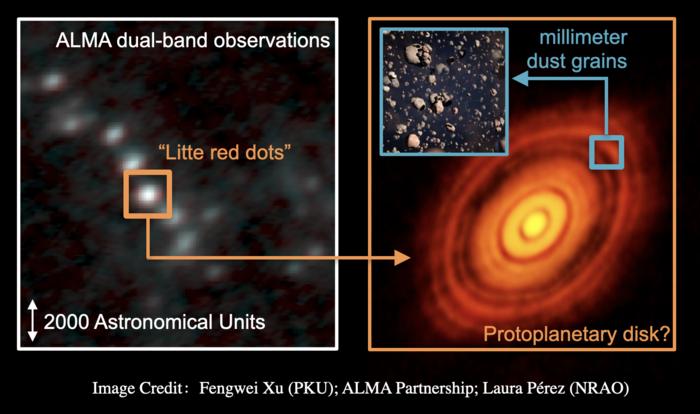
Credit: Fengwei XU (PKU); ALMA Partnership; Laura Pérez (NRAO)
For decades, astronomers have discovered hundreds of protoplanetary disks – structures believed to represent the early stages of our own solar system. However, most of these discoveries lie within our neighbourhood, which may not reflect the extreme conditions found in other parts of the Milky Way. Among the most dynamic and turbulent regions is the Central Molecular Zone (CMZ) near the Milky Way Galactic Centre, where high pressure and density may shape star and planet formation in fundamentally different ways. Studying protoplanetary systems in the CMZ provides a rare opportunity to test and refine our theories of solar system formation.
An international team of researchers from the Kavli Institute for Astronomy and Astrophysics at Peking University (KIAA, PKU), the Shanghai Astronomical Observatory (SHAO), and the Institute of Astrophysics of the University of Cologne (UoC), along with several collaborating institutions, has conducted the most sensitive, highest-resolution, and most complete survey to date of three representative molecular clouds in the Milky Way’s CMZ. Their observations revealed over five hundred dense cores – the sites where stars are being born. The results have been published in the journal Astronomy & Astrophysics under the title ‘Dual-band Unified Exploration of three Central Molecular Zone Clouds (DUET). Cloud-wide census of continuum sources showing low spectral indices’.
Detecting such systems in the CMZ is exceptionally challenging. These regions are distant, faint and deeply embedded in thick layers of interstellar dust. To overcome these obstacles, the team utilized the Atacama Large Millimeter/submillimeter Array (ALMA) in the Chilean Atacama Desert, an interferometric telescope that combines signals from antennas spread over several kilometres to achieve extraordinary angular resolution. “This allows us to resolve structures as small as a thousand astronomical units even at CMZ distances of roughly 17 billion AU away,” said Professor Xing Lu, a researcher at Shanghai Astronomical Observatory and the Principal Investigator of the ALMA observing project.
By reconfiguring the array and observing at multiple frequencies, the team performed ‘dual-band’ observations – capturing two different wavelengths at the same spatial resolution. Just as human vision relies on colour contrast to interpret the world, dual-band imaging provides critical spectral information about the temperature, dust properties and structure of these remote systems.
To their surprise, the researchers found that more than seventy percent of the dense cores appeared significantly redder than expected. After carefully ruling out observational bias and other possible explanations, they proposed two leading scenarios – both suggesting the widespread presence of protoplanetary disks.
“We were astonished to see these ‘little red dots’ cross the whole molecular clouds,” said first author Fengwei Xu, who is currently conducting research at the University of Cologne’s Institute of Astrophysics in the context of his doctoral work. “They are telling us the hidden nature of dense star-forming cores.”
One possible explanation is that these cores are not transparent, homogeneous spheres as once thought. Instead, they may contain smaller, optically thick structures – possibly protoplanetary disks – whose self-absorption at shorter wavelengths results in the observed reddening. “This challenges our original assumption of canonical dense cores,” said Professor Ke Wang, Fengwei Xu’s doctoral supervisor at the Kavli Institute.
Another possibility involves the growth of dust grains within these systems. “In the diffuse interstellar medium, dust grains are usually just a few microns in size,” explained Professor Hauyu Baobab Liu at the Department of Physics of National Sun Yat-sen University, who led the radiative transfer modelling in the study. “But our models indicate that some cores may contain millimetre-sized grains, which could only form in protoplanetary disks and then be expelled – perhaps by protostellar outflows.”
Regardless of which scenario proves dominant, both require the presence of protoplanetary disks. The findings suggest that over three hundred such systems may already be forming within just these three CMZ clouds. “It is exciting that we are detecting possible candidates for protoplanetary disks in the Galactic Centre. The conditions there are very different from our neighbourhood, and this may give us a chance to study planet formation in this extreme environment,” said Professor Peter Schilke at the University of Cologne, Fengwei Xu’s doctoral co-supervisor. Computing resources and technical support at the UoC’s Institute of Astrophysics contributed to the result.
Future multi-band observations will help to further constrain their physical properties and evolutionary stages, offering a rare glimpse into the early processes that give rise to planetary systems like our own, even in the most extreme corners of the Milky Way.
The Southwest Research Institute-led Ultraviolet Spectrograph (UVS) aboard NASA’s Europa Clipper spacecraft has successfully completed its initial commissioning following the October 14, 2024, launch. Weighing just over 40 pounds and drawing only 7.9 watts of power, Europa-UVS is smaller than a microwave oven, yet this powerful instrument will determine the relative concentrations of various elements and molecules in the atmosphere of Jupiter’s moons once it arrives in the Jovian system in 2030.
SAN ANTONIO — May 15, 2025 — The Southwest Research Institute-led Ultraviolet Spectrograph (UVS) aboard NASA’s Europa Clipper spacecraft has successfully completed its initial commissioning following the October 14, 2024, launch. Scheduled to arrive in the Jovian system in 2030, the spacecraft will orbit Jupiter and ultimately perform repeated close flybys of the icy moon Europa. Previous observations show strong evidence for a subsurface ocean of liquid water that could host conditions favorable for life.
Europa-UVS is one of nine science instruments in the mission payload, including another SwRI-led and developed instrument, the MAss Spectrometer for Planetary EXploration (MASPEX). The UVS instrument collects ultraviolet light to create images to help determine the composition of Europa’s atmospheric gases and surface materials.
“SwRI scientists started this process in January from NASA’s Jet Propulsion Laboratory, however, we had to evacuate due to the fires in southern California,” said SwRI Institute Scientist Dr. Kurt Retherford, principal investigator (PI) of Europa-UVS. “We had to wait until May to open the instrument’s aperture door and collect UV light from space for the first time. We observed a part of the sky, verifying that the instrument is performing well.”
SwRI has provided ultraviolet spectrographs for other spacecraft, including ESA’s Rosetta comet orbiter, as well as NASA’s New Horizons mission to Pluto, Lunar Reconnaissance Orbiter mission in orbit around the Moon and Juno mission to Jupiter.
“Europa-UVS is the sixth in this series, and it benefits greatly from the design experience gained by our team from the Juno-UVS instrument, launched in 2011, as it pertains to operating in Jupiter’s harsh radiation environment,” said Matthew Freeman, project manager for Europa-UVS and director of SwRI’s Space Instrumentation Department. “Each successive instrument we build is more capable than its predecessor.”
Weighing just over 40 pounds (19 kg) and drawing only 7.9 watts of power, UVS is smaller than a microwave oven, yet this powerful instrument will determine the relative concentrations of various elements and molecules in the atmosphere of Europa once in the Jovian system. A similar instrument launched in 2023 aboard ESA’s Jupiter Icy Moons Explorer spacecraft, which will be studying several of Jupiter’s icy moons, gases from the volcanic moon Io and Jupiter itself. Having two UVS instruments in the Jupiter system at one time offers complementary science.
In addition to performing atmospheric studies, Europa-UVS will also search for evidence of potential plumes erupting from within Europa.
“Europa-UVS will hunt down potential plumes spouting from Europa’s icy surface and study them to understand what they tell us about the nature of subsurface water reservoirs,” said Dr. Thomas Greathouse, SwRI staff scientist and Europa-UVS co-deputy PI. “The instrument is working fabulously, and we’re excited about its ability to make new discoveries once we get to Jupiter.”
NASA’s Jet Propulsion Laboratory (JPL) manages the Europa Clipper mission for NASA’s Science Mission Directorate in Washington, D.C. The Europa Clipper mission was developed in partnership with the Johns Hopkins University Applied Physics Laboratory (APL), in Laurel, Maryland.
This “first-light” image from the Europa-UVS instrument shows data at far-ultraviolet wavelengths, photons more energetic than the UV light that gives us sunburns on Earth. Light passes from its telescope into a long, narrow slit onto the detector, left to right, and the top-to-bottom direction of the image captures spatial information along this length in addition to the wavelength separations in spectral bins — a powerful combination for use in astronomical studies. Light from hydrogen atoms in the solar system is the source of the red line in the middle of the image, and this sky-background measurement confirms Europa-UVS is working well.
Credit
Southwest Research Institute
Astronomers take a second look at twin star systems
New Haven, Conn. — Apples-to-apples comparisons in the distant universe are hard to come by.
Whether the subject is dwarf galaxies, supermassive black holes, or “hot Jupiters,” astronomers can spend months or years searching for comparable objects and formations to study. And it is rarer still when those objects are side-by-side.
But a new Yale study offers a road map for finding “twin” planetary systems — showing whether binary stars that orbit each other, and that were born at the same time and place, tend to host similar orbiting planets. The study’s authors found that certain orientations of twin star systems may provide critical information about planet formation, while also being easier for astronomers to discover planets within the systems.
The side-by-side, “edge on” configuration of certain binary star systems potentially allows astronomers to do comparative studies, in the same way that doctors study human twins to gain knowledge about biological and behavioral mechanisms.
“This could be an unprecedented avenue for examining how deterministic, or orderly, the process of planet formation is,” said Malena Rice, an assistant professor of astronomy in Yale’s Faculty of Arts and Sciences and senior author of the new study.
The study appears in The Astrophysical Journal Letters. The first author is Joseph Hand, an undergraduate at the University of Kansas who conducted the research as a Dorrit Hoffleit Undergraduate Research Scholar, a Yale fellowship named in honor of the longtime Yale astronomer. Konstantin Gerbig, a Ph.D. candidate in Yale’s Graduate School of Arts and Sciences, is co-author of the study.
In earlier work, Rice identified an unexpectedly large number of binary systems with orbits that are perfectly aligned, meaning that the two binary stars and their planets orbit on the same geometrical plane. In such systems, the companion star can serve as a stabilizer for the planets' orbits, preventing dramatic long-term climate variations that may otherwise be destructive to life as we know it.
These “edge-on” binary systems, because of their alignment, are also excellent candidates for the detection of new planets, according to the researchers: the stars wobble directly toward and away from Earth, creating a signal boost.
For the study, the team identified nearly 600 edge-on binary star systems based on data from the European Space Agency’s Gaia DR3 catalogue of high-precision stellar astrometry. Drawing from the Gaia dataset, the researchers found the brightest nearby binary star systems, measured their orbits, and simulated the set of expected planets waiting to be discovered orbiting each star.
The result, researchers say, is essentially a prediction for locations in the sky where planet-hunters are more likely to find new planets to identify and characterize — and, for the first time, to compare planets across stars in the same system.
“We outline how this could, for the first time, be used to conduct comparative studies of planet formation where we have a control sample — that is, a second planetary system born together with the first planetary system,” Rice said.
The work was funded by the Dorrit Hoffleit Undergraduate Research Scholarship program and support from the Heising-Simons Foundation.
# # #
Journal
The Astrophysical Journal Letters
Stretched in a cross pattern: Our neighboring galaxy is pulled in two axes
New evidence supports the Small Magellanic Cloud’s ‘tearing phenomenon’.
Researchers at Nagoya University in Japan have discovered that Cepheid variable stars in our neighboring galaxy, the Small Magellanic Cloud (SMC), are moving in opposing directions along two distinct axes. They found that stars closer to Earth move towards the northeast, while more distant stars move southwest. This newly discovered movement pattern exists alongside a northwest-southeast opposing movement that the scientists previously observed in massive stars.
These complex bidirectional movements along two different axes indicate that the SMC is being stretched by multiple external gravitational forces—its larger neighbor, the Large Magellanic Cloud (LMC) in one direction and another, currently unknown mechanism in the other. The findings were published in the journal The Astrophysical Journal Letters.
This study is the first to analyze stellar motions within the SMC by taking individual distances into account. Previous studies that investigated stellar motions within the SMC assumed that all stars were at the same distance from Earth (200,000 light-years), due to the lack of precise distance measurements—an oversimplification that may have caused errors.
The researchers used data from the Gaia satellite to analyze over 4,200 Cepheid variable stars—pulsating stars that expand and contract rhythmically causing their brightness to change. Astronomers can accurately measure their distances from Earth by comparing the time it takes for one complete cycle of brightening and dimming. By accounting for these individual distances, the researchers could analyze the stars' movements with more accuracy than previous studies.
A previous study by the same group reported that the SMC is being stretched by its bigger neighbor, the LMC. These two galaxies are gravitationally bound and interact with each other. These interactions have likely influenced their structure and evolution.
“There is also a possibility that the gravitational influence from our own Milky Way or the effects from a past close encounter between the two Magellanic Clouds contribute to the stretching of the SMC,” Dr. Kengo Tachihara from the Department of Physics at Nagoya University said.
Additionally, the research confirmed the theory that the SMC does not rotate, further suggesting that this relatively small, irregular shaped galaxy has unique dynamics likely influenced by gravitational interactions with the Milky Way and the LMC.
"Our discovery challenges previous theories of the galaxy’s structure and dynamics. We need to rethink how the SMC, LMC, and the Milky Way interact. New simulations that consider the SMC's non-rotating nature are needed to understand these complex relationships,” PhD student and lead author, Satoya Nakano, explained.
Stars observed by the Gaia satellite. The image shows our galaxy, the Milky Way, and our two smaller neighbor galaxies to the bottom right. Data from more than 1.8 billion stars was used to create this map of the entire sky.
Credit
European Space Agency (ESA)
Arrows show the velocities of approximately 4,000 Cepheid variable stars. Green arrows represent closer stars, while magenta arrows indicate more distant stars. The green star (★) marks the average position of stars closer than 180,000 light-years, and the magenta star (★) marks those more than 230,000 light-years. Arrows from these stars show the average motion direction (northeast and southwest). The top of the figure is north, and the left side is east.
Figure 1: (Left) Rotation and acceleration measurements using the CSSAI in-orbit and (Right) Rotation comparison between the CSSAI and the classical gyroscopes of the CSS.
High-precision space-based gyroscopes are important in space science research and space engineering applications. In fundamental physics research, they can be used to test the general relativity effects, such as the frame-dragging effect. These tests can explore the boundaries of the validity of general relativity and search for potential new physical theories. Several satellite projects have been implemented, including the Gravity Probe B (GP-B) and the Laser Relativity Satellite (LARES), which used electrostatic gyroscopes or the orbit data of the satellite to test the frame-dragging effect, achieving testing accuracies of 19% and 3% respectively. No violation of this general relativity effect was observed. Atom interferometers (AIs) use matter waves to measure inertial quantities. In space, thanks to the quiet satellite environment and long interference time, AIs are expected to achieve much higher acceleration and rotation measurement accuracies than those on the ground, making them important candidates for high-precision space-based inertial sensors. Europe and the United States propose relevant projects and have already conducted pre-research experiments for AIs using microgravity platforms such as the dropping tower, sounding rocket, parabolic flying plane, and the International Space Station.
The research team led by Mingsheng Zhan from the Innovation Academy for Precision Measurement Science and Technology of the Chinese Academy of Sciences (APM) developed a payload named China Space Station Atom Interferometer (CSSAI) [npj Microgravity 2023, 9 (58): 1-10], which was launched in November 2022 and installed inside the High Microgravity Level Research Rack in the China Space Station (CSS) to carry out scientific experiments. This payload enables atomic interference experiments of 85Rb and 87Rb and features an integrated design. The overall size of the payload is only 46 cm × 33 cm × 26 cm, with a maximum power consumption of approximately 75 W.
Recently, Zhan’s team used CSSAI to realize the space cold atom gyroscope measurements and systematically analyze its performance. Based on the 87Rb atomic shearing interference fringes achieved in orbit, the team analyzed the optimal shearing angle relationship to eliminate rotational measurement errors and proposed methods to calibrate these angles, realizing precise in-orbit rotation and acceleration measurements. The uncertainty of the rotational measurement is better than 3.0×10⁻⁵ rad/s, and the resolution of the acceleration measurement is better than 1.1×10⁻⁶ m/s². The team also revealed various errors that affect the space rotational measurements. This research provides a basis for the future development of high-precision space quantum inertial sensors. This work has been published in the 4th issue of National Science Review in 2025, titled "Realization of a cold atom gyroscope in space". Professors Xi Chen, Jin Wang, and Mingsheng Zhan are the co-corresponding authors.
The research team analyzed and solved the dephasing problem of the cold atom shearing interference fringe. Under general cases, the period and phase of shearing fringes will be affected by the initial position and velocity distribution of cold atom clouds, thus resulting in errors in rotation and acceleration measurements. Through detailed analyses of the phase of the shearing fringes, a magic shearing angle relationship was found, which eliminates the dephasing caused by the parameters of the atom clouds. Furthermore, a scheme was proposed to calibrate the shearing angle precisely in orbit. Then, the research team carried out precision in-orbit rotation and acceleration measurements based on the shearing interference fringes. By utilizing the fringes with an interference time of 75 ms, a rotation measurement resolution of 50 μrad/s and an acceleration measurement resolution of 1.0 μm/s² were achieved for a single experiment. A long-term rotation measurement resolution of 17 μrad/s was achieved through data integration. Furthermore, the research team studied error terms for the in-orbit atom interference rotation measurement. Systematic effects were analyzed for the imaging magnification factor, shearing angle, interference time sequence, laser wavelength, atom cloud parameter, magnetic field distribution, etc. It is found that the shearing angle error is one of the main factors that limits the measurement accuracy of future high-precision cold atom gyroscopes in space. The rotation measured by CSSAI was compared with that measured by the gyroscope of the CSS, and these two measurement values are in good agreement, further demonstrating the reliability of the rotation measurement.
This work not only realized the world's first space cold atom gyroscope but also provided foundations for the future space quantum inertial sensors in engineering design, inertial quantity extraction, and error evaluation.
Figure 2: Atom interferometer and data analysis with it. (a) The China Space Station Atom interferometer. (b) Analysis of the dephasing of shearing fringes. (c) Calibration of the shearing angle.


No comments:
Post a Comment