Australia’s Reclaim Bid Of Port Darwin Irks China – Analysis
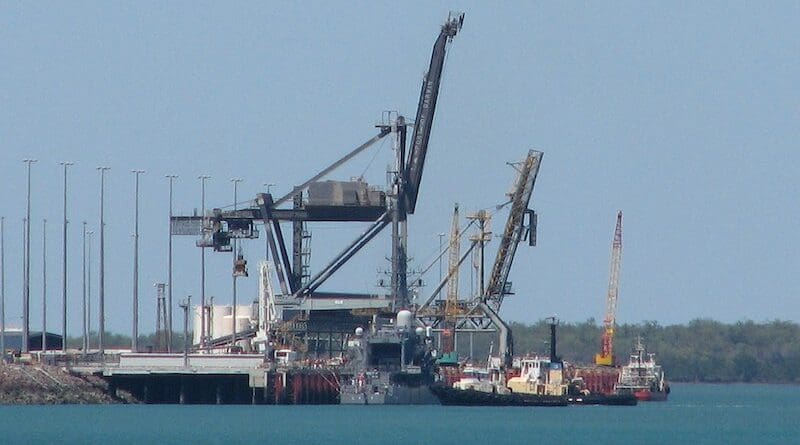
Port Darwin, Australia. Photo Credit: Ken Hodge, Wikipedia Commons
Amid the escalating trade and tariff wars unleashed by the US President Donald Trump with almost all of the US trading partners, tensions are brewing up in the South Pacific theatre between China and Australia not on trade and tariff issue but on the control and ownership of the strategic Port Darwin in Australia’s north. As China continues to expand its strategic footprint much beyond its frontiers and towards the South Pacific islands to the consternation of Australia, the strategic relevance of the Darwin port assumes sudden significance.
The genesis of the controversy lie when the port, vital to regional economies and national security and is currently under Chinese company Landbridge after a 2015 deal is now being claimed back by the Australian government. In a move that sparked diplomatic tensions, China’s ambassador to Australia Xiao Qian openly criticised the Australian government’s intentions to reclaim Darwin Port from Chinese ownership. The strategic port, leased to China’s Landbridge Group in 2015 for 99 years under a deal originally approved by the Northern Territory government is poised for transfer back to local hands under Prime Minister Anthony Albanese’s administration as it cites national interests as the main driving factor.
When the deal was done in 2015, it was criticized by then-U.S. President Barack Obama as he was aware that the Darwin Port plays host to regular exercises by thousands of U.S. Marines. As part of the strategic defense arrangements, approximately 2,000 U.S. Marines conduct exercises in Darwin, underlining the port’s strategic importance. The port’s importance is underscored by its role in the regional economy and national infrastructure, a fact reiterated by Australian officials as they intensify efforts to return it to domestic control. Amid diplomatic discourse, Landbridge insists the port is not for sale and continues usual operations. Meanwhile, Australian government remains firm on its intent to have Darwin Port returned to Australian hands. With the government prioritising national interest, a direct purchase is being considered if unable to secure a private buyer, highlighting the site’s significance in the burgeoning defence cooperation with the U.S. This move comes as part of a broader strategy to bolster defense ties with the United States in the northern region. During his re-election campaign, Albanese had indicated that his government was prepared to directly intervene and buy the port if it could not find a private buyer.
The strategic significance of Darwin Port came to the limelight for the first time when on 19 February 1942, 242 Japanese aircrafts in two separate raids attacked the town, ships in Darwin Harbour and the town’s two airfields in an attempt to prevent the Allies from using them as bases to contest the invasion of Timor and Java during World War II. That was the largest single attack ever mounted by a foreign power on Australia. That time the bombing of Darwin was called the Battle of Darwin.
Darwin was lightly defended relative to the size of the attack, and the Japanese inflicted heavy losses upon Allied forces at little cost to themselves. More than half of Darwin’s civilian population left the area permanently, before or immediately after the attack. In 1942, Darwin, the capital of the Northern Territory, was a small town with limited civil and military infrastructure. Due to its strategic position in northern Australia, the Royal Australian Navy (RAN) and Royal Australian Air Force (RAAF) had constructed bases near the town in the 1930s and the early years of World War II. Since then, the port’s strategic relevance has increased manifold.
Beijing is aware of the strategic significance of the Darwin Port and is thus unwilling to surrender the advantage it has enjoyed for the past decade when its ambitions as a global power is on the upswing. The Chinese ambassador therefore expressed disapproval of Australia’s plan to reclaim Darwin Port from its current Chinese owners, citing concerns about ethical practices. Prime Minister Albanese aims to ensure the strategic port’s ownership aligns with national interests, amidst Australia-US military collaborations in the region. The Chinese ambassador highlighted that the Chinese company, Landbridge, which currently manages the port, should not face consequences for their investment. Hitting out at Australia’s “questionable” Darwin Port return plan, Xiao Qian argues that the Landbridge Group with a 99-year lease right has made significant investments in the port and contributed to the local economy. Albanese’s government of Australia is seriously working on a plan to buy back Darwin Port from its Chinese owners on national interest grounds, saying the port needed to be “in Australian hands”.
Xiao Qian argued that the Landbridge Group had made significant investments in maintaining and building the port’s infrastructure, optimising its operations and management, and expanding its customer sources, thereby contributing to the local economy. He argued that these efforts have brought remarkable improvements to the port, turning its financial situation from losses to profits and contributing positively to local economic and social development.
He further argues that such an enterprise and project deserves encouragement, not punishment. He says: “It is ethically questionable to lease the port when it was unprofitable and then seek to reclaim it once it becomes profitable.” Xiao Qian argued that the Landbridge Group had secured the lease through an open and transparent bidding process and expressed hope that Australia would view the project “objectively”.
Though the two countries are comprehensive strategic partners and need to foster mutual trust aligning shared interests for mutually beneficial cooperation, the reality is that the current state of bilateral relations is marred by contending claims of trade discrimination, thereby eroding the vital element of mutual trust. As a result, it is difficult to restore the pre-existing fair, transparent and predictable business environment for Chinese companies in Australia that led to the booming economic ties between the two countries in the past two decades. The Chinese ambassador’s criticism came at a time when relations between Australia and China had begun to show signs of improvement. This included Beijing’s decision to lift trade bans on Australian exports in December 2024. The trust deficit nevertheless remains.
Despite tensions in bilateral relations, trade between the two continues to flourish. China continues to dominate Australia’s trade landscape, accounting for approximately 28% of Australia’s total trade in goods and services in the financial year 2024-2025. The total trade volume between Australia and China reached AUD 285 billion, with exports to China valued at AUD 195 billion and imports at AUD 90 billion. Australia’s exports to China remain heavily reliant on natural resources, with iron ore, coal, and natural gas constituting over 75% of total exports. Iron ore alone contributed AUD 120 billion, underscoring its critical role in the bilateral trade relationship.
Despite ongoing geopolitical tensions, the trade volume has remained robust, driven by China’s demand for Australia’s natural resources. However, the diversification of Australia’s export markets has gained momentum, with increased focus on Southeast Asia and India. The financial year 2024-2025 also saw a partial recovery in Australian agricultural exports to China, particularly barley and wine, following the easing of some trade restrictions. Yet, Beijing threatens to ban nearly US$400 million worth of Australian wheat imports.
For Australia however, the strategic consideration underpinning the country’s foreign policy goal needs to be seen in the perspective of the Darwin Port as a strategic asset, where US marines conduct exercises. Australian authorities discussed ways to deal with the port following concerns that the Chinese firm was facing financial difficulties and after Chinese warships conducted live-fire drills in international waters near Australia in February 2025.
The strategically important northern Australian port has been a hotly debated national security issue since it was leased to the Chinese firm Landbridge by the NT government for 99-years in 2015. Members of the previous NT government that leased the port to Landbridge have said the decision was made to lease it after the federal government of the day failed to fund needed infrastructure upgrades.
Federal Labor MP and special envoy for defence and northern Australia Luke Gosling says he has been meeting with potential buyers of the port’s lease. During the last federal election campaign, both Labor and the Coalition made duelling pledges to get the port “back into Australian hands”. Federal Infrastructure Minister Catherine King said the port was a “critical infrastructure asset of national importance”.
The key question that arises is, Darwin Port has been controversial for years, so why the new thinking by the Albanese government now? The port’s lease to Landbridge has outclassed successive prime ministers. Therefore the reasons why major parties are talking about cancelling it now beg answers. The Albanese government is yet to give a firm indication of exactly how it will do that, but has repeatedly said it has been speaking with Australian firms to possibly take over the lease. In the meantime, Beijing calls upon the NT and federal governments to “honour its binding commitments” under the contract and “respect the autonomous decisions made by businesses made by development needs”. The ambassador argued that it is ethically questionable to lease the port when it was unprofitable and then seek to reclaim it once it becomes profitable.
The larger consideration of the Albanese government seems to be to keep in check Beijing’s aggrandizement plans and larger strategic design. In particular, Australia is building up its northern military bases, which will host US bombers and fighter jets on a rotational basis, as it increases defence cooperation with the US. So, the strategic competition for larger space by either shall continue to remain.

Dr. Rajaram Panda
Dr. Rajaram Panda is former Senior Fellow at Pradhanmantri Memorial Museum and Library (PMML). Earlier Dr Panda was Senior Fellow at MP-IDSA and ICCR Chair Professor at Reitaku University, JAPAN. His latest book "India and Japan: Past, Present and Future" was published in 2024 by Knowledge World. E-mail: rajaram.panda@gmail.com

No comments:
Post a Comment