It’s possible that I shall make an ass of myself. But in that case one can always get out of it with a little dialectic. I have, of course, so worded my proposition as to be right either way (K.Marx, Letter to F.Engels on the Indian Mutiny)
Sunday, May 18, 2025
Greenpeace Captain and Activists on Trial in Korea for Boarding Tanker
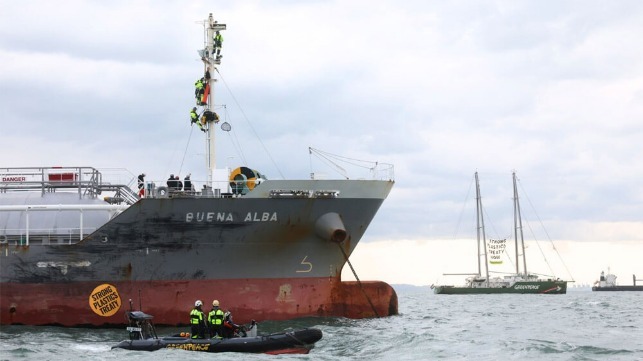
Greenpeace activists boarded the tanker from the Rainbow Warrior seen in the distance (Greenpeace International on X)
The captain of Greenpeace’s vessel Rainbow Warrior and four activists made their first appearance in a South Korean court on Friday, May 16, on charges related to a 2024 incident where they boarded a Japanese-owned LPG tanker that was anchored off South Korea. They have been detained in the country since November after the protest in which they used the ship to call for a strong international plastics treaty ban.
The protest was coordinated to the fifth round of negotiations for a UN Global Plastic Treaty that was taking place in Busan, South Korea. Greenpeace’s vessel Rainbow Warrior was conducting a “Sailing for Change” tour in Eastern Asia and coordinated a visit to the scheduled negotiations.
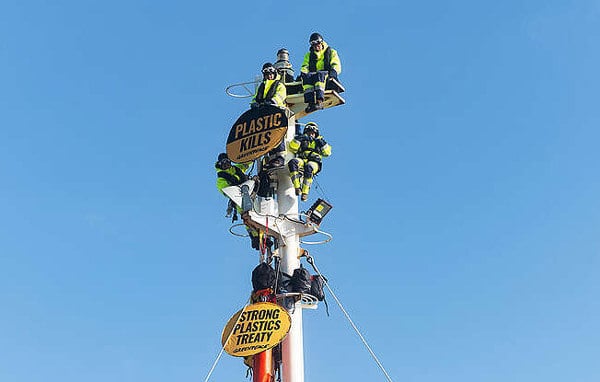
The four protestors set off from the mother ship on November 30 for one of the group's typical protests that involve banners to draw attention to their cause. The protestors displayed banners calling for the treaty and painted the words “Plastics Kill” on the side of the Panama-registered LPG tanker Buena Alba (3,146 dwt). Four activists, Sam Rodrigues (Mexican), Alex Wilson (British), Ash (Taiwanese), and Jens (German) also boarded the ship, which was at anchor, and climbed its mast to unfurl their banners.
Greenpeace's activists atop the mast of the LPG tanker (Greenpeace)
Greenpeace contends it was a peaceful protest and put no one in danger. They said the tanker was waiting to load chemicals at the Hyundai Daesan Refinery.
The South Korean police took the four into custody along with the captain of the Rainbow Warrior and held them for nearly two days during the investigation. While they were released, they were ordered to remain in South Korea for the outcome of the investigation.
Today, they appeared in the Seoul Central District Court for their first hearing. They are all being charged with obstruction of business and unlawful intrusion onto a vessel according to the Korean Yonhap news agency. They report that the court continues to prohibit the five from leaving the country.
The group staged a protest outside the court as part of a campaign calling for the release of its members so that they can return home to their families. They also called for a quick conclusion to the trial, and at the same time, repeated their calls for the Plastics Treaty.
It is the latest in a series of court cases involving Greenpeace activists for their incidents with ships. In September 2024, a Danish court fined the group for its efforts at blocking tankers they linked to the Russian oil trade, which were transferring or transporting crude oil in Danish waters. Greenpeace and Shell also settled a case in December after the group’s activists boarded and set up camp on an oil platform that was being transported into the North Sea. Greenpeace agreed to donate £300,000 ($383,000) to the RNLI, a charity that provides lifeboat search and rescue, lifeguards, water safety education, and flood rescue around the UK, and for its activists to stay away from Shell sites in the North Sea for periods ranging between five to 10 years.
Heads I Win, Tails I Don't Lose: How LNG Became a Failsafe Investment
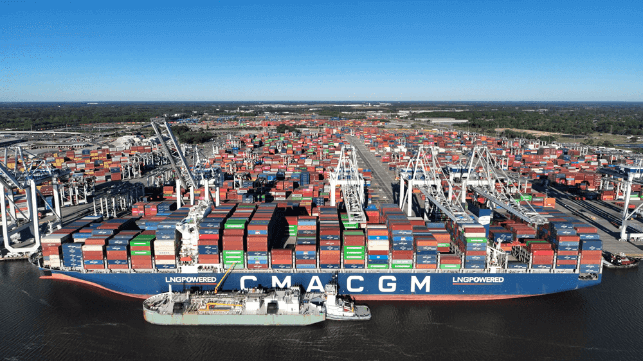
LNG bunkering at Port of Savannah (Georgia Ports Authority / SEA-LNG)
For the duration of shipping's decarbonization journey, one question has remained top of mind: how can the industry successfully achieve net-zero while still maintaining commercial viability?
Shipping companies, much like every other business, must achieve revenue and growth goals in order to sustainably operate, support global trade infrastructure, and our broader ecosystems. If they fail to prioritize commercial objectives, many companies will struggle to stay afloat in an increasingly competitive landscape. On the other hand, if they fail to adhere to regulation and legislation, companies are certain to jeopardize their bottom line and longevity.
Achieving the careful balance between decarbonization and commercialism has, for many, been the most significant challenge in recent times. But for financiers, owners and operators who opted for LNG, the optionality of the marine fuel has presented a uniquely beneficial outcome: heads I win, tails I don't lose.
A rise in LNG investment
As the industry is all too familiar with, the urgent need to decarbonize is upon us - and it has set us on a path to identify the most efficient and effective options.
Common solutions explore retrofitting vessels with the technology needed to adopt new energy sources. But the capex required to achieve this presents a significant investment hurdle - not to mention the inevitable downtime as changes to vessel operations are made.
Alternative marine fuels - such as ammonia, methanol or hydrogen - equally have their limitations, largely down to immature engine technologies, bunkering infrastructure, safety considerations, cost and even efficacy.
Now, many shipping companies are turning to LNG as a marine fuel - the clear, compliant, and commercially competitive option.
In its current form, the fuel can achieve GHG emissions reductions of up to 23%, making it compliant with IMO 2030. The use of bio-LNG, or liquefied biomethane, can increase this figure to about an 80% reduction. And with synthetic LNG (liquefied e-methane), shipping can reach net-zero and fully decarbonize its operations.
Suddenly, we have seen a rise in LNG uptake.
Leading up to 2022, LNG dual-fueled container ships enjoyed a compelling opex advantage. Prices of the marine fuel were lower than 'traditional' fuels, and dual-fueled engines presented much-needed flexibility to an industry evolving alongside emerging regulation. This provided substantial cash savings.
Not only this, but the growing bunkering infrastructure worldwide made LNG more accessible. LNG bunkers are currently available in 185 ports (and growing), and SEA-LNG members are prepared to offer bio-methane bunkers in approximately 70 ports. Investments from shipping giants such as CMA CGM set the tone for the long-term viability and commercial strength of the marine fuel.
This comparatively early adoption, before the 2023/24 boom, provided financiers, owners and operators (as well as others in the shipping value chain) with clear savings.
Ergo: 'Heads I Win'.
Then came a market shift…
Post-2022, the industry saw a sharp rise in fuel costings as the Russia-Ukraine conflict resulted in the mass disruption of natural gas markets. At its highest, prices hit US$70.50 per million British thermal units (mmBtu) for LNG. If one thing was evident, shipping companies needed alternative energy sources, and quickly.
But those who had already opted for LNG dual-fueled container ships, by contrast, were in a different position.
Owners and operators now had the option to rapidly switch to conventional VLSFO and remove themselves from the cost spike and subsequent market scramble. This optionality preserved wealth, and it ensured companies maintained trajectory towards emissions reduction goals - and regional regulations - without sudden, additional capex.
Few other alternative fuels could provide this level of flexibility and stability in unpredictable trade and geopolitical landscapes.
This could be called 'Tails I Don't Lose'.
Whichever side of the coin, LNG presents key benefits
So, where are we now in relation to LNG markets?
At the time of writing, the industry has reverted back to a 'Heads I Win' positioning. In 2023, LNG prices restabilized, and moved lower. This, combined with the fuel's proven statistical benefits, resulted in exponential adoption. And in 2024, the industry experienced a 'boom'.
Nearly half of all container vessels ordered over the course of the year were LNG dual-fuel, accounting for 70% of alternative fueled tonnage ordered (excluding LNG carriers) in 2024 - a figure that increased from 43% in 2023.
Most recently, MEPC 83 approved new measures to reduce GHG emissions from ships. This will mandate that ships over 5,000 gross tonnage to progressively reduce annual GHG fuel intensity (GFI) on a well-to-wake basis.
Without a crystal ball, it's impossible to give any certainty on the continued positioning of the fuel. But given the emissions reduction capabilities through the LNG pathway, use of biomethane and further e-methane will enable owners and operators to maintain compliance as regulations tighten. Plus, the technological advances by OEMs to tackle the issue of methane slip and the ongoing increase in global LNG production means we're less likely to see the drastic price spikes we saw in 2022.
Conclusion
The optionality of LNG as a marine fuel brings wealth gains and preservation by adapting to a new business window in minimum time at minimal cost - something which most alternative fuels cannot achieve. Real Asset Options carry the highest value during periods of greater risk and uncertainty, providing investment flexibility to defer, launch, expand, or abandon. For an industry navigating complex and changeable landscapes - and an often volatile global market - this commerciality, compliance and convenience cannot be underestimated.
LNG has stood out not only as a fuel in transition from fossil sourced through bio towards renewable hydrogen - enabling shipping's decarbonization - but also as a strategic enabler for financiers. Its clear capabilities have given the fuel a shrewd edge against an unpredictable backdrop. Growth in adoption of the fuel, global bunkering infrastructure, and technological advancements addressing methane slip has secured a unique outlook for LNG, and its adopters.
No single solution can claim to be a silver bullet, but LNG offers a practical, realistic and profitable route forward today. And an intelligent investment in the long term.
John Hatley is Chairman, Decarbonization Investments at SEA-LNG. He currently serves as vice chairman of SGMF (formerly the Society for Gas as a Marine Fuel) and was previously VP Marine Solutions & Director Market Shaping at WärtsiläNorth America, where he was responsible for global development and market shaping for gas as a preferred fuel.
The opinions expressed herein are the author's and not necessarily those of The Maritime Executive.

No comments:
Post a Comment