India-Pak Battle of “Nuclear” Egos!
Photo by Zoltan Tasi
Numerous questions can be posed about Modi government’s decision to send seven multi-party delegations to more than 30 countries with apparently a specific message, that is convince them about “terrorist” designs of Pakistan. These delegations include a considerable number of members from opposition parties. Besides, specific emphasis appears to have been given to their “secular” image, with inclusion of at least one non-Hindu member, whether Muslim, Christian or Sikh, in each delegation. Naturally, one is prompted to deliberate on what really is the aim of these delegations. It is difficult to digest that these delegations will succeed in convincing other countries about India’s stand regarding Pakistan. India is not a superpower and Modi is not Trump.
One hundred hours of solitude: A Pakistani peacenik recounts the India-Pakistan war
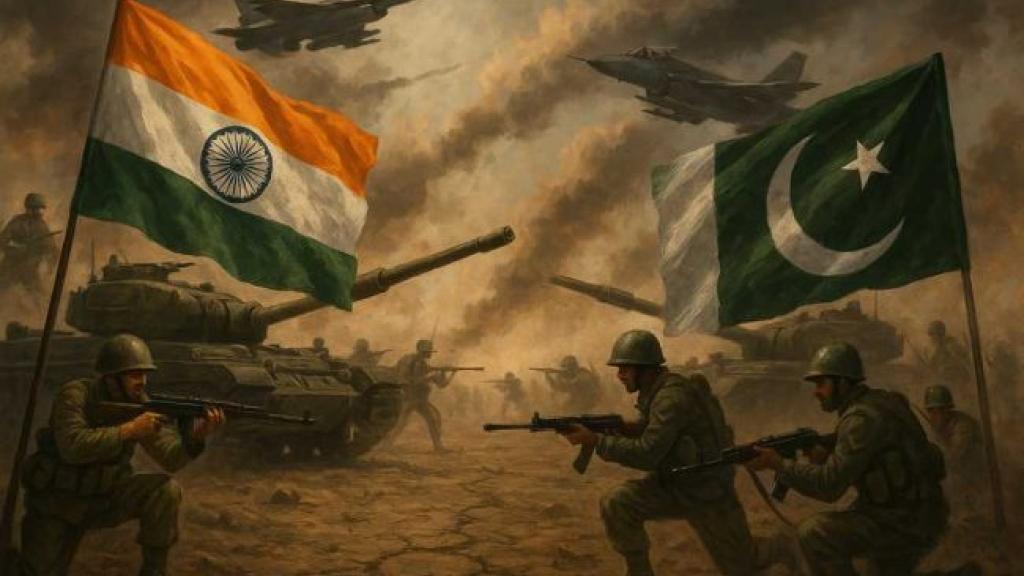
Every Tuesday, I deliver three lectures. I am teaching an additional module this semester to earn some extra money. Hence, it was already an extra-busy Tuesday on May 6, on top of which was the daily grind of posting articles on Jeddojehad (Struggle), which I edit.
On arriving home that Tuesday, I dozed off on my sofa about 9pm, making sure to put my phone on silent. The next morning, I found a deluge of WhatsApp messages on my phone asking: “Are you safe?”
People were expecting India to attack, but not to attack Lahore. Since 1971, the pattern had always been to lock horns in my unfortunate ancestral land, Jammu and Kashmir (J&K). I looked up BBC Urdu, which confirmed Lahore was under attack.
Ironically, the first voice message I heard was from my nephew, an undergrad student at Islamabad’s Quaid-e-Azam University: “Uncle, India has attacked Lahore. All okay with you?” I quipped: “I have embraced martyrdom. Greetings from al-Jannah. Don’t trust the mullahs … al-Jannah is not as nice as they say it is”.
I smiled thinking my reply might tickle his confessional sensibilities, not realising this would be my last hearty smile for three days. As a peacenik, my hundred hours of solitude had begun.
Fundamentalisms
Having answered messages and emails from friends and relatives about my wellbeing, I began scrolling through social media. Pakistani social media users were spewing venom against India. Indians were paying back in kind.
I do not have a television at home to deliberately avoid Pakistani news channels. Their coverage of the war convinced me to stick to my stance until these channels are banned. Facebook clips of Indian news channels convinced me that the Hindu-Taliban ruling India had also denuded its media of any decency.
My thoughts turned to the late Marxist-feminist poet, Fahmida Riaz (1946-2018). When living under Pakistan’s General Zia-ul-Haq dictatorship became impossible, Riaz went into exile in New Delhi in the 1980s.
At the time, the Bharatiya Janata Party (BJP) was gaining ground as a Hindu fundamentalist (Hindutva) project. But the Indian National Congress (INC) — reduced by then to dynastic politics centred on the Nehru-Gandhis clans — was already playing the soft-Hindutva card.
I had the privilege of meeting and listening to Indian Marxist academic Aijaz Ahmad, as part of my PhD fieldwork in New Delhi. During a seminar at Jawaharlal Nehru University (JNU), he stated, to the amusement of the students who had packed the auditorium: “The BJP is programmatically Hindu fundamentalist, the Congress is pragmatically Hindu fundamentalist.”
Disillusioned by the INC’s fake secularism and concerned over growing Hindutva, Riaz penned an immortal poem, which peaceniks on the Pakistani side send to Indian counterparts every time the BJP inflicts a new brutality on the religious minorities there. An excerpt reads:
So it turned out you are just like us!
Where were you hiding all this time, buddy?
That stupidity, that ignorance
we wallowed in for a century —
look, it arrived at your shores too!....Yep. We’ve been there for a while now.
Once you are there,
once you’re in the same hell-hole,
keep in touch and tell us how it goes!
WhatsApp was not banned. I was able to speak to my friend Sushovan Dhar in Calcutta. He reported that war hysteria had taken grip across all of India. We agreed to jointly write an essay for Jacobin, but concluded the war would not last long.
Comrade! You too?
I knew that as long as the war dragged on, peaceniks would remain highly isolated, marginalised, trolled, estranged. What I did not expect was that the left would contribute to this solitude.
I was expecting a vague position from the Communist Party of India (CPI) and the Communist Party of India–Marxist (CPI-M). Given that the CPI and CPI-M have been largely reduced to electoral politics and lacking in any militancy, I understood that the two would not be willing to take a stance that could hand Hindutva a whip with which to lash the left in the lead up to the elections. I was proven miserably wrong: the mainstream Indian left was far from vague — it unabashedly supported India’s war on Pakistan, on the boringly familiar pretext of waging a “war on terror”.
But it was not the mainstream Indian left that made me feel personally betrayed; I was ready for their position. It was the fact that some Pakistani groups also started beating the war drums. There were a flurry of statements by noted “burger leftists” — a popular satirical term that makes reference to the burger-eating (affluent) classes — busy outdoing the mainstream warmongers cluttering the television screens.
In disgust, on May 8, the third day of war, I posted a statement on Facebook, “Border Skirmishes Expose the ‘Revolutionaries’.” I wrote (originally in Urdu):
Wars — even when they happen to be as prolonged and destructive as the world wars — come to an end. As a socialist, one sticks by the internationalist viewpoint of [Vladimir] Lenin, Rosa [Luxemburg], [Karl] Leibknecht, and [Leon] Trotsky. It is indeed imperative.
It is possible that one may be bombed to death during a war. However, the stance you take chases you even in death. India-Pakistan, most likely, will not go beyond border skirmishes.
Pity! Only a few missiles were exchanged and certain “revolutionaries” have already exposed the Second International [pro-war stance] deeply embedded in them.
I stopped wasting time on social media and instead read Maxim Gorky’s biography. I had not been able to finish this masterpiece for ages. Half-read, it lay on my bedside table. I also dug out some peace poetry.
Déjà vu! I had already written a piece on the subject of war 15 years ago, “Hawks and Poets”, which I translated to Urdu for Jeddojehad and published on LINKS International Journal of Socialist Renewal. Written in 2010 after the Mumbai terror attack, it detailed the war-like situation that emerged between India and Pakistan. Back then, the left had behaved decently on both sides.
True, the Pakistani left is very small; it is a marginal force in politics. It is also equally true that the Pakistan Trade Union Defence Campaign (PTUDC) took a principled position during the recent four-day war. But it was some of the left stalwarts, capable of writing in English and disseminating their works via international networks built up as a result of their urban middle-class backgrounds littered with degrees from metropolitan universities, who came to represent the position of the Pakistani left.
More visible than the PTUDC and the countless individuals who are members of no group, these stalwarts appeared everywhere in the global left-wing media. Internationally, the “burger left” took a careful position. Domestically however, especially in their Urdu-language posts, they lent full ideological support to the Pakistani state’s jingoism. The examples are too numerous to document.
Left-wing myopia
While better-informed Indian comrades and peaceniks are suitably placed to analyse the Indian left’s role during this recent India-Pakistan war, I will outline the position of these revolutionaries on this side of the border. Their support for Pakistan was basically justified on the following counts.
One, India is the aggressor. Ironically, the same revolutionaries lent full support to Russian President Vladimir Putin, when Russia invaded Ukraine. Two, fascist India is collaborating with Zionist Israel. Proof? The fact that India fired Israeli drones at Pakistan.
Ridiculously, an imperial twist was given to the position of these revolutionaries. India was portrayed as a US ally, while Pakistan a regional David patronised by a benign global Goliath, China. That China has $24 billion in trade with Israel or aids Israel in building settlements did not bother these revolutionaries.
Most problematically, every crime of the Pakistani regime was whitewashed. Yes, it is true that India resorted to aggression instead of diplomacy. Notably, the left in India is divided over whether to characterise the BJP as “fascist”. But even if the BJP is fascist, the job of the Pakistani left is to hold their state accountable, before pointing fingers at New Delhi.
Here, the establishment was giving jihadi outfits a pat on the back, at least those in Pakistan-administered Jammu Kashmir (PaJK). Moreover, an impetuous Indian response objectively helps Pakistan’s internally besieged hybrid regime; this is clearly evident in how the military has regained its lost popularity.
Jihad re-activated
Living in London as an exile after the publication of her book, Military Inc, Ayesha Siddiqua is a noted expert on Pakistan’s military. In an article for the Indian website, The Print (not-accessible in Pakistan without VPN), she noted in February:
One knowledgeable source in Islamabad said that Rawalpindi is getting ready to restart militancy — at a comparatively lower but noticeable scale — after winters to force India to negotiate on Balochistan.
Pakistan is facing an armed separatist movement in Balochistan, geographically the largest of the four provinces and bordering both Iran and Afghanistan. China has built a huge port in Gwadar, a seaside town in Balochistan, making the province an important link in China’s Belt and Road Initiative (BRI).
Pakistan has repeatedly accused India of arming and training the Balochistan Liberation Army (BLA), a militant outfit responsible for several guerrilla attacks on security installations and Chinese workers in Balochistan. Claiming that Pakistan’s present army chief, General Asim Munir, was reversing the policy of appeasing India pursued by his predecessor, General Qamar Javed Bajwa, Siddiqua noted:
It’s not just that Munir is more traditionally hawkish toward India, he needs to build his image of being steadfast and become more likable among his soldiers and officers, who are distracted due to the Imran Khan factor. While Munir has the entire country, its judiciary, civil bureaucracy, the media, and the political system firmly under his thumb, none of this has brought him the popularity that he imagined was possible.
In the absence of any empirical evidence, it is hard to state with any certainty whether Pakistan sponsored the Pahalgam terrorist attack. Likewise, one can not substantiate or verify Siddiqua’s claims. However, a resumption of jihadist propaganda, with clear state-patronage, in PaJK has been ominously visible since 2024.
Jihadist outfits and fundamentalist groups were initially deployed to counter the mass movement against hyper-inflationary utility bills that convulsed PaJK in 2023-24. This anti-neoliberal intifada successfully forced the state to cut electricity prices.
After initial agitation against the secular nationalists and Marxists leading the movement, jihadist outfits remained in the public sphere. Their public presence from autumn 2024 onwards was noticeable, especially after a relative dormancy of roughly six years. Their gun-toting militants held public rallies, despite a ban on brandishing weapons.
Earlier this year, PaJK Prime Minister Anwar ul Haq twice suggested the resumption of jihad: in an interview with a second-rate TV channel; and in the company of Pakistan Prime Minister Shehbaz Sharif and Munir, when they gathered in the PaJK capital of Muzaffarabad to observe “Kashmir Solidarity Day”.
The day is observed under Islamabad’s tutelage every year on February 5. It is usually centred in Islamabad, Pakistan’s capital, with the aim of catching the eye of foreign embassies. This year, a grand show was staged in Muzaffarabad instead. Anwar’s plea for jihad was not replayed on mainstream Pakistani channels.
An equally hush-hush affair was the “Kashmir Solidarity and Hamas Operation Al Aqsa Flood” conference, also held on February 5 in the scenic PaJK town of Rawalakot. Organised under the auspices of the previously unknown Rawalakot Civil Society, the event hosted a Hamas delegate. Notably, Rawalakot is a hub for radical politics; Marxists and secular nationalists dominate the streets and student politics there.
Talha Saif, the younger brother of Jaish-e-Mohammed (JeM) founder Masood Azhar, was drafted to mobilise support for the conference. One of the targets hit by Indian missiles on May 6 was a JeM premise in Bahawalpur, which killed ten members of Azhar’s family and four JeM fighters. Lashkar-e-Tayyiba (LeT, renamed Jamaat-ud-Dawa) and Sipah-e-Sahaba commanders also publicly rallied support for the Rawalakot conference, held at Sabir Shaheed Stadium.
As if to top it all off, General Munir recalled the idiomatic “Two-Nation Theory” in his address to a convention of Pakistani expatriates in Islamabad on April 16. The theory is based on the implicit notion that Hindus and Muslims are eternal foes. It was deployed by the Pakistani ruling classes to justify the creation of Pakistan in 1947. His speech, undoubtedly venomous and highly problematic, drew the ire of Indian media hawks.
In short, ominous signs of escalation were appearing, even if inadvertently. Unfortunately, facts in this post-truth period hardly matter, even for some revolutionaries.
War hysteria temporarily ends alienation
On the second day of the war, May 7, I spoke to a worker I have known for a few years. He often complains about his economic problems when I go to his workplace. He is a paragon of piety and faith.
Like everyone else, he started talking about the India-Pakistan war and said a few jingoistic things. I countered his arguments. The next moment, he was criticising the “leadership” that had brought this war on the people of Pakistan. He knew the post-war period would aggravate the economic situation.
After leaving his workplace and pondering what had occurred, I wrote on Facebook (slightly edited):
While it is an old wisdom that jingoistic nationalism takes hold of people at the start of war, this wisdom is only descriptive. Nationalism at this stage helps workers and disempowered people overcome their alienation and estrangement caused by capitalism. Capitalism atomises them, especially in a country such as Pakistan, where unionisation is non-existent.
Workers both create and fear capitalist bosses, simultaneously; these bosses appear like compatriots at the start of war and, for a while, all of them — workers and bosses, military generals and soldiers — apparently become one united whole.
That this is an illusion is perhaps known to the workers and soldiers. However, the pent-up anger against their own bosses is vented against the “enemy”. A sort of catharsis which further soothes the feelings of suspended alienation/estrangement.
Neverending war
On the morning of May 9, I heard a thud. It came from a distance away, but close enough for my windows to shake. A missile? A drone? I shuddered. Another to follow? I froze for a while, physically and mentally.
I decided to go to my office, even though the university had gone online. “Come-what-may,” I thought and started brewing my coffee. Fatalism is the last escape in such situations.
Walking to my office, I thought of Gaza and felt embarrassed over all the “are you safe?” messages, my own numbness caused merely by a thud.
The next day, after the announcement of a ceasefire, I asked my students their thoughts during these one hundred hours of madness. I wanted to know if my teachings had any effect. They all said they too were thinking of Gaza. For a second time, an inexplicable numbness paralysed me.
The war is apparently over for now, but it has not stopped for peaceniks.
Next month, Pakistan will raise its military budget by 13%. Debt servicing — Pakistan remains on the brink of bankruptcy — and military spending already consumes the lion’s share of the budget.
News channels and social media users are busy glorifying victory over India. Meanwhile, my Jeddojehad colleague, Harris Qadeer, based in Rawalakot, is facing police harassment.
Twice detained by police during the four long days of war, he was quickly released both times when local civil society and journalists intervened. His arrest was in violation of the law — laws which themselves are unjust.
Harris is a voice of peace and socialism, and one of the finest journalists we have in PaJk. He was instrumental in the anti-neoliberal mass movement that convulsed PaJK last year. He is well known as a journalist and an activist.
The daily he founded, Jadaliya (Dialectics), was shut down by the state a few years ago. During his arrest and harassment — and with memories of Jadaliya still very fresh in our minds — we wondered about the future of Jeddojehad.
India-Pakistan wars do not last long. The two states, however, have never ended their wars on their respective citizens.
The future of Jeddojehad will not be defined by an inevitable India-Pakistan war that will visit us again in a few years’ time. The fate of Jeddojehad, which both Harris and I are devoted to, will be decided by the never-ending war on free speech in Pakistan.
We hope Jeddojehad survives. We also believe Jeddojehad will be revived by the next generation of peaceniks, even if we fail this time. Jeddojehad must go on!
Pahalgam, Operation Sindoor and after: Lessons India must learn (plus: Pahalgam, Operation Sindoor, Ceasefire: Pressing questions awaiting answers)
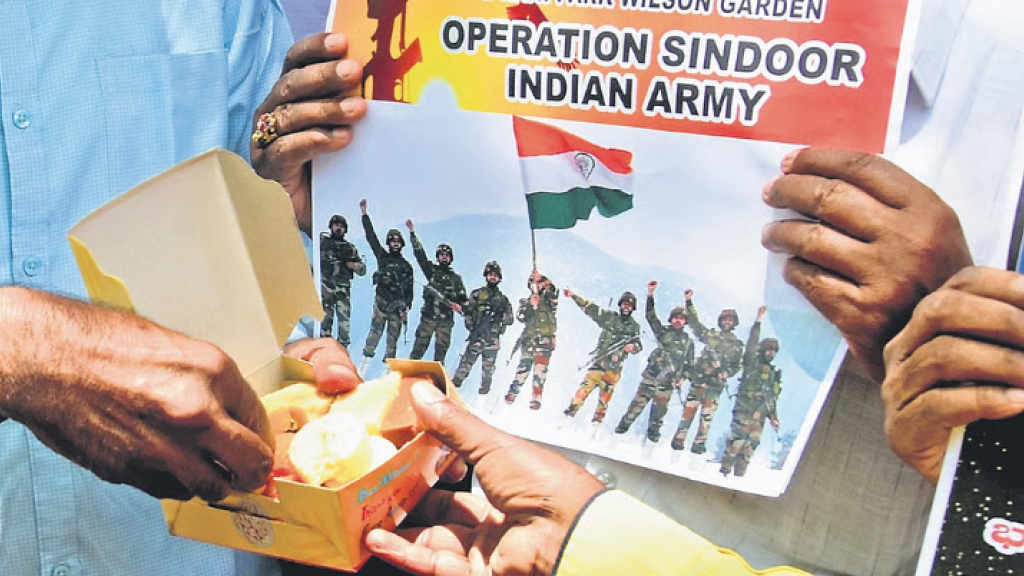
First published at CPI(ML) Liberation.
Operation Sindoor and its immediate military aftermath that threatened to escalate into a full-scale war between India and Pakistan have given way to at least a temporary truce. The Sangh brigade, the loudmouth godi media anchors and the vocal community of Modi bhakts who were already in a celebratory mode anticipating another 1971-type decisive outcome are deeply disappointed and frustrated. The short-lived triumphalist exuberance over, there is now an orchestrated campaign to silence and persecute every voice that preferred peace to war and stood boldly against war hysteria and anti-Muslim hate. This can be seen not just in the form of abusive social media trolling that targets even people like Himanshi Narwal who lost her husband in the Pahalgam terror attack or Foreign Secretary Vikram Misri who led the public briefings during Operation Sindoor, but in violent attacks on anti-war meetings and marches and the vindictive arrest of a scholar like Professor Ali Khan Mahmudabad on totally baseless charges.
The trajectory of events from the horrific terrorist attack in Pahalgam to the sudden announcement of ceasefire has given rise to many questions regarding India's national security and foreign policy. The Modi government has been claiming great successes in these two areas but facts now clearly suggest that it has completely failed even on its own terms. From Uri and Pathankot to Pulwama and now Pahalgam, there have been major attacks on India's security forces and military installations and on civilians during the last ten years. Add the Galwan valley clash with China in 2020, and it is evident to all that, unsurprisingly, Jammu and Kashmir has not become a more peaceful region in the Modi era. With Pakistan India has now had to settle for a ceasefire that Trump says was brokered by his government, and as for the clash with China we still remember how Modi told the country that there was no incursion or occupation by China, making us wonder what the clash then was all about.
The countrywide mock drills and the spread of military exchanges across almost the entire stretch of the India-Pakistan border rekindled memories of the 1971 war. Any sober comparison between the 1971 war and the latest conflict should however tell us how much things have changed since then. We must never forget that 1971 was primarily Bangladesh's own liberation war which turned into an India-Pakistan war only after India's open military intervention and declaration of support for Bangladesh. The international strategic environment and balance of forces has also undergone a dramatic shift since then. In 1971, India had the fullest backing of the Soviet Union without which the war could not possibly have been clinched so quickly and decisively. This time round India had hardly any external support while Pakistan had the full backing of China. We must also remember that for all their disparities in size and strength, there is now nuclear parity between the two countries, a reality that both can only ignore at their own peril.
In his post-ceasefire address to the nation, Narendra Modi sought to come up with a new doctrine of national security when he said that every act of terror would henceforth be treated as an act of war and India would not accept any ‘nuclear blackmail’. Nuclear parity produces nuclear deterrence, which if ignored can only guarantee mutually assured destruction. Whatever Modi may mean by nuclear blackmail, no nuclear power in the world today can risk a nuclear war with another nuclear power. Nuclear weapons apart, constant upgradation of technology has also drastically changed the nature of warfare. The latest military showdown between India and Pakistan gave us some glimpses of this new mode of technology-driven warfare. If India can buy sophisticated weaponry and military technologies from the US, Israel or France, so can Pakistan from China and other weapons-exporting countries, the US included. A permanent threat of war can only mean a spiralling arms race between India and Pakistan.
The question we need to ask ourselves is obvious. If a former superpower like the Soviet Union collapsed under the weight of an unsustainable arms race with the US, should not India avoid such a suicidal course by all means possible? This is where the role of diplomacy and foreign policy becomes so important. In the wake of the Pahalgam terror attack, India had sympathy from across the world. But when the Modi government launched Operation Sindoor and the threat of a full-scale war between two nuclear-powered neighbours began to loom large, the sympathy for India dissipated and almost the entire world called for de-escalation and dialogue. Israel and to an extent Afghanistan have been the only two countries that have appeared to side with India, whereas the United States, after initial expressions of indifference, stepped in and broke the news of ceasefire. At the hour of its biggest test, the Modi era foreign policy proved to be an abject failure and India virtually stood thoroughly isolated in the global arena.
Known for his declared policy of seeking opportunities in adversity, Modi has now outsourced his foreign policy fiasco to parties of the very opposition the Sangh brigade had been dubbing anti-national all this while. A few opposition MPs have been selectively chosen to join and even head parliamentary delegations that will visit select countries in the world on a so called diplomatic outreach mission. China and India's other South Asian neighbours, along with Iran and Canada are however conspicuously missing among the delegation destinations. In the Modi era India has been busy abandoning and ignoring relevant regional and global south platforms like SAARC and BRICS while becoming obsessed with West-dominated groupings like G7 and G20 and becoming increasingly dependent on and subservient to the US-Israel axis. The result is there for all to see - utter isolation in India's own neighbourhood which the government now seems to accept as a permanent reality.
India needs an urgent rethink on national security and course correction on foreign policy. The opposition had rightly demanded an immediate special joint session of Parliament for a proper update on the situation and discussion on the pressing questions. The Modi government is trying to avoid its accountability by now hiding behind this global outreach mission comprising selectively curated delegations. The world has been watching the entire course of post-Pahalgam developments. The vicious targeting of Himanshi Narwal, the abusive trolling of India's own foreign secretary, the derogatory remarks about Colonel Sofiya Qureshi by Madhya Pradesh BJP minister Kunwar Vijay Shah and the arrest of Professor Ali Khan Mahmudabad are all global news. If Narendra Modi's much publicised foreign visits and the pursuit of a foreign policy that caters to the corporate greed of India's crony capitalists at the cost of India's own strategic needs, and the failure of the Modi government's Kashmir policy have landed India into the current crisis, the seemingly bipartisan diplomatic outreach mission where handpicked opposition MPs provide a thin facade of 'national unity' around these same failed policies cannot change the scenario. What India needs is a decisive policy shift - reject the disastrous course of the Modi regime and reorient the country's internal and external policies in consonance with the constitutional proclamation of a sovereign socialist secular democratic republic and the legacy of the inclusive and anti-imperialist nationalism nurtured in the course of India's historic freedom movement.
Pahalgam, Operation Sindoor, ceasefire: Pressing questions awaiting answers
First published at CPI(ML) Liberation.
Three eventful weeks have elapsed since the horrific terrorist attack in Pahalgam that claimed twenty-six lives including twenty-four Indian tourists, a Nepali tourist and a local Kashmiri pony operator. India responded by first announcing a series of measures against Pakistan including the controversial decision to suspend the 1960 Indus water-sharing agreement. Pakistan responded with a set of retaliatory measures including the suspension of the historic Simla Agreement of 1972 which had ruled out any third-party intervention in Indo-Pak bilateral matters. Two weeks later India launched a military reprisal against alleged terror camps in Pakistan. Retaliation ensued from the Pakistan side and the conflagration threatened to escalate into yet another full-scale war.
With the whole world apprehensive of the consequences of this growing military combat between these two nuclear-powered neighbours, there came the announcement of a truce. The news was broken on social media by US President Trump who credited it to a long night of American mediation, before formal announcements followed from India and Pakistan. Two days later Prime Minister Modi acknowledged the ceasefire, describing it as a watchful and conditional suspension of the Indian military response, codenamed Operation Sindoor, and attributing it to a desperate plea from Pakistan for respite. But once again, moments before Modi's address, President Trump reiterated that the truce had been achieved through American intervention and the US did it by leveraging its power in international trade. And after Modi's address, Trump has again repeated his claim during his visit to Saudi Arabia along with his offer to invite the PMs of India and Pakistan to 'a nice dinner'.
Three weeks since the Pahalgam terror attack, we are thus faced with a number of pressing unanswered questions. Modi has made two major speeches in these three weeks, the first from what can only be called an election rally in Bihar's Madhubani where he announced his government's resolve to pursue the perpetrators of terror to the end of the earth and now his post-ceasefire televised address to the nation. For all his rhetorical bravado, his silences continue to ring louder than his assertions. By the government's own proclamations, Operation Sindoor was meant to secure justice for the victims of the Pahalgam terror attack and now the government claims that justice has been served. But even as we are told that several terror camps in Pakistan have been destroyed and many 'dreaded terrorists' eliminated, we know nothing about the perpetrators of the Pahalgam carnage.
Modi has remained conspicuously silent about the claims made by Trump and senior US officials. His silence only lends credence to the American claims. India has in the past always been against American intervention in India's internal matters or Indo-Pak bilateral affairs. By suspending the 1972 Simla Agreement, Pakistan has clearly signalled its intention to open the Kashmir question to international mediation, and Trump has quickly stepped in with his renewed offer to mediate. Modi's silence about the growing signs and claims of American intervention does not inspire any confidence or clarity about the future of India's foreign policy when India continues to get increasingly isolated in the region even as India's dependence on the US-Israel axis grows by the day.
In the context of Russia's war on Ukraine, Modi came up with the grand formulation: this is not the era of war. Now after the ceasefire, he chose the occasion of Buddha Purnima, to return to that formulation: this is the era of neither war nor terror. He would like us to believe that with Operation Sindoor, his government has made a bold and defining statement against terror. But as of now, even the military balance sheet of the exercise does not suggest any clear victory with India's military establishment telling us that losses are a part of combat and will be counted when the combat is truly over. We are told that our pilots are all safely back home but there is no clarity about the reported loss of India's fighting aircrafts.
If anything, this operation has taught us once again that a country must not rush into war without exhausting diplomatic options. The media which was spreading the fake news of capturing Karachi and Lahore now has to live with the reality of a ceasefire. In his address to the nation, Modi has said that from now on every act of terror will be treated as an act of war. Such a generalised conflation of terror with war, will put India and Pakistan in a permanent warlike situation, and as the chain of events from Operation Sindoor to ceasefire has demonstrated, such a situation will only turn the subcontinent into an extended theatre of a US-China showdown. If we have to overcome the twin threats of terror and war and keep the subcontinent free from the strategic implications of a US-China showdown, India and Pakistan will have to work for lasting peace in the region and improved bilateral understanding and cooperation.
Enraged by the new turn of events, the Sanghi troll army targeted Foreign Secretary Vikram Misri and his family, forcing him to lock his twitter account, and the government refused to condemn this abusive trolling of one of its own senior officials. Madhya Pradesh BJP Minister Kunwar Vijay Shah has made insulting remarks against Colonel Sofiya Qureshi, calling her a sister of the terrorists. The war hysteria and communal venom is not giving rise to only abusive trolling, but also to heightened attacks on Kashmiri people and migrant Muslim workers. BJP hooligans are also attacking citizen assemblies and marches for peace and harmony.
As the myths built assiduously around the so-called great global standing and power of the Modi government get shattered in real life, the frustrated Sangh brigade and bhakt army are likely to give vent to their anger by unleashing more communal venom and violence in the coming days. But these tension-filled days since the Pahalgam terror attack have also shown us enough glimpses of the strength and courage of the people to face the challenges with unity and calm resolve. We saw the people of Kashmir come out in large numbers on the streets to unequivocally condemn terrorism and the heinous attacks on tourists. We heard Himanshi Narwal insisting on justice with peace and appealing against any targeting of Kashmiris and Muslims in the name of avenging terror. We watched Shaila Negi confront a violent hate-filled mob on the streets of Nainital with inspiring courage and clarity.
The entire opposition has demanded an urgent special session of Parliament to discuss the current crisis in depth and seek answers on the whole gamut of questions the government is trying to evade. We need to acknowledge every life we have lost, of civilians or soldiers, in the Pahalgam terror attack and in the course of Operation Sindoor and Pakistani retaliation. The state must compensate for the deaths and stand with the families that have lost their breadwinners. Action has to be taken against the propagators of hate and lies in the media that only weakened India at such a crucial juncture. The politics of hate and violence and the policies of persecution and suppression of dissent will have to stop.
On May 20, the united trade union movement of India has called for a one-day strike against the anti-worker codes the government wants to inflict on the working class. Just as we the people of India had supported the farmers in the battle against corporate takeover of agriculture, let us also support the working class with all our might in this battle for labour rights. The spirit of nationalism and concern for national unity must not be used as a smokescreen to deprive the people of their rights and curb their just democratic struggles. India's national security is best defended through India's composite culture, constitutional rule of law, and a conducive environment for the people to exercise their democratic rights.
Kashmir, India, Pakistan: on the history and internationalist stakes of a state of war
Saturday 17 May 2025, by Pierre Rousset
This article attempts to take stock of the recent ‘hot’ crisis between India and Pakistan over Kashmir. Many factors need to be taken into account. Recent events are undoubtedly part of a long history of military tensions and wars dating back to the disastrous partition imposed on the sub-continent by British imperialism in 1947. In recent years, however, profound changes have affected the countries concerned, as well as the geopolitical environment, regional management of water resources and the weapons used. So we cannot assume that history will simply repeat itself almost identically. This is perhaps the main question before us: what’s new? The answer, of course, lies primarily with the left-wing organisations in the region. I shall confine myself to submitting some elements of analysis or hypotheses for discussion and criticism, even if I have to revise later my copy.
The partition of 1947 imposed a gigantic forced displacement of population, concerning approximately 15 million people, according to religious criteria. Muslims were grouped together in Pakistan in the west (in the Indus basin) and in the east of the sub-continent (in the Ganges basin, East Pakistan having become Bangladesh after the war of independence in 1971). However, there is still a very large Muslim population. Many, but not all, of the Hindus who used to live in ‘Muslim’ territory have joined India.
Kashmir is a Himalayan country that was included within the borders of the British Empire. Its population is predominantly Muslim. It was fractured by the so-called ‘unfinished’ partition of 1947 and the First Indo-Pakistani War that followed. A vote on self-determination was promised, but obviously never took place. Pakistan now occupies the territories of Azad Kashmir and Gilgit-Baltistan; India the territories of Jammu and Kashmir and Ladakh; China Aksai Chin and the Shaksgam Valley.
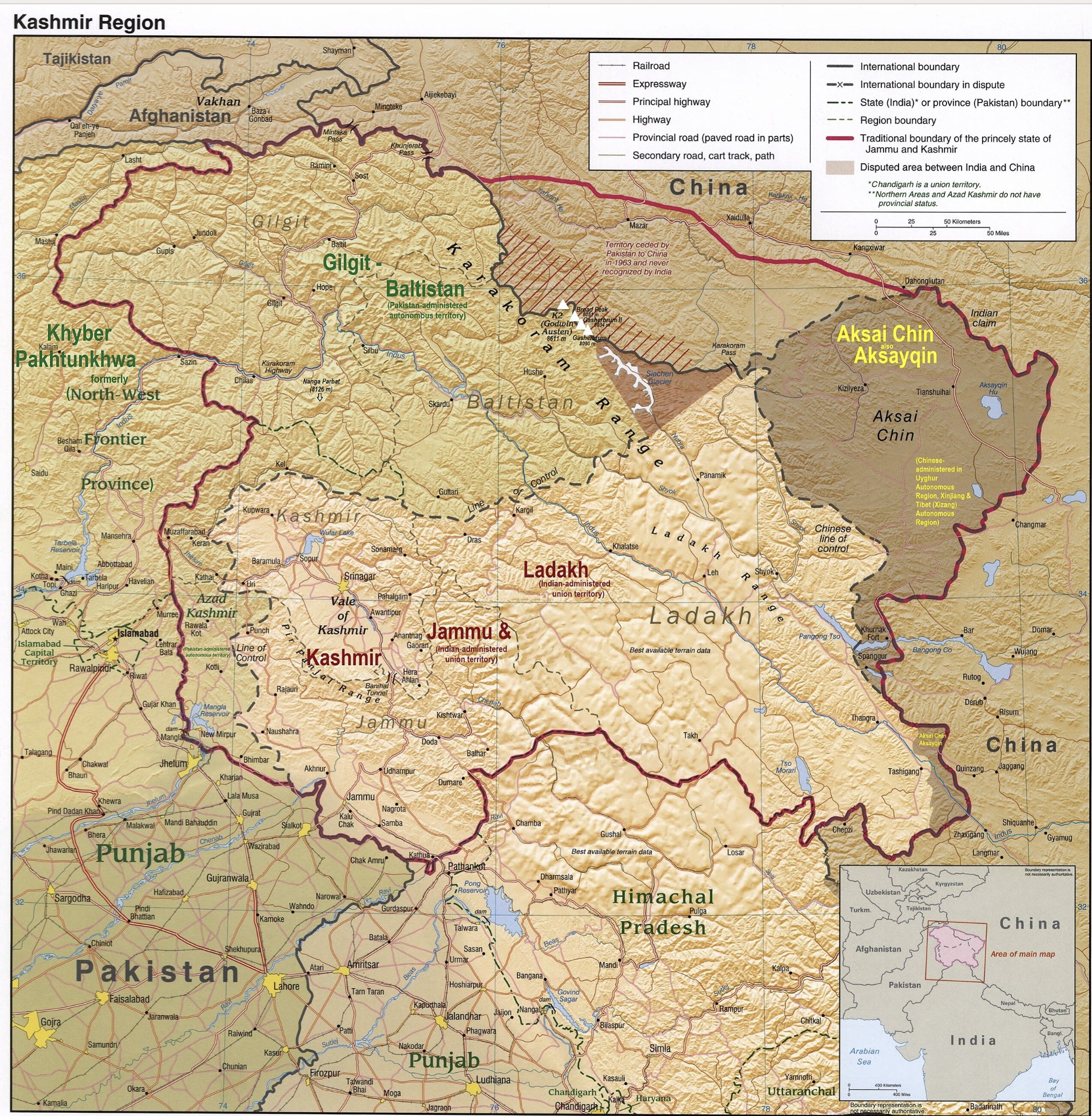
[Map of Kashmir showing sub-regions administered by different countries]
Constant tension and three wars
The consequences of the imperial policy of ‘divide and rule’ are still being felt, but mainly because the ruling elites are constantly rekindling them. This latent state of low-intensity warfare is used by the Pakistani and Indian regimes to marginalise or silence opposition, to appeal (with varying degrees of success) for national unity, to divert attention from social problems, to justify the size of military budgets, and so on.
Three high-intensity wars took place. The first in 1947-1949, in the wake of partition. It ended under the aegis of the UN with the establishment of a line of control cutting Kashmir in two (this was not a recognised border). The second in 1965-1966 and the third in 1999, on the heights of Kargil, resulted in several thousand deaths on both sides. The fighting takes place at high altitude in extremely trying conditions.
India acquired nuclear weapons in 1974, in response to China, with whom it is also in conflict on the Himalayan border. Pakistan imported the appropriate technology and carried out its first tests in 1998 (it is the only Muslim country to possess it). However, just as in Europe, the ‘balance of terror’ has not put an end to military conflicts, even if the situation is very different from that on the Korean peninsula, where it is difficult to ignore the risk of ‘slippage’. France, for its part, is trying to politically ‘normalise’ the idea of its use by referring to its research into ‘tactical’ weapons - a dangerous smokescreen. Universal nuclear disarmament remains a top priority.
The unfolding of the current crisis
On 22 April, an armed religious group carried out an attack in Pahalgam in the eastern part of Kashmir (under Indian occupation). India denounced Pakistan.
On 7 May, New Delhi launched Operation Sindoor. In addition to the usual artillery fire on either side of the Line of Control in Kashmir, its air force and drones attacked numerous targets in Pakistani territory.
The conflict is escalating, with Pakistan sending drones to destroy targets deep inside India, including airports.
In both countries, the media have inflamed war nationalism. But it is clear that the massive use of drones, in particular, has changed the situation. The Indian bourgeoisie was party to the patriotic hysteria, sobering up and demanding that Prime Minister Narenda Modi agree to a ceasefire. India is trying to take advantage of the Washington-Beijing conflict to attract international capital. Fanning the embers of anti-Muslim ideology is good for the ethno-nationalist policy of the BJP (Modi’s party), which aims to complete the process of illiberal ‘Hinduisation’ of the country - but military insecurity is bad for business.
India has always felt superior to its neighbour Pakistan. Demographics, strategic depth (1,600 km from east to west), economic capacity and today a racist ideology feed this feeling. Strategically, Pakistan does not have these advantages. The long-standing links between the army’s secret services and the Afghan Taliban on its north-western border should have made it a ‘friendly’ country, giving it a certain strategic depth. The Afghan Taliban have now become its main enemies, supporting the Pakistani Taliban.
However, Pakistan’s defences have proved more effective than expected. Its pilots are better trained than those of its large neighbour. It is equipped with an air fleet and Chinese missiles that can hit the attacker from very far away. Five Indian aircraft are reported to have been shot down, including the French Rafale, while its countermeasures to protect against missiles do not appear to have been effective or activated.
However, Islamabad cannot sustain a lasting war effort. The country is drowning in debt and under intense pressure from the IMF. With each country claiming victory, the ceasefire agreement was signed on 10 May and announced on 12 May. It is only a truce, not a peace. After whipping up the BJP supporters, who do not understand this truce, Narenda Modi declared that the Sindoor operation was not over, that it had even become a permanent policy of the government. He is thus preparing for important elections, particularly in the state of Bihar, by continuing to stir up ‘anti-Muslim hatred’ against his neighbour, as well as against India’s large Muslim community (around 15% of the total population). Christians are also the target of Hindu fundamentalists, advocates of Hindu supremacism (Hindutva).
Who carried out the Pahalgam attack?
Who is the armed fundamentalist group that carried out the terrorist operation on 22 April in Pahalgam, in Indian-occupied Kashmir, killing 26 perfectly innocent people? India immediately denounced the Lashkar-e-Taiba, thus directly implicating Islamabad, since the LeT is linked to the Pakistani army. However, there is nothing to indicate that this is the case.
The identity of this organization remains unknown, but the hypothesis that the attack (absolutely reprehensible in its terrorist nature) was not ordered by Pakistani services, but was carried out by a Kashmiri group in its own right, must be seriously considered.
This group operated a long way from the demarcation line without sophisticated means, with the basic weaponry of any guerrilla group, it seems (automatic weapons, but no quality explosives), in an ultra-militarised zone where long-distance travel is dangerous. The situation in Jammu and Kashmir continues to worsen for its inhabitants, both socially and religiously. The autonomous status from which the territory ‘benefited’ never meant much in practice, but the fact that it was repealed in 2019 heralded a brutal hardening of New Delhi’s colonial policy of dispossession, giving impetus to the Hinduisation of the administration, and so on. There were so many ‘disappeared persons’ that they are referred to as ‘half-widows’, women who do not know whether their husbands are dead or alive. A repressive situation that my Indian comrades denounce in no uncertain terms. Under these conditions, it would be surprising if no local resistance groups were formed.
Conditions are much less drastic in the Kashmiri territories under Pakistani administration.
There is no doubt that the army and the Inter-Service Intelligence (ISI) trained and mentored the terrorist organisations operating in Jammu and Kashmir. Recently, however, the situation has changed. Many of the fundamentalist groups based in Pakistan are said to have become autonomous, pursuing their own objectives. As for the Afghan Taliban, they support the Pakistani Taliban (the Tehreek Taliban Pakistan, TTP)... who are fighting the military and control part of the country. They have supplied them with heavy weaponry taken from stocks left by the United States and its local supporters when they left the country in a hurry in 2021.
Pakistan has long lived under direct or indirect military regimes (as it does today, with Shehbaz Sharif’s government as a front), with democratic periods being only interludes. Now, however, it is going through a regime crisis that is probably unprecedented. The Pakistani army has been very unpopular since it threw its erstwhile protégé, Imran Kahn, into prison after he had become too powerful and remained surprisingly popular. A high-ranking Pakistani officer can swagger about after the attack in an attempt to restore his image, but the call for national unity behind the military caste seems to have gone unheeded for the time being, whatever the anger felt by the population after the attacks of Operation Sindoor, which targeted not only military installations but also religious schools (madrasas) and mosques that were no longer fundamentalist training centres.
Geopolitics of water and power
Regional tension has been considerably aggravated by the Modi government’s decision to suspend the Indus Treaty. The equitable sharing of its waters is vital for Pakistan, contributing in particular to the irrigation of agriculture in Punjab, the country’s breadbasket. Signed in 1960, this treaty provides a mechanism for stable cooperation between the two countries, something rare enough to warrant mention. This suspension, taken in the wake of the Pahalgam attack, amounts to a veritable act of hostility. As we know, in an era of global warming, control of water resources is becoming even more of a strategic issue than in the past.
Turkey and other states in the Near and Middle East mediated to stop the fighting. They will also defend Pakistan - one of the world’s largest Muslim countries, along with Indonesia, and the one that could give them access to nuclear weapons. But the two powers that count remain the United States and China. Who can predict what Trump will do tomorrow? Then there is Beijing.
The ‘Pakistan corridor’ is of major importance to the Chinese regime, enabling it to bypass India to the west and gain access to the ocean. The north-south route to the port of Gwadar (under construction) starts in Pakistan-administered Kashmir (in Gilgit-Baltistan) and ends in Baluchistan, a conflict zone where various independence resistance movements operate (sometimes supported by India?) and where the Pakistani army is especially brutal (people ‘disappear’ here too). Chinese investment is considerable and its armed forces are present all along the corridor, under cover of the security services of... Chinese companies. Beijing’s grip is so obvious that it has caused some upheaval among the Pakistani elites, but it looks very much like a fait accompli.
This is a fact that the Modi regime cannot afford to ignore.
Taking account of the new, looking at things from a different angle, acting as an internationalist
We need to think in the ’new’. In the case that interests us here, the ‘new’ is considerable: in India, the exclusionary dynamic of Hindutva (Modi claims the entire borders of the former British Empire); in Pakistan, a major regime crisis in a country plagued by regionalism and armed conflict; an upheaval in the geography of fundamentalist movements; the accelerating effects of the climate crisis; the renewal of geopolitical stakes with the unknown factor represented by the future of another regime crisis, the one into which the United States is sinking and whose repercussions will be global...
It is normal for each organisation to begin by analysing the state of the regional crisis, let’s say from the point of view of its own country and its own political orientation. However, in order to take the analysis further and take joint action across borders, we need to make an effort to look at the situation from a different angle, by observing the situation as seen from other countries involved in the crisis (and other organisations with which we want to take action).
This is true in Europe (Western Europeans should see the Ukrainian war as it is experienced in Eastern Europe), or for a European trying to understand a distant Asian crisis...
Internationalism is obviously the plumb line for forces claiming to be on the left in the event of military conflict. The two parliamentary communist parties - the Communist Party of India (CPI) and the Communist Party of India (Marxist) (CPI M) - have failed in their responsibilities by supporting the government’s decision to launch military action against Pakistan. On the other hand, the vast majority of my comrades in the countries concerned have maintained this plumb line against the current and in the face of intense pressure for national unity or militarism, keeping their stand in favour of full recognition of the Kashmiris’ right to self-determination, a primary duty for Pakistani, Indian and... Chinese activists.
Implementing this right to self-determination is not easy, not least because each Kashmiri territory has been separated for decades. Nevertheless, until the Kashmiris’ right to self-determination is recognised, there will be no lasting solution to a regional crisis that is being exploited by many established powers, both state and non-state.
17 May 2025
Source ESSF. Translated by the author with the help of DeepLpro.
Corrections were made on May 18 at 10 a.m. concerning the large presence of Muslims in India (around 15% of the total population), who are not concentrated in the historic state of Hyderabad (now Andhra Pradesh and Telengana), but are present in many states. Another concerning the position of my Indian comrades, who have taken into account the possibility that the organization responsible for the Pahalgam attack was a local formation.
Attached documentskashmir-india-pakistan-on-the-history-and-internationalist_a8999-2.pdf (PDF - 978.6 KiB)
Extraction PDF [->article8999]
kashmir-india-pakistan-on-the-history-and-internationalist_a8999.pdf (PDF - 978.6 KiB)
Extraction PDF [->article8999]
Pierre Rousset
Pierre Rousset is a member of the leadership of the Fourth International particularly involved in solidarity with Asia. He is a member of the NPA in France.
International Viewpoint is published under the responsibility of the Bureau of the Fourth International. Signed articles do not necessarily reflect editorial policy. Articles can be reprinted with acknowledgement, and a live link if possible.

No comments:
Post a Comment