It’s possible that I shall make an ass of myself. But in that case one can always get out of it with a little dialectic. I have, of course, so worded my proposition as to be right either way (K.Marx, Letter to F.Engels on the Indian Mutiny)
Tuesday, June 03, 2025
SPACE/COSMOS
Why We Must Prevent The Militarisation Of Outer Space: How To Reconcile National Interests with Transnational and Transplanetary Interests
By Nayef Al-Rodhan - 03 June 2025 Conflict and security Nayef Al-Rodhan argues that critical militarisation and binary zero-sum paradigms in space won’t make us safer – they will only increase our vulnerability.
As the United States and China escalate their rivalry across economic, technological, and military dimensions – including the latest tit-for-tat tariff increases that have reignited fears of a prolonged trade war – their competition risks evolving into a full-spectrum strategic confrontation. Outer space could be next. If left unchecked, the increased militarisation of outer space could have catastrophic consequences for global security and human progress. What does this mean for global efforts to shape a cooperative framework for space governance?
Historically, space has served as a domain of awe and ambition – where human ingenuity transcended borders. The International Space Station stands as a monument to what global cooperation can achieve. Today, the logic of terrestrial geopolitics is rapidly encroaching on this final frontier. At the heart of this drift lies the intensifying strategic competition between the United States, China and Russia, which have all invested heavily in space-based military capabilities. The establishment of the U.S. Space Force (USSF) in 2019 formalised the militarisation of space as a central component of national security. Other space-faring nations have mirrored these efforts and NATO has labeled space a warfighting domain. The US remains the unrivalled power in cosmos and has long held the upper hand in technological innovations.
However, the USSF's “Space Warfighting Framework” released last month has raised the stakes by declaring that “space superiority” and "control of space" are now the foundation of U.S. military power, not just a strategic advantage. In parallel, China and Russia have accelerated their space ambitions by expanding offensive and defensive counterspace measures including anti-satellite (ASAT) weapons, jamming technologies, and dual-use satellite systems. U.S. officials claim Russia is developing a space-based nuclear anti-satellite weapon that could disrupt military and civilian systems alike. Moscow denies this, but vetoed a 2024 UN resolution reaffirming the Outer Space Treaty’s ban on nuclear weapons in orbit.
These developments are not isolated. They reflect a broader trend in which space is increasingly seen as a critical extension of military and economic power. Satellites now underpin everything from navigation and communications to surveillance and missile defence. As such, their strategic value has become immense – and so too their vulnerability. Herein lies the danger: the more reliant we become on space-based infrastructure, the more tempting it becomes for rival powers to target those systems in times of tension. A recent CSIS report warns that a space-based global strike would be a game-changer, offering unmatched speed and lethality. But even an accidental satellite mishap could trigger cascading effects, crippling communications and risking escalation. Worse still, kinetic ASAT weapons could create debris clouds, rendering orbits unusable for generations – a scenario known as the "Kessler Syndrome.”
As Brookings notes, despite the increasing reliance on space-based systems, the US (and the other global powers) still does not have a clearly defined strategy for deterring attacks in space – highlighting a dangerous gap between capability and doctrine in an era of escalating orbital threats. The logic of mutually assured destruction, which helped stabilise the nuclear balance during the Cold War, does not hold in space. The domain is asymmetric, poorly regulated, and alarmingly fragile. In the absence of robust norms, responsible behaviour and binding treaties, the potential for miscalculation is profound. Moreover, the spillover effects of an exponential space arms race will not be confined to the warring nations. A new global space compact is therefore urgently needed: one that bans the deployment of offensive weapons in orbit, establishes norms of responsible behaviour, and ensures equitable access to space for all humanity. All space-faring nations should be pushing hard for the revitalisation of the Outer Space Treaty of 1967, whose noble principles now require modernisation.
Outer space is a shared "Global Commons", belonging to no nation but holding significance for all. We must therefore recognise that space security also has deeply ethical and philosophical dimensions, which reveal uncomfortable truths: as emotional, amoral egoists, states rarely show restraint without binding norms. Ultimately, this challenges our ability to act ethically and cooperatively on a planetary scale. That is why the future of space must be guided by what I call "Symbiotic Realism": an acknowledgment of the importance of healthy competition between states and the understanding that our interdependence, as states and species, must outweigh zero-sum competition. Non-conflictual competition, when fueled by transparency, accountability, dialogue, shared interests, ethical conduct and mutual respect can propel states toward collective prosperity while avoiding destructive rivalries. Above all, we must reconcile national interests with transnational and transplanetary interests by embracing a framework rooted in guaranteeing dignity, collective security, and sustainable prosperity for all.
Let us not repeat in space the errors we made on Earth. Critical militarisation and binary zero-sum paradigms in space won’t make us safer – they will only increase our vulnerability. Confidence-building measures, joint missions, and greater transparency in space operations are urgently needed. The three global powers need to lead by example and engage in direct dialogue on space security, safety and sustainability. This can only be done by adopting win-win symbiotic realist approaches, multi-sum security commitments and responsible restraint. Our collective human future depends on it. If space becomes unsafe, it will not be selectively unsafe, it will be unsafe for all states and corporations alike.
Professor Nayef Al-Rodhan is a philosopher, neuroscientist, geostrategist and futurologist. He is the Head of the Geopolitics and Global Futures Department, and head of the Outer Space Security Cluster, at the Geneva Centre for Security Policy in Switzerland, and a Member of the Global Future Council on Complex Risks at the World Economic Forum. He is also an Honorary Fellow at Oxford University’s St. Antony’s College and a Senior Research Fellow at the Institute of Philosophy at the University of London.
The space industry is currently undervalued, particularly in Europe, while the US and China are making significant advances.
Private companies have been instrumental in reducing launch costs and driving innovation in space exploration.
The future success of the space industry depends largely on reducing bureaucratic regulations and providing more freedom for private sector development.
The most undervalued industry in the world is the space industry. It is particularly unappreciated in Europe, which has now fallen hopelessly behind the United States and China. The US carried out 153 launches last year, China 68 and Europe three.
The science fiction author Arthur C. Clarke wrote back in 1977: “The impact of satellites on the entire human race will be at least the same impact as the advent of the telephone in so-called developed societies”. And he was right. Satellite mega-constellations such as Starlink, Qianfan, Kuiper, and Sat Net will ensure that the third of the world’s population that does not currently have access to the internet will soon be connected – with far-reaching economic implications.
CNBC has called space “Wall Street’s next trillion-dollar industry”, and according to a study by the World Economic Forum in April 2024, the space economy is expected to be worth USD 1.8 trillion by 2035. Morgan Stanley expects a space-based business to create the world’s first trillionaire.
Following the moon landings at the end of the 1960s and beginning of the 1970s, manned space flight in the U.S. all but stalled, largely due to political interference. Each new president came to office with new ideas and new priorities, and contracts were too often awarded or simply cancelled on blatantly political grounds.
NASA’s space shuttle program failed to live up to expectations. Despite the substantial investments made in the International Space Station (ISS), questions remain as to whether the money was spent wisely. And the launch costs, measured as the cost of getting one kilogram of payload into space, more or less stagnated for almost four decades.
It was private companies that achieved the breakthrough, driving launch costs down by approximately 80%. And this is just the beginning. Space exploration once again proves the superiority of capitalism. The space race between the Soviet Union and the United States in the 1960s has now been replaced by a contest between the United States and China. But there is one crucial difference: during the original space race, the U.S. and USSR space programs were both state-led. Yes, private companies also built rockets for the Apollo program, but those companies were given strict and narrow guidelines by the state space agency NASA, which told them exactly how to construct a rocket and led to high costs as the companies followed NASA’s instructions meticulously. Through cost-plus programs, there was not the slightest incentive to reduce costs; instead, the companies were incentivized to increase costs.
The relationship between NASA and private companies has changed dramatically in recent years. Elon Musk insisted on fixed prices and instead of telling SpaceX what to build, NASA specified what services it wanted to buy. The result: of 261 space missions worldwide in 2024, 134 were launched by SpaceX. If SpaceX were a country, it would by far surpass the second-largest country in the world, China, which registered 68 launches.
Even today, private space travel is hampered by superfluous regulations and government interference, particularly in Europe, but also in the United States. I suspect that a key reason for Elon Musk’s foray into politics is that he wanted to find a way to liberate private space companies from the growing bureaucratic burdens in the U.S.
The outcome of the new space race – whether China or the United States emerges victorious – will largely depend on which country grants more freedom to the growth of private space exploration. Currently, the United States is well ahead, but it would be dangerous to underestimate developments in China, which is also reducing its reliance on an exclusively public sector space program and is increasingly involving private companies.
Magnetic curtains on the sun: NSF Inouye Solar Telescope reveals ultra-fine striations in solar surface
NSF Daniel K. Inouye Solar Telescope captures sharpest-ever view of the solar surface to reveal our finest look at narrow magnetic stripe-like features known as striations
Association of Universities for Research in Astronomy (AURA)
Sharpest-ever view of the Sun’s surface, using the NSF Inouye Solar Telescope, reveals ultra-fine magnetic “stripes,” known as striations, just 20 kilometers wide.
Maui, Hawai‘i; June 3, 2025 – A team of solar physicists has released a new study shedding light on the fine-scale structure of the Sun’s surface. Using the unparalleled power of the U.S. National Science Foundation (NSF) Daniel K. Inouye Solar Telescope, built and operated by the NSF National Solar Observatory (NSO) on Maui, scientists have observed, for the first time ever in such high detail, ultra-narrow bright and dark stripes on the solar photosphere, offering unprecedented insight into how magnetic fields shape solar surface dynamics at scales as small as 20 kilometers (or 12.4 miles). The level of detail achieved allows us to clearly link these stripes to the ones we see in state-of-the-art simulations—so we can better understand their nature.
These stripes, called striations and seen against the walls of solar convection cells known as granules, are the result of curtain-like sheets of magnetic fields that ripple and shift like fabric blowing in the wind. As light from the hot granule walls passes through these magnetic "curtains," the interaction produces a pattern of alternating brightness and darkness that traces variations in the underlying magnetic field. If the field is weaker in the curtain than in its surroundings it appears dark, if it is relatively stronger it appears bright.
“In this work, we investigate the fine-scale structure of the solar surface for the first time with an unprecedented spatial resolution of just about 20 kilometers, or the length of Manhattan Island,” says NSO scientist Dr. David Kuridze, the study’s lead author. “These striations are the fingerprints of fine-scale magnetic field variations.”
The findings were not anticipated, and only possible because of the Inouye Solar Telescope’s unprecedented abilities. The team used the Inouye’s Visible Broadband Imager (VBI) instrument operating in the G-band, a specific range of visible light especially useful for studying the Sun because it highlights areas with strong magnetic activity, making features like sunspots and fine-scale structures like the ones in the study easier to see. The setup allows researchers to observe the solar photosphere at an impressive spatial resolution better than 0.03 arcseconds (i.e., about 20 kilometers on the Sun). This is the sharpest ever achieved in solar astronomy. To interpret their observations, the team compared the images with cutting-edge simulations that recreate the physics of the Sun’s surface.
The study confirms that these striations are signatures of subtle but powerful magnetic fluctuations—variations of only a hundred gauss, comparable to a typical refrigerator magnet's strength—that alter the density and opacity of the plasma, shifting the visible surface by mere kilometers. These shifts, known as Wilson depressions, are detectable thanks only to the unique resolving power of the 4-meter primary mirror of the NSF Inouye Solar Telescope, the largest in the world.
“Magnetism is a fundamental phenomenon in the universe, and similar magnetically induced stripes have also been observed in more distant astrophysical objects, such as molecular clouds,” shares NSO scientist and co-author of the study Dr. Han Uitenbroek. “Inouye’s high resolution, in combination with simulations, allows us to better characterize the behavior of magnetic fields in a broad astrophysical context.”
Studying the magnetic architecture of the solar surface is essential for understanding the most energetic events in the Sun’s outer atmosphere—such as flares, eruptions, and coronal mass ejections—and, consequently, improving space weather predictions. This discovery not only enhances our understanding of this architecture but also opens the door to studying magnetic structures in other astrophysical contexts—and at small scales once thought unachievable from Earth.
“This is just one of many firsts for the Inouye, demonstrating how it continues to push the frontier of solar research,” says NSO Associate Director for the NSF Inouye Solar Telescope, Dr. David Boboltz. “It also underscores Inouye's vital role in understanding the small-scale physics that drive space weather events that impact our increasingly technological society here on Earth.”
The paper describing this study, titled “The striated solar photosphere observed at 0.03’’ resolution,” is now available in The Astrophysical Journal Letters.
The striated solar photosphere observed at 0.03’’ resolution
Thread-like structures - known as photospheric striations. The bottom panel shows a processed version of the image, produced using a feature-extraction technique that highlights the fine-scale details of this phenomenon.
The surface of the Sun (photosphere), captured with the VBI instrument at the Inouye Solar Telescope in the G-band (430 nanometers) with a resolution of approximately 20 kilometers. The zoomed-in area reveals unprecedented details of the solar photosphere - granular walls dominated by ultra-thin stripes approximately 20–50 kilometers wide. Comparison of the Inouye Solar Telescope image (right) and synthetic image (left) produced using a state-of-the-art, physics-based simulation of the solar surface. The excellent agreement between the simulated and observed data has helped us understand the origin and formation of fine-scale structures in the photosphere. Near the summit of Maui’s Haleakalā, the NSF Daniel K. Inouye Solar Telescope, the largest in the world, is set to pave the way for a deeper understanding of our home star.
Credit
NSF/NSO/AURA
Vienna calling: Strauss’s ‘The Blue Danube’ to waltz into outer space
This year is the 200th birthday of Austria's world-famous waltz composer Johann Strauss II - Copyright AFP Alex HALADA
Blaise GAUQUELIN
Austrian composer Johann Strauss II’s “The Blue Danube” has, for many people, been synonymous with space travel since it was used in Stanley Kubrick’s 1968 sci-fi film classic “2001: A Space Odyssey”.
But the world famous waltz will truly travel among the stars on Saturday, when the European Space Agency’s (ESA) antenna will broadcast a live performance of it into space to celebrate the composer’s 200th birthday.
The Vienna Symphony Orchestra will play a concert in the Austrian capital from 1930 GMT, Josef Aschbacher, ESA’s director general, told AFP.
The concert will be broadcast live on the internet and also be shown at a public screening in Vienna, in New York at Bryant Park, and near the antenna in Spain.
“The digitised sound will be transmitted to the large 35-metre satellite dish at ESA’s Cebreros ground station in Spain,” Aschbacher said.
And from there, the waltz will be “transmitted in the form of electromagnetic waves”, the Austrian astronomer explained. – ‘Typical of space’ –
Like no other waltz by Strauss junior, “The Blue Danube” evokes the elegance of 19th-century imperial Vienna, which lives on in the city’s roaring ball season.
For Norbert Kettner, director of the Vienna tourist board, the Danube waltz is a “true unofficial space anthem” because of Kubrick.
The timeless waltz is the “typical sound of space”, Kettner said, with the tunes being played “during various docking manoeuvres of the International Space Station (ISS)”.
When the waltz is performed on Saturday, the Vienna Symphony Orchestra will make sure to underline the waltz’s airiness as if it were floating through space, its director Jan Nast said.
According to Nast, who put together the programme for Saturday’s hour-long “interstellar concert”, music is a language “which touches many people” and has “the universal power to convey hope and joy”.
– Filling a gap –
Once transmitted via Spain’s satellite dish, the signal will travel at the speed of light to eventually reach NASA’s Voyager 1 spacecraft — the most distant man-made object in the universe — in approximately 23 hours and 3 minutes.
After surpassing Voyager 1, it will continue its interstellar journey.
By catching up with the spacecraft and its twin, Voyager 2, Austria also seeks to right a perceived wrong.
Both Voyagers carry “Golden Records” — 12-inch, gold-plated copper disks intended to convey the story of our world to extraterrestrials.
The record holds 115 images of life on Earth, recorded in analogue form, and a variety of sounds and snatches of music.
While “The Magic Flute” by Austria’s composer Wolfgang Amadeus Mozart was included among the selection of 27 music pieces, Strauss’s famous waltz was not.
Johns Hopkins study shows how scientists can use black holes as supercolliders
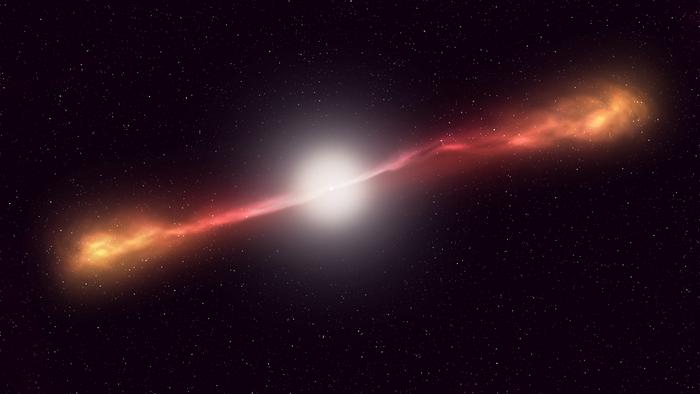
Artist’s conception of a supermassive black hole, billions of times more massive than the sun, like those found at the centers of galaxies. The black hole’s rapid spin and powerful magnetic fields can launch enormous jets of plasma into space, a process that could potentially generate the same results as human-made supercolliders.
As federal funding cuts impact decades of research, scientists could turn to black holes for cheaper, natural alternatives to expensive facilities searching for dark matter and similarly elusive particles that hold clues to the universe’s deepest secrets, a new Johns Hopkins study of supermassive black holes suggests.
The findings could help complement multi-billion-dollar expenses and decades of construction needed for research complexes like Europe’s Large Hadron Collider, the largest and highest-energy particle accelerator in the world.
“One of the great hopes for particle colliders like the Large Hadron Collider is that it will generate dark matter particles, but we haven’t seen any evidence yet,” said study co-author Joseph Silk, an astrophysics professor at Johns Hopkins University and the University of Oxford, UK. “That’s why there are discussions underway to build a much more powerful version, a next-generation supercollider. But as we invest $30 billion and wait 40 years to build this supercollider—nature may provide a glimpse of the future in super massive black holes.”
The research appears today in Physical Review Letters.
Particle colliders smash protons and other subatomic particles into each other at nearly the speed of light, exposing the most fundamental aspects of matter. Subtle energy flashes and debris from the clash could reveal previously undiscovered particles, including potential candidates for dark matter, a critical but ghostly component of the universe that scientists have yet to detect. Facilities such as the Large Hadron Collider, a 17-mile circular tunnel, have also helped transform the internet, cancer therapy, and high-performance computing.
A black hole can spin around its axis like a planet, but with much greater strength because of its intense gravitational field. Scientists are increasingly discovering that some rapidly spinning massive black holes at the centers of galaxies release enormous outbursts of plasma, likely because of jets powered by energy from their spin and surrounding accretion disks. It’s these events that could potentially generate the same results as human-made supercolliders, the new study shows.
“If supermassive black holes can generate these particles by high-energy proton collisions, then we might get a signal on Earth, some really high-energy particle passing rapidly through our detectors,” said Silk, who is also a researcher at the Institute of Astrophysics in Paris and at the University of Oxford. “That would be the evidence for a novel particle collider within the most mysterious objects in the universe, attaining energies that would be unattainable in any terrestrial accelerator. We’d see something with a strange signature that conceivably provides evidence for dark matter, which is a bit more of a leap but it’s possible.”
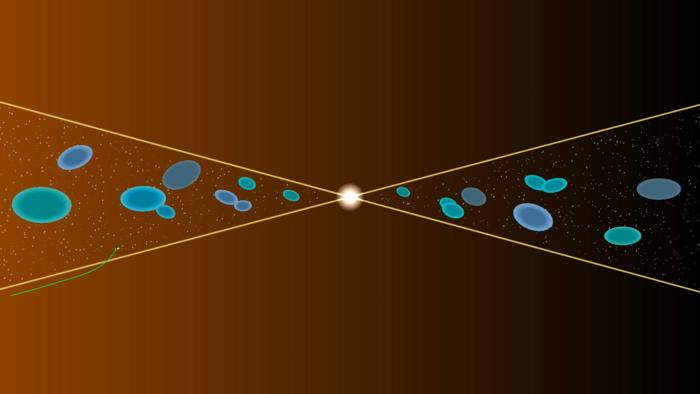
The new study shows that plunging “gas flows” near a black hole can draw energy from its spin, becoming much more violent than scientists thought possible. Near a rapidly spinning black hole, these particles can chaotically collide. Although not identical, the process is similar to the collisions scientists create using intense magnetic fields to accelerate particles in the circular tunnel of a high-energy particle collider.
“Some particles from these collisions go down the throat of the black hole and disappear forever. But because of their energy and momentum, some also come out, and it’s those that come out which are accelerated to unprecedentedly high energies,” Silk said. “We figured out how energetic these beams of particles could be: as powerful as you get from a supercollider, or more. It’s very hard to say what the limit is, but they certainly are up to the energy of the newest supercollider that we plan to build, so they could definitely give us complementary results.”
To detect such high-energy particles, scientists could use observatories already tracking supernovae, massive black hole eruptions, and other cosmic events, Silk said. These include detectors like the IceCube Neutrino Observatory in the South Pole or the Kilometer Cube Neutrino Telescope, which recently detected the most energetic neutrino ever recorded under the Mediterranean Sea.
“The difference between a supercollider and a black hole is that black holes are far away,” Silk said. “But nevertheless, these particles will get to us.”
Dr. Andrew Mummery, a theoretical physicist at University of Oxford, is also an author of the study.
Journal
Physical Review Letters
Article Title
Black Hole Supercolliders
Article Publication Date
3-Jun-2025
SwRI-led research finds particles energized by magnetic reconnection in the nascent solar wind
Research offers insights into processes that heat the solar atmosphere and accelerate the solar wind
An SwRI-led study identified particles accelerated to extremely high energies by magnetic reconnection near the Sun. As NASA’s Parker Solar Probe (trajectory shown in green) crossed the heliospheric current sheet, it encountered merging magnetic islands (blues) and protons accelerated toward the Sun, establishing reconnection as their source, distinct from unrelated solar processes.
SAN ANTONIO — June 3, 2025 —New research led by a Southwest Research Institute scientist identified a new source of energetic particles near the Sun. These definitive observations were made by instruments aboard NASA’s Parker Solar Probe, which detected the powerful phenomena as the spacecraft dipped in and out of the solar corona.
These new results offer fresh perspectives on how magnetic reconnection could heat the solar atmosphere, which then transitions into the solar wind, and also how solar flares accelerate a small fraction of charged particles to near-relativistic speeds.
“Through the SwRI-led Magnetospheric Multiscale mission, scientists made the first direct detection of the source of magnetic reconnection near Earth, observing how this explosive physical process converts stored magnetic energy into kinetic energy and heat,” said SwRI’s Dr. Mihir Desai, lead author of a new paper about this research. “Now Parker has made direct observations of how magnetic reconnection at the heliospheric current sheet (HCS), where the interplanetary field reverses its polarity, energizes charged particles to extremely high energies.”
As Parker crossed the HCS, scientists discovered a sunward-directed reconnection jet and sunward-propagating highly energetic protons, establishing their origin from HCS reconnection sites and not from unrelated processes at the Sun. Within the core of the reconnection exhaust, Parker detected trapped energetic protons a thousand times greater than the available magnetic energy per particle.
“These findings indicate that magnetic reconnection in the HCS is an important source of energetic particles in the near-Sun solar wind,” Desai said. “Everywhere there are magnetic fields there will be magnetic reconnection. But the Sun’s magnetic fields are much stronger near the star, so there’s a lot more stored energy to be released.”
Magnetic reconnection — when magnetic field lines converge, break apart and reconnect in an explosive physical process — energizes particles and generates high-speed flows. At the heart of space weather, reconnection is responsible for powerful solar events, such as solar flares and coronal mass ejections (CMEs), and drives disturbances in Earth’s space environment. Such disturbances produce spectacular auroras but can also shut down electrical power grids and disrupt satellite-based communication and navigation systems.
“Reports from the American Meteorological Society indicated that the powerful solar events in May 2024 wreaked havoc with farmers when extreme geomagnetic storms disrupted the precise GPS-guided navigation systems used to plant, fertilize and harvest rows of seeds, causing an estimated loss of up to $500 million in earning potential,” Desai said. “Parker’s access to this new data is critical, particularly as we remain in the midst of a very active solar cycle.”
Parker was able to make these measurements due to its record-breaking proximity to the Sun, flying through its corona up to three times a year. Of particular interest is understanding how the Sun’s atmosphere heats up and accelerates the solar wind. Understanding these processes can also help scientists develop ways to predict and mitigate the effects of solar flares and CMEs, as well as provide new insights for laboratory fusion research.
The Parker Solar Probe was developed as part of NASA’s Living With a Star program to explore aspects of the Sun-Earth system that directly affect life and society. The Living With a Star program is managed by the agency’s Goddard Space Flight Center in Greenbelt, Maryland, for NASA’s Science Mission Directorate in Washington. The Johns Hopkins University Applied Physics Laboratory designed, built and operates the spacecraft and manages the mission for NASA.
To read The Astrophysical Journal Letters paper, titled "Magnetic Reconnection-driven Energization of Protons up to ~400 keV at the Near-Sun Heliospheric Current Sheet," go to DOI: 10.3847/2041-8213/ada697.
Scientists analysing an ultra-hot giant planet believe it was formed by absorbing lightweight gases like methane evaporating from tiny space pebbles, whilst being bombarded with large rocky objects.
Using the James Webb Space Telescope (JWST) to explore the atmosphere of WASP-121b, researchers successfully detected water (H₂O), carbon monoxide (CO), and silicon monoxide (SiO) in the side facing its star or ‘dayside’. They also found methane (CH₄) in the planet’s ‘nightside’ atmosphere.
Publishing its findings today (2 June) in Nature Astronomy, the international research team’s discoveries mark the first conclusive identification of SiO in any planetary atmosphere, either within or beyond our solar system.
WASP-121b orbits its host star at a distance only about twice the star’s diameter, meaning its eternal dayside has temperatures locally exceeding 3000 degrees Celsius, while the nightside drops to 1,500 degrees.
Co-author Dr Anjali Piette, from the University of Birmingham, commented: “Detecting SiO in WASP-121b's atmosphere is groundbreaking - the first conclusive identification of this molecule in any planetary atmosphere.
“The 'nightside’ atmospheric composition of WASP-121b also suggests ‘vertical mixing’ - the transport of gas from deeper atmospheric layers to the infrared photosphere. Given how hot this planet is, we weren’t expecting to see methane on its nightside.”
The measured atmospheric carbon-to-hydrogen (C/H), oxygen-to-hydrogen (O/H), silicon-to-hydrogen (Si/H), and carbon-to-oxygen (C/O) ratios suggest that, during its formation, WASP-121b’s atmosphere was enriched by inward-drifting pebbles supplemented by a bombardment of refractory material.
“Dayside temperatures are high enough for refractory materials – typically solid compounds resistant to strong heat – to exist as gaseous components of the planet’s atmosphere,” lead-author Dr Thomas Evans-Soma, from the University of Newcastle (Australia), explained.
Scientists analysing the atmosphere of WASP-121b used a technique called ‘phase curve observation’, which involves watching the planet as it orbits its star to see how its brightness changes. These observations provide a view of both the dayside and nightside hemispheres, and their chemical makeup.
“The successful use of JWST to detect these elements and characterize the atmosphere of WASP-121b demonstrates the telescope's capabilities and sets a precedent for future exoplanet studies,” added Dr Piette.
ENDS
For more information, interviews or an embargoed copy of the research paper, please contact the University of Birmingham Press Office pressoffice@contacts.bham.ac.uk or +44 (0) 121 414 2772.
Notes to editor:
The University of Birmingham is ranked amongst the world’s top 100 institutions. Its work brings people from across the world to Birmingham, including researchers, teachers and more than 8,000 international students from over 150 countries.
‘SiO and a super-stellar C/O ratio in the atmosphere of the giant exoplanet WASP-121b' - Thomas M. Evans-Soma, David K. Sing, Joanna K. Barstow, Anjali A. A. Piette, et al is published in Nature Astronomy.
Participating institutions: University of Birmingham, UK; University of Newcastle, Australia; Max-Planck-Institut für Astronomie, Heidelberg, Germany; Johns Hopkins University, Baltimore, USA; The Open University, Milton Keynes, UK; Carnegie Institution for Science, Washington, USA; University of Oxford, UK; Space Telescope Science Institute, Baltimore, USA; NSF NOIRLab, La Serena, Chile; National Institute of Science Education and Research (NISER), Odisha, India; University of Exeter, UK; California Institute of Technology, Pasadena, USA; Flatiron Institute, New York, USA; University of Illinois at Urbana-Champaign, Urbana, USA; Columbia University, New York, USA; American Museum of Natural History, New York, USA; and University of Arizona, Tucson, Arizona, USA.
Journal
Nature Astronomy
Method of Research
Observational study
Subject of Research
Not applicable
Article Title
SiO and a super-stellar C/O ratio in the atmosphere of the giant exoplanet WASP-121b
Article Publication Date
2-Jun-2025
New Venus observation mission - World's first long-term planetary cubesat study by Korea’s Institute for Basic Science and NanoAvionics
Korea’s Institute for Basic Science pioneers 15-year multi-satellite programme to monitor Venus from low Earth orbit
Daejeon, South Korea, and Vilnius, Lithuania, 2 June 2025 – Kongsberg NanoAvionics (NanoAvionics), a leading small satellite bus manufacturer and mission integrator, has been selected by the Institute for Basic Science (IBS) in South Korea to build the first CubeSat for the world’s first long-term planetary science campaign which will use a series of CubeSats to monitor Venus from low Earth orbit.
This long-term Venus observation initiative, the CLOVE project (Chasing the Long-term Variability of Our Nearest Neighbor Planet Venus) has been a research project within the IBS Planetary Atmospheres Group since 2022. Its first satellite, CLOVESat-1, an 8U CubeSat bus to be designed and manufactured by NanoAvionics, is scheduled to launch in 2026. IBS plans to launch a new satellite every three years over a 15-year period to span at least one full solar activity cycle (11 years).
Under the contract, NanoAvionics will also integrate the scientific payload provided by IBS, conduct environmental testing, arrange launch services, and manage launch and early orbit operations (LEOP).
CLOVESat-1 will investigate Venus’s atmospheric temporal variabilities of cloud top altitude, vertical structure of clouds, gaseous sulfur dioxide abundance, and mysterious unknown absorber(s).
LEE Yeon Joo, Chief Investigator of the Planetary Atmospheres Group at IBS, said: “The payload for this mission was developed through a domestic partnership and reflects South Korea’s growing capabilities in planetary science instrumentation. With the support of NanoAvionics and their flight-proven CubeSat platform, we will gather continuous space-based data that has been inaccessible through previous missions. The findings will help us better understand the evolving nature of the Venusian atmosphere, its climate, and how it compares to Earth’s. We welcome collaboration for space exploration and data analysis, as we plan to make the data public.”
The first CubeSat built by NanoAvionics will carry instruments covering ultraviolet to near-infrared at four selected wavelengths and a total of eight channels including polarization filters, which will work in tandem with ground-based observatories.
Atle WØLLO, CEO of Kongsberg NanoAvionics, said: “This mission reflects a growing trend in space science, where small satellites play an increasingly important role in complementing larger-scale missions. We’ve already seen this in multimessenger X-ray astronomy, where NanoAvionics-built smallsats provide valuable data alongside flagship observatories, filling critical observational gaps and providing more data points and agility.
“With more than 20 research-focused missions using our satellite buses to conduct everything from material research to Earth science and astrophysics, CLOVESat-1 will extend our platform’s heritage into planetary research.”
The satellite’s high temporal resolution data will help researchers track elusive atmospheric changes and, over 15 years, provide valuable insight into Venus’s climate evolution. These clues may help scientists better understand volcanic activity, solar-atmosphere interactions, and planetary climate shifts—such as how a planet once resembling Earth became hostile to life.
Consistent and long-term monitoring from follow-up CLOVESats is expected to overlap the operative time with the upcoming NASA and ESA Venus missions, DAVINCI, VERITAS, and EnVision. The simultaneous observations by CLOVESats can provide a cross-comparison reference of the planet's time variable reflectance of the global view, while the orbiters acquire high spatial resolution data.
8U CubeSat. Credits - Kongsberg NanoAvionics
8U CubeSat. Credits - Kongsberg NanoAvionics
Atle Wøllo, CEO, Kongsberg NanoAvionics
CLOVESat-1 in Orbit. Credits - Kongsberg NanoAvionics



No comments:
Post a Comment