The US Empire’s 72-Year War on Iran

The likely temporary Israel-Iran ceasefire notwithstanding, if you need proof of how despicable Donald Trump is, consider this:
When asked last week if he would ask Israeli Prime Minister Netanyahu to stop bombing Iran, which had already said it would stop retaliating for Israeli attacks, Trump said, “I think it’s very hard to make that request right now. If somebody is winning, it’s a little bit harder to do that [than] if somebody’s losing. But we’re ready, willing and able, and we’ve been speaking to Iran. Israel is doing well, in terms of war, and… Iran is doing less well. It’s a little bit hard to get somebody to stop.”
Of course, Trump could have done more than request. He could have told Netanyahu that the transfer of American tax money, bombs, missiles, planes, arms, and spare parts would end at once if he did not stop the war. Trump did not do that. Instead, he made light of the question. That’s despicable.
To say the least, Trump has a thing about Iran. That is likely explained in part by the 1979 Islamic revolution, which overthrew the American- and Israeli-backed dictator-monarch, and the taking of hostages in the American embassy. However, history did not begin in 1979. The U.S. government had helped abuse the Iranians long before that. A more suitable date on which to begin the story is August 15, 1953. That is when the CIA and British operatives ousted the democratically elected prime minister, Mohammad Mosaddegh, and restored the autocratic Shah of Iran to power. Mosaddegh, among other things, had nationalized the oil industry to the detriment of British oil interests.
It so happens that in 2014, when the Obama administration was negotiating a nuclear deal with Iran (the JCPOA) and congressional Democrats and Republicans were trying to undermine the interim agreement that had been agreed to, my old friend Marc Joffe and I wrote an article in the Guardian detailing the U.S. government’s long abuse of Iran. Here are highlights from that article.
Congressional hostility toward Iran is rooted in a black-and-white worldview that runs as follows: the United States and Israel are liberal democracies that defend individual rights and human dignity, whereas Iran is a despotic theocratic regime that sponsors terrorism and would do anything within its power to wipe Israel off the map.
The world is rarely black and white, and conflicts are usually not resolved until each side understands the other’s point of view. With that in mind, it may be worth pondering some inconvenient truths that would cause a fair-minded Iranian to doubt congressional wisdom.
The assertion that US policies are driven by a concern for human rights is not consistent with the history of US-Iran relations.
That may have been (and still may be) news to many Americans, but it should not have been. It wasn’t news to the Iranians. The U.S. government has been aligned with brutal regimes all over the world for a long time. You can look it up. No need to go through the larger record here. The history of U.S.-Iran relations makes the point.
As the CIA now admits, [the U.S. government] overthrew a democratically elected Iranian government in 1953 and restored Shah Mohammed Reza Pahlavi to power. For the next quarter century, until the 1979 Islamic revolution, the US government supported the autocratic Shah – whose regime also enjoyed close relations with Israel.
The Shah’s secret police – Savak – became increasingly brutal, ultimately detaining without trial and torturing tens of thousands of Iranian citizens. By the 1970s, the regime’s brutality had been well documented in the west.
In 1976 the International Commission of Jurists in Geneva reported: “There is abundant evidence showing the systematic use of impermissible methods of psychological and physical torture of political suspects during interrogation.”
Yet successive US administrations supported the Shah until the very end and then shielded him from prosecution after his overthrow.
Not only did the United States impose and support a regime that tortured innocent Iranians, there is also evidence that the CIA assisted Savak. A 1980 report on CBS’s 60 Minutes documented close ties between these two organizations.
Joffe and I pointed out that this “adds perspective to the US embassy hostage-taking drama that stretched over the last 444 days of the Carter administration. Many in Iran believed that US embassy staff had aided and abetted Savak and were thus fair targets for retaliation. One need not condone the hostage-taking to understand that it was not merely an unprovoked, sadistic act.” The 66 American embassy personnel were not seized by militant students until months after the revolution, when President Jimmy Carter admitted the Shah to the United States for medical treatment and presumably political refuge. The students were backed by the new ruler, Ayatollah Ruhollah Khomeini.
That was not the end of the story. Americans might have forgotten the U.S. role in Iraq’s savage war on Iran.
It is now well known that the Reagan administration helped Iraq with “intelligence and military support” after Saddam Hussein attacked Iran in 1980 and launched a brutal eight-year war. “[I]t was the express policy of Reagan to ensure an Iraqi victory in the war, whatever the cost,” Shane Harris and Matthew M Aid wrote in Foreign Policy magazine last year. With the administration’s knowledge,
Note well: “Iraq used chemical weapons against Iranian forces, killing thousands. Declassified government records show that the Reagan administration, represented by special envoy Donald Rumsfeld, helped Saddam’s military produce and deploy these awful weapons of mass destruction, which included biological as well as chemical agents.”
Got that? The U.S. government provided WMD to Saddam Hussein for use against Iran. Iran’s ruler refused to permit his military to produce chemical weapons for retaliation. (In 2003 the U.S. military invaded Iraq supposedly over WMD that Saddam had gotten rid of years earlier.)
To add injury to injury:
In 1988, while the war was in progress, a US warship, the USS Vincennes, shot down an Iranian civilian aircraft over the Persian Gulf, killing all 290 aboard, including 66 children. The captain of the ship said it was under assault by Iranian gunboats at the time and that the Airbus A300 was misidentified as an attacking F-14 Tomcat. Iran countered that flight 655 left Iran the same time every day. Witnesses with Italy’s navy and on a nearby US warship said that at the time it was shot down, the airliner was climbing. In 1996 the United States settled an Iranian claim against it at the International Court of Justice for $131.8m. While it was appropriate for the US government to accept responsibility, it could not make up for the Iranian people’s losses: more innocent lives were snuffed out by this attack than were killed in the Pan Am 103 bombing over Lockerbie, Scotland.
President George H. W. Bush, however, refused to apologize for the tragedy. As Bush I put it: “I’ll never apologize for the United States of America, ever. I don’t care what the facts are.” Sensitive, yes?
The new century signaled no diminution in American belligerence toward Iran—not even after the 9/11 attacks, which presented an opportunity for rapprochement with the Islamic Republic.
Despite Iran’s efforts to cooperate with the United States after 9/11 (the Shiite regime opposed both the Sunni Taliban and al-Qaida in next-door Afghanistan to the east), President [George W.] Bush in 2002 included Iran as a member of the “axis of evil” along with North Korea and Iraq. The following year, the United States overthrew Saddam Hussein and occupied Iraq – placing US forces on both Iran’s western and eastern flanks. Finally, in 2011, Iranian forces captured a US surveillance drone that was flying well within its air space – about 140 miles from the Afghanistan border.
Thus, “far from being innocent, US policy toward Iran appears downright hostile when viewed from the other side. Rather than continuing to tell ourselves tales, it is time we embrace the truth about our relations with Iran, which even American and Israeli intelligence agencies say is not building a nuclear weapon. We have a historic chance to end the destructive cold war with Iran, which, like it or not, will remain a major power in the Middle East. It would be a tragedy if Congress were to sabotage this opportunity.”
Congressional obstruction notwithstanding, Obama, working with the other Security Council members, Germany, and the rest of the European Union, finalized the nuclear agreement with Iran, which imposed an additional inspections regime along with other restrictions and seemed to take war off the table. In return, Western sanctions were to be lifted, and Iran was to rejoin the world economy. In the 1990s, Iran’s second and current “Supreme Leader,” Ayatollah Ali Khamenei, issued a fatwa forbidding the procurement, production, or use of nuclear weapons.
Unfortunately, Trump tore up the agreement in 2018. President Joe Biden did precious little to revive his old boss’s deal, but Trump presumably would have torn that up too when he returned to office this year. The U.S. government’s shameful record concerning Iran continues to haunt the world. It’s not over yet, no matter what Trump says.
Sheldon Richman is the executive editor of The Libertarian Institute and a contributing editor at Antiwar.com. He is the former senior editor at the Cato Institute and Institute for Humane Studies; former editor of The Freeman, published by the Foundation for Economic Education; and former vice president at the Future of Freedom Foundation. His latest books are Coming to Palestine and What Social Animals Owe to Each Other.
Iran and the Nuclear Order
John Feffer
July 4, 2025

Photo by Arman Taherian
A spate of break-ins has been taking place in your neighborhood. Armed thugs associated with a crime syndicate have been knocking down doors and grabbing what they can. The police show up only after the assaults, which have led to injuries and even a few deaths. Under-resourced and overstretched, they haven’t been able to thwart the robbers.
Someone in your neighborhood puts up a sign: This Homeowner Is Armed and Dangerous. The next night, the thugs break into the houses on either side, not even bothering to test whether the homeowner in the middle has a gun or knows how to use it. They just leave that house alone.
Question for you: do you buy a gun?
Maybe you don’t believe in guns. So, do you consider putting up a similar sign even though the most dangerous item in your house is a nail clipper? The evidence seems clear. Even just the threat of retaliation is enough to dissuade the would-be attackers. Your life and the lives of your family are on the line.
This is the dilemma facing many countries around the world, except that the gun in this analogy is a nuclear weapon. Countries without nuclear weapons—Libya, Yugoslavia—experienced attacks that eventually led to regime change. Countries that possess even just a few warheads—North Korea, China—have managed to deter states with malign intent.
Iran, a country that has put up a warning sign in its window without fully committing to acquiring the ultimate deterrent, was recently bombed by both Israel and the United States. A tenuous ceasefire now holds in this conflict. The Trump administration imagines that it has destroyed Iran’s nuclear program. It also believes that it can now put more pressure on Iran to give away its nuclear weapons program at the negotiating table.
But the obvious takeaway for Iran after the recent attacks is that it’s certainly dangerous to semi-covertly pursue nuclear weapons but it’s perhaps even more dangerous not to have them. If nuclear powers don’t suffer devastating bombing campaigns, insecure nations conclude that they best acquire a nuke as quickly as possible.
It’s not just Iran. Other countries are drawing similar conclusions about how to survive in an international environment where collective security—the global equivalent of the police—is falling apart as quickly as a fence in a hurricane.
Iran’s Complex
Guns can be used for different things—to hunt, to hit clay targets, to massacre children at a school.
Likewise, nuclear complexes can serve very different purposes. Iran has long maintained that its nuclear facilities are for the production of energy, medical isotopes, and so on. But a country doesn’t need to enrich its uranium to 60 percent, as Iran reportedly has done, to achieve these peaceful goals. Nuclear power requires an enrichment level of 3-5 percent. Weapons-grade uranium, meanwhile, is 90 percent.
The Obama administration, with a number of international partners, negotiated a nuclear agreement with Iran that capped the level of enrichment at 20 percent and began diluting Iran’s uranium stockpiles to 3.5 percent. The Trump administration pulled the United States out of the agreement. The enrichment level of Iran’s uranium not surprisingly began to creep upwards.
Iran has maintained two underground enrichment facilities at Natanz and Fordow. These were two of the targets of U.S. bunker-busters. The 14 bombs the United States dropped on these targets might be expected to have returned Iran to the pre-nuclear stone age. And that’s certainly what the Trump administration has claimed.
But Donald Trump is quick to claim victory even in the throes of obvious defeat (remember COVID, Afghanistan, and the 2020 election?). According to an anonymous source in the Defense Intelligence Agency, the recent U.S. attack set Iran back “maybe a few months, tops.” The Trump administration dismissed this assessment as a leak from “an anonymous, low-level loser in the intelligence community.”
But the head of the International Atomic Energy Agency, Rafael Grossi, echoed the DIA report: “The capacities they have are there. They can have, you know, in a matter of months, I would say, a few cascades of centrifuges spinning and producing enriched uranium, or less than that.” Even Iranian officials, caught speaking privately about the attack, were surprised that the damage was not as great as they’d anticipated.
Even if the capacity to enrich uranium had been destroyed, the U.S. and Israeli attacks couldn’t root out the knowledge of these processes from the minds of the Iranian scientists—or the desire to acquire nuclear weapons from the Iranian population as a whole. According to a poll from June of last year, nearly 70 percent of Iranian respondents favored the country going nuclear—this after nearly two decades of public opinion opposing the weaponization of the program.
Memo to both the United States and Israel: it’s not just Iran’s political leadership that wants nukes. In other words, regime change is not going to resolve this nuclear question. Iran’s complex.
Future Negotiations?
Considering Trump’s cancellation of the Iranian nuclear accord back in 2017, diplomacy wouldn’t seem to be top on the administration’s agenda. But it wasn’t diplomacy per se that Trump rejected, only diplomacy associated with the Obama administration.
As late as the Friday before the U.S. attack, even as Israel was continuing its own bombing runs, the Trump administration was conducting secret talks with Iran. According to CNN:
Among the terms being discussed, which have not been previously reported, is an estimated $20-30 billion investment in a new Iranian non-enrichment nuclear program that would be used for civilian energy purposes, Trump administration officials and sources familiar with the proposal told CNN. One official insisted that money would not come directly from the US, which prefers its Arab partners foot the bill. Investment in Iran’s nuclear energy facilities has been discussed in previous rounds of nuclear talks in recent months.
That sounds a lot like the Agreed Framework that the Clinton administration pursued with Pyongyang, with South Korea largely footing the bill for the construction of reactors that could power North Korea’s civilian sector. Those reactors were never built, and North Korea went on to assemble its own mini-arsenal of nuclear weapons.
Iran has said that it would consider returning to the negotiating table at some point after it receives guarantees that there will be no future attacks. Without much trust among the various sides, it would be hard to imagine Iran forever renouncing a nuclear option or Israel forever forswearing attacks on Iran, even if they both make rhetorical commitments for the purpose of restarting talks.
Trump the Opportunist
There is much loose speculation that Donald Trump is an isolationist, an anti-militarist, a believer in spheres of influence. The U.S. attack on Iran should dispense with such nonsense.
Donald Trump is a political opportunist. He takes positions—anti-abortion, pro-crypto—based not on principles but on how much they will boost his political (and economic) fortunes.
On foreign policy, Trump has raised opportunism to the level of a geopolitical doctrine. He has talked of steering clear of military conflicts in the Middle East, but then the opportunity presented itself to strike against Iranian targets effectively risk-free (because Israel had already secured the airspace). He has railed against corruption in Ukraine and declared President Volodymyr Zelensky a “dictator,” but then the opportunity presented itself to sign a minerals agreement with the government in Kyiv.
Trump has no problems negotiating with religious fundamentalists. He gets along just fine with Sunni absolutists in the Middle East, and he would probably be hard-pressed to explain the religious differences between the Sunnis of Saudi Arabia and the Shia of Iran. If an opportunity presents itself to negotiate a deal with Iran, Trump may well take it—mostly because he can then call himself the person who really vanquished that country’s nuclear “threat” (take that, Obama!).
Meanwhile, Trump continues to make it more likely that countries around the world will invest in their own nuclear weapons programs.
At home, despite some rhetoric about the lack of any need for new nuclear weapons, Trump is adding nearly $13 billion to the budget for nuclear weapons. And his plan for a “golden dome” will only encourage other nuclear powers to spend more to evade such heightened defenses Such dangerous one-upmanship was, after all, the rationale for the dearly departed Anti-Ballistic Missile treaty.
Trump’s reluctance to provide assurances to allies that the United States will come to their defense in case of attack has poked huge holes in the nuclear umbrella that hitherto covered much of Europe and Asia. Now European politicians are talking about building out their own nuclear capabilities—with the French arsenal at its center—and conservatives in South Korea have also begun talking about establishing a nuclear deterrent.
And the rest of the world? The Iranian parliament has begun drafting the country’s withdrawal from the Nuclear Non-Proliferation Treaty. Only one other country has exited the treaty—North Korea—and only a handful of countries are not parties to it (Israel, India, Pakistan, South Sudan) If Iran goes, there may well be a rush to the exits, beginning with Saudi Arabia and Turkey, which have made noises about the nuclear option.
Nothing speaks louder than Trump’s actions. He exchanged “love letters” with North Korea’s Kim Jong Un (nukes), is a big fan of Vladimir Putin (nukes), and has indicated that he has more respect for China (nukes) than Taiwan (no nukes). On the other side of the nuclear fence, he has bombed Iran, threatened Venezuela and Cuba, and discussed the possibility of taking over Greenland and Canada.
I’m no advocate of nuclear armaments. But if I were Canadian, I might start thinking that a reputation for niceness just doesn’t cut it in TrumpWorld. A couple of nuclear-tipped ICBMs, however, would send a message that this White House more readily understands.
John Feffer is the director of Foreign Policy In Focus, where this article originally appeared

The likely temporary Israel-Iran ceasefire notwithstanding, if you need proof of how despicable Donald Trump is, consider this:
When asked last week if he would ask Israeli Prime Minister Netanyahu to stop bombing Iran, which had already said it would stop retaliating for Israeli attacks, Trump said, “I think it’s very hard to make that request right now. If somebody is winning, it’s a little bit harder to do that [than] if somebody’s losing. But we’re ready, willing and able, and we’ve been speaking to Iran. Israel is doing well, in terms of war, and… Iran is doing less well. It’s a little bit hard to get somebody to stop.”
Of course, Trump could have done more than request. He could have told Netanyahu that the transfer of American tax money, bombs, missiles, planes, arms, and spare parts would end at once if he did not stop the war. Trump did not do that. Instead, he made light of the question. That’s despicable.
To say the least, Trump has a thing about Iran. That is likely explained in part by the 1979 Islamic revolution, which overthrew the American- and Israeli-backed dictator-monarch, and the taking of hostages in the American embassy. However, history did not begin in 1979. The U.S. government had helped abuse the Iranians long before that. A more suitable date on which to begin the story is August 15, 1953. That is when the CIA and British operatives ousted the democratically elected prime minister, Mohammad Mosaddegh, and restored the autocratic Shah of Iran to power. Mosaddegh, among other things, had nationalized the oil industry to the detriment of British oil interests.
It so happens that in 2014, when the Obama administration was negotiating a nuclear deal with Iran (the JCPOA) and congressional Democrats and Republicans were trying to undermine the interim agreement that had been agreed to, my old friend Marc Joffe and I wrote an article in the Guardian detailing the U.S. government’s long abuse of Iran. Here are highlights from that article.
Congressional hostility toward Iran is rooted in a black-and-white worldview that runs as follows: the United States and Israel are liberal democracies that defend individual rights and human dignity, whereas Iran is a despotic theocratic regime that sponsors terrorism and would do anything within its power to wipe Israel off the map.
The world is rarely black and white, and conflicts are usually not resolved until each side understands the other’s point of view. With that in mind, it may be worth pondering some inconvenient truths that would cause a fair-minded Iranian to doubt congressional wisdom.
The assertion that US policies are driven by a concern for human rights is not consistent with the history of US-Iran relations.
That may have been (and still may be) news to many Americans, but it should not have been. It wasn’t news to the Iranians. The U.S. government has been aligned with brutal regimes all over the world for a long time. You can look it up. No need to go through the larger record here. The history of U.S.-Iran relations makes the point.
As the CIA now admits, [the U.S. government] overthrew a democratically elected Iranian government in 1953 and restored Shah Mohammed Reza Pahlavi to power. For the next quarter century, until the 1979 Islamic revolution, the US government supported the autocratic Shah – whose regime also enjoyed close relations with Israel.
The Shah’s secret police – Savak – became increasingly brutal, ultimately detaining without trial and torturing tens of thousands of Iranian citizens. By the 1970s, the regime’s brutality had been well documented in the west.
In 1976 the International Commission of Jurists in Geneva reported: “There is abundant evidence showing the systematic use of impermissible methods of psychological and physical torture of political suspects during interrogation.”
Yet successive US administrations supported the Shah until the very end and then shielded him from prosecution after his overthrow.
Not only did the United States impose and support a regime that tortured innocent Iranians, there is also evidence that the CIA assisted Savak. A 1980 report on CBS’s 60 Minutes documented close ties between these two organizations.
Joffe and I pointed out that this “adds perspective to the US embassy hostage-taking drama that stretched over the last 444 days of the Carter administration. Many in Iran believed that US embassy staff had aided and abetted Savak and were thus fair targets for retaliation. One need not condone the hostage-taking to understand that it was not merely an unprovoked, sadistic act.” The 66 American embassy personnel were not seized by militant students until months after the revolution, when President Jimmy Carter admitted the Shah to the United States for medical treatment and presumably political refuge. The students were backed by the new ruler, Ayatollah Ruhollah Khomeini.
That was not the end of the story. Americans might have forgotten the U.S. role in Iraq’s savage war on Iran.
It is now well known that the Reagan administration helped Iraq with “intelligence and military support” after Saddam Hussein attacked Iran in 1980 and launched a brutal eight-year war. “[I]t was the express policy of Reagan to ensure an Iraqi victory in the war, whatever the cost,” Shane Harris and Matthew M Aid wrote in Foreign Policy magazine last year. With the administration’s knowledge,
Note well: “Iraq used chemical weapons against Iranian forces, killing thousands. Declassified government records show that the Reagan administration, represented by special envoy Donald Rumsfeld, helped Saddam’s military produce and deploy these awful weapons of mass destruction, which included biological as well as chemical agents.”
Got that? The U.S. government provided WMD to Saddam Hussein for use against Iran. Iran’s ruler refused to permit his military to produce chemical weapons for retaliation. (In 2003 the U.S. military invaded Iraq supposedly over WMD that Saddam had gotten rid of years earlier.)
To add injury to injury:
In 1988, while the war was in progress, a US warship, the USS Vincennes, shot down an Iranian civilian aircraft over the Persian Gulf, killing all 290 aboard, including 66 children. The captain of the ship said it was under assault by Iranian gunboats at the time and that the Airbus A300 was misidentified as an attacking F-14 Tomcat. Iran countered that flight 655 left Iran the same time every day. Witnesses with Italy’s navy and on a nearby US warship said that at the time it was shot down, the airliner was climbing. In 1996 the United States settled an Iranian claim against it at the International Court of Justice for $131.8m. While it was appropriate for the US government to accept responsibility, it could not make up for the Iranian people’s losses: more innocent lives were snuffed out by this attack than were killed in the Pan Am 103 bombing over Lockerbie, Scotland.
President George H. W. Bush, however, refused to apologize for the tragedy. As Bush I put it: “I’ll never apologize for the United States of America, ever. I don’t care what the facts are.” Sensitive, yes?
The new century signaled no diminution in American belligerence toward Iran—not even after the 9/11 attacks, which presented an opportunity for rapprochement with the Islamic Republic.
Despite Iran’s efforts to cooperate with the United States after 9/11 (the Shiite regime opposed both the Sunni Taliban and al-Qaida in next-door Afghanistan to the east), President [George W.] Bush in 2002 included Iran as a member of the “axis of evil” along with North Korea and Iraq. The following year, the United States overthrew Saddam Hussein and occupied Iraq – placing US forces on both Iran’s western and eastern flanks. Finally, in 2011, Iranian forces captured a US surveillance drone that was flying well within its air space – about 140 miles from the Afghanistan border.
Thus, “far from being innocent, US policy toward Iran appears downright hostile when viewed from the other side. Rather than continuing to tell ourselves tales, it is time we embrace the truth about our relations with Iran, which even American and Israeli intelligence agencies say is not building a nuclear weapon. We have a historic chance to end the destructive cold war with Iran, which, like it or not, will remain a major power in the Middle East. It would be a tragedy if Congress were to sabotage this opportunity.”
Congressional obstruction notwithstanding, Obama, working with the other Security Council members, Germany, and the rest of the European Union, finalized the nuclear agreement with Iran, which imposed an additional inspections regime along with other restrictions and seemed to take war off the table. In return, Western sanctions were to be lifted, and Iran was to rejoin the world economy. In the 1990s, Iran’s second and current “Supreme Leader,” Ayatollah Ali Khamenei, issued a fatwa forbidding the procurement, production, or use of nuclear weapons.
Unfortunately, Trump tore up the agreement in 2018. President Joe Biden did precious little to revive his old boss’s deal, but Trump presumably would have torn that up too when he returned to office this year. The U.S. government’s shameful record concerning Iran continues to haunt the world. It’s not over yet, no matter what Trump says.
Sheldon Richman is the executive editor of The Libertarian Institute and a contributing editor at Antiwar.com. He is the former senior editor at the Cato Institute and Institute for Humane Studies; former editor of The Freeman, published by the Foundation for Economic Education; and former vice president at the Future of Freedom Foundation. His latest books are Coming to Palestine and What Social Animals Owe to Each Other.
Iran and the Nuclear Order
July 4, 2025
Photo by Arman Taherian
A spate of break-ins has been taking place in your neighborhood. Armed thugs associated with a crime syndicate have been knocking down doors and grabbing what they can. The police show up only after the assaults, which have led to injuries and even a few deaths. Under-resourced and overstretched, they haven’t been able to thwart the robbers.
Someone in your neighborhood puts up a sign: This Homeowner Is Armed and Dangerous. The next night, the thugs break into the houses on either side, not even bothering to test whether the homeowner in the middle has a gun or knows how to use it. They just leave that house alone.
Question for you: do you buy a gun?
Maybe you don’t believe in guns. So, do you consider putting up a similar sign even though the most dangerous item in your house is a nail clipper? The evidence seems clear. Even just the threat of retaliation is enough to dissuade the would-be attackers. Your life and the lives of your family are on the line.
This is the dilemma facing many countries around the world, except that the gun in this analogy is a nuclear weapon. Countries without nuclear weapons—Libya, Yugoslavia—experienced attacks that eventually led to regime change. Countries that possess even just a few warheads—North Korea, China—have managed to deter states with malign intent.
Iran, a country that has put up a warning sign in its window without fully committing to acquiring the ultimate deterrent, was recently bombed by both Israel and the United States. A tenuous ceasefire now holds in this conflict. The Trump administration imagines that it has destroyed Iran’s nuclear program. It also believes that it can now put more pressure on Iran to give away its nuclear weapons program at the negotiating table.
But the obvious takeaway for Iran after the recent attacks is that it’s certainly dangerous to semi-covertly pursue nuclear weapons but it’s perhaps even more dangerous not to have them. If nuclear powers don’t suffer devastating bombing campaigns, insecure nations conclude that they best acquire a nuke as quickly as possible.
It’s not just Iran. Other countries are drawing similar conclusions about how to survive in an international environment where collective security—the global equivalent of the police—is falling apart as quickly as a fence in a hurricane.
Iran’s Complex
Guns can be used for different things—to hunt, to hit clay targets, to massacre children at a school.
Likewise, nuclear complexes can serve very different purposes. Iran has long maintained that its nuclear facilities are for the production of energy, medical isotopes, and so on. But a country doesn’t need to enrich its uranium to 60 percent, as Iran reportedly has done, to achieve these peaceful goals. Nuclear power requires an enrichment level of 3-5 percent. Weapons-grade uranium, meanwhile, is 90 percent.
The Obama administration, with a number of international partners, negotiated a nuclear agreement with Iran that capped the level of enrichment at 20 percent and began diluting Iran’s uranium stockpiles to 3.5 percent. The Trump administration pulled the United States out of the agreement. The enrichment level of Iran’s uranium not surprisingly began to creep upwards.
Iran has maintained two underground enrichment facilities at Natanz and Fordow. These were two of the targets of U.S. bunker-busters. The 14 bombs the United States dropped on these targets might be expected to have returned Iran to the pre-nuclear stone age. And that’s certainly what the Trump administration has claimed.
But Donald Trump is quick to claim victory even in the throes of obvious defeat (remember COVID, Afghanistan, and the 2020 election?). According to an anonymous source in the Defense Intelligence Agency, the recent U.S. attack set Iran back “maybe a few months, tops.” The Trump administration dismissed this assessment as a leak from “an anonymous, low-level loser in the intelligence community.”
But the head of the International Atomic Energy Agency, Rafael Grossi, echoed the DIA report: “The capacities they have are there. They can have, you know, in a matter of months, I would say, a few cascades of centrifuges spinning and producing enriched uranium, or less than that.” Even Iranian officials, caught speaking privately about the attack, were surprised that the damage was not as great as they’d anticipated.
Even if the capacity to enrich uranium had been destroyed, the U.S. and Israeli attacks couldn’t root out the knowledge of these processes from the minds of the Iranian scientists—or the desire to acquire nuclear weapons from the Iranian population as a whole. According to a poll from June of last year, nearly 70 percent of Iranian respondents favored the country going nuclear—this after nearly two decades of public opinion opposing the weaponization of the program.
Memo to both the United States and Israel: it’s not just Iran’s political leadership that wants nukes. In other words, regime change is not going to resolve this nuclear question. Iran’s complex.
Future Negotiations?
Considering Trump’s cancellation of the Iranian nuclear accord back in 2017, diplomacy wouldn’t seem to be top on the administration’s agenda. But it wasn’t diplomacy per se that Trump rejected, only diplomacy associated with the Obama administration.
As late as the Friday before the U.S. attack, even as Israel was continuing its own bombing runs, the Trump administration was conducting secret talks with Iran. According to CNN:
Among the terms being discussed, which have not been previously reported, is an estimated $20-30 billion investment in a new Iranian non-enrichment nuclear program that would be used for civilian energy purposes, Trump administration officials and sources familiar with the proposal told CNN. One official insisted that money would not come directly from the US, which prefers its Arab partners foot the bill. Investment in Iran’s nuclear energy facilities has been discussed in previous rounds of nuclear talks in recent months.
That sounds a lot like the Agreed Framework that the Clinton administration pursued with Pyongyang, with South Korea largely footing the bill for the construction of reactors that could power North Korea’s civilian sector. Those reactors were never built, and North Korea went on to assemble its own mini-arsenal of nuclear weapons.
Iran has said that it would consider returning to the negotiating table at some point after it receives guarantees that there will be no future attacks. Without much trust among the various sides, it would be hard to imagine Iran forever renouncing a nuclear option or Israel forever forswearing attacks on Iran, even if they both make rhetorical commitments for the purpose of restarting talks.
Trump the Opportunist
There is much loose speculation that Donald Trump is an isolationist, an anti-militarist, a believer in spheres of influence. The U.S. attack on Iran should dispense with such nonsense.
Donald Trump is a political opportunist. He takes positions—anti-abortion, pro-crypto—based not on principles but on how much they will boost his political (and economic) fortunes.
On foreign policy, Trump has raised opportunism to the level of a geopolitical doctrine. He has talked of steering clear of military conflicts in the Middle East, but then the opportunity presented itself to strike against Iranian targets effectively risk-free (because Israel had already secured the airspace). He has railed against corruption in Ukraine and declared President Volodymyr Zelensky a “dictator,” but then the opportunity presented itself to sign a minerals agreement with the government in Kyiv.
Trump has no problems negotiating with religious fundamentalists. He gets along just fine with Sunni absolutists in the Middle East, and he would probably be hard-pressed to explain the religious differences between the Sunnis of Saudi Arabia and the Shia of Iran. If an opportunity presents itself to negotiate a deal with Iran, Trump may well take it—mostly because he can then call himself the person who really vanquished that country’s nuclear “threat” (take that, Obama!).
Meanwhile, Trump continues to make it more likely that countries around the world will invest in their own nuclear weapons programs.
At home, despite some rhetoric about the lack of any need for new nuclear weapons, Trump is adding nearly $13 billion to the budget for nuclear weapons. And his plan for a “golden dome” will only encourage other nuclear powers to spend more to evade such heightened defenses Such dangerous one-upmanship was, after all, the rationale for the dearly departed Anti-Ballistic Missile treaty.
Trump’s reluctance to provide assurances to allies that the United States will come to their defense in case of attack has poked huge holes in the nuclear umbrella that hitherto covered much of Europe and Asia. Now European politicians are talking about building out their own nuclear capabilities—with the French arsenal at its center—and conservatives in South Korea have also begun talking about establishing a nuclear deterrent.
And the rest of the world? The Iranian parliament has begun drafting the country’s withdrawal from the Nuclear Non-Proliferation Treaty. Only one other country has exited the treaty—North Korea—and only a handful of countries are not parties to it (Israel, India, Pakistan, South Sudan) If Iran goes, there may well be a rush to the exits, beginning with Saudi Arabia and Turkey, which have made noises about the nuclear option.
Nothing speaks louder than Trump’s actions. He exchanged “love letters” with North Korea’s Kim Jong Un (nukes), is a big fan of Vladimir Putin (nukes), and has indicated that he has more respect for China (nukes) than Taiwan (no nukes). On the other side of the nuclear fence, he has bombed Iran, threatened Venezuela and Cuba, and discussed the possibility of taking over Greenland and Canada.
I’m no advocate of nuclear armaments. But if I were Canadian, I might start thinking that a reputation for niceness just doesn’t cut it in TrumpWorld. A couple of nuclear-tipped ICBMs, however, would send a message that this White House more readily understands.
John Feffer is the director of Foreign Policy In Focus, where this article originally appeared
The Madmen Behind the Israel/US-Iran War
July 4, 2025
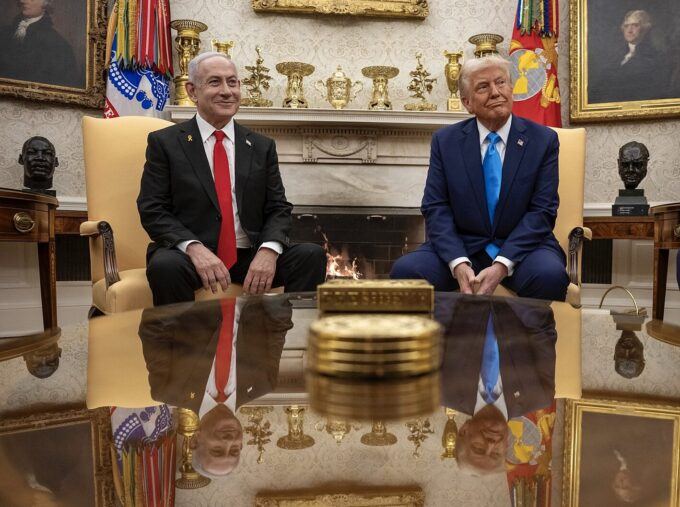
Photograph Source: Dan Scavino – Public Domain
It has now been more than 30 years since the butcher of Auschwitz Gaza, Benjamin Netanyahu, warned the world that Iran would soon acquire nuclear weapons. In 1992, in an address to the Israeli Knesset, he stated: “Within three to five years, we can assume that Iran will become autonomous in its ability to develop and produce a nuclear bomb.” He repeated the warning and whispered the need to invade Iran in the ears of every US president ever since. The warnings became louder after Al Qaeda attacked the US. The Jerusalem Post reported on September 12, 2001, that “Netanyahu warned last night that the attack could be a harbinger of worse tragedies that could kill millions of people once Iran or Iraq acquires nuclear weapons.” Later Netanyahu admitted that he had told the US Congress that there was “no question whatsoever that [Saddam] Hussein was developing weapons of mass destruction.” Ahead of the 2003 Iraq invasion, Netanyahu told the US Secretary of Defense, Donald Rumsfeld, “you will finish this [invasion] very quickly. But your primary goal is the Iranian regime. And the Iranian regime is trying to develop a nuclear weapon.” He urged the US to invade both Iran and Iraq, but primarily Iran. This was, of course, at the time when Netanyahu’s moles in the White House, the so-called neocons (neoconservatives), were pushing George W. Bush to invade Iraq and Iran, in a policy that was called dual containment. Bush complied by invading Iraq, saying: “God told me to strike at al Qaeda and I struck them, and then he instructed me to strike at Saddam [Hussein], which I did, now I am determined to solve the problem in the Middle East.” But given the fiasco that followed the Iraq invasion, Bush did not grant Netanyahu his main wish, i.e., invading Iran. Netanyahu, however, kept trying. In 2009, after Barack Obama took office, Netanyahu told members of Congress that Iran was just one or two years away from nuclear capability.
Three years later, on September 27, 2012, Netanyahu appeared before the UN General Assembly and held up a diagram of a cartoonish-looking bomb with a fuse and drew a redline on it at 90% enriched uranium. The bizarre spectacle was mocked by some as “Bibi’s Wile E. Coyote-style cartoon bomb.” As I stated at the time, this was not only the proverbial “one too many times” that Netanyahu had cried wolf, but it was mocked so much by the media that it seemed to be the beginning of the end of Netanyahu’s intense and unsuccessful campaign to make the US attack Iran.
Netanyahu could not convince Obama that bombing Iran was necessary. Instead, Obama signed a deal with Iran in 2015 called the Joint Comprehensive Plan of Action (JCPOA). In exchange for some sanctions relief, the JCPOA placed a 15-year limit on Iran’s enrichment of uranium to a maximum level of 3.67%, limited the stockpile of enriched uranium to 300 kilograms, and put a 10-year limit on the number of centrifuges Iran could operate. Netanyahu did everything in his power to sabotage the enactment of the JCPOA. He even appeared before a joint session of the US Congress in 2015 to challenge the US president and overturn the deal. He received standing ovations, but the JCPOA continued to hold despite much opposition to it in the US Congress.
But why was Netanyahu crying wolf for all those years and trying to defeat an agreement that assured peaceful nature of Iran’s nuclear program? The answer is that Netanyahu never believed that Iran is building a nuclear bomb. Like the case of Iraq, Netanyahu, as I had argued for many years in my books and articles, used the issue of a nuclear bomb as a ruse to bring about the so-called regime change in Iran. Why a regime change? Because Iran, similar to Saddam Hussein, supported militant groups that stood in the way of total annexation of Palestinian lands. Netanyahu was interested in resurrecting the friendly relations that Israel had with the Shah of Iran prior to the 1979 Iranian Revolution. This intention was laid bare recently when Netanyahu talked about regime change, and the son of the infamous Shah declared his readiness to return to Iran.
Netanyahu could not get what he wanted as long as some degree of sanity prevailed in the White House. All this changed when Donald Trump, who shares many traits with Netanyahu, entered office. The man who had never read a page of the JCPOA and had no clue what the agreement was all about withdrew the US from the JCPOA, talking gibberish as to why he was doing so. But it appeared that his animosity toward Obama was the sole reason for his action. The leaders of Iran decided to stay in the agreement but kept enriching more and more uranium, hoping to bring the US back to the bargaining table. Instead of negotiating, Trump exerted “maximum pressure” on Iran by imposing more and more sanctions. He invaded Iranian airspace by flying a drone that was shot down by Iran and ordered the assassination of Qasem Soleimani, the commander of Iran’s Quds Force. Iran attacked a US base in Iraq and promised to punish the perpetrators of the assassination. The attack was choreographed, designed mostly for domestic consumption. Iran had informed the US ahead of time about the attack, and, therefore, there were no serious injuries. Trump left office without any retribution for assassinating an Iranian general and his compatriots.
Joe Biden, a self-proclaimed Zionist, who showed signs of aging and dementia, was not much interested in returning to the JCPOA. He allowed Netanyahu to turn Gaza into a killing field and to slaughter people in Lebanon. He also continued Trump’s policy of maximum pressure on Iran, levying more and more sanctions and threatening, through his European allies, to bring back UN- imposed sanctions, using a clause in the JCPOA usually referred to as “snapback” or “trigger mechanism.” He was also hoping that the IAEA would build a stronger case against Iran, using some decades-old issues, as well as some new ones, such as activities related to the enrichment of uranium. Knowing all of this, the leaders of Iran, instead of trying to de-escalate the situation, continued to increase the stockpile of enriched uranium and the level of enrichment. This insane and dangerous act, as I argued in a recent interview, was meant to bring back to the negotiation table a cognitively impaired man and his mostly Israeli-loving advisors. The Iranian leaders ignored the fact that Netanyahu was on a killing spree in the region and would soon attack Iran with his far more superior force, aided by the US and European allies. Instead, the generals of the Islamic Revolutionary Guard Corps (IRGC) boasted, almost daily, about their prowess and the impending demise of Israel.
In April 2024, Israel attacked the Iranian embassy in Damascus, killing top Iranian commanders and several officers. A few days later, the IRGC launched drones and missiles at Israel, most of which were intercepted by Israel, the US, European countries, and regional allies of Israel. Soon after, Israel attacked Iran, taking out some anti-aircraft systems that protected nuclear facilities. In July 2024, Israel assassinated one of the political leaders of Hamas, Ismail Haniyeh, in a guesthouse in Tehran run by the IRGC (details of which remain unclear to this day). The IRGC did nothing but make the usual bombastic statements. In September 2024, Israel injured Iran’s ambassador to Lebanon in the infamous and diabolical pager attack on Iran’s ally, Hezbollah. Subsequently, Israel killed the leader of Hezbollah, Hassan Nasrallah, in an airstrike near Beirut. In retaliation, in October 2024, Iran launched drones and ballistic missiles at Israel, most of which were once again intercepted. Israel responded by attacking and destroying Iran’s air defense systems in late October. Iran promised retaliation, but it never materialized. By now, the IRGC knew what Israel was capable of and that Iran had no air defenses. Yet, they continued with their pompous rhetoric. The amount of enriched uranium, particularly highly enriched, also increased. The stage was set for a full-blown attack on Iran by Israel and its allies.
Donald Trump’s victory in the presidential election gave the Iranian leaders the false hope that they could make a deal with a man who bragged about his deal-making abilities. So, they enthusiastically welcomed making a deal with Trump and entered five rounds of negotiations with Trump’s representative, Steven Witkoff. As I stated in my interview with a reformist journal in Iran—a few weeks before the Israel/US-Iran war—the leaders of Iran not only forgot Trump’s hostile acts toward Iran, but they ignored all the vile traits of the man. They appealed to his crooked shopkeeper mentality. They forgot that Trump, who is basically a real estate dealer, knew nothing about the intricacies of Iran’s nuclear dispute and the history of Netanyahu’s decades-old claims about Iran’s intention. All Trump knew and could say was that “Iran can’t have a nuclear bomb.” Steven Witkoff was also a real estate dealer and as ignorant as Trump about world affairs. In the first rounds of negotiations, he appeared to be completely lost, not knowing what the issues were. He made comments that were contrary to the wishes of Netanyahu and his brethren in the US, mostly the same neocons who had made the US invade Iraq in search of nuclear bombs that did not exist. But after a few rounds of talks, Witkoff was apparently told to say that Iran couldn’t enrich any uranium on its soil, period. Soon after, Trump, who was silent about the issue of enrichment level, started to say the same thing. This position, as most analysts pointed out, was a “deal-breaker.” The Iranian officials had always argued that, under the Treaty on the Non-Proliferation of Nuclear Weapons, they have an inalienable right to enrich uranium for peaceful purposes. Thus, they would never agree to the zero-enrichment level proposed by Trump and Netanyahu. Given the impasse, war was inevitable; Netanyahu’s 33-year-old dream was finally becoming a reality.
Two days before the sixth round of negotiations started, Israel staged a massive attack against Iran with the full knowledge and backing of Trump and his cohorts. It is, of course, too early to evaluate this attack and its consequence, especially in this short space. But in brief, the attack that lasted for 12 days resulted in the death of many top members of the IRGC, Iranian nuclear scientists, and ordinary citizens. According to the latest official data, as this essay is being written, 935 people died in Iran. Other sources put the estimate much higher. Israel also bombed Iranian nuclear facilities, missile sites, storage facilities, chemical facilities, infrastructures, hospitals, residential buildings, etc. They even bombed Iran’s state broadcasting building and the Evin prison, where some political prisoners are kept. This last diabolic act was apparently intended to help bring about the proverbial “regime change.” According to official estimates, 79 people died in that attack. Iran threw some punches of its own against Israel with drones and long-range missiles. But the death and destruction in Israel was nothing near to what Israel had done to Iran. According to Israeli sources, 28 people died in Israel. The death ratio between Iran and Israel, by itself, points to the power imbalance.
In the middle of the war, the deranged man who rules the US tried to take credit for what the madman in Israel was doing. He posted on his “Truth Social”: “We now have complete and total control of the skies over Iran.” He seemed to forget that he had said he deserved a Nobel Peace Prize, wanted to get the US out of “forever wars,” and was in the middle of negotiations with Iran when his and Netanyahu’s war with Iran started. In a final act of madness, the President of the US did what previous presidents had refused to do: he dropped bombs on Iranian nuclear facilities at the behest of Netanyahu. These nuclear sites had already been attacked by Israel, but in one case—a deeply buried facility at Fordo—the US dropped twelve 30,000-pound “bunker-buster” bombs. After bombing these sites, Trump said: “Iran’s key nuclear enrichment facilities have been completely and totally obliterated.” In another choreographed act, intended mostly for domestic consumption, Iran, in turn, fired some missiles at a US base in Qatar, almost all of which were intercepted, since Iran had already warned Qatar.
After this senseless war, which has cost many lives and perhaps billions of dollars (one bunker-buster bomb alone is estimated to cost $20 million), an uneasy and unofficial truce ensued. All sides declared victory and boasted about their destructive abilities. Somewhat reminiscent of the Iraq War, when US forces looked for nonexistent nuclear bombs, the US, Israel, and the IAEA are now trying to find out what happened to the stockpile of enriched uranium. Were they “obliterated,” along with the nuclear sites? Are they still there, or were they taken away? To find some answers, human elements, such as IAEA members, must enter the sites. But then the IAEA, which Iran accuses of being in cahoots with Israel, the US and other Israeli allies, can’t access these sites, especially if they were “obliterated.” This is now a bigger mess than before the war started.
I have been asked by some people what I expect to happen next. My answer is: I don’t know! We deal with some madmen and a few madwomen. Can we predict what mad people would do?
Some things, however, are certain. Netanyahu has not accomplished his goal of “regime change,” i.e., to restore the monarchy in Iran. He will, therefore, continue his push. The new IRGC officials will continue with their long-winded rhetoric about their prowess and the imminent demise of Israel. They will try to resurrect their enrichment program and use it as a bargaining chip to get some sanctions relief. They might dig deeper holes to protect their nuclear facilities, but they will certainly not build shelters to protect their citizens from future attacks. And Donald Trump will continue to wreak havoc on this planet.
The Dog’s Curve: How Corporate Media Obscures the Machinery of War
July 4, 2025
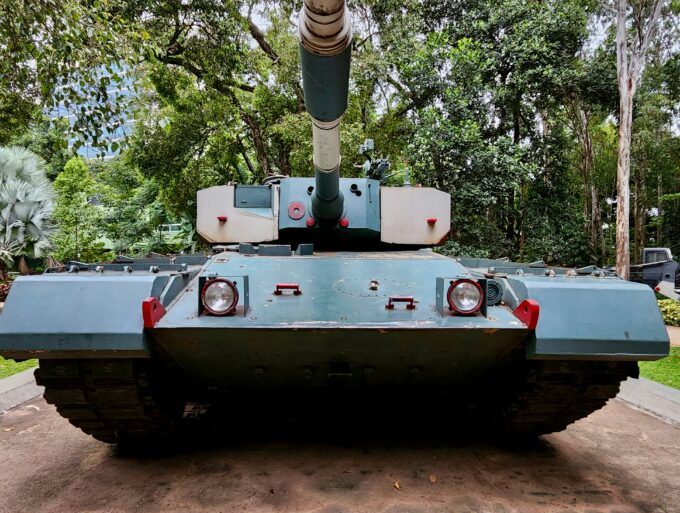
Image by Zoshua Colah.
Here we go again. Another bombing, another military “response,” another foreign policy crisis framed in the language of necessity. The headlines are already there: U.S. Targets Iranian Militants After Escalation. Cable anchors dutifully speculate: “Will this spark a regional conflict?” Pundits from think tanks with Pentagon ties flood the airwaves, telling us what we’re supposed to think.
It’s always the same loop—reaction, analysis, distraction—and it’s always behind the curve. Not the arc of history but the dog’s curve: legacy media panting after each event like a dog chasing a rabbit—eyes on the latest spectacle, oblivious to the machinery behind it.
It’s not that the corporate press is lazy. It’s complicit. It keeps us fixated on the effects of U.S. imperial power while playing the innocent about its trajectory. The result is a truncated consciousness. We’re allowed to debate whether a bombing was “proportional” or “legal,” but never to ask how the path to war was paved long before the first bomber left the airfield.
Here’s the truth: these wars are not accidents. They are not even responses. They are the execution of policies that were written years ago in think tanks funded by weapons manufacturers, fossil fuel giants, and billionaire-backed foundations, as primed for action as a Manchurian candidate waiting for the trigger word.
Take the Brookings Institution’s 2009 policy blueprint Which Path to Persia?—a document that might as well have been titled How to Justify War with Iran While Pretending We Tried Everything Else. Written in the cold language of strategic planning, the paper lays out multiple “paths”: sanctions, covert action, regime destabilization, and, of course, outright military intervention. These aren’t hypotheticals. They’re options on a shelf, ready to be taken down when the timing is right—or when the public is suitably softened up by headlines and horror stories.
This is how empire works in the 21st century. First, the government and its corporate backers fund “nonpartisan” think tanks to generate policy proposals. These papers are drafted by former government officials, ex-military strategists, and Ivy League technocrats. Next, lawyers scrub the documents and shape their language into legislative text. Lobbyists—often from the same think tanks—deliver the packages to lawmakers who depend on their donors. Finally, when the time comes, the president announces that we must “act decisively.”
And the media? They chase the dog’s curve—never ask where the rabbit is heading. They bring on a retired general, maybe a “senior fellow” from Brookings or CSIS, and they talk about the tactical details. They might even question the decision—Was this the right time? Did we warn allies?—but the underlying logic of permanent U.S. military dominance? That never makes it to the segment.
The irony is that the real planning isn’t even secret. It’s all out in the open. The policy papers are online. The revolving door between think tanks, Congress, the Pentagon, and the defense industry is well-documented. But acknowledging this would mean confronting the fact that America is not a democracy in any meaningful sense when it comes to foreign policy. It’s an empire run on autopilot, with bipartisan support and a corporate media machine trained to explain it all away.
And it works because the spectacle is so good. Bombs are cinematic. Drones are sleek. Maps of missile trajectories look like video game graphics. Meanwhile, the institutions that manufacture consent—the think tanks, the editorial boards, the so-called “serious” policy experts—remain untouched, unquestioned, and endlessly recycled.
You want to stop the next war? Stop chasing the aftermath. Start interrogating the institutions that plan these wars in advance. Dig into the budgets, the white papers, the interlocking boards of directors that tie together Raytheon, CNN, and the State Department. Name the names. Burn the polite fiction that any of this is about freedom, democracy, or defense.
Because until we stop confusing motion with meaning—until we stop reacting to each war as if it’s a surprise—we’ll be dragged along behind that spectacle-studded dog’s curve, watching each “new” surprise, as if it leapt out of nowhere.
Iran’s Anti-Modern Revolution Still Terrifies the West
July 4, 2025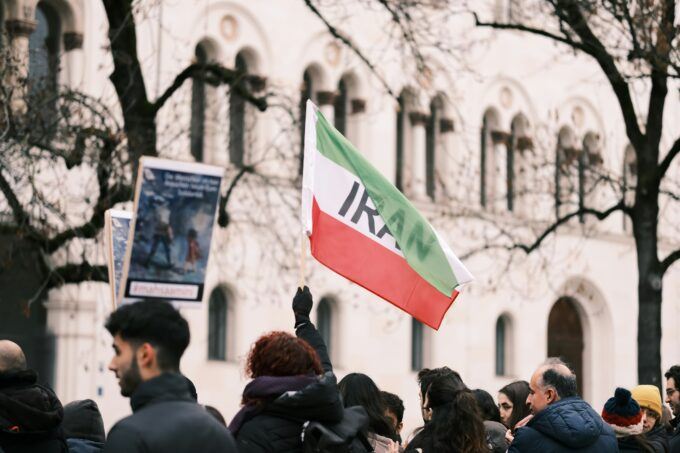
Image by Nk Ni.
After spending the last year killing pretty much everybody else in the Middle East, Israel and its less-than-silent partners back in Washington finally zeroed in on their ‘big bad’ in Tehran this June. All of this is hardly surprising nor is the fact that the orange lunatic in the White House has been complicit in pretty much every single move the IDF has made. Regardless of what Donald Trump may try to tell his increasingly suspicious MAGA supporters, his involvement in this bloodbath did not begin and end with the 14 bunker busters he violated the Constitution by dropping on three Iranian nuclear sites. Israel’s temporarily aborted attempt at regime change by bombardment was performed completely in tandem with the Trump regime from start to finish.
Trump shipped Israel the 300 Hellfire missiles used in the strikes three days before they began. He deliberately lulled Iran into a false state of security by scheduling the latest round of peace talks regarding Iran’s non-existent nuclear weapons program for the weekend when the attacks were secretly scheduled to begin. He quite openly aided and abetted the proceeding attacks by providing Israel with the intelligence they needed to hit their targets which included the now badly wounded Ali Shamkhani, who was the Ayatollah’s handpicked point man in the ongoing peace talks. He even provided the IDF with cover fire by using the US military to shoot down Iranian missiles and drones.
Trump also engaged in a downright absurdist campaign to convince the more consistently isolationist members of his MAGA base that neocon-style regime-change on behalf of a secular war junkie like Bibi Netanyahu somehow amounts to putting America first. It didn’t work. MAGA flipped and Trump chickened out. Don’t get me wrong, it isn’t over yet, but the Trump regime appears to be attempting to change the narrative to one in which their direct intervention somehow ended a massacre which they clearly engineered from the beginning.
However, perhaps the most astounding thing about this whole bloody charade is actually how restrained big bad Iran has been throughout the ordeal. They have made it perfectly clear through public communiques that they rightly consider this entire adventure to be an American attack on Iranian soil, one that targeted some of the nation’s leading military figures, and yet their only response to the men standing behind the Zionist minotaur was a glorified fireworks display over a US base in Qatar followed almost immediately by a peace deal which Israel blatantly violated before the ink had even dried on the treaty.
All of this and more begs the question what exactly is so goddamn scary about this allegedly rogue state? And why is their very existence so offensive as to inspire such treachery and downright reckless animosity on the part of the wealthiest nation on earth?
When you scratch the surface of the Zionist propaganda, Iran actually looks downright boring compared to their head-chopping Salafi neighbors. While Saudi Arabia can directly finance throwing commercial airliners into Manhattan’s skyline like tomahawks without so much as a yawn of resignation from America’s warmonger class, Iran mostly resigns itself to furnishing regional militias with cheap rockets and drones. Even their support for Hamas pales in comparison to the Muslim Brotherhood affiliated Qatar who actually houses much of their leadership, but Israel isn’t blowing Doha apart and America is literally protecting them with boots on the ground.
Iran’s supposed nuclear weapons program only deepens my argument. All available intelligence suggests that Iran shelved whatever militant nuclear ambitions they once had back in 2003 when the US dispatched their most unpredictable rival in the region, Saddam Hussein. A decision the Ayatollah Khamenei himself even sealed with a public fatwa against even pursuing weapons of mass destruction.
Of course, none of this stopped Netanyahu from spending the last twenty years declaring that the Mullahs were just twenty minutes away from an atom bomb and none of that stopped Iran from continuing to jump through their ass to prove otherwise. This endless game of atomic chicken ultimately led the Iranian government to sign on to the JCPOA in 2015. A UN brokered peace deal in which Iran agreed to an unprecedented level of international oversight on their civilian nuclear energy program in exchange for sanctions relief that never actually materialized.
The Mullahs only raised their enrichment levels after Donald Trump unilaterally violated this deal during his first term with more sanctions in spite of Iran being in full compliance and they only continued to do so when the other nations in the P5+1 along with the Biden Administration refused to make any attempt to return to the peace table. Even then, Iran never came close to weapons grade enrichment, and they continue to beg America, a nation clearly committed to their destruction, to return to a treaty regime which even they acknowledge the US is likely just using as an excuse to spy on a totally legal program between bombings.
So, I ask once more with theatric flare, who is afraid of the big bad wolf? What exactly is so goddamn scary about the so-called Islamic Republic? Some will point out their colorful objections to the existence of a Zionist state in Palestine, but these are largely rhetorical at best, after all they haven’t lifted a finger in defense of the hundreds of thousands of Gazans still being obliterated as we speak.
Others will point to Iran’s strategic location atop a sea of oil at the threshold of the Eurasian Century and I don’t doubt that this is a factor. It certainly is prime real estate but the price of buying the Mullahs off is far cheaper than blowing them up and they can just as easily be made customers of Raytheon as they could be made unwilling recipients of their ordinances. No, there is something far more complex at play here, something far bigger than oil or nuclear bombs.
Call it a theory but I believe that the grotesque reality is that it isn’t even Iran that is dangerous to the west, it’s their revolution and the so-called proxies that this unique uprising continues to inspire long after the Mullahs sold out.
In 1979, Iran was one of the wealthiest and most westernized nations in the Middle East. They had been one of the largest recipients of US military aid for decades and their ancient monarchy of over two millennia was the subject of a CIA driven campaign of secular modernization that every American journalist seemed certain would deliver the Muslim world to capitalism with the irresistible allure of Coca-Cola and miniskirts. And then a strange coalition of communist and Islamist student movements smashed it all to bits with zero outside influence from the equally shocked Soviet bloc in favor of something entirely indigenous.
The Islamic Revolution wasn’t simply a rejection of American imperialism; it was a rejection of Western Civilization itself along with all the false promises of liberal democracy and the Enlightenment which never really amounted to much more than a smokescreen for cultural subjugation in the Third World. But the Iranians weren’t simply rejecting modernity for the sake of contrarian animosity; they were trying to redefine themselves outside of its polluted influence.
Before Khomeini hijacked the nation amidst the unprecedented upheaval, the leading ideologue of the Islamic Revolution was a left-wing Shiite named Ali Shariati who preached what he referred to as “Red Shiism,” a kind of Islamic liberation theology that actually rejected idolatrous clerical hierarchies in favor of a populist “salvation of the masses” and preached that the malign influence of western colonialism had actually upended Islam’s traditional place at the forefront of human rights and kept the Muslim world from developing their own unique school of women’s liberation not defined by materialist sexuality.
Shariati died before the revolution could be betrayed but his influence would continue to define the ideas of the more radical leaders of Iran’s Revolutionary Guard like the Fatah-trained Gaddafiite, Mohammad Montazeri, and the Che Guevara inspired Mostafa Chamran, who were inspired by Shariati’s notion of the “solidarity of the oppressed” to build an “Islamic International” united against capitalism, Zionism and Wahhabism that would eventually develop into what would become known as the Axis of Resistance, a rag-tag coalition of rogue states and non-state actors that would eventually lead to the rise of the Shia militia.
As much as the west would like to paint these bearded badmen as braindead Iranian proxies, the facts on the ground do not support this narrative. In fact, while Iran has drifted farther and farther into the abyss of a corrupt and moneyed Islamic bureaucracy, movements like the Houthis, Hezbollah, and Iraq’s Sadrists seem to have moved in the opposite direction, establishing functioning parallel governments in direct contradiction to Iranian financed nation-states. These stateless societies bare far more resemblance to the pre-western tribal orders that once defined the region than Iran’s weird Westphalian theocracy. Muqtada al-Sadr, a populist cleric who actually studied under the Ayatollah, has become one of Iraq’s most outspoken critics of Iran’s influence over Bagdad and the Houthi rebels overthrew their own government after Iran had directly ordered them to stand down.
This is what the west really fears, and it is way bigger than Iran. The west is terrified of something adjacent to the kind of Islamic anarchism that nearly succeeded in Somalia with the Islamic Courts System, only this time written too large to contain. Iran is just a corrupt nation with just enough revolutionary malcontents amongst its dwindling hardliners to keep the kind of militias who will outlive them armed without carrying the moral or financial authority to govern them. After all, who is the only force that has even dared to hold Israel, and their globalist sponsors responsible for their genocidal sins? While the fat Mullahs cut deals for dinner scraps with the Great Satan, the starving rebels of Ansar Allah expand their blockade on Zionist shipping while Trump refuses to bomb them anymore as long as they leave his loot alone on the high seas.
The ironic thing is that if Trump and Bibi ever do achieve their dream of regime change in Iran, they would likely only succeed in bringing the revolution back home again. Iran still maintains a volunteer militia left over from the Iran-Iraq War known as the Basij. 25 million reserves from Iran’s bucolic tribal heartland, many with battle experience in Syria among the Axis of Resistance. Without an Ayatollah to inspire them where do you think these angry young men will turn, to some Pahlavi exile quisling or to a new generation of Red Shiism not beholden to any nation state?
The shit could get wild before it gets interesting so stay tuned to your TV sets while the lion corners the tamer, one drone at a time.

July 4, 2025
Photograph Source: Dan Scavino – Public Domain
It has now been more than 30 years since the butcher of Auschwitz Gaza, Benjamin Netanyahu, warned the world that Iran would soon acquire nuclear weapons. In 1992, in an address to the Israeli Knesset, he stated: “Within three to five years, we can assume that Iran will become autonomous in its ability to develop and produce a nuclear bomb.” He repeated the warning and whispered the need to invade Iran in the ears of every US president ever since. The warnings became louder after Al Qaeda attacked the US. The Jerusalem Post reported on September 12, 2001, that “Netanyahu warned last night that the attack could be a harbinger of worse tragedies that could kill millions of people once Iran or Iraq acquires nuclear weapons.” Later Netanyahu admitted that he had told the US Congress that there was “no question whatsoever that [Saddam] Hussein was developing weapons of mass destruction.” Ahead of the 2003 Iraq invasion, Netanyahu told the US Secretary of Defense, Donald Rumsfeld, “you will finish this [invasion] very quickly. But your primary goal is the Iranian regime. And the Iranian regime is trying to develop a nuclear weapon.” He urged the US to invade both Iran and Iraq, but primarily Iran. This was, of course, at the time when Netanyahu’s moles in the White House, the so-called neocons (neoconservatives), were pushing George W. Bush to invade Iraq and Iran, in a policy that was called dual containment. Bush complied by invading Iraq, saying: “God told me to strike at al Qaeda and I struck them, and then he instructed me to strike at Saddam [Hussein], which I did, now I am determined to solve the problem in the Middle East.” But given the fiasco that followed the Iraq invasion, Bush did not grant Netanyahu his main wish, i.e., invading Iran. Netanyahu, however, kept trying. In 2009, after Barack Obama took office, Netanyahu told members of Congress that Iran was just one or two years away from nuclear capability.
Three years later, on September 27, 2012, Netanyahu appeared before the UN General Assembly and held up a diagram of a cartoonish-looking bomb with a fuse and drew a redline on it at 90% enriched uranium. The bizarre spectacle was mocked by some as “Bibi’s Wile E. Coyote-style cartoon bomb.” As I stated at the time, this was not only the proverbial “one too many times” that Netanyahu had cried wolf, but it was mocked so much by the media that it seemed to be the beginning of the end of Netanyahu’s intense and unsuccessful campaign to make the US attack Iran.
Netanyahu could not convince Obama that bombing Iran was necessary. Instead, Obama signed a deal with Iran in 2015 called the Joint Comprehensive Plan of Action (JCPOA). In exchange for some sanctions relief, the JCPOA placed a 15-year limit on Iran’s enrichment of uranium to a maximum level of 3.67%, limited the stockpile of enriched uranium to 300 kilograms, and put a 10-year limit on the number of centrifuges Iran could operate. Netanyahu did everything in his power to sabotage the enactment of the JCPOA. He even appeared before a joint session of the US Congress in 2015 to challenge the US president and overturn the deal. He received standing ovations, but the JCPOA continued to hold despite much opposition to it in the US Congress.
But why was Netanyahu crying wolf for all those years and trying to defeat an agreement that assured peaceful nature of Iran’s nuclear program? The answer is that Netanyahu never believed that Iran is building a nuclear bomb. Like the case of Iraq, Netanyahu, as I had argued for many years in my books and articles, used the issue of a nuclear bomb as a ruse to bring about the so-called regime change in Iran. Why a regime change? Because Iran, similar to Saddam Hussein, supported militant groups that stood in the way of total annexation of Palestinian lands. Netanyahu was interested in resurrecting the friendly relations that Israel had with the Shah of Iran prior to the 1979 Iranian Revolution. This intention was laid bare recently when Netanyahu talked about regime change, and the son of the infamous Shah declared his readiness to return to Iran.
Netanyahu could not get what he wanted as long as some degree of sanity prevailed in the White House. All this changed when Donald Trump, who shares many traits with Netanyahu, entered office. The man who had never read a page of the JCPOA and had no clue what the agreement was all about withdrew the US from the JCPOA, talking gibberish as to why he was doing so. But it appeared that his animosity toward Obama was the sole reason for his action. The leaders of Iran decided to stay in the agreement but kept enriching more and more uranium, hoping to bring the US back to the bargaining table. Instead of negotiating, Trump exerted “maximum pressure” on Iran by imposing more and more sanctions. He invaded Iranian airspace by flying a drone that was shot down by Iran and ordered the assassination of Qasem Soleimani, the commander of Iran’s Quds Force. Iran attacked a US base in Iraq and promised to punish the perpetrators of the assassination. The attack was choreographed, designed mostly for domestic consumption. Iran had informed the US ahead of time about the attack, and, therefore, there were no serious injuries. Trump left office without any retribution for assassinating an Iranian general and his compatriots.
Joe Biden, a self-proclaimed Zionist, who showed signs of aging and dementia, was not much interested in returning to the JCPOA. He allowed Netanyahu to turn Gaza into a killing field and to slaughter people in Lebanon. He also continued Trump’s policy of maximum pressure on Iran, levying more and more sanctions and threatening, through his European allies, to bring back UN- imposed sanctions, using a clause in the JCPOA usually referred to as “snapback” or “trigger mechanism.” He was also hoping that the IAEA would build a stronger case against Iran, using some decades-old issues, as well as some new ones, such as activities related to the enrichment of uranium. Knowing all of this, the leaders of Iran, instead of trying to de-escalate the situation, continued to increase the stockpile of enriched uranium and the level of enrichment. This insane and dangerous act, as I argued in a recent interview, was meant to bring back to the negotiation table a cognitively impaired man and his mostly Israeli-loving advisors. The Iranian leaders ignored the fact that Netanyahu was on a killing spree in the region and would soon attack Iran with his far more superior force, aided by the US and European allies. Instead, the generals of the Islamic Revolutionary Guard Corps (IRGC) boasted, almost daily, about their prowess and the impending demise of Israel.
In April 2024, Israel attacked the Iranian embassy in Damascus, killing top Iranian commanders and several officers. A few days later, the IRGC launched drones and missiles at Israel, most of which were intercepted by Israel, the US, European countries, and regional allies of Israel. Soon after, Israel attacked Iran, taking out some anti-aircraft systems that protected nuclear facilities. In July 2024, Israel assassinated one of the political leaders of Hamas, Ismail Haniyeh, in a guesthouse in Tehran run by the IRGC (details of which remain unclear to this day). The IRGC did nothing but make the usual bombastic statements. In September 2024, Israel injured Iran’s ambassador to Lebanon in the infamous and diabolical pager attack on Iran’s ally, Hezbollah. Subsequently, Israel killed the leader of Hezbollah, Hassan Nasrallah, in an airstrike near Beirut. In retaliation, in October 2024, Iran launched drones and ballistic missiles at Israel, most of which were once again intercepted. Israel responded by attacking and destroying Iran’s air defense systems in late October. Iran promised retaliation, but it never materialized. By now, the IRGC knew what Israel was capable of and that Iran had no air defenses. Yet, they continued with their pompous rhetoric. The amount of enriched uranium, particularly highly enriched, also increased. The stage was set for a full-blown attack on Iran by Israel and its allies.
Donald Trump’s victory in the presidential election gave the Iranian leaders the false hope that they could make a deal with a man who bragged about his deal-making abilities. So, they enthusiastically welcomed making a deal with Trump and entered five rounds of negotiations with Trump’s representative, Steven Witkoff. As I stated in my interview with a reformist journal in Iran—a few weeks before the Israel/US-Iran war—the leaders of Iran not only forgot Trump’s hostile acts toward Iran, but they ignored all the vile traits of the man. They appealed to his crooked shopkeeper mentality. They forgot that Trump, who is basically a real estate dealer, knew nothing about the intricacies of Iran’s nuclear dispute and the history of Netanyahu’s decades-old claims about Iran’s intention. All Trump knew and could say was that “Iran can’t have a nuclear bomb.” Steven Witkoff was also a real estate dealer and as ignorant as Trump about world affairs. In the first rounds of negotiations, he appeared to be completely lost, not knowing what the issues were. He made comments that were contrary to the wishes of Netanyahu and his brethren in the US, mostly the same neocons who had made the US invade Iraq in search of nuclear bombs that did not exist. But after a few rounds of talks, Witkoff was apparently told to say that Iran couldn’t enrich any uranium on its soil, period. Soon after, Trump, who was silent about the issue of enrichment level, started to say the same thing. This position, as most analysts pointed out, was a “deal-breaker.” The Iranian officials had always argued that, under the Treaty on the Non-Proliferation of Nuclear Weapons, they have an inalienable right to enrich uranium for peaceful purposes. Thus, they would never agree to the zero-enrichment level proposed by Trump and Netanyahu. Given the impasse, war was inevitable; Netanyahu’s 33-year-old dream was finally becoming a reality.
Two days before the sixth round of negotiations started, Israel staged a massive attack against Iran with the full knowledge and backing of Trump and his cohorts. It is, of course, too early to evaluate this attack and its consequence, especially in this short space. But in brief, the attack that lasted for 12 days resulted in the death of many top members of the IRGC, Iranian nuclear scientists, and ordinary citizens. According to the latest official data, as this essay is being written, 935 people died in Iran. Other sources put the estimate much higher. Israel also bombed Iranian nuclear facilities, missile sites, storage facilities, chemical facilities, infrastructures, hospitals, residential buildings, etc. They even bombed Iran’s state broadcasting building and the Evin prison, where some political prisoners are kept. This last diabolic act was apparently intended to help bring about the proverbial “regime change.” According to official estimates, 79 people died in that attack. Iran threw some punches of its own against Israel with drones and long-range missiles. But the death and destruction in Israel was nothing near to what Israel had done to Iran. According to Israeli sources, 28 people died in Israel. The death ratio between Iran and Israel, by itself, points to the power imbalance.
In the middle of the war, the deranged man who rules the US tried to take credit for what the madman in Israel was doing. He posted on his “Truth Social”: “We now have complete and total control of the skies over Iran.” He seemed to forget that he had said he deserved a Nobel Peace Prize, wanted to get the US out of “forever wars,” and was in the middle of negotiations with Iran when his and Netanyahu’s war with Iran started. In a final act of madness, the President of the US did what previous presidents had refused to do: he dropped bombs on Iranian nuclear facilities at the behest of Netanyahu. These nuclear sites had already been attacked by Israel, but in one case—a deeply buried facility at Fordo—the US dropped twelve 30,000-pound “bunker-buster” bombs. After bombing these sites, Trump said: “Iran’s key nuclear enrichment facilities have been completely and totally obliterated.” In another choreographed act, intended mostly for domestic consumption, Iran, in turn, fired some missiles at a US base in Qatar, almost all of which were intercepted, since Iran had already warned Qatar.
After this senseless war, which has cost many lives and perhaps billions of dollars (one bunker-buster bomb alone is estimated to cost $20 million), an uneasy and unofficial truce ensued. All sides declared victory and boasted about their destructive abilities. Somewhat reminiscent of the Iraq War, when US forces looked for nonexistent nuclear bombs, the US, Israel, and the IAEA are now trying to find out what happened to the stockpile of enriched uranium. Were they “obliterated,” along with the nuclear sites? Are they still there, or were they taken away? To find some answers, human elements, such as IAEA members, must enter the sites. But then the IAEA, which Iran accuses of being in cahoots with Israel, the US and other Israeli allies, can’t access these sites, especially if they were “obliterated.” This is now a bigger mess than before the war started.
I have been asked by some people what I expect to happen next. My answer is: I don’t know! We deal with some madmen and a few madwomen. Can we predict what mad people would do?
Some things, however, are certain. Netanyahu has not accomplished his goal of “regime change,” i.e., to restore the monarchy in Iran. He will, therefore, continue his push. The new IRGC officials will continue with their long-winded rhetoric about their prowess and the imminent demise of Israel. They will try to resurrect their enrichment program and use it as a bargaining chip to get some sanctions relief. They might dig deeper holes to protect their nuclear facilities, but they will certainly not build shelters to protect their citizens from future attacks. And Donald Trump will continue to wreak havoc on this planet.
The Dog’s Curve: How Corporate Media Obscures the Machinery of War
Image by Zoshua Colah.
Here we go again. Another bombing, another military “response,” another foreign policy crisis framed in the language of necessity. The headlines are already there: U.S. Targets Iranian Militants After Escalation. Cable anchors dutifully speculate: “Will this spark a regional conflict?” Pundits from think tanks with Pentagon ties flood the airwaves, telling us what we’re supposed to think.
It’s always the same loop—reaction, analysis, distraction—and it’s always behind the curve. Not the arc of history but the dog’s curve: legacy media panting after each event like a dog chasing a rabbit—eyes on the latest spectacle, oblivious to the machinery behind it.
It’s not that the corporate press is lazy. It’s complicit. It keeps us fixated on the effects of U.S. imperial power while playing the innocent about its trajectory. The result is a truncated consciousness. We’re allowed to debate whether a bombing was “proportional” or “legal,” but never to ask how the path to war was paved long before the first bomber left the airfield.
Here’s the truth: these wars are not accidents. They are not even responses. They are the execution of policies that were written years ago in think tanks funded by weapons manufacturers, fossil fuel giants, and billionaire-backed foundations, as primed for action as a Manchurian candidate waiting for the trigger word.
Take the Brookings Institution’s 2009 policy blueprint Which Path to Persia?—a document that might as well have been titled How to Justify War with Iran While Pretending We Tried Everything Else. Written in the cold language of strategic planning, the paper lays out multiple “paths”: sanctions, covert action, regime destabilization, and, of course, outright military intervention. These aren’t hypotheticals. They’re options on a shelf, ready to be taken down when the timing is right—or when the public is suitably softened up by headlines and horror stories.
This is how empire works in the 21st century. First, the government and its corporate backers fund “nonpartisan” think tanks to generate policy proposals. These papers are drafted by former government officials, ex-military strategists, and Ivy League technocrats. Next, lawyers scrub the documents and shape their language into legislative text. Lobbyists—often from the same think tanks—deliver the packages to lawmakers who depend on their donors. Finally, when the time comes, the president announces that we must “act decisively.”
And the media? They chase the dog’s curve—never ask where the rabbit is heading. They bring on a retired general, maybe a “senior fellow” from Brookings or CSIS, and they talk about the tactical details. They might even question the decision—Was this the right time? Did we warn allies?—but the underlying logic of permanent U.S. military dominance? That never makes it to the segment.
The irony is that the real planning isn’t even secret. It’s all out in the open. The policy papers are online. The revolving door between think tanks, Congress, the Pentagon, and the defense industry is well-documented. But acknowledging this would mean confronting the fact that America is not a democracy in any meaningful sense when it comes to foreign policy. It’s an empire run on autopilot, with bipartisan support and a corporate media machine trained to explain it all away.
And it works because the spectacle is so good. Bombs are cinematic. Drones are sleek. Maps of missile trajectories look like video game graphics. Meanwhile, the institutions that manufacture consent—the think tanks, the editorial boards, the so-called “serious” policy experts—remain untouched, unquestioned, and endlessly recycled.
You want to stop the next war? Stop chasing the aftermath. Start interrogating the institutions that plan these wars in advance. Dig into the budgets, the white papers, the interlocking boards of directors that tie together Raytheon, CNN, and the State Department. Name the names. Burn the polite fiction that any of this is about freedom, democracy, or defense.
Because until we stop confusing motion with meaning—until we stop reacting to each war as if it’s a surprise—we’ll be dragged along behind that spectacle-studded dog’s curve, watching each “new” surprise, as if it leapt out of nowhere.
Image by Nk Ni.
After spending the last year killing pretty much everybody else in the Middle East, Israel and its less-than-silent partners back in Washington finally zeroed in on their ‘big bad’ in Tehran this June. All of this is hardly surprising nor is the fact that the orange lunatic in the White House has been complicit in pretty much every single move the IDF has made. Regardless of what Donald Trump may try to tell his increasingly suspicious MAGA supporters, his involvement in this bloodbath did not begin and end with the 14 bunker busters he violated the Constitution by dropping on three Iranian nuclear sites. Israel’s temporarily aborted attempt at regime change by bombardment was performed completely in tandem with the Trump regime from start to finish.
Trump shipped Israel the 300 Hellfire missiles used in the strikes three days before they began. He deliberately lulled Iran into a false state of security by scheduling the latest round of peace talks regarding Iran’s non-existent nuclear weapons program for the weekend when the attacks were secretly scheduled to begin. He quite openly aided and abetted the proceeding attacks by providing Israel with the intelligence they needed to hit their targets which included the now badly wounded Ali Shamkhani, who was the Ayatollah’s handpicked point man in the ongoing peace talks. He even provided the IDF with cover fire by using the US military to shoot down Iranian missiles and drones.
Trump also engaged in a downright absurdist campaign to convince the more consistently isolationist members of his MAGA base that neocon-style regime-change on behalf of a secular war junkie like Bibi Netanyahu somehow amounts to putting America first. It didn’t work. MAGA flipped and Trump chickened out. Don’t get me wrong, it isn’t over yet, but the Trump regime appears to be attempting to change the narrative to one in which their direct intervention somehow ended a massacre which they clearly engineered from the beginning.
However, perhaps the most astounding thing about this whole bloody charade is actually how restrained big bad Iran has been throughout the ordeal. They have made it perfectly clear through public communiques that they rightly consider this entire adventure to be an American attack on Iranian soil, one that targeted some of the nation’s leading military figures, and yet their only response to the men standing behind the Zionist minotaur was a glorified fireworks display over a US base in Qatar followed almost immediately by a peace deal which Israel blatantly violated before the ink had even dried on the treaty.
All of this and more begs the question what exactly is so goddamn scary about this allegedly rogue state? And why is their very existence so offensive as to inspire such treachery and downright reckless animosity on the part of the wealthiest nation on earth?
When you scratch the surface of the Zionist propaganda, Iran actually looks downright boring compared to their head-chopping Salafi neighbors. While Saudi Arabia can directly finance throwing commercial airliners into Manhattan’s skyline like tomahawks without so much as a yawn of resignation from America’s warmonger class, Iran mostly resigns itself to furnishing regional militias with cheap rockets and drones. Even their support for Hamas pales in comparison to the Muslim Brotherhood affiliated Qatar who actually houses much of their leadership, but Israel isn’t blowing Doha apart and America is literally protecting them with boots on the ground.
Iran’s supposed nuclear weapons program only deepens my argument. All available intelligence suggests that Iran shelved whatever militant nuclear ambitions they once had back in 2003 when the US dispatched their most unpredictable rival in the region, Saddam Hussein. A decision the Ayatollah Khamenei himself even sealed with a public fatwa against even pursuing weapons of mass destruction.
Of course, none of this stopped Netanyahu from spending the last twenty years declaring that the Mullahs were just twenty minutes away from an atom bomb and none of that stopped Iran from continuing to jump through their ass to prove otherwise. This endless game of atomic chicken ultimately led the Iranian government to sign on to the JCPOA in 2015. A UN brokered peace deal in which Iran agreed to an unprecedented level of international oversight on their civilian nuclear energy program in exchange for sanctions relief that never actually materialized.
The Mullahs only raised their enrichment levels after Donald Trump unilaterally violated this deal during his first term with more sanctions in spite of Iran being in full compliance and they only continued to do so when the other nations in the P5+1 along with the Biden Administration refused to make any attempt to return to the peace table. Even then, Iran never came close to weapons grade enrichment, and they continue to beg America, a nation clearly committed to their destruction, to return to a treaty regime which even they acknowledge the US is likely just using as an excuse to spy on a totally legal program between bombings.
So, I ask once more with theatric flare, who is afraid of the big bad wolf? What exactly is so goddamn scary about the so-called Islamic Republic? Some will point out their colorful objections to the existence of a Zionist state in Palestine, but these are largely rhetorical at best, after all they haven’t lifted a finger in defense of the hundreds of thousands of Gazans still being obliterated as we speak.
Others will point to Iran’s strategic location atop a sea of oil at the threshold of the Eurasian Century and I don’t doubt that this is a factor. It certainly is prime real estate but the price of buying the Mullahs off is far cheaper than blowing them up and they can just as easily be made customers of Raytheon as they could be made unwilling recipients of their ordinances. No, there is something far more complex at play here, something far bigger than oil or nuclear bombs.
Call it a theory but I believe that the grotesque reality is that it isn’t even Iran that is dangerous to the west, it’s their revolution and the so-called proxies that this unique uprising continues to inspire long after the Mullahs sold out.
In 1979, Iran was one of the wealthiest and most westernized nations in the Middle East. They had been one of the largest recipients of US military aid for decades and their ancient monarchy of over two millennia was the subject of a CIA driven campaign of secular modernization that every American journalist seemed certain would deliver the Muslim world to capitalism with the irresistible allure of Coca-Cola and miniskirts. And then a strange coalition of communist and Islamist student movements smashed it all to bits with zero outside influence from the equally shocked Soviet bloc in favor of something entirely indigenous.
The Islamic Revolution wasn’t simply a rejection of American imperialism; it was a rejection of Western Civilization itself along with all the false promises of liberal democracy and the Enlightenment which never really amounted to much more than a smokescreen for cultural subjugation in the Third World. But the Iranians weren’t simply rejecting modernity for the sake of contrarian animosity; they were trying to redefine themselves outside of its polluted influence.
Before Khomeini hijacked the nation amidst the unprecedented upheaval, the leading ideologue of the Islamic Revolution was a left-wing Shiite named Ali Shariati who preached what he referred to as “Red Shiism,” a kind of Islamic liberation theology that actually rejected idolatrous clerical hierarchies in favor of a populist “salvation of the masses” and preached that the malign influence of western colonialism had actually upended Islam’s traditional place at the forefront of human rights and kept the Muslim world from developing their own unique school of women’s liberation not defined by materialist sexuality.
Shariati died before the revolution could be betrayed but his influence would continue to define the ideas of the more radical leaders of Iran’s Revolutionary Guard like the Fatah-trained Gaddafiite, Mohammad Montazeri, and the Che Guevara inspired Mostafa Chamran, who were inspired by Shariati’s notion of the “solidarity of the oppressed” to build an “Islamic International” united against capitalism, Zionism and Wahhabism that would eventually develop into what would become known as the Axis of Resistance, a rag-tag coalition of rogue states and non-state actors that would eventually lead to the rise of the Shia militia.
As much as the west would like to paint these bearded badmen as braindead Iranian proxies, the facts on the ground do not support this narrative. In fact, while Iran has drifted farther and farther into the abyss of a corrupt and moneyed Islamic bureaucracy, movements like the Houthis, Hezbollah, and Iraq’s Sadrists seem to have moved in the opposite direction, establishing functioning parallel governments in direct contradiction to Iranian financed nation-states. These stateless societies bare far more resemblance to the pre-western tribal orders that once defined the region than Iran’s weird Westphalian theocracy. Muqtada al-Sadr, a populist cleric who actually studied under the Ayatollah, has become one of Iraq’s most outspoken critics of Iran’s influence over Bagdad and the Houthi rebels overthrew their own government after Iran had directly ordered them to stand down.
This is what the west really fears, and it is way bigger than Iran. The west is terrified of something adjacent to the kind of Islamic anarchism that nearly succeeded in Somalia with the Islamic Courts System, only this time written too large to contain. Iran is just a corrupt nation with just enough revolutionary malcontents amongst its dwindling hardliners to keep the kind of militias who will outlive them armed without carrying the moral or financial authority to govern them. After all, who is the only force that has even dared to hold Israel, and their globalist sponsors responsible for their genocidal sins? While the fat Mullahs cut deals for dinner scraps with the Great Satan, the starving rebels of Ansar Allah expand their blockade on Zionist shipping while Trump refuses to bomb them anymore as long as they leave his loot alone on the high seas.
The ironic thing is that if Trump and Bibi ever do achieve their dream of regime change in Iran, they would likely only succeed in bringing the revolution back home again. Iran still maintains a volunteer militia left over from the Iran-Iraq War known as the Basij. 25 million reserves from Iran’s bucolic tribal heartland, many with battle experience in Syria among the Axis of Resistance. Without an Ayatollah to inspire them where do you think these angry young men will turn, to some Pahlavi exile quisling or to a new generation of Red Shiism not beholden to any nation state?
The shit could get wild before it gets interesting so stay tuned to your TV sets while the lion corners the tamer, one drone at a time.


No comments:
Post a Comment