It’s possible that I shall make an ass of myself. But in that case one can always get out of it with a little dialectic. I have, of course, so worded my proposition as to be right either way (K.Marx, Letter to F.Engels on the Indian Mutiny)
Tuesday, August 05, 2025
Australia Awards Contract for 11 Frigates to Mitsubishi Heavy Industries
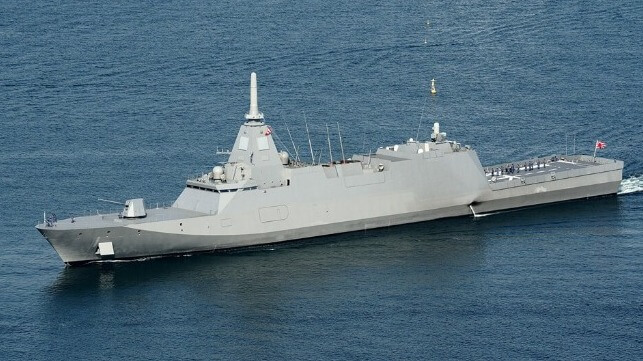
Mogami-class frigate (Hiroshi Miyaji / CC BY SA 4.0)
On Tuesday, the Australian government announced that it has awarded Mitsubishi Heavy Industries a $6.5 billion deal to build its next generation of "general purpose" frigates, with first deliveries scheduled for 2029. The timetable is rapid for a naval shipbuilding program, but MHI will be using its existing Mogami-class frigate design as the basis for the new series, reducing up-front engineering hours compared to a clean-sheet design.
The Mogami-class is a modern multi-mission warship capable of air defense and surface warfare. It was designed to perform its tasks with a smaller crew - a common goal for modern navies facing cost and manpower limitations. With a high degree of automation, the vessels are designed to operate with about 90 people, about the same as the reported deployable crew size of the Littoral Combat Ship series. Australia's version of the Mogami-class will be an enlarged variant, and will have 32 full-size VLS cells for anti-ship and anti-aircraft missiles.
The new warships will replace Australia's existing Anzac-class frigates, which were delivered in 1993-2003 and are beginning to decommission due to advancing age. Compared to the Anzacs, the Mogami-class has much greater range, much more firepower and about half as many people aboard. Its combat management system is interoperable with U.S. Navy-standard systems, a valuable advantage for the RAN, according to ASPI analyst Malcolm Davis.
The contract calls for building the first three hulls in Japan, then constructing the remaining eight in the series at the Austal yard in Western Australia. The shipyard site for the Australian-built hulls, BAE's Henderson complex, has recently downsized its workforce by 150 people due to a slowdown on other projects.
The price of the Mogami-class program has not yet been fully determined, and contract talks are under way. The outcome will be a disappointment for German defense shipbuilder ThyssenKrupp Marine Systems (now TKMS), the other bidder in the process. TKMS had proposed a much smaller design, the Mako A-200; parent company ThyssenKrupp has announced plans to spin off the division.
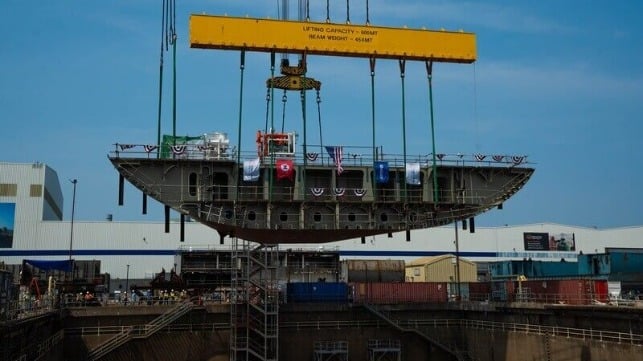
Hanwha Philly Shipyard and Matson marked a key milestone in the construction of the first of three new "Aloha Class" containerships as assembly began. The first grand block of the Matson vessel, which is being named Makua, was lowered into the construction dry dock on August 4.
During the event, the first engine room section of the vessel — weighing 420 metric tons — was lowered into the dry dock, marking the official start of hull assembly. Matson placed the order for the ships in November 2022, with steel cutting commencing last September.
"Today's keel laying marks more than the beginning of another great ship — it symbolizes the strength of our ongoing partnership with Matson and our shared commitment to American shipbuilding," remarked David Kim, Hanwha Philly Shipyard CEO.
It is also an important milestone for the yard, which was acquired at the end of 2024 by South Korea’s Hanwha Systems and Hanwha Ocean. The company looks to leverage its expertise in shipbuilding to realize new opportunities in the American market, with this being the first commercial project to start since the change in ownership.
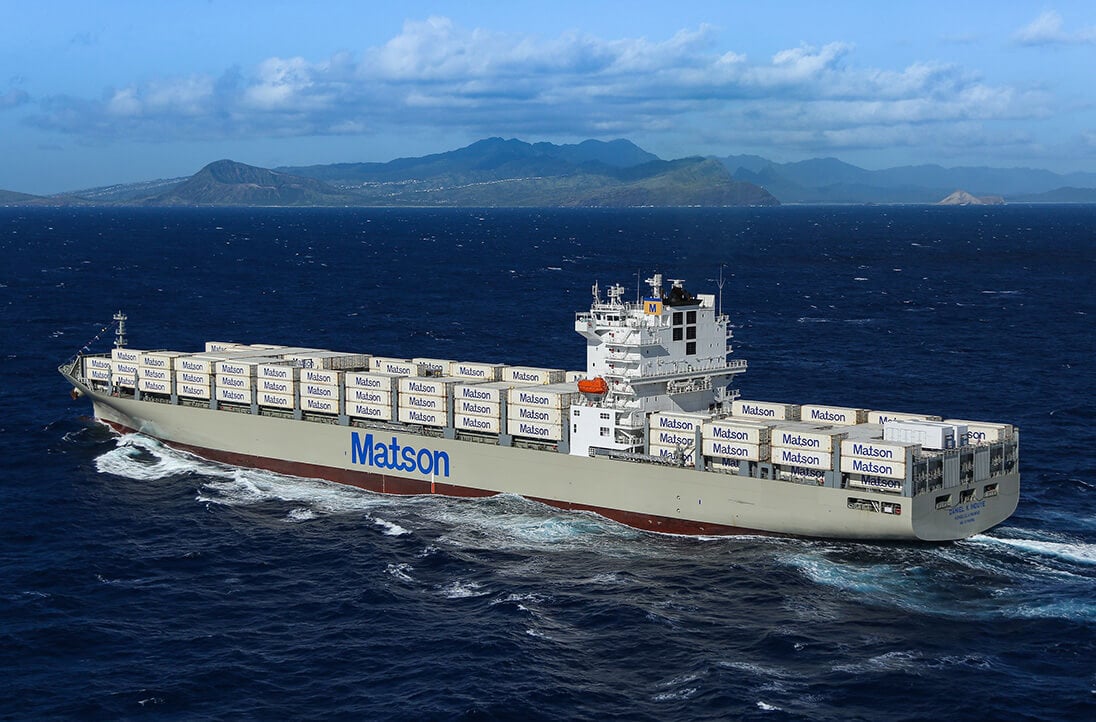
Matson has two previously built containerships of the same class from Philly Shipyard (Matson)
"These new ships are just the latest Jones Act vessels Matson has built with Philly Shipyard over the past 22 years, supporting 1,500 jobs for skilled American workers and providing additional opportunities for American mariners," said Matt Cox, Chairman and Chief Executive Officer of Matson. "Our existing Aloha Class ships are among the fastest, most efficient vessels in the Matson fleet."
The yard previously built Matson's first two Aloha Class ships, delivered in 2018 and 2019. The Daniel K. Inouye and her sister ship Kaimana Hila were the largest containerships ever built in the U.S. and in 2023 and 2024 were converted to LNG fueled operations. The yard also delivered four new Jones Act containerships for Matson between 2003 and 2006.
The new 854-foot Aloha Class ships will each have a carrying capacity of 3,600 TEU and are designed to operate at speeds exceeding 23 knots, supporting Matson's reputation for fast, reliable delivery across its Hawaii, Guam, and China-Long Beach Express (CLX) trade lanes. The new vessels also feature a more fuel-efficient hull design and dual-fuel engines that will allow operation on liquefied natural gas (LNG) from delivery.
The three new Aloha Class ships will replace three vessels currently deployed in Matson's Hawaii, Guam, and CLX services. The new ships are due to be delivered to Matson in 2027 and 2028.
Op-Ed: In Shipbuilding, Don’t Confuse Efficiency with Effectiveness
We often hear the terms used interchangeably, but doing things right (efficiency) is not the same as doing the right things (effectiveness). True success in complex industries like shipbuilding and maritime operations demands alignment between the two. Yet in practice, that alignment is rarely achieved and often confused as one driving the other.
Focusing on data, as leaders we track cost-per-unit, man-hour ratios, and schedule milestones and while these are important, these are known process metrics, not outcome indicators. It’s entirely possible to deliver a ship “on time and on budget” and still fail the mission if it can’t sail, can’t be maintained, or is delivered to an understaffed fleet.
Below are three common traps that erode effectiveness, even in the pursuit of efficiency.
It’s Not the Talent. It’s the Team.
A Chief Engineer once told me, “If I just had better trained people, I could finally fix this place.” Any Sailor worth their salt knows: it takes more than individual competence to get a complex system working. It takes a functioning team. While training is important, individuals can win a battle, but teams win wars.
Effective leadership isn’t about cherry-picking talent; it’s about cultivating team effectiveness. Building trust, purpose, and cohesion, that’s where sustained productivity is born. Once you’ve built the team, then you can drive efficiencies. Forming, storming, norming, performing… and yes, reiterating the cycle. For those that recognize the quote, “It gets easier. Every day it gets a little easier. But you gotta do it every day. That’s the hard part.”
It isn’t dollars that make cents. It is dollars that make sense.
Despite the Navy doubling its shipbuilding budget over the last 20 years, fleet size has flatlined and our known problems have exacerbated. In 2024, the GAO reported up to 3-year delays in ship deliveries and an estimated 46% (known) shortfall in effective output per dollar spent, adjusted for inflation.
Why? Because money alone doesn’t build ships.
Two structural issues remain unaddressed (as noted in the same report):
Infrastructure bottlenecks: Many shipyards physically lack the space and tooling to handle the current or future workload.
Workforce deficits: Even where facilities exist, skilled labor is in short supply. Production timelines are slipping due to workforce attrition, training gaps, and overreliance on overtime.
Ask any economist or professional estimator: appropriations without investment in people and capacity don’t solve the problem, they just inflate the baseline in cascading estimates and award.
Conglomeration Chokes Competition
The U.S. maritime sector, like many industries of our economy, has quietly consolidated into a few mega-firms. In the case of Navy shipbuilding, reduced competition has resulted in an extreme case; a non-functional duopoly:
Huntington Ingalls Industries (HII): Formed from Northrop Grumman’s shipyard spin-off, HII now commands over 50% of Navy shipbuilding contracts, with a 2023 backlog of $49B.
General Dynamics (GD): Through Electric Boat, Bath Iron Works, and NASSCO, GD builds nearly all submarines and destroyers another 45–50% share.
That leaves just 10–15% of the market to all remaining players combined (Fincantieri, Austal USA, Bollinger, and Vigor (Titan)). As Rear Admiral Matt Lake recently put it best, we face entrenched “barriers to entry, lack of a supplier ecosystem, and monopolistic practices born of decades of consolidation.”
This isn’t just about cost, it’s about capacity, agility, and resilience. A market of two cannot surge, innovate, or adapt fast enough to meet today’s threats.
So, What Now?
We have the talent. We’ve diagnosed the problems. We need action.
Policymakers must distinguish effectiveness from efficiency and stop mistaking full budgets for full readiness (of which we have neither, but that is another post). The maritime sector is not just about ships, it’s about national security, economic mobility, and industrial leadership. China now commands 51% of global shipbuilding; the U.S. needs more than spreadsheets to compete.
Never one to follow but a country that leads, we must:
Rebuild competitive industrial capacity
Channel dollars toward workforce and infrastructure
Develop metrics that measure effectiveness, not just execution
Make no mistake, none of this is easy. But if we are serious, and I believe we are, that’s how we restore strength to America’s shipbuilding backbone.
See you on the deck plate
Benjamin Miner is a licensed professional mariner with more than 25 years in industry, both at sea and on shore. He has been a resident of Hampton Roads since 2017, where he lives with his wife and son.
The opinions expressed herein are the author's and not necessarily those of The Maritime Executive.
Op-Ed: Digitalization Can Help Revitalize U.S. Shipbuilding
Shipbuilding efficiency is vital if the U.S. is to rejuvenate its maritime capabilities, says Mikko Forss, Executive Vice President of NAPA, a maritime software company.
SHIPS for America
The U.S. has set out clear ambitions for a shipbuilding and shipping renaissance. Targets were outlined in the Shipbuilding and Harbor Infrastructure for Prosperity and Security (SHIPS) for America Act introduced to congress in 2024, and while it remains to be seen if it will be passed into law, it does have bipartisan support.
As well as highlighting the need for a new National Maritime Strategy, the SHIPS for America Act establishes a Strategic Commercial Fleet Program, which aims to increase the U.S.- flagged international fleet by 250 ships in 10 years and facilitate the development of a fleet of domestically built vessels that are commercially and competitively operated.
The SHIPS for America Act?also introduces financial incentives for U.S. shipyard modernization and domestic shipbuilding by creating a tax credit of up to 40.5% for investments to construct, repower, or reconstruct eligible oceangoing vessels in the U.S., and a 25% tax credit for the modernization of qualified domestic shipyards.
In a similar vein, US President Donald Trump said in March 2025: “To boost our defense industrial base, we are also going to resurrect the American shipbuilding industry, including commercial shipbuilding and military shipbuilding. And for that purpose, I am announcing tonight that we will create a new office of shipbuilding in the White House and offer special tax incentives to bring this industry home.”
Shipbuilding efficiency
The U.S. has a proud history of world-leading shipbuilding, from the Liberty ships of World War II to today’s naval powerhouses. There’s now a renewed opportunity to channel that same industrial spirit into the digital age and be a global leader in shipbuilding innovation. To ramp up production, the focus must be on modernizing and scaling shipbuilding capabilities with a resolute focus on efficiency in concept development, design maturation and production.
The clearest path to accelerating domestic capabilities once again is by adopting proven best practices from shipbuilders around the world. Digitalization has played a pivotal role in ensuring efficiency, scalability and modernization of shipbuilding across both Europe and Asia, however, adopting digital shipbuilding tools comes with important caveats.
Digitalization, if done correctly, can break down silos and facilitate collaboration between shipowners, operators, shipyards, naval architects, engineers, academia and class societies. It can reduce inefficiencies in communication between various entities and enable more design iterations in less time. Done wrong, conversely, fragmentation and delays can result.
The nature of shipbuilding is engineer-to-order, which means considerable engineering efforts are required for every novel design. Unlike other industries where prototyping and series production can enhance the final product and reduce per-unit engineering costs, shipbuilding must meet various conflicting requirements and regulatory standards in a multidisciplinary field, necessitating accurate design on the first attempt. This is especially true in the initial stages of design, where key project management and engineering decisions will impact the overall safety, cost and efficiency of the entire project.
Providing the various stakeholders involved in the ship design process the means to access a consistent digital ecosystem, through a comprehensive set of interoperable digital tools, promotes consistency, efficiency, and optimization from concept to class approval to delivery and life-cycle management.
Digital shipyards
Digitalization provides the means for shipyards to do more with less. For smaller and mid-sized shipyards, where skilled labor can be hard to come by, efficiency isn’t just an advantage – it’s a necessity.
Insights from around the world shows that attracting new talent to the shipbuilding industry can been difficult amid rapid population declines, as seen in Japan and Korea. In Korea, the problem has been particularly acute in the past two years, since newbuilding work resumed after the lifting of COVID restrictions. But the situation has its roots in the layoffs that followed the 2014 market downturn, when the workforce was halved from approximately 203,000 workers to around 92,000.
Digital technology can help alleviate recruitment challenges on two fronts: by removing duplicated tasks to enable engineers and naval architects to maximize their productivity, and by making the sector more attractive to younger generations. Technologies such as artificial intelligence, metaverse, and AR/VR/MR have the potential to increase efficiency and attractiveness even further, as we are witnessing a paradigm shift in our society regarding how we live, work and interact – which also impacts shipbuilding.
Going forwards, the digital technology revolution unlocks a world of opportunities for shipyards to be more efficient with scarce resources, from creating new value from replacing 2D based methods with smart 3D models to digital twins to production simulation. This enables shipyards to prevent expensive errors during the downstream construction process through digital continuity by integrating computer-aided design (CAD), computer-aided engineering (CAE), and product data management (PDM) workflows using best-of-breed domain solutions.
Revitalizing U.S. shipbuilding is an opportunity to recapture the industry’s innovative and industrial spirit. Beyond strategic policymaking and investments, it will require a heavy focus on shipbuilding efficiency on a practical level. Effective digital transformation that promotes efficiency, innovation, and collaboration from shipyard to sea is key.
By combining the legacy of American industrial ingenuity with global best practices, the U.S. shipbuilding industry can benefit from proven methods, without the cost of lengthy development processes. Ultimately, by embracing innovative digital solutions and fostering collaboration across the value chain, the U.S. can not only enhance its shipbuilding capabilities but also set the industry on a course towards a sustainable and prosperous future.
Mikko Forss is Executive Vice President of NAPA, a maritime software company.
The opinions expressed herein are the author's and not necessarily those of The Maritime Executive.
 SHIPS for America

No comments:
Post a Comment