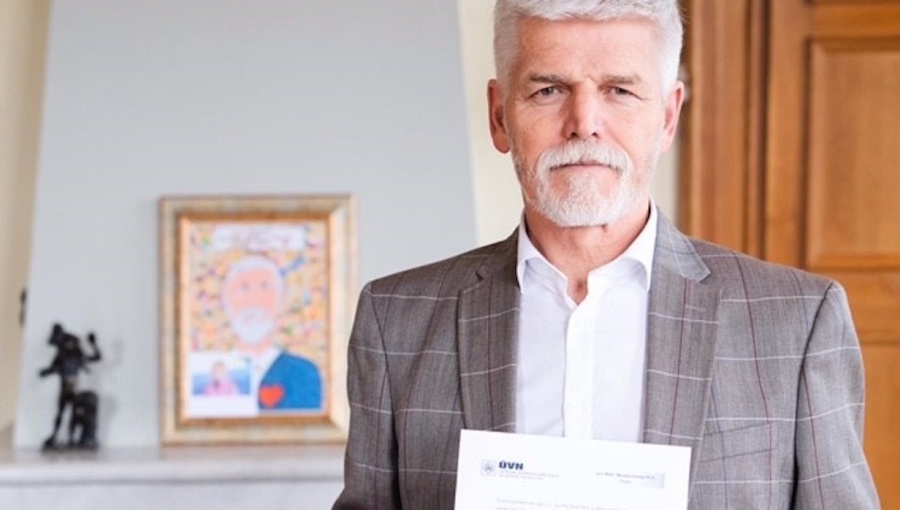
Czech President Petr Pavel has said Ukraine will not be able to liberate its Russian-occupied territories in the near future, and that it is unfair to pressure Kyiv to give them up, Interfax reported on August 5.
“Right now, Ukraine, with all Western support, is not in a position to liberate occupied territories in a short time frame without a significant cost to lives,” Pavel told the BBC in an interview published on August 5. “It will be very unfair from the West to push Ukraine to liberate all occupied territories right now, because we don’t want to exterminate the Ukrainian nation. We want them to survive as an independent sovereign country.”
Pavel said even with maximum Western support, the Armed Forces of Ukraine (AFU) will be unable to liberate the four regions annexed by Russia in 2023 and the Crimea, which Moscow has controlled since 2014. He suggested that economic hardship will prompt residents to relocate to areas under Kyiv’s control. He also repeated his pragmatic line that economic cooperation between Russia and the EU will eventually resume after a ceasefire.
Pavel said that if the price of restoring Ukraine’s independence was to accept that “part of the territory will be temporarily occupied, without recognising it legally, then so be it,” stressing, “we will never recognise these occupied territories as legally Russian.”
Pavel drew parallels with other historical examples, noting that Czechia itself remained under occupation for 22 years. He argued that EU integration and economic reconstruction could serve as a powerful incentive for residents in occupied regions, stating that they “will be much better off in Ukraine than in Russia.”
The Czech president described the occupied territories as a burden for Moscow, saying the Russian authorities “do not care about the local population.” Asked whether Russia would allow people to leave the occupied areas, he replied, “sooner or later. Who knows? Do you know what regime will be in Russia in 20, 30 years? Vladimir Putin will not be there forever.”
The World Bank estimates the value of the damage done to Ukraine in the war to date is $526bn, however, as reported by bne IntelliNews most of the destruction has been done to cities in the eastern part of the country that are under Russian occupation. In the even of a ceasefire, experts told bne IntelliNews that the cost to the Ukrainian government for repairs of cities under Kyiv’s control should be on the order of some $200bn, or about a third, whereas the Kremlin will bear the lion’s share of the costs to repair cities under its control that have been all but flattened.
Pavel said there was no available means to oust Russia from the territories without causing heavy casualties and more destruction, adding that defeating a country with Russia’s military and human resources was especially difficult when it was supported by “another huge and economically powerful country like China.”
Nevertheless, Pavel noted a significant improvement with the supply of artillery shells to Ukraine in the last two years thanks to the so-called "Czech initiative," where Prague took the lead in purchasing artillery shells from non-Nato countries.
According to the president, who is also a former Nato general, about 1.5mn large-calibre shells were delivered to Ukraine last year, and this year that would rise to 1.8mn. At its low point Ukraine was only firing one shell for each ten Russia fired. Pavel claims that ratio is now one to two. The Czech president says the AFU is now receiving an average of 80,000 rounds of ammunition every month, enough to mount a capable defence.
On whether accepting the current situation amounted to conceding to Moscow’s terms, he acknowledged the legal and moral difficulty but said, “We also live in reality. Will the Czech Republic fight with Russia endlessly? Such an approach will definitely lead to much more loss of life for all of us and cause extreme damage to our economies.”
He called for negotiations beginning with a ceasefire, followed by a peaceful settlement, and said that in such a scenario, EU countries could restore economic cooperation with Russia. “The main prerequisite for all of this is peace in Ukraine,” he said.
Pavel said he could not guarantee that the country’s military support for Ukraine would remain unchanged after upcoming parliamentary elections, noting that a change of government was likely. He added that while the new administration’s priorities were uncertain, he was focused on promoting a unified security and defence policy, as support for Ukraine was, in his view, essential to the Czech Republic’s own security.
Ukraine’s agro-powerhouse MHP completes acquisition of majority stake in Spain’s Grupo UVESA

MHP, the Ukraine-based international food and agriculture group, has completed its acquisition of more than 92% of the share capital of Grupo UVESA, one of Spain’s largest vertically integrated poultry and pork producers, the company announced on August 4.
The deal follows the expiry of the accession period to the share purchase agreement signed in March 2025 and the receipt of regulatory approvals, including antitrust clearances in Ukraine, Spain, Saudi Arabia, Serbia, Montenegro and Kosovo, as well as merger control and foreign subsidies approval from the European Commission. The transaction was settled in cash at closing at a fixed price of €225 ($246) per share, with a contingent consideration of up to €21.43 per share backed by a first-demand bank guarantee.
“With the deal now finalised, we are moving into the integration phase. Our goal is to build on UVESA’s strengths, focusing on operational excellence and sustainable development. We are also deeply committed to investing in our team by creating an environment where talent can thrive and innovation becomes part of everyday work. Backed by MHP’s international experience and expertise, we are confident in our ability to unlock new opportunities and drive long-term value,” said Dr John Rich, Executive Chairman of the MHP Board of Directors.
MHP said the integration process will focus on operational alignment, knowledge exchange and targeted investments in efficiency and product innovation. The companies will also seek to enhance export capacity and expand their presence in European and Middle Eastern markets.
Antonio Sánchez, President of UVESA, said: “The partnership with MHP marks a new and significant chapter for UVESA, which will be able to boost its growth thanks to MHP’s extensive experience in operational innovation, and continue to consolidate its excellence with the sustainable production of high-quality food and ensure total food security.”
MHP is Europe’s largest poultry producer and ranks among the top 10 globally. It operates production facilities in Ukraine and South-Eastern Europe, exporting to more than 70 countries. UVESA, with over 60 years in Spain’s agri-food industry, operates advanced poultry, pork and feed facilities and holds international quality and food safety certifications.

No comments:
Post a Comment