China Unveils Large Shipboard Laser System for "Maritime Attack"

China's military has unveiled a previously-unseen laser weapons system at its massive parade in Beijing. The new LY-1 laser is designed for shipboard applications, but for the reveal, it was fielded in a truck-mounted mobile version.
The LY-1 is the latest in a series of laser weapons that China's PLA Navy has been developing since the late 2010s. Laser weapons have advantages, particularly against high-volume threats like drone aircraft and drone boats, but they also pose significant technical challenges: they must be able to track on target long enough to heat up and burn a hole in an incoming drone or missile, and the length of time required goes up if the power delivered goes down. Atmospheric conditions like fog and smoke can interfere with a laser beam, reducing impact on the target.
The LY-1's power and range were not disclosed, but the announcer for the parade described the device as "strongly capable of precision disruption and persistent strike." In the West, shipboard laser weapons are discussed in the context of point defense against drones and missiles; by contrast, the official description advertised the LY-1 as a device capable of "maritime attack" applications, indicating an offensive capability is contemplated.
Global Times, a state media outlet, said that the LY-1 can also be used for damaging optical sensors - a low-end application for a shipboard laser. "On ships, the LY-1 has sufficient space for power units, meaning that it could have higher power, enabling it to be capable of intercepting not only attacks from unmanned equipment, but also anti-ship missiles, with very low cost for each interception," Global Times wrote.
Zhao Dashuai, a social media commentator for the People's Armed Police Propaganda Bureau, connected LY-1's development to U.S. Navy weapons systems. "Capable of shooting down missiles, this makes subsonic antiship missiles obsolete," Zhao wrote. "Looking at you LRASM, Harpoon and NSM [Lockheed's Long Range Anti-Ship Missile, Boeing's Harpoon and Kongsberg's Naval Strike Missile]."
At the parade, the PLA also displayed the Hurricane 3000, a massive microwave array for disabling drones' electronics mid-flight. Not just a jammer, the array is powerful enough to cause internal damage to electronic circuits, like putting a smartphone in a microwave oven. China North Industries Group Corporation claims that it has a range of three kilometers, and it is truck-mounted for road-mobile deployment (or mounting on an open weather deck).
The U.S. Army has a comparable system with a more compact form factor and somewhat less range, the Leonidas Generation II. The U.S. Navy tested an earlier version of this system against small craft targets, and found it effective in disabling electronically-controlled motors - a useful technology for defeating swarms of unmanned drone boats.
Leidos Develops Autonomous Commando Landing Craft for UK

Leidos, the IT and defense tech company behind the Sea Hunter drone boat, has come up with an autonomous commando team delivery craft for the Royal Navy - a new and unusual application of naval autonomous technology. The program's goal is to deliver a series of 24 "medium surface insertion craft" that can deploy special forces, lightweight vehicles and "medium combat loads."
Leidos was historically known as a government IT contractor, but its work with the Navy has allowed it to build up expertise in maritime autonomy, and that's a big part of the firm's focus going forward. "We're not world renowned as an autonomous naval vessel builder. That's because we don't build ships. But everything around it, and everything that enables those commercial shipyards to become government shipyards, we have," CEO Thomas Bell told DefenseOne last month.
Originally developed for long-distance oceanic navigation for patrol, submarine-tracking and surface warfare missions, Leidos' autonomy technology can be found aboard the ACTUV / Sea Hunter and the crewboat-based Ghost Fleet Overlord prototype series. The private company currently holds an operation and management contract for the Navy's Ghost Fleet vessels, plus a $250 million five-year contract for unmanned ISR system R&D.
Leidos announced Thursday that it has now developed an autonomous landing craft for delivering British commando teams to shore, capable of long range and high speeds (above 40 knots). An illustration released with the announcement shows that it will have a stern ramp for disembarking troops; enough space and deadweight for carrying light tactical vehicles; and a sloped tumblehome hull, typically selected for reduced radar signature.
The vessel was designed by Leidos Naval Architects (Gibbs & Cox), the Royal Navy, and the UK Commando Force. It will be fitted out for AI and vessel autonomy, making it one of the larger operationally-deployed autonomous vessels in military service (though it is still not a pure unmanned design, like the Saildrone or NOMARS).
Glamox Provides Advanced Helicopter Landing Systems for Royal Navy Warships
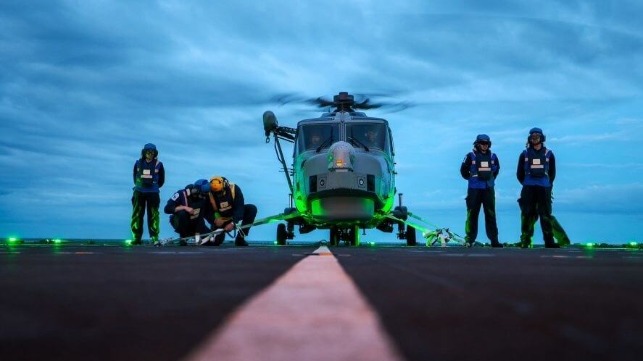
[By: Glamox]
Glamox, a world leader in lighting, has enhanced the capabilities of the Royal Navy’s Offshore Patrol Vessels, HMS Trent and HMS Spey, to land helicopters on a moving deck in challenging weather and during night conditions. HMS Trent was the first vessel to be equipped with the advanced Helicopter Visual Landing Aid System (HVLAS), which underwent rigorous testing off the English south coast in July, involving three days of day and night landings from a Wildcat helicopter. HMS Spey is the next in line to be fitted with the system. Additionally, Glamox supplied both vessels with military-grade Night Vision Imaging System navigation lights.
The HVLAS is a comprehensive flight deck-based lighting system that provides pilots with visual cues and information during approach and landing. It includes a stabilised horizon bar that shows pilots the position of the horizon, regardless of the roll and pitch of the vessel. A glide path indicator assists pilots in judging approach angles using a three-colour light beam to show the correct path or whether the helicopter is too high or too low. Additional deck-edge lighting and focused LED beam lines provide accurate positional cues for pilots operating in low-visibility conditions or using night vision goggles. See the video.
The lighting system includes controls to dim or adjust the lighting intensity for improved visibility. This means that the ship can support covert missions, operating in near-dark conditions, and the lighting can be tuned to meet the operational requirements of helicopters from other forces.
“The fact that we now have the ability to control our lights in such a different manner will mean that the ability for partner nations to land helicopters will be significantly easier,” said Lieutenant Harry Jukes, HMS Trent’s Weapon Engineer Officer, interviewed by the British Forces Broadcast Service.
Following HMS Trent’s refit in Malta and the successful validation of the system at sea, the vessel is expected to be deployed to the Caribbean, where it can support various missions from counter-narcotics to humanitarian aid. The HVLAS for HMS Spey will be fitted in Singapore during its scheduled maintenance period. The Royal Navy has a further three Batch 2 River Class Offshore Patrol Vessels that could benefit from the system.
“This is the first time that Royal Navy Ships have had an HVLAS retrofit, and we are delighted with the results. The new technology greatly extends the capabilities of the Offshore Patrol Vessels to conduct helicopter operations at night and in bad weather conditions,” said Ronny Orvik, head of Glamox’s Defence & Security business. “Furthermore, this major update underscores the value of the Defence Equipment & Support arm of the UK’s Ministry of Defence in keeping its ships at the forefront of advanced technology.”
The products and services herein described in this press release are not endorsed by The Maritime Executive.

No comments:
Post a Comment