Report: Denmark and Sweden Are Close to Orders for UK Frigates
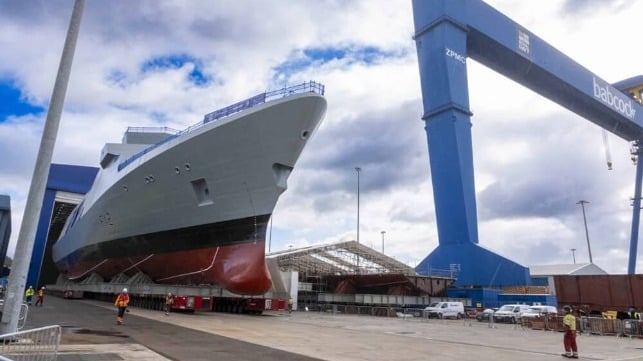
UK naval shipbuilding appears to be on the verge of a major surge in new orders. According to a report in the Financial Times, hot on the heels of Norway’s decision last week to acquire British Type 26 frigates, Denmark and Sweden are in “advanced talks” to acquire British Type 31 frigates. Negotiations with Denmark are in the closing stages, according to the Financial Times, while Sweden is still considering a French option as well.
Contract negotiations, the BBC reports, have been underway for more than a year, and the decisions are expected within the next six months. BBC estimates the value of the Danish contract at more than £1billion.
Whereas the Type 26 is a specialist anti-submarine warfare platform built by BAE, the Type 31 “Arrowhead 140” is built by Babcock at Rosyth in Scotland, and has a multi-functional role. The Royal Navy has ordered five Type 31s. The design has also been sold to Indonesia and Poland for domestic manufacture.
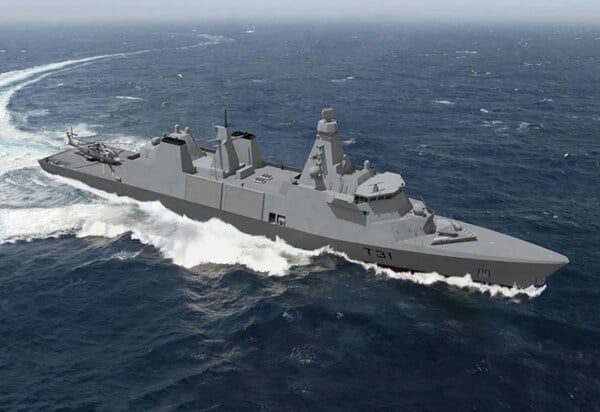
HMS Venturer (F12) is expected for Royal Navy service in 2027 (Royal Navy)
The first of class, HMS Venturer (F12), was semi-launched in June and has now been fitted with its 24-ton mast. It seems likely to come into full service with the Royal Navy in 2027. HMS Active, the second in class, is still in the assembly shed in Rosyth, and is following about six months behind. The last of what will be known as the Inspiration Class, HMS Campbelltown, is scheduled to come into service in May 2030. Inevitably, there may be delays if production slots are reallocated to new purchasers, to the detriment of the Royal Navy. Nevertheless, the new orders and accelerated production will have the effect of increasing the overall number of vessels available to NATO.
The Inspiration Class will be fitted with a vertical launch system able to launch Standard Missile SM-2, SM-3, and SM-6s, Tomahawk cruise missiles, and SeaSparrow short-range anti-missiles. The frigates will have a hangar for a Merlin or Wildcat helicopter, a launch capability for three 8m Pacific 24 rigid inflatable boats, and a flexi-use space plumbed into the ship’s combat system for six TEU containers, with configuration dependent on mission.
The Norwegian order, the previous purchase of the Type 31 design by Poland, and these potential Danish and Swedish orders are a reflection of the emphasis that the United Kingdom has placed on working with Northern European countries within the NATO context. In May 2022, the government of Boris Johnson took the lead in offering the security support of a nuclear nation to the governments of Finland and Sweden, while both contemplated joining NATO. The Joint Expeditionary Force was formed in London in 2014 to better integrate high-readiness forces of member nations, and is currently made up of Denmark, Estonia, Finland, Iceland, Latvia, Lithuania, the Netherlands, Norway, Sweden, and the UK.
Ernst Russ Orders First New Ships in Years in Partnership with Eimskip
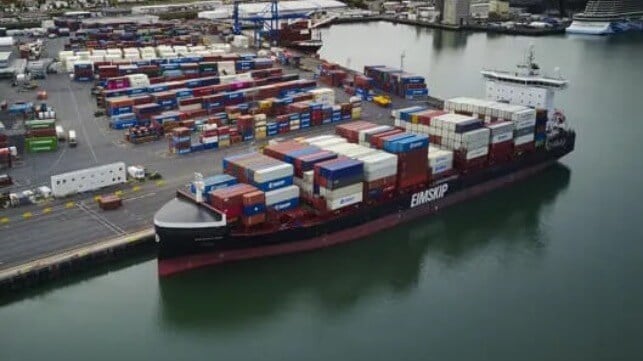
Germany’s Ernst Russ is moving forward with its first newbuild orders in years, an innovative pair of feeder containerships specially designed for Iceland’s Eimskip and the challenges of the North Atlantic. The companies report that the design incorporates future technology while also being specifically designed with customer service needs in mind.
The project builds on a partnership between the companies and provides a financial structure to support the newbuild effort. The joint-venture company ElbFeeder, majority owned by Ernst Russ, has signed the contract to build the two vessels with China Merchants Jin Ling Shipyard (Nanjing), while the board of Eimskip approved a 10-year time-charter.
“This investment will be a milestone for Ernst Russ, marking our first newbuild investment in decades,” said Joseph Schuchmann, Co-CEO and Chief Commercial Officer of Ernst Russ. “We are delighted to be able to implement it together with our long-standing partner Eimskip, who will also function as the initial long-term charterer and thus contributes significantly to the financial viability of the project.”
Due for delivery in the second half of 2028, the vessels will be 185 meters (607 feet) in length with a capacity of 2,280 TEU. They will be the largest vessels in Eimskip’s operation and will be used on the company’s Blue Line sailing between Reykjavik and Rotterdam as well as Teesport in the UK.
“We see great opportunities with the delivery of these new vessels, especially considering the ambitious plans to increase exports of fresh seafood and salmon,” said Vilhelm Mar Thorsteinsson, CEO of Eimskip. He notes that the time-charter in combination with the newbuilding contract enables Eimskip to future-proof its Iceland-Europe trade, while ElbFeer secures long-term revenues.
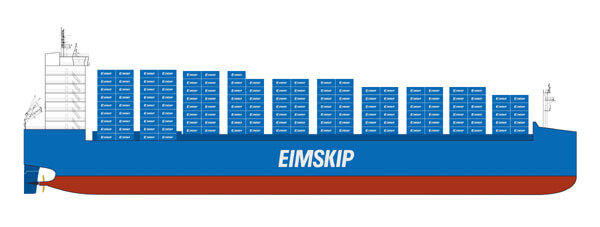
The new ships use advanced designs suited to the North Atlantic (Eimskip)
The vessels were designed for the demanding conditions of North Atlantic routes in collaboration with the Shanghai Merchant Ship Design and Research Institute (SDARI). Their optimized hull structure has been engineered to enhance hydrodynamic performance, enabling higher service speeds and maneuverability while maintaining fuel efficiency and operational reliability, ideal for the conditions in the North Atlantic.
In addition to the design supporting service speed in an efficient way, they report that the focus is also on optimal energy utilization, including hull design, silicone coating, shore power connection, and other equipment selection. The vessels will also feature a dual-fuel propulsion system, methanol- and LNG-ready.
ElbFeeder currently operates a fleet of seven container vessels. The newbuilds will increase the fleet to nine, and options for two additional vessels were negotiated. Eimskip operates a total fleet of 14 vessels, while Ernst Russ manages a fleet of 26 vessels with a focus on smaller containerships, as well as bulkers and multipurpose vessels.
Construction Starts on First Short-Sea, Ammonia-Fueled Containership
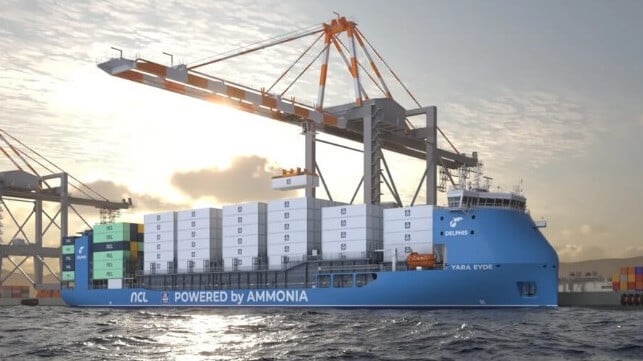
Nearly two years after the project was unveiled, construction started today in China for what is likely to become the world’s first ammonia-fueled containership. The project, which is being led by CMB.TECH, as part of its efforts to accelerate the transition in the shipping industry, will launch a vessel that they report will transform short-sea shipping and demonstrate the potential of ammonia as a low-emission fuel.
The vessel, which is named Yara Eyde, is being built in China the Qingdao Yangfang Shipbuilding and will be a 1,400 TEU ice-class containership optimized for operations between Norway and Germany. The vessel will be owned by Delphis, the container division of CMB.TECH and operated by NCL Oslofjord, a joint venture between North Sea Container Line and Yara Clean Ammonia. The Norwegian Government, through its Enova Investment Fund, provided approximately $3.6 million in grants to the project.
Today, September 5, marked the first day of steel cutting for the vessel. The companies previously said delivery is scheduled for mid-2026.
“This is more than the start of a ship – it is the start of a new chapter in maritime decarbonization,” said Hans Olav Raen, CEO of Yara Clean Ammonia. “Yara Eyde embodies our ambition to make low-emission ammonia a reality for shipping and to inspire the industry toward solutions that reduce emissions.”
So far, ammonia-fueled shipping has mostly been a few pilot projects as the leading engine manufacturers work to perfect their first offerings and complete certification. The industry is also awaiting the finalization of regulations and is still working to develop the fueling infrastructure and safety protocols for ammonia, which is highly toxic.
The potential for ammonia as one of the fuels to address decarbonization, however, has created strong anticipation in the shipping industry. While there are only three vessels currently in service with ammonia as their primary fuel, an offshore supply vessel and two tugboats, there are now 39 ammonia-fueled vessels on order for delivery over the next four years, according to data from DNV.
Yara Eyde is set to operate on a route between Oslo, Porsgrunn, Bremerhaven, and Rotterdam. NCL will manage the commercial operations. Yara Clean Ammonia will deliver ammonia fuel to the vessel, while Yara International has entered into a contract for shipping containers between Yara’s fertilizer plant in Porsgrunn, Norway, and Hamburg and Bremerhaven in Germany.
In addition to being a demonstration of the potential for ammonia-fueled operations, the goal is to use the ship to drive investment and build industry support for the infrastructure and adoption of ammonia technology.
“Yara, NCL, and CMB.TECH are walking the talk to decarbonise shipping by combining our know-how on clean ammonia, operational excellence in the North Sea, and state-of-the-art low-carbon ships,” said Alexander Saverys, CEO of CMB.TECH in 2023, announcing the project. “We want to prove to the world that we can decarbonise today to navigate tomorrow.”
Med Marine Launches Third RAmparts 2800 Tug to Reinforce OMMP’s Fleet
[By: Med Marine]
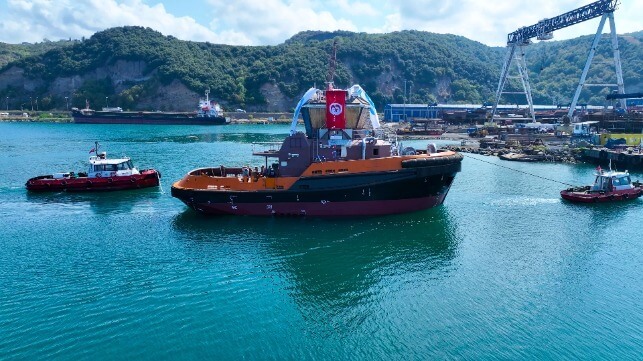
Turkey’s leading shipbuilder and tug operator, MED MARINE, proudly announces the successful launch of the MED-A2800SD tug on August 23, marking the third vessel in the six-unit RAmparts 2800 series ASD (Azimuth Stern Drive) fleet being built for Tunisia’s renowned port authority, OMMP. The launch, held at MED MARINE’s EREGLI SHIPYARD, underscores the steady progress of this fleet project and further strengthens the partnership established under the prestigious contract signed between OMMP and MED MARINE.
Measuring 28.20 meters in length and delivering a forward bollard pull of 60 tonnes, the MED-A2800SD tug has been engineered by the internationally renowned naval architecture firm Robert Allan Ltd. to meet the rigorous demands of modern port operations. Powered by twin medium-speed diesel engines and fully compliant with Class FIFI-E standards, the tug ensures both operational excellence and safety.
Thanks to its optimized hull design, the MED-A2800SD tug delivers exceptional manoeuvrability, stability, and fuel efficiency, even under the most demanding harbour conditions. Capable of performing a wide range of operations—including towing, mooring, escorting, firefighting, pollution control, and coastal support—this vessel exemplifies MED MARINE’s commitment to providing reliable and versatile assets for international operators.
This milestone represents a key advancement in the six-vessel fleet program, reaffirming MED MARINE’s ability to deliver world-class tugboats on schedule while maintaining the highest standards of quality. The launch of the RAmparts 2800 series tug highlights the ongoing progress of the project and OMMP’s strategic vision to strengthen its towing capabilities with future-ready assets.
Technical specifications of the tugboat:
Length: 28.20 m
Beam: 11.50 m
Depth: 5.49 m
Draft: 5.40 m
Gross Tonnage: 428
Bollard Pull: 60 tons
Speed: 12 knots @ 80% MCR
Crew: 8
The products and services herein described in this press release are not endorsed by The Maritime Executive.

No comments:
Post a Comment