Gen Z’s political rebellion is just getting started
Right-Wing Watch
Left Foot Forward.
What’s emerging isn’t a single youth movement but a fractured political landscape. Some are turning left, others veering hard right, but most are turning away from ‘traditional’ parties altogether.

“Because youth’s a mask and it don’t last, live it long and live it fast,” sang Rod Stewart in The Killing of Georgie in 1976, a line that once captured the hopeful, rebellious energy of youth movements in the 1960s and ’70s. Back then, youthful defiance was powered by optimism, economic growth, and newfound freedoms. Today, that same defiance is back, but, this time, instead of prosperity fuelling rebellion, it’s stagnation.
Generation Z is angry, priced out of housing, trapped in insecure work, crippled by the extortionate cost of education, and disillusioned with a political establishment that feels indifferent to their future. And unlike past generations, they have tools – social media platforms that offer a louder voice than ever before, and they’re using them to reject the status quo.
But what’s emerging isn’t a single youth movement but a fractured political landscape. Some are turning left, others veering hard right, but most are turning away from ‘traditional’ parties altogether.
A generation divided
Financial Times’ data journalist John Burn-Murdoch says Gen Z might be more accurately split into two: one liberal and predominantly female, the other increasingly conservative and predominantly male. The divide isn’t just ideological, it’s gendered.
In the UK’s 2024 general election, fewer 18 to 24-year-olds voted for Labour than middle-aged voters. While only 9 percent voted Reform UK, that number is expected to rise. A recent John Smith Centre poll found 26 percent of young men aged 16–29 felt ‘warm’ towards Reform, compared with just 15 percent of young women.
But this isn’t just a rebellion against the left. It’s a rejection of liberal democracy itself, a generation unsure whether the system can still deliver. While women lean into Green Party-style progressivism, young men are drifting toward nationalist, anti-immigration populism. One European study found 21 percent of young men backed far-right parties in 2024, compared to 14 percent of young women.
As the FT’s Jemima Kelly argues, the old adage, “If you’re not a liberal when you’re young, you have no heart…,” no longer applies. Given that there is abundant evidence that this generation has plenty of heart, albeit not always expressed politically, what’s more likely is that they’ve lost faith in institutions and traditional parties, and are “doubtful that liberal democracy can do anything worthwhile.”
Populism with personality
Enter the populist with personality – apparently.
“Donald Trump and Nigel Farage are funny. They’ve got more personality than Keir Starmer,” my 16-year-old son told me recently. Granted, he likes to wind me up, but what’s worrying is that he’s not alone in his thinking, far from it.
Many young men in particular see figures like Farage as refreshingly blunt, even entertaining. And for a generation raised on TikTok, personality matters.
TikTok, with its short, emotionally charged clips, rewards content that is provocative, humorous, and shareable, all traits’ populists excel at. Farage’s personal account boasts over 1.2 million followers, dwarfing his rivals. Reform UK itself has more TikTok followers than all three main parties combined. Their brand of informal, meme-ready messaging hits the right note for younger audiences, especially young men, who make up the majority of TikTok users, 44.3 percent female vs 55.7 percent male, according to global data.
The blame game
So why are young men especially attracted to the far right?
Beyond the perceived ‘charisma’ of its leader and its mastery of TikTok, Reform and much of the far-right’s appeal among young men may lie in its ability to translate complex societal challenges into simple, blame-oriented narratives.
“Young men in Western Europe are feeling increasingly disillusioned,” says Professor Anand Menon, director of think-tank UK in a Changing Europe. “There are all sorts of sociological reasons, such as not understanding their role in society or being the primary breadwinner anymore.”
According to Menon, far-right parties across Europe are capitalising on this discontent, pushing a message that “how elites have let you down,” and telling you “’it’s no fault of your own. It’s all down to immigrants’. Some sections of younger males find that a very appealing and persuasive message.”
At a time when traditional roles and paths to success are dissolving, especially for young men, such messaging resonates. It provides identity, purpose, and, crucially, someone to blame.
Meanwhile, many young women, who are more likely to attend university and be exposed to socially liberal environments, are moving left.
In the 2024 general election, the Green Party performed especially well with young women, winning 23 percent of their vote, nearly double it received from young men.
These national trends echo the dynamics I see in my son’s friendship group. The boys lean right, sceptical on issues like immigration, climate change, and gender identity. The girls, on the other hand, tend to be more sympathetic to progressive values and causes.
This week, the Green Party of England and Wales announced it has surpassed 100,000 members for the first time, a nearly 50 percent surge since Zack Polanski took over as leader just last month. Polanski’s pitch of bold communication and “eco-populism” appears to be resonating, particularly with younger voters drawn to a more dynamic political message.
The Conservative Party doesn’t publish official membership numbers but estimates put them at around 120,000. If the Greens continue their momentum, they may soon overtake the Tories in membership.
Of course, membership doesn’t always translate into electoral victory. Under Jeremy Corbyn, Labour reached over 500,000 members at its peak and still lost two general elections. And while one recent poll put the Greens at 15 percent, most have them hovering around 11 or 12 percent, suggesting limited movement in the polls since Polanski took charge.
Still, the shift is meaningful. Researchers have identified a clear trend – young people are fed up with a two-party system that no longer delivers for them and the political landscape among the under-25s is polarising.
As Dr Ceri Fowler, a fellow in comparative politics at Oxford University, put it:
“Young people are still more progressive in their attitudes compared to older generations, but when you break that down there is a divide where young men are more right wing and young women more left wing. And it isn’t a divide between the two main parties, it’s at the more extreme ends, so either for support by men for Reform, or women for the Greens.”

Blame the Boomers?
It could be argued that at the heart of this shift is resentment towards older generations.
Many young people see Baby Boomers as having had it all: secure jobs, affordable homes, generous pensions. And they believe Boomers have consistently voted in ways that make life harder for younger generations.
Take Brexit, voted for largely by older generations.
It’s “pretty evident” that “places with lots of older voters voted for Brexit while places with more younger voters voted Remain,” said Rob Ford, professor of political science at the University of Manchester.
David Cameron’s decision to hold the referendum in 2016, followed by Boris Johnson’s hardline approach and abandonment of the single market, plunged the UK into years of political and economic uncertainty.
And it’s young people, in particular, who have felt the decline. The freedom to live, work and travel across the EU was snatched from them, perhaps the greatest betrayal of all.
Even Keir Starmer has finally admitted that Brexit was a mistake. But for many young voters, the damage is done. The establishment, left and right, is seen as complicit.
No wonder they’re looking elsewhere.

The question now is whether mainstream parties can catch up. Can they speak to young people’s anger without pandering to populism? Can they offer solutions that feel real, not recycled? And can they bridge the growing gender divide in youth politics?
Worryingly, the seemingly youth-savvy Reform seems to be ‘bridging the gender divide’ case. The party know it has to do more to attract female voters, as well as male, and there are already signs the party’s gender gap is starting to narrow.
Luke Tryl, from pollsters More in Common, says: “While Reform still has a gender gap and its voters remain more male overall, this gender gap has narrowed since the general election, as the party’s vote share has expanded – with Gen X women in particular swinging toward Reform.”
In August, Reform launched a Women for Reform campaign, fronted by its only female MP Sarah Pochin and Dame Andrea Jenkyns, the mayor of Greater Lincolnshire, claiming they care about the safety and security of women and girls.

But the irony is glaring. As Hope Not Hope noted in response:
“From the top down, Reform idolises misogynists… Reform UK are a misogynist magnet, packed with candidates posting pro-Andrew Tate and Jordan Peterson content alongside anti-feminist and pro-domestic violence jokes and memes.”
Like generations before them, Gen Z is rebelling, this time, against the political establishment that feels increasingly disconnected from their lives. But, unlike their predecessors, who turned to the Daily Mail, Telegraph or Guardian to shape their worldview, whether they tilt towards progressive change or reactionary backlash, may hinge on who shouts loudest on TikTok.
Because if, as Rod Stewart sang, youth is a mask that doesn’t last, this generation is going to live it long and live it fast, then today’s leaders have a choice – catch up, or step aside.

Peru’s Gen Z helps bring down the president
First published at NACLA.
Dozens of protesters jump for joy outside the Peru’s Congress of the Republic. It’s October 10 and President Dina Boluarte has just been removed from office by the same lawmakers who shielded her for almost three years.
The day before, Peru’s long-running social and political crises reached a boiling point. Presidential candidate Phillip Butters was attacked with stones during a provocative visit to a southern town whose protesters he had long denounced as “terrorists.” In Lima, a brutal shooting at a concert by a well-renowned cumbia band left five musicians injured, heightening the sense that crime was spiraling out of control. Hours after the shooting, in the early hours of Friday morning, Boluarte was impeached by Congress after a quick hearing she chose not to attend.
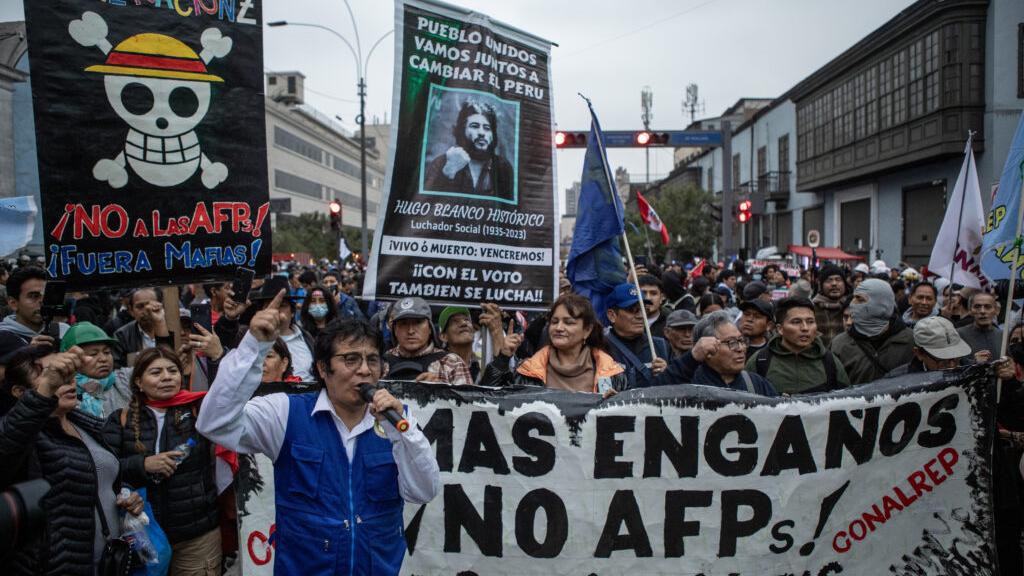
But public anger at the government has much deeper roots. The current wave of outrage and discontent began on September 20, when dozens of young people took to the streets of downtown Lima to protest a pension reform law that would require them to contribute to the national pension fund from the age of 18. Police responded to the demonstration with force.
“There was too much repression,” says Jessica, a 19-year-old college student who only provided her first name out of security concerns. “They fired directly at the protesters’ bodies. One boy was hit in the chest by a bullet. If he hadn’t put his arm up, he would have died,” she says.
This violence has continued in the protests that followed. At a demonstration in Lima on September 21, the police detained Samuel Rodríguez, a young man who had tried to help an officer but ended up being arrested. Later that week, 18 protesters were injured at another demonstration in Lima, including an elderly man whose assault quickly went viral after being caught on camera.
As with recent protests in Nepal, Morocco, and Madagascar, young people have been leading the charge in denouncing Peru’s crisis — and demanding change. Like their global counterparts, Peru’s youth have rallied under a flag with a smiling skull and straw hat from the anime show One Piece, whose main character, the young pirate Monkey D. Luffy, embarks with his crew on a journey to overthrow corrupt powers and find freedom. It’s a fitting symbol for the the philosophy of Generation Z: to change everything.
A violent state in ruins
Social tensions in Peru, the product of a deep-seated political crisis, have been on the rise since 2022, when former President Pedro Castillo staged a failed self-coup in an attempt to overcome congressional obstruction. Boluarte, his vice president at the time, took office as president and soon colluded with center and right-wing forces to remain in power.
Boluarte’s presidency, marred by corruption scandals, failed to address even the most basic concerns of Peruvians. “There is a growing sense of unrest,” says Omar Coronel, a political scientist at the Pontifical Catholic University of Peru. “Not only among young people, but throughout the country. Since 2023, polls have been very consistent, giving the president and Congress an approval rating of less than 10 percent.”
Violence against protesters has become commonplace across the country, fueling the current uprising. “My first protest was on September 20. I was in the front row,” says Jessica. “What I saw made me feel sick. The police show no mercy. They shoot you because they shoot you. If there’s a child there, they don’t care. If there’s an elderly person there, they don’t care.”
While violence against demonstrators has long been a feature of the Peruvian state, Boluarte’s government has been exceptionally brutal. The crackdown started immediately after the fall of Castillo, when the south of the country erupted in protest in late 2022 and early 2023 in Castillo’s defense. Forty-nine people were killed by police during demonstrations in the heavily-Indigenous towns of Apurímac, Ayacucho, and Puno — including bystanders and seven teenagers. The January 9 massacre in Puno became infamous for its brutality: at least 18 people were shot dead in a single day, in what the Inter-American Court of Human Rights described as a “massacre.”
The government denied all accusations, labeling the protesters “terrorists.” At a press conference with international media, Boluarte told reporters, “Puno is not Peru,” an offensive statement that is emblematic of Peru’s deep geographical divides.
In Lima, meanwhile, people remained on the sidelines. “There was no support from us. We were still in a bubble,” says 22-year-old Lima resident Yacok Solano. “That’s why there’s resentment towards the people of Lima. When you live in Lima, you think it’s the center of the world.”
Recent demonstrations, however, have spread nationwide — a reflection of the country’s deepening crisis. In just nine years, Peru has had seven presidents, a cycle that has has bred institutional instability, impunity, and corruption. Generation Z and its allies are now calling for nothing less than a complete restructuring of the country.
The roots of popular discontent
On September 5, the government approved a pension reform that required all those over 18 to contribute to the system starting in 2027. The law also made contributions mandatory for self-employed workers and set the retirement age at 65. The austerity measure provoked immediate backlash.
Seventy percent of Peru’s workforce is informal, a figure that is even higher among youth. The 2021 National Youth Report revealed that 83 percent of jobs held by young people are informal. The divide between Lima and the Andean regions is stark: while informality in urban areas reaches 79 percent, in rural areas it climbs to 96 percent. Meanwhile, the average income for young people is around $320 per month, just above the minimum wage.
The economic precarity of the vast majority of Peru’s population stands in stark contrast to the conduct of its leaders. In July, Boluarte doubled her salary to about $10,000 per month. The country’s politicians “ don’t think about the people,” says Jessica. “They don’t think about young people. They only think about lining their pockets, plundering the country, and doing whatever they want with it.”
Peru’s powerful transport workers have also joined the protests. Long subject to violence at the hands of criminal groups — this year alone, more than 180 drivers have been murdered for refusing to pay extortion fees — their pleas for protection have fallen on deaf ears. Boluarte responded to their concerns by advising drivers to avoid being targeted by “not answering phone calls” from unknown numbers. With nowhere else to turn, they have linked up with the Gen Z protesters to demand an overhaul of the status quo.
Jessica echoes the feeling of a sprawling crisis linked to insecurity. “It wasn’t just the AFP law that affected me, but what I saw in the news. Crime, laws that favor criminals, extortion. That’s what sparked Generation Z to take to the streets in protest,” she says.
“Discontent is exploding on all sides,” says Noelia Chávez, a sociologist at the Pontifical Catholic University. “But in Peru, there are no parties, leaders, or political projects that serve as a reference point. Young people are protesting because there is a direct cause that affects them. And added to this discourse against injustice is that of a corrupt government whose repression they experience firsthand.”
This discontent has already claimed its first political casualty: Boluarte, who was removed and replaced by Congress President José Jerí on October 10. Yet according to activists, her removal is only the beginning. Gen Z says the marches will continue.
From TikTok to the streets
Instagram and TikTok are the main platforms Gen Z uses to stay informed. With memes and short videos that quickly go viral, they have become skilled at generating simple messages that can generate massive popular outrage on the streets. They coordinate demonstrations through Telegram and Facebook groups.
“These are young people who have resources, time, and more opportunities to go out and march than other generations,” says Chávez. “Although they are a heterogeneous group, they share the same identity linked to the political and social situation and, above all, the use of technology.”
The hashtags #GenZ, #corupción, and #ProtestasPeru generate content that incites anger, outrage, and protest. When Boluarte fell, young people drew on this playbook to quickly mobilize crowds to surround the Brazilian and Ecuadorian embassies to prevent her possible escape. According to Jessica, a poster with Boluarte’s photo was shared on Whatsapp with the message: “No to the rat’s escape.”
“We are organizing ourselves better, creating alliances, and gradually bringing more people on board. With the little experience we have, we are achieving a lot,” she says.
The organizing power of Peru’s young protesters has long been discounted. Boluarte’s Minister of Transport and Communications, César Sandoval, mockingly called them “Degeneration Z.” Yet for now, it seems the protesters have had the last laugh.
A global phenomenon
Peru’s youth movement has drawn inspiration from uprisings abroad. They learned how protests can yield results after Nepalese youth burned down Parliament and forced the resignation of Prime Minister Khadga Prasad Oli. His wife, Rajyalaxmi Chitrakar, died from her injuries after their home was set on fire.
Nepalese anger and discontent towards the country’s “nepo babies” — the children of politicians who flaunted their ostentatious lifestyles online amid growing inequality — translated easily to Peruvians’ frustration with their own political elite.
Generational identity is crucial to framing the protests in the Global South as a struggle by young people for their future. In Peru, it is mortgaged by the certainty that the pension system will fail; in Nepal, by unemployment and external economic dependence.
Still, youth-led protests face limits. “The mobilizations of Generation Z function more as a brake on authoritarianism than as a social movement that transforms reality,” says political scientist Coronel. “Young people have a legitimate claim to restore democracy and the balance of powers, but we must bear in mind that this generation is huge and varied.”
But today’s young people draw on a wealth of shared symbols to creatively denounce the concentration of power in the hands of the few. In this scenario, the One Piece flag has become a powerful emblem. The anime portrays political elites as a parasitic group that benefits from the citizenry and, for that reason, deserves to be overthrown.
The road ahead
The young Peruvians leading the protests say their fight is far from over. They continue to draw on symbols from the anime show that inspired them to take action. In a recent video announcing a national march for October 15, a dozen young people appear with their faces pixelated, standing before a One Piece flag that hangs on the living room wall.
Though the struggle ahead will be difficult, the country’s new president, José Jerí, is a clear target. A 38-year-old lawyer affiliated with the Somos Perú party, his background includes allegations of rape, illicit enrichment, and contempt of court. The new president also shielded Boluarte from being investigated for the massacres committed under her watch.
Generation Z has achieved a large victory against corruption and impunity with Boluarte’s removal. But, like the pirate Monkey D. Luffy and his crew, there are still many seas to sail.
Lucero Chávez is a journalist specializing in gender, citizenship, and migration. She was born in Lima, Peru, and lives in Santiago, Chile. Her articles have been published on Epicentro TV, Anfibia Chile, and La Indómita. She is the founder of La Válvula, the V side of news.

No comments:
Post a Comment