Tanzania: Hundreds defy lockdown in second day of protests

Streets in Tanzaniasaw another round of demonstrations on Thursday, a day after a general election marred by violence. Protesters gathered in at least three neighborhoods in the commercial hub of Dar es Salaam, where police fired tear gas and gunshots to disperse the crowds, witnesses told Reuters.
The unrest in Dar es Salaam and other cities began on Wednesday over the exclusion of opposition candidates. While results are still to come, President Samia Suluhu Hassan is expected to cement her position for a second term in office.
Her party, Chama Cha Mapinduzi (CCM), has governed since Tanzania's independence in 1961.
The AFP news agency cited a diplomatic source saying that protests continued into the night despite a curfew imposed on Wednesday.
What the government has said
"All public servants in the country should work from home except those whose job duties require them to be present at their workplaces as directed by their employers," said a post on the Instagram account of government spokesperson Gerson Msigwa late on Wednesday.
Tanzania's state broadcaster also announced that students should remain at home on Thursday.
The French AFP news agency also reported that the internet blackout was still in place on Thursday, a day after the election, citing a diplomatic source.
The same source said that military and police checkpoints were in place in and around Dar es Salaam.
Covering Wednesday's polls has proven difficult as many journalists, both local and international, were denied accreditation.
Those who attempted to enter polling stations were not allowed to take photos.
In Ubungo, Dar es Salaam, witnesses on Wednesday told DW there had been opposition protests and that some polling stations had been vandalized.
Presidential poll without main opposition parties
Tanzania's largest opposition party, Chadema, boycotted the presidential election after its leader Tundu Lissu was imprisoned and faces treason charges after calling for electoral reforms.
Luhaga Mpina, the presidential candidate for the second-largest opposing party, the Alliance for Change and Transparency (ACT-Wazalendo), was disqualified by the Independent National Electoral Commission.
Sixteen opposition candidates representing smaller parties were on the ballot but were not expected to be a challenge for President Samia Suluhu Hassan, who is widely expected to win a second term.
Edited by: Darko Janjevic
Curfew declared in Tanzania's main city after election-day protests
Authorities in Tanzania have imposed a curfew in Dar es Salaam, the country's biggest city, following violent unrest between the police and protesters that erupted during Wednesday’s general election which is expected to offer President Samia Suluhu Hassan a second term.
Issued on: 30/10/2025 - RFI
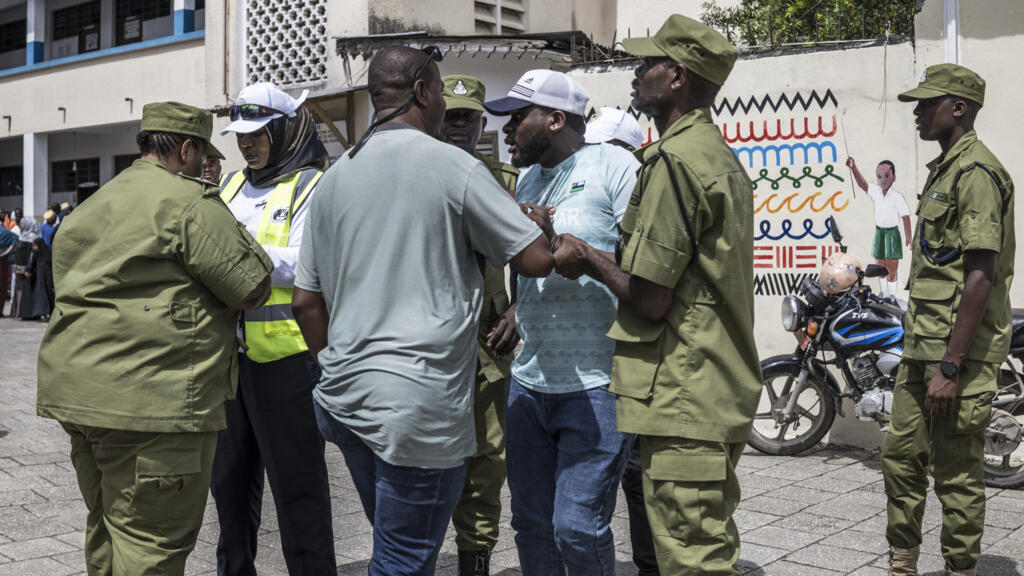
Police in Tanzania's main city of Dar es Salaam fired gunshots and teargas on Thursday to disperse dozens of protesters who returned to the streets a day after elections were marred by violent demonstrations, Reuters reported.
Protests broke out in Dar es Salaam and several other cities during the presidential and parliamentary vote on Wednesday with demonstrators setting fire to vehicles and a local government office.
They are angered over the exclusion of Hassan's two biggest challengers from the presidential race, as well as what they say is increasing repression of government critics.
Police ordered an overnight curfew in Dar es Salaam, a city of more than seven million people, and internet access remains disrupted across the country. Global internet monitor NetBlocks described the interruption a "nationwide digital blackout".
The US embassy said that some major roads, including the main one leading to Dar es Salaam's international airport, were closed.
On the Zello app, some protesters discussed plans for further demonstrations, including marches on government buildings.
The government has remained silent and the heavily controlled local media made no mention of the unrest, nor provide any update on the election.
There are reports that upwards of 30 people may been killed in Wednesday's violence, a diplomatic source told AFP, but this could not be verified.
Tanzania blackout after election chaos, deaths feared
Civil servants and students told to stay home
In a post on his Instagram account, government spokesperson Gerson Msigwa said all civil servants should work from home on Thursday except for those whose duties require them to be present at their workplaces.
The state television channel also announced that students should study from home on Thursday.
Tanzania's main opposition party Chadema had called for protests during the election, which it said amounted to a "coronation" of Hassan.
Chadema was disqualified in April from the election, which also included votes for members of parliament and officials for the semi-autonomous Zanzibar archipelago, after it refused to sign a code of conduct. Its leader Tundu Lissu was charged with treason.
The commission also disqualified Luhaga Mpina – the candidate for the ACT-Wazalendo opposition party, leaving only minor parties to take on Hassan.
Reports say voter turnout in Dar es Salaam was low, with many people reluctant to show up amid safety concerns.
The electoral body is expected to announce results over the weekend.
Tanzanian opposition leader to represent himself in court over treason charges
Increasing censorship
Hassan is expected to win the election. Her ruling party, Chama Cha Mapinduzi – Swahili for “Party of the Revolution” (CCM), has dominated Tanzania politics and won all the elections since the country gained independence from Britain in 1961.
But the unrest presents a major test for Hassan.
She was initially praised after taking office in 2021 for easing repression of political opponents and censorship that had increased under her predecessor John Magufuli.
In recent years, however, rights campaigners and opposition candidates have accused the government of unexplained abductions of its critics.
Hassan said last year she had ordered an investigation into reports of abductions, but no official findings have been made public.
(with newswires)

Protests erupted across Tanzania on October 29, voting day in a general election widely seen as non-competitive, with President Samia Suluhu Hassan facing no major challenger after opposition figures were barred, detained, or withdrew in protest over electoral conditions.
Demonstrators clashed with security forces in Dar es Salaam, setting a bus and a gas station ablaze, prompting authorities to impose a curfew from 6 p.m., the Associated Press reports. The military was deployed in Dodoma, Zanzibar, and the commercial capital, while internet service was disrupted nationwide.
Hundreds demonstrated in the Kimara and Ubungo districts, with unrest also reported in Magomeni, Kinondoni and Tandale. Polling stations were vandalised in Arusha and Mbeya outside the capital.
Dar es Salaam Regional Commissioner Albert Chalamila said security agencies were prepared to deal with any “disruptors of peace.” The U.S. Embassy issued a security alert, warning of “country-wide” protests in Tanzania.
In the lead-up to the general election, opposition figures, activists, and government critics reported surveillance, intimidation and arbitrary detentions, while local civil society organisations said political rallies and dissent were increasingly restricted.
Tanzania’s main opposition party, Chadema, said it would boycott the presidential and parliamentary elections unless the government implemented what it calls "fundamental electoral reforms".
Preliminary results are expected on October 30, with the National Electoral Commission due to announce the final outcome within seven days.
Turnout was low, observers reported, particularly among young voters. University student James Matonya told the AP he did not vote because the election was a “one-horse race.”
Hassan assumed the presidency in 2021 following the death of John Magufuli. She is facing 16 candidates from smaller opposition parties. Tanzania has more than 37mn registered voters, a 26% increase from 2020.
Chadema’s disqualification in the contest came amid broader political tensions, including a treason charge brought in April against party leader Tundu Lissu, who was blocked from contesting. Another prominent opposition figure, Luhaga Mpina of ACT-Wazalendo, was also barred from seeking the presidency.
Early voting in Zanzibar by electoral and security officials was criticised by the ACT-Wazalendo party for alleged irregularities, including impersonation and the barring of party representatives.
While Tanzania is a multiparty democracy, a version of Hassan's CCM – whose name translates as the Party of the Revolution – has been in power since the East African country won independence from Britain in 1961.
Rights and pro-democracy groups, such as Amnesty International and Freedom House, say that under Hassan, there has been a narrowing of political space, although her government maintains that legal processes are being followed.
David Omojomolo, Africa Economist at Capital Economics, wrote in a note to clients ahead of the vote Tanzania’s presidential election is likely to result in a win for incumbent Samia Suluhu Hassan and ongoing investments into infrastructure and the extractives sector will support strong GDP growth in the coming years.
“The key risk is post-election unrest – and a government backlash – which could call into question the concessional financing that Tanzania is reliant upon,” he said, adding that a key economic risk is how international donors like the IMF and World Bank perceive the government’s response to any unrest.
“The World Bank, for example, has in the past suspended disbursements – just last year an infrastructure project was halted due to complaints of excessive government force directed towards communities affected by a funded project.”
“The multilaterals are critical given how reliant Tanzania is on concessional financing. The IMF estimates that concessional financing is needed to cover around half of Tanzania’s gross financing needs (total fiscal financing needs), which are equal to around 6% of GDP per annum, over the coming years.
“A scenario where the IMF or World Bank were to be more reluctant to lend further to Tanzania would be particularly damaging given open questions as to whether Tanzania could successfully access international capital markets in its place – it has struggled to issue a Eurobond for some years, for example.”

No comments:
Post a Comment