Looking back at exemplary moments of American liberalism to counter MAGA rhetoric is an entirely understandable and even comforting move to make, but there is no golden age to return to.
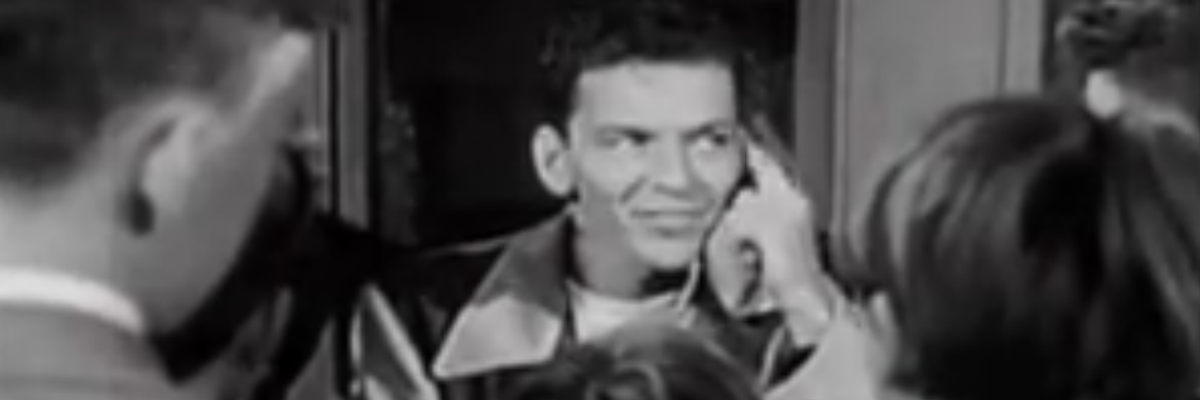
Frank Sinatra educates the youth in the 1945 short film “The House I Live in.”
(Photo: YouTube/Screengrab)
Jeffrey C. Isaac
Dec 29, 2025
Common Dreams
Stephen Miller misses no opportunity to exult in racism and xenophobia. Friday’s Common Dreams headline gets right to the point regarding Miller’s most recent offense: “‘Horrible Racist’ Stephen Miller Slammed for Using Classic TV Christmas Special to Bash Immigrants.”
Apparently Miller spent Christmas day watching a 1967 holiday special called “Christmas with The Martins and The Sinatras” and, being the miserable misanthrope that he is, the show—featuring Dean Martin and Frank Sinatra, two very famous children of first-generation Italian Americans—prompted him to wax nostalgic about a world in which America was Great and there was no mass immigration. Everything that Miller says or does deserves outrage, and his X post was no exception. One form the justified outrage has taken recently crossed my Facebook feed:
Stephen Miller misses no opportunity to exult in racism and xenophobia. Friday’s Common Dreams headline gets right to the point regarding Miller’s most recent offense: “‘Horrible Racist’ Stephen Miller Slammed for Using Classic TV Christmas Special to Bash Immigrants.”
Apparently Miller spent Christmas day watching a 1967 holiday special called “Christmas with The Martins and The Sinatras” and, being the miserable misanthrope that he is, the show—featuring Dean Martin and Frank Sinatra, two very famous children of first-generation Italian Americans—prompted him to wax nostalgic about a world in which America was Great and there was no mass immigration. Everything that Miller says or does deserves outrage, and his X post was no exception. One form the justified outrage has taken recently crossed my Facebook feed:

The Sinatra video that has gone viral is a clip from a 10-minute film short that premiered in November, 1945 called “The House I Live In.” It’s a powerful film, featuring a young and very charismatic Sinatra both speaking and singing against bigotry and for toleration and cultural pluralism.
The film begins with Sinatra, playing himself, in the studio recording a love song. He then takes a break, goes outside, and encounters a group of boys on an unnamed American city street who are very much modeled on Hollywood’s 1940s “Dead End Kids.” He finds them taunting a young, somewhat different-looking boy who is pretty clearly Jewish, and stops to interrupt the taunting and to engage them in conversation about the meaning of “America.”
When the boys inform him that they are bullying the (Jewish) boy because “we don’t like his religion,” Sinatra teases them: “You must be a bunch of those Nazi werewolves I’ve been reading about.” When one of the boys incredulously suggests he is “screwy” to think this, Sinatra replies: “Not me, I’m an American.” When the boys insist that they too are Americans, and one of them volunteers that his father had indeed been wounded in the war, Sinatra points out that the dad had probably needed a blood transfusion, and then points to the excluded boy: “Maybe his pop’s blood saved your dad’s life.”
Sinatra then delivers a monologue:
Look fellas. Religion makes no difference, except maybe to a Nazi or somebody who’s stupid. Why, people all over the world worship God in many different ways. God created everybody. He didn’t create one people better than another. Your blood’s the same as mine, mine’s the same as his. Do you know what this wonderful country is made of? It’s made up of a hundred different kinds of people and a hundred different ways of talking. A hundred different ways of going to church. But they’re all American ways. Wouldn’t we be silly if we went around hating people because they comb their hair different than ours?... My dad came from Italy. But I’m an American. But should I hate your father because he came from Ireland or France or Russia? Wouldn’t I be a first-class fathead?
He then tells them a story about how, after Pearl Harbor, American airmen had inspired the entire country by bravely bombing a Japanese battleship: “They sank it, and every American threw his head back and felt much better. The pilot of that ship was named Colin Kelly, an American and a Presbyterian. And you know who dropped the bombs? Meyer Levin, an American and a Jew. You think maybe they should have called the bombing off because they had different religions?”
Sinatra then heads back to the recording studio. But before entering, he stops to sing for the boys the song he is recording inside, “The House I Live In.” Here are the lyrics:
What is America to me?
A name, a map, the flag I see,
A certain word, “Democracy.”
What is America to me?
The house I live in,
A plot of earth, a street,
The grocer and the butcher
And the people that I meet,
The children in the playground,
The faces that I see;
All races, all religions,
That’s America to me.
A place I work in
A worker by my side
A little town or city
Where my people lived and died
The howdy and the handshake
The air of feeling free
And the right to speak my mind out
That’s America to me
The things I see about me
The big things and the small
The little corner newsstand
And the house a mile tall
The wedding and the churchyard
A laughter and the tears
And the dream that’s been a growing
For 180 years
The town I live in
The street, the house, the room
Pavement of the city
Or a garden all in bloom
The church, the school, the clubhouse
The millions lights I see
But especially the people
That’s America to me.
Sinatra then smiles, returns to the studio, and the boys walk off together, inviting the Jewish kid to join them, while the music of “America the Beautiful” plays in the background.
The film is very powerful and uplifting. It is emblematic of the spirit of American liberalism in the immediate aftermath of WWII, a spirit perhaps symbolized by the stardom of Sinatra, the child of working-class Italian immigrants who grew up in Hoboken, New Jersey. Critics of Miller, and of President Donald Trump, are right to invoke the film, and to evoke the idealism of Rooseveltian liberalism, as a reproach to MAGA xenophobia.
At the same time, there are at least three important ways that the film exemplifies the limits of Rooseveltian idealism and the depth of the forms of illiberalism repudiated in the very lyrics of “The House That I Live In”—forms of illiberalism with which we are still reckoning today.
The first relates to the political circumstances surrounding the song itself. The music was written by Earl Robinson, a composer and folk musician from Seattle who belonged to the Communist Party from the 1930s through the 1950s; collaborated with Paul Robeson, Pete Seeger, and other well-known leftist artists and performers; and was blacklisted during the McCarthy period. And the lyrics were written by Lewis Allan, the pseudonym of Abel Meeropol, also a Communist at the time, who also composed the lyrics to “Strange Fruit,” the anti-lynching song made famous by Billie Holiday, and later adopted the sons of Julius and Ethel Rosenberg after their parents were executed as Soviet agents in 1953.
Robinson and Meeropol were two of the hundreds of writers, artists, musicians, and performers who made seminal contributions to American culture during the 1930s and 1940s in connection with the Popular Front, described by historian Michael Kazin as “a vigorously democratic and multiracial movement in the arts and daily life that was sponsored but not controlled by the Communist Party.” The patriotic rhetoric of “The House I Live In”—both the song and the film—bears the traces of Popular Front leftism even as the connections to the left, and to anti-capitalism, were as disguised, and erased, as the actual name of the lyricist.
The second is the way in which the film’s repudiation of antisemitism, and its message of tolerance, is advanced—through an understandable anti-fascist patriotism that is juxtaposed to evil “Nazi werewolves” and invading “Japs.” Sinatra’s uplifting story of the bombing of the Japanese battleship Hiruma three times uses the racist term “Japs.” Erased from the story are some very memorable recent events: the wartime incarceration of well over 100,000 Japanese Americans; the 1945 American fire-bombing of Tokyo that killed over 100,000 Japanese civilians; and the atomic bombings of Hiroshima and Nagasaki in August, 1945, months before the film’s release. (It is worth nothing that the film’s producer-director, Mervyn Leroy, also produced the 1944 film “30 Seconds Over Tokyo,” a glorification of the 1942 “Doolittle Raid,” the first US bombing of Tokyo, starring Spencer Tracy). The film’s valorization of American democracy is thus linked to a racially-tinged narrative of American innocence with increasingly illiberal ramifications as the Cold War evolved.
And there is, finally, the striking fact that while Sinatra powerfully gives voice to the idea that “God created everybody, he didn’t create one people better than another,” and that “your blood’s the same as mine, mine’s the same as his,” every person in the film—Sinatra, the boys, the studio orchestra—is white.
To point these things out is not to disparage “The House I Live In,” a very important cultural creation that contained genuinely progressive elements while also condensing some of the contradictions of its time. It is simply to note the complexity of the recurrent historical contests over what it means to be “an American,” and the lack of innocence of even the most appealing episodes of the past. Trumpism is xenophobic, racist, deeply anti-liberal, and literally reactionary. Looking back at exemplary moments of American liberalism to counter MAGA rhetoric is an entirely understandable and even comforting move to make. Rewatching “The House I Live In” this holiday season was genuinely uplifting for me. But post-WWII liberalism at its height was no Golden Age, and we can no more return to it than we can to the time of Andrew Jackson, or William McKinley, or 1920s racist Madison Grant, or George Wallace, or Bull Connor, or whoever it is that warms Stephen Miller’s deformed and shriveled heart.
Our work is licensed under Creative Commons (CC BY-NC-ND 3.0). Feel free to republish and share widely.
Jeffrey C. Isaac
Jeffrey C. Isaac is James H. Rudy Professor of Political Science at Indiana University, Bloomington. His books include: "Democracy in Dark Times"(1998); "The Poverty of Progressivism: The Future of American Democracy in a Time of Liberal Decline" (2003), and "Arendt, Camus, and Modern Rebellion" (1994).
Full Bio >

No comments:
Post a Comment