A Supreme Court case that could potentially undo and restrict citizenship rights shows that the border is everywhere.
December 30, 2025
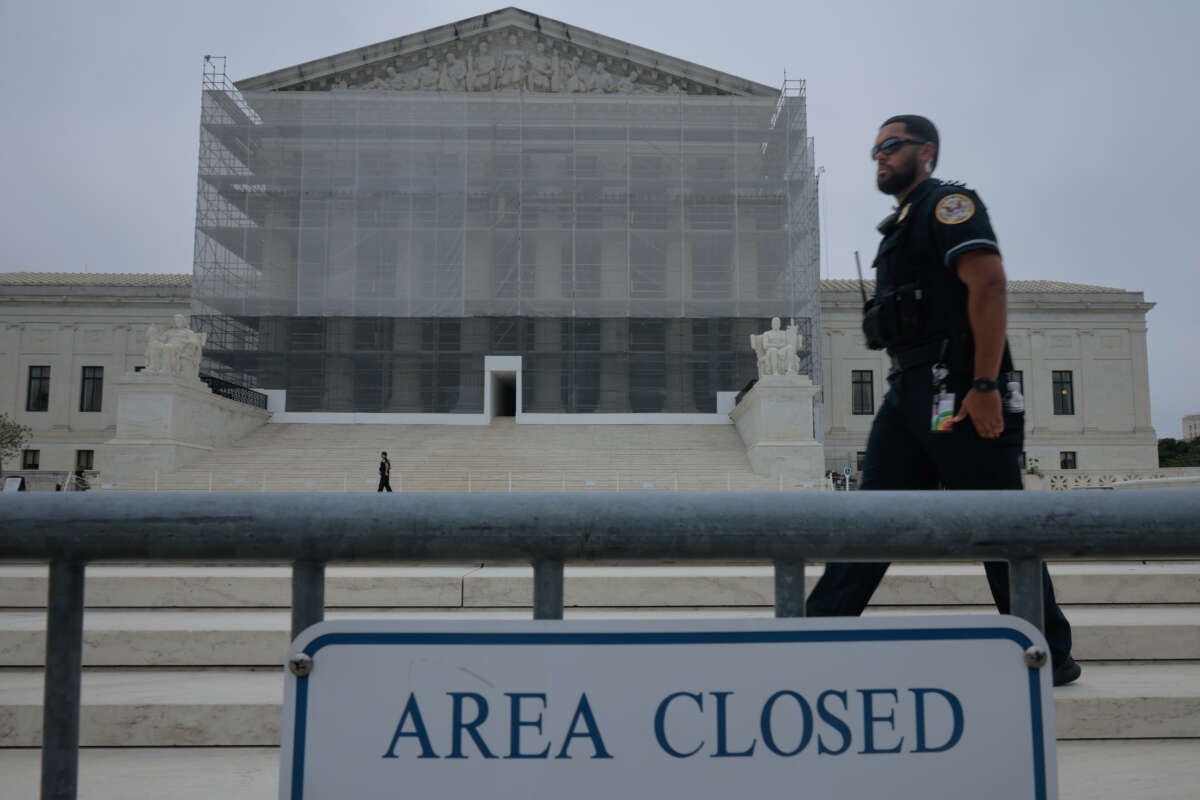
The plaza in front of the U.S. Supreme Court building is seen to be closed on June 27, 2025, in Washington, D.C.Chip Somodevilla / Getty Images
As we produce journalism that combats authoritarianism, censorship, injustice, and misinformation, your support is urgently needed. Please make a year-end gift to Truthout today.
The Supreme Court has scheduled a hearing early next year regarding historic challenges to the Trump administration’s attempt to undermine the Fourteenth Amendment’s longstanding guarantee of birthright citizenship, which was enacted in 1868. The administration proposed to get rid of birthright citizenship by means of an executive order issued on inauguration day, and not through a proposed constitutional amendment, which most scholars argue is legally required.
The administration’s assault on birthright citizenship firmly anchors its campaign of terror against migrant communities in a white supremacist framework, one that extends the militarization and politics of racial subordination of the U.S-Mexico border region throughout the country.
Now, more than ever, it is clear that the border is present wherever immigrant communities are present — wherever our sisters and brothers live, work, and struggle.
This is why immigrant rights groups like Witness at the Border decided to launch our “Blue Triangle” campaign in response to the Trump administration’s criminalization of migrants. This initiative highlights the connection between Nazi persecution of migrants and political exiles as a distinct category — first in forced labor camps in the 1930’s and eventually in the Holocaust — and the repressive logic of the Trump administration’s targeting of our communities through measures such as mass detention and mass deportation, the negation of internationally protected rights to asylum and refuge, the reactivation of the Alien Enemies Act and Insurrection Act, and related abuses.
Immigrant rights groups, human rights defenders, and their allies throughout the U.S. are mobilizing in defense of birthright citizenship in the lead up to the Supreme Court’s consideration of these issues. We organized in the spirit of observances here and around the world of International Human Rights Day on December 10 and International Migrants Day on December 18. For us, these are days of conscience, solidarity, and resistance, without borders, in defense of the universal right to freedom of movement in search of a dignified life.
As we produce journalism that combats authoritarianism, censorship, injustice, and misinformation, your support is urgently needed. Please make a year-end gift to Truthout today.
The Supreme Court has scheduled a hearing early next year regarding historic challenges to the Trump administration’s attempt to undermine the Fourteenth Amendment’s longstanding guarantee of birthright citizenship, which was enacted in 1868. The administration proposed to get rid of birthright citizenship by means of an executive order issued on inauguration day, and not through a proposed constitutional amendment, which most scholars argue is legally required.
The administration’s assault on birthright citizenship firmly anchors its campaign of terror against migrant communities in a white supremacist framework, one that extends the militarization and politics of racial subordination of the U.S-Mexico border region throughout the country.
Now, more than ever, it is clear that the border is present wherever immigrant communities are present — wherever our sisters and brothers live, work, and struggle.
This is why immigrant rights groups like Witness at the Border decided to launch our “Blue Triangle” campaign in response to the Trump administration’s criminalization of migrants. This initiative highlights the connection between Nazi persecution of migrants and political exiles as a distinct category — first in forced labor camps in the 1930’s and eventually in the Holocaust — and the repressive logic of the Trump administration’s targeting of our communities through measures such as mass detention and mass deportation, the negation of internationally protected rights to asylum and refuge, the reactivation of the Alien Enemies Act and Insurrection Act, and related abuses.
Immigrant rights groups, human rights defenders, and their allies throughout the U.S. are mobilizing in defense of birthright citizenship in the lead up to the Supreme Court’s consideration of these issues. We organized in the spirit of observances here and around the world of International Human Rights Day on December 10 and International Migrants Day on December 18. For us, these are days of conscience, solidarity, and resistance, without borders, in defense of the universal right to freedom of movement in search of a dignified life.
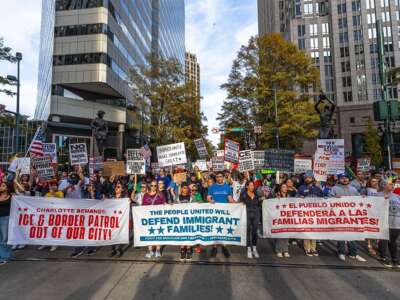
Our understanding and defense of birthright citizenship is within this overall framework of reaffirmation of a broader vision and commitment to the full range of rights recognized by the Universal Declaration of Human Rights in 1948 and those of migrants, refugees, asylum seekers and displaced persons throughout the world. But ultimately, ours is a fight for a world without borders.
An Attack on Birthright Citizenship
The constitutionally protected right to birthright citizenship, embodied in what is known as the “Citizenship Clause” of the Fourteenth Amendment, is grounded in the Reconstruction Era’s abolition of slavery and the broader constitutional changes undertaken in the wake of the Civil War. These measures sought to give substantive content to the empty promises of equal rights affirmed in the Declaration of Independence and the Bill of Rights, contradicted in practice by constitutional protections for slavery, the slave trade, and the policing and hunting of fugitive slaves.
The constitutional amendments passed during this period for the first time extended rights of citizenship not only to formerly enslaved Black people but also to “all persons” [emphasis added] born on U.S. soil, including those born to non-citizens. This is crucial in terms of our understanding of the context and origins of birthright citizenship; prior to the adoption of the Fourteenth Amendment in 1868, naturalization for immigrants as citizens had been limited by previous laws exclusively to “free white persons” (in effect, white male property owners).
The express purpose of the radical reforms enacted during Reconstruction in the 1860s and 1870s was to reverse the Supreme Court’s denial of citizenship rights to Black Americans, both enslaved and free, on the basis of their race in the Dred Scott case in 1857. This decision and its implications became a tipping point which sharpened the deep divisions that accelerated the conditions culminating in John Brown’s rebellion, the Civil War itself, and finally, emancipation.
The Dred Scott case shares key traits with other Supreme Court decisions such as Plessy v. Ferguson in 1896, which upheld Jim Crow laws in the deep South pursuant to the “separate but equal” doctrine, and Korematsu v. U.S. in 1944, which affirmed the constitutionality of racially discriminatory detention policies imposed on people of Japanese origin, including tens of thousands of U.S. citizens, under the guise of “national security” during the Second World War.
These are particularly egregious examples of Supreme Court decisions that restrict rights within a white supremacist landscape, rather than expanding them. The pending case regarding birthright citizenship poses the same kind of challenge for the court today.
The Trump administration’s efforts to undo the birthright citizenship guarantees of the 14th Amendment come with high stakes. Today’s court, for example, will have to confront the Supreme Court’s own historic ruling in 1898 in United States v. Wong Kim Ark, which upheld the Fourteenth Amendment’s guarantee of birthright citizenship for a Chinese cook born in San Francisco who had been denied reentry to the U.S. in the wake of the passage of a series of laws targeting Chinese immigrants.
Trump’s executive order seeks to deny citizenship rights to any child born in the U.S. to a mother who is either here without papers or only temporarilypresent in the country, and whose father is not a U.S. citizen or legal permanent resident (for example, migrants holding student or work visas). The order directs federal agencies to stop issuing citizenship papers to these children. The Brennan Center suggests that this probably means the children would still be issued birth certificates, but those would not serve as proof of citizenship.
Though Trump’s order has until now been tied up in the courts — and still has to go through the Supreme Court — one can already see how this might play out in states and localities where officials could consider themselves empowered to refuse to issue or facilitate the processing of official documents or benefits on discretionary grounds, based on their interpretation, understanding, or perception of the immigration status of the parents applying for this kind of vital documentation. Aggressive community-based organizing and court actions to resist encroachments on birthright citizenship have been crucial in resisting abuses of this kind.
Trump 2.0’s Anti-Immigrant Strategy
The Trump administration’s initiative to undo and restrict existing rights to citizenship aims to perpetuate the demographic effects of Trump 2.0’s overall weaponization and normalization of an overtly white supremacist reframing of immigration and border policy.
The intended result is a kind of extreme civic exclusion imposed on racially and ethnically targeted, policed, and subordinated immigrant communities relegated to the kind of permanent second class status or “social death” envisioned for Black Americans in the majority’s ruling in Dred Scott. This is also what the Supreme Court sought to avoid through its narrow decision in the Plyler v. Doe case in 1982, that affirmed the constitutional right of undocumented immigrant children to free public education, which the Trump administration has also sought to undermine.
The underlying political and ideological goal is to combine the ongoing practices of racially and ethnically targeted mass detention and mass deportation, such as the raids we have seen on the streets of cities across the country, with racial and ethnic engineering to limit who is entitled to citizenship, voting, and representation, and ultimately to “social membership” in the broadest sense. Trump has normalized the kind of militarization of immigration enforcement which has long been accepted as a standard practice in the U.S.-Mexico border region, extending the border together with the Border Patrol and its historic, ingrained violence and abuses throughout the country. The administration has further coupled these moves with a convergent series of measures to restrict the rights of permanent residents (non-citizens with green cards, people holding student and work visas, etc.), and of refugees and asylum seekers.
The Trump administration’s policies and practices of mass detention and mass deportation echo past abuses at the same time as they normalize new forms of persecution, cruelty, and terror against migrant families, communities, and countries of origin. These measures constitute an essential component of the overall weave of MAGA’s version of neo-fascist authoritarianism (or “late fascism”) that has undermined the rule of law within the U.S., driven by militarism, nationalism, and supposed “populism” grounded in racism, hatred, and xenophobia.
Their concrete expressions include the proliferation of militarized, inhumane detention camps characterized by conditions equivalent to torture in settings such as the Everglades (“Alligator Alcatraz”), Fort Bliss (“Camp East Montana”), and beyond U.S. borders in settings such as Guantánamo Bay, on illegally occupied Cuban national territory.
This overall archipelago of Trumpian terror also includes systematic, recurrent patterns of forced disappearances and torture through third country deportations to settings such as CECOT in El Salvador and complicity in persecution and terror against migrants in contexts ranging from Mexico, Panama, Costa Rica, and Peru to Eswatini, Djibouti, South Sudan, Rwanda, and Ghana, as well as the racist targeting and collective punishment of Afghan, Somali, and Haitian migrants and communities and of their countries of origin.
This immigration policing is the other side of the coin of the rekindled imperialist interventionism that has become rampant in contexts such as the illegal airstrikes on boats in the Caribbean and Pacific, the potentially imminent threats of intervention against Venezuela and Colombia, and ongoing U.S intervention in the Honduran elections.
This is a historical moment that shares important political, ethical, and spiritual dimensions with previous eras when illegitimate forms of power had to be challenged by people of good will as a duty of collective, conscientious citizenship on a local, national, and global scale.
Today, we must stand with immigrants everywhere, within the U.S. and beyond, without walls, in the spirit of the abolitionist movement of the 1850’s and the civil rights and anti-war movements of the 1960’s and their successors. This is part of the community-based struggles needed for what amounts to a “Third Reconstruction” in the tradition of “abolition democracy,” including the abolition of ICE, the Border Patrol, and ultimately of borders themselves — as part of a revolutionary configuration of existing nation-states throughout the world.
This article is licensed under Creative Commons (CC BY-NC-ND 4.0), and you are free to share and republish under the terms of the license.
Camilo Pérez-Bustillo
Camilo Pérez-Bustillo is former executive director of the San Francisco Bay Area chapter of the National Lawyers Guild; member of the leadership team at Witness at the Border; a fellow at the Institute for the Geography of Peace in Juárez, Mexico/El Paso, Texas, and at the University of Bergen, Norway’s, Global Research Programme on Inequality; co-chair of the National Lawyers Guild’s Task Force on the Americas; professor of law and ethnic studies at St. Mary’s College of California; visiting chair professor of human rights at National Taiwan University’s College of Law; and co-founder of the International Tribunal of Conscience of Peoples in Movement.

No comments:
Post a Comment