Zionism Remade the Story of Hanukkah in Its Image. We Celebrate an Older Truth.
Zionism turned the moral of the Hanukkah story on its head to praise militarism. In truth, it is a holiday of peace.
By Elliot Kukla ,
December 13, 2025
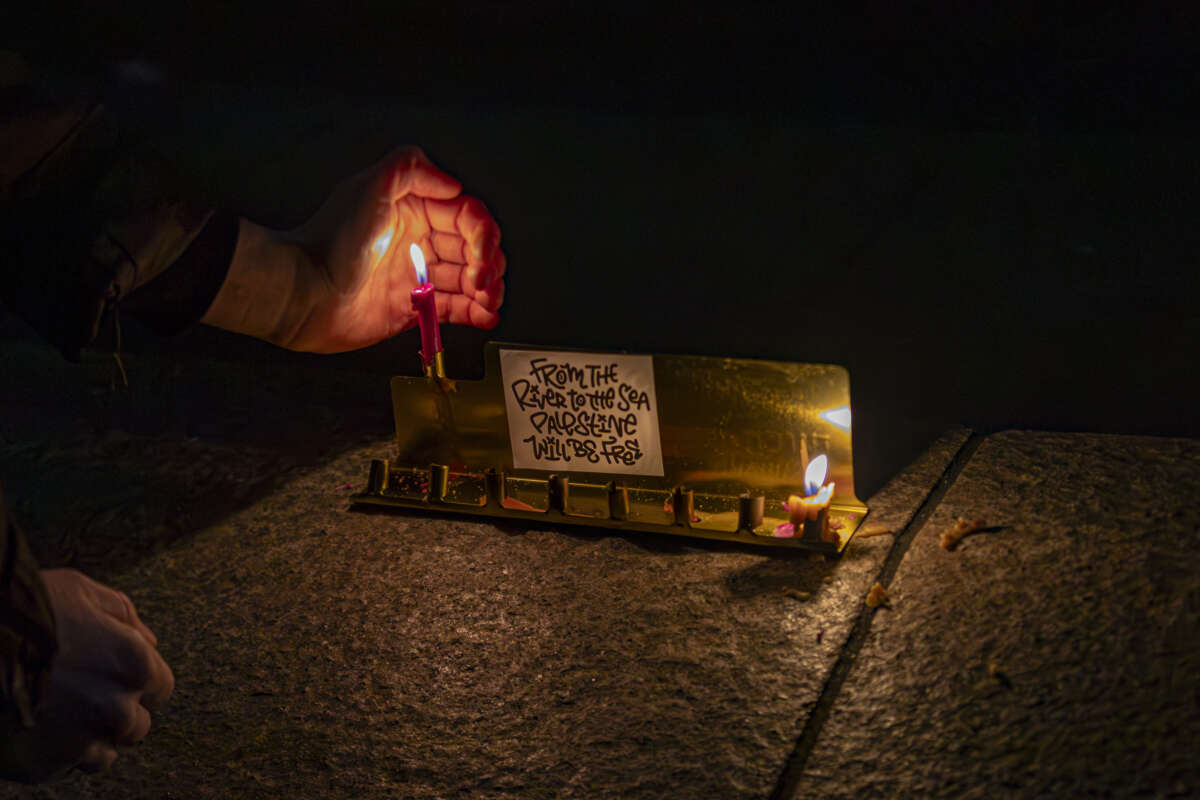
A person lights candles on a menorah with signs that say "From the river to the sea Palestine will be free" as Jewish groups gather at Columbus Circle on the first night of Chanukah during an action dubbed "Chanukah for Ceasefire" on December 7, 2023, in New York City.
Michael Nigro / Pacific Press / LightRocket via Getty Images
When I was 19 years old, I traveled to Israel to find long-lost relatives who had survived the Holocaust. While I was there, I was “picked up” on the street by an ultra-orthodox woman who offered me free lodging in a hostel exclusively for Jewish travelers in the Old City of Jerusalem. I was a broke teenager at the time, so I said yes. It was Hanukkah, and all across the Jewish Quarter, picturesque oil menorahs twinkled in the windows and doorways of ancient-looking buildings built from a pearly-pink marble called “Jerusalem stone.”
I didn’t grow up celebrating Hanukkah, so my hosts explained to me that in 167 BCE, the ancient Jewish Temple, which once stood just around the corner from where I was staying, had been occupied by the mighty Hellenistic Seleucid Empire. Luckily, a small group of rebels known as the Maccabees fought back and recaptured the Temple. Since then, they said, Jews have kindled Hanukkah candles every year in honor of this marvelous battle, and dreamed of a return to reoccupy these very homes, in this exact neighborhood. The fact that we were finally there, they said, was the Hanukkah miracle come true.
I was captivated. It was an inspiring story, perfectly matched by the stirring ancient setting. Unfortunately, almost none of it was true.
The pearlescent stone buildings that looked age-old to my teenage eyes had actually mostly been constructed in the last few decades, on top of Palestinian homes that were bulldozed after Jerusalem was seized by the Israeli military in 1967. John Tleel, a Palestinian whose family lived in the Old City for 400 years, describes how the residents of the neighborhood where I was staying were given only 12 hours to evacuate. New homes and plazas were hastily built over what is now known as the Jewish Quarter, and constructed to look as if they’d always been there.
Likewise, Hanukkah, as a tale of a glorious battle, is a thin Zionist facade, pasted onto an old story that conveyed the opposite meaning for thousands of years. Traditionally, Hanukkah was a quiet, pacifist festival that taught an age-old lesson about the dangers of zealotry and the wisdom of gentleness in the face of force.
Related Story
Hanukkah Is a Time for Palestine Solidarity, From Fasting to Public Disruption
This holiday of feasts begins as people starve amid genocide in Gaza. Activists are fasting weekly for a ceasefire. By Maya Schenwar , Truthout December 7, 2023
It is true that in 167 BCE, there was a Jewish uprising against the Hellenistic Seleucid Empire, led by a group of rebels known as the Maccabees, which means “the hammers.” However, the Maccabees were not just fighting against the Hellenists. They were also fighting with many other Jewish groups who they saw as weak collaborationists because they wanted to negotiate with, instead of fight, the Seleucid Empire. In the end, the Maccabees’ military tactics led to a lot of bloodshed and a short-lived victory. The Temple was soon destroyed. For the next two thousand years, Jews lived all over the world, ate different foods, and spoke different languages. It was not retaking the land or rebuilding an army that led to our cultural survival, but telling shared stories that fostered a sense of belonging across generations and around the world.
Hanukkah was a quiet, pacifist festival that taught an age-old lesson about the dangers of zealotry and the wisdom of gentleness in the face of force.
For centuries, the Maccabees didn’t make it into these Jewish sacred stories. The Book of Maccabees, which records their battle, is a holy text in Catholic and Eastern Orthodox Christianity, but it’s not included in Jewish holy books. In the Talmud, the ancient texts that lie at the center of all Jewish laws and practices, the rabbis ask: “What is Hanukkah about, anyway?” They knew the history of the Maccabees, but their question implies that they didn’t see this event as worthy of celebration. Instead, they offer a very different tale to explain the season: “For when the Hellenists entered the Temple, they defiled all the oils in it, and when the Hasmonean dynasty prevailed over them and defeated them, they searched and found only one bottle of oil sealed by the High Priest. It contained only enough for one day’s lighting. Yet a miracle was brought about with it, and they lit with that oil for eight days.” (Shabbat 21b)
Early Zionists took the Maccabees from obscurity and claimed them as heroes precisely because traditional Judaism had dismissed them as unpleasant zealots.
This story is a consciously gentle miracle. Instead of celebrating the Maccabees’ military might, it lifts up spiritual values of faith, trust, and patience in a little bit going a long way. The choice to remember the perseverance of small flickering lights, and not a battle, is a decision to not canonize bloodshed even when “our” side is the winner. This message is explicit in the prophetic biblical passage from the Book of Zechariah read on the shabbat of Hanukkah in synagogue: “Not by might, nor by power, but by My spirit.”
Zionism arose in the late 19th century as a secular European colonial movement, and many of its early tropes were explicitly a rebuke of religious Judaism. Early Zionists took the Maccabees from obscurity and claimed them as heroes precisely because traditional Judaism had dismissed them as unpleasant zealots. Early Zionists named sports clubs and athletics contests after the Maccabees, and argued that they were models for a new “muscular Jewry.” Israeli pop songs scoffed at the miracle of oil, and instead reframed the Hanukkah miracle to glorify the newly established gangs of Zionist militias that were chasing Palestinians off their lands.
This was a completely new and intentionally irreligious version of Hanukkah. And yet historical memory can be very short. Today, many people, including leftists, have forgotten that there is another, more ancient version of Hanukkah underneath the modern, Zionist facade. In this time of ongoing genocide in Palestine and cascading worldwide catastrophes, remembering the original meaning of Hanukkah, and its refusal to celebrate violence, is particularly important.
The word Hanukkah means rededication, because the Temple was defiled by the Hellenist Empire, and the menorah needed to be kindled to rededicate it. Since October 7, 2023, ancient Jewish symbols like the Star of David have been burned into Palestinian farmlands and branded onto the cheeks of Palestinians as signs of domination. Today, we again need to rededicate what has been defiled by this monstrous disregard of life.
As authoritarianism rises worldwide and many of our systems of care fragment, we need to save our age-old stories like seeds in a seed bank, as they contain vital spiritual nourishment. Within the story of Hanukkah’s oil, there are timeless, universal truths that we will need in order to survive this era: tales last longer than Temples, and faith can be more powerful than force. The night is often long, with only a little bit of fuel to warm and light it, but when we work together in solidarity, there is enough for everyone.
This article is licensed under Creative Commons (CC BY-NC-ND 4.0), and you are free to share and republish under the terms of the license.
Elliot Kukla
Rabbi Elliot Kukla (he/they) is an author and activist who has spent the past 20 years working at the intersection of justice and spiritual care to the dying and bereaved. His book on hidden grief, The Heart Lives by Breaking, is forthcoming in Fall 2027 from Schocken (Knopf Doubleday).

No comments:
Post a Comment