In a recent focus group, one voter who supported the president in 2024 said Trump’s recent claims that the economy is strong were “delusional.”
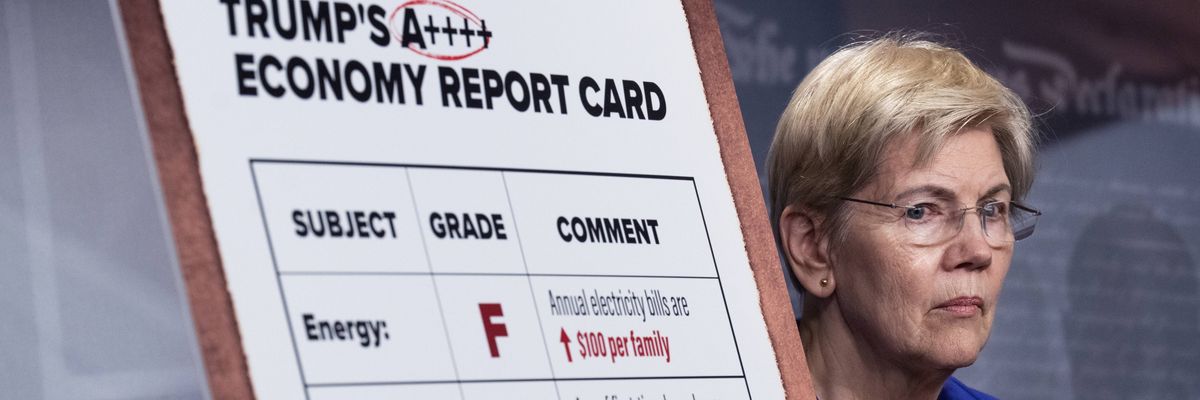
Sen. Elizabeth Warren (D-Mass.) is seen with a sign referencing President Donald Trump’s “report card,” during a news conference on a new “Democratic initiative to lower costs,” in the U.S. Capitol on December 17, 2025.
(Photo by Tom Williams/CQ-Roll Call, Inc. via Getty Images)
Julia Conley
Dec 29, 2025
COMMON DREAMS
New polling from The Guardian on Monday bolstered recent analyses that have shown low consumer confidence and job creation numbers and higher household costs and unemployment: Americans are struggling under President Donald Trump’s economic policies, and they increasingly believe the White House—for all Trump’s claims that the economy is strong—is to blame.
The poll, conducted by Harris for the news outlet between December 11 and 13, found that respondents were twice as likely to say their financial security is getting worse as they were to report an improvement.
Nearly half of those surveyed said their financial situation is worsening, and 57% said they perceived that the US is in a recession—although that would be defined by two quarters of negative growth in the US economy, which the country has not experienced at this point.
Despite that, the poll—along with recent focus groups including members of Trump’s 2024 base, held by Syracuse University and reported on Monday by NBC News—illustrated how Trump’s focus on imposing tariffs on countries around the world and his promotion of policies that have raised household bills for millions of people have left Americans feeling pessimistic about their own financial health and that of the country.
Democratic voters were far more likely than Republicans to tell Harris that their financial security is getting worse, with 52% of the latter saying so compared with 27% of the former.
But 54% of independent voters agreed that they are struggling more financially, despite Trump’s recent claim that he would give the economy a grade of “A-plus-plus-plus-plus-plus.”
“We have seen a shift among these voters collectively, cracks in their faith, more questioning, oscillating, or outright change of heart about Trump.”
Respondents from across the political spectrum were more likely than ever before to blame the White House for their financial struggles, Harris said.
More than three-quarters of Democrats blamed Trump’s policies and “government management of the economy,” along with 72% of independents and more than half of Republicans—55%.
Analyses this year have shown Trump’s tariffs, which he claimed soon after taking office would “liberate” Americans from the national debt, are raising costs for small businesses and making it harder for them to stay afloat, and are passing on higher prices to consumers—resulting in ballooning grocery bills for millions of Americans.
Trump made lowering grocery prices a central promise of his campaign last year, along with repeatedly pledging that he was “going to get your energy prices down by 50%.”
But the president’s embrace of artificial intelligence and the expansion of data centers—something he and congressional Republicans have aggressively pushed states to allow despite public disapproval—is unlikely to result in lower utility prices for households. Those costs have risen by 13% since Trump took office, with the president’s cancellation of renewable energy projects to blame as well as energy-sucking data centers.
The focus groups held by Syracuse recently found that voters who supported the president last year have rapidly grown discouraged by his economic policies, including his tariffs, which one participant called “a tax on the American people.”
“That’s who pays for it, so I don’t support it,” David S. of New Jersey told NBC. “The people who are buying those imports are paying the tax.”
With less than a year until voters are set to decide if Republicans should keep their majorities in the US House and Senate, fewer than half of the people surveyed in four focus groups said they believed Trump has made it a priority to fight inflation and reduce their costs. Robert L. of Virginia told Syracuse researchers that the president’s recent comments painting a sunny picture of the economy were “delusional.”
Another Virginia voter, Justin K., said the president has been focused on “prosecuting his political enemies” and “pardoning people” and has not “tried at all” to tackle the rising cost of living.
A number of those surveyed said they had decided to back Democratic candidates Abigail Spanberger and Mikie Sherrill in this year’s gubernatorial elections in Virginia and New Jersey just a year after supporting Trump.
“Many of these voters gave President Trump a long runway well into the summer because they believed that he understands how business works better than they do and that his own fortune would eventually translate to enriching the country and their own finances,” Margaret Talev, director of Syracuse University’s Institute for Democracy, Journalism, and Citizenship, told NBC on Monday.
“But as the year wore on, we have seen a shift among these voters collectively, cracks in their faith, more questioning, oscillating, or outright change of heart about Trump,” Talev said. “What we almost never see is a wish for a do-over vote or a rush toward Democrats for the answer.”
‘Trump’s Economic Policies Did This’: US Business Bankruptcies Surge to 15-Year High
At least 717 US companies filed for bankruptcy through November 2025—the highest figure recorded since the aftermath of the Great Recession.
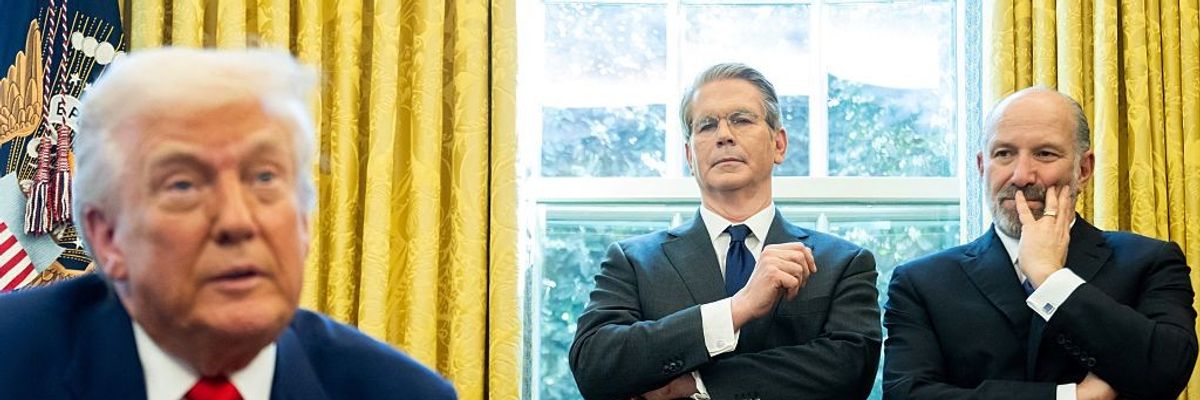
US Treasury Secretary Scott Bessent and Commerce Secretary Howard Lutnick look on as President Donald Trump speaks on April 9, 2025.
(Photo: Saul Loeb/AFP via Getty Images)
Jake Johnson
Dec 29, 2025
COMMON DREAMS
Businesses in the United States have filed for bankruptcy this year at a level not seen since 2010 as President Donald Trump’s tariff regime has jacked up costs for companies in manufacturing and other major sectors.
Citing data from S&P Global Market Intelligence, the Washington Post reported over the weekend that at least 717 US companies filed for bankruptcy through November 2025, the highest figure recorded since the aftermath of the Great Recession and a 14% increase compared to the same period last year.
“Companies cited inflation and interest rates among the factors contributing to their financial challenges, as well as Trump administration trade policies that have disrupted supply chains and pushed up costs,” the Post noted. “But in a shift from previous years, the rise in filings is most apparent among industrials—companies tied to manufacturing, construction, and transportation. The sector has been hit hard by President Donald Trump’s ever-fluid tariff policies—which he’s long insisted would revive American manufacturing.”
Recent data shows that the US has lost 49,000 manufacturing jobs since Trump’s return to office.
The bankruptcy figures add to the growing pile of evidence showing that Trump’s tariffs and broader policy agenda have harmed the US economy—weakening job growth, driving the unemployment rate up to the highest level since the Covid-19 pandemic, and worsening the nation’s cost-of-living crisis.
Democrats immediately seized on the new reporting as evidence of Trump’s failed stewardship of the US economy, messaging that’s likely to be central as the 2026 midterms approach.
Ken Martin, chair of the Democratic National Committee, said Monday that “when Donald Trump signed his Big Ugly Bill into law, he cemented the Republican Party as the party of billionaires and special interests—not working families, farmers, or small business owners.”
“While millions of working families are already being squeezed to afford groceries, utilities, and rent, Trump chose to strip them of their healthcare and food assistance just so he could give his ultrawealthy friends and donors an extra buck,” said Martin. “Make no mistake: Trump’s ‘signature achievement’ will be the nail in the coffin for the Republican majority when voters head to the polls next November.”
At least 717 US companies filed for bankruptcy through November 2025—the highest figure recorded since the aftermath of the Great Recession.
US Treasury Secretary Scott Bessent and Commerce Secretary Howard Lutnick look on as President Donald Trump speaks on April 9, 2025.
(Photo: Saul Loeb/AFP via Getty Images)
Jake Johnson
Dec 29, 2025
COMMON DREAMS
Businesses in the United States have filed for bankruptcy this year at a level not seen since 2010 as President Donald Trump’s tariff regime has jacked up costs for companies in manufacturing and other major sectors.
Citing data from S&P Global Market Intelligence, the Washington Post reported over the weekend that at least 717 US companies filed for bankruptcy through November 2025, the highest figure recorded since the aftermath of the Great Recession and a 14% increase compared to the same period last year.
“Companies cited inflation and interest rates among the factors contributing to their financial challenges, as well as Trump administration trade policies that have disrupted supply chains and pushed up costs,” the Post noted. “But in a shift from previous years, the rise in filings is most apparent among industrials—companies tied to manufacturing, construction, and transportation. The sector has been hit hard by President Donald Trump’s ever-fluid tariff policies—which he’s long insisted would revive American manufacturing.”
Recent data shows that the US has lost 49,000 manufacturing jobs since Trump’s return to office.
The bankruptcy figures add to the growing pile of evidence showing that Trump’s tariffs and broader policy agenda have harmed the US economy—weakening job growth, driving the unemployment rate up to the highest level since the Covid-19 pandemic, and worsening the nation’s cost-of-living crisis.
Democrats immediately seized on the new reporting as evidence of Trump’s failed stewardship of the US economy, messaging that’s likely to be central as the 2026 midterms approach.
Ken Martin, chair of the Democratic National Committee, said Monday that “when Donald Trump signed his Big Ugly Bill into law, he cemented the Republican Party as the party of billionaires and special interests—not working families, farmers, or small business owners.”
“While millions of working families are already being squeezed to afford groceries, utilities, and rent, Trump chose to strip them of their healthcare and food assistance just so he could give his ultrawealthy friends and donors an extra buck,” said Martin. “Make no mistake: Trump’s ‘signature achievement’ will be the nail in the coffin for the Republican majority when voters head to the polls next November.”

No comments:
Post a Comment