Resistance Grows as US Border Wall Construction Threatens Jaguars
On a sunny and modestly warm day in mid-November, I have a clear view of the San Rafael Valley from high in Montezuma Pass in the Coronado National Monument. A road cuts a straight orange-red line through the juniper trees and grassland below. That road, I am told by one of the border wall resisters I traveled with from Tuscson, marks the delineation between Mexico and the United States. Turning, she points to the south. I focus my eyes as she says, “See that black line? That’s the new border wall.”
Though there are sections of border wall that have been in place for decades, the desire of the current regime to build a complete wall which would stretch nearly 2000 miles from the Pacific Ocean in California to the Gulf of Mexico in Texas is unprecedented. If successful, such a wall would mark the first time in human history that a continent has been cut in half by a man-made structure.
Though it is touted by proponents as necessary to stop undocumented people including drug runners and murderers from entering the United States, the wall will ultimately fail in this task (as existing border walls show). Instead, it will merely stand as a monument to arrogance, xenophobia, and enriching the already rich.
The mountain pass where I am standing is part of the Coronado National Monument, which is named after Francisco Vazquez de Coronado, who, in 1540, set off from a small city north of Puerto Vallarta, Mexico, believing he would find boundless riches within the mythical “Seven Cities of Gold.” On foot and horseback, the Coronado expedition navigated the Huchuca Mountains that we have just driven up. But after two years of searching for gold-lined streets and gilded buildings as far away as western Kansas, Coronado returned to Mexico with no gold; as far as the history books go, he has been noted as a dismal failure.
History repeats. Today, just as in Cornando’s time, the drive to build the wall reflects greed and the abuse of power running roughshod over communities, existing laws, and the land itself. Trump’s desperate desire for this monstrosity to be a part of his legacy, regardless of the impacts, is a mirror of the arrogant lust for power of the conquistadors. The gold of today is forty-five billion dollars of American taxpayers money that is being spent to build this wall which is lining the pockets of private contractors — a number of whom have personal relationships with the Trump Administration.
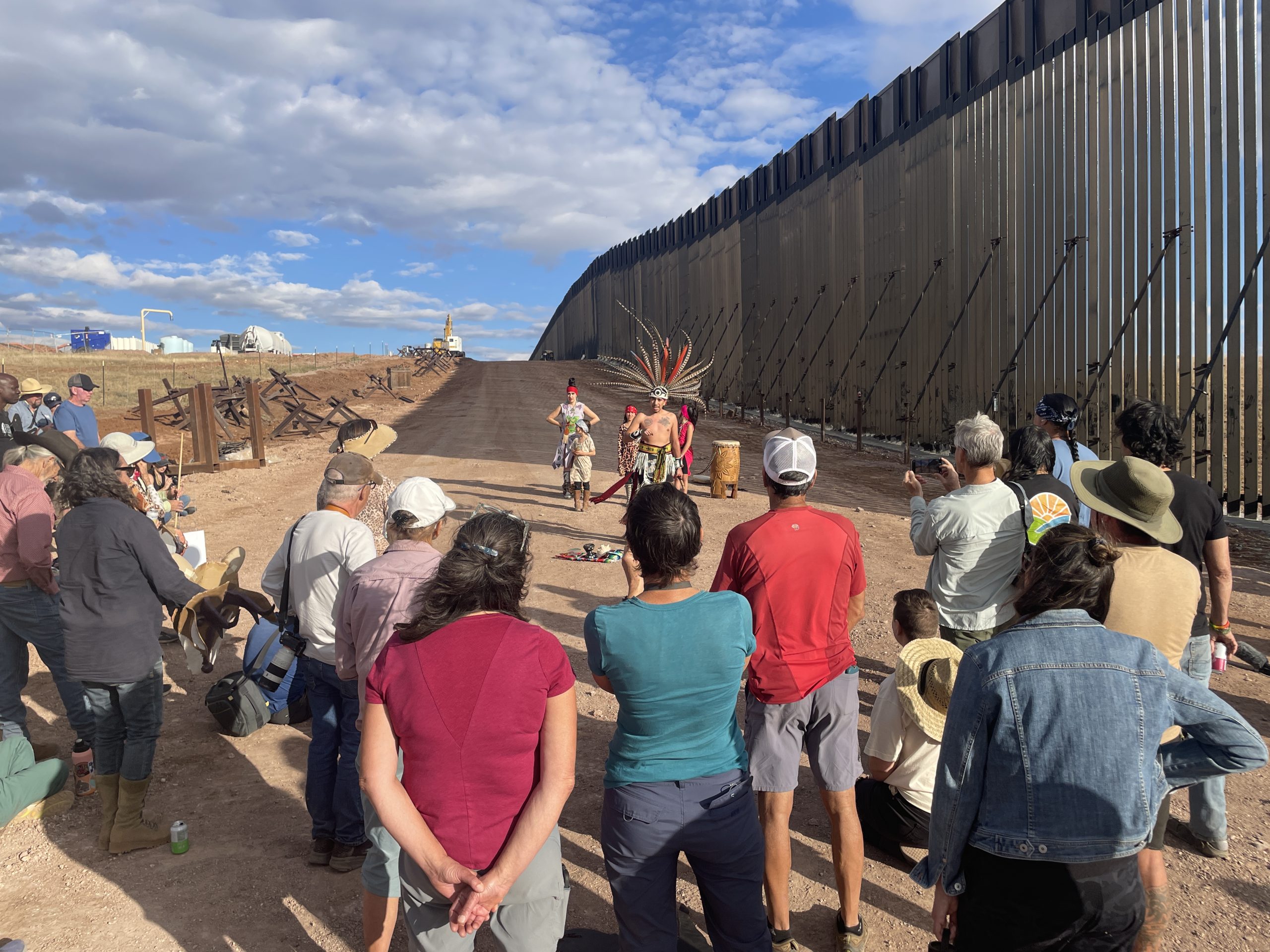
We pile back into our vehicles, and after a bumpy ride down from the pass and across the valley, gather with two hundred other people who converged this day near a section of the new wall. It looks like oversized black prison bars, like something meant more to contain dinosaurs than people, rising up thirty feet from the ground. Though this section is not even a mile long at this point, it already stands out like a dark scar across the landscape. I imagine Cornando’s expedition must have looked similar from Montezuma Pass as they marched north: fools on a fool’s errand.
What currently guards the border road is something on a much smaller scale: a simple fence that resembles any in cattle country. It is a cross-hatch construction of railroad iron meant to be a vehicle barrier. As out of place as this fence is, it would stop a car or truck but allows people and other animals to pass under or over. And though any barrier separating the landscape in this manner is still a form of violence to those who inhabit the area, in comparison to the new wall, the existing barrier feels quaint. There will be no passing the new wall for anything larger than a mouse, unless it has wings. The jaguars, pronghorn, cougar, black bears, ocelots, javelina, deer, bobcats, badgers, and other wildlife will all be cut off.
The gathering has been dubbed “the Rally in the Valley.” The people who have come are border wall resisters, family members, first timers like me, journalists and others concerned about the construction of the wall, and they’ve come mostly from Arizona, with others hailing from other areas along the path of the new wall like Laredo, Texas and San Diego, California. There is music, customary dances from Tohono O’odham people, and varieties of art from an oil painting of the valley to paper mache animal masks to “NO BORDER WALL” stickers that found their way on the construction equipment and the bars of the new wall. There are speeches and hundreds of conversations about the beauty of the valley, the fate of residents like the pronghorn and jaguar, ways to disrupt the wall construction, and how best to bring people together on both sides of the border to stop the madness.
Along with tribal leaders of the Tohono O’odham and a handful of activists from various national and local organizations who provide words of guidance, facts, inspiration, and warning, Arizona Representative Adelita Grijalva, just two days after being sworn in, also addresses the crowd. Though she speaks powerfully about the absurdity of the wall and promises that she will do what she can inside the morass that is Congress, it isn’t her words that had the most impact on me; I find out later that evening from one of the rally organizers that upon seeing the wall, she became physically ill and needed a moment to settle herself before talking.
Tohono O’odham leader Austin Nuñez speaks about how this area for millennia was open land: a place to migrate through, to be nourished by, or to call home depending on the time of year and conditions. The wall threatens this history of right-relationship with the land and with non-humans. In the scheme of the fear-mongering the federal administration has been pronouncing about the flood of illegal immigrants and the crime they will bring and taxpayer resources they will drain, it is well-documented that the overwhelming majority of those who cross the border into the United States without papers find a way to become valuable contributors in American society. Even discounting this, the San Rafael Valley is not a typical place where people look to cross. A wall here is simply useless. It’s political theatre. The valley is, however, habitat for small and large animals alike from jackrabbit to bear to pronghorn to ocelot to the highly endangered jaguar. These non-human relations of ours will be cut off from each other and the place that sustains them. The wall will function not as a deterrent to human migration but as an ecocidal wound on the land.
The high desert is spectacular anytime of year, but as we head into the winter solstice the sunlight is even more spectacular in how it frames and illuminates everything on the ground and in the sky. Looking out across this threatened land, I can see why so many find this place to be special. Shortly before the shade of night falls on the gathering, we share a meal next to the new wall. The food, a variety of burritos, is a gift from border wall resisters on the Mexican side. They have traveled a long distance on a combination of roads and open landscape to join those on the US side. It looks like a picnic between friends and family with people chatting, sitting and leaning on the existing border fence, passing food across, laughing, and exchanging hugs. At one point I look up and see two little blond-haired girls running through the grass on the Mexican side of the fence. They have slipped under from the US side, doing what kids want to do: play and take in the wonders around them. Their freedom and friendship is a sacred reminder.
Though the wall is intended to stop and separate people, from my vantage it looks to be doing more to bring people together, whether it be the two hundred people gathered for the rally this day, or those coming together on a daily basis to resist the kidnapping of people by border patrol and Immigration and Customs Enforcement (ICE) in small and large communities all across the United States. As we drive away from the border, I keep thinking that for those wanting to disrupt the construction and to ultimately keep the wall from being built will need to channel the power and resolve of the landscape itself to insure that this foolish quest fails just as spectacularly as Coronado’s did nearly 500 years ago.

No comments:
Post a Comment