THE GRIFT
Commentary
Trump is replacing the UN with an absolute monarchy
It was not difficult to see the plan for what it was: a neo-colonial project that denies the Palestinian people the right to self-determination. One does not need to be an expert jurist to understand the regressive and subversive character of this project.

The “Board of Peace” will be “one of a kind,” “the most impressive and consequential Board ever assembled, which will be established as a new international organization,” writes Donald Trump, as level-headed as usual, in the letter of invitation sent on January 16 to 60 heads of government.
The contents of the letter were promptly tweeted out on X by Argentine President Javier Milei. We know that the Board of Peace is the political body envisioned by the Trump plan for Gaza. The White House had announced the establishment of a founding Executive Council composed of members of his administration, his son-in-law Jared Kushner, the perennial Tony Blair, the CEO of an enormous investment fund and the President of the World Bank. Now phase 2 of the plan is taking shape – regardless of the fact that Israel continues to kill Palestinians, ration humanitarian aid and expel NGOs. It was not difficult to see the plan for what it was: a neo-colonial project that denies the Palestinian people the right to self-determination and envisions a mandate of the type the League of Nations entrusted to European powers over the “inferior” peoples of Africa and Asia.
But unfortunately, there is more. According to the Financial Times, the Trump administration believes the committee could be a “potential replacement for the UN,” “a kind of parallel unofficial body for resolving other conflicts outside Gaza.” Haaretz has come into possession of the draft statute of the Board of Peace. Among those invited to participate are Turkey, Egypt, Argentina, Indonesia, Italy, Morocco, the U.K., Germany, Canada and Australia. The document harshly criticizes the UN in veiled terms: a lasting peace, it claims, requires “the courage to depart from approaches and institutions that have too often failed.”
Its presidency is entrusted to Trump himself, not as U.S. President but as a private person. And only he would have the power to invite or expel states, nominate the Executive Council and veto decisions. His mandate could cease only by resignation or by a unanimous vote of the Executive Council – and, of course, he would get to nominate the successor. To top it all, states are members for a term of three years, unless they contribute at least a billion dollars to remain permanent members. Thus, an organization of friendly states selected by Trump himself, ruled by an absolute monarchy.
One does not need to be an expert jurist to understand the regressive and subversive character of this project. We have pointed out many times that international law was born Eurocentric and has been used to legitimize imperialism, and we have highlighted the contradictions lying at the core of the global institutions, right up to the UN Security Council: a directory of great powers replicating the model of the Holy Alliance. Double standards and violations of international law and international humanitarian law have been the norm in the policies of Trump’s predecessors, an approach adopted by the rest of the world as well. But this goes even further than that.
It is as if the unchanging line that runs through Trump’s wavering foreign policy – the imposition of the strategic and economic interests of the U.S. and American companies via brute force – found its institutional form as a despotic empire. Instead of the promised lasting peace, it seems to set up the premise for a clash – perhaps a military one – between the empire and the rest. It is particularly disturbing that all this has been based on the endorsement of the Security Council with Resolution 2803 (2025), on which China and Russia decided to abstain. Trump poignantly recalls this Resolution as he designs the replacement of the UN.
While setting up our worst nightmares, Trump writes in his letter that it is time to “turn … dreams into reality.” Let’s try to take him seriously. Right now, the peoples and movements are the ones mobilizing to defend international law. We dream of a world in which states and governments will also realize the slippery slope we are on and the danger we are facing. We even dream of a Europe that takes up its role once again and is aware of its strength, and that would oppose this folly instead of submitting in the hope of limiting damage. Unfortunately, going by the first reactions of Italy’s Prime Minister (“We have always offered and are offering our willingness to play a leading role in the realization and construction of the peace plan for the Middle East, which we consider to be a unique opportunity in a very complex and very fragile context”), there is little hope of our dreams coming true.
The draft framework, obtained by Drop Site, would bestow sweeping authority on Trump to determine all aspects of Gaza’s governance and future.
By Jonathan Whittall
January 26, 2026
Source: Drop Site Now
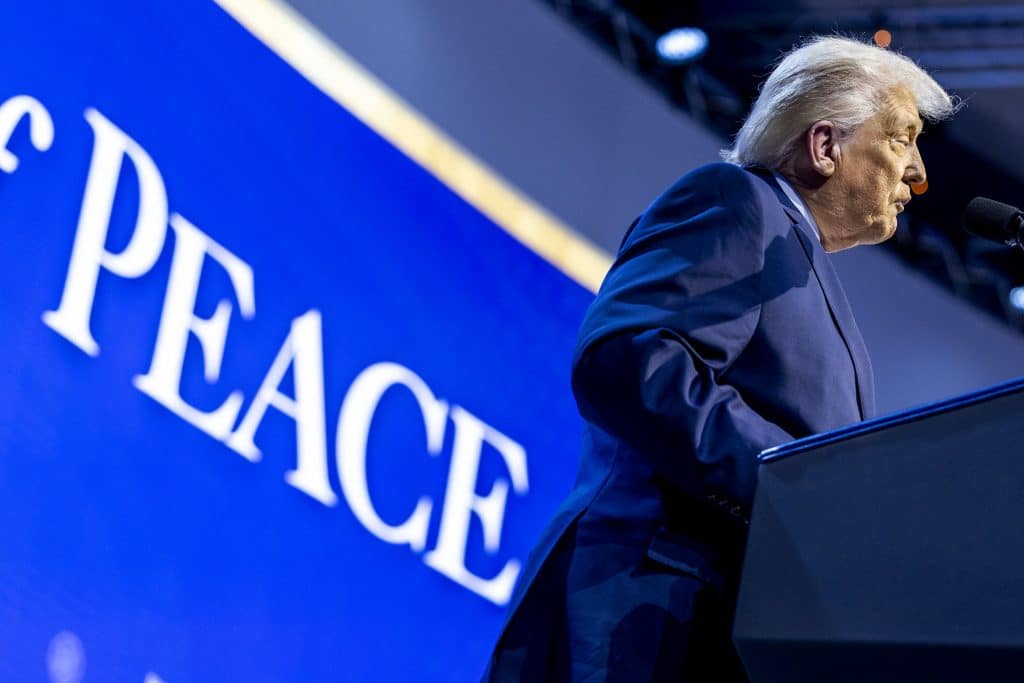
The so-called Board of Peace that President Donald Trump officially launched in Davos, Switzerland last week is developing sweeping plans for a U.S.-backed administration to rule Gaza, according to a draft of the Board’s resolution.
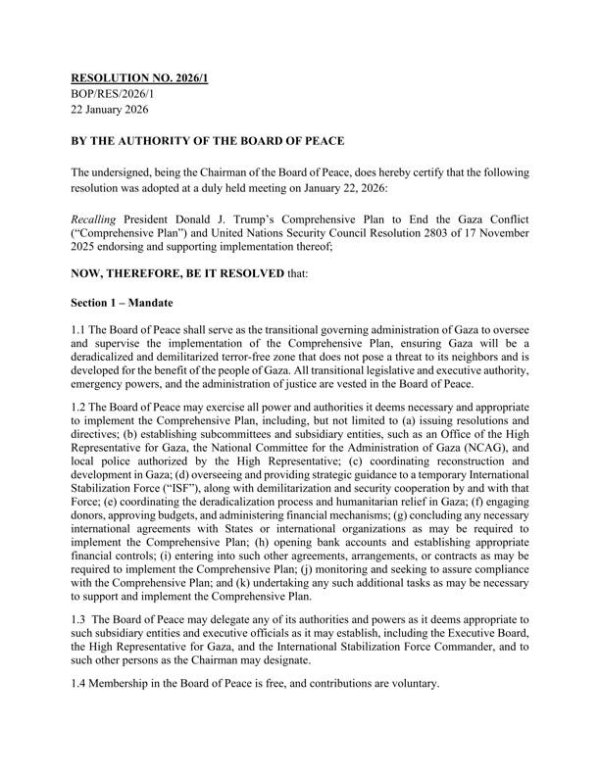
Drop Site obtained the unsigned document, which is dated January 22, 2026 and titled “Resolution No. 2026/1,” from three independent sources, all of whom are in regular contact with U.S. and Israeli authorities regarding Gaza reconstruction. The sources confirmed that its contents align with ongoing discussions in Israel and the U.S. about the implementation of planned governance structures for the Strip.
The resolution, which is the first of its kind from the Board of Peace, details the structure of a U.S.-backed governing authority that would assume full legislative, executive, and judicial control over Gaza, including “emergency powers.” The stated goal of the Board of Peace is to transform Gaza into a “deradicalized and demilitarized terror-free zone that does not pose a threat to its neighbors.”
The copy of the document obtained by Drop Site is unsigned. A blank space is left for the signature of Donald J. Trump, in his capacity as Chairman of the Board of Peace. It remains unclear whether the resolution has been formally adopted, or whether the version received reflects a final text.
The metadata indicates that the document was first created in mid-December by the State Department—and the date on the document corresponds to President Trump’s appearance at the World Economic Forum in Davos, Switzerland, where he formally presided over the official launch of his board.The State Department declined to comment to an inquiry from Drop Site about the resolution.
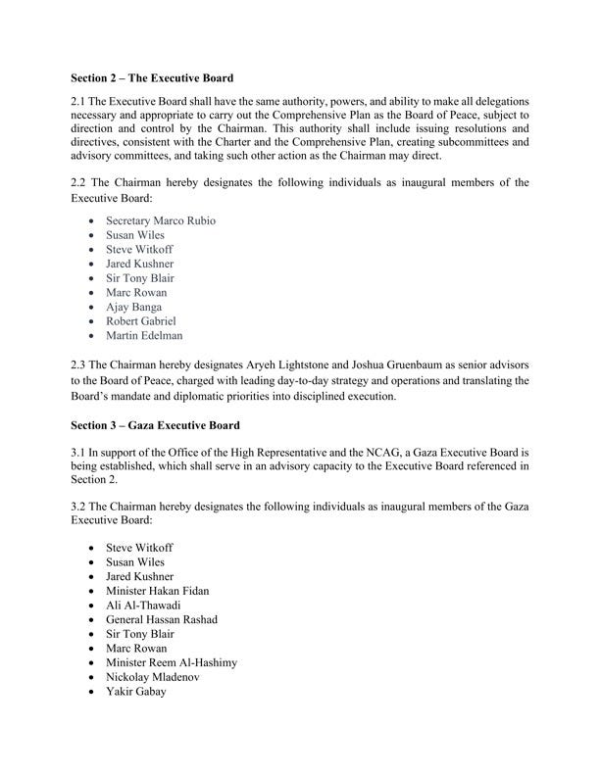
The draft resolution formalizes a hierarchical structure for the Board of Peace, with Trump as the chairperson and an executive board that has “the same authority, powers, and ability to make all delegations necessary and appropriate to carry out the Comprehensive Plan as the Board of Peace.” The Executive Board has the power to “enact new law, or modify or repeal prior” civil and criminal laws in Gaza.
The resolution lists the nine members of the executive board: seven that were already announced by the White House on January 16, plus two more who have not been publicly named. The previously announced members are: Secretary of State Marco Rubio, Special Envoy Steve Witkoff, former UK Prime Minister Tony Blair, Trump son-in-law Jared Kushner, businessman Mark Rowan, World Bank President Ajay Banga, and Deputy National Security Advisor Robert Gabriel. The two new names revealed in the document are Trump’s chief of staff Susan Wiles and Martin Edelman, a real estate attorney and a special advisor to the government of the United Arab Emirates.
There will also be a Gaza Executive Board, which includes several of the same members serving in an advisory capacity.
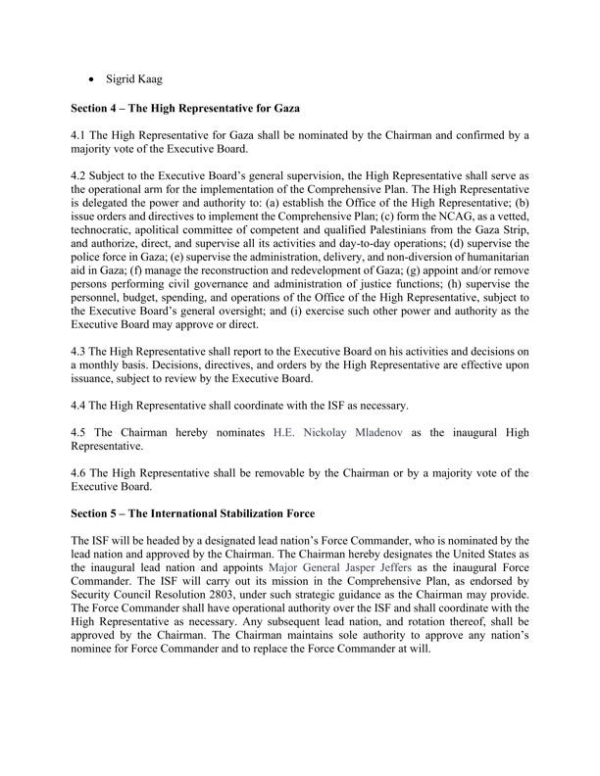
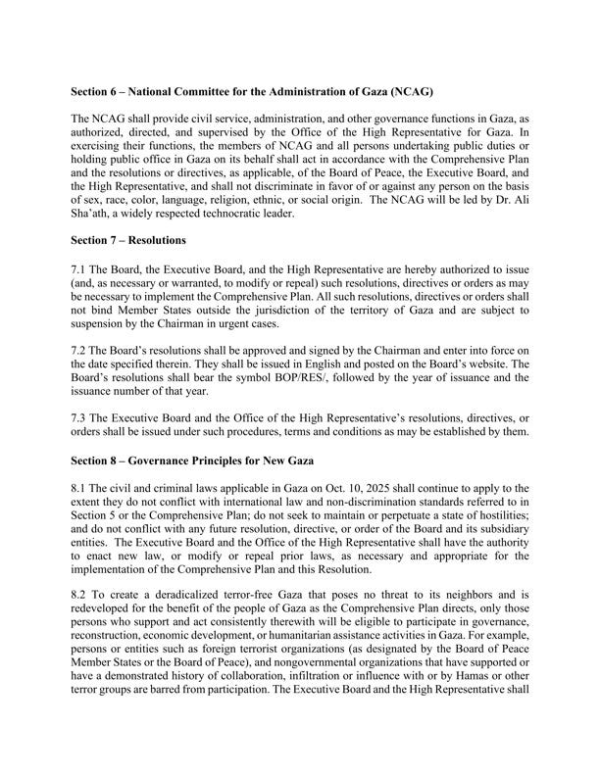
The draft resolution would also establish a National Committee for the Administration of Gaza (NCAG), described as a “vetted, technocratic, apolitical committee” of Palestinians operating strictly under the supervision of a High Representative. The High Representative is named as Nickolay Mladenov, the former Bulgarian defense and foreign minister and a former U.N. envoy to the Middle East. The NCAG would be led by Ali Shaath, a former Palestinian Authority government official. No Palestinians were included on the Board of Peace, though Trump did give a spot to Prime Minister Benjamin Netanyahu, who remains under war crimes indictment and is subject to an arrest warrant by the International Criminal Court. The board, which critics say is an attempt to circumvent any meaningful U.N. oversight or even to position itself as a privatized alternative to the world body, envisions operating in an environment where it answers exclusively to Trump.
“It’s sadly the case that neither the Board of Peace nor its subordinate structures are representative or accountable. This may be seen in the untrammeled power of the Chairman, Mr. Trump himself,” the former United Nations Under-Secretary-General for Humanitarian Affairs and now Executive Director of Mediation Group International, Martin Griffiths, told Drop Site. He added that this imbalance is most evident in the resolution’s treatment of Palestinians, whose involvement is reduced “to the lowest and most technical level.”
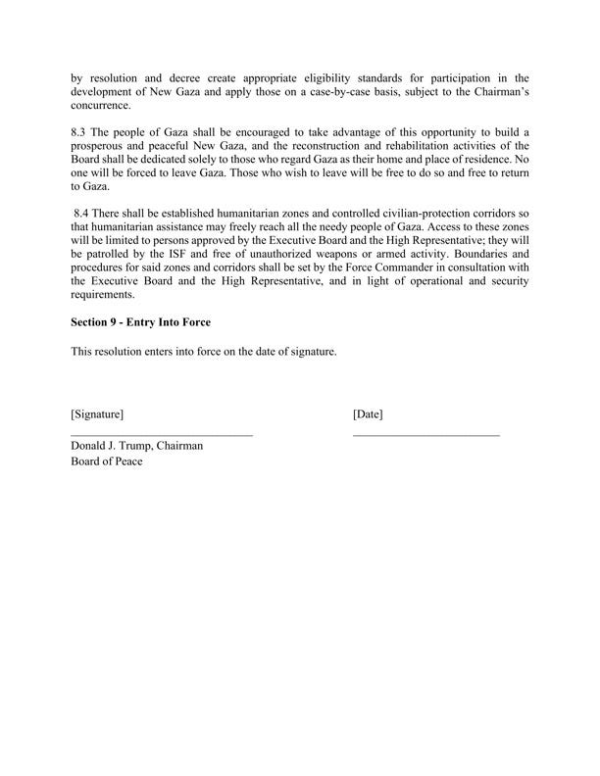
The draft resolution states that “only those persons who support and act consistently” to create a “deradicalized terror-free Gaza that poses no threat to its neighbors” will be eligible to “participate in governance, reconstruction, economic development, or humanitarian assistance activities in Gaza.” It bars from participation any individuals or organizations deemed to “have supported or have a demonstrated history of collaboration, infiltration or influence with or by Hamas or other terror groups.” It does not make clear how these determinations will be made but that the Executive Board and the High Representative will create “eligibility standards for participation in the development of New Gaza” and apply those on a case-by-case basis subject to Trump’s approval. Both Israel and the U.S. have repeatedly denounced without credible evidence UN agencies and nongovernmental organizations as fronts for Hamas or enablers of terrorism.
The Board of Peace draft would establish “humanitarian zones” and “controlled civilian-protection corridors,” patrolled by the International Stabilization Force. Access would be restricted to individuals approved by the Executive Board and the High Representative, with boundaries set according to unspecified “operational and security requirements.” The “temporary” ISF would be led by U.S. Major General Jasper Jeffers, with the Board’s chairman (Trump) solely authorized to approve or replace commanders, as well as to approve future lead nations.
While the resolution states that “no one will be forced to leave Gaza” and that “those who wish to leave will be free to do so and free to return to Gaza,” it also makes clear that access to resources, aid, and political participation in Gaza will be conditional on compliance with the “Comprehensive Plan” and the authority of the Board.
Griffiths criticized the resolution for reducing Palestinians to “implementers of the decisions of others,” leaving them “once again not at all the masters of their own fate.” While Israel, he said, “has a place at the top table,” Palestinians are “deprived and excluded.” “They are nowhere to be found,” Griffiths added, “except at the very bottom of this pyramid of power.”
The resolution states all its provisions would be enacted immediately upon signature.
Full text of resolution obtained by Drop Site News
Download pdf here
Jonathan Whittall
Jonathan Whittall is a political analyst and humanitarian worker with two decades of work in emergencies with MSF and the UN. He is now the Executive Director of the KEYS Initiative.
Trump’s ‘Board of Peace’ Is The Nail In Gaza’s Coffin
Feckless European leaders like Starmer let Israel and the US tear up international law in Gaza. Now, faced with Greenland and Ukraine, they are suffering from a severe case of buyer’s regret
By Jonathan Cook
January 25, 2026
Source: Middle East Eye
US President Donald Trump has declared the three-month “ceasefire” in Gaza a great success, and now wants to move on to phase two of his so-called “peace plan”.
What does success look like? Israeli soldiers have killed more than 460 Palestinians since October, including at least 100 children.
Israel has levelled another 2,500 buildings, the last of the few that were still standing.
And amid a continuing humanitarian catastrophe engineered by Israel through its blockade of food, water, medicines and shelter, at least eight babies are known to have frozen to death as winter temperatures plummet.
Marking the transition to the new phase, Trump announced last Friday a “Board of Peace” to determine the enclave’s future.
“Peace” here is being used in exactly the same Orwellian sense as “ceasefire”. This is not about ending Gaza’s suffering. It is about creating Big Brother-style narrative control, selling as “peace” the final eradication of Palestinian life in Gaza.
The narrative spin is that, once Hamas is disarmed, the board will take on the job of Gaza’s reconstruction.
The implicit assumption is that life will gradually return to normal for the survivors of the two-year genocide Israel has carried out – though no western leader is acknowledging it as a genocide, or cares to find out how many Palestinians have actually been killed in the onslaught.
But, as we shall see, peace is definitely not what the board is aiming to achieve. This is a cynical exercise in smoke and mirrors.
The term “board” hints not only at Trump’s preference for the language of business over politics. It alludes too to the business opportunities he intends to make from Gaza’s “transformation”.
His plan is to strip the United Nations – and thereby the international community – of any oversight of Gaza’s fate.
We are back to the time of viceroys. Colonialism is again out and proud.
Lab rats
Trump’s “Board of Peace” has much grander ambitions than simply managing Gaza’s takeover. In fact, the enclave and its future is not even mentioned in the board’s so-called “charter” sent out to national capitals.
In a leaked invitation to the president of Argentina, Trump referred to the board as a “bold new approach to resolving global conflicts”.
The charter says it will be “results-orientated” and have the “the courage to depart from approaches and institutions that have too often failed”.
Some of us have long warned that Israel and the US view the Palestinians as lab rats, both for testing weapons and surveillance technologies and for changing the norms developed after the Second World War to safeguard against the return of fascist, militaristic and expansionist ideologies.
The critical legal and humanitarian architecture put in place in the post-war era included the UN and its various institutions, including the International Court of Justice (ICJ) and the International Criminal Court (ICC).
Israel and the US stress-tested this system to destruction from the very start of the two-year genocide in Gaza, as Israel carpet-bombed the enclave’s homes, schools, hospitals, government buildings and bakeries.
Trump’s second presidency has pushed this agenda into overdrive.
‘War is peace’
Only this month the White House announced that the US was pulling out of 66 global organisations and treaties – some half of them affiliated with the UN.
Meanwhile, the judges and prosecutors of the ICC have been under draconian US sanctions for issuing an arrest warrant for Israeli Prime Minister Benjamin Netanyahu and his defence minister Yoav Gallant. The ICJ, which is investigating Israel for genocide, appears to have been cowed into silence.
Trump’s kidnapping of Venezuela’s President Nicolas Maduro and his imminent seizure of Greenland are evidence enough that the already dysfunctional, international “rules-based order” is now in tatters. Both the UN and Nato, the West’s so-called “defence” alliance, are on the ropes.
The US president hopes his “Board of Peace” will deliver the knockout blow, supplanting the UN and the system of international law it is there to uphold.
The reconstruction of Gaza may be its first task, but Trump has much larger aspirations.
The board stands at the heart of a new world order being shaped in Trump’s image. Billionaires and their hangers-on will openly decide the fate of weak nations, based on the power elite’s naked, predatory instincts to make money.
In a petulant letter sent to Norway’s prime minister at the weekend, Trump advised that, after being passed over for the Nobel peace prize: “I no longer feel an obligation to think purely of Peace.” What in that case, one might wonder, is the point of a “Board of Peace”?
The answer is that Orwell’s moment is truly upon us: “War is peace.”
Finishing the job
Trump, of course, has sat himself atop this new imperial business venture, an updated East India Company – the gargantuan, militarised corporation licensed by England’s Queen Elizabeth I that went on to pillage much of the globe for more than two centuries, spreading death and misery in its wake.
As chairman, Trump hand-picks the other members – he is reported to have sent out invitations to some 60 national leaders. He can terminate their participation whenever he sees fit. He decides when the board sits and what it discusses. He alone has a veto.
His term as chair, it seems, may extend even beyond his time as US president.
Members are granted a three-year term. A permanent seat at Trump’s new alternative to the UN Security Council can be bought for $1bn in “cash funds”.
Hungary’s far-right leader Viktor Orban was among the first out of the blocks. He was joined by Netanyahu on Wednesday. Other early participants include the United Arab Emirates, Vietnam, Uzbekistan, Kazakhstan, Morocco, Belarus and Argentina.
Russia’s Vladimir Putin is reported to be considering a place at the top table.
The significance of this is not lost on the diplomatic community. One told Reuters: “It’s a ‘Trump United Nations’ that ignores the fundamentals of the UN charter.”
Similarly, in a desperate attempt to hold the line, the French foreign ministry issued a forlorn statement that “reiterates [France’s] attachment to the United Nations charter”.
But the founding UN document, with its formal commitments to non-aggression, self-determination, multilateral obligations and the protection of human rights, has been put through the White House shredder.
Gangsters have no time for rules.
For decades, Israel has been dreaming of this moment: of taking a wrecking ball to the UN and its legal and humanitarian institutions.
With a record number of UN resolutions against it, Israel believes the world body has too often limited its room for manoeuvre. Now it will hope Trump frees it to finish its long-cherished plan of eradicating the Palestinian people from their homeland.
As if in celebration, Israeli bulldozers swept into occupied East Jerusalem on Tuesday to demolish the buildings of Unrwa, the UN refugee agency that has served as the main aid lifeline for Gaza’s people.
Unrwa called Israel’s action an “unprecedented attack” and one that “constitutes a serious violation of international law and the privileges and immunities of the United Nations”.
Don’t hold your breath waiting for the “Board of Peace” to raise any objections.
Decades to rebuild
Trump’s sidelining of the UN means its assessments of the realities facing Gaza, after Israel’s two-year campaign of genocidal destruction, can be quietly shunted into the shadows.
Trump has set a five-year timeline for Gaza’s transition. But the figures simply don’t add up.
The world body has warned that, even if Israel stops its blockade tomorrow, it will take decades to reconstruct Gaza, effectively from scratch, to house those of its 2.1 million inhabitants who survive.
According to estimates from the UN Development Programme, on the best-case scenario it could take seven years to clear some 60 million tonnes of rubble. Other surveys by the UN suggest a more realistic timetable of 20 years, with 10 years to clear unexploded ordnance.
The UN’s trade and development arm further warns that Israel has erased 70 years of human development in Gaza, and destroyed nearly 90 percent of cropland, leading to “the worst economic collapse ever recorded”.
Gaza’s schools, universities, hospitals, libraries and government offices are all gone. And Israel’s so-called “Yellow Line” that divides Gaza into two has annexed in all but name almost 60 percent of what was already a tiny territory, one of the most densely populated on the planet.
The fact is that these enormous hurdles to restoring life in Gaza to anything approximating “modernity” barely register in Trump’s peace plan. There is a good reason for that: strip away the fanfare and the plan has nothing substantive to say about the welfare of Gaza’s population.
Or to put it more bluntly, Trump’s Gaza’s plan is not interested in Gaza’s population because it does not envision them being present in the enclave for much longer.
Israel’s barely veiled goal over the past two years has been the wholesale ethnic cleansing of Gaza. The carpet bombing was intended to make the territory entirely uninhabitable.
Trump’s plan does not conflict with that ambition. It complements it. His “Board of Peace” is the means to arrive at the final destination willed by Israel.
Deepen complicity
The first practical function of the “Board of Peace” will be to entrench the complicity of western and Arab states in Israel’s eradication of Gaza. None can wriggle out of their responsibility for what follows.
Real decision-making powers, however, will reside not in the Board but in an executive body comprising seven figures close to Trump. The “Board of Peace” will presumably be expected to sign off on – and fund – whatever they decide.
This “Founding Executive Board”, like the “Board of Peace”, will have no Palestinian representatives.
Instead, Palestinians will be present only on a technocratic, dogsbody committee, called the National Committee for the Administration of Gaza. It will oversee the administration of day-to-day affairs in the so-called Red Zone, where Gaza’s people are penned up, in place of Hamas.
Finally an “International Stabilisation Force”, a revamped UN peacekeeping force, will be led by a US major-general, and presumably partner closely with Israel’s genocidal army.
Even assuming that Trump has the Palestinians’ welfare at heart – he doesn’t – no progress can be made by any of these bodies until Israel gives its approval.
In the meantime, their role will be to provide a veneer of legitimacy for further inaction, while more of Gaza’s survivors die from the Stone Age conditions engineered for them by Israel.
Note well the three real power brokers appointed to the “Founding Executive Board”: Jared Kushner, Steve Witkoff and Tony Blair. Gaza’s fate is effectively in their hands.
It was Jared Kushner, Trump’s son-in-law and scion of a real estate business family, who way back in February 2024 – long before Trump took office – framed Israel’s genocide in Gaza as “a real-estate dispute”.
It was then that Kushner first publicly floated the idea of developing the enclave into a “very valuable” waterfront property, once it had been “cleaned up”.
Steve Witkoff, a New York real estate mogul and Trump’s special envoy, has spent long months with Kushner – as Israel has been busy clearing out Old Gaza – working on a 40-page prospectus for their proposed New Gaza.
In October, on the US TV news show 60 Minutes, panic was etched on Kushner’s face as Witkoff observed that the pair had been working on a “masterplan” for Gaza’s reconstruction for two years – long before Gaza was levelled by the Israeli military.
He added: “Jared has been pushing this.”
Witkoff’s slip suggested Trump’s team had known from the outset of Israel’s bombing campaign that the intention was to eradicate the whole of Gaza rather than just Hamas. They therefore began working on a business plan to cash in on the carnage.
Through a so-called GREAT Trust – an oh-so-clever acronym for Gaza Reconstitution, Economic Acceleration and Transformation – they have reimagined the enclave as a glitzy seaside resort and a tech hub generating billions of dollars in annual revenue.
A surreal video Trump posted on social media nearly a year ago gave an early idea of what the pair may have in mind. It showed the US president and Netanyahu sipping cocktails on sun loungers in their swimwear amid high rises on Gaza’s ethnically cleansed beachfront.
Gaza’s population – impoverished and malnourished by decades of isolation and blockade, even before the genocide – is viewed as an obstacle to the plan’s realisation.
The enclave’s Palestinians must first be resettled elsewhere, on terms that are as yet unclear, seemingly even to the plan’s formulators.
Cozying up to dictators
Also popping up on the Executive Board, like a bad penny, is Tony Blair, the former British prime minister who misled Parliament and the public to make the case for joining President George W Bush’s illegal invasion of Iraq in 2003.
A subsequent, long, violent US-led occupation resulted in the collapse of Iraqi society, a vicious sectarian civil war, the development of an extensive US torture programme, and the deaths of more than a million Iraqis.
Those seem like exactly the kind of qualifications Trump needs from someone overseeing his Gaza plan.
His administration is therefore selling Blair as a safe pair of hands, a statesman apparently well-acquainted with navigating the yawning gap between the imperious demands of Israel and the forlorn hopes of the Palestinian leadership.
Blair’s skill set, we are assured, will be critically important as the board turns its attention to rebuilding Gaza.
In fact, the last person Gaza needs is Blair, as he proved during his disastrous eight-year stint as special envoy to the Middle East, shoe-horned in by the US in 2007 on behalf of a little-missed, defunct international body known as the Quartet.
At the time most observers mistakenly assumed Blair’s mandate would be to revive a moribund “peace process” between Israel and the Palestinians.
But Blair avoided bringing any diplomatic pressure to bear on Israel and remained silent about what was then a newly instituted blockade of Gaza in 2007 that rapidly eviscerated its economy and left much of its population destitute and poorly fed.
Seizing Gaza’s gas
One of his key battles as envoy was lobbying Israel – over the Palestinians’ heads – to let a British-led consortium drill for natural gas in Gaza’s territorial waters, where large reserves are known to exist.
According to reports, he sought to entice Israel into approving a $6bn deal by promising that the pipeline would head directly to Israel’s port of Ashkelon. Israel would be the only customer permitted to buy the Palestinians’ gas and could therefore dictate the price.
Israel, preferring to maintain its chokehold on Gaza’s people, refused.
Blair claimed he promoted the Gaza gas project at the behest of the Palestinians. But even the supine Palestinian leadership of the Palestinian Authority, based in the West Bank, had no love for him. In 2011 Nabil Shaath, then one of Palestinian leader Mahmoud Abbas’ most trusted advisers, observed of Blair: “Lately, he talks like an Israeli diplomat, selling their policies. Therefore he is useless to us.”
Another official called him “an obstacle to the realisation of Palestinian statehood”.
Like Blair, Trump has no interest in the Palestinians ever benefiting from their own resources. But doubtless he will be keen to leverage the former UK prime minister’s “experience” as envoy to assist in plundering its gas fields.
The centrality of Israel to Blair’s moral worldview was underscored in a comment by him in 2011 about the Arab Spring, in which peoples across the Middle East tried to liberate themselves from the toxic grip of tyrants. The former British prime minister chiefly saw these democratic uprisings as likely to “pose a problem for Israel”.
Trump’s new world order
Blair has denied any personal dealings with Kushner and Witkoff’s Gaza Riviera plan – now sometimes referred to as the Sunshine Project – of luxury beachfront resorts and a “smart manufacturing zone” named for billonaire Elon Musk.
But a version leaked last July suggest his fingerprints are all over the plan, including a proposed “voluntary relocation” scheme to buy out Palestinian landowners with minor sums to leave Gaza.
It emerged that two key members of his think tank, the Tony Blair Institute for Global Change, had been liaising behind the scenes with Israeli businessmen and the Boston Consulting Group on the project.
This week a statement from the institute welcomed Blair’s role on Trump’s Executive Board, noting: “For Gaza and its people, we want a Gaza which does not reconstruct Gaza as it was but as it could and should be.”
It is hard to believe that Blair’s “should” connotes anything other than Israel’s dream of a Palestinian-free Gaza and Trump’s vision of Gaza as a playground for the rich.
The template for a new Trumpian world order is being crafted in Gaza. The US president’s road to the takeover of Venezuela and Greenland is being paved in this tiny Palestinian territory.
Feckless European leaders, like Britain’s Keir Starmer, who helped arm Israel and provided it with diplomatic cover as it levelled the enclave, were the ones who emboldened Trump.
Those now trying to assert the primacy of international law and the “rules-based world order” – whether in Greenland or Ukraine – were the ones who helped Washington destroy that order. They are now suffering from a severe case of buyer’s regret.
They could still stymie Trump’s latest, sinister vanity project by refusing to join the “Board of Peace” and instead defend the United Nations and its legal institutions like the International Court of Justice and the International Criminal Court.
Will they do so? Don’t bet on it.

Jonathan Cook
Jonathan Cook is a British independent journalist, who has covered issues of Palestine and Israel for much of his over 20-year career. He formerly wrote for the Guardian and Observer newspapers and is a winner of the Martha Gellhorn Special Prize for Journalism.
By Dr. Muhammad Zulfikar Rakhmat
January 26, 2026
Source: Originally published by Z. Feel free to share widely.
Indonesia’s decision to join the Board of Peace (BoP) for Gaza is not a diplomatic adjustment. It is a moral collapse. It is a betrayal so grave that it places Indonesia on the side of domination rather than justice, control rather than liberation, power rather than principle.
On Jan. 22, 2026, at the World Economic Forum in Davos, President Prabowo Subianto stood beside U.S. President Donald Trump and signed the charter of the BoP. Foreign Minister Sugiono celebrated this as international recognition of Indonesia’s diplomacy and its commitment to peace in Palestine. He claimed the board would manage Gaza’s administration, stabilize security, oversee reconstruction, supervise a transitional Palestinian authority, open the Rafah crossing for humanitarian aid and deploy an International Stabilization Force.
These are not commitments to justice. They are bureaucratic phrases designed to conceal the removal of Palestinian self-determination and the consolidation of foreign control over Gaza.
This initiative was conceived by Donald Trump — the political architect of Israeli impunity. His record is not one of peacemaking but of systematic dismantling of international law, endorsement of illegal Israeli expansion and enabling policies that reduced Gaza to rubble and mass graves. A political structure designed by such a figure does not exist to free Palestinians. It exists to contain them, discipline them and render their oppression manageable.
Indonesia’s leadership insists this move is a “strategic, constructive and concrete” step toward Palestinian independence. But no concrete guarantees of freedom, sovereignty or equality have been offered. There is no binding mechanism to end military domination, no assurance that Palestinians will exercise real political authority, and no safeguard against Gaza being ruled, rebuilt and reshaped by foreign powers hostile to Palestinian rights.
Instead, Gaza is being placed under an externally designed administrative regime that marginalizes Palestinian agency and empowers those who have spent decades denying it.
Even more damning are the unanswered questions. What actual power does Indonesia hold within this board? Are all members equal, or is decision-making monopolized by Washington? What protections exist to prevent Gaza’s reconstruction from becoming a massive profit-making venture for foreign governments, corporations and elites — turning devastation into investment opportunity and Palestinian suffering into capital? How will Indonesia prevent Gaza from being treated as a development project rather than a homeland restored to its people?
There is no clarity on how disputes among members will be resolved, nor on how states can avoid becoming extensions of Trump’s transactional, coercive diplomacy. If Israeli leaders sit at this table, where is Palestinian representation? Who speaks for Gaza? Who decides its future? And when ceasefires are violated — as history shows they inevitably are — what enforcement power does this board have beyond issuing statements while Palestinians die?
Perhaps the most obscene element of all is the reported requirement of a staggering financial contribution to secure permanent membership. If true, this transforms peace into a purchase, justice into a transaction and solidarity into a commodity. It implies that access to Gaza’s future can be bought — even while Palestinians themselves remain excluded from deciding that future.
This betrayal must be understood within the broader transformation of Indonesia’s foreign policy under President Prabowo. His administration has moved away from Indonesia’s traditional ASEAN-centered diplomacy toward a “post-ASEAN” strategy that prioritizes global stature and great-power alignment over moral consistency. He has sidelined regional forums, aggressively courted Washington, pursued deeper engagement with Moscow and Beijing, and sent Foreign Minister Sugiono to seek entry into BRICS — a move that succeeded in 2025, making Indonesia the first ASEAN nation to join the bloc.
At the same time, Prabowo has cultivated closer ties with Donald Trump and maintained discreet engagement with Israel even before assuming office, including security and agricultural cooperation. Indonesia’s embrace of the Board of Peace must therefore be understood not as humanitarian concern but as geopolitical repositioning — even if that repositioning comes at the expense of Palestinian liberation.
Let us speak plainly about what this board does not do. It does not dismantle apartheid. It does not end occupation. It does not restore stolen land. It does not guarantee political equality. It does not place Palestinians at the center of their own destiny. Instead, it institutionalizes external control, normalizes domination and rebrands subjugation as “stability.”
Peace imposed without freedom is not peace. Reconstruction without sovereignty is not justice. Administration without equality is not liberation. Any future that preserves structures of hierarchy, exclusion and domination — even under new bureaucratic arrangements — merely repackages oppression.
Indonesia once stood firmly on the side of the oppressed. It rejected colonialism, apartheid and occupation not as diplomatic conveniences, but as constitutional and moral obligations rooted in its own anti-colonial struggle. That legacy is now being dismantled.
This board does not exist to liberate Gaza. It exists to manage it. It does not exist to dismantle injustice. It exists to regulate it. It does not empower Palestinians. It sidelines them.
Indonesia’s participation does not soften this structure. It legitimizes it.
Peace cannot be built by those who enabled devastation. Reconstruction cannot be just when it is imposed by those who deny Palestinian humanity. Administration cannot be legitimate when it is designed by those who refuse Palestinians political existence.
By joining the Board of Peace, Indonesia has chosen access over accountability, power over principle, optics over justice and diplomacy over dignity. It has crossed from solidarity into submission, from resistance into accommodation, from moral leadership into moral collapse.
The Indonesian people deserve truth, not slogans. They deserve accountability, not abstraction. And the Palestinian people deserve liberation — not management, not supervision, not occupation by another name.
History will not remember who signed documents in Davos. It will remember who stood against injustice — and who chose instead to normalize it.
Dr. Muhammad Zulfikar Rakhmat
Dr. Muhammad Zulfikar Rakhmat is the Director of the Indonesia-MENA Desk at the Centre for Economic and Law Studies (CELIOS) in Jakarta and a Research Affiliate at the Middle East Institute, National University of Singapore. He spent over a decade living and traveling across the Middle East, earning a B.A. in International Affairs from Qatar University. He later completed his M.A. in International Politics and Ph.D. in Politics at the University of Manchester.
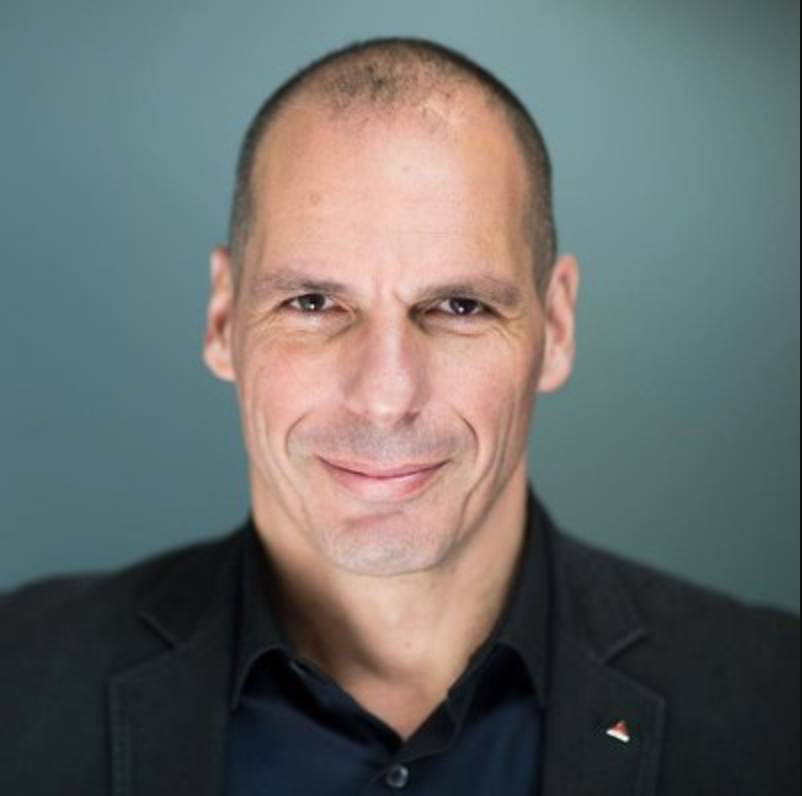
We speak to Greek economist Yanis Varoufakis about the United States under Donald Trump and its attempts to reshape the post-World War II international consensus. “Trump has all his work done for him by placid European centrists who went along with the policy of trashing international law and creating the circumstances for him to create his private company and say, ‘Right, I’m taking over the world,’” laments Varoufakis as he draws a connection between Trump’s pay-to-play diplomacy and the mercantalist policies of European colonial powers. Varoufakis comments on plans for the reoccupation of Gaza by the U.S.-led “Board of Peace,” which signed its founding charter this week; Trump’s designs on the Danish territory of Greenland; and European leaders’ ineffectual, largely symbolic resistance to Trump’s assertion of U.S. supremacy on the world stage.
Transcript
This is a rush transcript. Copy may not be in its final form.
NERMEEN SHAIKH: President Trump hosted an elaborate signing ceremony today in Davos for his so-called Board of Peace. Over 20 countries have joined, but that number is expected to increase. Many critics fear the board could undermine the United Nations. Trump will serve as chairman indefinitely. Each permanent seat has a price tag of a billion dollars, which Trump will control. Trump initially proposed the board to oversee Gaza, but said he now envisions a much broader vision.
PRESIDENT DONALD TRUMP: Once this board is completely formed, we can do pretty much whatever we want to do. And we’ll do it in conjunction with the United Nations. You know, I’ve always said, the United Nations has got tremendous potential — has not used it, but there’s tremendous potential in the United Nations. You know, on the eight wars that I ended, I never spoke to the United Nations about any of them. And you would think that I should have. You would think they could have done those eight wars, but they couldn’t have. And they tried, I guess, in some of them, but they didn’t try hard enough.
This is for the world. As everyone can see today, the first steps toward a brighter day for the Middle East and a much safer future for the world are unfolding right before your very eyes, because I’m calling the world a region. The world is a region. We’re going to have peace in the world. And, boy, would that be a great legacy for all of us. Everybody in this room is a star, or you wouldn’t be here. There’s a reason that you’re here. And you’re all stars.
NERMEEN SHAIKH: The charter makes no mention of Gaza.
Countries that have joined the board so far include many right-wing or authoritarian governments, including Argentina, Azerbaijan, Bahrain, Belarus, Egypt, Indonesia, Morocco, Saudi Arabia, Turkey and the United Arab Emirates. Hungary is the only European country to sign on. France, Norway, Slovenia, Sweden and the United Kingdom have all said they will not join.
Trump has invited Israeli Prime Minister Benjamin Netanyahu and Russian President Vladimir Putin to join the Board of Peace. The Israeli press reports Netanyahu opted not to fly to Switzerland, out of fear that he would be arrested for war crimes. During the Board of Peace ceremony, Trump also suggested a settlement on the Ukraine war is, quote, “coming very soon.”
Also at today’s signing ceremony, President Trump’s son-in-law and senior White House adviser Jared Kushner unveiled the board’s new $25 billion “master plan” for a new Gaza.
JARED KUSHNER: So, we did a master plan. We brought in — I thank you — Yakir Gabay, who’s one of the most successful real estate developers and brilliant people I know. He’s volunteered to do this not for profit, really because of his heart. He wants to do this. And we’ve developed ways to redevelop Gaza.
Gaza, as President Trump’s been saying, has amazing potential. And this is for the people of Gaza. We’ve developed it into zones. In the beginning, we were toying with the idea of saying, “Let’s build a free zone, and then we have a Hamas zone.” And then we said, “You know what? Let’s just plan for plan for catastrophic success.” We — Hamas signed a deal to demilitarize. That is what we are going to enforce.
People ask us what our plan B is. We do not have a plan B. We have a plan. We signed an agreement. We are all committed to making that agreement work. There’s a master plan. We’ll be doing it in phasing. In the Middle East, they build cities like this in — you know, 2-3 million people, they build this in three years. And so, stuff like this is very doable, if we make it happen.
Rafah, we’ll start with. This will show a lot of workforce housing. We think this could be done in two, three years. We’ve already started removing the rubble and doing some of the demolition. And then, New Gaza. It could be a hope. It could be a destination, have a lot of industry, and really be a place that the people there can thrive.
AMY GOODMAN: That’s former — that is former White House adviser, Trump’s son-in-law Jared Kushner.
Meanwhile, President Trump has backed down on his threats to take Greenland from Denmark and to impose tariffs on European allies who oppose his plans — at least for now. After a dramatic day at the World Economic Forum in Davos Wednesday, Trump announced the “framework of a future deal” had been reached for Greenland and the entire Arctic region. During his speech, Trump repeatedly referred to Iceland, instead of Greenland.
PRESIDENT DONALD TRUMP: Iceland, that I can tell you, I mean, our stock market took the first dip yesterday because of Iceland. So Iceland has already cost us a lot of money. But that dip is peanuts compared to what it’s gone up.
AMY GOODMAN: Trump’s comment came after he met with NATO Secretary General Mark Rutte. Details of the framework have not been made public. Trump said the deal would involve the United States getting mineral rights and for Greenland to be used for Trump’s proposed “Golden Dome” missile defense system. Rutte was asked about the deal by journalist Fareed Zakaria.
FAREED ZAKARIA: Does all of this give you a sense that the United States and the current administration is truly committed to the support of Ukraine and to the independence and sovereignty of Ukraine?
MARK RUTTE: Yes. And when it comes to the Arctic, President Trump, in his first term, already said we should spend more time and more energy on the Arctic and to defend the Arctic against the Russians and the Chinese, because the sea lanes are opening up. Greenland, yes. Not only Greenland, it is the whole Arctic, seven nations in NATO, one outside NATO, Russia. And these seven have to defend themselves against Russia and China.
AMY GOODMAN: For more, we go to Athens, Greece, where we’re joined by Yanis Varoufakis, former finance minister of Greece, author of several books, including Technofeudalism: What Killed Capitalism.
Yanis, welcome back to Democracy Now! When we got in touch with you yesterday, the top news was President Trump backing off saying he would invade Greenland, and also dropping the tariffs. But a lot has happened in the ensuing minutes, or, I should say, hours, as it so happens every day now, this fire hose of news. Just as we are broadcasting, President Trump has held a charter signing ceremony for the so-called Board of Peace. While the Board of Peace he referred to was initially for Gaza, he now says it’s the region — it will deal with the region of the world. He said, yes, “The world is a region.” And he was surrounded by everyone from the head of Argentina, Milei, had Belarus sign, Morocco, Saudi Arabia. The European community, meanwhile, is meeting in Brussels, the 27 nations. It’s very interesting to note. Is he having this gathering in Davos to take away from this image of the European community, fiercely critical of what he has done just alone in these last few days, imposing the sanctions, saying he would invade Greenland, what he called Iceland, and then taking it all back?
YANIS VAROUFAKIS: Well, what we see is the geopolitical version of Steve Bannon’s infamous policy or tactic of flooding the zone. He abducts Maduro from Venezuela. Before we have a chance to think about it, he talks about Greenland. Then he threatens military action in Greenland. Then he takes it all back. Then he abandons the Board of Peace. Then he brings it back and, you know, proposes it as a substitute for the United Nations.
I think that, you know, it’s very easy to dismiss this as a toddler on LSD, but I think that behind this tactic, we have the Steve Bannon strategy of making the rest of us, the rest of the world, you know, sink into a black hole of uncertainty, while he’s getting on with the business of enriching himself, a ruling class of tech lords around him, and solidifying his power and keeping his divided MAGA movement somehow pacified.
NERMEEN SHAIKH: And, Yanis, already before today’s developments, you had called the Board of Peace, quote, “one of the most despicable developments” in your lifetime. So, if you could explain what your sense is now, given that we know more about the contours of this board, in particular the fact that the charter itself made no mention of Gaza, though it was supposed to be a Board of Peace for Gaza?
YANIS VAROUFAKIS: When I first heard about the board of Gaza, months ago, it made me think that, you know, this is something that Philip K. Dick would invent — part of science fiction — if he was on really bad drugs. The reason why it is a monstrous idea is because — think about it — what he initially proposed — and this is still going on — is that a private company, headed by him for life, will annex the occupied land of Gaza. And interestingly, the Europeans, they went along with that, because they thought it was only about Gaza. But it wasn’t. They were wrong. It was much bigger than that. It was all about, as we now see, replacing the international order that came out of 1945, the carnage of the Second World War, the Holocaust and so on.
Look, the United Nations, undoubtedly, has proven itself particularly weak. He said so, didn’t he? We heard him say, “Oh, they haven’t sorted out any wars.” Well, there’s a reason for that: because people like him keep vetoing any serious peace proposal at the level of the Security Council.
But the whole point of what he’s doing is essentially to create an unholy alliance of big business. This is — you know, this is what the tech lords, you know, Peter Thiel, various members of this cabal that were with him during his inauguration, the second inauguration — this is a new ideology, the ideology of corporations resembling, if you want, if you want to go back centuries ago, the Dutch East India Company or the British East India Company. That monstrous — how shall I put it? — nightmare is now coming back, in very flimsy terms, with a charter which is not worth the paper it’s written on. But this is the whole intention. This is where we’re being pushed.
NERMEEN SHAIKH: And, Yanis, let’s just talk about who is on this, the executive committee of this board. It includes, of course, Trump’s son-in-law Jared Kushner, Secretary of State Marco Rubio, as well as the former British Prime Minister Tony Blair. Now, the French President Emmanuel Macron refused to join, warning that it could undermine the United Nations. But Trump will not only serve as the board’s chair indefinitely, he will also have veto power over all the board’s decisions. I mean, what do you think that means, especially in light of critics, like yourself, saying that this might actually be an organization that supersedes the United Nations, or, in fact, makes the U.N. entirely redundant?
YANIS VAROUFAKIS: Well, this is not a matter of interpretation. I mean, it’s what Trump wants. It’s what he says he wants to do. He says, “OK, well, maybe we can keep the United Nations as a rubber stamp.” You know, after all, he did push through his proposal of this Board of Peace for Gaza through the Security Council, with the complicity of the French and the British, who are now realizing that this is not just about, you know, Brown people in the developing world. It’s not just about the Palestinians, whom they themselves condemned to genocide. It’s about them, as well. So, they’re beginning to understand that they’re getting their comeuppance.
But, you know, when President Macron, for instance — you mentioned that — says, “Oh, but, you know, your Board of Peace is going to undermine the United Nations,” no, where were — where was President Macron when Israel was, effectively, wiping the floor clean with the Charter of the United Nations, with the decisions of International Court of Justice ordering Israel to withdraw from Occupied Territories? The answer is, people like President Macron and Prime Minister Keir Starmer of Britain and Friedrich Merz, the chancellor of Germany, were aiding and abetting this trashing of the United Nations. So, in a sense, Trump has all his work done for him by placid European centrists who went along with the policy of trashing international law and creating the circumstances for him to create his private company and say — right? — “I’m taking over the world.”
NERMEEN SHAIKH: Yanis, but what about this fact of a billion dollars? Each member will pay a billion dollars to join. Now, this is unprecedented as far as international organizations go. Which international organizations require payment from member states?
AMY GOODMAN: And, of course, Trump will all —
YANIS VAROUFAKIS: Well, it’s not unprecedented.
AMY GOODMAN: — will be in charge of that money.
YANIS VAROUFAKIS: It’s not at all unprecedented. It’s how capitalism made its first fluttering moves. Remember the East India Company, both the Dutch version and the British version? How did it happen? In the case of the British East India Company, while Shakespeare was writing a play somewhere in London, businessmen got together, and they chipped in the equivalent of a billion pounds or dollars, or whatever, each to create that company. And that company, in the end — let us not forget that — was the first colonizer. They had 200,000 soldiers under their command. They took over East India. They took over Indonesia. And it was only later that states came and effectively nationalized colonialism.
So, we are going back many centuries. It’s not — maybe it’s unprecedented given the narrative that we have been led to believe falsely, that it’s now permanent, over the last 60, 70 years. But, essentially, Trump is, with the complicity of the Europeans, at least in terms of their deeds, if not their words, is trying to maintain American hegemony, the hegemony of a very tiny ruling class of the United States, not of the people of the United States, over the world.
AMY GOODMAN: It’s very interesting that Commerce Secretary Howard Lutnick was heckled at the World Economic Forum dinner earlier this week, with the European Central Bank President Christine Lagarde walking out. Lutnick had written in an opinion piece in the Financial Times earlier this week, saying, “We’re not going to Davos to uphold the status quo. We’re going to confront it head-on. … We are here at Davos to make one thing crystal clear: With President Trump, capitalism has a new sheriff in town.” Yanis Varoufakis?
YANIS VAROUFAKIS: Well, it is interesting, isn’t it? What he said to them was, “We’re not here to join your multilateral global order, which we Americans created in the first place, and you became beneficiaries of that. We’re here to bury it.”
You know, Christine Lagarde walked out. But where did she walk towards? Back to Frankfurt, to the European Central Bank, which is steadfastly refusing to do anything in order to challenge the hegemony of the U.S. dollar. Because, you know, here in Europe, we have manufactured a European Union and a monetary union, for decades now, in a manner that it was always subservient to the United States, always acquiescent towards the dollar zone, towards the authority of the Federal Reserve. Never, never did the Europeans try to create — it’s not that they tried and failed. They never wanted to create a sustainable, independent Europe. And now they are running around like headless chicken, bleeding around, you know, in apoplexy, but without a plan. There is no European plan, for instance, for Ukraine.
There is no — what happened when, you know, President Trump ordered the Marines to go into Venezuela and abduct Maduro, whatever one thinks about Maduro? Did they protest the violation of international law? No, because they, again, like in the case of the Board of Peace in Gaza, they thought that this is for Brown people, you know, for people in the developing world. So, this is — you know, as a European, I am far more cross with our own leaders here, who, you know, now protest. But it’s too late.
AMY GOODMAN: Very interesting to see Jared Kushner giving, center stage, a PowerPoint presentation on what they would do with Gaza — you know, no Palestinians included here — and President Trump himself saying today, describing Gaza as a “beautiful piece of property,” said he is a “real estate person at heart.” As we begin to wrap up, your comments on what this means for Israel and Gaza, and Netanyahu not coming to stand with his friend, President Trump, in Davos, concerned that he could be arrested for war crimes when he comes into Switzerland?
YANIS VAROUFAKIS: Well, that’s the only silver lining, that something keeps him up at night. He’s a war criminal, and he should be kept up at night.
But just to answer your question directly, what this Board of Peace plan for Gaza is is the completion of the genocide. This is the logical limit of what Israel has been doing, to treat Gaza as a piece of real estate. Palestinians don’t exist. They can only exist as servants, as in the same way that under South African apartheid, the Blacks were tolerated only to the extent that they didn’t choose where to live, that they were confined in Bantustans, and they were beaten up the moment they asserted their right to exist and to breathe as human beings.
NERMEEN SHAIKH: And finally, Yanis, if you could talk about the latest with respect to Trump’s comments on Greenland, withdrawing his threat to impose tariffs on Europe, and what the latest is about these talks that he says the framework of an agreement that’s been reached with NATO on Greenland’s status?
YANIS VAROUFAKIS: Well, it seems to me that he’s retreated slightly, from a tactical perspective, from saying, “Greenland is going to be mine,” like Alaska was sold by Russia to the United States. Now he’s shifting to saying, “I’m going to have freehold. I’m going to have something along the lines of Guantánamo Bay,” a permanent freehold or leasehold with Denmark. But, of course, you know, we will probably have to revisit this conversation tomorrow or the day after, because this is not a settled agreement.
AMY GOODMAN: We want to thank you very much for being with us. We’re going to end with the comments of the Canadian Prime Minister Mark Carney addressing world leaders at Davos.
PRIME MINISTER MARK CARNEY: Let me be direct. We are in the midst of a rupture, not a transition. Over the past two decades, a series of crises in finance, health, energy and geopolitics have laid bare the risks of extreme global integration. But more recently, great powers have begun using economic integration as weapons.
AMY GOODMAN: Yanis Varoufakis, we just have 30 seconds. Your response, as he talks about the great disruption at this point?
YANIS VAROUFAKIS: A brilliant speech, a very good diagnosis of where we are, and a terrible recipe for what we should be doing.
AMY GOODMAN: Yanis Varoufakis, we thank you so much for being with us, a former finance minister of Greece. Most recent book is titled Raise Your Soul: A Personal History of Resistance. And we will have you back on to talk about that book, co-founder of Progressive International.

No comments:
Post a Comment