Thursday, August 26, 2021

US offshore oil workers flee as storm approaches Gulf of Mexico
Reuters | August 26, 2021 

Shenzi Petroleum development in the deepwater Gulf of Mexico. (Image courtesy of BHP Billiton.)

U.S. energy companies on Thursday began airlifting workers from Gulf of Mexico oil production platforms and moved vessels from the path of what could become a devastating hurricane by the weekend.


A storm brewing in the Caribbean Sea is forecast to grind through the main oil-producing region of the Gulf. It could become a major hurricane ahead of landfall on the central Gulf Coast, the National Hurricane Center said. Hurricanes with winds of up to 111 miles (178 km) per hour are classified as major and can bring devastating damage onshore.

BP PLC, BHP, Chevron, Equinor and Royal Dutch Shell have begun removing workers from offshore facilities, spokespeople said. BHP, Shell and Chevron are beginning with non-essential staff while Equinor said it is preparing to move workers off its Titan platform.

BHP and BP said they have begun to shut in production at offshore platforms. Chevron said its production remained at normal levels on Thursday. Occidental Petroleum and Hess Corp said they are monitoring weather conditions.

U.S. Gulf Coast gasoline prices rose in the past two sessions because of concerns around the storm, traders said.

Gulf of Mexico offshore wells account for 17% of U.S. crude oil production and 5% of dry natural gas production. Over 45% of total U.S. refining capacity lies along the Gulf Coast.

Exxon Mobil Corp said it was preparing its 520,000 barrel-per-day (bpd) Baton Rouge, Louisiana refinery for severe weather, but operations were normal on Thursday.

Phillips 66 operations at refineries in Lake Charles and Alliance, Louisiana, “will be adjusted based on the storm’s progression,” spokesman Bernardo Fallas said.

The preparations comes nearly four years to the day after Hurricane Harvey hit the Gulf Coast and dumped several feet of rain in areas of Texas.

“This storm has the potential for rapid increases in intensity before it comes ashore” because of extremely warm waters off Louisiana, said Jim Foerster, chief meteorologist at DTN, which provides weather advice to oil and transportation companies.

“Water temperatures are 85 degrees to 88 degrees Fahrenheit (29-31 degree Celsius), that’s anomalously high, 3 to 5 degrees higher than it normally would be,” said Foerster. Its projected path over warm waters will mean it drops heavy rains that cause onshore flooding, he said.

(By Sabrina Valle, Erwin Seba, Gary McWilliams and Liz Hampton; Editing by Marguerita Choy and David Gregorio)
US Capitol Police officers sue Trump over January 6 riot

The suit alleges Trump incited the Capitol attack and that he conspired to prevent the certification of the presidential election.

TRUMP GIVING WHITE POWER SIGN JAN 6,2021
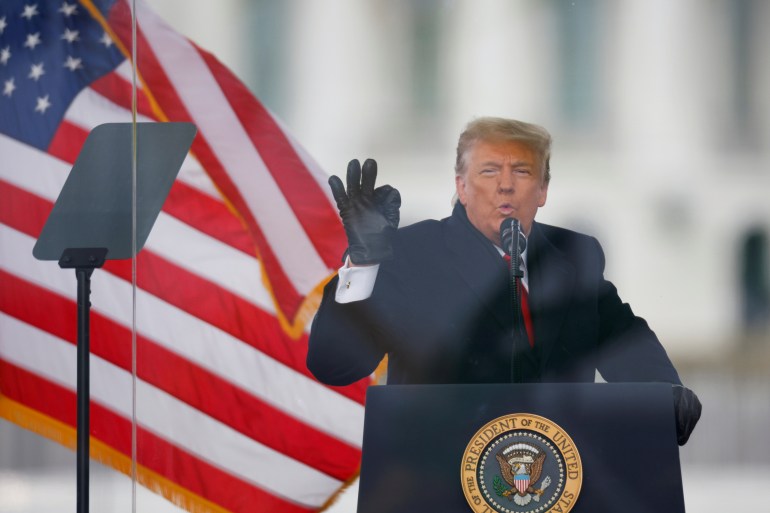
Seven US Capitol Police officers accuse US President Donald Trump of inciting the January 6 riot in a new lawsuit [File: Jim Bourg/Reuters]

26 Aug 2021

A group of seven US Capitol Police officers are suing former President Donald Trump accusing him of conspiring with far-right groups and intentionally sending a violent mob on January 6 to disrupt the congressional certification of the election.

The suit filed on Thursday in federal court in Washington, DC, alleged Trump “worked with white supremacists, violent extremist groups, and campaign supporters to violate the Ku Klux Klan Act, and commit acts of domestic terrorism in an unlawful effort to stay in power”.
KEEP READINGTrump lawyers sanctioned by US judge in ‘frivolous’ election suit‘Grabbed, beaten, tased’: Police testify in US Capitol riot probePence does not see ‘eye to eye’ with Trump on US Capitol riot

The suit was filed on behalf of the seven officers, five of whom are Black, by the Lawyers’ Committee for Civil Rights Under Law. It names the former president, the Trump campaign, Trump ally Roger Stone and members of the far-right groups the Proud Boys and Oath Keepers who were present at the Capitol and in Washington on January 6.

The 71-page suit lays out in detail the officers’ arguments that Trump and his supporters conspired in the months leading up to January 6 “to prevent Congress from certifying the election results through the use of force, intimidation, and threats”.

The suit also describes racial epithets directed at the officers during the riot, as well as injuries they suffered “from being physically struck by attackers and from exposure to noxious pepper spray, bear spray, fire extinguishers, and other pollutants sprayed by attackers”.

Other similar cases have been filed in recent months by Capitol Police officers and Democratic members of Congress.

A report last week by the Reuters news agency, however, revealed that the FBI has found scant evidence that the attack was the result of an organised plot to overturn the presidential election result.

The FBI, at this point, believed the violence was not centrally coordinated by far-right groups or prominent supporters of then-President Donald Trump, Reuters reported, according to four current and former law enforcement officials who have been either directly involved in or briefed regularly on the wide-ranging investigations.

The sources told Reuters that FBI investigators did find that cells of protesters, including followers of the Oath Keepers and Proud Boys groups, had aimed to break into the Capitol. But they found no evidence that the groups had serious plans about what to do if they made it inside, the sources said.

Congressional investigation

A House committee has started to investigate in earnest what happened that day, sending out requests Wednesday for documents from intelligence, law enforcement and other government agencies. Their largest request so far was made to the National Archives for information on Trump and his former team.

The requested documents are just the beginning of what is expected to be a lengthy, partisan and rancorous investigation into how the mob was able to infiltrate the Capitol and disrupt the certification of Biden’s presidential victory, inflicting the most serious assault on Congress in two centuries.

In a statement Wednesday evening, Trump accused the committee of violating “long-standing legal principles of privilege”.

“Executive privilege will be defended, not just on behalf of my Administration and the Patriots who worked beside me, but on behalf of the Office of the President of the United States and the future of our Nation,” Trump said.

Committee members are also considering asking telecommunications companies to preserve phone records of several people, including members of Congress, to try to determine who knew what about the unfolding riot and when they knew it. With chants of “hang Mike Pence,” the rioters sent the then-vice president and members of Congress running for their lives and did more than $1m in damage, and wounded dozens of police officers.

The demands were made for White House records from the National Archives, along with material from the departments of Defense, Justice, Homeland Security and Interior, as well as the FBI and the Office of the Director of National Intelligence.

The committee so far has heard from police officers who were at the Capitol on January 6. In emotional testimony, those officers spoke of how afraid and frustrated they were by the failure of law enforcement leaders to foresee the potential for violence and understand the scope of planning by the Trump backers.

SOURCE: AL JAZEERA AND NEWS AGENCIES

US Palestine solidarity activists rally against Bennett’s visit

A meeting between Naftali Bennett and Joe Biden was moved to Friday amid turmoil in Afghanistan.

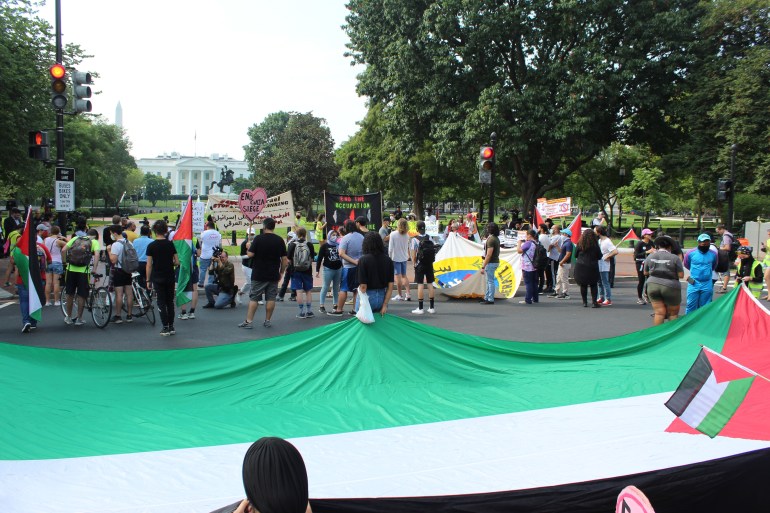
Pro-Palestinian activists gather near the White House to protest the visit by Israeli Prime Minister Neftali Bennet, August 26 [Ali Harb/Al Jazeera]

By Ali Harb
26 Aug 2021

Washington, DC – Dozens of Palestinian rights advocates have gathered near the White House to denounce a visit by Israeli Prime Minister Naftali Bennett to Washington.

Waving Palestinian flags and chanting against the occupation, the demonstrators on Thursday called on President Joe Biden to uphold his campaign promise to advance human rights globally.
KEEP READINGPalestinians in Gaza protest against Israel’s crippling blockadeIn a bid to ease tensions, Israel says will allow goods into GazaBiden, Bennett to discuss Iran’s ‘out of the box’ nuclear program

Biden was set to meet Bennett at 11:30 (15:30 GMT) but the bilateral talks were moved to Friday as the White House turned its attention to the situation in Kabul where two explosions killed and wounded people outside the airport.

“The US is sending this message of moral authority, moral responsibility, but then they don’t do anything when the Israelis commit violence against Palestinians,” Yousef Abdelfattah, a 24-year-old protester, told Al Jazeera.

The activists invoked Israeli efforts to forcibly displace Palestinian families from their homes in the Jerusalem neighbourhood of Sheikh Jarrah and the blockade on Gaza, where Israeli forces have wounded dozens of protesters this week.

They urged Biden to end the “blank cheque” policy to Israel.


Laura Albast, an activist with the Palestinian Youth Movement, one of the groups that organised the protest, said Biden has failed to deliver on his promise of conducting a human rights-centred foreign policy.

“But we’re here to stay, and he will listen to us whether he likes it or not,” she said.

Bennett told the New York Times earlier this week that his government will not proceed with former Prime Minister Benjamin Netanyahu’s plans to annex large parts of the West Bank.

“This government will neither annex nor form a Palestinian state, everyone gets that,” he said, citing the delicate balance in his coalition cabinet that spans across the ideological spectrum in Israeli politics.

Albast, however, said de-facto annexation is continuing, even if it is not formally announced, noting Israeli policies against Palestinians in East Jerusalem, which Israel annexed in 1980.


“The families in Sheikh Jarrah are still under threat of losing their homes, and houses in Silwan have already been demolished, including small businesses of Palestinians,” she told Al Jazeera.

The Biden administration regularly calls for “equal measures” of freedom for Israelis and Palestinians, but it has categorically rejected suggestions of restricting or conditioning the annual $3.8bn in military aid to Israel.

The president and his top aides have also avoided publicly criticising the Israeli government.
Dozens of Palestinian rights advocates gather in front of the White House, August 26
 [Ali Harb/Al Jazeera]

Before a meeting with Bennett on Wednesday, Secretary of State Antony Blinken said the American-Israeli partnership is “unshakable”.

The State Department later released a statement saying Blinken reiterated Washington’s commitment to Israel’s security.

“The Secretary also emphasized that Israelis and Palestinians alike deserve equal measures of freedom, prosperity, and dignity, which is important in its own right and as a means to advance prospects for a two-state solution,” the statement said.

A senior administration official told reporters earlier this week that Biden will promote the two-state solution in his talks with Bennett.

“We’ve had very constructive discussions with this new government on the set of issues regarding Israel-Palestinian peace,” the official said.

“President Biden believes a negotiated two-state solution is ultimately the only way to ensure Israel’s future [as a] democratic and Jewish state.”

At the protest on Thursday, Nihad Awad, the executive director of the Council on American-Islamic Relations (CAIR), an advocacy group, said by hosting Bennett and refusing to condemn Israeli policies, Biden is letting down the voters seeking justice, who elected him.

“I remind President Joe Biden today that he’s breaking his promise that he will honour and promote and defend human rights … Justice for people here is no different than justice for people in Palestine,” Awad said.

SOURCE: AL JAZEERA

The Photos That Show Everything Wrong With Our Current Moment

The Caldor Fire is closing in on Lake Tahoe. Firefighters are doing everything they can to battle the blaze while... people just golf?


A golfer wears a face mask as he practices his putting at the smoke-shrouded Lake Tahoe Golf Course in South Lake Tahoe, California.
Photo: Rich Pedroncelli (AP)

The Caldor Fire is California’s latest megafire in a wildfire season from hell. It’s among a number of unchecked blazes, but this one hits slightly different because it’s encroaching on the Lake Tahoe basin.

The fire has continued to march eastward from its ignition point in the El Dorado Forest, engulfing more than 450 structures along the way. The fire front now sits roughly 13 miles (21 kilometers) from South Lake Tahoe, a tourist hot spot. As 2,531 firefighters battle the blaze, it appears to be business as smoke-choked usual in Tahoe.

Images show people in the resort town, casinos, and surrounding recreation spots acting out some semblance of normal life even as ash rains down and fires burn ever-closer. The above photo captures the surreal hell as a man plays golf in a mask to keep smoke or covid-19 (or both) at bay.

A green golf course in California is also, of course, a symbol of what’s wrong with the West right now. The region is gripped in a profound megadrought, fueled by the climate crisis, that has primed forests to burn. It’s also triggered water supply cuts to parts of the region. Reservoirs in the state have plunged to record lows, causing a dropoff in hydropower production and widespread fish dieoffs as waterways become too warm for salmon to navigate.

The putting green in the midst of apocalypse is only one of the profoundly unnerving images that define our times and the increasingly weird juxtapositions between everyday life and losing everything. Let’s take a tour through the corner of California’s hell.

Start slideshow
Sports cars, drugs, death: Thai police colonel investigated

David Rising
The Associated Press Staff
Thursday, August 26, 2021

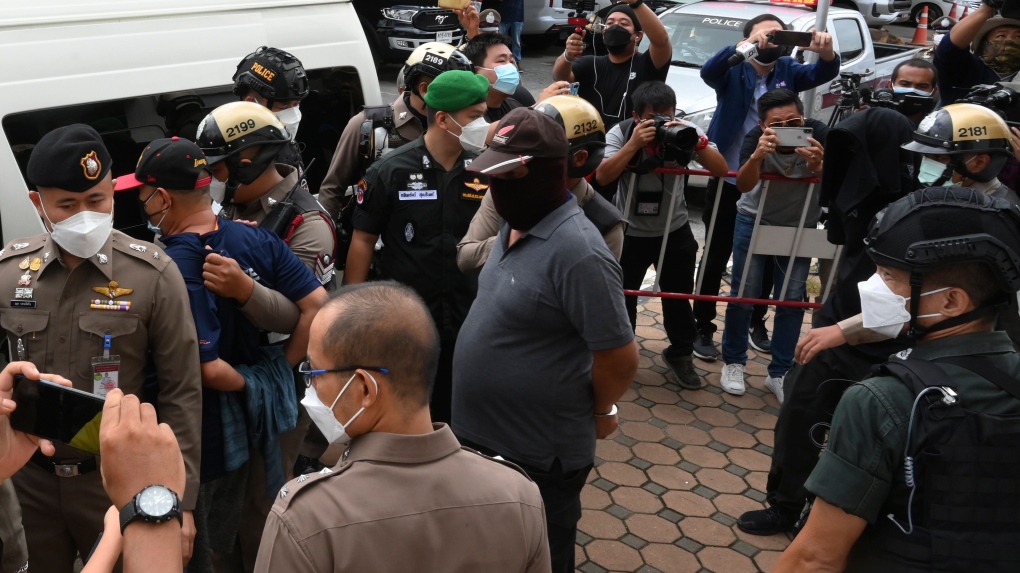
Three of five police officers who are accused of jointly murdering a suspect are brought to Nakhon Sawan Provincial Court to request a remand in Nakhon Sawan province, Thailand, Thursday, Aug. 26, 2021. (AP Photo/Surat Sappakun)

BANGKOK -- A Thai police colonel known as “Jo Ferrari” due to his collection of fine cars, who was wanted on suspicion of involvement in the death of a detained drug dealer who was allegedly being shaken down for cash, turned himself in on Thursday amid a nationwide manhunt.

Police officials said Col. Thitisan Utthanaphon turned himself in at a police station in Saen Suk, a coastal village southeast of Bangkok. Another suspect, Lt. Thoranin Matwanna, was apprehended in a town southwest of the capital.

“I apologize that this has happened,” National Police Chief Suwat Janyodsuk told reporters at a news conference late Thursday. “We never release anyone who did wrong without punishment.”

He said little more about the case, but gave the apprehended colonel an opportunity to address reporters by telephone and answer questions.

Thitisan defended his actions, denying any part in a shakedown and insisting he was attempting to get information from the drug dealer about where he had stashed his main supply of methamphetamine.

“Since I've been in the police I have never been involved in corruption,” the colonel said. “I did not have any intention to kill him. I just wanted to do my work.”

Thai media have reported that Thitisan had a collection of 29 luxury automobiles worth more than 100 million baht ($3 million), some of which he kept at a home in Bangkok worth about 60 million baht ($1.8 million).

One of the cars found at the house, a yellow Lamborghini, was purchased by Thitisan from a car company that was involved in a tax evasion investigation two years ago, the police Department of Special Investigation said. Thitisan was not charged in that case.

Police on Thursday did not immediately say what charges Thitisan is being held on.

Earlier in the day, five other suspects, including a major and a captain, were brought before a judge who ordered them held without bail on charges of dereliction of duty, torture and murder.

Thitisan, who was chief of the station in Nakhon Sawan province, disappeared shortly before a video surfaced on social media that appears to show him directing the deadly assault on the suspect.

Police started investigating the case only after a well-known lawyer, Decha Kittiwittayanan, published an account of it on his Facebook page on Sunday.

Decha said he had received a complaint from a junior policeman in Nakhon Sawan who said that police had arrested two drug suspects, the 24-year-old man and his female companion, with more than 100,000 methamphetamine tablets.

The policemen first demanded 1 million baht ($30,560) from the suspects, which they agreed to pay for their release, according to the account. But then Thitisan demanded double that amount and ordered his subordinates to cover the male suspect's head with a plastic bag and beat him until he agreed, said the junior policeman, whose name was not revealed.

When the suspect died, Thitisan allegedly ordered his men to take the body to the hospital and tell the doctor the death was caused by a drug overdose. The junior policeman said the woman was released but told not to say anything about it, and that Thitisan paid the victim's father to remain silent.

The initial police response to the furor over the story posted by the lawyer was to transfer Thitisan to another post.

On Tuesday, however, a video clip of the incident was shared on the Facebook page of another lawyer, Sittra Biabanggerd, who said he had received it from a police officer at the Nakhon Sawan station where all but one of the suspects worked.

It shows the male suspect in handcuffs being led into a room, his head covered with a black plastic bag.

He is then assaulted and thrown to the floor by officers who put more bags on his head. One of them appears to briefly kneel on him until he goes limp.

Allegations of police brutality and corruption are not uncommon in Thailand, and Human Rights Watch called Thursday for a transparent, outside investigation.

“A prosecution fully independent of the Thai police is needed if there is any hope of justice,” said Brad Adams, the group's Asia director.

“Successive Thai governments have a long history of failing to ensure accountability for even the most ghastly police abuses against people in custody,” he said.

Associated Press reporters Chalida Ekvitthayavechnukul and Tassanee Vejpongsa contributed to this report.

Thai police chief accused of killing suspect in custody is arrested

Manhunt for Thitisan Utthanaphon followed allegation he tortured suspect to death to extort money


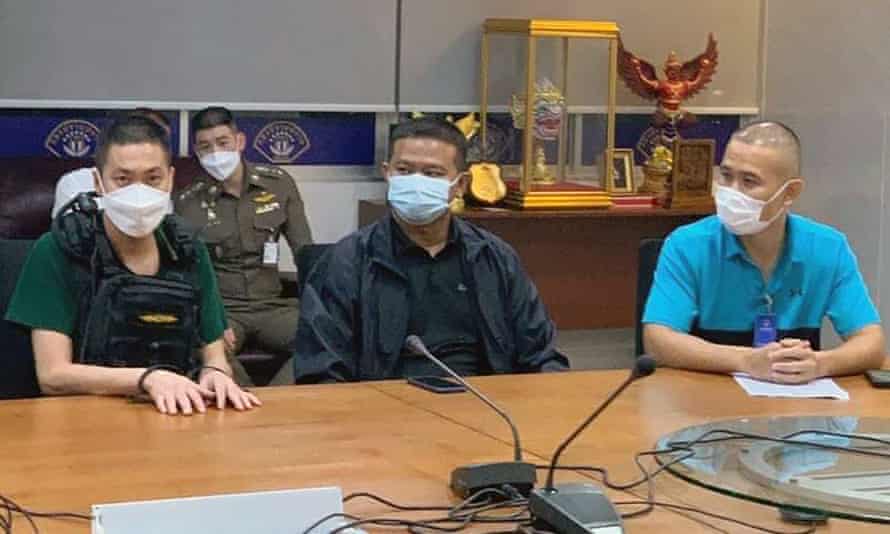
Thitisan Utthanaphon (left) at a press conference at which he admitted
 using violence during interrogation, but said he had been trying to obtain information. Photograph: Royal Thai Police Handout/EPA

Ryn Jirenuwat and Rebecca Ratcliffe in Bangkok
Thu 26 Aug 2021 

A Thai police chief accused of torturing and killing a suspected drug dealer while in custody, allegedly in an attempt to extort tens of thousands of pounds, has been arrested following a manhunt.

Thitisan Utthanaphon, 39, who has been removed from his position as superintendent of Muang police station in Nakhon Sawan, north of Bangkok, is accused of trying to extract 2m baht (£44,463) from the suspect. He disappeared days before a video of the incident went viral on social media, but was detained by police on Thursday.


The woman on a mission to expose torture in Thailand’s troubled south

As police searched Thitisan’s home this week, Thai media showed footage of his vast, luxury estate, including a collection of expensive sports cars. He reportedly owns 29 cars worth more than 100m baht (£2.2m), which have earned him the nickname “Jo Ferrari”.

At a press conference held after his arrest, Thitisan, who was dialled in to speak to media, admitted using violence during the interrogation but said he had only been trying to obtain information about potential criminal activities. “I must testify that I didn’t have any intention to kill him. My intention was to work, to work for the people, and prevent people’s children from getting addicted to drugs,” he said.

Kissana Phathanacharoen, deputy spokesperson for Royal Thai police, said two other officers had been arrested on Thursday in relation to the case, and that a further five were arrested on Wednesday. “Disciplinary actions have also been taken against those seven police officers,” he said.

In his comment, Thitisan said: “For my subordinates, I take all responsibly [for what they did] because I ordered them. They have nothing to do with this. They tried to stop me. I take all the responsibility.”

He denied suggestions that he had been trying to extort money, stating: “We did it because it is for our job. Money isn’t involved.” He added: “Never once in my police life I have ever been corrupted.”

A recording of the interrogation shows an officer placing multiple plastic bags over the head of a handcuffed man. The man is then pushed to the floor. Police later try to revive him by carrying out CPR and pouring water on his face, but are not successful.

The man has been named by Thai media as Jeerapong Thanapat.

When Jeerapong died, Thitisan allegedly ordered officers to tell doctors the death was caused by a drug overdose, according to an account of the incident posted on Facebook by a prominent lawyer, Decha Kittiwittayanan, who said he had been contacted by intermediaries for at least one anonymous whistleblower.

The officers had tried to report the incident internally, Decha told Thai media, but no action was taken. They shared their accounts with him because they wanted the story to be made public and forwarded to the national police commissioner, he said. “They made complaints to various places. They made complaints to local media, few [well known] Facebook pages, and supervisors but nothing was done,” he said.

Footage was also sent to a different lawyer, reportedly by a junior officer who wanted the matter investigated. It was shared widely on social media, prompting public outrage and calls for reform.

Thai police already face growing criticism over its use of force, including rubber bullets, to control recent anti-establishment demonstrators in Bangkok. The response to recent protests has been disproportionate, according to rights groups, who also warn the case involving Jeerapong is far from isolated.

“This is not the first death in custody in this country. It is just one that has been caught on camera,” said Pornpen Kongkachonkiet, director of Cross Cultural Foundation, a human rights group.

“Trust in the police among the public is at rock bottom. This is yet another reminder of the urgent need for an end to police impunity and for the police force to demonstrate to the public – who pays their salaries – that they work for them,” Pornpen said.

Human Rights Watch has said the case should be a wake-up call for Thai police, and that an independent investigation was needed. “Successive Thai governments have a long history of failing to ensure accountability for even the most ghastly police abuses against people in custody,” said Brad Adams, the Asia director at Human Rights Watch.

CATHOLIC CHURCH SEXUAL ABUSE IS ABOUT THE FAILURE OF ABSTENINCE 
The challenge of sexual abuse: What has happened since the February 2019 Summit
AND ITS COVER UP

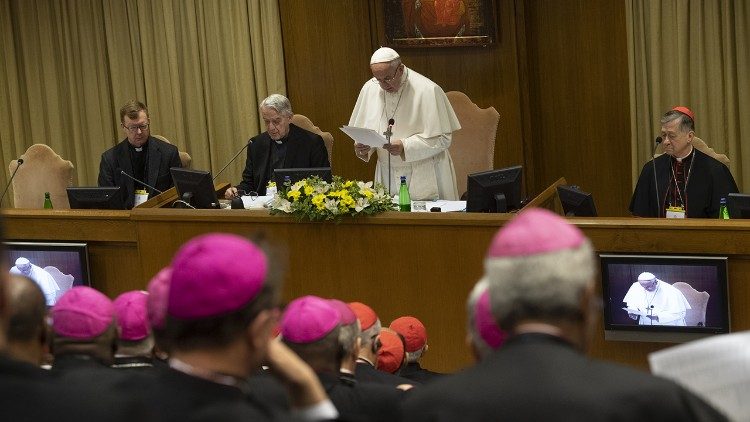
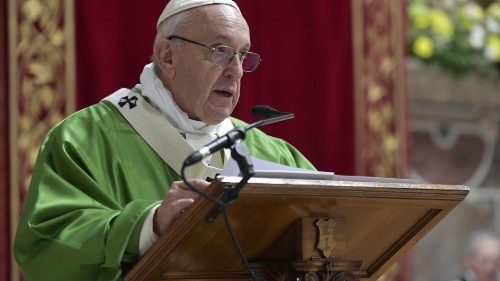
Pope Francis addresses the 2019 Meeting on the Protection of Minors in the Church
VATICAN

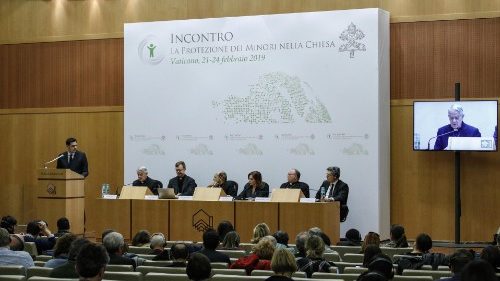
In February 2019, Pope Francis invited the presidents of every episcopal conference to the Vatican for a Meeting on the Protection of Minors in the Church to address the issue of the sexual abuse of minors by members of the clergy. A similar meeting focusing on the region of Central and Eastern Europe will take place in Warsaw from September 19-22. In this article, Fr Federico Lombardi puts this regional meeting into the context of the Church journey thus far.

By Father Federico Lombardi, SJ

The Church must confront the challenges present in today’s world, the most fundamental being the faith and the proclamation of the God of Jesus Christ, with all the grandiose cultural and anthropological transformations present. There are also specific challenges, however, that profoundly influence the life of the Church and its evangelizing mission. One of the most critical challenges that has emerged in the last few decades, is that of the sexual abuse of minors by members of the clergy. This has undermined the Church’s credibility and, therefore, its authority and its capacity of proclaiming the Gospel credibly. It has cast the shadow of inconsistency and insincerity over the Church as an institution, and on the entire community of the Church as a whole. This is indeed extremely serious.

Over time and with experience, beginning with the sexual abuse of minors – which is the most serious – we have learned to broaden the perspective to include various aspects. Thus, today, we often speak of abuse suffered by “vulnerable” persons. And we know the abuses sustained are not only sexual, but also abuse of power and conscience, as Pope Francis has often stated.


READ ALSO

24/02/2019
Pope Francis: Protecting children. Eradicating abuse

In addition, it is necessary to remember that the problem of abuse, in its various manifestations, is a general problem in human society, in the countries we live in and on the various continents. It is not a problem exclusive to the Catholic Church. Rather, those who study the issue objectively and as a whole, have seen that there are different regions, places, and institutions where it is dramatically widespread.

At the same time, it is only right that the Church look specifically at the problem since, as has already been noted, its credibility and constancy is at stake. The Church has always insisted on its teaching regarding sexual behavior and respect for the human person. Therefore, even if we know that this is not a problem that exists exclusively in the Church, we must be absolutely serious about it and understand that it has a terrible impact in the context of ecclesial life and on the proclamation of the Lord’s Gospel.

In particular, what is at stake is the depth and truth of relationships between people whose dignity is to be profoundly respected. As Christians and as Catholics, we pride ourselves on recognizing the primacy of the dignity of the person who is the image of God. So, the abuse of a person, the lack of respect, considering others as objects, not being attentive to their sufferings, and so on, is a sign that something specific and fundamental is missing in our faith and in our vision of the world.

In the latest reform of the Church’s penal code, there is an aspect that might seem purely formal, but is instead very significant from this point of view. The crimes of sexual abuse were inserted under the heading of offences “against human life, dignity and liberty”. They are not “scandalous” actions or deeds considered “unworthy of the clergy”. Rather, the emphasis is placed on the Church’s understanding that the dignity of the person is central and must be respected because we are and as God’s image. This is absolutely fundamental. The fact that a conversion is taking place and we have begun to more seriously listen to and respect each individual person, even the smallest and weakest, is one of the most important steps on the journey in our time toward the conversion and purification of the Church to regain its credibility.
The 2019 Meeting: responsibility, accountability, transparency


READ ALSO

26/02/2020
The Protection of Minors meeting a year on: An Irish perspective

Without going through the entire history of the tragic events and the Church’s response regarding the sexual abuse of minors, we can, for simplicity’s sake, begin with the February 2019 Meeting. It was convened by the Pope as a global moment, in which the entire Church (represented by members of every Episcopal Conference, in which representatives of institutes of consecrated men and women also participated), gathered together to become aware of and dedicate itself to continue to more effectively embrace the path of renewal.

The organization of that Meeting revolved around three main points (the Acts were subsequently published in the book published by Libreria Editrice Vaticana entitled Consapevolezza e purificazione – Awareness and Purification).

First of all, becoming aware of and embracing responsibility for the problem, of the issues connected to the sexual abuse of minors and others; the importance of profound and compassionate listening and understanding, which leads to the openness to participate in the consequences, the suffering, the seriousness of what has happened and is happening. Listening and compassion form the starting point in forming the conviction that needs to be adopted. Then, of course, there is the need for justice to be done for crimes that have harmed others. Another aspect is that of prevention so that such crimes never be committed again, or at least, that becoming more and more rare, this tragic reality can be controlled. This implies the formation of all who work within the ecclesial community, and specifically, the formation of competent people who can act as reference points for dealing with the problem. In short, awareness and responsibility in facing the issue go together.

Another very important and crucial point is accountability so as to overturn the culture of covering up or concealing the problem. One of the tragic aspects of this crisis is that it has brought a serious situation to the surface, to the awareness of the public (even though at times people knew what was happening) – a way of dealing with the sexual abuse of minors that had become systemic, often interpreted as “natural”, kept in the shadows or swept under the carpet, due to embarrassment or to defend the honor of the families or the institutions involved, and so on. This tendency to hide the issue needs to be replaced by the tendency to be accountable for what has been done, even by those in leadership roles. This tendency to cover abuse up was so widespread at every level, even more serious when done by those in positions of responsibility (superiors of communities, bishops, etc.). Thus, bringing things to the light and making sure that everyone is accountable for their actions, is a way to make sure that we are moving toward transparency, responsibility and justice – another absolutely necessary step forward in the process.

The third point that was talked a lot about during the Meeting was transparency, which is a consequence of the first two. This does not only mean admitting that crimes were and still are being committed, talking about them and focusing on them. Certainly, facing the truth of the facts is essential. But transparency also means knowing and making known what is being done in response, what the procedures are by which the Church, in all of its manifestations, is facing and dealing with the issue, what measures it is taking, what the verdicts are regarding those who are guilty, and so forth. In this way, both the ecclesial and civil community becomes aware not only of the faults and crimes committed, but also of the journey the community is consciously engaged in by which it is responding to this problem.
Important steps taken since the 2019 Meeting


READ ALSO

09/05/2019
New norms for the whole Church against those who abuse or cover up

But if the Meeting in 2019 was supposed to be a common point of departure, it needs to be recognized that subsequently many steps were taken by the Pope and Church leadership that implemented all of the main tasks identified during that Meeting. What are they?

Firstly, already by the end of March, Pope Francis issued an Apostolic Letter promulgating new laws and guidelines pertaining to the Vatican and the Holy See which broadened the perspective beyond the abuse of minors to include “vulnerable persons”. Then on May 9, 2019, he promulgated a very important new law for the entire Church, the Motu Proprio Vos estis lux mundi – “You are the light of the world” – in which the Pope legislated that an office be organized in every diocese to receive reports and to initiate the canonical procedures in response to the sexual abuse of minors. In addition, he also established that every priest and religious who becomes aware of such abuse is obliged to report it. The Pope also extended an invitation to members of the laity to report such abuse as well. Now, all priests and men and women religious are obliged in conscience to report cases regarding the sexual abuse of minors that they are made aware of; this obligation applies not only to minors, being the most serious, but applies also to other vulnerable persons or other abuses that include the use of violence. Once again, members of the laity are also invited to do so. In order to report abuse, the offices established to receive the reports must be publicized.

This is one of the most decisive steps. Of course, it needs to be ascertained whether all of this is being implemented. However, the law is already in place for the entire Church. It is an absolutely fundamental step the Pope took, probably the most important in the last twenty years regarding this issue. Furthermore, the same law instituted a process that involves the reporting of superiors at the highest levels – superiors general of institutes of consecrated life, bishops and cardinals – not only those accused of sexual abuse of minors, but also those who cooperate(d) in “covering it up”. Therefore, concrete steps toward responsibility and accountability have been radically implemented.


READ ALSO

17/12/2019
The Pope abolishes the pontifical secret in cases of sexual abuse

Yet another step taken leading toward greater transparency took place in December 2019 when Pope Francis abolished the “papal secret” that previously covered cases of the sexual abuse of minors. This allows clearer and easier collaboration to take place between ecclesiastical and civil authorities than had previously been the case. Finally, the famous Vademecum that had been developed was published in July 2020. This document was a direct request brought to the February 2019 Meeting, and had been indicated early on in the Meeting by Pope Francis as one of the Meeting’s first objectives. The Congregation for the Doctrine of the Faith compiled it. Although not containing anything new, it is a well-presented document that presents in an orderly manner and clearly explains what every bishop or other person in authority needs to know and what they need to do in different situations. It is an extremely necessary tool, even though it did not receive a lot of attention when it was published. It was, however, a key suggestion requested by the participants in the 2019 Meeting that was accomplished.

Even more recently, on the Solemnity of Pentecost 2021, Pope Francis promulgated a reform of Book VI of the Code of Canon Law. This portion of Canon Law contains a summary of the Penal Sanctions in the Church. The new version rewords and reorganizes the previous version in such a way that the new norms established throughout the years dealing with the sexual abuse of minors and other issues are now contained in a well-organized way in the Code of Canon Law. Prior to this date, the legislation remained “scattered” throughout a whole series of documents and other types of interventions.

It can now be confirmed beyond a doubt that all the things we expected from the Pope and the Holy See in the aftermath of the 2019 Meeting have been accomplished.

READ ALSO

10/11/2020
McCarrick Report: a sorrowful page the Church is learning from

But something else can be added. In this same period, in November 2020 to be exact, the voluminous “McCarrick Report” was published by the Vatican Secretariat of State. Ordered by Pope Francis himself, this investigation revealed the details regarding the grievous scandal that rocked the Church in the United States and throughout the world, and how it was possible that someone guilty of such abuse could have climbed to the heights of ecclesiastical responsibility as the Cardinal Archbishop of Washington, DC. The publication of this report can also be considered a painful, but very courageous, step in the direction toward transparency and demonstrates the desire to account for crimes and to own responsibility even at the highest levels of the Church.

Thus, we are before an enormous, difficult and painful problem, that touches the Church’s very credibility. Although this is true, it is not at all true that nothing has been done or that nothing, or next to nothing, is being done. On the contrary, it can be unhesitatingly stated that the universal Church has faced and is facing the problem, that it has taken necessary steps to establish norms, procedures and laws to deal with it correctly.

The next steps forward: from norms to practice

Of course, this does not mean that everything has been done, because as we know, it is one thing to establish norms or create a framework, and quite another to change the situation, by enforcing them. The upcoming September Conference of the Church in Central and Eastern Europe in Warsaw on the protection of minors and vulnerable persons is, in fact, taking this direction. Every geographic and ecclesiastical area possessing certain commonalities from the historical and cultural point of view need to reflect on where they are and need to identify what needs to be done concretely to effectively enforce the guidelines of the universal Church at the local level.

This has been done in other geographic regions. For example, a large conference for Latin America was held in Mexico about a year ago. The pandemic interrupted many other plans and caused delays. However, conferences are being planned, or have already taken place, on various continents, conferences similar to that planned for the countries making up Central and Eastern Europe. These regional meetings are also necessary steps on the common journey of the universal Church applied specifically to geographical, cultural and ecclesial regions.

To conclude, much has been done at the general and normative levels, in addition to gaining concrete experience. In some areas more has been done, and in other areas, less. Meetings are necessary for the circulation of knowledge and insight into the concrete and efficacious ways to face the problem. We are on a journey and we will remain on the journey. But the road on which it is necessary to move quickly and without uncertainties is now substantially and sufficiently delineated. This road must be taken to heal suffering, apply justice, prevent future abuse, restore trust and credibility within the ecclesial community and in the Church’s mission for the good of the world.

SEE NOT A WORD ABOUT ABSTENINCE 
Massive iceberg narrowly avoided collision with Antarctic ice shelf

Such a crash could have caused a new, even more massive iceberg to break off.


By Yasemin Saplakoglu
Live Science 
A-74 recently brushed by the Brunt Ice Shelf, which it split from last February. (Image credit: Contains modified Copernicus Sentinel data (2021), 
processed by ESA, CC BY-SA 3.0 IGO)

A massive iceberg that broke off of Antarctica last year recently spun around and narrowly avoided colliding with the Brunt Ice Shelf. Such a crash could have caused a new, even more massive iceberg to break off.


Iceberg A-74, which is more than 20 times the size of Manhattan, split from Antarctica's Brunt Ice Shelf in February 2020, Live Science previously reported. Ocean currents kept the giant beast near its parent ice shelf for the past six months, according to a statement from the European Space Agency (ESA). Everything was quiet, until the winds came.

In early August, strong winds spun the iceberg around the ice shelf. Two polar-orbiting satellites that make up the Copernicus Sentinel-1 mission captured radar images between Aug. 9 and Aug. 18 that showed A-74 "brushing slightly" against a thin strip of ice that juts off the shelf and then moving south.

"The nose-shaped piece of the ice shelf, which is even larger than A-74, remains connected to the Brunt Ice Shelf, but barely," Mark Drinkwater, head of ESA's Mission Science Division, said in the statement. "If the berg had collided more violently with this piece, it could have accelerated the fracture of the remaining ice bridge, causing it to break away."

A-74 is about 490 square miles (1,270 square kilometers), but if it had hit the ice shelf hard enough, it could have released another iceberg with an area of about 656 square miles (1,700 square km), according to the statement.

Two major cracks in the ice shelf, known as "Chasm 1" (extending northward) and the "Halloween Crack" (extending eastward), are separated by a small distance. If they were to meet — for example, if there were a strong impact — an iceberg would break off, according to ESA. It's natural for ice shelves to calve, and glaciologists have been following the formation of small fractures and larger chasms for years.

A-74 broke off along the North Rift crack, the third major chasm to open in the Brunt Ice Shelf in the past decade, Live Science previously reported. Drinkwater noted that the team will continue monitoring the iceberg and the ice shelf using the Sentinel satellite imagery.
Bernie Sanders Says $3.5 Trillion Spending Plan Is 'The Minimum'

"I already negotiated. The truth is we need more," said the chair of the Senate Budget Committee.


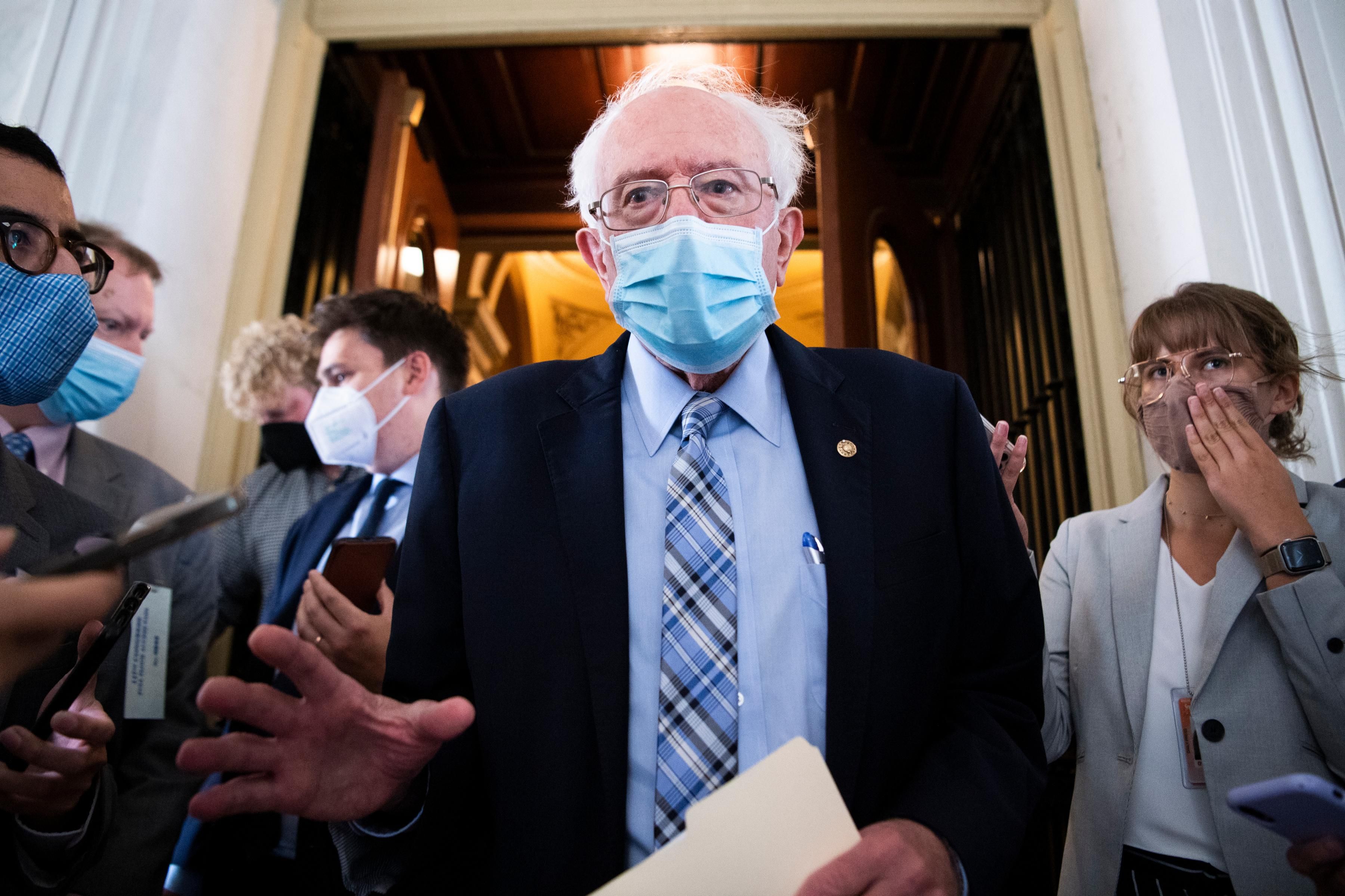
Sen. Bernie Sanders (I-Vt.) talks to reporters while leaving the U.S. Capitol on August 9, 2021. (Photo: Tom Williams/CQ-Roll Call, Inc. via Getty Images)

JAKE JOHNSON
COMMON DREAMS
August 26, 2021


Anticipating a clash with conservative Democrats over the price tag of the party's emerging reconciliation package, Sen. Bernie Sanders on Thursday laid down a clear marker: the $3.5 trillion in spending outlined in a newly approved budget resolution is already the compromise, and anything less won't cut it.

"I already negotiated. The truth is we need more," Sanders (I-Vt.), chair of the Senate Budget Committee and chief architect of the reconciliation blueprint, told Politico in an interview published Thursday.

"While it will have no Republican support in Washington, Democrats, independents, and working-class Republicans all over the country support our plan.
"
—Sen. Bernie Sanders

"The needs are there," the Vermont senator added. "This is, in my view, the minimum of what we should be spending."

Sanders' remarks came less than 48 hours after the House Democratic leadership quelled a small revolt of right-wing members and passed the $3.5 trillion budget resolution, which the Vermont senator helped usher through the upper chamber earlier this month.

Congressional approval of the budget blueprint—which establishes the outer boundaries of the reconciliation package—sets in motion the likely contentious process of converting the popular resolution into legislative text. With Republicans unanimously opposed to the filibuster-proof reconciliation package, Democrats will need the support of virtually every member of the House and Senate to ensure it reaches President Joe Biden's desk, a reality Sanders acknowledged Thursday.

"Democrats have a very slim majority in the House. We have no majority in the Senate. That's it. It is 50/50," Sanders said. "Trust me, there are a lot of differences in the Senate among the Democrats. But at the end of the day, every Democrat understands that it is terribly important that we support the president's agenda. And most of these ideas came from the White House."

But conservative Democrats in both chambers are already threatening to derail the reconciliation process by expressing opposition to the $3.5 trillion price tag—which, as Sanders noted, is significant downward compromise from the $6 trillion proposal that he and Senate Majority Leader Chuck Schumer (D-N.Y.) were originally considering.

Earlier this week, a spokesperson for Sen. Kyrsten Sinema (D-Ariz.) reiterated that "she will not support a budget reconciliation bill that costs $3.5 trillion"—music to the ears of Republicans who are openly hoping that Sinema and Sen. Joe Manchin (D-W.Va.) team up to pare back the legislation, in which progressives hope to include historic investments in green energy, Medicare expansion, and other top priorities.

A $3.5 trillion bill could also face trouble in the House, where at least nine conservative Democrats have voiced "concerns about the level of spending and potential revenue raisers." Among the revenue raisers floated for the reconciliation package are tax hikes on wealthy individuals and large corporations, proposals that are popular with the U.S. public but opposed by some right-leaning Democrats—many of them bankrolled by powerful corporate interests.

In his Politico interview Thursday, Sanders made clear that he views "every single thing" in the reconciliation framework—from the proposed lowering of the Medicare eligibility age to paid family and medical leave—as essential, though he declined to say what he would do if such priorities were stripped from the package.


On Friday, Sanders is set to travel to the Republican stronghold of Indiana to advocate for a $3.5 trillion reconciliation package. Two days later, the Vermont senator will hold a town hall on the legislation in Iowa.

"Sanders said if he could, he would travel to all 50 states this fall to make his case," Politico reported Thursday. "And he did not rule out West Virginia and Arizona, home to the Senate's two most conservative Democrats."

In a statement last week announcing his trips to Indiana and Iowa, Sanders said that "while it will have no Republican support in Washington, Democrats, independents, and working-class Republicans all over the country support our plan to finally invest in the long-neglected needs of working families."

"I very much look forward to hearing from some of them," Sanders added.
Our work is licensed under Creative Commons (CC BY-NC-ND 3.0). Feel free to republish and share widely.
Peace Group Challenges 'Architect' of Failed Wars Tony Blair to Public Debate

"Far from having a humanitarian impact, these interventions have served to make the world a much more dangerous and unstable place."

IT GAVE HIM A POST PM JOB; GO AROUND AND JUSTIFY THE WAR

"The lessons learnt or not learnt from these wars will have a real impact on the future of our foreign policy," Stop the War told former British Prime Minister Tony Blair. 
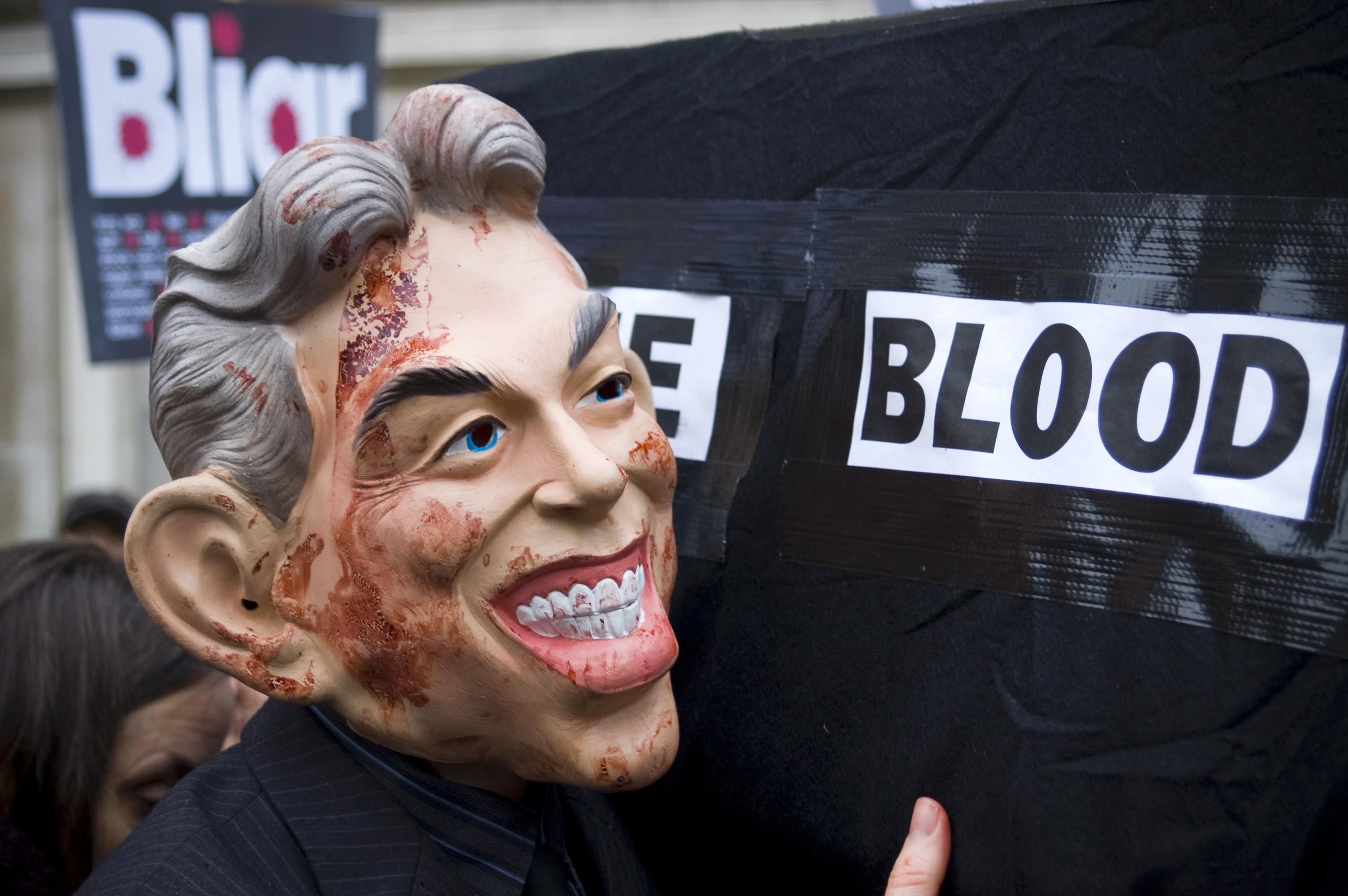
(Photo: lewishamdreamer/CC BY-NC 2.0)

ANDREA GERMANOS
COMMON DREAMS
August 26, 2021

The Stop the War coalition on Thursday invited former British Prime Minister Tony Blair—whom they called "one of the architects of the war on terror"—to a public debate on the impacts of the U.K.'s wars over the past two decades, framing such a dialogue as necessary "to help guide the foreign policy of the future."

The challenge (pdf) from the antiwar group followed an over 2,700-word essay Blair posted Saturday on his website in which he slammed U.S. President Joe Biden's decision to withdraw troops from Afghanistan as "tragic, dangerous, unnecessary," and an act merely "in obedience to an imbecilic political slogan about ending 'the forever wars,' as if our engagement in 2021 was remotely comparable to our commitment 20 or even 10 years ago."


In 2001, then-Prime Minister Blair led the U.K. to war in Afghanistan alongside U.S. President George W. Bush. In 2003, he backed the Bush-led U.S. invasion of Iraq. Blair also called for British military intervention in Syria.

Stop the War said in their letter to Blair that "the death and destruction caused by the invasion of Afghanistan and Iraq and the attacks on Syria and Libya was catastrophic in itself and that, far from having a humanitarian impact, these interventions have served to make the world a much more dangerous and unstable place."

"This is not just a quetion of the interrpetation of history," the group continued. "The lessons learnt or not learnt from these wars will have a real impact on the future of our foreign policy."

In contrast to Blair's "continued emphasis on military intervention" to solve global problems, the peace group's letter advocates bringing an "end to the wars" by deploying a "foreign policy based on international cooperation, diplomacy, and negotiation."

MSNBC host Mehdi Hasan also responded to Blair's essay, tweeting Saturday, "Weird Blair said so many words when he could have just said ‘SORRY!’"

In a minute-long rant on his show Sunday, Hasan suggested that was the only word proponents of the war in Afghanistan, including ex-government officials, should utter in reaction to the ongoing U.S. withdrawal from Afghanistan.


Speaking on Democracy Now! Thursday, British MP Jeremy Corbyn, former chair of the Stop the War coalition, also offered a critical response to comments from Blair.

Along with George W. Bush, Blair "took us into a war that made no sense whatsoever," said Corbyn, lamenting that "all the worst predictions that any of us ever made have all come to pass."

Our work is licensed under Creative Commons (CC BY-NC-ND 3.0). Feel free to republish and share widely.
'Stop Making Things Worse': Biden Denounced for Plan to Resume Oil and Gas Leasing

"More oil and gas leasing is insane policy in light of the climate crisis," said one critic.


The sun sets over container ships and oil platforms off the coast of Huntington Beach, California on January 12, 2021. (Photo: Leonard Ortiz/MediaNews Group/Orange County Register via Getty Images)

KENNY STANCIL
COMMON DREAMS
August 26, 2021


Progressive advocates are rebuking the Biden administration after it said this week that federal officials will soon resume selling new leases for oil and gas drilling on public lands and waters.

"While the administration's appeal is pending, Interior Secretary Deb Haaland should use her discretion under the law to authorize the least amount of leasing required to comply with the court's order."

—Robert Weissman, Public Citizen

President Joe Biden's Tuesday announcement (pdf) came in response to a June court ruling by a Trump-appointed federal judge who sided with a group of Republican attorneys general that sued the Biden administration in March over its temporary pause on new leases for onshore and offshore fossil fuel extraction on federal property.

Despite Biden's 2020 campaign promise to ban new oil and gas leasing on public lands and waters, the Department of Interior plans to restart the leasing process as early as next Tuesday, putting the administration on track to hold a lease auction for the Gulf of Mexico as soon as October and onshore auctions early next year.

Public Citizen president Robert Weissman called the Biden administration's disclosure "distressing news" in a statement released Wednesday.

"The first, easiest steps to address the climate crisis are to stop making things worse," said Weissman. "More oil and gas leasing is insane policy in light of the climate crisis."

According to the U.S. Geological Survey, roughly 25% of the nation's total carbon emissions can be attributed to fossil fuel extraction on public lands and waters. Ramping up drilling defies evidence-based recommendations made by the International Energy Agency and the United Nations' Intergovernmental Panel on Climate Change, which warned in recent reports that preventing catastrophic levels of global warming requires halting new fossil fuel projects.

Weissman acknowledged that "the administration's hands are somewhat tied by a flawed district court ruling" prohibiting its temporary moratorium on new leases for oil and gas drilling on federal lands and waters.

Reuters reported:

The filing to a Louisiana federal district court on Tuesday was in response to a motion by the state of Louisiana and 12 other states from earlier this month that sought to compel Interior to restart the leasing program and to show why it should not be held in contempt for failing to comply with the order issued weeks earlier.

Nevertheless, Weissman continued, the Interior Department "should do more to prevent the damage that new leasing will inflict."

"Among other measures," he said, "the Biden administration should force dirty energy companies to clean up the mess they have created on public lands and pay higher royalties for the privilege of extracting resources from public lands."

Earlier this month, the Interior Department announced that it is challenging the district court's decision, but "federal onshore and offshore oil and gas leasing will continue" as the process unfolds.

Biden's January executive order suspending new oil and gas leasing on federal property was meant to give administration officials time to conduct a comprehensive review of the "potential climate and other impacts associated with oil and gas activities on public lands or in offshore waters," which the Interior Department said is ongoing.

The moratorium did not affect existing leases, something the Trump administration sold in droves. The Biden administration, which in March declined to renew the Interior Department's policies limiting the provision of drilling permits, has so far approved fossil fuel drilling permits on federal and tribal property at a faster rate than its two immediate predecessors.

While fossil fuel industry groups celebrated Biden's decision to comply with the district court's order to restart the federal oil and gas leasing program, environmental groups criticized the administration for being excessively deferential and argued that the Interior Department still has the authority to limit the provision of new leases.


"The Biden administration doesn't necessarily have to keep incessantly offering land for sale to polluters without pauses or changing up the oil and gas leasing program," journalist Molly Taft wrote on Wednesday.

Earthjustice attorney Brettny Hardy told Taft that the federal judge's injunction "didn't say the Interior Department needed to start leasing again. What it said was you can't implement the pause Biden called for in his executive order."

"It didn't eliminate any of the Interior Department's regular discretion over whether it should lease, and how much to lease," said Hardy. "There's a number of federal laws that regulate that process and give Interior the power to cancel a lease sale if it determines that's necessary. There's a lot of discretion in the law."

According to Taft:


Hardy said there are a number of different, perfectly legal options the agency could exercise to put off the lease sales this year, which were initially scheduled by the Trump administration. "It sounds like they're going beyond what the court is requiring," Hardy said of the documents the administration filed Tuesday. She added she didn't have any direct insight as to why they were acting this way, but said a colleague suggested that "disinformation and politics is driving their decision."


Weissman, for his part, stressed that "while the administration's appeal is pending, Interior Secretary Deb Haaland should use her discretion under the law to authorize the least amount of leasing required to comply with the court's order."
Our work is licensed under Creative Commons (CC BY-NC-ND 3.0). Feel free to republish and share wide