Wednesday, November 10, 2021

Escaped fox raised as a dog caught in Peru

Issued on: 09/11/2021 -

An Andean fox is seen walking on a road in Argentina in June 2020 
FRANCISCO RAMOS MEJIA AFP/File

Lima (AFP) – An escaped fox, whose owners thought it was a dog, has been caught and sent to a zoo after terrorizing a Lima neighborhood, Peruvian authorities said Tuesday.

The medium-sized, eight-month old Andean fox named Run Run wreaked havoc on small farms in the Comas neighborhood, eating ducks, chickens and guinea pigs much to the chagrin of its owners' neighbors.

"Following a patient pursuit, the Forest and Wildlife Service (Serfor) managed to catch the Andean fox, called Run Run, while it wandered close to the Comas district," said the Ministry of Agrarian Development and Irrigation in a statement.

Serfor officials used a tranquilizer dart to catch the fox after throwing it food on Monday night, the ministry said.

Run Run is in good health and has been taken to a Lima zoo, where the fox has quickly become the star attraction.

A local newspaper said Run Run devoured 15 guinea pigs and six chickens over the weekend alone.

Another newspaper spoke to a neighbor who said she had befriended the fox and had been feeding it grilled chicken.

The fox's former owners paid 50 soles (close to $15) to buy what they thought was a Siberian Husky for their daughter at a back street animal market where they were conned by animal traffickers.

"They said it's a wolf-dog, but we didn't know it was a fox. It ate normally, like any dog, but as it was growing it was clear that it wasn't a dog," Maribel Sotelo, who bought the animal for her daughter, told America Television.

The government says the Andean fox is a victim of wild animal trafficking, a crime that is punishable by three to five years in jail.

© 2021 AFP


Australian man, 60, uses pocket knife to fight off crocodile

Issued on: 10/11/2021


Saltwater crocodile numbers have exploded since they were declared a protected species in 1971, with recent attacks reigniting debate about controlling them 
WILLIAM WEST AFP/File

Brisbane (Australia) (AFP) – A 60-year-old Australian man escaped the jaws of a large crocodile by stabbing it repeatedly in the head with his pocket knife as it dragged him into a river, local authorities said Wednesday.

After surviving the terrifying attack at a remote riverbank in Australia's far northern Cape York Peninsula, the injured man drove himself to hospital, the Queensland state environment department said.

The man had gone fishing on his property last week near Hope Vale, about five hours' drive from Cairns, and shooed away a bull from the riverbank so he could take over the spot.

Then, the crocodile struck.

"He described seeing the crocodile seconds before it lunged at him, knocking him over as he was about to cast his fishing rod," the department said in a statement

He grabbed onto the branch of a mangrove tree in a desperate attempt to stay out of the river as the crocodile's jaws wrapped around his boots. But he quickly lost the tug-of-war and was pulled in.

"The man said that as he entered the water, he managed to retrieve his knife from his belt and stabbed the crocodile in its head until it let him go."

The man then scrambled up the bank and drove to Cooktown Hospital for treatment. He was later flown to Cairns Hospital, where he is still recovering a week later.

Wildlife officers who interviewed him Tuesday confirmed that his injuries were consistent with a crocodile attack.

They would not attempt to capture the reptile -- which was believed to be attracted to the area by the presence of the bull -- because it is too remote.

Saltwater crocodile numbers have exploded since they were declared a protected species in 1971, with recent attacks reigniting debate about controlling them.

The "salties", which can grow up to seven metres long and weigh more than a tonne, are a common feature of the vast continent's tropical north.

Known as "croc country", the area sees attacks relatively frequently but they are rarely fatal, with locals and visitors warned to keep their distance from waterways.

© 2021 AFP
STATEHOOD OR INDEPENDENCE

'Science and solidarity': Why Puerto Rico leads US in Covid vaccinations

Issued on: 10/11/2021 


San Juan (AFP) – Puerto Rico has an underfunded health care system, high levels of poverty and its infrastructure remains devastated by a major hurricane that swept through the island in 2017.

So how is the US territory leading the rest of the country in Covid vaccinations?

Experts credit the surprising success to two major factors: a sense of solidarity forged from past brushes with disasters, and a public health response untainted by political polarization seen on the mainland.

No fewer than 74 percent of the island's 3.2 million people are now fully vaccinated -- well above the US total of 58 percent -- but also ahead of wealthy and liberal northeastern states such as Massachusetts and Vermont.

"Everyone should get vaccinated," Jose de Jesus, a retired government employee, told AFP.

"You have to take care of yourself, you have to live life until you can," added the 74-year-old, who happily got a Moderna booster shot last week.

As a result of the high uptake, Puerto Rico is crushing its coronavirus curve, with daily cases currently running at three per 100,000 people compared to 22 for the country as a whole, and deaths at 0.1 per 100,000.

The situation is the complete opposite of what was expected at the start of the pandemic, when the odds seemed stacked against the Caribbean archipelago.

Puerto Rico's poverty rate is 43 percent, more than double that of Mississippi, the poorest US state.

Its government is facing an ongoing financial crisis that skyrocketed debt in 2017, and forced the imposition of a drastic austerity policy.

A hammer blow came in September 2017, when Hurricane Maria ravaged the island, leaving nearly 3,000 dead. Many of the victims perished from a lack of resources and poor post-disaster response. The storm struck the island less than a month after Hurricane Irma passed by, causing vast power outages.

After that, protests in 2019 led to the resignation of a governor, Ricardo Rossello, and an earthquake destroyed nearly 8,000 homes in January 2020.

Lessons learned

"I couldn't sleep, I kept thinking the pandemic would be handled as badly as the responses to Hurricane Irma and Maria," Monica Feliu Mojer, spokesperson for the nonprofit Ciencia Puerto Rico organization that advocates for science in Puerto Rico, told AFP.

Instead, though, the memory of these disasters has made "people do their part," creating a critical wave of unity to respond to the challenge.

The Puerto Rican government began vaccinating in December 2020, like the rest of the United States.

And in just a few weeks, professional groups, hospitals, universities, private corporations and non-profit organizations joined the effort, collaborations key to the later Covid vaccination campaign.

Paradoxically, the trauma of Hurricane Maria prepared Puerto Ricans to face the coronavirus.

The work of the NGO VOCES, which has administered more than 378,000 doses since January, is an example of this.

According to its founder, Lilliam Rodriguez, the organization began in 2013 to promote vaccinations against various diseases.

After the hurricane destroyed vaccine dose stockpiles, the NGO's mission changed. Instead of just advocating for immunization, it began receiving funding and vaccines, and its workers "went to the fields, to the neighborhoods, to administer them," Rodriguez recalls.

"That prepared us to develop skills of first responders in the area of public health and vaccination. What we're doing now is not very different to what we did after Maria," she adds.
Sticking to the science

Feliu Mojer points to another key to the success of the vaccination push.

Unlike what happened in the rest of the United States, Puerto Rico "has not politicized" the response to the pandemic.

"In the United States there is a relationship between people, their political party and their willingness to get vaccinated," says the expert, something that does not exist in Puerto Rico.

On the island, "the main parties are not organized around conservative or progressive ideologies, but status preferences" over the future of the island's political relationship with the United States, she explains.

That unity allowed the government to take tougher preventative measures over the summer, at the height of the global wave driven by the Delta variant.

The government reimposed restrictions like masking and ordered vaccination or weekly negative PCR test for public employees, as well as for workers and customers of certain businesses like restaurants and gyms. Public response was largely favorable.

The success "has been a combination of science and solidarity," sums up Feliu Mojer.

© 2021 AFP
Europe's battle to curb Big Tech


The so-called GAFAM are still targeted by the EU and US for a number of allegedly unfair practices 
JUSTIN TALLIS AFP/File


Issued on: 10/11/2021

Paris (AFP) – US tech giants Google, Apple, Facebook, Amazon and Microsoft -- collectively dubbed GAFAM -- have been accused of not paying enough taxes, stifling competition, stealing media content and threatening democracy by spreading fake news.

As a European Union court rules Wednesday on a 2.4-billion euro ($2.8-billion) anti-trust fine on Google, we look at how the bloc has tried to regulate Big Tech.
Nobbling competition

The digital giants are regularly criticised for dominating the market by elbowing out rivals.

The EU has slapped a total 8.25 billion euros in fines on Google for abusing its dominant market position across several of its products.

The European Court of Justice in Luxembourg will rule Wednesday on Google's challenge to a 2.4-billion-euro fine imposed by the EU Commission in 2017 for abusing its power over its rivals in online shopping.

Microsoft was fined 561 million euros by the EU in 2013 for imposing its search engine Internet Explorer on users of Windows 7.

Amazon, Apple and Facebook are also the targets of EU probes for possible violations of competition rules.

The EU has also unveiled plans for mammoth fines of up to 10 percent of their sales on tech firms that break competition rules, that could even lead to them being broken up.

- Taxation -

Germany, France, Italy and Spain won a major victory in June when the Group of Seven (G7) agreed to a minimum global corporate tax rate of at least 15 percent mainly aimed at the tech giants.

For years they have paid little or no tax through complex tax avoidance schemes.

In one of the most notorious cases, the European Commission in 2016 found that Ireland granted "illegal tax benefits to Apple" and ordered the company to pay 13 billion euros plus interest to the Irish taxpayer.

After a EU court later ruled in favour of Apple, the Commission turned to the European Court of Justice to appeal.

The following year, Amazon was told to pay back 250 million euros to Luxembourg over similar abuses there.
Personal data

Tech giants are regularly criticised over how they gather and use personal data.

The EU has led the charge to rein them in with its 2018 General Data Protection Regulation, which has since become an international reference.

They must ask for consent when they collect personal information and may no longer use data collected from several sources to profile users against their will.

Amazon was fined 746 million euros in July by Luxembourg authorities for flouting the EU's data protection rules.

After having fined Twitter nearly half a million euros, the Irish regular opened a probe into Facebook in April after the personal data of 530 million users was pirated.

France has also fined Google and Amazon a total of 135 million euros for breaking rules on computer cookies.
Fake news and hate speech

Social networks are often accused of failing to rein in misinformation and hate speech.

The European Parliament and member states agreed to force platforms to remove terrorist content, and to do so within one hour.

EU rules now also forbid using algorithms to spread false information and hate speech, which some major platforms are suspected of doing to increase ad revenue.

- Paying for content –

GAFAM are accused by media outlets of making money from journalistic content without sharing the revenue.

To tackle this an EU law in 2019 created a form of copyright called "neighbouring rights" that would allow outlets to demand compensation for use of their content.

After initial resistance, Google signed agreements to pay for content with several French newspapers last year, a world first.

However, it did not stop the company being fined half-a-billion euros by France's competition authority in July for failing to negotiate "in good faith" with news organisations. Google has appealed.

© 2021 AFP
Nasa bumps moon landing back to 2025 at the earliest

Agency says funding issues, along with delays tied to 
Bezos legal challenge, will push back first landing in a half century

Nasa's Space Launch System, which will send astronauts to the moon on the Artemis missions. Photograph: Nasa/AFP/Getty Images


Associated Press
Wed 10 Nov 2021

Nasa has delayed putting astronauts back on the moon until 2025 at the earliest, missing the deadline set by the Trump administration.

The space agency had been aiming for 2024 for the first moon landing by astronauts in a half century.

In announcing the delay on Tuesday, the Nasa administrator, Bill Nelson, said Congress had not provided enough money to develop a landing system for its Artemis moon program and more money was needed for its Orion capsule. In addition, a legal challenge by Jeff Bezos’s rocket company, Blue Origin, stalled work for months on the Starship lunar landing system under development by Elon Musk’s SpaceX.

Officials said technology for new spacesuits also needed to ramp up before astronauts could return to the moon.


Nasa stacks Orion capsule atop Artemis 1 as moon mission nears

Nasa is still targeting next February for the first test flight of its moon rocket, the Space Launch System, or SLS, with an Orion capsule. No one will be onboard.

Instead, astronauts will strap in for the second Artemis flight, flying beyond the moon but not landing, in 2024. That would bump the moon landing to at least 2025, according to Nelson.


“The human landing system is a crucial part of our work to get the first woman and the first person of color to the lunar surface, and we are getting geared up to go,” Nelson told reporters. “Nasa is committed to help restore America’s standing in the world.”

Nelson made note of China’s ambitious and aggressive space program and warned it could overtake the US in lunar exploration.

Nasa’s last moon landing by astronauts occurred during Apollo 17 in 1972. Altogether, 12 men have explored the lunar surface.

During a National Space Council meeting in 2019, the former vice-president Mike Pence called for landing astronauts on the moon within five years “by any means necessary”. Nasa had been shooting for a lunar landing in 2028, and pushing it up by four years was considered at the time exceedingly ambitious, if not improbable.
Congress will need to increase funding, beginning with the 2023 budget, in order for Nasa to have private companies competing for the planned 10 or more moon landings by astronauts, Nelson said.

The space agency also is requesting a bigger budget for its Orion capsules, from $6.7bn to $9.3bn, citing delays during the coronavirus pandemic and storm damage to Nasa’s Michoud Assembly Facility in New Orleans, the main manufacturing site for SLS and Orion. Development costs for the rocket through the first Artemis flight next year stand at $11bn.

The vice-president, Kamala Harris, will convene her first National Space Council meeting, as its chair, on 1 December. Nelson said he had updated her on the latest schedule and costs during their visit to Maryland’s Goddard Space Flight Center on Friday.


At the time of writing last Monday, rebel forces were steadily advancing on Addis Ababa and nine factions have reportedly formed a political alliance to “push for a political transition in Ethiopia”. It looks like the game is up for Nobel peace prize laureate and Ethiopian Prime Minister Abiy Ahmed.


Abiy launched a full-scale military assault on the Tigray region in response to an attack by the Tigray People Liberation’s Front (TPLF) on army headquarters in November 2020. With military support from Eritrea, a long-time foe of the TPLF, he promised a swift victory. A year later, Abiy stands on a precipice. He declared a state of emergency on Wednesday and called on former soldiers to defend the capital against a possible attack.

The humanitarian situation in Tigray is overwhelming. There are credible reports of thousands of deaths and more than 1-million people displaced. The UN says aid supplies have not entered the region since mid-October. It is facing widespread famine.

This week a joint investigation by the UN and an Ethiopian state-appointed human rights commission found “serious abuses and violations of human rights, humanitarian and refugee law” by all sides, and said it “has reasonable grounds to believe that a number of these violations may amount to crimes against humanity and war crimes”.

The attack on Tigray in 2020 was a major miscalculation by the federal forces. The TPLF, which ran the country for 27 years, had no intention of folding. “PM Abiy threw an ill-trained peasant army against a battle-hardened, formidable army with an iron will to fight and expected to win,” said Rashid Abdi, a Horn of Africa expert. Last week’s takeover of Dessie and Kombolcha by TPLF forces, which gives them access to an airport, and the alliance with the Oromo Liberation Army (OLA) is likely to change the balance of power.

With 100-million people and two decades of double-digit economic growth, Ethiopia plays a central role in the stability and security of the Horn of Africa. Its unravelling threatens a region that has already seen a military coup in Sudan in October and flailing regimes in South Sudan and Somalia.

Early on in his administration, US President Joe Biden addressed the AU summit of African presidents and reaffirmed his commitment to the continent. US support for Ngozi Okonjo-Iweala as the head of the World Trade Organization, the interest in the African Continental Free Trade Area, and the strongly worded statements by US secretary of state Antony Blinken against human rights abuses, indicated that America was truly “back”.

Events last week suggest the US dropped the ball. Up to now, the US deployed diplomacy and gentle threats to ease the tensions between the two sides. It refrained from singling out responsibility in an attempt to stay neutral. On Tuesday, the US finally made a move. Biden announced a suspension of Ethiopia’s special duty-free access in January 2022 under the African Growth and Opportunity Act (Agoa), telling the US Congress that “Ethiopia’s “gross violations of internationally recognised human rights” made it ineligible for Agoa under the law.

If this suspension is enforced it would affect Ethiopia’s exports to the US of up to $200m each year. In response, and as a result of the TPLF’s march towards the capital, Ethiopia’s sovereign dollar bond and its Eurobonds plunged on Wednesday.

Other world leaders have finally woken up. The AU has been conspicuously absent to date, but the threat of Addis Ababa falling to the rebels has sent shock waves through the region, especially in Kenya where the fear is that the conflict will spill over the border.

The AU said on Thursday that commission chair Moussa Faki Mahamat had met the US special envoy, Jeffrey Feltman, “to discuss efforts towards dialogue and political solutions to the conflict”. The UN Security Council reiterated calls for calm. Ugandan President Yoweri Museveni called for an East African Intergovernmental Authority on Development  meeting on November 16. It may be too little, too late.

Could it be that a policy of even-handedness went too far, even when reports from Tigray of aid blockages, famine, deaths, rapes and other human right violations made it clear the situation was unbearable? Could it be that the international community could not stomach the idea that a Nobel peace prize laureate had taken the country down the wrong path?

Even Facebook staked out a position — much to the anger of the Ethiopian government. It removed Abiy’s post on Wednesday that called on his fellow countrymen to “organise and march through [any] legal manner with every weapon and power ... to prevent, reverse and bury the terrorist TPLF”. A Meta spokesperson said it violated “our policies against inciting and supporting violence”. Social media has stoked ethnic tensions throughout the year.

What happens next is unclear. The ideal scenario would be for the two sides to lay down arms and reach agreement. That does not seem likely. There is talk of Abiy being deposed by his own government. He is seen as an increasing liability. The TPLF and OLA could capture Addis Ababa, but they would not have legitimacy to rule. They lost the seat of power in 2018 for good reason. The possibility of a broad political alliance to prepare for a post-Abiy transition may be the most promising option of stopping the bloodshed — if the more than 80 ethnic groups in Ethiopia can agree. 

Peaceful transitions are hard. Zambia is one of the few recent examples of a successful transfer of power with the election of Hakainde Hichilema in August 2021. Even then, it was far from certain that the incumbent, Edgar Lungu, would step down without a fight. Sudan, once feted for toppling Omar al-Bashir in 2019, is now in crisis. South Sudan fell into civil war just two years after independence. Most transitions in the region end in tragedy.

As the TPLF circles and Abiy entrenches his position, the world must act. It needs to use its diplomatic, financial and military powers to avert disaster. The fate of Ethiopia hangs in the balance.

• Wolfe, an international lawyer based in the UK, is MD of Marlow Strategy.

Nobel laureate Orhan Pamuk faces probe for insulting Turkey’s founder

Following an Istanbul court’s decision to launch an investigation into “Nights of Plague,” the recent novel by Orhan Pamuk, many writers and activists are rallying to support the Nobel laureate.

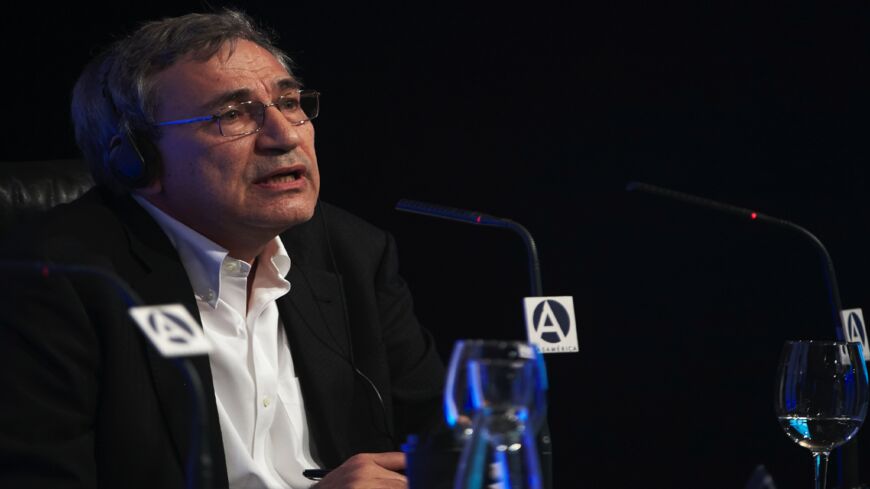
Turkish author and Nobel Prize in literature winner Orhan Pamuk attends the Vargas Llosa: Cultura, Ideas Y Libertad seminar at Casa de America on March 30, 2016, in Madrid, Spain. - Carlos Alvarez/Getty Images

Nazlan Ertan
@NazlanEr

November 9, 2021

Orhan Pamuk, Turkey’s only Nobel Prize laureate in literature, faces judicial investigation once again after an Istanbul court decided to follow up on charges that Pamuk’s most recent novel, “Nights of Plague,” insults Turkey’s founder, Kemal Ataturk.

The charges are being brought by Tarcan Uluk, a lawyer from the Aegean port city of Izmir, who says that Kolagasi Kamil, one of the main characters in the historical fiction, is a thinly veiled avatar of Turkey’s founder. “Nights of Plague” is set in Minger, an imaginary, multiethnic and multifaith Ottoman island on the Aegean Sea in 1901, as a pandemic hits the island and quarantine measures are imposed.

“The figure of Kamil (an ambitious and single-minded military officer whose meteoric rise makes him the president of the island) mocks the figure of Ataturk,” Uluk told Al-Monitor, explaining that he filed a criminal complaint to Izmir’s chief prosecutor’s office shortly after the novel came out based on penal code articles that protect Ataturk and national symbols of Turkey. “We demanded that this novel, which insults Ataturk and the Turkish flag … [be] pulled off the shelves immediately.”

Izmir prosecutors have passed the file to Istanbul on the grounds that the publisher of the novel was based there. Following the testimony of the author, the prosecutors decided on nonprosecution.

“We then appealed the nonprosecution, and a night court ruled earlier this week after studying the file that the investigation would be reopened," said Uluk, who defines himself as a staunch Turkish nationalist and an unyielding Kemalist. “I have to see the official verdict of the court yet, but I assure you that we will pursue the case till the end.”

Many activists, lawyers, artists and writers came out to extend their support to Pamuk and express their anger at the reversal of the nonprosecution decision, calling it a “disgrace.” The first reaction came from pianist Fazil Say. “The decision of nonprosecution given against him is reversed and an investigation is launched,” he tweeted, posting a photo of himself with Pamuk in 2005. “It is a disgrace for the country; it is total ignorance and archaism. What has been done to one of the world's most well-known authors is back to the dark ages.”

Zeynep Oral, the chair of PEN Turkey, expressed disbelief that the investigation was reopened. “Investigation on Orhan Pamuk? Wow. It is the jurists who do not read, who fail to understand what they read and cannot understand the basics of fiction that cause all the harm to this country,” she tweeted.


Oral’s words refer to other Turkish authors who had to face a judge to defend fictional characters. In 2006, writer Elif Shafak had to appear before a court to defend herself against charges of “insulting Turkishness” due to a comment made by one of the characters in her novel, “The Bastard of Istanbul.” Kemal Kerincsiz, a nationalist lawyer, had taken on Shafak for the remarks of a minor character, who said, “My father is Barsam Tchakhmakhchian, my great-uncle is Dikran Stamboulian … all my family tree has been Something Somethingian, and I am the grandchild of genocide survivors who lost all their relatives in the hands of Turkish butchers in 1915, but I myself have been brainwashed to deny the genocide because I was raised by some Turk named Mustapha!”

Kerincsiz was also the name behind the 2005 trial of Pamuk for “insulting Turkishness” by telling a Swiss journal that “a million Armenians had been killed in these lands.” The case against Pamuk had been dropped on the first hearing.

When Pamuk’s “Night of Plague” was released in March, many nationalist and Islamist pundits rapped him for what they called the likeness between Kamil and Kemal Ataturk, accusing Pamuk of trying to curry favor with the West by attacking Turkey and Ataturk. Finally, Yapi Kredi Yayincilik (YKY), Orhan Pamuk’s publisher, issued a press release in April denying that the book belittled Ataturk, saying that Kamil was “a heroic figure for the people of the fictional island of Minger.”

The YKY release also included a statement that quoted Pamuk as saying that the novel, on which he worked for five years, “shows no disrespect to Ataturk and the heroic founders of the nation-states established from the ashes of Empire.”

“On the contrary, the novel was written with respect and admiration for these libertarian and heroic leaders. As those who read the book will see, Kamil is a hero of many virtues who is loved by the public,” Pamuk said in the release. According to the Turkish press reports, this was very much in line with the statement made to the prosecutor on charges brought by Uluk.

“It is tragicomic to invite a Nobel laureate to elaborate on the characters in his novel, to get him to comment, shed light or dismiss any resemblance to figures in power now or in the past. Such actions are in contradiction on freedom of expression, which … I believe should much more concern us than giving so-called protection to the people in power,” said Orhan Kemal Cengiz, a human rights lawyer and commentator for Al-Monitor.

In an interview with independent news outlet Bianet in August, Pamuk said, “Kamil opposes the sultan, feudalism and the old regime when he says ‘long live freedom.’ The biggest, most magical, most powerful ideological concept is freedom. We understand that when Kamil calls out to the crowd in the square saying ‘long live freedom.’ This, of course, refers to lack of freedoms in today’s Turkey.”

Read more: https://www.al-monitor.com/originals/2021/11/nobel-laureate-orhan-pamuk-faces-probe-insulting-turkeys-founder#ixzz7Bnlp5PK0
Myanmar charges US journalist with terrorism, sedition


Fenster was detained in May as he attempted to board a plane in Yangon (AFP/-)

Tue, November 9, 2021, 9:50 PM·3 min read

Myanmar's junta has charged a US journalist detained since May with sedition and terrorism, which carry a maximum sentence of life imprisonment, his lawyer said Wednesday.

The military has squeezed the press since taking power in a February coup, arresting dozens of journalists critical of its crackdown on dissent that has killed over 1,200 people, according to a local monitoring group.

Danny Fenster, who had been working for local outlet Frontier Myanmar for around a year, was arrested as he was heading home to see his family in May and has been held in Yangon's Insein prison since.

The 37-year-old is already on trial for allegedly encouraging dissent against the military, unlawful association and breaching immigration law.

The additional charges under Myanmar's anti-terror and sedition laws open Fenster up to a maximum sentence of life imprisonment. The trial is scheduled to begin on November 16.

"He has become quite thin," Than Zaw Aung said.

Fenster was "disappointed" at being hit with the new charges, which were filed on Tuesday, the lawyer added.

They come days after former US diplomat and hostage negotiator Bill Richardson met junta chief Min Aung Hlaing in the capital Naypyidaw, handing the increasingly isolated junta some rare publicity.

Richardson has previously negotiated the release of prisoners and US servicemen in North Korea, Cuba, Iraq and Sudan and has recently sought to free US-affiliated inmates in Venezuela.

The former UN ambassador said he was hopeful he had brokered a deal for a resumption of visits by the International Committee of the Red Cross to prisons -- which have been filled with political prisoners.

Richardson, declining to give further details, said the US State Department asked him not to raise Fenster's case during his visit.

"Danny's case has become emblematic of the utter contempt Myanmar's military has for independent media," Emerlynne Gil, Amnesty International's deputy regional director for research, said in a statement.

"These harsh new charges only further highlight the clumsy attempt to prosecute an independent journalist who should be freed immediately and unconditionally so he can be reunited with his family and friends."


- Press clampdown -

Fenster is believed to have contracted Covid-19 during his detention, family members said during a conference call with American journalists in August.

He last spoke with US consular officials by phone on October 31, State Department spokesman Ned Price said Monday, adding Washington remained "deeply concerned over his continued detention".

The Southeast Asian country has been mired in chaos since the military ousted Aung San Suu Kyi's elected government, with the junta trying to crush widespread democracy protests and stamp out dissent.

The military has tightened control over the flow of information, throttling internet access and revoking the licences of local media outlets.

Several journalists critical of the military government were among those released last month in a junta amnesty to mark a Buddhist festival.

More than 100 journalists have been arrested since the putsch, according to Reporting ASEAN, a monitoring group.

It says 31 are still in detention.

The coup snuffed out the country's short-lived experiment with democracy, with civilian leader Suu Kyi now facing a raft of charges in a junta court that could see her jailed for decades.

bur-rma/pdw/axn

COP26 has ‘mountain to climb’ to curb warming as talks intensify

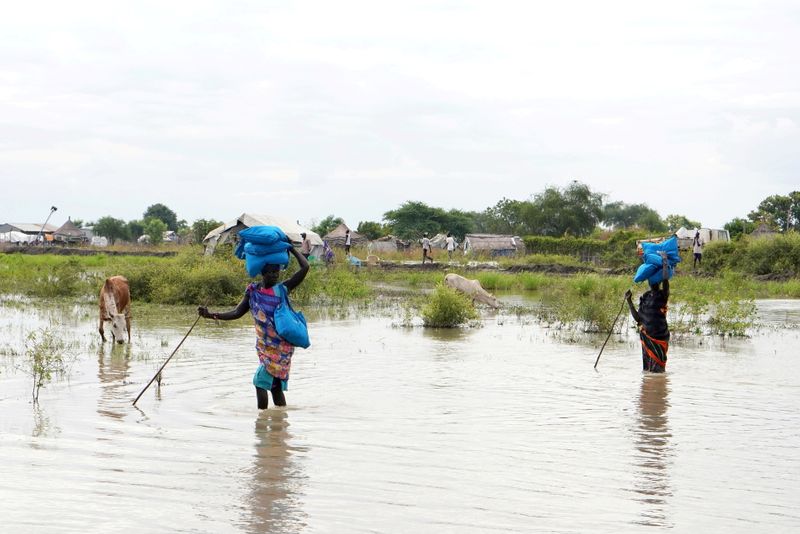
FILE PHOTO: Women carry sacks on their heads as they walk through water, after heavy rains and floods forced hundreds of thousands of people to leave their homes, in the town of Pibor, Boma stat

GLASGOW, Scotland (Reuters) -The president of the U.N. climate talks https://www.reuters.com/business/cop said on Tuesday there was still a mountain to climb towards a goal of capping the global temperature rise at 1.5 Celsius, as a research group said existing pledges would allow the Earth to warm far beyond that.

Britain’s Alok Sharma told reporters that COP26 officials would soon publish the first draft of the so-called cover decision, which summarises the commitments of more than 190 countries, in a bid to focus minds in the three days remaining.

Climate activists and experts will pore over the document looking for items such as timelines to phase out public subsidies of fossil fuels, or provide long-promised funds to help poor countries tackle climate change.

These and a raft of other complex issues to be hammered out will determine whether the two-week Glasgow summit can succeed in keeping within reach the 1.5C ceiling considered vital to avoid catastrophic climate consequences.

“We are making progress at COP26 but we still have a mountain to climb over the next few days,” said Sharma.

The European Union’s climate policy chief, Frans Timmermans, delivered a similarly blunt message, telling reporters, “the honest truth is we’re not where we want to be, not even close.”

The Climate Action Tracker (CAT) research group put a sobering number on the size of the task at hand, saying that all the national pledges submitted so far to cut greenhouse gases by 2030 would allow the Earth’s temperature to rise 2.4C from pre-industrial levels by 2100.

Scientists say 1.5C – the aspirational goal set down in the 2015 Paris Agreement – is the most the Earth can afford to avoid an acceleration of the intense heat waves, droughts, storms, floods and crop failures it is already experiencing.

RISING SEAS

Underscoring the stakes for vulnerable nations, the tiny Pacific island of Tuvalu said it was looking at legal ways to keep ownership of its maritime zones and recognition as a state even if it is engulfed by rising seas.

“We’re actually imagining a worst-case scenario where we are forced to relocate or our lands are submerged,” its foreign minister, Simon Kofe, told Reuters.

British Prime Minister Boris Johnson, who opened the COP26 eight days ago and attended the first two days, will return to the conference on Wednesday, his spokesperson said.

To meet the 1.5C goal, the United Nations wants to achieve “net zero” – where no more greenhouse gases are emitted than can simultaneously be absorbed – by 2050.

And it says that will be impossible unless emissions – mostly of carbon dioxide from burning coal, oil and gas – are cut 45% from 2010 levels by 2030.

“Even with all new Glasgow pledges for 2030, we will emit roughly twice as much in 2030 as required for 1.5°C,” CAT said.

China, the world’s largest emitter, says it will achieve net zero only in 2060, the same year as major oil and gas producer Russia. India, another large-scale polluter, has a target date ten years later.

Moreover, CAT explicitly warned against assuming that longer-term “net zero” pledges would even be met, since most countries have not yet implemented the short-term policies or legislation needed.

“It’s all very well for leaders to claim they have a net zero target, but if they have no plans as to how to get there, and their 2030 targets are as low as so many of them are, then frankly, these ‘net zero’ targets are just lip service to real climate action,” said Bill Hare, CEO of Climate Analytics, one of the organisations behind the CAT.

Sharma acknowledged as much, saying: “The world needs confidence that we will shift immediately into implementation, that the pledges made here will be delivered, and that the policies and investment will swiftly follow.”

WEAK DEAL OR NO DEAL?

A key pillar of climate action is carbon pricing and trading – mechanisms that force polluters to pay a market price for their emissions, or pay others to offset them, by planting trees that bind carbon or investing in cleaner power.

COP26 is supposed to create a global framework for carbon pricing, but the problem has defeated the last two climate summits, and is in danger of proving insurmountable in Glasgow too.

“There’s a higher chance of getting a deal this time, but it could be very weak,” said Gilles Dufrasne, a policy officer with Carbon Market Watch. “Having no deal might hence be an acceptable outcome.”

Many campaigners including Greenpeace oppose the use of carbon offsets under any circumstances, saying they lessen the incentives for polluters to change their habits, and risk paying for changes elsewhere that would have happened anyway.

“Net zero does not mean zero,” warned Teresa Anderson, climate policy coordinator for ActionAid International. “In the majority of cases, these corporations … are planning to carry on business as usual ” for long periods, she added.

https://www.reuters.com/business/cop/more-net-than-zero-do-carbon-cutting-promises-add-up-climate-2021-11-09

But some say things could be worse, noting how U.S. President Joe Biden had promptly returned the world’s second-biggest greenhouse gas emitter to the Paris Agreement, from which his predecessor Donald Trump had withdrawn, and pushed a $555 billion climate package through Congress.

Democratic U.S. Representative Alexandria Ocasio-Cortez underlined the more constructive U.S. approach at the Glasgow conference on Tuesday.

“We’re just here to say that we’re not just back. We’re different and we’re more just. And we are more open-minded to questioning prior assumptions of what is politically possible,” she said.

(Reporting by Kate Abnett and William James in GlasgowAdditional reporting by Shadia Nasralla and Stefica Nicol BikesWriting by Kevin Liffey, Gavin Jones and Richard ValdmanisEditing by Philippa Fletcher, Alexander Smith and Matthew Lewis)

New report warns COP26 negotiators that new pledges are inadequate

Andrew Freedman

AXIOS
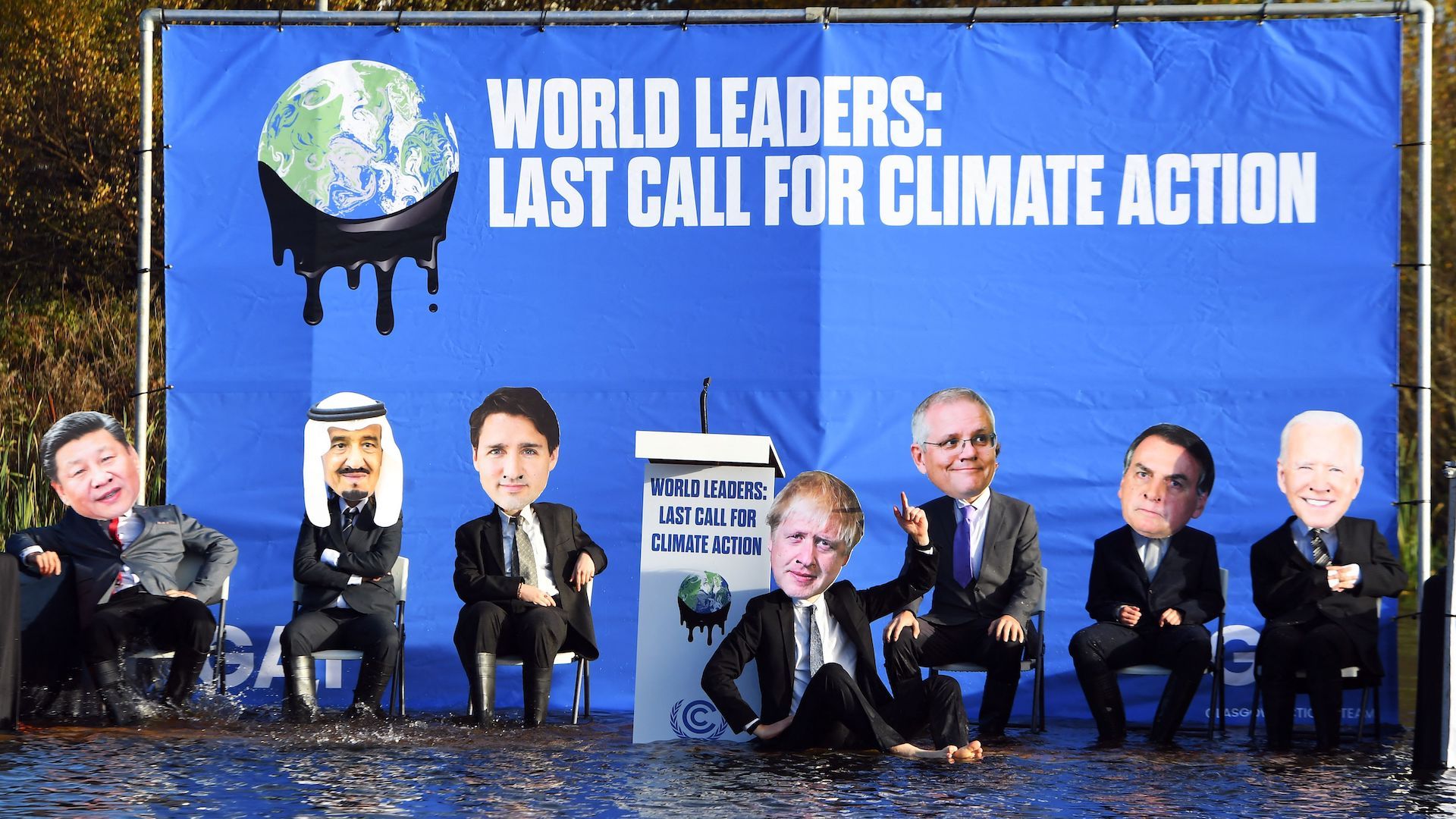

Climate change activists dressed as world leaders, pose for a photograph during a demonstration in the Forth and Clyde Canal in Glasgow on November 9, 2021, during the COP26 UN Climate Change Conference. (Andy Buchanan/AFP via Getty Images)

GLASGOW, Scotland -- A new analysis released during the COP26 climate summit finds that despite additional countries' pledges to cut greenhouse gas emissions by 2030 and reach net zero by 2050, nations are still on a course to be emitting twice the amount of greenhouse gas emissions in 2030 than would be consistent with the Paris Agreement's more ambitious temperature target.

Why it matters: As negotiators work this week to hammer out the text of a climate agreement, they are now more aware of the large gap that exists between commitments to date and what is needed to avert far worse climate change impacts.

Driving the news: The new analysis comes from the Climate Action Tracker, a nonprofit group that keeps tabs on nations' pledges to cut emissions and calculates the climate change that would result if those voluntary commitments are met.

The group found that the world is now on a path to warm by 2.4°C (4.32°F), when looking only at 2030 targets. However, based on a continuation of current policies (i.e. what's happening in the real world), the group found the globe will likely warm by about 2.7°C (4.86°F) compared to preindustrial levels by 2100.

Such warming would be inconsistent with the Paris Agreement's target of keeping warming to "well below" 2°C, with the stretch goal of limiting it to 1.5°C.

The negotiations in Glasgow are aimed in large part at keeping the 1.5-degree goal viable, with officials speaking of keeping "1.5 alive."

"Even with all new Glasgow pledges for 2030, we will emit roughly twice as much in 2030 as required for 1.5 [degrees]," the Tracker's analysis states.

The intrigue: The new numbers are already being discussed in Glasgow, adding additional urgency to the work of negotiators from nearly 200 countries.

"There have been obviously a number of reports that have come out over the past few days and I suspect there will be further reports that come out," COP President Alok Sharma said at a press conference Tuesday. "What I think they will be demonstrating is that there's been some progress but clearly not enough."

The bottom line: The net zero targets, which more than 140 countries have announced, are subjected to particular scrutiny in the Tracker's analysis, since most countries have not offered plans to get from where they are today to net zero.

“It’s all very well for leaders to claim they have a net zero target, but if they have no plans as to how to get there, and their 2030 targets are as low as so many of them are, then frankly, these net zero targets are just lip service to real climate action, said Bill Hare, CEO of Climate Analytics, a Climate Action Tracker partner organization, in a statement.
 
"Glasgow has a serious credibility gap."

Gavin Newsom Skips U.N. Conference and Attends Oil Heiress' Wedding, Faces Backlash

BY JUSTIN KLAWANS ON 11/9/21

California Governor Gavin Newsom has received some backlash after being spotted at the wedding of oil heiress Ivy Getty in San Francisco over the weekend, despite canceling a trip to a recent climate change summit.

Getty, 26, is the great-granddaughter of oil baron J. Paul Getty and heiress to one of the wealthiest fortunes in California history.

Newsom attended the wedding after having not been seen at a public event in the 13 previous days. He had been scheduled to appear at the United Nations' COP26 Climate Conference in Scotland, but scratched it off his agenda at the end of October.

Some criticism was angled towards Newsom after various outlets documented the opulent nature of the wedding compared to the message being sent by COP26. The wedding included a number of high-society engagements at the Getty Mansion, a DJ party with Earth, Wind and Fire, and a lavish ceremony at San Francisco City Hall.
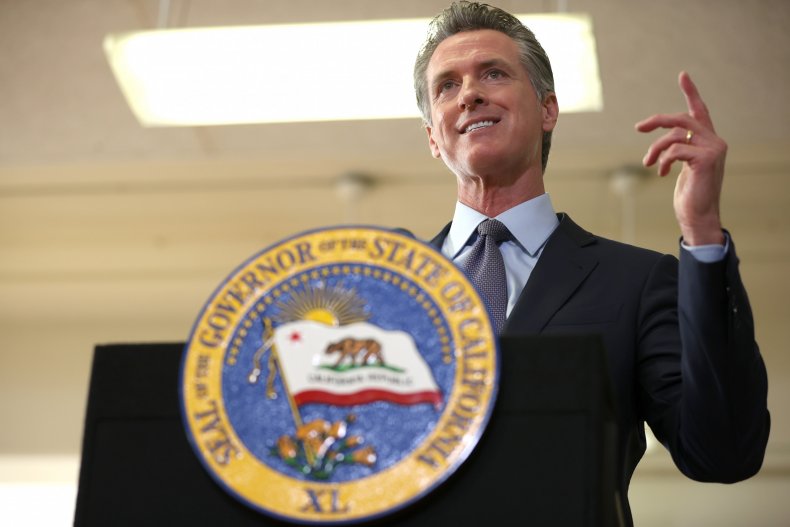
California Governor Gavin Newsom has come under fire for attending an opulent wedding for a member of the Getty family. Here, Newsom can be seen giving a speech in California.
JUSTIN SULLIVAN/GETTY

A number of other politicians attended, including San Francisco Mayor London Breed and House Speaker Nancy Pelosi, who presided over the ceremony. Numerous high-profile celebrities were also spotted, including singer Olivia Rodrigo and The Queen's Gambit star Anya Taylor-Joy, who served as Getty's maid of honor.

While Newsom's office did not officially confirm that the governor was in attendance, a picture was snapped of a figure that appeared to be Newsom watching the ceremony.

Washington Post national correspondent Philip Bump tweeted that the wedding was a "powerful editorial in support of a wealth tax."


Critics were quick to point out that, given the Getty's wealth from oil profits, Newsom's attendance at the lavish wedding seemingly went against the Democratic Party's green platform, specifically President Joe Biden's climate change initiatives seen in his reconciliation bill.

Some outlets speculated that Newsom's absence at COP26 could have been due to a negative reaction to the COVID-19 booster shot he received before the trip. His office, however, told Newsweek that this was not the case, and that Newsom had simply canceled the trip to spend time with his children over Halloween.

COP26 took place from November 1 to November 3, meaning that Newsom would have theoretically had time to fly to Scotland for the conference and attend the wedding.


READ MORE
Newsom's Wife Tells Critics 'Get a Life' After Governor Cancels U.N. Trip
Newsom to Make First Public Appearance in Weeks Amid Questions Over Absence
Gavin Newsom Says He Canceled U.N. Trip After Family 'Intervention'

Despite not being physically present, Newsom did participate in COP26, with his office issuing a statement that "[Newsom] will instead be participating virtually, focusing on California's landmark climate change policies."

Newsom likely attended the wedding due to his history with the Getty family. The Sacramento Bee documented how Newsom grew up around the family, and was by their side for a large portion of his political career. Speaker Pelosi, a representative for California, also has a close relationship with the Getty family.

Newsweek has reached out to Governor Newsom's office for comment.