Thursday, December 23, 2021

‘Mission Unaccomplished: America’s Underperforming Military

ANTIWAR.COM

Originally posted at TomDispatch.

“There’s no such thing as a free lunch” is an old American adage. Venerable, time-tested, and seemingly true, though here’s an exception: retired general, disgraced former CIA chief, and leaker of classified information, David Petraeus.

For years, I’ve presented the retired general with an opportunity for that rarest of opportunities, a noon nosh out for nothing. More than five years ago, I offered to take “King David” to lunch at New York City’s tony Four Seasons. That posh restaurant – a Manhattan mainstay for 60 years – is now long gone, but my appetite for that meal remains. Earlier this month, I renewed my offer to take him to lunch. An intermediary replied: “Hi, Nick – Appreciate your interest, but he respectfully declines.”

Petraeus is in a rare position. Leakers of government secrets often end up eating their lunch in a prison mess hall. After former CIA agent John Kiriakou pleaded guilty to violating the Intelligence Identities Protection Act by disclosing the name of a covert CIA officer to a freelance reporter, he was sentenced to 30 months in federal prison. After Stephen Kim, a former State Department official, merely discussed a classified report about North Korea with a Fox News reporter and pleaded guilty to one count of violating the Espionage Act, he was handed a 13-month prison sentence.

Petraeus, on the other hand, leaked hundreds of secret documents to his then-lover, yet pleaded guilty to a single misdemeanor and served no jail time, allowing him, as the New York Times put it, “to focus on his lucrative post-government career.” More specifically, he became a partner at New York private equity firm Kohlberg, Kravis, Roberts & Co. L.P. (KKR), where he also serves as the chairman of the KKR Global Institute. There, he’s overseen “the institute’s thought leadership platform focused on geopolitical and macro-economic trends, as well as environmental, social, and governance issues.” He also serves on the board of directors of Optiv (“a market-leading provider of end-to-end cyber security solutions”) and of OneStream (“which supports a cloud-based platform that helps companies close their books accurately and do planning, budgeting, forecasting, and analysis”), while acting as “a venture investor in some 20 startups.” And when he’s not engaged in “thought leadership” or venture investing, Petraeus takes time out to pontificate on national security issues, like praising the U.S. armed forces, while pressing for the endless military occupation of, and lamenting the end of, the U.S. war in Afghanistan.

Today, TomDispatch regular Andrew Bacevich examines the Petraeus-era cohort of war-losing, the-buck-stops-somewhere-else, upwards-failing generals, and presses for a full-scale purge of the Pentagon high command. His piece raises many crucial questions: Could the world’s private equity firms support that many out-of-work generals? Could that much brass fit through Washington’s famed revolving door? Would any of them have lunch with me given that I (along with so many other citizens) bankrolled the wars they lost and the generous pensions they reap? In the meantime, let Bacevich explain why there’s no accountability for what Petraeus has called “the best military in the world today” and what Joe Biden could (but won’t) do about it. Still think there’s no such thing as a free lunch? Don’t you believe it. ~ Nick Turse


How Awesome Is “Awesome”?

By Andrew Bacevich

Professional sports is a cutthroat business. Succeed and the people running the show reap rich rewards. Fail to meet expectations and you get handed your walking papers. American-style war in the twenty-first century is quite a different matter.

Of course, war is not a game. The stakes on the battlefield are infinitely higher than on the playing field. When wars go wrong, “We’ll show ’em next year – just you wait!” is seldom a satisfactory response.

At least, it shouldn’t be. Yet somehow, the American people, our political establishment, and our military have all fallen into the habit of shrugging off or simply ignoring disappointing outcomes. A few years ago, a serving army officer of unusual courage published an essay – in Armed Forces Journal no less – in which he charged that “a private who loses a rifle suffers far greater consequences than a general who loses a war.”

The charge stung because it was irrefutably true then and it remains so today.

As American politics has become increasingly contentious, the range of issues on which citizens agree has narrowed to the point of invisibility. For Democrats, promoting diversity has become akin to a sacred obligation. For Republicans, the very term is synonymous with political correctness run amok. Meanwhile, GOP supporters treat the Second Amendment as if it were a text Moses carried down from Mount Sinai, while Democrats blame the so-called right to bear arms for a plague of school shootings in this country.

On one point, however, an unshakable consensus prevails: the U.S. military is tops. No less august a figure than General David Petraeus described our armed forces as “the best military in the world today, by far.” Nor, in his judgment, was “this situation likely to change anytime soon.” His one-word characterization for the military establishment: “awesome.”

The claim was anything but controversial. Indeed, Petraeus was merely echoing the views of politicians, pundits, and countless other senior officers. Praising the awesomeness of that military has become twenty-first-century America’s can’t miss applause line.

As it happens, though, a yawning gap looms between that military’s agreed upon reputation here and its actual performance. That the troops are dutiful, seasoned, and hardworking is indisputably so. Once upon a time, “soldiering” was a slang term for shirking or laziness. No longer. Today, America’s troops more than earn their pay.

And whether individually or collectively, they also lead the world in expenditures. Even a decade ago, it cost more than $2 million a year to keep a G.I. in a war zone like Afghanistan. And, of course, no other military on the planet – in fact, not even the militaries of the next 11 countries combined – can match Pentagon spending from one year to the next.

Is it impolite, then, to ask if the nation is getting an adequate return on its investment in military power? Simply put, are we getting our money’s worth? And what standard should we use in answering that question?

Let me suggest using the military’s own standard.

Demanding Victory

According to the United States Army’s 2021 “Posture Statement,” for example, that service exists to “fight and win the nation’s wars.” The mission of the Air Force complements the Army’s: “to fly, fight, and win.” The Navy’s mission statement has three components, the first of which aligns neatly with that of the Army and Air Force: “winning wars.”

As for the Marine Corps, it foresees “looming battles” that “come in many forms and occur on many fronts,” each posing “a critical choice: to demand victory or accept defeat.” No one even slightly familiar with the Marines will have any doubt on which side of that formulation the Corps situates itself.

In other words, the common theme uniting these statements of institutional purpose is self-evident. The armed forces of the United States define their purpose as winning. Staving off defeat is not enough, nor is fighting to a draw, waging gallant Bataan-like last stands, or handing off wars-in-progress to pliant understudies whom American forces have tutored.

Mission accomplishment necessarily entails defeating the enemy. In General Douglas MacArthur’s famously succinct formulation, “There is no substitute for victory.” But victory, properly understood, necessarily entails more than just besting the enemy in battle. It requires achieving the political purposes for which the war is being fought.

So when it comes to winning, both operationally and politically, how well have the U.S. armed forces performed since embarking upon the Global War on Terror in the autumn of 2001? Do the results achieved, whether in the principal theaters of Afghanistan and Iraq or in lesser ones like Libya, Somalia, Syria, and West Africa qualify as “awesome”? And if not, why not?

A proposed Afghanistan War Commission now approved by Congress and awaiting President Biden’s signature could subject our military’s self-proclaimed reputation for awesomeness to critical scrutiny. That assumes, however that such a commission would forego the temptation to whitewash a conflict that even General Mark Milley, the current chairman of the Joint Chiefs of Staff, acknowledged ended in a “strategic failure.” As a bonus, examining the conduct of America’s longest war might well serve as a proxy for assessing the military’s overall performance since 9/11.

The commission would necessarily pursue multiple avenues of inquiry. Among them should be: the oversight offered by senior civilian officials; the quality of leadership provided by commanders in the field; and the adequacy of the military’s training, doctrine, and equipment. It should also assess the “fighting spirit” of the troops and the complex question of whether there were ever enough “boots on the ground” to accomplish the mission. And the commission would be remiss if it did not take into account the capacity, skills, and determination of the enemy as well.

But there is another matter that the commission will be obliged to address head-on: the quality of American generalship throughout this longest-ever U.S. war. Unless the commission agenda includes that issue, it will fall short. The essential question is obvious: Did the three- and four-star officers who presided over the Afghanistan War in the Pentagon, at U.S. Central Command (CENTCOM), and in Kabul possess the “right stuff”? Or rather than contributing to a favorable resolution of the war, did they themselves constitute a significant part of the problem?

These are not questions that the senior ranks of the officer corps are eager to pursue. As with those who reach the top in any hierarchical institution, generals and admirals are disinclined to see anything fundamentally amiss with a system that has elevated them to positions of authority. From their perspective, that system works just fine and should be perpetuated – no outside tampering required. Much like tenured faculty at a college or university, senior officers are intent on preserving the prerogatives they already enjoy. As a consequence, they will unite in resisting any demands for reform that may jeopardize those very prerogatives.

A Necessary Purge

President Biden habitually concludes formal presentations by petitioning God to “protect our troops.” While not doubting his sincerity in praying for divine intervention, Biden might give the Lord a hand by employing his own authority as commander-in-chief to set the table for a post-Afghanistan military-reform effort. In that regard, a first step should entail removing anyone inclined to obstruct change or (more likely) incapable of recognizing the need to alter a system that has worked so well for them.

On that score, Dwight D. Eisenhower offers Biden an example of how to proceed. When Ike became president in 1953, he was intent on implementing major changes in U.S. defense priorities. As a preliminary step, he purged the Joint Chiefs of Staff, which then included his West Point classmate General Omar Bradley, replacing them with officers he expected to be more sympathetic to what came to be known as his “New Look.” (Eisenhower badly misjudged his ability to get the Army, his own former service, to cooperate, but that’s a story for another day.)

A similar purge is needed now. Commander-in-chief Biden should remove certain active-duty senior officers from their posts without further ado. General Mark Milley, the discredited chair of the Joint Chiefs, would be an obvious example. General Kenneth McKenzie, who oversaw the embarrassing conclusion of the Afghanistan War as head of Central Command, is another. Requiring both of those prominent officers to retire would signal that unsatisfactory performance does indeed have consequences, a principle from which neither the private who loses a rifle nor the four stars who lose wars should be exempt.

However, when it comes to a third figure, our political moment would create complications that didn’t exist when Ike was president. When he decided which generals and admirals to fire and whom to hire in their place, Eisenhower didn’t have to worry about identity politics. Top commanders were of a single skin tone in 1950s America. Today, however, any chief executive who ignores identity-related issues does so at their peril, laying themselves open to the charge of bigotry.

Which brings us to the case of retired four-star general Lloyd Austin, former Iraq War and CENTCOM commander. As a freshly minted civilian, Austin presides as the first Black defense secretary, a notable distinction given that senior Pentagon officials have tended to be white or male (and usually both). And while, by all reports, General Austin is an upright citizen and decent human being, it’s become increasingly clear that he lacks qualities the nation needs when critically examining this country’s less-than-awesome military performance, which should be the order of the day. Whatever suit he may wear to the office, he remains a general – and that is a problem.

Austin also lacks imagination, drive, and charisma. Nor is he a creative thinker. Rather than an agent of change, he’s a cheerleader for the status quo – or perhaps more accurately, for a status quo defined by a Pentagon budget that never stops rising.

speech Austin made earlier this month at the Reagan Library illustrates the point. While he threw the expected bouquets to the troops, praising their “optimism, and pragmatism, and patriotism” and “can-do attitude,” he devoted the preponderance of his remarks to touting Pentagon plans for dealing with “an increasingly assertive and autocratic China.” The overarching theme of Austin’s address centered on confrontation. “We made the Department’s largest-ever budget request for research, development, testing, and evaluation,” he boasted. “And we’re investing in new capabilities that will make us more lethal from greater distances, and more capable of operating stealthy and unmanned platforms, and more resilient under the seas and in space and in cyberspace.”

Nowhere in Austin’s presentation or his undisguised eagerness for a Cold War-style confrontation with China was there any mention of the Afghanistan War, which had ended just weeks before. That the less-than-awesome U.S. military performance there – 20 years of exertions ending in defeat – might have some relevance to any forthcoming competition with China did not seemingly occur to the defense secretary.

Austin’s patently obvious eagerness to move on – to put this country’s disastrous “forever wars” in the Pentagon’s rearview mirror – no doubt coincides with the preferences of the active-duty senior officers he presides over at the Pentagon. He clearly shares their eagerness to forget.

As if to affirm that the Pentagon is done with Afghanistan once and for all, Austin soon after decided to hold no U.S. military personnel accountable for a disastrous August 29th drone strike in Kabul that killed 10 noncombatants, including seven children. In fact, since 9/11, the United States had killed thousands of civilians in several theaters of operations, with the media either in the dark or, until very recently, largely indifferent. This incident, however, provoked a rare storm of attention and seemingly cried out for disciplinary action of some sort.

But Austin was having none of it. As John Kirby, his press spokesperson, put it, “What we saw here was a breakdown in process, and execution in procedural events, not the result of negligence, not the result of misconduct, not the result of poor leadership.” Blame the process and the procedures but give the responsible commanders a pass.

That decision describes Lloyd Austin’s approach to leading the Defense Department. Whether the problem is a lack of daring or a lack of gumption, he won’t be rocking any boats.

Will the U.S. military under his leadership recover its long-lost awesomeness? My guess is no. In the meantime, don’t expect his increasingly beleaguered boss in the White House to notice or, for that matter, care. With a load of other problems on his desk, he’s counting on the Lord to prevent his generals from subjecting the troops and civilians elsewhere on the planet to further abuse.

Follow TomDispatch on Twitter and join us on Facebook. Check out the newest Dispatch Books, John Feffer’s new dystopian novel, Songlands (the final one in his Splinterlands series), Beverly Gologorsky’s novel Every Body Has a Story, and Tom Engelhardt’s A Nation Unmade by War, as well as Alfred McCoy’s In the Shadows of the American Century: The Rise and Decline of U.S. Global Power and John Dower’s The Violent American Century: War and Terror Since World War II.

Andrew Bacevich, a TomDispatch regular, is president of the Quincy Institute for Responsible Statecraft. His new book, After the Apocalypse: America’s Role in a World Transformed, has just been published.

Copyright 2021 Andrew Bacevich


US Military and Sustainability

ANTIWAR.COM

Thought experiment: China contaminates the groundwater in certain places on Oahu, the most populous and popular island in Hawaii.

Should we issue a statement of concern? Should we impose trade sanctions? Should we bomb a few Chinese military bases? Should we just declare war on China?

Whatever response is appropriate in our thought experiment, now consider that the actual perpetrator is the US military. Indeed, the US Army is accusing the US Navy of contaminating the water in a massive number of its 24 military communities in the vicinity of Pearl Harbor. US Navy attacks US military on Pearl Harbor? Can it get any more ironic?

Though the news of the Navy’s egregious error has sparked outrage amongst the citizens of Hawaii and abroad, this is not necessarily anything new. The US military is one of the biggest polluters in the world. Just a tiny fraction of what we are learning now:

  • Military members, their families, and surrounding civilian residents in the Marietta, Georgia Dobbins Air Reserve Base are learning this week that their drinking water is contaminated by some of the "forever chemicals" used on the base and that the first many heard about it was when the local Fox News reporters came to them for comment. These chemicals are known carcinogens and cause thyroid disease and – some of the worst news in the pandemic – weakened immune systems in children.
  • The Pentagon is the world’s greatest single consumer of oil and thus one of the largest single emitters of greenhouse gases and thus the single entity most responsible for climate chaos – massive hurricanes, forest fires, floods, rising seas, climate refugees, and more.

Aside from jet fuel leakages and them being one of the largest consumers of oil in the world, a great deal of nuclear weapons testing has led to islands in the Pacific and areas of Native American land to be desolate and abandoned. These actions have made some of these areas unlivable to this day.

The US military spends more than any other military. The international position that the US is usually seen as is one where they are considered the strongest and most powerful, commanding respect from allies and instilling fear in adversaries. As a result, they have also been excused from most of their mishaps and negligence by the international community and historically by our own EPA.

Unless we act and hold the military accountable for their extreme negligence and haphazard usage of equipment and chemicals that has persisted for decades, incidents like the one in Hawaii will continue to arise. Possible reforms may include:

  • Ensuring the military’s budget is reduced or at the very least reprioritized to bioremediation, pollution prevention, and military purchase of clean energy and manufactured items.
  • Holding the military accountable for every environmental impact it produces anywhere, including basic transparency so military members, their families, and all civilians understand the threats to their health and can make informed decisions.

All these incidents are done with your earned money, your income taxes. All those decisions are made in your name in our democracy.

All these acts are either accidental or deliberate, of course. Accidents should be teachable events so better prevention protections are instituted. Deliberate decisions to pollute because it’s easier should be outlawed and there should be serious consequences.

Otherwise, our own "protectors" are the ones hurting us. This is wrong at every level and only correctable by all of us deciding to elect lawmakers who will take this as seriously as it deserves to be taken.

Sebastian Santos, syndicated by PeaceVoice, is a graduate of Portland State University and is currently pursuing a master’s degree at Lewis and Clark College.


Stephany Griffiths-Jones – Chile: Boric’s economic programme

A sobering explanation of the economic policies to be expected from the new Chilean president

PEF Council member Prof. Stephany Griffiths-Jones is a member of Chilean President Gabriel Boric’s group of economic advisors.

Interview conducted by Andy Robinson. Original (in Spanish).

Cross-posted from the PEF website

Gabriel Boric

Gabriel Boric. Photo: Mediabanco Agencia / Wikimedia Commons / CC BY 2.0,

Stephany Griffith-Jones, one of the most eloquent promoters of the role of the state and public banks in the equitable development of South American economies, joined a group of advisers to Gabriel Boric, Chile’s presidential candidate, before the start of his second round campaign for the Presidency. The decision to appoint Griffith-Jones – a professor at the University of Sussex and collaborator with Nobel Laureate Joseph Stiglitz at Columbia University in New York – is proof that Boric build on not only ideas from the 2019 protest movement, but also experts close to Concertación and Nueva Mayoría, who led the centre-left governments of Chile’s slow transition from dictatorship.

It is also proof that, at the age of 35, Boric is aware of the importance of working with experienced economists such as Griffith Jones, Born in Prague in 1947, great-niece of Franz Kafka, and whose family emigrated to Chile the following year, we spoke about Boric’s dilemmas in needing to both respond to the demand for change in Chile, and to stabilise the economy.

It seems that Gabriel Boric is facing a problem. He is a candidate for change, a movement that has taken to the streets of Santiago to protest the neo-liberal model. But if he wins, he will come to power in a difficult budget situation that leaves little room for progressive budget policy…

Yes. At the moment the budgetary situation is very difficult. The fiscal deficit is already at 13% of GDP… Piñera went from one extreme to another in his response to the pandemic. He did nothing at first, and a lot of low-income people were in real trouble. This is where the first withdrawals from pension funds were introduced, to help low-income people in great difficulty. [Piñera’s government allowed raids on Chile’s privatised pension funds during covid, turning them into a “piggy-bank”, with about $50bn or 25% of their value withdrawn to date.] But then, in 2021, Piñera went to the other extreme. He gave generous support, perhaps too much, to many, even people who were not so poor. And consumption skyrocketed. Chilean GDP will grow this year between 11% and 12%. The economy is totally overheated.

What should be done?

Boric has committed himself to significantly reducing the budget deficit in one year and respecting the budget already approved by Parliament. It is a sign of his moderation. In the coming years, he wants to raise taxes gradually and increase the collection of existing taxes – higher direct taxes, and lower indirect taxes. Indirect taxes, such as value added tax, account for more than 50% of Chile’s total tax revenue, well above the OECD average. There is also a commitment to combat tax evasion, which in Chile is twice the OECD average, but this requires more tax inspectors.

The problem is more general. Latin America is experiencing a moment of polarization. It is necessary to break a model that was very unpopular, but the economic and economic reality of countries like Brazil or Chile leaves very little space, and both Lula and Boric have moved closer to the centre.

Yes, at first many people thought that Boric would be too radical. But now perhaps the greatest fear is that he can not do enough.

Despite this, he is portrayed as radical in many media …

It’s true. The media talk about far right and far left. We must reject this false dichotomy, because Boric is a Social Democrat. [Right-wing candidate Jose Antonio] Kast is an extremist. In economics, he is quite radical; to reduce taxes when the deficit is 13% of GDP is downright daring. In politics, he is even more extreme. One of his deputies said that women should never have had the right to vote. Unbelievable. Kast proposed restricting the right to abortion, even for women who were raped, and forgiving Pinochet-era torturers.

But Boric is a European-style Social Democrat. I met him first at a conference to discuss the Scandinavian model of government. He has been more on the left, but he is aware of the current budget problems and is very open to discussions with all sides. That said, he is very committed to the need for redistribution.

Given the polarity and rejection of the system, do you think it can be a double-edged sword to enjoy the support of the main political figures from Concertación?

No. That’s very positive for Boric. Leftists will vote for him anyway. The problem is attracting the votes of most of those in the middle. Although the most important thing is to attract young people who demonstrate, but sometimes do not vote. Participation in the first round was very low. In the past, the center and the left always worked when they merged. It can be expected to be the same this time. Boric acknowledged the contribution of the Christian Democrats (PDC) and it was a very good move. He met Ricardo Lagos [centre-left president from 2000 to 2006] and Michelle Bachelet [centre-left President from 2006 to 2010, and from 2014 to 2018]. They were wonderful to him. Much of the center and left have already joined the campaign. And the Christian Democrats support him even though they say they would not enter government with him. It is also true that the fact that Kast is perceived as disastrous made the reunion easier.

It is strange to compare the victory of the left in the Constituent Assembly with the results of November in the parliamentary elections. How did this happen?

Yes, 78% of voters voted [on 25 October 2020] in favour of a new constitution. Voting in the Constituent Assembly [over 15 and 16 May 2021] was a great victory for the left. But then, just a year after the referendum, the same voters voted for a parliament that was divided between left and right. There is therefore a lack of consistency. If Boric wins, he will have problems with Congress, which will likely try to block proposals such as the budget and tax reform.

Will there be more leeway afterwards?

I think so, after the first year. Boric and his supporters are very committed to the ecological transition. Chile is lucky because it has lithium, which is essential for batteries, and copper, which is essential for the enerfy transition. In addition, there is great potential for further development of solar and wind energy. It is necessary to give priority to certain sectors for that transition, supporting their development, and Kast does not understand this. Development banks must be mobilized for the green transition. And financial regulation can be used to incentivize commercial bank loans to companies with low-carbon investments.

Public investment is key. For example, Boric wants to invest heavily in building an extensive rail network. Then there is hydrogen. Hydrogen can be produced sustainably in Chile because there are many ways to generate renewable energy. We can use green hydrogen in mining to have green copper.

Is there not a risk that the energy transition will create demand for metals and lead to more extraction and dependence on the export of raw materials?

The idea would be to move up the value chain. Manufacture batteries, incorporate more technology and knowledge. Scandinavian economies, which in the past were like Chile, dependent on exports of raw materials such as wood, managed to move up the value chain and develop rapidly. So it is necessary, for example, to produced more refined copper, to manufacture higher value-added cables.

Why would the left do it better than the right?

Because public investment and the development bank are essential for the green transition, and then catalysing private investment in this sector is key. Kast doesn’t understand this. He caricatures the state as a dark and negative force, but those are the ideas of the past.


Chile: copper-bottomed?

The victory of former student leader and activist Gabriel Boric in Chile’s presidential election is the culmination of a sweeping change of mood and direction among Chilean voters.  In a 56% turnout, the highest since voting was made voluntary, 35-year old Boric took 56% of the vote compared to ultra-right Antonio Kast’s 44%.  

Boric has pledged to stop mining projects that damage the environment, increase taxes on the rich, end private pension schemes and remove student debt. During his victory speech, Boric, who is part of a broad left-wing coalition that includes the Chilean Communist party, said he would oppose mining initiatives that “destroy” the environment. That included the contentious $2.5bn Dominga mining project that was approved this year. 

Earlier this year, elections to Chile’s Constituent Assembly resulted in a majority for the (disparate) left.  The Assembly is supposedly rewriting the Constitution to replace the authoritarian structure of the Pinochet military regime after 40 years.  But Chile’s Congress (parliament) is split down the middle between right and left coalitions.

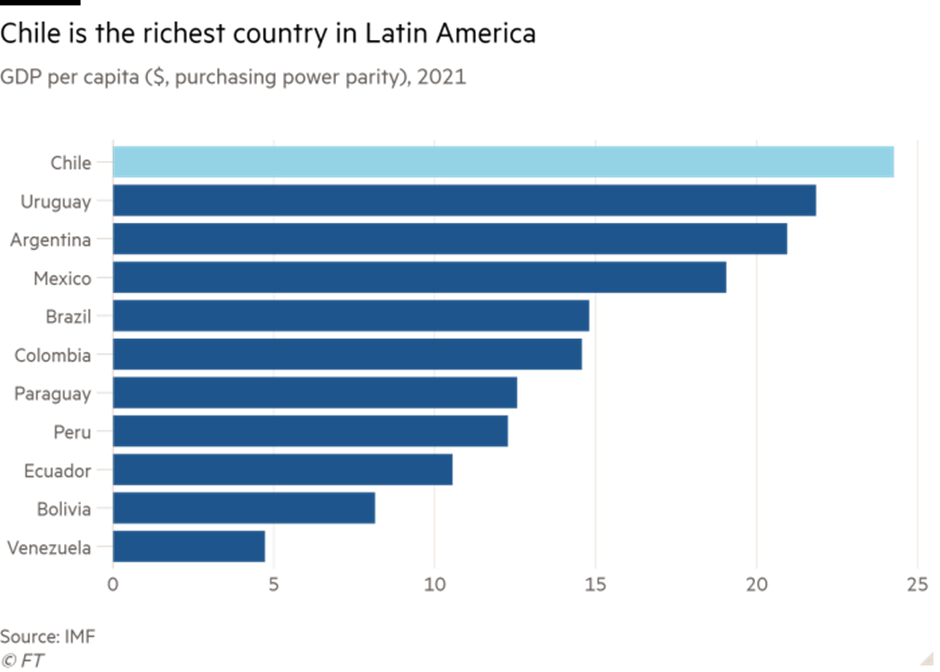
Chile is the richest country in Latin America as measured by GDP per head.  But its 20m population makes it tiny compared to Mexico or Brazil, which have populations six to ten times larger and GDPs four to five times larger.  Argentina and even Venezuela are much larger in population and GDP.

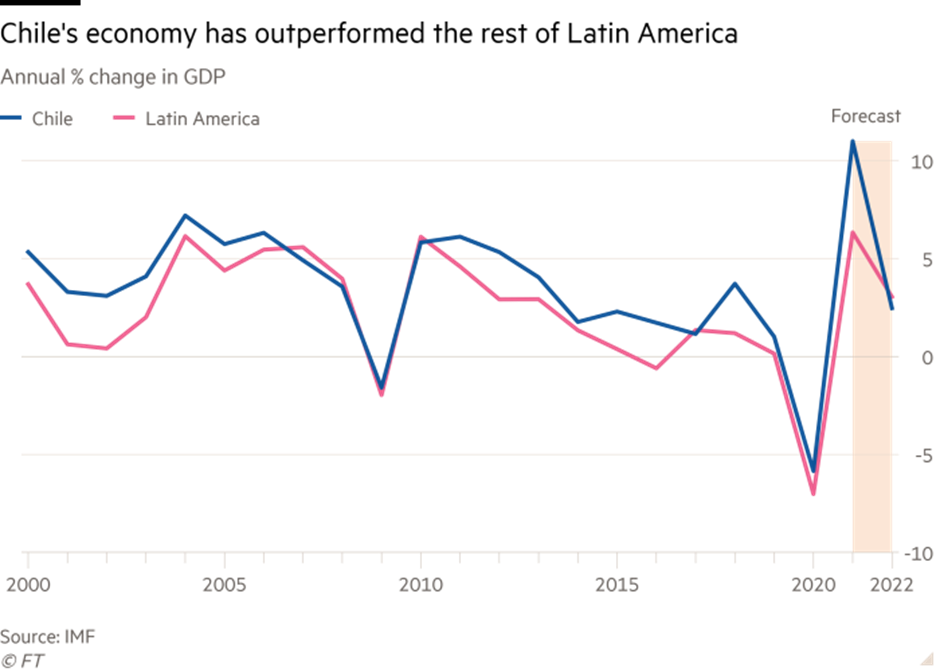
Nevertheless, Chile’s real GDP growth rate has generally been slightly faster than the rest of Latin America and its governments have thus been relatively stable.  Many mainstream economists and political theorists often use this to claim that Chile is a ‘free market’ capitalist economic success story and consider Chile as the “Switzerland of the Americas”. Chile is a member of the OECD, the rich nations club, and in the (NAFTA-USMCA) trade bloc with Canada, Mexico and the US.

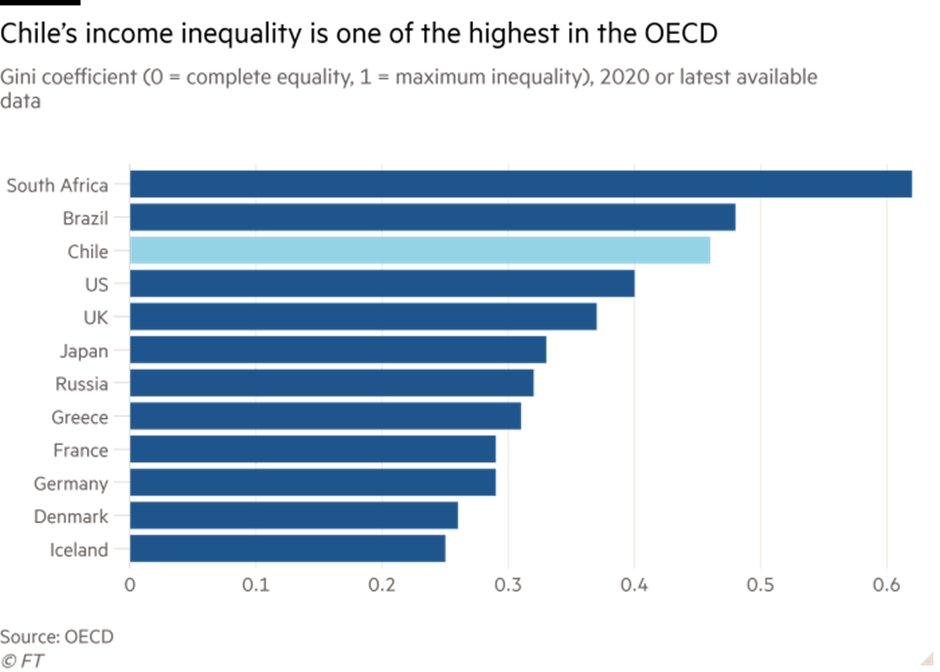
But this apparent success story is only relative in GDP growth compared to other Latin American economies.  Moreover, such gains have mainly gone to the rich in Chile.  Income inequality is among the worst in the OECD, only surpassed by Brazil and South Africa. 

The income share of the bottom decile in Chile is one of the lowest in the world.  Only a few countries, largely from Latin America, have lower income share accruing to the bottom decile of the distribution and this share has deteriorated in relative terms in the last 20 years.  Social spending (as a share of GDP) in Chile appears higher than in Mexico and Peru.  But public services have been reduced, forcing people to use private profit operations.  In particular, pensions are dominated by private sector companies and most Chileans find their savings for retirement are just too meagre to fund a decent standard of living in old age.

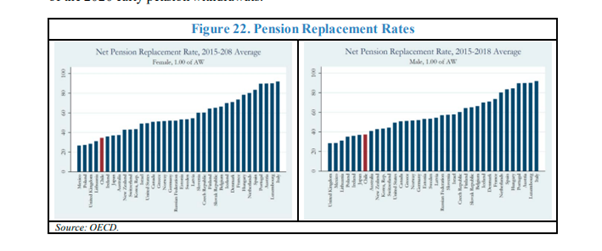
This was one of the big issues in the election and led to the widespread protests against pro-capitalist policies in 2019 (before COVID) which has now culminated in Boric’s election.  The IMF found that ‘replacement rates’ (ie pensions relative to average working income) in Chile are very low relative to other OECD economies, and this deficiency is even more pronounced for females than for males.

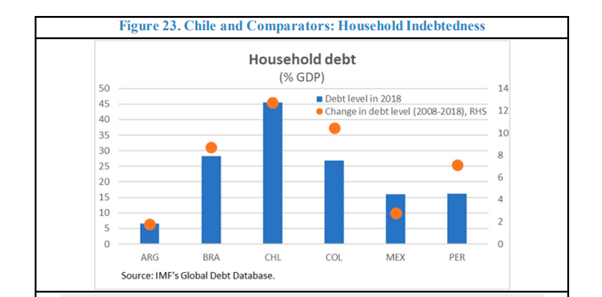
Amid high and rapidly increasing costs of living alongside limited income growth and low pensions, many households have accumulated considerable amounts of debt.

Taxes on the rich are very low, so that income redistribution is lower than almost all OECD peers and many other poor economies.

Chile’s relative economic success has always been based on its copper and mineral exports.  If copper and mineral prices are high and rising, Chile’s economy does better and conversely – but of course, little of that ‘trickles’ down from the profits of multi-nationals to the average Chilean household.

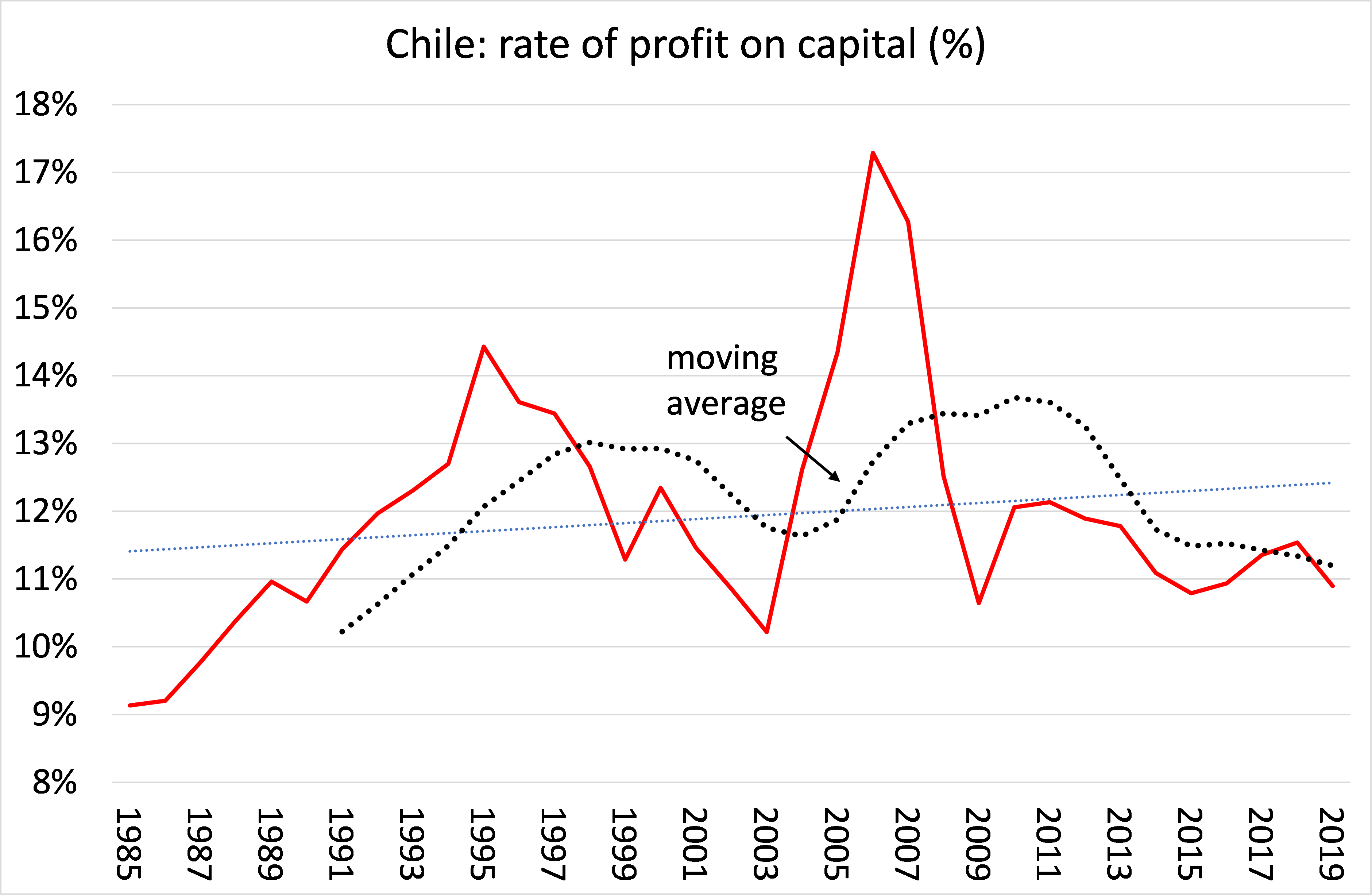
There have been some Marxist analyses of the Chilean economy that show how the profitability of Chilean capital has been driven by the copper cycle. Diego Polanco in his study for the whole of 20th century noted that “capital accumulation is driven by profitability” and that “the profit rate is a crucial variable for economic growth.”  Polanco found that and collapse of profitability explained the crisis phases in the Chilean capitalist economy.  “While Chile was a surplus labor economy, technical change had favorable contributions to the profit rate. However, once the process of urbanization advanced, Marx-Biased Technical Change took place, having a negative contribution to profitability.”  The neo-liberal period under Pinochet from the 1970s saw a rise in profitability enabling the regime to maintain its control for decades.

In a more recent study, Gonzalo Duran and Michael Stanton found that the rate of exploitation in Chile’s economy rose or fell according to the movement of the copper price. Profitability fell during the 1990s as copper prices stayed low and Marx’s law of profitability operated to lower the rate of profit. “In contrast, during the copper super-cycle period of 2004–2009, profits related to wages went up enormously due to the rise in copper prices, but new capital was still imported at low cost and wages were relatively constant. In other words, profits went up relatively to capital and wages and the ROP rose as a consequence.”

However, with the end of the commodity price boom from 2010 across Latin America, there was relative economic stagnation and a fall in the ROP.

My own measure of Chile’s profitability is based on the Penn World Tables IRR series. It delivers a similar trajectory for the profit rate: a drop in the rate from the mid-1990s; then a recovery in the commodity boom from 2003 to 2010, and then with the collapse of commodity prices from 2010, stagnation and decline in profitability.

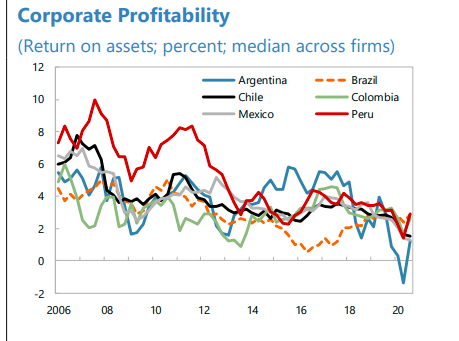
The IMF’s own recent measure from 2006 confirms this general trajectory for all Latin American economies after about 2010.

The fall in profitability after 2010 led to slowing growth in GDP, investment, incomes and a further squeezing of public services prior to the COVID slump.  With COVID and the health disaster, there was a collapse in the economy, with the main impact falling on those with the lowest incomes and worst jobs.  The pro-capitalist forces have been forced into retreat politically.

The victory of Boric could open up a new chapter is Chile’s political economy.  Indeed, there are huge opportunities for the Chilean economy to increase investment and diversify the economy.  The IMF finds that even under the previous regimes there has been some development in non-mineral and technology exports.  This must be the way for Chile to go.

So will Boric revive the socialist experiment began by Salvador Allende in the early 1970s?  So far, that seems unlikely, as Boric’s program is moderate by those standards; with no plans to socialise the economy, but merely to try and redistribute the largesse appropriated by capital somewhat more evenly.  The multi-nationals and the forces of the reactionary right-wing in the Chilean business sector, Congress and the media are gearing up for an incessant campaign of attack against the new President.

Michael Roberts is an Economist in the City of London and a prolific blogger

Michigan GOP candidate says public schools are plotting to 'eliminate the white people'

Matthew Chapman
RAW STORY
December 22, 2021

Mellissa Carone (screengrab).

On Wednesday, Michigan Advance reported that Mellissa Carone, a GOP anti-"voter fraud" activist who is running for state legislature in Michigan, espoused white supremacist propaganda to supporters on social media.

"During a Facebook live video Tuesday, Mellissa Carone ... said that public schools and the government are trying to 'eliminate' white people in America," reported Allison Donahue. "'They’re trying to eliminate the white people in America, particularly the white male in America,' Carone said after criticizing public schools for asking students for their pronouns and calling transgender rights 'government control.'"

"These comments are similar to what is said by far-right extremists against critical race theory, which is a graduate-level course examining the systemic effects of white supremacy in America. It is not taught in any of Michigan’s K-12 schools," continued the report. "In the nearly 90-minute video, Carone also criticized the COVID-19 vaccine, statewide shutdowns during the pandemic and defended insurrectionists who stormed the U.S. Capitol on Jan. 6. "

Carone gained national attention after she served as the star witness for Trump ally Rudy Giuliani during a Michigan hearing on election integrity, where she baselessly claimed to have seen Dominion Voting Systems rigging electoral counts and claimed that the Republican state lawmaker questioning her looked like a penis. She has also claimed that the COVID-19 vaccine is a sign of the Biblical apocalypse.

Until recently, Carone was on probation for a "computer crime" after she allegedly harassed her fiancé's ex-wife with sexually explicit videos.

THIRD WORLD USA
Infrastructure bill to aid US tribes with water, plumbing

By GILLIAN FLACCUS, FELICIA FONSECA and BECKY BOHRER
Dan Martinez, emergency manager for the Confederated Tribes of Warm Springs, pauses in the hallway of a storage building filled with donated water on Tuesday, Dec. 7, 2021, in Warm Springs, Ore. “The infrastructure bill brought joy to my heart because now it gives me hope — hope that it’s going to be repaired,” said Martinez, the tribes’ emergency manager, who expects to receive federal funds to replace underground pipes and address the 40-year-old treatment plant.
 (AP Photo/Nathan Howard)


WARM SPRINGS, Ore. (AP) — Erland Suppah Jr. doesn’t trust what comes out of his faucet.

Each week, Suppah and his girlfriend haul a half-dozen large jugs of water from a distribution center run by the Confederated Tribes of Warm Springs to their apartment for everything from drinking to cooking to brushing their teeth for their family of five. It’s the only way they feel safe after countless boil-water notices and weekslong shutoffs on a reservation struggling with bursting pipes, failing pressure valves and a geriatric water treatment plant.

“About the only thing this water is good for is cleaning my floor and flushing down the toilet,” Suppah said of the tap water in the community 100 miles (160 kilometers) southeast of Portland. “That’s it.”

In other, more remote tribal communities across the country, running water and indoor plumbing have never been a reality.

Now, there’s a glimmer of hope in the form of a massive infrastructure bill signed last month that White House officials say represents the largest single infusion of money into Indian Country. It includes $3.5 billion for the federal Indian Health Service, which provides health care to more than 2 million Native Americans and Alaska Natives, plus pots of money through other federal agencies for water projects.

Tribal leaders say the funding, while welcome, won’t make up for decades of neglect from the U.S. government, which has a responsibility to tribes under treaties and other acts to ensure access to clean water. A list of sanitation deficiencies kept by the Indian Health Service has more than 1,500 projects, including wells, septic systems, water storage tanks and pipelines. Some projects would address water contamination from uranium or arsenic.

About 3,300 homes in more than 30 rural Alaska communities lack indoor plumbing, according to a 2020 report. On the Navajo Nation, the largest Native American reservation, about one-third of the 175,000 residents are without running water.

Residents in these places haul water for basic tasks such as washing and cooking, sometimes driving long distances to reach communal water stations. Instead of indoor bathrooms, many use outhouses or lined pails called “honey buckets” that they drag outside to empty. Some shower or do laundry at community sites known as “washeterias,” but the equipment can be unreliable and the fees expensive.

“You look at two billionaires competing to fly into outer space, yet we’re trying to get basic necessities in villages of interior Alaska,” said PJ Simon, a former chairman of an Alaska Native nonprofit corporation called the Tanana Chiefs Conference.

Many more tribal communities have indoor plumbing but woefully inadequate facilities and delivery systems riddled with aging pipes.

The coronavirus pandemic, which disproportionately hit Indian Country, further underscored the stark disparities in access to running water and sewage systems.

In Warm Springs, the water crisis has overlapped with COVID-19.

“During a worldwide pandemic, we’ve had a boil-water notice. How are we supposed to wash our hands? How are we supposed to sanitize our homes to disinfect, to keep our community members safe? How can we do that ... when our water isn’t even clean?” said Dorothea Thurby, who oversees the distribution of free water to tribal members and food boxes to those who are quarantined.

A 2019 report by a pair of nonprofit groups, US Water Alliance and Dig Deep, found Native American homes are 19 times more likely than white households to lack full plumbing. And federal officials note tribal members without indoor toilets or running water are at increased risk of respiratory tract, skin and gastrointestinal infections.

On the Navajo Nation, Eloise Sullivan uses an outhouse and often drives before dawn to beat the crowd at a water-filling station near the Arizona-Utah border to get water for the five people in her household. They use about 850 gallons (3,200 liters) a week, she estimated.

Sullivan, 56, doesn’t mind hauling water, but “for the younger generation, it’s like, ‘Do we have to do that?’”

“It’s kind of like a big issue for them,” she said.

She once asked local officials what it would cost to run a water line from the closest source about 2 miles (3.2 kilometers) away. She said she was told $25,000 and never pursued it.

Libby Washburn, special assistant to President Joe Biden on Native American affairs, recently told tribes the infrastructure bill included enough money to complete all the projects on the Indian Health Service list. The agency said it’s consulting with tribes and won’t make allocation decisions before that process is over.

Until now, tribes and outside organizations have worked to address needs with their own funding, donations or federal money, including pandemic relief.

“If you live without running water, you understand the importance and the connection you have with it, deep down as a person, as a human being,” said Burrell Jones, who sets up water systems and delivers water around Dilkon, Arizona, with Dig Deep’s Navajo Water Project. “You can’t exist without water.”

Andrew Marks recently moved back to Tanana, a community of about 190 people in Alaska’s interior. He initially relied on a washeteria but found the equipment unreliable. He now has running water and plumbing where he lives but hauls water for family members who don’t.

“I believe if we had more people with water, more people connected to the grid, it would drastically improve their life,” he said.

In Oregon, tribal officials have handed out about 3 million gallons (11 million liters) of water — almost all of it donated — from a decommissioned elementary school on the reservation. A steady stream of residents pick up a combined 600 gallons (2,270 liters) of water a day from the building. Former classrooms overflow with five-gallon (19-liter) containers and cases of bottled water.

“The infrastructure bill brought joy to my heart because now it gives me hope — hope that it’s going to be repaired,” said Dan Martinez, the tribes’ emergency manager, who expects to receive federal funds to replace underground pipes and address the 40-year-old treatment plant.

“If you came to work one day and someone said, ‘Hey, you need to go and find water for a community of 6,000 people.’ ... I mean, where do you start?’”

The money won’t provided immediate relief. Funding to the Indian Health Service is supposed to be distributed over five years. There is no deadline for its use, and projects will take time to complete once started. The money won’t cover operation and maintenance of the systems, a point tribes have criticized.

In Warm Springs, tribal members don’t pay for their water, and proposals to charge for it are deeply unpopular. That provides little incentive for tribal members to conserve water and raises questions about how new infrastructure will be maintained.

“There are some Natives who say — and I believe this myself — ‘How do you sell something you never owned? The Creator has given it to us,’” said Martinez, a tribal member.

Building out infrastructure in remote areas can be onerous, too. Most roads on the Navajo Nation are unpaved and become muddy and deeply rutted after big storms.

In Alaska, winter temperatures can fall well below zero, and construction seasons are short. Having enough people in a small community who are trained on the specifics of a water system so they can maintain it also can be a challenge, said Kaitlin Mattos, an assistant professor at Fort Lewis College in Colorado who worked on a 2020 report on water infrastructure in Alaska.

“Every bit of funding that is allocated is going to help some family, some household, which is wonderful,” she said. “Whether it’s enough to help every single household, I think, remains to be seen.”

____

Fonseca reported from Flagstaff, Arizona. Bohrer reported from Juneau, Alaska.

Did COVID-19 change life expectancy in America?

A new CDC report tracks homicides, drug overdose deaths and whether those numbers rose or fell amid the pandemic
DESERT NEWS
 Dec 22, 2021
Medical staff tend to a patient with coronavirus, on a COVID-19 ward inside the Willis-Knighton Medical Center in Shreveport, La., Aug. 18, 2021. 
Gerald Herbert, Associated Press

In 2020, COVID-19 joined what had been a fairly stable list of leading causes of death in the United States, coming in at No. 3 behind heart disease and cancer. The pandemic also contributed heavily to a dip in projected lifespan compared to 2019.

Life expectancy at birth in 2020 was 77 years overall in the United States, down nearly two years from the projection for those born in 2019, according to data released Wednesday by the National Center for Health Statistics in the Centers for Disease Control and Prevention. Females are expected to live 5.7 years longer than males, at 79.9 years vs. 74.2 years. Both those numbers dropped compared to 2019 predictions.

The age-adjusted death rate for the whole population rose from 715.2 per 100,000 in 2019 to 835.4 in 2020. Increases in the age-adjusted death rate for ethnic and racial groups varied from just over 12% for non-Hispanic white females to a nearly 48% jump for Hispanic males.

Overall, age-adjusted death rates rose the most for Hispanics, followed by non-Hispanic Blacks, whose rates were double those of non-Hispanic whites. An age-adjusted death rate weights age-specific rates for each group by the proportion of each group in the population. The new report notes that the age-specific death rate increased in each age group 15 and older between 2019 and 2020.

Unintentional injuries, stroke, chronic respiratory disease, Alzheimer’s, diabetes, influenza/pneumonia and kidney disease rounded out the top 10 list of leading causes of death in the U.S. in 2020.

Overall, the report said, 3,383,729 resident deaths were recorded in the United States in 2020, up 528,891 compared to 2019.

The 16.8% increase in the age-adjusted death rate for the total population was the biggest single-year increase since the data collection began, and the decrease in life expectancy was the largest single-year decrease in more than 75 years.
COVID-19 toll

As of Dec. 20, 2021, 804,046 deaths had been attributed to COVID-19 on death certificates. In 90% of cases, CDC reported, COVID-19 was listed as the underlying cause of death, while the others listed it as a contributing cause of death. The report said the largest number of COVID-19 deaths reported in a single week came in early January of 2021, when 25,984 deaths were attributed to the pandemic.

COVID-19 changed a trajectory that had been trending toward longer life. A year ago, the final data on 2019 deaths compared to 2018 showed that life expectancy had increased for the second year in a row, “despite an increase in deaths from drug overdoses and an all-time high of over 2.85 million deaths in the U.S.,” that earlier report said

.
Workers wearing personal protective equipment bury bodies in a trench on Hart Island, Thursday, April 9, 2020, in the Bronx borough of New York.
 John Minchillo, Associated Press

Drug overdose and homicide


The CDC said that drug overdose deaths make up more than a third of all accidental deaths in the country and had increased in 2019, after they declined in 2018 for the first time in 28 years.

2020 brought other death-related challenges, as well. In July, the CDC reported that drug overdose deaths were up 30% compared to the previous year. And in October the agency reported that 2020 brought the “largest one-year increase in the U.S. homicide rate.”

Provisional data found that in 2020, the homicide rate in the United States was 7.8 per 100,000, compared to 6.0 the year before — and the highest rate since 1995, “but significantly lower than the early 1980s, which topped 10 homicides per 100,000.”
Infant deaths

The new report said 19,582 children younger than age 1 died in 2020, which was 1,339 fewer than in 2019.

Among infants, the leading causes of death were the same as in 2019: congenital malformations, low birth weight, sudden infant death syndrome, unintentional injuries, maternal complications, cord and placental complications, bacterial sepsis, respiratory distress, diseases of the circulatory system and neonatal hemorrhage.

There was a statistically significant increase in sudden infant death syndrome, from 33.3 to 38.4 per 100,000 live births in 2019 compared to 2020. Low birth weight was the only category where deaths among infants decreased meaningfully, from 91.9 to 86.9 per 100,000.

The CDC has an interactive web dashboard where the leading causes of death are regularly updated.