Wednesday, February 23, 2022

Disbelieving but fretful, Kyiv hears nearing drumbeats of war
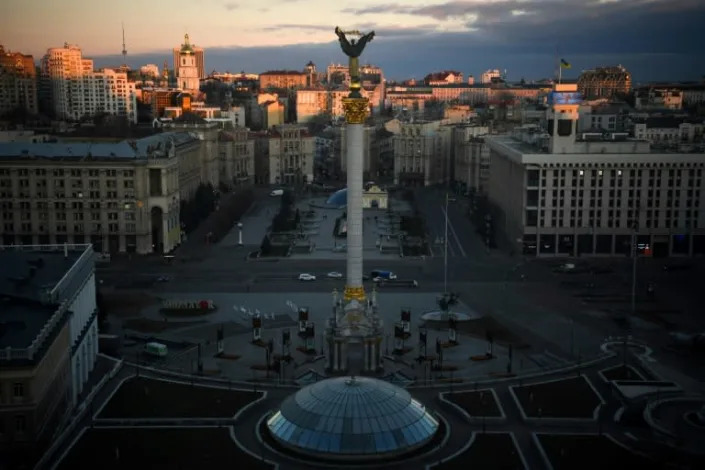


The level of anger at Russian President Vladimir Putin is palpably rising on the streets of Kyiv as the threat of war nears (AFP/Sergei SUPINSKY)


Daphne ROUSSEAU
Wed, February 23, 2022


Every hour, from dawn til dusk, Ukraine's soulful national anthem echoes across Kyiv's expansive Maidan Square, just as it did in 2014.

Back then, it was a rousing call to join the masses braving the bitter cold on the square during Kyiv's historic -- and ultimately bloody -- pro-EU revolution. Today it is playing again as the former Soviet republic girds for all-out war.

Russia has amassed more than 150,000 Russian soldiers on Ukraine's borders, according to US estimates.

Russia's parliament has approved sending its "peacekeepers" into parts of Ukraine's east that Moscow has recognised as independent statelets and President Vladimir Putin's rhetoric is sounding militant.

But on the spring-like streets of sunny Kyiv, no one stops to look at the giant screen showing pixelated images of the country's yellow and blue flag, the anthem blasting from speakers.

"Everything will be fine," said Zoya Rozuman, a cleaning lady, her blue outfit partially unzipped on a warm afternoon.

"I don't think the Russian people, those who live around Moscow and Vladimir, want our sons to die. And we don't want their sons to die."

Instead of worrying about the war, the 59-year-old plans to spend the coming weeks tending her garden.

- War footing -

The anthem started playing on Tuesday, when Russian lawmakers sitting 800 kilometres (500 miles) from Ukraine's eastern front in Moscow unanimously authorised the use of military force abroad.

In the Kremlin, Putin is coy about his plans, telling reporters that the deployment of Russian forces would "depend on the situation on the ground".

But the nearing drumbeats of war have many in Kyiv worried, even it they do not think that the Ukrainian capital itself will come under attack.

"We are afraid of war, but we are ready to fight, because this is a defensive war," said Atantoliy Tarasenko, 74.

Like many others, the pensioner still seethes that his Western-backed government "did not lift a finger" to keep Russia from annexing Ukraine's Crimea peninsula in 2014.

Now, Moscow has recognised the independence of two eastern Ukrainian regions that began waging a deadly insurgency at around the same time.

The government in Kyiv says it is ready to fight, with the defence ministry warning of "hardship" and human "losses".

Students and workers have started receiving emailed instructions from their schools and bosses about how to prepare for the worst, including what to stockpile and where to find the nearest bomb shelter.

- Anger at Putin -

Oleg Koras, 38, has joined a "territorial defence" unit in Kyiv.

But despite going to training twice a week, he acknowledged feeling slightly helpless.

"If the bombs start falling on our city, what can you do but jump in a shelter," he said, before adding: "But then we will know how to respond."

Besides nerves, a palpable level of anger is rising at Putin, who has tried to keep Ukraine under Russia's influence for the past two decades.

Putin's tactics sparked two pro-Western revolutions -- one in 2004 and the other a decade later -- and are bringing the two countries dangerously close to war today.

"He is not someone you can reach deals with," said Maksym Dizhechko, a 41-year-old lawyer.

"He is like this huge kid in shool who beats everyone up, and who only understands things when he gets punched back."

The sentiment was shared by Ksenya Baliy, a 31-year-old DJ.

"I still feel hatred toward that man. I don't think he deserves to be where he is," she said. "I want him to disappear as soon as possible from our beautiful planet."

Yet the cultural and familial links between the two neighbours linger, rising up above the fury at political figures.

Volodymyr Khroviy, 39, identifies himself as a "Russian from Ukraine", with his family living on the other side of the border.

But his home is Ukraine, Khroviy says, "and if they come with their tanks and weapons, I will certainly not be pleased to see them".

dar-zak/dt/yad
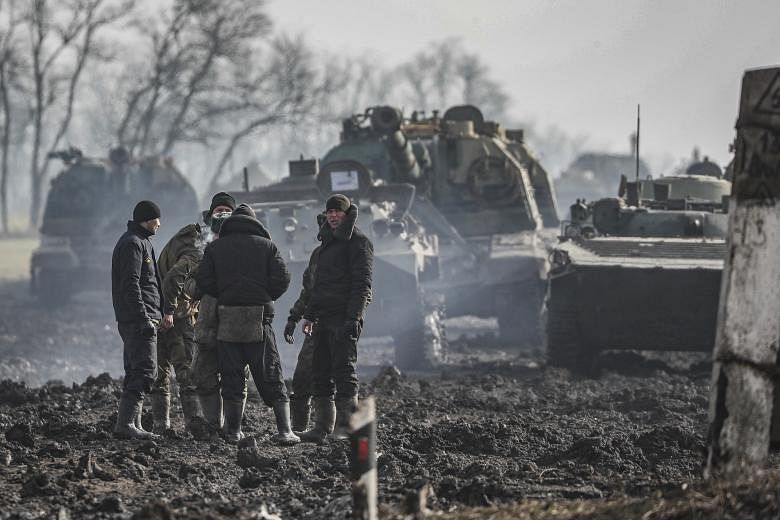
On Ukraine border, Russian soldiers await orders


Russian servicemen and armoured vehicles stand on a road in Russia's Rostov region. PHOTO: EPA-EFE

ROSTOV REGION, RUSSIA (AFP) - In a roadside cafe a few dozen kilometres from the border between Russia and rebel-held areas in Ukraine, some Russian soldiers were eating as they rested, the smell of frying in the air.

"Thank you, we'll come back," said one of them as he got up after finishing his cheburek - a type of fried turnover filled with meat and onion.

Another soldier knocked at the door of a small room where an AFP team sat working - the only civilian customers seen on Wednesday (Feb 23) at the cafe.

"Do you want to buy some dry rations?" he asked.

On a screen above showing music videos, some soldiers could be seen running in a muddy field. But it was just a video of the 1980s British rock classic In The Army Now by Status Quo.

Outside in the village, soldiers were everywhere - some wearing camouflage hats, others in army-issue grey synthetic fur hats.

They smoked in the parking lot, drank their coffee or kept busy working on the military vehicles on flatbed train wagons parked in railway sidings stretching for hundreds of metres.

The wagons carried rocket launchers, artillery pieces and fuel tanks.

On the road leading to the border, empty heavy military trucks and a convoy of military green-coloured vehicles crossed paths.

Russia's Rostov region, which borders the self-proclaimed separatist republics of Donetsk and Lugansk, was silent and shrouded in heavy fog on Wednesday - a Russian public holiday celebrating the military.


After being crossed in recent days by thousands of refugees leaving the separatist statelets one way and military convoys heading the other way, the region is now in a mood of tense anticipation.

Russia has massed some 150,000 soldiers on Ukraine's borders, according to Western estimates.
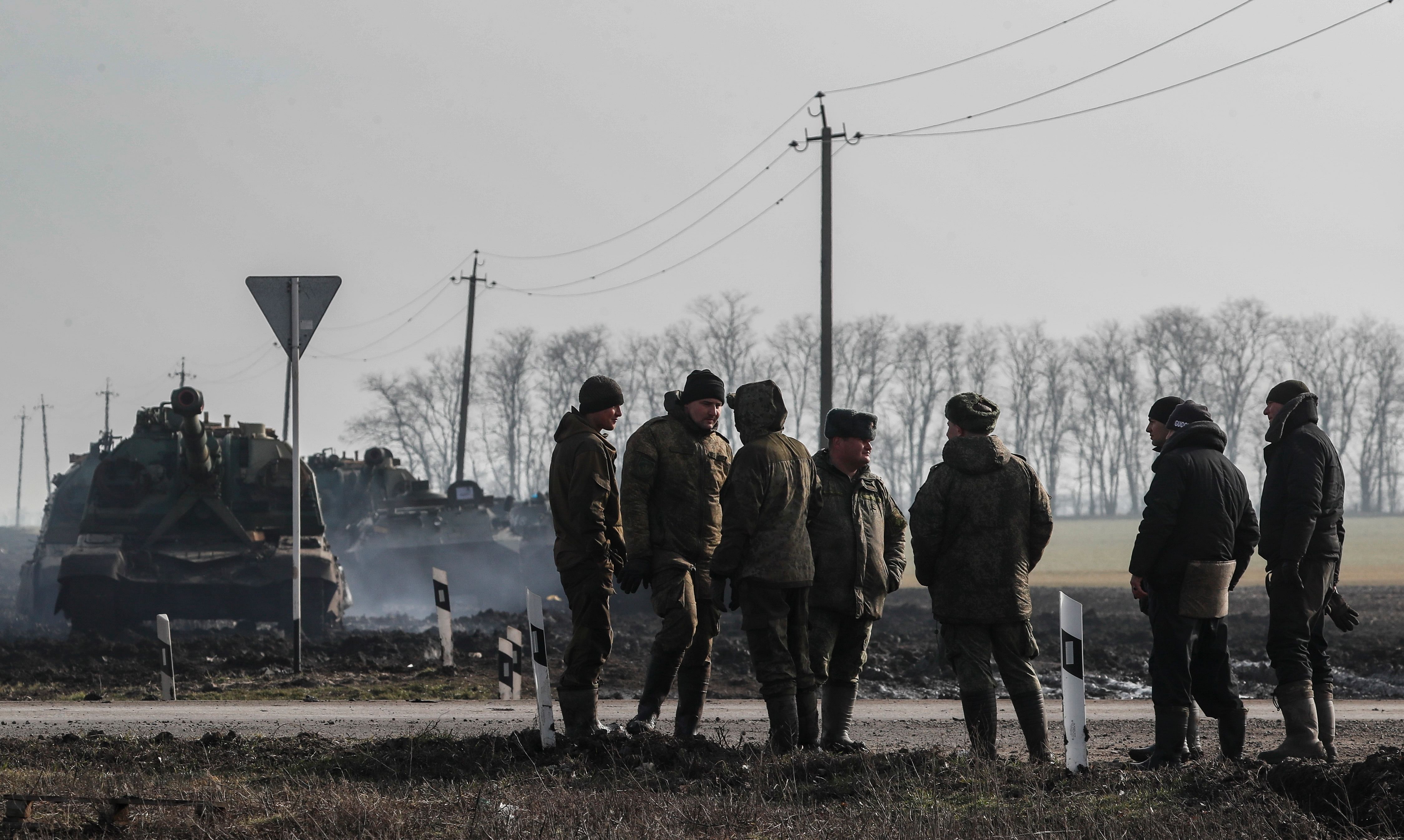
Russian servicemen and armoured vehicles are pictured in 
Russia's Rostov region, on Feb 22, 2022. 
PHOTO: EPA-EFE PHOTO: EPA-EFE

It has said it is prepared to send in troops, ostensibly to protect Donetsk and Lugansk after recognising their independence this week, raising fears of an all-out war with Ukraine.

The separatist conflict in eastern Ukraine, which has dragged on since 2014, has already claimed more than 14,000 lives.
'Afraid to go back'

A group of middle-aged men passed the time playing football.

Valery Belik, a 52-year-old retired policeman wearing a cap reading "No Fear", was in goal.

"Of course, we are all worried for the People's Republic of Donetsk, for Lugansk.

"It's a shame for people who are suffering the terror of a war that Ukrainian authorities have unleashed," he said, echoing the Kremlin message of Russia coming to the aid of the separatists against supposed Ukrainian aggression.
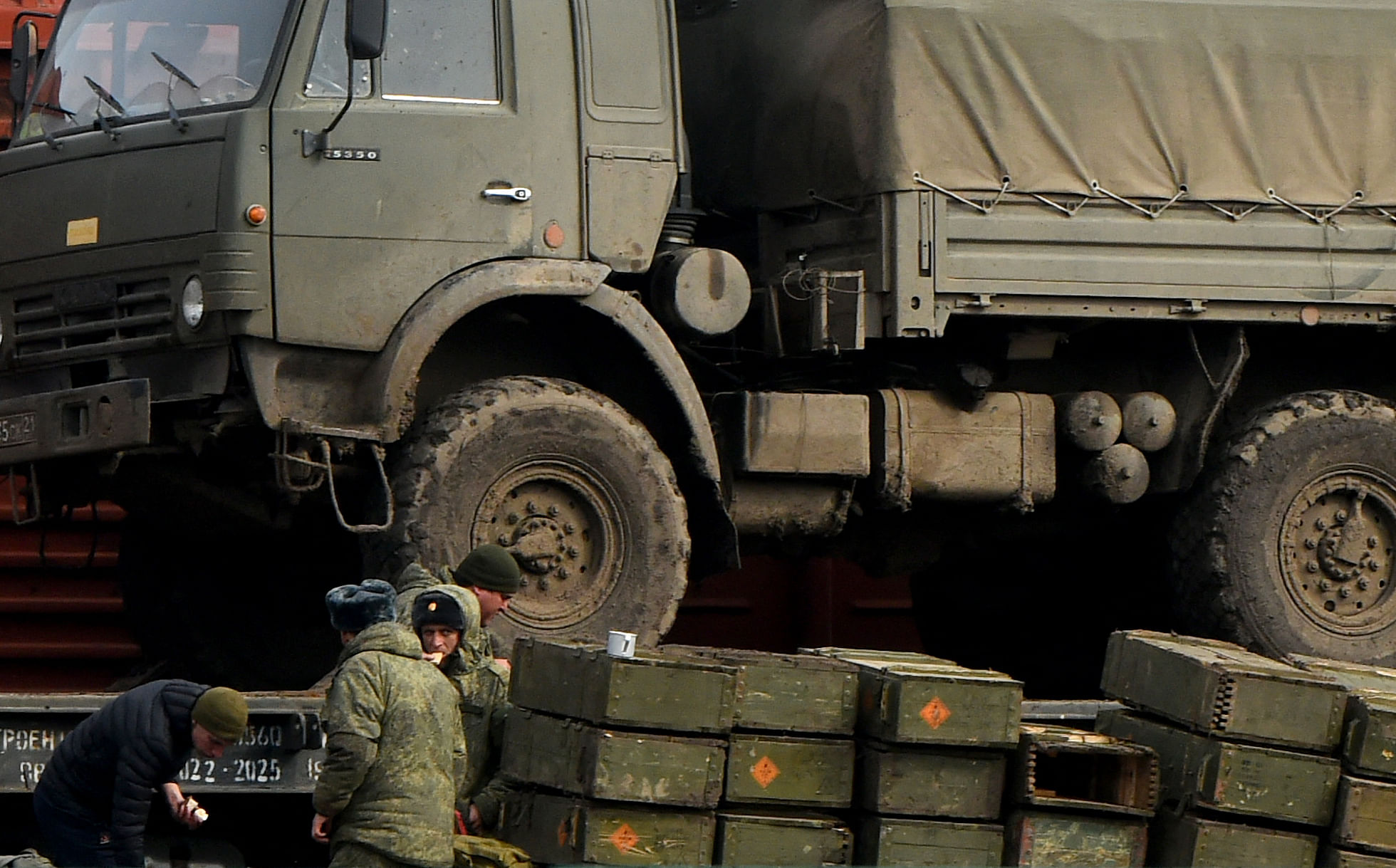
Russian military vehicles are seen on train platforms in Russia's southern Rostov region, some 50km from the border with the self-proclaimed Donetsk People's Republic, on Feb 23, 2022. PHOTO: AFP

On the way to the border, a bus was parked on the side of the road.

"I went to pick up my Russian passport," said Grigory, a 35-year-old mechanic from Shakhtarsk, located in one of the rebel regions.

"I am a bit afraid to go back, we hear shooting and explosions," he said. "But my family is there. I won't leave. My work, my whole life are there."

Nearer to the border, the streets empty out.
'Everything is so frightening'

In the last village before the border, Valentina Druzhinenko, a 75-year-old pensioner, sat on a bench with her neighbour.

She had mixed feelings about Russian President Vladimir Putin's move to recognise the independence of the separatists this week.

"I understand the consequences, they will be terrible," she said.

"Our grandchildren will not be able to handle them.

"But if Vladimir Putin did it, it means it was necessary. I respect and love him."

Her neighbour, Maria Yagnuk, born in 1941, spoke in Ukrainian about having lived under Nazi occupation in the area during World War II.

"How can we not be afraid? Who can not be afraid? I myself was born during the war.

"We don't even watch the news. Everything is so frightening."


Sanofi, GSK to seek approval for COVID vaccine candidate

Wed., February 23, 2022

* Seeking approval as primary vaccine regimen and booster dose

* Full trial results expected to be published later this year

* Two doses 100% effective against severe COVID-19


* Booster dose raises neutralizing antibodies across platforms (Adds details on prospective deliveries, background on vaccine class)

PARIS, Feb 23 (Reuters) - French drugmaker Sanofi and its British partner GlaxoSmithKline are seeking regulatory approval for their COVID-19 vaccine to be used as a booster, as well as a standalone two-dose shot, after several setbacks.

The companies said on Wednesday they intended to submit data to regulators from a late-stage trial of the vaccine, and another testing it as a booster, with full results for both studies expected to be published "later this year."

Sanofi, which plans to produce the vaccine in France, Italy and the United Sates, is hoping for a comeback after falling behind in the race for COVID-19 shots, while GSK, the world's biggest vaccine maker by sales, has not developed its own candidate and is instead contributing its adjuvant technology to developers.

Sanofi-GSK's shot relies on a conventional protein-based approach, compared with the newer mRNA technology used in established COVID-19 vaccines from Pfizer-BioNTech and Moderna.

It is similar in technology to one of Sanofi's seasonal influenza vaccines, and is coupled with GSK's adjuvant, a substance that increases the effectiveness of a shot. It is also easier to store and transport than some rival shots.

The protein technology, which is also behind the recently approved COVID-19 shot from Novavax, has been in use since the mid-1980s, leading public health experts to hope that some of those who have shunned mRNA shots might opt for a vaccine class with a decades-long safety record.

The companies said final analysis of the booster trial, which included participants previously given shots based on mRNA technology or adenovirus viral vectors, showed it could increase neutralising antibodies by 18 to 30 times.

"We are confident that this vaccine can play an important role as we continue to address this pandemic and prepare for the post-pandemic period," said President of GSK Vaccines, Roger Connor.

Early data from the late-stage trial of the vaccine as a standalone two-dose shot showed it was 100% effective against severe COVID-19 and hospitalisation, with 75% efficacy against moderate or severe disease.

"No other global Phase 3 efficacy study has been undertaken during this period with so many variants of concern, including Omicron, and these efficacy data are similar to the recent clinical data from authorized vaccines," said Thomas Triomphe, executive vice president for Sanofi Vaccines.

The companies said they were in discussions for approval of their shot with regulators including the U.S. Food and Drug Administration and European Medicines Agency.

A Sanofi spokesperson added the filing was imminent and would take a few days at most.

He reiterated the French drugmaker's commitment to supply a total of 75 million doses to the EU and Britain, as well as 100 million to the United States, contingent on regulatory approval.

The planned U.S. deliveries would be governed by a $2.1 billion contract with the U.S. government signed in July 2020, he added.

Discussions with the international vaccine-sharing facility COVAX about shipments to lower-income countries are ongoing.

The head of the Coalition for Epidemic Preparedness Innovations (CEPI), Richard Hatchett, said new protein-based vaccines administered with adjuvants could "potentially become the workforce for vaccinations in the future," when asked about the role of late-comers to the vaccine race.

CEPI co-runs COVAX.

Sanofi and GSK surprised investors in December by delaying key results from the vaccine trials to this year, while Sanofi also dropped plans for its own mRNA shot due to the dominance of Pfizer-BioNTech and Moderna. (Reporting by Sudip Kar-Gupta and Benoit Van Overstraeten in Paris, Pushkala Aripaka in Bengaluru and Ludwig Burger in Frankfurt Editing by Jason Neely and Mark Potter)
BioNTainers and co: The disjointed quest to produce COVID mRNA vaccines in Africa

The European Union-African Union summit brought dissonant news about COVID-19 mRNA vaccine development in Africa, revealing cracks in collaboration between the world's largest drug companies and the WHO.


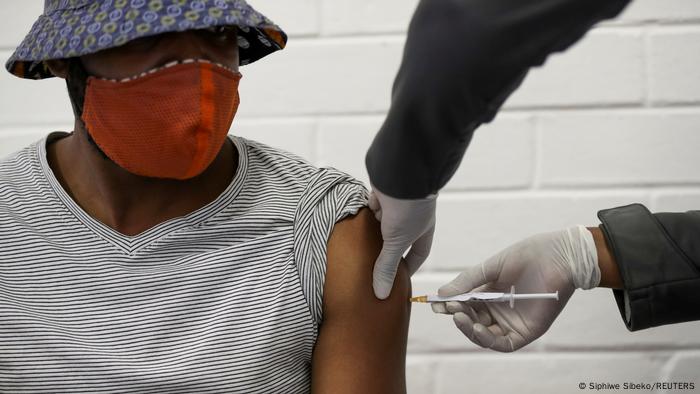
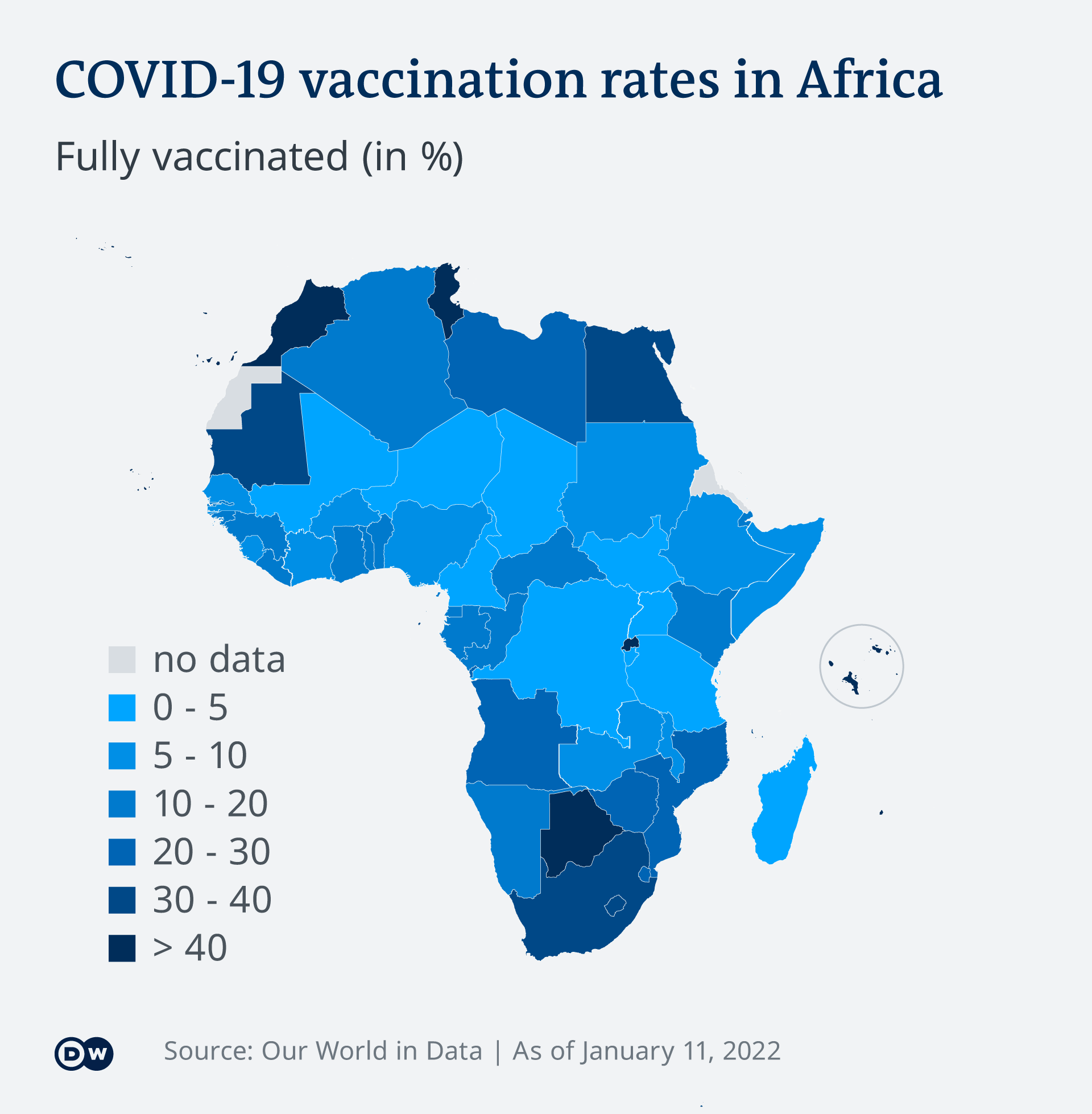
Two years into the pandemic, only a fraction of the African population has been vaccinated against the coronavirus.

Last week's European Union-African Union summit brought conflicting news about mRNA vaccine production in Africa.

Two days after BioNTech executives announced plans to export a version of its Marburg factory to locations in Senegal and Rwanda via "BioNTainers," leaders of South Africa's WHO-backed mRNA technology transfer hub announced the first six countries chosen to receive the technology to create mRNA vaccines at their own in-country hubs.

Neither development will help speed up vaccination against the coronavirus this year.

Meryame Kitir, Minister of Development Cooperation and Urban Policy of Belgium, said in a WHO press conference she expects the Hub's vaccines will receive approval in 2024.

BioNTech expects their solution will be up and running in two to three years, said COO Sierk Poetting in a press conference following the BioNTainer announcement.

According to leaders of Africa's mRNA vaccine hub, the two events are not related.

The apparent dissonance between the announcements is just the latest in the story of the West's disjointed quest to vaccinate the African continent.
COVAX

By June 2021, more than a year into the pandemic and around the same time the COVID-19 vaccine had become widely available across the West,it was clear something wasn't working.

While Europe and the United States had already been vaccinating citizens for six months, some African countries had only just received their first shipments.

There had been plans in place to avoid this problem, which many global health experts had anticipated from the start. COVAX, the UN-backed global vaccine alliance, was supposed to deliver vaccines to Africa. But those plans got muddled when wealthy countries bought the bulk of the vaccines for themselvesleaving little for low-income countries.

The COVAX alliance had good intentions, but it wasn't working. And with talks to lift patents seemingly infinitely stalled, making Africa-based development of already-existing vaccines all but impossible, African leaders decided to try something new. They would create their own.
Hub Opens

With the help of the WHO, in late June 2021 the world's first mRNA technology transfer hub opened in South Africa with partners Biovac, Afrigen Biologics and Vaccines, a network of universities and the Africa Centers for Disease Control and Prevention (Africa CDC).

Their plan was simple: They'd create an mRNA vaccine, then partner with other "hubs" in low-income countries across the world to share the technology, allowing for cheap global production of mRNA vaccines. The plan would free low-income countries of a reliance on their high-income counterparts for vaccine shipments.

COVID-19: Africa plans a vaccine revolution

The Hub decided to use unpatented data from the Moderna vaccine, which the company made available for the duration of the pandemic. From the start, they'd asked the largest pharmaceutical companies for help, Afrigen director Petro Terblanche said. But the companies didn't answer.

Instead of responding to the hub's requests for collaboration, BioNTech-Pfizer announced its own separate plans one month later to help ease access to vaccines on the African continent.


COVID-19 vaccination rates in Africa are lower than in most of the rest of the world

In collaboration with Biovac, a South African biopharmaceutical company, BioNTech would make the vaccines, then send them to South Africa, where they'd be bottled and transported across the continent. Production would start around the second half of 2022, they said.

Four days later, they announced more plans to help vaccinate Africans ― this time not against COVID, but malaria.

Together with the Kenup Foundation, a Malta-based lobbying firm that's been working with BioNTech over the past few years on its EU-funded "eradicateMalaria" campaign, they would develop the first mRNA vaccine against Malaria.Vaccine manufacturing facilities would co-locate with the WHO technology transfer hubs, they said.
'Stop copying Moderna immediately'

Around two weeks later, Kenup executive Holm Keller set off on a journey to South Africa. He visited the technology transfer hub and met with multiple South African health leaders. The trip had nothing to do with malaria ― it was focused on the transfer hub.

Perhaps the leaders Keller met thought this meant BioNTech was ready to collaborate with the Hub in its quest to develop its own mRNA vaccine.

But a report recapping the mission stated the opposite.

"The WHO Vaccine Technology Transfer Hub's project of copying the manufacturing process of Moderna's COVID-19 vaccine should be terminated immediately," the report, titled Supporting South Africa's Vaccine Production Hub, said. "This is to prevent damage to Afrigen, BioVac, and Moderna."

The report was first made public in an investigation published in early February by the British Medical Journal.

Two weeks after the mission, on August 27, Kenup officials convened a meeting during the G20 summit on behalf of BioNTech. President Paul Kagame of Rwanda, President Macky Sall of Senegal, President Ursula von der Leyen of the European Commission and BioNTech CEO Uğur Şahin met in Berlin to discuss the development of manufacturing sites to produce mRNA vaccines against Malaria, TB and COVID-19.


Once built, BioNTech's "BioNTainers" will be able to produce up to 50 million vaccine doses per year.

In a joint communique , Kenup wrote that prospective locations of the necessary manufacturing sites "are expected to co-locate with the World Health Organization’s (WHO) upcoming Vaccine Hubs."

The report added that "in principle, BioNTech’s COVID-19 vaccine could potentially also be manufactured in the local facilities for distribution in Africa."
BioNTainer solution

At the African Union-European Union summit around six months later and two weeks after Hub officials declared they’d successfully replicated an mRNA COVID-19 vaccine, BioNTech made its own big announcement.

The company would build BioNTainers ― exact replications of the BioNTech factory in Marburg, Germany ― in Rwanda and Senegal.

When asked in a press conference why the company wasn't collaborating with the Hub, as it had stated it would in the August 27 joint communique and in the July malaria announcement, Poetting replied: "We are actually collaborating with the transfer hubs and we are co-locating with the transfer hubs."

This isn't true, Afrigen director Petro Terblanche told DW. Terblanche has led the Hub to replicate the Moderna vaccine and met with Keller in August.

"They are not co-located with the mRNA hub," Terblanche said. "I am not aware of any other hubs in Africa. They are also not collaborating with the mRNA hub at the moment. I still hope that they will."

WHO officials, when asked by DW why BioNTech wasn't co-locating with the South African hub, and why Poetting said the company was co-locating with the hub when hub officials say it is not, said: "Please ask BioNTech that."

Neither BioNTech nor the Kenup Foundation responded to multiple requests for comment from DW.

The Global Vaccine Inequity and its Consequences
The fastest option?

Poetting said in the press conference that the reasoning behind the BioNTainer solution was speed. It would be faster than other options, he said.

But Achal Prabhala, coordinator of the AccessIBSA project, which aims to expand access to medication and vaccines for those in need, and Alain Alsalhani, from Médecins Sans Frontières, say that's not true.

The two wrote a report in December outliningeight already-existing vaccine manufacturers in Africa where pharmaceutical companies like BioNTech or Moderna could outfit to produce mRNA vaccines.

The BioNtainers will take longer to come into operation in comparison with retrofitting already-existing facilities, Prabhala said. While the BioNTainer solution will take around two to three years, retrofication would only take three to six months, he said.

"In my opinion, BioNTech's announcement is a splashier way of a major multinational making a fairly simple announcement: That it will set up a few regional outposts," Prabhala told DW.

Alsalhani told DW that if it's fully validated by regulators, the BioNTainer concept could be a very fast way to establish new mRNA manufacturing capacity, "but we are not there yet."

He believes the major benefit to the BioNTtainer concept as opposed to the retrofication concept is full control of facilities. BioNTech can determine the price and location of the products sold.
'It boggles my mind'

Terblanche said she's mystified by BioNTech's disinterest in collaboration.

"I do not understand why they did not engage with the Hub," she told DW.


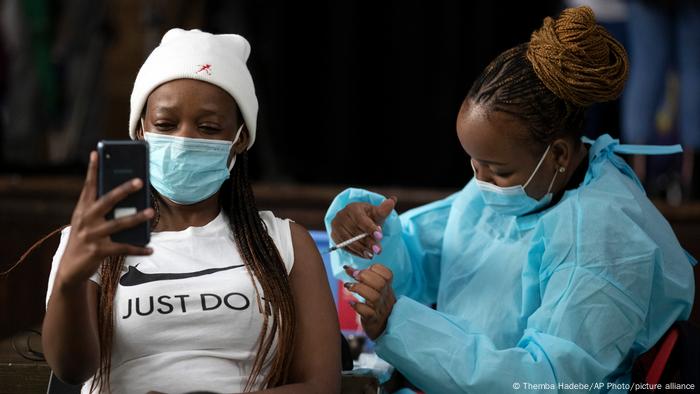
A selfie-worthy occasion: A young woman receives a COVID-19 jab in South Africa

She said it doesn't make sense to her that the company didn't "grab the opportunity" to share their technology with the outposts, which the Hub announced Friday will so far exist in Egypt, Kenya, Nigeria, Senegal, South Africa and Tunisia.

"What they are now proposing and planning is going to cost them much more," she said. "To be honest I try to understand this strategy and it boggles my mind."

Terblanche, like Alsalhani, acknowledged the BioNTainer solution is very innovative.

But she said it's the opposite approach to the transfer hub. The hub is focused on sharing technology. The BioNTainers will be fully controlled by the company.

Edited by: Carla Bleiker

German women face large equality gap in child care: study

Over 60% of German working mothers were employed part-time, according to a new study, as women bear the bulk of child care responsibilities. Researchers say the trend is a significant factor in the gender pay gap.


Researchers highlight that progress in gender pay gap and childcare burden 

could be imperiled by the COVID-19 pademic

German women have continued to make strides in key gender equality metrics, but a large gap remains when it comes to child care, according to a study by the Institute of Economic and Social Research (WSI) at the Hans Böckler Foundation published on Wednesday.

In areas such as employment and income, women have made progress. Female labor force participation at the end of 2020 was still 7% lower than men between the ages of 15 and 64, but in 1991 that difference was 21%.

When it comes to education, German women were reaching higher levels on average than men. In 2019, some 41% of women and 39% of men in Germany had a high school diploma or qualification to enter technical college.

But although women are becoming more qualified for their professions, they are still far less likely to be in top-level jobs compared to men. In 2020, only 11% of all board-level positions at Germany's 160 largest listed companies were held by women.

The study also noted the lingering differences in earnings. The average hourly wage for women was most recently €18.62 euros per hour ($21), some €4.16 euros, or 18%, less than that of men.

Germany's wage gap has been shrinking slowly, but women on average also receive 49% lower retirement income than men, when statutory pensions, occupational and private old-age provisions are taken into account.

Children a major burden for working women

Researchers said this could be attributed to many women choosing careers in service-related or lower-paid jobs, while men tend to opt for technical or higher-paying jobs.

But the gender pay disparity is also due, in large part, to women being four times more likely to work part-time to reconcile work and family.

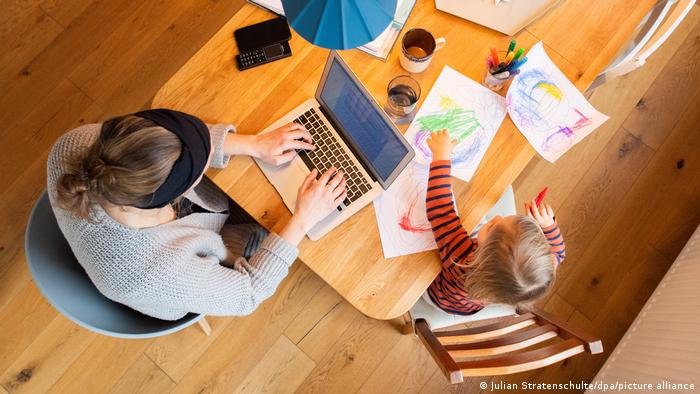
The study points to official figures that show that only 26.7% of couples with children in Germany worked full-time. Some 67.7% of working mothers were part-time workers, compared to 1.9% of men.

In Germany, "women continue to provide the majority of childcare," researchers wrote. They found that while 98% of mothers are currently taking parental leave benefits, only 42% of men did so this year. 

Institutional childcare supply has also reflected the trend of women scaling back on work for childcare. While institutional daycare hours have extended in Germany over the past decade, only 48% of children between the ages of three and six, and just 20% of children under one, were in full-day institutional care. 

"The existing demand for childcare hours in Germany has still not been met," researchers wrote, adding that gender equality could be furthered by an increased supply in full-time daycare for young children.

COVID-19 pandemic could make things worse

Researchers noted that the onset of the COVID-19 pandemic seemed to have helped with the childcare burden. Prior to the pandemic, 62% of women were providing the majority of childcare, but that figure dropped to 53% in April 2020.

Before the pandemic, only 5% of fathers provided a majority of childcare, with the figure increasing to 13% once the pandemic got underway. 

But by June 2021, the share of women providing the majority of childcare increased to a higher level than before the pandemic to 71%, while the share of men dropped to 7%.

The pandemic has also shown that women's jobs are less secure and less crisis-proof than those of men. Researchers said women were more affected in 2020 by layoffs and shortened working hours — especially in the lower-income categories of service-sector, so-called "mini jobs" that were hit hard by the pandemic. 

jcg/fb (dpa, AFP)

New project tells Jewish art collectors' stories

The stories of the people whose art collections were looted by the Nazis are rarely told. A new project in Berlin and Munich aims to change this.


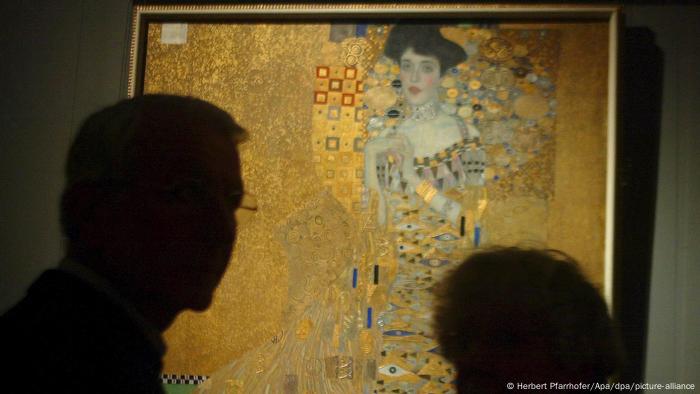
Adele Bloch-Bauer — the subject of this Gustav Klimt piece — is one of the Jewish 

collectors whose story is now told

These days, the topic of art restitution is the subject of conferences and debates — be it the Benin bronzes in Berlin or Nazi-looted art. The 2012 Gurlitt case, in which 1,500 works of art were found on properties belonging to the son of a Nazi art dealer, made it clear that the time was finally rife for the restitution debate. Yet little has been told about the people behind the paintings, drawings and sketches.

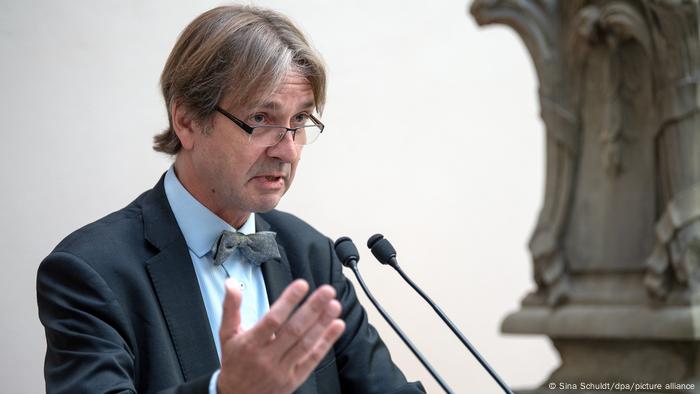
A new joint project by the Prussian Cultural Heritage Foundation and the Bavarian State Painting Collections aims to close this gap and tell the human stories behind some art restitution cases. "We have been doing provenance research for 20 years, helping with restitutions or initiating them," Bernhard Maaz, director general of the Bavarian State Painting Collections, told DW. "But the great emotional impact of these processes is not often conveyed" he said.

Archive of forgotten fates

Thirty such stories about works of art and their Jewish owners will be told in films during the three-year project. They will trace the artwork's path through the hands of collaborators and illuminate the value they have for their rightful owners and descendants. Ideally, all stories told will end with restitution.


Bernhard Maaz says the emotional impact of restitution processes is not conveyed

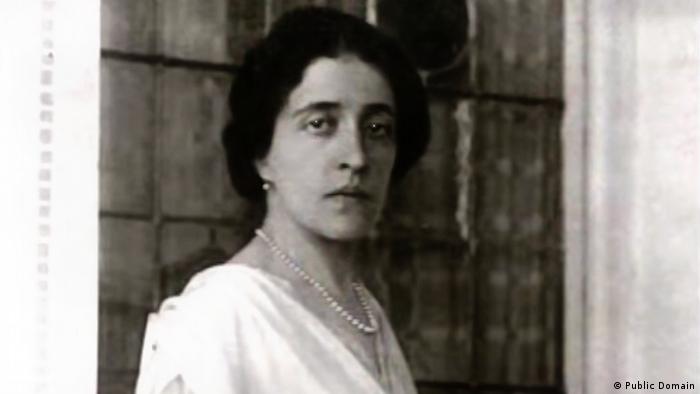
The stories of Jewish art collectors are little known, although the paintings associated with them may be famous. Such stolen works include the golden portrait of Adele Bloch-Bauer by Gustav Klimt, "Berlin Street Scene" by Ernst Ludwig Kirchner or "The Eye of the Law (Justitia)" by Carl Spitzweg. The stories behind the artworks tell of persecution, expropriation and murder.

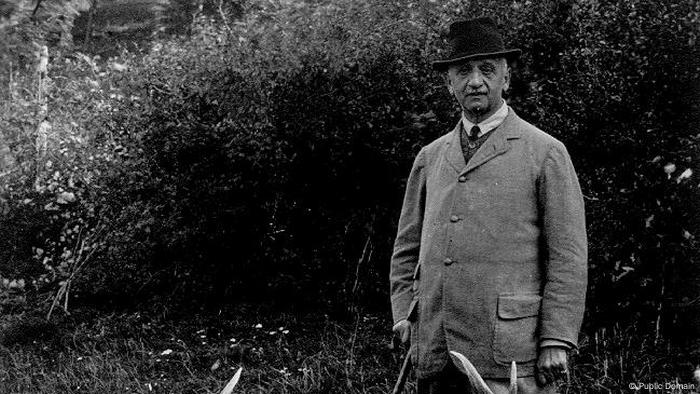
The business of the Austro-Czech sugar manufacturer and art lover Ferdinand Bloch-Bauer was "Aryanized," forcing him to flee into exile in Switzerland in 1939. Alone and impoverished, he died shortly after the end of the war. The Hess family owned a shoe factory in the eastern city of Erfurt and had owned what was probably the best collection of German Expressionist art. Thekla Hess and her son Alfred survived the war in exile in London, and large parts of their collection were sold. Thekla's two sisters-in-law and cousin Olga were murdered by the Nazis in Theresienstadt.


Adele Bloch-Bauer was a prominent Jewish art collector who was painted by Klimt

A matter of justice

Painter Carl Spitzweg's 1857 painting "The Eye of the Law (Justitia)" was part of the small collection of the Jewish businessman and art collector Leo Bendel, who was born in Poland, lived in Berlin but fled to Vienna with his wife in 1937. In the same year, he was forced to sell two Spitzweg paintings at rock-bottom prices.

"Justitia" was acquired by a buyer for a museum dedicated to Hitler. During the sale, Bendel was not noted as being of "non-Aryan origin," and for this reason, the painting was classified as "unobjectionable" and was therefore given to the German president's office in 1961. The painting hung in the city of Bonn's Villa Hammerschmidt until 2007. It was then restituted on the basis of research by Bendel's heirs.

'Justitsia' features a golden statue on a staircase.

It took decades for Carl Spitzweg's painting "Justitia" to be restituted

Leo Bendel was arrested by the Gestapo in 1939 as a Polish Jew, abused and ultimately deported to the Buchenwald concentration camp. He was there with a group of people crammed into a fenced-off part of the concentration camp above the Jewish block next to the area where roll call took place. It became the site of the first intentional mass killing of Jews and Poles in the Buchenwald concentration camp. The name Leo Bendel was also found listed among the dead: He died on March 30, 1940 of "senile debility" as it was written.

Washington Declaration and Provenance Research

The Washington Principles on Nazi-Confiscated Art, recognized in a joint declaration by Germany and the United States in 1998, have provided the framework in which Nazi-looted art has been treated ever since. In them, Germany pledged to examine its works of art and to identify looted art or to contribute to the investigation. It was more than 50 years after the end of World War II and high time to make amends for Nazi-looted art.

But objects don't tell their stories on their own. The art world has been examining its holdings ever since — albeit with varying levels of commitment — if any. Provenance research, which is historical research on how objects were obtained, is complex. "We're talking about an estimated 600,000 works of art in total, which is huge," Bernhard Maaz elaborates. Provenance research is often time-consuming. "Because every case is an individual case," says Maaz. "This will keep us busy for decades."

The Bavarian State Painting Collections, have been able to restitute 25 works from 17 collections since 1998. The Prussian Cultural Heritage Foundation has processed more than 50 restitution requests since 1999, returning more than 350 works of art and around 2,000 books to the rightful owners. These included a drawing by Vincent van Gogh, works by Edvard Munch and "Der Watzmann" by Caspar David Friedrich. Provenance research has been undertaken professionally in Germany since 1998 — but many have questioned if enough is being done.


Businessman Ferdinand Bloch-Bauer was a prominent Jewish collector

More remembrance culture

The importance of Jewish patrons was immense, and not only for Germany's art world. Many of the greatest art treasures were brought in by Jewish collectors. The crowning piece in Berlin's Neues Museum — the bust of Nefertiti — is one such example.

Its excavation was financed by James Simon, who was Jewish, and then donated to the Egyptian Museum in 1920. The memory of James Simon has found an appropriate place in the Neues Museum, but other places of remembrance are still "works in progress," such as Berlin's Johanna and Eduard Arnhold Platz, dedicated to the prominent Jewish patrons and those associated with them in Berlin whose legacy was destroyed by the Nazis.

The core idea of restitution policy is to make amends for the injustices done, if not through the restitution of property, at least through fully acknowledging it.

This article was originally written in German.

Germany: Climate activists try to block roads to airports

The "Uprising of the Last Generation" group sought to block access to airports in Berlin, Frankfurt and Munich in protest of food waste in Germany.


Climate activists have used blockades and hunger strikes to raise awareness for their demands

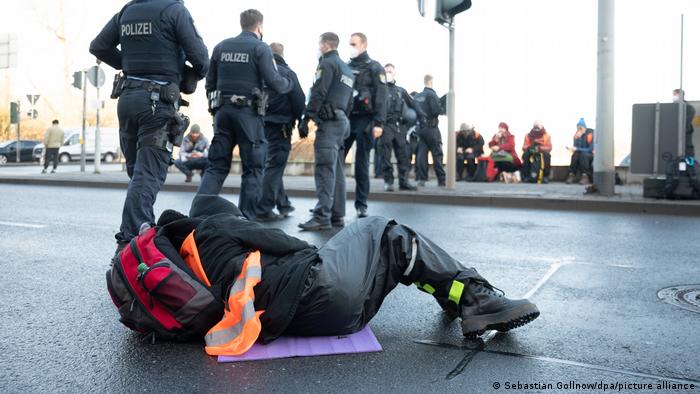
Members of the group "Uprising of the Last Generation" on Wednesday protested by blocking access to Germany's three largest airports. 

The group has been calling on the German government to commit to more legal measures to end food waste, which it says contributes to both hunger and climate change. 

The climate activists protested in Frankfurt, Munich and Berlin. They said they wanted to disrupt cargo and passenger traffic at airports in those major cities. 

In Munich, eight activists glued their hands onto the pavement on Wednesday morning in a bid to block two roads leading to the airport. They were taken to a police station at around 9:30 a.m. local time (0830 UTC). 

Six activists holding banners that read, "Save food, save lives," blocked a road in Frankfurt.

Meanwhile, in Berlin, five activists glued their hands onto a road leading to the airport, diverting traffic. 

Jürgen Trittin of Germany's Green Party told Zeit newspaper that staging "civil disobedience" did not turn protesters into "criminals." He said he could understand those who've been protesting for weeks now.

The climate activists have been protesting in Berlin, Hamburg and other German cities for weeks. Their protests involve blockades and hunger strikes

Wildfires to increase up to 30% by 2050, experts warn

The intense, destructive fires that have dominated headlines in recent years are expected to become more frequent, even in places like the Arctic. Experts warn our response must shift toward planning and preparedness.


The Argentine government estimates recent fires have caused some $184 million (€162 million) in economic damage

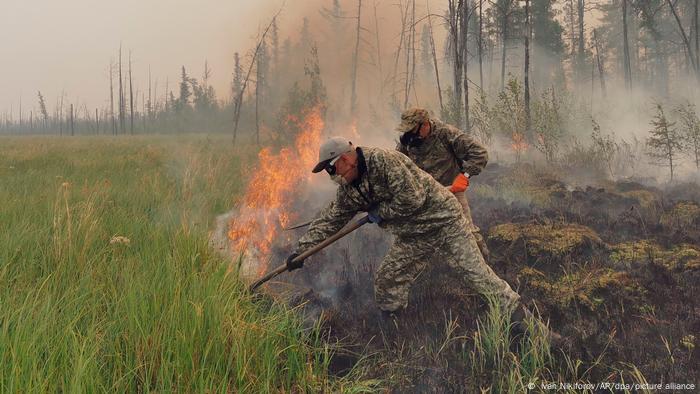
Exhausted firefighters have been battling blazes in northern Argentina for weeks. Fueled by strong winds, little rain and dry conditions brought on by an unusually long drought, wildfires have already destroyed nearly 8,000 square kilometers (3,000 square miles) of forest, swamp and farmland, an area slightly smaller than the island of Puerto Rico.

"It never happened to us, we never lived something like this, we were really overcome," one resident, Jorge Ayala, told The Associated Press news agency over the weekend. But wildfires like this are expected to become more prevalent, and more destructive, in the coming years and decades.

Extreme fires — more frequent, intense and increasingly found in atypical areas like the Arctic — are projected to rise up to 14% by 2030 and 30% by mid-century, according to a new report by the UN Environment Programme (UNEP) and Norwegian environmental nonprofit GRID-Arendal.

By 2100, they say, fires could be as much as 50% more likely to occur. Even if we manage to significantly reduce emissions, the world is likely to see an increase in wildfires, the report said.

Researchers have increasingly linked these disasters to human-caused climate change, a fact underscored by the report, which links the growing severity of fires to a higher incidence of drought, rising temperatures and strong winds.

"At the same time, climate change is made worse by wildfires, mostly by ravaging sensitive and carbon-rich ecosystems like peatlands and rainforests," said the authors of the report. As these ecosystems are destroyed, they release stored CO2 emissions into the atmosphere, further contributing to global warming and reducing their potential to capture future emissions. "This turns landscapes into tinderboxes, making it harder to halt rising temperatures," they said.
Fires 'disproportionately affect world's poorest nations'

This dire prediction has already started to become a reality. The past few years have seen increasingly destructive fire seasons in places like North America, Brazil, parts of Europe, Siberia and Australia, which have devastated ecosystems and communities around the world.

That destruction — to crops and homes, human health and the natural environment — means wildfires "disproportionately affect the world's poorest nations," according to the report. The fallout can linger for years after fires have been extinguished, especially in parts of the world that lack the resources to rebuild and adapt to the changing environment.


Even regions previously unaffected by wildfires, including Siberia in the Arctic, are now at risk


"Fire impacts air, soil and water," said Glynis Humphrey of the University of Cape Town, who contributed to the report. "Fire interacts closely with the climate, in terms of carbon emissions and rainfall patterns, and it impacts human and ecosystem health. And it impacts people's jobs and the economic situation that people find themselves in."
Focus needs to be on planning and prevention, not response

And yet, experts warned, most global government spending when it comes to wildfires is devoted to fighting blazes after they break out, with less than 1% going to planning, prevention and preparedness. To confront this increasing risk and to lessen the impact of destructive fires, governments will need to "radically shift their investments."

"Current government responses to wildfires are often putting money in the wrong place," said Inger Andersen, executive director of UNEP. "We have to minimize the risk of extreme wildfires by being better prepared: invest more in fire risk reduction, work with local communities, and strengthen global commitment to fight climate change."

The report calls on governments to divert two-thirds of funding to planning, prevention, preparedness and recovery. "It's integral that fire be in the same category as disaster management [for] floods and droughts," said Humphrey, speaking at a media briefing. "It's absolutely essential."
Reintroduction of Indigenous knowledge key

While some of that funding should go toward improved monitoring and analysis, to better understand how wildfires are evolving in a changing climate and what can be done to manage that, the authors also highlight the importance of Indigenous knowledge.

This can include the use of prescribed burns, or "good fires," to reduce fuel that can feed larger blazes. Other methods include creating fire breaks or using controlled blazes to establish mosaic landscapes, which inhibit the spread of wildfires, or promoting the growth of grass and plants that help ward off drought.

7 WAYS AFRICA IS ADAPTING TO CLIMATE CHANGE
Feeding frenzy
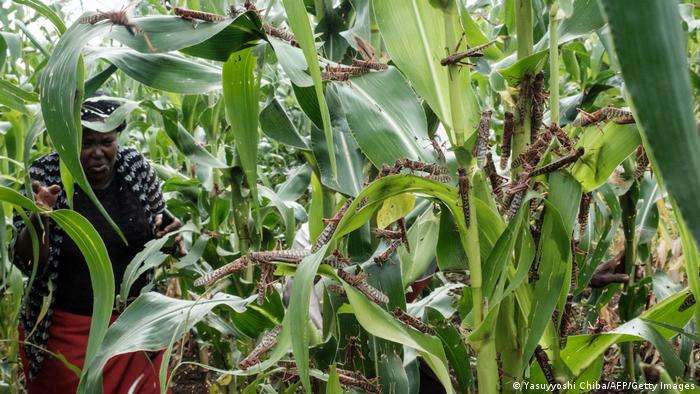
Locusts, boosted by drought, heavy rains and warm temperatures, have devastated crops in East Africa. Pesticides can help, though they're not exactly environmentally friendly. Scientists in Nairobi have experimented with fungi and other microbes to make safer poisons. They've also used the locusts' unique smell, which changes as they mature, to break up swarms and even drive them to cannibalism.

"As countries develop and as economies develop and demographics change, a lot of those traditional practices either wither or change or reduce over time, or [are replaced by] alternative land practices," said Peter Moore, who worked as a fire management specialist at the UN's Food and Agriculture Organization.

In response to a DW question, Moore pointed out that Indigenous practices were starting to be recognized and implemented in Australia, Canada and the western US, with organizations such as the International Savanna Fire Management Initiative transplanting traditional Indigenous practices from Australia to places like Botswana.

He stressed that documentation, and having that knowledge made widely accessible, is key to convincing people of the value of these traditional practices — "being able to map [Indigenous] experience, being able to work with it and reintroduce it back into the landscape."

Edited by: Tamsin Walker

DW RECOMMENDS

Disasters around the world are more closely linked than we might think

Climate catastrophes, pandemics and other crises ultimately stem from the same root causes, a United Nations University report finds.


Climate change: Cost of weather disasters surged in 2021

The 10 most expensive weather disasters of 2021 caused more than $170 billion (€150 billion) in damages, UK charity Christian Aid has reported. That's up $20 billion on last year's figure.

Uganda: Author Kakwenza Rukirabashaija 'relieved' to be in Germany

Kakwenza Rukirabashaija said he had been delivered from "the mouth of the crocodile." He said he was tortured in prison for insulting Ugandan strongman Yoweri Museveni and his son on social media.


Rukirabashaija said that the first thing he would do in Germany was get medical

 attention related to being tortured in prison

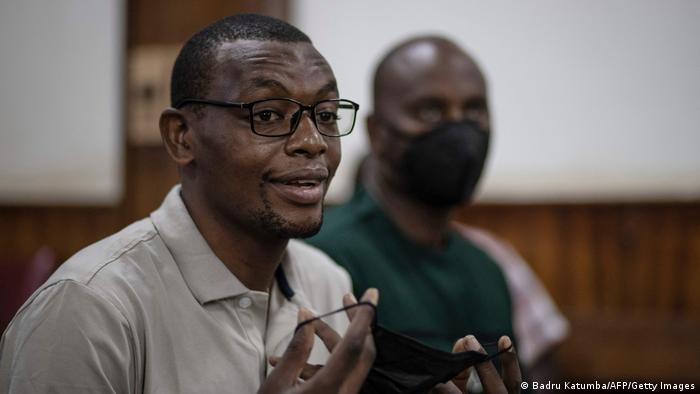
Award-winning Ugandan author Kakwenza Rukirabashaija arrived in Germany on Wednesday, ending a months-long ordeal during which he reported being tortured in jail.

Rukirabashaija expressed being "relieved" to arrive in Germany and seek medical treatment

Although authorities had taken his passport, Rukirabashaija was able to slip out of Uganda by walking to neighboring Rwanda. He then entered a third, unnamed country before the UN refugee agency facilitated his travel to Europe.

"I'm being persecuted for being a thinker. Uganda hates thinkers, so I'm being punished," the 33-year-old novelist told DW.

He added that arriving in Germany made him "feel like I've escaped from the mouth of a crocodile, so I really feel safe."

What happened to Kakwenza Rukirabashaija?

Rukirabashaija rose to prominence for his 2020 book "The Greedy Barbarian", a satirical account of Ugandan leader Yoweri Museveni, who has been in power since 1986.

His first arrest came shortly after the book was published. Rukirabashaija said he was also brutally beaten during that stint in prison, but eventually he was released. 

In 2021, writers' association PEN gave him the Pinter International Writer of Courage Award.

His most recent arrest came in late December 2021. He was held for several weeks without charges, prompting an international outcry, particularly from the European Union and the United States.

In early January, Rukirabashaija was charged with "offensive communication" relating to social media posts insulting Museveni and his son Muhoozi Kainerugaba, who many believe is being groomed to take over for his father.

He was released on bail later in January and appeared on television to reveal painful-looking welts criss-crossing his back and scars on other parts of his body.

The writer said that Kainerugaba had been "in charge" of his torture in prison.

Since leaving Uganda, Rukirabashaija has stepped up his social media criticism of Kainerugaba, including calling him a "baby despot."

PEN's German branch said Rukirabashaija was "under the care of friends and PEN," adding that he would now be enrolled in its Writers-in-Exile program which provides grants to authors facing persecution in their home countries.

Asked if he would ever return to Uganda, the author told DW that "Uganda is my country, my motherland.. I think after getting medication and the doctor tells me I'm fit for returning, I'll go back to my country."

He added: "I am unstoppable. I'm not fine, but I'm unstoppable."

es/nm (AFP, KNA)

Renewed hope for jailed Saudi blogger Raif Badawi's release

As a possible release date approaches, the wife of the high profile Saudi Arabian writer argues that the issues he was sent to jail for highlighting 10 years ago are no longer such a taboo in the Gulf kingdom.

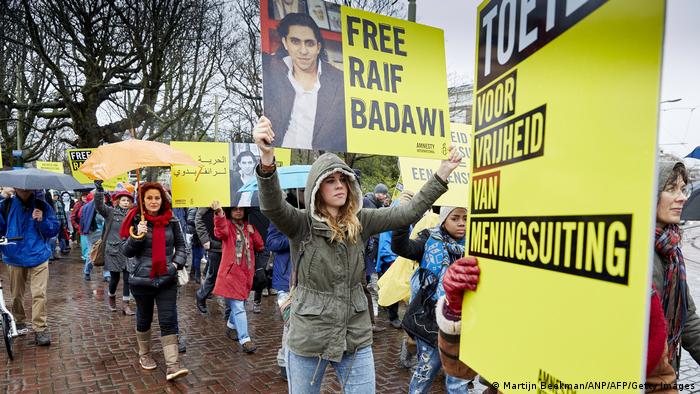
#FREEBADAWI #FREERAIF #FREERAIFBADAWI


Human rights groups like Amnesty International have highlighted Raif Badawi's cause

Hopes are high that Saudi writer Raif Badawi may be released from jail within the week.

Badawi has spent almost ten years behind bars for publishing a blog called Free Saudi Liberals. He was arrested in June 2012 and sentenced to a decade in prison in 2014, as well as a $266,000 fine and 1,000 lashes for "insulting Islam" because he had discussed the separation of religion and state in Saudi politics on his blog.

Badawi was sentenced using the Islamic — or hijri — calendar. By that calendar's reckoning, on Rajab 26 1443 he will have spent ten years in jail. This date translates to February 28.

Human rights group Amnesty International told German news agency dpa that they believed Badawi could be free by March 1. The group has campaigned for his release for years, along with other organizations such as Human Rights Watch and Reporters Without Borders.

Saudi Arabia's reforms

Badawi is one of Saudi Arabia's most high profile political prisoners. While imprisoned, Badawi, who turned 38 in January, has been awarded a number of international prizes, including the European Union's Sakharov Prize for Freedom of Thought in 2015 and the DW Freedom of Speech award the same year.

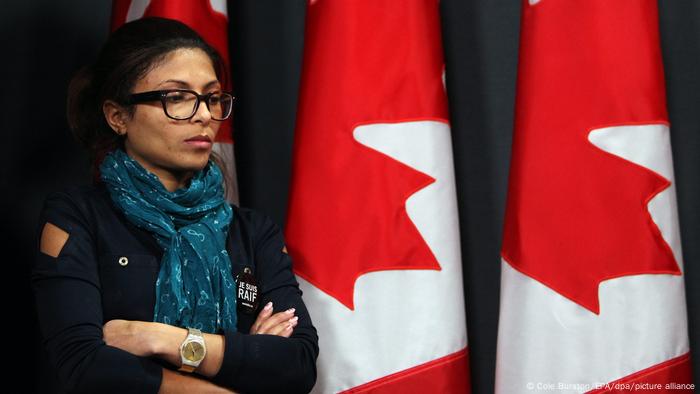
Badawi's wife, Ensaf Haidar, who now lives in Canada with the couple's three children, told DW she believes that, as Saudi Arabia has been opening up more, the time is right for her husband to be freed.

"Everything that Raif and I wished for the country [Saudi Arabia] is coming to fruition," she said. Saudi Arabia's royal rulers "are working for more openness," she added. "More freedom for women, access to non-religious studies for them, allowing them to drive and many other things."


In 2018, one of Saudi Arabia's reforms was lifting the ban on public movie theatres

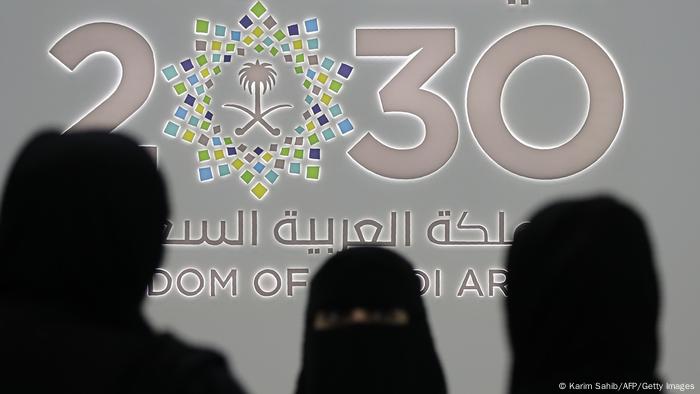
Many of the more recent reforms in Saudi Arabia are part of the so-called Vision 2030, a wide-ranging set of socio-economic reforms first proposed in 2016 by Saudi Crown Prince Mohammed bin Salman, in an effort to make his country more modern, liberal, not to mention business and tourism friendly.

Other significant changes since 2016 have involved lifting a decades-long ban on cinemas as well as the ongoing, gradual relaxation of gender segregation rules. The role that the country's religious police play has also been reduced. One of the allegations Badawi faced was speaking ill of the religious police.

In 2020, as part of this liberalization, Saudi Arabia also abolished flogging as a punishment. Badawi was lashed publicly 50 times in 2015 outside a local mosque in Jeddah, but international pressure resulted in the suspension of the rest of that part of the sentence. The 2020 abolition saved him from having to endure the remaining 950 lashes.


Despite its efforts at modernization, Saudi Arabia still faces criticism, among other things for being a world leader in executions

'Seven days to go'

"Raif has never criticized the current government and was imprisoned for advocating the very same reforms that the current government has implemented," Brandon Silver, an international human rights lawyer and member of Badawi's legal team, pointed out.

"We trust that Saudi Arabia will honor the decisions of its own legal system," argued Silver, who also serves as director of policy and projects at the Montreal, Canada-based Raoul Wallenberg Center for Human Rights. "It is not only the right thing to do, according to Saudi law and custom, but the smart thing to do, in order to shift international opinion."

Despite the recent reforms, Saudi Arabia continues to be criticized for its human rights record.

Haidar and her children, who sought asylum in Canada in 2013 and live in Quebec, have started a countdown on Twitter.

Badawi's children last saw their father when the eldest daughter, Najwa, was seven. She's now 18 and has spoken on behalf of her father at international events.

Badawi, however, remains unaware of the widespread support his case enjoys, Haidar explained. "He does not have internet access," she told DW. "He calls me when he can from the public phone booth of the prison. We have so little time, we talk about the children and about life."

Becoming Canadian

Should Badawi be released soon, his life in Saudi Arabia would be far from easy. The financial fine is still pending and he not only faces a media ban, but a ten-year travel ban as well. So he would not be able to leave the country to reunite with his wife and children.

To overcome this, attempts are ongoing to make Badawi a Canadian citizen, just like his wife and children. In January 2021, Canadian politicians supported a motion in the country's federal parliament asking that Badawi be granted citizenship.


Raif Badawi's wife, Ensaf Haidar, has been advocating for Canadian citizenship for her husband

Canada's laws allow its immigration minister discretion to grant citizenship in special circumstances "in order to remedy a particular situation and unusual distress."

But over a year later, there has been no further progress. Canadian media have reported that sources inside the federal government believe citizenship might actually make things worse for Badawi.

Not giving up

Relations between the two countries have been strained ever since Canada's former minister of foreign affairs, Chrystia Freeland, called for the release of Saudi political prisoners in 2018. That included Badawi and his sister, Samar, a women's rights activist who was arrested in 2018, as well as Badawi's brother-in-law, Waleed Abulkhair, who acted as his lawyer.

In January, a former Canadian ambassador to Saudi Arabia, Dennis Horak, told local newspaper The Globe and Mail, he believed the chances of Badawi being released on February 28 were only around 50%. And although citizenship would mean he could get more help from Canadian diplomats, experts have also noted that the Saudis don't recognize dual citizenship anyway.

Nonetheless, Haidar is not giving up. "We are still waiting," Haidar said of the possibility of Canadian citizenship. 

What would be better though, is if the Saudi government revoked the travel ban, she added. "We hope that he will receive a travel document allowing him to come to Canada as soon as he is released," she told DW. "I also hope that all the governments that have defended Raif — the European Union, Germany, Austria, the United States — will unite to supervise his release so that he can join us in Quebec. His friends, his children and I are looking forward to it."

Edited by: Lucy James

DW RECOMMENDS