Thursday, February 24, 2022

Stellantis makes over $15 billion in first full year since merger of FCA, Peugeot


Stellantis, the result of a merger between Fiat Chrysler and PSA Group in 2020, manufactures vehicles under more than a dozen brands, including Jeep, Dodge and Chrysler. 
File Photo by Roger L. Wollenberg/UPI | License Photo

Feb. 23 (UPI) -- Stellantis said on Wednesday that it's giving significant revenue-sharing checks to workers after earning more than $15 billion in net profit for 2021 -- the automaker's first full year after a merger between Fiat Chrysler and PSA Group.

In its earnings report, Stellantis said its profit for last year totaled $15.1 billion -- an increase of 179% compared to 2020.

Stellantis manufactures vehicles under more than a dozen brands, including Jeep, Dodge and Chrysler.

The automaker said that cost-cutting measures and strong sales were the main factors in the increase in profits -- even in the face of a global semiconductor chip shortage that slowed the industry. Stellantis said it increased prices for raw materials and other dealership inventories, which boosted vehicle prices.

With the revenues, the company said it will distribute profit-sharing payments to UAW-represented workers of almost $15,000, according to the Detroit Free Press -- the largest amount in its history.

"It is thanks to their continued focus on execution and excellence that we were able to achieve record results in our first year as Stellantis," CEO Carlos Tavares said in a statement. "Every Stellantis employee took on an extraordinary task in 2021 of combining two automakers while facing serious external challenges."

Stellantis was created by a merger in 2020 of Fiat Chrysler and Peugeot.
Amazon labor organizer arrested for trespassing after dropping off food for workers

Jeffrey Dastin and Julia Love
Wed, February 23, 2022

Amazon's JFK8 distribution center in Staten Island, New York City

By Jeffrey Dastin and Julia Love

(Reuters) -Amazon.com Inc labor organizer Christian Smalls was arrested on Wednesday, accused of trespassing when he delivered warehouse workers food as part of a high-profile union campaign he is leading.

Smalls, a former Amazon employee, and two other individuals have been charged with obstructing governmental administration, said Lt. John Grimpel of the New York City Police Department, adding that Smalls was also charged with resisting arrest and trespassing.

The other two individuals were Amazon workers, an advocacy group said. Smalls said all three were later released, adding that he disputed the charges and would continue his battle in court.

Amazon spokesperson Kelly Nantel said Smalls has "repeatedly trespassed despite multiple warnings." The company had not contacted the police about its own employees.

Thirty-three year-old Smalls' quest to make Amazon's JFK8 Staten Island warehouse a unionized facility will come to a head when workers vote starting March 25.

A second closely watched election is currently occurring at Amazon's Bessemer, Alabama warehouse, with vote-by-mail being accepted until March 25 and the vote count starting March 28. Last year, workers at that warehouse voted against unionizing.

A majority vote to unionize at either facility would mark Amazon's first organized workplace in the United States and a milestone for those seeking to invigorate the American labor movement.

Reached by phone, Smalls said he brought food on Wednesday afternoon for current employees to distribute, something he has done for months. The break-room meals are the ALU's chance to share literature and build relationships with workers, he said.

But this time, Smalls said the Amazon manager who had fired him two years ago told him to leave, later calling the police.

"I'm literally a visitor. Do y'all call police on taxi drivers and Uber drivers who wait for associates?" Smalls said, adding Amazon wanted to "increase the intimidation factor" through his arrest. Amazon had no immediate comment on Smalls' claim.

His clashes with Amazon date back to March 2020 when the company terminated him for protesting at JFK8 despite being on a paid quarantine. Smalls then sued Amazon, alleging it fired him because he is Black and had opposed discriminatory COVID-19 policies. A federal judge dismissed the complaint this month.

Sienna Fontaine, general counsel for advocacy organization Make the Road New York, said: "The people that Amazon is throwing in jail are fighting for better working conditions and should be treated with respect and dignity."

Smalls said the arrest would not stop him from organizing at the warehouse.

"I’m on my way there now," he said, shortly before 10 p.m. Eastern Time. "I’m going to bring more food for the night shift."

(Reporting by Jeffrey Dastin in Palo Alto, Calif., and Julia Love in San Francisco; Editing by Kenneth Maxwell and Shivani Singh)
The Doctor QUACK Giving DeSantis' Pandemic Policies a Seal of Approval
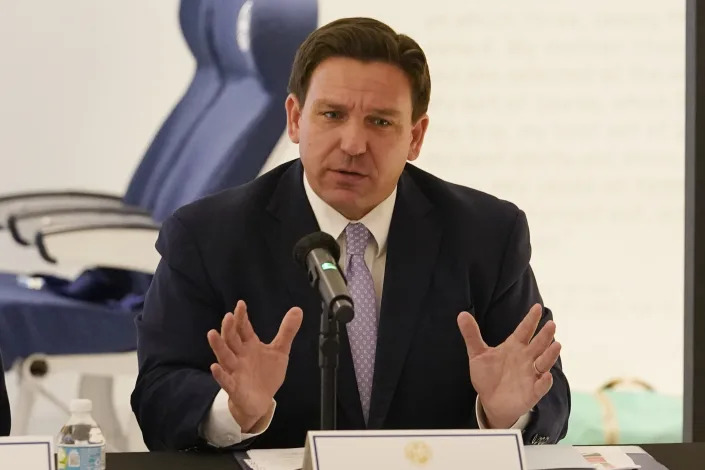

Florida Gov. Ron DeSantis speaks at a news conference, 
Monday, Feb. 7, 2022, in Miami.
 (AP Photo/Marta Lavandier) 

Patricia Mazzei
Wed, February 23, 2022

MIAMI — Dr. Joseph Ladapo has come out strongly against mask mandates and lockdowns, only supports vaccination campaigns if the shots are voluntary and will not say whether he himself has been vaccinated.

But in pushing for state Senate confirmation of Ladapo as Florida’s next surgeon general, Gov. Ron DeSantis has found a partner in fighting what Ladapo calls the policies of “fear.”

For a Republican governor whose brash opposition to conventional public health wisdom has helped fuel obvious presidential ambitions, the appointment of Ladapo signals DeSantis’ determination to continue powering through a pandemic that has already cost 68,000 lives in Florida — this time, with what the governor can claim is a medical seal of approval.

The Florida Senate is expected to confirm Ladapo’s appointment before the annual session wraps in mid-March, after a contentious committee hearing this month ended with a recommendation on a strict party-line vote. Democrats walked out of an earlier hearing.

The DeSantis doctrine has asserted that older people should be protected from the virus but that younger people who are less at risk should do as they wish. Otherwise, the psychological and economic effects might be too damaging, both for individuals and for Florida’s cachet as a mecca for tourism and international business.

“Telling the truth, I think, is important, and I think that’s what Dr. Ladapo understands,” DeSantis said in selecting the former researcher at the University of California, Los Angeles, to run the Florida Department of Health. “You’ve got to tell people the truth, and you’ve got to let them make decisions.”

But when it comes to the warped politics of the pandemic, few agree on the truth.

DeSantis has built his political brand as a fighter, especially against Dr. Anthony Fauci, President Joe Biden’s top medical adviser on the pandemic. Ladapo has helped DeSantis bolster his stance as a governor unafraid of living with the virus.

Florida ranks among the 20 worst states for its pandemic death rate and among the 12 worst for its case rate, but DeSantis has argued that the state also suffers when its economy and schools are restricted.

Some of Ladapo’s positions, like his opposition to lockdowns and mask-wearing in schools, have been conservative stands for some time and are beginning to be accepted by liberal leaders now that more people are vaccinated and cases are plummeting. But these views were relatively rare among physicians in charge of public health policy at the time he was espousing them.

To like-minded scientists who felt that their dissenting views had been silenced, Ladapo’s move from researcher to policymaker gave hope for those who hold views outside the mainstream.

To scientists appalled by Florida’s hands-off approach to the virus, Ladapo’s ascent cemented their belief that public health had become entrenched in the nation’s polarized politics.

Ladapo’s predecessor, Dr. Scott Rivkees, a more conventional surgeon general, had all but vanished from public view since warning early on in the pandemic that masking and social distancing would need to last for at least a year. Since his appointment, Ladapo has been a fixture at DeSantis’ side as Florida has abandoned those virus mitigation measures and banned their enforcement by local authorities.

“Florida will completely reject fear as a way of making policies,” Ladapo said.

He did away with school quarantines and masks. When public health officials across the country were urging vaccines as a way to end the pandemic, Ladapo was raising warning flags about possible side effects and cautioning that even vaccinated people could spread the virus. He has refused to disclose his own vaccination status, which he maintains is a private matter.

Though Ladapo has acknowledged that vaccines are highly effective at preventing hospitalization and death, he said in October that “adverse reactions” to vaccines should receive more attention and urged people to “stick with their intuition and their sensibilities.”

Equally troubling for his critics was Ladapo’s failure to reject more fringe views on virus treatments, including the drugs hydroxychloroquine and ivermectin. He joined DeSantis in clamoring for the federal government to supply some monoclonal antibody treatments even after they had been deemed ineffective against the omicron variant, which dominated caseloads.

“To say he’s out of the mainstream would be an understatement,” said Dr. Ashish K. Jha, dean of the Brown University School of Public Health. “His views are not only very unorthodox — they don’t make any sense.”

The Florida Department of Health did not respond to The New York Times’ requests to interview Ladapo.

Before the pandemic, Ladapo, 43, who immigrated from Nigeria when he was 5, was an accomplished clinical researcher at UCLA, with degrees from Harvard in medicine and health policy. He focused on topics like smoking cessation and cardiovascular risk for HIV patients.

In early 2020, he contacted Dr. Jeffrey Klausner, a professor of medicine at the University of Southern California, to discuss lockdowns, which Klausner saw as having limited utility.

Ladapo did not want to take policies at face value, Klausner said. “He was the kind of guy who’s going to be reading an article in the medical or scientific literature and then going to the references, digging up those references, and then going to the references of those references.”

In April 2020, Ladapo published an opinion essay in The Wall Street Journal, titled “Lockdowns Won’t Stop the Spread.” He argued that it was too late to stop the virus altogether, so policymakers should consider the heavy toll of shutdowns and not just “the singular goal of reducing COVID-19 deaths.”

His national profile grew. More opinion pieces followed.

A few months later, Ladapo appeared clad in a white medical coat on the steps of the U.S. Capitol with a group of people who called themselves “America’s Frontline Doctors.” Some physicians in the group gave misleading claims about the virus, including that the drug hydroxychloroquine was an effective treatment. The Food and Drug Administration advises otherwise, warning that it could cause irregular heart rhythms.

A video of their appearance, shared by President Donald Trump, went viral online before social media platforms could remove it for spreading misinformation. One of the group’s founders, Dr. Simone Gold, was later charged with violent entry and disorderly conduct in the Jan. 6, 2021, Capitol siege.

Asked about the group during confirmation hearings, Ladapo said he supported its push for “individual autonomy.” He said doctors should not be limited in their use of hydroxychloroquine. He called the science on another drug, ivermectin, “unsettled,” though the FDA has warned that it can be dangerous in large doses.

Emails released by a congressional committee reviewing the Trump administration’s coronavirus response found that, in August 2020, Dr. Deborah Birx, the response coordinator, pulled out of a White House roundtable with Ladapo and other proponents of pursuing herd immunity, which most experts say cannot be achieved for the coronavirus except at the cost of more deaths. She called them “a fringe group without grounding in epidemics, public health or on-the-ground, common-sense experience.”

Ladapo’s pandemic policy views unnerved some at UCLA, according to a former supervisor who was interviewed by the Florida Department of Law Enforcement for a background check.

The unnamed supervisor held the opinion that Ladapo’s views violated his Hippocratic oath to do no harm, and “created stress and acrimony among his co-workers and supervisors during the last year and a half of his employment,” as first reported by the USA Today Network.

Ladapo told Politico he was disappointed that disagreeing with someone had “become a ticket or a passport to activate personal attacks.”

His hiring stirred discontent at the University of Florida, where he is now a tenured professor. Of his annual $437,000 income, nearly $200,000 is defrayed by the university.

The chairman of the board of trustees, Morteza Hosseini, who is a top DeSantis political donor, pushed for Ladapo to be hired. Ladapo was granted tenure in only two weeks.

Faculty members later objected to the rushed process, though a university spokesman said it had been “standard.”

“I am very concerned that the state is not getting the best science and the best public health information,” said Dr. J. Glenn Morris Jr., director of the university’s Emerging Pathogens Institute. “There’s not the sense of the development of a public health strategy that goes beyond politics.”

Academics who described him as a talented data scientist said he had attempted to balance protecting people’s health with the costs of prolonged restrictions.

“We’ve been sold a lot of fear over this whole thing, and people don’t make calm, considered judgments when there’s this underlying message of being afraid,” said Dr. Harvey A. Risch, a public health researcher at Yale. “He of all people has managed to keep that in check and comes off as very collected.”

Ladapo’s unwillingness to strongly recommend the vaccines echoes how DeSantis has evolved on the shots. Though the governor pushed to get older residents vaccinated, he lost enthusiasm as anti-vaccination sentiment grew among Republicans.

DeSantis once stood next to a man making the false claim that a coronavirus vaccine “changes your RNA” without challenging his claim. The governor has also suggested without evidence that the vaccines could hurt female fertility.

About 66% of Floridians are fully vaccinated, compared with 64% of all Americans, but the state ranks lower than average when it comes to booster shots. DeSantis will not say if he has gotten boosted, even after Trump seemed to swipe at him, calling politicians who would not reveal their full vaccination history “gutless.”

Physicians have been disheartened at the lack of support to improve vaccination rates among vulnerable communities.

Other actions by Ladapo have also baffled public health experts.

He rewrote guidelines during the surge of the omicron variant to discourage asymptomatic people who were not at high risk from getting tested — though infected people can spread the virus even without symptoms. He argued that testing was most valuable for people who might need treatment.

And he refused to wear a mask when he visited state Sen. Tina Polsky, a Democrat, though she had asked him to, citing a serious health condition that she later revealed to be breast cancer. He said he meant no disrespect but did not apologize.

As cases plunge in Florida, DeSantis and Ladapo have committed more deeply to their policies.

DeSantis has backed withholding $200 million from administrators in 12 school districts that mandated masks. Some Republican lawmakers are trying to ban medical boards from revoking a doctor’s license for spreading COVID misinformation.

One such complaint had been lodged against Ladapo. It was dismissed.

© 2022 The New York Times Company
The largest flight attendants union expects the federal mask mandate on airplanes will be extended past March 18

Gabrielle Bienasz
Tue, February 22, 2022, 

An American Airlines flight attendant.
LM Otero/AP

The country's largest flight attendant union believes the mask mandate on airplanes will be extended.

It would expire on March 18 otherwise.

Violence on planes has increased markedly since the pandemic.


The federal government's mask mandate for airplanes and other methods of travel will likely be extended, the country's largest union of flight attendants told Bloomberg on Tuesday.

The Association of Flight Attendants-CWA represents flight attendants from companies including United Airlines and Delta Air Lines.

"We have every expectation that the mask mandate will be extended for the near term… The conditions in aviation are the same. Our youngest passengers do not yet have access to the vaccine," the union told the outlet in an emailed statement.

The federal mandate is set to lapse on March 18, even as states across the country ditch mask mandates. It was first established in February 2021 and has been lengthened three times, though the federal government has yet to indicate any plans for extending the mandate.

Bloomberg noted that the previous extensions were each announced a few weeks before the mandates were set to expire.

Airplanes and airports have become hotbeds of conflict since the mandates began: 2021 was the most violent year on record on airplanes according to Federal Aviation Administration data analyzed by CNN. Seventy-two percent of the 5,981 reports were related to masks.

In mid-February, two American Airlines planes had to be rerouted because of disruptive passengers. In one, a flight attendant had to subdue a person trying to open the airplane door with a coffee pot. In a Delta flight in early February, two passengers were removed for being disruptive. Stories like these have likely prompted reported discussion on a nationwide no-fly list, though creating it would be a complex process, Insider reports.

Other unions were less definitive on the fate of mask mandates to Bloomberg. The Southwest Airlines Pilot Association, for one, didn't respond to inquiry, and The Association of Professional Flight Attendants – representing about 22,000 employees of American Airlines – said it was fine with the extension but hoped times would come where the mask mandates were no longer needed.
25 years later, Mexican Catholic Legion of Christ victims seek reparations


Jose Barba, one of many victims in the Legion of Christ sex scandal, poses for a portrait in Mexico City, Tuesday, Feb. 22, 2022. Barba was one of the first persons to come forward, accusing the disgraced founder of the Legion Father Marcial Maciel of sexual abuse before the Vatican. It has been 25 years since a Connecticut newspaper exposed one of the Catholic Church’s biggest sexual abuse scandals. And still some of the whistleblowers are seeking reparations from the Legion of Christ after reporting that the revered founder of the Legion of Christ religious order had raped and molested them when they were boys. (AP Photo/Marco Ugarte)


NICOLE WINFIELD
Wed, February 23, 2022

VATICAN CITY (AP) — A Connecticut newspaper exposed one of the Catholic Church’s biggest sexual abuse scandals by reporting 25 years ago Wednesday that eight men had accused the revered founder of the Legion of Christ religious order of raping and molesting them when they were boys preparing for the priesthood.

It took a decade for the Vatican to sanction the founder, the Rev. Marcial Maciel, and another decade for the Legion to admit he was a serial pedophile who had violated at least 60 boys. In the meantime, the original whistleblowers suffered a defamation campaign by the Legion, which branded them liars bent on creating a conspiracy to hurt a man considered a living saint.

As they marked the quarter-century anniversary of revelations that tarnished the legacy of St. John Paul II, three of Maciel's victims are still seeking reparations from the Legion to compensate for the abuse they suffered and the “moral” harm done to their reputations by the order.

They had refused earlier compensation offers that their fellow survivors accepted, and a mediation process begun in 2019 has stalled, according to emails and documents provided to The Associated Press.

The Vatican in 2010 took over the Mexico-based Legion and imposed a process of reform after an investigation showed that Maciel had sexually abused seminarians and fathered at least three children with two women. The Vatican found he had created a system of power built on silence, deceit and obedience that enabled him lead a double life.

The findings were by no means news to the Holy See: Documents from Vatican archives show how a succession of popes, cardinals and bishops starting in the 1950s simply turned a blind eye to credible reports that Maciel was a con artist, drug addict, pedophile and religious fraud. The Vatican and especially John Paul, however, appreciated his ability to bring in vocations and donations.

The reality of Maciel’s depravity burst into the public domain Feb. 23, 1997, when The Hartford Courant published a lengthy expose by investigative journalists Jason Berry and the late Gerald Renner about Maciel and the order, whose U.S. headquarters were based in Connecticut.

The story, which formed the basis of a 2004 book “Vows of Silence,” quoted several victims by name who independently reported that Maciel would bring them into his bedroom at night, and under the pretense of abdominal pain, induce them to masterbate him.

“When The Courant ran the long investigative piece Renner and I did on Maciel, we thought Pope John Paul II would see the light and punish Maciel,” Berry told the AP in an email. He noted that other mainstream media only began reporting on clergy sexual abuse after the Boston Globe's “Spotlight” revelations in 2002. "By then, John Paul’s blind faith in Maciel was a cover-up by any other term, and lasted till his death.”

A year after the original Courant story, in 1998, the victims filed a formal canonical complaint against Maciel with the Vatican's Congregation for the Doctrine of the Faith, where the case languished until after John Paul died. Maciel was sentenced in 2006 to a lifetime of “penance and prayer,” and he died in 2008, still considered a saint by the Legion.

Following the Vatican-mandated reform process, the Legion apologized and tried to make amends, even as it has been forced to confront revelations of a new generation of abusers within its ranks — some of them Maciel’s original victims — and the superiors who covered up for the crimes, some of whom remain in power.

In 2020, the Legion publicly retracted the “negative institutional and personal judgments about the character and motivations of the people who made legitimate and necessary accusations” in the original Courant expose. Naming the original victims, it said “Today we recognize as prophetic their accusations in favor of truth and justice.”

But Jose Barba, one of the most vocal of the original eight survivors, wants the Legion to formally retract what he calls the “lies” the order provided to the Courant to discredit him and the other victims. They include what he says were a falsified letter from a Chilean bishop who had investigated Maciel in the 1950s, and false statements from four Mexicans who claimed the victims had tried to enlist them in a conspiracy against Maciel.

Barba, who says he represents fellow survivors Arturo Jurado and Jose Antonio Perez Olvera, drafted a proposed letter to the Courant and the Vatican newspaper that he wanted the Legion to submit to retract the claims. But then Legion superior, the Rev. Eduardo Robles-Gil, refused during a December 2019 mediation meeting in Mexico City, Barba said.

In a Jan. 4, 2020 summary of that meeting, Barba said the Legion’s initial calculus of a low five-figure settlement offer for each of the three remaining victims was a “humiliation,” and he proposed a team of five arbitration experts to determine a more “just” reparation.

Robles-Gil signed the summary but wrote: “I receive this without accepting the process that is asked for and it remains at our consideration to accept it or not.”

The Legion’s new superior, the Rev. John Connor, tried unsuccessfully to engage with Barba after his February 2020 election, sending two letters that went unanswered until Barba emailed him on Jan. 5, 2021, seeking to restart negotiations.

Connor assured him he wanted to “find ways to contribute to heal and close the painful events of the history of our congregation.” But in an email, Connor said Barba’s proposal for five arbitration experts wouldn’t help “in finding a shared resolution.”

Barba never replied. “I don’t trust them because it’s not in good faith,” he told the AP.

In a statement to the AP, Legion spokesman the Rev. Aaron Smith noted that the order had reached settlements with most of the historic victims and hoped for a resolution with the remaining ones.

“We are sad that meeting still has not happened, especially considering the positive experience of the encounters with other victims of Fr. Maciel,” Smith said in a statement. “We continue to remain hopeful it will take place in the near future permitting open dialogue with him.”

Barba, meanwhile, says he is getting old and his two confreres are ailing. While they are hailed by ex-Legionaries as “los 8 Magnificos” (the Magnificent Eight) for having stood up to Maciel and the order, Barba recalls a Nov. 8, 1997 letter he and the others wrote to John Paul, translated into Polish, asking for the pope to hear their pain and do something.

“It appears inconceivable to us, Holy Father, that our grave revelations and complaints mattered absolutely nothing to you,” they wrote, according to a copy of the letter provided to the AP. “We want the church and society to understand that all we want is justice: not only for legitimate personal vindication, but for the good of the church and society.”
BLACK HISTORY MONTH
'The Greatest Frontier Hero in American History' Was Formerly Enslaved: What to Know About Bass Reeves

Wed, February 23, 2022,

Bass Reeves

Public Domain Bass Reeves

Wyatt Earp and Wild Bill Hickok may rank as the Old West's best-known U.S. deputy marshals, but those two famous lawmen are strictly minor league when compared to Bass Reeves.

During his 30-year career, Reeves, who was known for his deadly prowess with his revolver and Winchester rifle, captured approximately 3,000 dangerous criminals and survived countless gun battles where he shot and killed at least 14 of the fugitives in self-defense.

"Bass was the most prolific law enforcement officer we've ever had in the United States," David Kennedy, the curator at the United States Marshals Museum — which will feature an exhibit about Reeves when it opens later this year in Fort Smith, Ark. — tells PEOPLE. "He worked in the most-deadly region and during the most-deadly time for deputy marshals."

Retired history professor Art Burton has spent decades researching and writing about Reeves, who died in 1907 at the age of 72, and has been instrumental in sharing his remarkable story with a new generation of fans.

"He's really the greatest frontier hero in U.S. history," says Burton. "You can't compare him to anybody. If an outlaw learned that Bass had a warrant out for their arrest, they'd often just turn themselves in. You couldn't run from him because he would always catch you."

RELATED: Jacqueline Avant's Daughter Says Late Activist Gave Her a 'Superpower' by Teaching Her Black History

Born into slavery in 1838, Reeves ended up knocking out his enslaver in a fight during a card game, and fled to what was then-known as Indian Territory — which later became the state of Oklahoma — before becoming one of the first Black U.S deputy marshals.

He soon learned to speak many of the languages of the Native American tribes living there and eventually worked as a scout and a guide for lawmen who would venture into the territory in search of fugitives.

By 1875, the then-36-year-old Reeves received his commission to become a deputy marshal and before long was making a name for himself capturing some of the most dangerous, deadly criminals in the region who had fled there to escape justice.

"If a criminal had a reason to run into the territory, they had every reason to fight to the death," says Kennedy, who adds that nearly one-third of the 386 U.S. marshals ever killed in the line of duty lost their lives in that region during the three decades Reeves worked there.

Adds Burton: "There were lots of places to hide and the outlaws there were always ready to fight. It was the most dangerous area in the Wild West, a real killing field for federal lawmen. Bass basically walked into this valley of death every day for 32 years."

Never miss a story — sign up for PEOPLE's free daily newsletter to stay up-to-date on the best of what PEOPLE has to offer, from juicy celebrity news to compelling human interest stories.

Besides his uncanny marksmanship skills ("He shot one felon during a gun battle from a quarter mile away with his Winchester—that's like Michael Jordan type of stuff," says Burton), Reeves—who often donned disguises while hunting for fugitives—was most proud of his detective skills.

"Bass was always kind, considerate and conducted himself as a gentleman," adds Burton. "But if you were an outlaw, then it was like you were dealing with the devil."

Reeves believed so strongly in justice and abiding by the law that when he learned that his son, Bennie, was going to be arrested for murdering his wife in 1902 he asked the marshal in Muskogee, Ok., if he could ride out to his property and arrest him himself.

"He didn't want any deputies getting hurt, bringing his son in," says Burton. "His son knew of Bass's reputation. So when Bass told him, 'Let's go. I don't want to have to put you down, but I will if I have to,' Bennie did exactly what his father told him."

RELATED: How Disney Imagineer and Inventor Lanny Smoot Strives to Inspire Black Youth to Chase STEM Careers

Stories about Reeves' exploits abounded in the years after his death and there's been plenty of speculation that he was the model for the character of the Lone Ranger, created and popularized in a radio show by a Detroit radio station in the 1930s and 1940s.

"We can't prove conclusively that Reeves was the inspiration for the Lone Ranger," explains Burton. "But we can say unequivocally that Bass is the closest person to resemble the fictional Lone Ranger . . . But Bass is much bigger than the Lone Ranger because he was a real person."
Dry cleaners are beginning to close as the pandemic drags on


Teo Armus
Tue, February 22, 2022

The first to go in the neighborhood was GQ Cleaners, where the "For Rent" sign quickly replaced any semblance of life inside the blue-walled shop. Next was Kim's Cleaners, now an empty sliver of a strip mall up the street.

Gary and Chong Whitesides had for the past three decades run a dry-cleaning business in Alexandria, Va., halfway between the two shops, and they hoped they might inherit some customers to lift sagging profits at Auburn Cleaners. But the pandemic eventually shut them down, too.

"Whatever they had left over wasn't enough to give us a big boost," Gary, 61, said of the extra customers as he swept the tile floor of his gutted storefront last month. "It's just an example of how far down business has gotten. When people aren't going out to work, they're not bringing clothes in."

Two metal racks holding laundered shirts and pants were still by the window, where a paper sign summed up their fate: "Notice: Store closing."

Nearly two years after the pandemic changed daily life, the divergent economic consequences for small businesses are familiar: There are the mom-and-pops that managed to hobble through and those that couldn't make it. The entrepreneurs who found a way to pivot - to contactless "ghost kitchens" or online-only yoga - and the family-run outfits still praying for some kind of return to normal.

Auburn Cleaners was firmly in the latter camp until the omicron variant of the coronavirus and its staggering number of cases delayed a return to the office. The blazers and blouses would stay inside closets a few months longer, and the Whitesideses decided that was it: They would leave the storefront where they and a handful of employees had cleaned, pressed and packed since the couple purchased it in the early 1990s.

It was another dry cleaner lost to the coronavirus - the third casualty on a stretch of about eight blocks and a much larger omen for an industry that may never recover. Some trade groups expect that, by December, 30% of dry-cleaning businesses operating before the pandemic will have closed.

In large metro areas, dry cleaning has long been seen a vehicle to the middle class for immigrant families, many of them Korean Americans who settled here in the 1970s through 1990s, industry experts say. There were low barriers for entry and limited need for language skills, not to mention a community of other store owners often willing to help with loans and training.

But even before the pandemic, many of those independent stores were bracing for change: Their U.S.-born children were choosing not to take over the family business, opting instead for white-collar fields. Even in buttoned-up Washington D.C., offices were loosening their norms for professional attire and lessening the need for professional cleaning.

"At one point, you had casual Friday, and then you went to casual every day," said Mary Scalco, the chief executive of the Drycleaning & Laundry Institute, a trade group based in Prince George's County, Md.. "Many of them repositioned themselves as convenience stores and took on a wider range of clothes - it's your golf shirts, polos, khakis, not just your ties and suits."

For the Whitesides, though, it was just a matter of keeping up with the multiple generations of clients that passed through the store - everyone from first responders and hotel workers to a U.S. congressman whom Gary declined to name. ("He has been in the news a little bit and coming under fire, and I don't want people to know he's living in this area," he said.)

Chong Whitesides, who immigrated to the United States from Korea as a teenager, had grown up working in her family's dry-cleaning stores and stuck around the business while Gary worked in telecommunications at a U.S. Army base in Maryland.

After they moved to Northern Virginia in the early 1990s, she decided to start her own business. The couple purchased the Auburn Cleaners store on East Glebe, a neighborhood mainstay on a block full of longtime establishments.

It soon became a family affair: Their son Jeremy, now a computer programmer, worked his way there through college. When Gary was laid off from his IT job during the Great Recession, he joined her - a ploy for them to spend more time together.

But the workweeks were 70 hours. Save for Sundays and a smattering of holidays, one of them was nearly always at the store - tagging clothes, checking for stains, pre-cleaning, spotting and pressing, then sorting and packing.

There would be seasonal rhythms: Spring meant prom dresses and wedding gowns; fall was for coats and sweaters. But "other than the very general seasonal things," he said, "it's a crapshoot from one month to the next."

Trade groups warn that the worst is yet to come.

Peter Blake, the executive director of the Mid-Atlantic Association of Cleaners, which represents 350 storefronts in the District, Maryland, Virginia and West Virginia, said that the number of closed outlets - about 10 to 15% of the industry — could double by the end of this year.

He said his group has also encouraged its members to diversify their business, dipping into wash-and-fold and delivery services that might appeal to customers who have few shirts that need to be pressed as they started working from home.

But as the original coronavirus gave way to the delta variant, which gave way to omicron, the outlook for the Whitesides was grim.

They shut down their store for a few weeks and then opened back up - with slightly limited hours - to serve the steady trickle of first responders and other front-line workers who came in through the summer of 2020. But business that year never reached more than a quarter of what it had been before the pandemic.

"There were all these different edicts - who can stay open and who can close - that was all undetermined for a while," he said. "At one point it didn't really matter, because no one was coming out anyway."

Auburn Cleaners received two rounds of loans through the Paycheck Protection Program, which "were enough to keep us going for a while," Gary said. (Some other business have relied on a special tax credit that was phased out in a federal infrastructure package last year, though industry groups are pushing to have it extended through March.)

The Whitesideses went through their savings. They crunched the numbers. They had some customers hanging on - and still do, even as they've shifted some operations out of a storefront entirely.

But the rest of their clientele, he fears, will simply never return.
CRIMINAL CAPITALI$M
Nigeria takes JP Morgan to court for $1.7 billion over oil deal


A sign outside JP Morgan Chase & Co offices is seen in New York


Tue, February 22, 2022
By Julia Payne

LONDON (Reuters) -A London high court began to hear a lawsuit on Wednesday launched by Nigeria against U.S. bank JP Morgan Chase, claiming more than $1.7 billion for its role in a disputed 2011 oilfield deal.

The civil suit filed in the English courts relates to the purchase by energy majors Shell and Eni of the offshore OPL 245 oilfield in Nigeria, which is also at the centre of ongoing legal action in Italy. A panel of judges in Milan acquitted the companies and executives, who all denied any wrongdoing, of bribery last March. Prosecutors have appealed the ruling.

In the court documents pertaining to the London case seen by Reuters, Nigeria alleges JP Morgan was "grossly negligent" in its decision to transfer funds paid by the energy majors into an escrow account to a company controlled by the country’s former oil minister Dan Etete instead of into government coffers.

The trial opened with details of the claim by Nigeria's lawyer, Roger Masefield. JP Morgan will present its defence early next week. The trial will end on April 7 and a judgment will likely take several months.

In court, Masefield said Nigeria's case rested on proving two key points: there was a fraud and JP Morgan was aware of the risk of fraud. He said JP Morgan had breached its duties.

"The evidence of fraud is little short of overwhelming," Masefield told the court.

"Under its Quincecare duty, the bank was entitled to refuse to pay for as long as it had reasonable grounds for believing its customer was being defrauded."

Quincecare is a legal precedent whereby the bank should not pay out if it believes its client will be defrauded by making the payment.

JP Morgan's London offices deal with business for Europe, Middle East and Africa, including Nigeria.

A spokesman for the bank in a statement to Reuters said it was "confident that it acted appropriately in making these payments" and said the bank would "robustly defend against this claim".

DAMAGES SOUGHT


The damages sought include cash sent to Etete's company Malabu Oil and Gas, around $875 million paid in three instalments in 2011 and 2013, plus interest, taking the total to over $1.7 billion. The Nigerian government at the time asked JP Morgan to make these transfers as part of the oilfield sale, court documents show.

The London case dates back to 1998 when Nigerian military ruler Sani Abacha awarded the offshore oilfield licence, OPL 245, to a company Etete owned.

The $20 million price tag - of which Etete paid about $2 million, according to court documents - was widely viewed by industry experts as too low given the block was expected to yield billions of dollars of crude, although it remains undeveloped.

Subsequent Nigerian administrations contested Etete's rights to the field, triggering years of legal wrangling until a deal designed to end the battles was struck in 2011.

Etete's company Malabu Oil and Gas handed the undeveloped OPL 245 back to Nigeria as part of a resolution agreement involving Shell and Eni.

To complete the deal, Shell and Eni paid a signature bonus of about $200 million directly to the Nigerian government and then deposited $1.1 billion in the Nigerian government's escrow account with JP Morgan, court documents show.

Etete's lawyers did not comment on the trial as Etete is not a party in this suit. Shell and Eni are also not parties to the London law suit and declined to comment.

(Reporting by Julia Payne; editing by Barbara Lewis)
Big Beef Loan Scrapped Amid Uproar Over Amazon Deforestation


Jessica Brice
Wed, February 23, 2022

(Bloomberg) -- A $200 million loan for Marfrig Global Foods SA has fallen apart amid growing concern that Brazil’s second-biggest beef producer is fueling deforestation in the Amazon.

The Inter-American Development Bank’s private-sector arm shelved a plan to lead the syndicated loan after a series of setbacks. First, a vote on the financing was pushed from December to May, according to two people familiar with the matter. The bank couldn’t agree with the company on environmental targets, as well as the financial terms of the loan, said one of the people. Now, the loan is inactive, according to IDB’s website, and will no longer go up for a vote.

Activist groups including Friends of the Earth started pressuring the bank to abandon the loan last year, alleging that the IDB credit line would violate the bank’s sustainability policies. For more than a decade, Marfrig and its biggest rivals like JBS SA have committed to ridding their supply chains of animals born or raised on deforested land.

Both companies say they set the highest standards for their suppliers, but a Bloomberg investigation published last month showed how they’re using a greenwashed version of an animal’s origin and working within a legal system so full of loopholes that prosecutors, environmentalists and even ranchers themselves consider it a farce. Amazon deforestation is now at a 15-year high, with more than 70% of illegally cleared land turning into pasture to graze animals.

Read more: How Big Beef Is Fueling the Amazon’s Destruction

The loan, in which $43 million would have come from IDB Invest and $157 million would have been syndicated, was announced in April 2021 to fund Marfrig’s Plano Verde+, or Green+ Plan, aimed at strengthening the sustainability of its beef supply chain.

Marfrig in an email confirmed that the loan is no longer under consideration and didn’t comment further. The IDB said by email that it “came to the mutual agreement that the conditions were not ideal to move forward with the loan” after carrying out in-depth due diligence of Verde+.

“We hope the IDB Invest’s decision to drop the Marfrig loan sends a signal to other banks,” said Kari Hamerschlag, deputy director of food and agriculture at Friends of the Earth U.S. “Public development banks cannot keep funding industrial livestock operations like Marfrig, which drive the climate crisis with deforestation, biodiversity loss and methane emissions in Brazil and globally.”

Marfrig’s 2031 bond traded 0.12 cent lower Wednesday at 88.18 cents on the dollar to yield 5.65%. Since the start of the year, the notes have fallen 7.4 cents.
A good day to die: doom for the dinosaurs came in springtime


Melanie During excavates the fossil of a Cretaceous Period paddlefish


Wed, February 23, 2022
By Will Dunham

WASHINGTON (Reuters) - On a spring day 66 million years ago, paddlefish and sturgeon swam in a river that meandered through a flourishing landscape populated by mighty dinosaurs and small mammals at North Dakota's southwestern corner. Death came from above that day.

Scientists said on Wednesday well-preserved fish fossils unearthed at the site are providing a deeper understanding of one of the worst days in the history of life on Earth and shedding light on the global calamity triggered by an asteroid 7.5 miles (12 km) wide striking Mexico's Yucatan Peninsula.

The ensuing mass extinction erased about three-quarters of Earth's species, including the dinosaurs at the end of the Cretaceous Period, paving the way for mammals - eventually including humans - to become dominant.

The researchers determined that it was springtime at the fossil site called the Tanis deposit - and throughout the northern hemisphere, including the spot where the asteroid hit - based on sophisticated examinations of bones from three paddlefishes and three sturgeons that died within about 30 minutes of the impact that occurred 2,200 miles (3500 km) away.

They found evidence that a hail of glass pelted the site, finding small spherules - molten material blasted by the impact into space that crystallized before falling back to Earth - embedded in fish gills. The Tanis fossils also indicated that a huge standing wave of water swept through after the impact, burying the local denizens alive. Among the dinosaurs living in the Tanis area was apex predator Tyrannosaurus rex.

"Every living thing in Tanis on that day saw nothing coming and was killed almost instantaneously," said Melanie During, a paleontology doctoral student at Uppsala University in Sweden and lead author of the research published in the journal Nature https://www.nature.com/articles/s41586-022-04446-1

During compared the fossils deposited at Tanis to "a car crash frozen in place."

Multiple lines of evidence pointed to a springtime impact.

Annual growth rings in certain fish bones - resembling those in tree trunks - showed increased growth levels associated with springtime after reduced growth in leaner winter months. Chemical evidence from one of the paddlefishes indicated that food availability was increasing as it does in springtime, but not at peak summer levels.

Springtime marks a time of growth and reproduction for many organisms.

"This season is crucial for the survival of species," said study co-author Sophie Sanchez, an Uppsala University senior lecturer in palaeohistology.

In the southern hemisphere, it was autumn at the time, Sanchez noted, a season when many creatures prepare for the deprivations of winter.

Dinosaurs - aside from their bird descendants - went extinct, as did major marine groups, including the carnivorous reptiles that dominated the seas. Among the survivors were paddlefishes and sturgeons, which survive to this day.

The Tanis fossils helped the researchers better understand the events following the impact, which left a crater about 110 miles (180 km) wide at a Yucatan site called Chicxulub.

The asteroid rocked the continental plate, generated earthquakes, sparked extensive wildfires, unleashed a massive shockwave in the air and seismic waves on the ground, and spawned massive standing waves called seiche waves - perhaps hundreds of yards tall - in water bodies.

These waves, carrying immense amounts of sediment and debris, inundated the Tanis site within approximately 15 to 30 minutes after the impact, burying alive all the inhabitants, including the fish whose fossils were studied.

The peril did not end that day. A cloud of dust enrobed Earth, precipitating a climate catastrophe akin to a "nuclear winter" that blocked sunlight for perhaps years, condemning countless species to oblivion.

"Although most of the extinction unfolded during the aftermath of the impact, which lasted much longer, zero hour - the exact timing of the impact - determined the course of the mass extinction," said study co-author Jeroen van der Lubbe, a geochemist and paleoclimatologist at Vrije Universiteit Amsterdam in the Netherlands.

(Reporting by Will Dunham, Editing by Rosalba O'Brien)