Wednesday, May 04, 2022

Column: Silent majority of Americans who support abortion rights just learned the danger of silence


Mary McNamara
Tue, May 3, 2022, 

A crowd gathers outside the Supreme Court on Tuesday after a purported leak that Roe vs. Wade would be overturned. (Kent Nishimura/Los Angeles Times)

Here we go again.

While the planet sizzles and Russia invades Eastern Europe, as the COVID-19 pandemic continues to claim hundreds of lives every day and millions of Americans search in vain for a living wage and affordable housing, the cynical machinations of conservative politicians who’ve turned reproductive rights into a single-issue campaign tactic have in all likelihood forced this country to fight once more for women’s most inalienable right: the ability to control what happens to their bodies.

A leaked Supreme Court document, obtained by Politico, appears to indicate a conservative court about to overturn Roe vs. Wade — the case that for a half a century has protected a woman’s right to choose a legal and safe abortion in every state.


Every poll conducted on the topic has found that a majority of Americans support a woman’s right to this choice, which means two things: Conservatives have surrendered all rights to their mendacious use of the term “silent majority”; and in this case, the actual majority has long remained silent. Americans are, in all likelihood, now going to have to fight in the street and at the ballot box to restore the rights that a repressive, control-hungry minority has tried so obsessively to curtail.

We should also take a good, hard look at a popular culture in which the reality and importance of reproductive rights have been rigorously ignored.

As many as one in four American women will have an abortion in their lifetimes, as estimated by the Guttmacher Institute — nearly all during the first trimester and most after having had at least one child. A majority are in their 20s and living at or below the poverty line, but many are college-educated professionals who look a lot like female characters from film and television.

So where are their stories? With the exception of series and films that revolve around an unexpected and/or unwanted pregnancy, I can count on one hand the number of storylines involving abortion as it most often occurs.

When, in 2011, “Grey’s Anatomy’s” Cristina (Sandra Oh) terminated a pregnancy for the simple reason that she had not planned to become — and did not want to be — a mother, it was the first time I had ever seen a female character do such a thing.

A few other series subsequently included similar storylines — "Jane the Virgin" gave birth to her absolutely unplanned child, but in Season 3, her mother chose not to do the same, right around the time that "Crazy Ex-Girlfriend's" Paula, also already a mother, terminated a pregnancy. A few years later, "Shrill’s" Annie had a surgical abortion when the morning-after pill failed. The morning-after pill has had an increasing on-screen presence, most recently in "Expecting Amy," but the examples of women choosing to terminate a pregnancy remain few and far between.

More often, abortion is depicted with all manner of Sturm und Drang (and, most usually, a “fortuitous” miscarriage). It's either historical and dangerous, as in the first season of "Bridgerton" or the upcoming French film "Happening," or it's something a man is trying to force upon a woman, as in the recent series "Maid."

Both situations also reflect reality, and no woman should ever be coerced into an abortion, but the fact remains that a woman making a choice that results in a baby fuels all manner of cinematic narrative; a woman making a similar choice that involves an abortion is exceedingly rare.

Apparently, we’d rather continue to humanize mobsters and serial killers or examine the horror of a potential dystopia than occasionally reflect the reality of so many women’s lives.

As we know from all types of stories too long ignored, that kind of erasure only reinforces ignorance and, too often, shame. The decision to have an abortion is private but so is masturbation, and lord knows we see plenty of that on the screen these days.

I understand that some people believe abortion is murder, just as some believe that weed is a gateway drug leading inevitably to a heroin overdose. I would recommend that none of those people ever have an abortion or visit a dispensary.

But personal beliefs are not, should never be, the basis of law. The moment a group of potentially developing cells becomes a fetus and then a potentially viable baby is at present unknowable — something scientists have debated for centuries.

Roe uses the medically accepted three trimesters of pregnancy, with their increasing chance of viability outside the womb, to guide the level of government restriction allowed to protect the potential baby. Written and supported by justices appointed by Republicans as well as Democrats, it has been accepted law for five decades, during which time the abortion rate has declined, and remains supported by most Americans.

But not all, obviously. Those who oppose a woman’s right to choose fall into certain demographics, which make them easy targets for politicians attempting to court support where, absent the issue of abortion, support might not be found. Richard Nixon successfully used antiabortion positions to appeal to Catholic voters; Republicans have been using the prospect of overturning Roe vs. Wade to cobble together an improbable coalition of Catholics, evangelicals and far right groups.

Aided by decades of theatrical and increasingly deadly attacks on women attempting to visit Planned Parenthood and other clinics, abortion became not a health or social issue but a singularly political hot button, used to turn American politics into a falsely framed, single-issue debate: You either supported killing babies or you didn’t.

This is where popular culture should have come in — and didn't. In the absence of stories depicting the reality of abortion for most women, that intentionally malicious misinterpretation of a woman’s right to control what happens to her own body became far too easy to sell.

Even in a time when intensified conversations about rape and sexual harassment have increased public awareness of the dangers women face. The Supreme Court document was leaked just as many news outlets were reporting on the countless Ukrainian women raped as an act of war, creating a moment of hideous synchronicity. For centuries, the abuse of women’s bodies has been used to break entire populations — in part by impregnation through rape. Under many state laws that would be upheld or go into effect should Roe vs. Wade be overturned, even victims of rape and incest would be denied access to safe and legal abortion.

And even without the specter of rape, legally enforced pregnancy is a war crime against women. No woman should be forced to become a mother or to serve as an unwilling incubator for the adoption industry. No one should be punished for having consensual sex, particularly when that punishment is visited on only one of the partners.

Time and again, the antiabortion forces have proved through policy and rhetoric that their concern is not for the actual babies, who require food, shelter and all manner of resources that this country is loath to provide to those who cannot afford them. Nor is it about decreasing the number of abortions — women will continue to terminate unwanted pregnancies, either in states where it is still legal or by means illegal and often fatal.

Those opposed to abortion are evidently uninterested in decreasing the number of unwanted pregnancies; their politics go hand-in-hand with calls to end or curtail sex education, to close clinics like Planned Parenthood that offer free or affordable birth control.

No, this is all about control, about reminding women that their bodies do not belong to them — that their reproductive capacity, unlike men’s, is the property of the state, that their ability to make decisions about their future ends the moment some man’s sperm collides with one of their eggs.

We can blame conservative politicians and their cynical leveraging of this issue for career gain; we can blame the religious organizations that continue to equate women’s bodies with sex and sex with sin; we can blame the voters who, sincerely or not, insist on seeing an end to legal abortion as the most important issue of our time.

But at a certain level, we’re all to blame. Too many of the vast majority of Americans who support Roe vs. Wade have been content to do just that: support reproductive rights without talking or writing or singing or filming enough about why they are so essential, why they were worth fighting for.

So now it looks like we are going to have to fight for them all over again. Right when there are so many other very important things to do.

This story originally appeared in Los Angeles Times.

Polling on abortion helps 

explain uproar over 

Supreme Court leak on

 Roe v. Wade

·West Coast Correspondent

A slew of recent polls showing most Americans want abortion to remain legal across the United States may help shed light on the uproar following Monday's report in Politico that five conservative Supreme Court justices seem poised to strike down Roe v. Wade, the landmark decision that established a constitutional right to abortion almost half a century ago.

Last month, only about 3 in 10 U.S. adults said the Supreme Court should overturn Roe v. Wade (30%) and transform abortion into a procedure that “individual states” are “able to outlaw” (27%), according to the most recent Yahoo News/YouGov survey.

In contrast, about twice as many Americans — a 54% majority — said in the same poll that abortion is “a constitutional right that women in all states should have some access to.”

Other surveys have repeatedly found, meanwhile, that even more Americans believe abortion should be legal in “all” or “most” cases (59%, according to Pew Research) and want the Supreme Court to uphold Roe v. Wade (60%, according to the Washington Post and ABC).

Protesters shout outside the U.S. Supreme Court on Tuesday after the leak of a draft majority opinion written by Justice Samuel Alito preparing for a majority of the court to overturn Roe v. Wade.
Protesters outside the Supreme Court on Tuesday after the leak of a draft opinion written by Justice Samuel Alito preparing for a majority of the court to overturn Roe v. Wade. (Evelyn Hockstein/Reuters)

Given this consensus, it’s no surprise that the leaked document has already triggered substantial backlash, even as Chief Justice John Roberts cautioned that the draft opinion “does not represent a decision by the Court or the final position of any member on the issues in the case.”

Yet beneath the consensus — and the backlash — much of the country tends to see abortion in shades of gray rather than black and white.

A question from the April Yahoo News/YouGov poll illustrates this dynamic. If the Supreme Court overturns Roe v. Wade, leaving it up to states to make their own abortion laws, only 13% of Americans would prefer their own state to “ban all abortions”; just 28% would prefer that their state “keep all abortions legal.” Far more — a full 46% — would prefer something in between: either keeping most (but not all) abortions legal (22%) or banning most (but not all) of them (24%).

The reason? Americans have mixed feelings about the morality of the procedure, which means it matters to them when and why it’s being performed.

Abortion rights activists and anti-abortion advocates protest in response to the leaked Supreme Court draft decision.
Abortion-rights and anti-abortion advocates in front of the Supreme Court on Tuesday. (Anna Moneymaker/Getty Images)

According to a 2018 Gallup poll, 6 in 10 U.S. adults think abortion should generally be legal in the first three months of pregnancy. But support drops by about half, to 28%, for abortions conducted between three and six months — and by half again, to 13%, for the final three months.

Further complicating matters, according to Gallup, is that “support for elective abortion depends on the specific reason a woman seeks the procedure. And that, in turn, varies by whether it occurs early or late in the pregnancy.”

In the same poll, Gallup found that a huge majority of Americans say that when a woman’s life is in danger, abortion should be legal in both the first trimester (83%) and the third trimester (75%) — by far the most widely accepted reason for getting an abortion. Majorities also favored legal abortion in both trimesters for pregnancies caused by rape or incest, “although support falls from 77% in the first trimester to barely half (52%) in the third.”

Meanwhile, most Americans said abortions performed because a child would be born with medical problems (such as a life-threatening illness or a mental disability) should be legal in the first trimester — but fewer than half said the same for the third trimester. And Americans were least accepting of abortions conducted because a pregnant woman “doesn’t want the child for any reason,” with just 45% telling Gallup they should be legal in the first trimester in that scenario and a mere 20% saying the same for the third.

Where this leaves public opinion in the wake of Monday’s potentially momentous news remains to be seen. (Yahoo News and YouGov will release a new survey later this week.) In recent years, views on abortion have not fluctuated much, with about half the country calling itself anti-abortion and about half calling itself pro-abortion-rights; about half the country saying abortion is morally wrong and half saying it’s morally acceptable; and with Democrats, independents and women much more inclined to support abortion rights than Republicans and men.

It’s possible a forthcoming Supreme Court decision to overturn Roe could scramble some of these categories, forcing politicians who have taken refuge in partisan talking points to confront America’s complex views on the issue. Or it could just push everyone even further into their respective corners.


'I am angry': Warren blasts 'extremist' Supreme Court after Roe opinion leaks

Nicole Darrah
·Breaking News Editor
Tue, May 3, 2022,

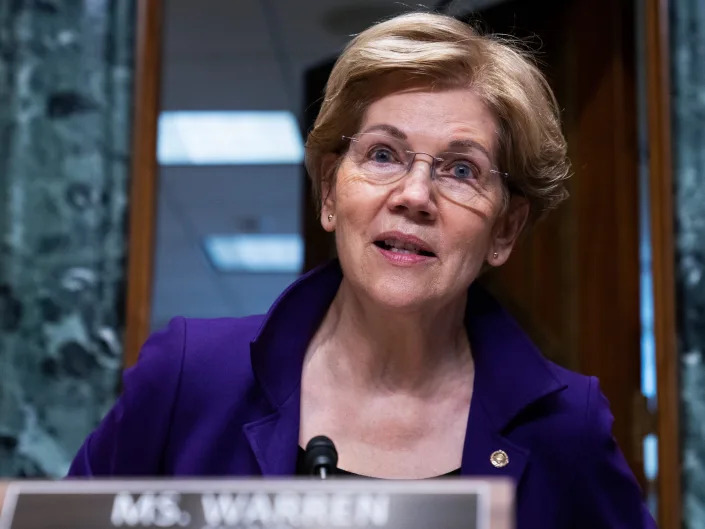
Sen. Elizabeth Warren, D-Mass., appeared shaken up as she talked to members of the press on Tuesday about the Supreme Court’s leaked draft decision to overturn Roe v. Wade.

“I am angry,” she said as she marched to a protest. “Angry and upset and determined.”

“I am angry,” she repeated once she made it to a rally outside the Supreme Court. “I am here because I am angry, and I am here because the United States Congress can change all of this! Angry, but committed.”

On Monday night, the political news outlet Politico sent shock waves across Washington and the nation when it published a leaked draft of the Supreme Court overturning the landmark 1973 decision that legalized abortion nationwide.

Sen. Elizabeth Warren at a demonstration outside the Supreme Court on Tuesday. (Evelyn Hockstein/Reuters)

The draft, from February, could still change before the expected ruling in June. But the conservative majority on the court appears ready to dismantle Roe, a long-held policy aim in Republican circles. Such a decision would send abortion laws to the states, and many GOP-led states have already passed laws to outlaw abortion the moment the high court acts.

“They have been out there plotting, carefully cultivating these Supreme Court justices so they could have a majority on the bench who would accomplish something that the majority of Americans do not want,” Warren said, blasting the “extremist” majority on the court.

Warren said her anger was driven by concern for the poor women in Republican-controlled states who lack the resources to travel to Democratic states that maintain legal abortion rights.

“I am angry because of who will pay the price for this. It will not be wealthy women. Wealthy women can get on an airplane, they can fly to another state, they can fly to another country, they can get the protection they need,” she told the rally before the court building. “This will fall on the poorest women in our country. This will fall on the young women who have been abused, who are victims of incest. This will fall on those who have been raped. This will fall on mothers who are already struggling to work three jobs, to be able to support their children they have.”


Warren, who ran for president in 2020, argued that Congress should pass a federal law protecting abortion rights. That effort faces an uphill battle, as Republicans would be sure to filibuster the measure in the Senate, and moderate Democrats in the chamber are unlikely to buck the filibuster.

“The United States Congress can keep Roe v. Wade the law of the land — they just need to do it,” Warren said, also endorsing expanding the number of Supreme Court justices.

Several other liberal lawmakers, including Sen. Bernie Sanders, also called for the filibuster to end and for Roe v. Wade to be codified.

“Congress must pass legislation that codifies Roe v. Wade as the law of the land in this country NOW,” Sanders tweeted. “And if there aren’t 60 votes in the Senate to do it, and there are not, we must end the filibuster to pass it with 50 votes.”


President Biden on Tuesday told reporters he would work to codify the decision into law, saying it “makes a lot of sense.” He also looked ahead to this year’s midterm elections.

“If the court does overturn Roe, it will fall on our nation’s elected officials at all levels of government to protect a woman’s right to choose,” Biden said in a statement. “And it will fall on voters to elect pro-choice officials this November. At the federal level, we will need more pro-choice senators and a pro-choice majority in the House to adopt legislation that codifies Roe, which I will work to pass and sign into law.”
Newsom: Democrats need 'counter-offensive' in culture wars


California Gov. Gavin Newsom poses with workers and volunteers on Wednesday, May 4, 2022, at a Planned Parenthood office near downtown Los Angeles. Newsom faulted his own political party Wednesday for setbacks in the nation's culture wars and urged Democrats to launch a vocal “counter-offensive” to protect rights from abortion to same-sex marriage. (AP Photo/Michael R. Blood)More

MICHAEL R. BLOOD
Wed, May 4, 2022

LOS ANGELES (AP) — California Gov. Gavin Newsom faulted his own political party Wednesday for setbacks in the nation's culture wars and urged Democrats to launch a vocal “counter-offensive” to protect rights from abortion to same-sex marriage.

At an appearance at a Planned Parenthood office near downtown Los Angeles, Newsom warned that the U.S. Supreme Court's conservative majority could unravel decades of court rulings that could redefine what it means to live in America. He said the Democratic Party has been too passive in response, and urged a “counter-offensive” to protect what he called fundamental rights.

Earlier this week, a leaked draft of a Supreme Court opinion suggested the court’s conservative majority is poised to overturn Roe v. Wade, the landmark 1973 decision legalizing abortion.

“This Supreme Court is poised to roll back constitutionally protected rights and don’t think for a second — don’t think for a second — this is where they stop,” Newsom said.

“They are coming after you,” he added. “You think for a second same-sex marriage is safe in the United States?” he asked. “If privacy is not constitutionally protected, this opens up panoply of issues.”

With much at stake, the liberal governor who is seeking a second term this year railed against Democrats, saying they had been largely absent as rights were being eroded.

He alluded to recent battles across the country, including over a Texas law that bans abortions after a fetal heartbeat can be detected, possibly as early as six weeks, and a Florida law that forbids classroom instruction on sexual orientation and gender identity in kindergarten through third grade."

“Where is the Democratic Party?” he asked. “Why aren't we standing up more firmly? More resolutely? Why aren't we calling this out?”

“We sit there 24-7 taking it from the ... misinformation and rage machine on the right,” he said. The Republicans, he added, “are winning.”

Newsom appeared to spare President Joe Biden from criticism, noting he was dealing with global crises. He said House Speaker Nancy Pelosi is “delivering,” but added that important legislation “is just not getting through the door” in the Senate.

California is making plans to become an abortion “sanctuary,” where reproductive rights would be expansively protected and patients could travel from other states for services. One proposal seeks to guarantee a right to an abortion in the state constitution.

If the Supreme Court overturns the Roe ruling, at least 26 states are likely to outlaw abortions, according to the Guttmacher Institute, an abortion rights advocacy group.

He said states that were restricting abortion rights were imposing “state-sponsored birth,” but failing to provide child care and other services for those women once a child is born.

When asked what he would say to a woman in California or elsewhere fearful of losing abortion rights, Newsom answered, “You matter. We care. We have your back. We love you.”

In a midterm election year when the president's party typically loses seats in Congress, and with Biden's approval ratings sagging, Newsom said he was hopeful Democratic voters would become energized amid the fight over abortion rights. California is a heavily Democratic state, but Republicans are hoping anger over rising crime rates, homelessness and inflation will help their party make inroads.

Earlier in the day, Newsom's campaign released a new television ad, spotlighting his efforts to protect abortion rights and linking his leading Republican rival, state Sen. Brian Dahle to former Republican President Donald Trump. He employed a similar strategy against Republicans last year, when he easily survived a recall election that could have removed him from office.

“Elections do have consequences and we saw that with Donald Trump,” Newsom said at the clinic. “Wake up America. Wake up to who you are electing.”

A sociology professor said she used to invoke China as a prime example of reproductive coercion. 

Now she uses the US.

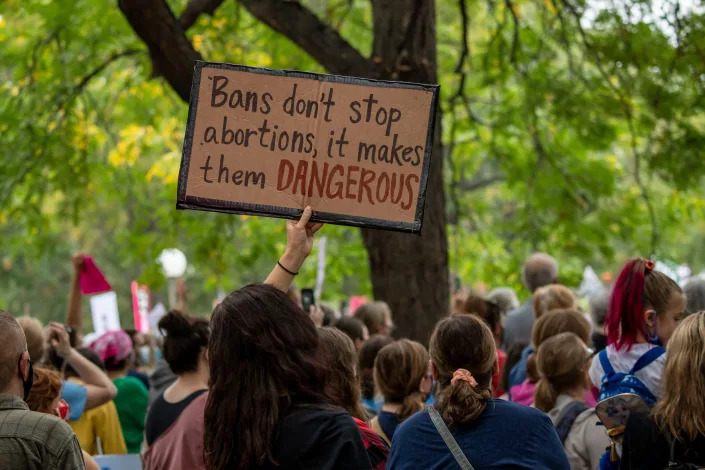
March for reproductive freedom.
UCG/Getty Images
  • Dr. Carole Joffe, a scholar of reproductive health, teaches reproductive coercion.

  • She said she used to tell her students about China's one-child policy as an example.

  • But now she almost always uses the US to illustrate an example of a lack of bodily autonomy.

In the decades Dr. Carole Joffe, a sociologist at the University of California, San Francisco, spent teaching students about reproductive health, she's developed her own strategies to help students grasp the material.

For years, Joffe said she invoked China's one-child policy, using the country as her go-to example to illustrate what a lack of bodily autonomy looks like.

"We used to tell our students about China," she told Insider. "When they had the one-child policy, which they no longer have, we used to tell our shocked students that there are community workers who go around and tabulate when a woman's last period was to make sure she wasn't pregnant."

If a woman was pregnant, Joffe said, she'd be forced to get an abortion.

"That for us was the absolute prime example of reproductive coercion. A rare example where people are being forced to have abortions against their will," she said.

But in recent years, as restrictive abortion bills have been emerging all over the country, Joffe, a reproductive rights advocate, has begun instead to talk about and emphasize reproductive healthcare in the United States.

The Guttmacher Institute, a pro-choice research organization, dubbed 2021 as the "worst year for abortion rights in almost half a century."

"Buoyed by the Supreme Court's 6–3 anti-abortion majority, state legislators raced to enact abortion restrictions," the institute said in its report. "As of December 31, 108 abortion restrictions had been enacted in 19 states. This is the highest total in any year since abortion rights were affirmed by the US Supreme Court in 1973."

The attack on reproductive rights has continued into 2022, with several other states introducing enacting their own restrictive anti-abortion laws. In just the first third of the year, 536 abortion restrictions have been introduced in 42 states, data from the Guttmacher Institute says. As of April 15, 28 have been passed in at least one chamber in 11 states.

On Monday, Politico published a leaked draft opinion in which Supreme Court Associate Justice Samuel Alito called the 1973 landmark ruling that legalized abortions nationwide "egregiously wrong from the start."

Abortion will remain legal in the United States until the court hands down a final verdict, which could come as early as June when the bench decides the verdict for another abortion case. But the draft itself was enough to put reproductive rights activists and doctors who perform abortions on edge.

Joffe said she fears that if Roe is overturned, people who have miscarriages in the US will be accused of having an abortion.

"If I had gone to the hospital, and I was devastated like many people are when they have miscarriages, in addition to my grief, the ER staff or the OB/GYN staff said, 'Oh, are you sure you didn't cause this yourself? Are you sure you didn't take abortion pills?'"

"I can't imagine anything more barbaric," Joffe said.

What Abortion's Past Can Tell Us About Our Future

Sarah Schulman
Tue, May 3, 2022

Photo credit: Graphic House - Getty Images

In 1979 when I was 21, I dropped out of the University of Chicago. Instead of paying my tuition, I used my student loan check to buy a one-way ticket to Luxembourg and started a journey south. My plan was to stop for a few days to visit friends, who I had met some years before during a high school student exchange program, in Albi, a town of about 80,000 in Tarn, France. We were sitting in their garden when the phone rang. The rapid Spanish-speaking voice on the other end was Maria-Theresa, who they had also met as exchange students in Madrid. She was pregnant and heading to France to get an abortion. In fact, she was arriving the next day.

We picked her up at the train station and went directly to the office of Dominique Malvy, the local feminist gynecologist. My friends knew Dr. Malvy because it was a small town, but also because they were in a collective together, trying to start what was then called a “battered women’s center” in Albi. Maria-Theresa had scars on her stomach from the boiling water that she had poured on herself trying to abort the fetus.

In Spain at that time, fascism had ended with the death of dictator Francisco Franco, who died four years earlier, and Prince Juan Carlos was facilitating a transitional constitutional monarchy. The first free election was in 1977, producing a fragile coalition, and no one really knew what was possible in Spain or where the country was going—certainly not for women.

Malvy explained that Maria-Theresa was probably 22 weeks pregnant and that it would be impossible for her to conduct the procedure. Though abortion on pregnancies up to 10 weeks had been legal in France for two years, Malvy didn’t own the necessary equipment. So she recommended a clinic in London. Albigoises (women of Albi) collected money, and I was selected to accompany Maria-Theresa because I spoke English (she did not speak French or English, and I did not speak Spanish). So we got on the train and went to London.

The only person I knew in London was the mother of a man named David, who I had met in Chicago when he tried to recruit me to the Spartacist League, a Trotskyist organization. He was ultimately expelled and we became friends. His mother, Dorothy, was a feminist writer and activist, and she took us in. The next morning, we took a taxi to the clinic, out in a wooded area on the outskirts of the city. The cab driver was familiar with the place, which surprised me. He said that it was owned by some doctors from Spain. When we arrived, it all made sense, because the place—basically an abortion mill, though clean and operating by British standards—was packed. I was expecting some demure living room, but this was a large facility, with probably 40 women, many of them speaking Spanish. What I came to understand as I traveled back and forth from Dorothy’s to the clinic, as Maria-Theresa healed from her procedure, was that according to guards and patients, there were round-trip charter flights leaving Spain every month, filled with women seeking abortions. This was despite laws forbidding Spanish citizens from traveling to obtain abortions. The setup was so blatant, however, that tickets could be purchased at the Corte Inglés, which is like the Macy’s of Spain. Each person I spoke to paid a different rate, with all the costs being high and all the profits going to men. Spain was an economically poor country at the time, still rural and still reeling from the consequences of fascism.


Photo credit: Santiago Barrio - Getty Images

After Maria-Theresa got her abortion, she went back to Madrid. I reported back to the women of Albi, and it was determined that two of us should go to Spain and contact the feminists there, to tell them about the nature of this clinic and try to set up an alternative in France. The Albigoises were willing to receive Spanish women who were pregnant up to 10 weeks and accommodate them for an abortion there and in the neighboring big city of Toulouse. The South of France had a long history of harboring Communist and anarchist refugees from the Spanish Civil War, and this would be the next rendition. This was a time of global feminist collectives, and everyone just assumed that Spanish counterparts were there to be found.

My friend Genevieve and I were selected to go—she spoke fluent Spanish—and we were given a box of diaphragms and spermicidal cream to bring as gifts. After decades of a complete ban, contraception methods had just been decriminalized in Spain, but they were still hard to obtain. The diaphragm was the most symbolic and popular mode of contraception supported by feminists, because it had no side effects and could be inserted and removed at will. We took the train across the border; it was my first time in Spain. Though in transition to democracy, it still had a full leg stuck in fascism; the Guardia Civil, Spain’s military police force, were still associated as Franco’s henchmen, his enforcers and torturers of opposition. So when they appeared at customs with their signature tricornio hats worn flat side out, Genevieve and I got very nervous. They looked at my U.S. passport and waved me through, not opening my suitcase filled with diaphragms. But when they got to French Genevieve, they opened her valise and discovered tubes of spermicidal cream. Oh, shit. I stood on the other side of the border, watching as they asked her aggressively, “What is this?” Genevieve took out one tube, unscrewed the top, and put a bit of cream on her finger. Then she massaged it into her scalp. “Cosmetica!” she said, smiling. They waved her on.

We got a small, dark hotel room in Barcelona and started scouring leftist meetings that might attract women. Genevieve explained that some of the older people in attendance had been in exile for years, and were only now getting home to Spain. I watched an old woman tell her story of flight and return before a room of workers. I did not understand Spanish, but I grasped her bitterness, anger, relief, and hope. At the end of her talk, everyone stood and cheered, and the whole room sang “The Internationale.” During the social period after the event, Gene and I just started telling people who we were and what we were looking for. One short woman in glasses asked us a few questions, and then moved on to some other conversations. But by the end of the night, she returned and handed us a piece of paper with an address on it and instructions to visit the following evening.

We arrived in a seemingly deserted part of Barcelona. Totally silent. This must be a joke. We quietly entered the empty building and went up the dark stairs. At the top floor, we knocked on a door and entered into a new world. It was a series of waiting rooms crammed with women. The thing about Spain during that period, there was little immigration and few tourists. The wide variety of racial and ethnic backgrounds of Spanish people was apparent in those rooms: European, Arab, Romany, African, Nordic, and Indigenous women sat in chairs, some with somber male partners, some with children, most alone. Then we saw the short woman with glasses we had met at the leftist meeting. She warmly squeezed us into a corner, and we talked quickly. What we learned was that this underground feminist abortion service was run by three Argentine Communist women who were in exile from Fascist Argentina, still under the rule of dictator Jorge Videla, conducting his Dirty War, which would result in the murder and disappearance of around 30,000 people. Speaking quickly, we worked out that they would start referring women less than 10 weeks pregnant to the South of France to try to get abortions women to women, bypassing the profiteers.


Photo credit: Paco Junquera - Getty Images

For the next year or so, women arrived from Spain by train to Toulouse Station. They risked arrest, as not only was abortion illegal in Spain, but going out of the country to get an abortion was illegal for Spanish citizens. As is the case in Texas today, abetting an abortion was also illegal. So the signal we decided on was for these women to carry a copy of the French magazine Des Femmes. Their French guides would approach, and they would be brought to the offices of gynecologists throughout the South of France. What was so interesting was the way that growing up in fascism had affected these Spanish women who had to take such a risk to get control of their own reproductive lives. Despite the moments of reality that they shared with each other and with their French hosts, for many, this abortion was a dissociated experience. Their husbands and friends at home often had no idea of what they were doing. Soon, French women started to ask their Spanish sisters to speak to a referred pregnant woman, wanting reassurance before committing to the experience. But the act of support proved difficult to complete. The vast majority of women who received abortions refused to talk. Once they got their procedures, they just washed their hands of the experience, hanging up on pregnant women who called for support. In some cases, women even denounced the Argentines once they returned home to their Catholic and fascist contexts.

As heartbreaking as that was then, I understand it so much more clearly now. We see it in white women who voted against their own gender interests, in men who have historically refused to join the abortion-rights movements over the years, in the weird expectation today from the country that somehow “women in Texas will revolt” instead of the rest of us taking responsibility for our collective well-being. Even though I am lesbian and was not personally implicated, I returned from these experiences to witness the enactment of the 1979 Hyde Amendment, which barred federal funding for abortion use in all but seven U.S. states. I then joined the U.S. reproductive rights movement. I saw the unholy alliance between the Republican Party and evangelicals in order to get Ronald Reagan elected, and then watched the Tea Party people define the party entirely.

But it is this question of denunciation that brought these long-ago experiences full circle back to life for me. The new Texas law not only denies American women their Constitutional rights, but, like the Spanish fascist laws, implicates and punishes those who assist Texans in getting the abortions that they feel they must have. Forced motherhood is not enough for these people; they want to punish women for asking for help, for being connected to others, for disobeying. Hopefully, we will all soon be similarly accused.


Justice Alito's reasoning for overturning Roe v. Wade could lead to 'Handmaid's Tale'-style anti-feminist laws nationwide, says Rep. Jamie Raskin

Cheryl Teh
Tue, May 3, 2022, 

Pro-choice activists protest in response to the leaked Supreme Court draft decision to overturn Roe v. Wade in front of the US Supreme Court on May 3, 2022.Alex Wong/Getty Images

Rep. Jamie Raskin criticized Justice Samuel Alito's reasoning in the latter's leaked draft opinion.

Raskin said the scrapping of Roe v. Wade would be "an invitation" to overturn other laws.

Raskin said Alito's line of thinking could lead to "Handmaid's Tale type anti-feminist regulation."


Maryland Rep. Jamie Raskin said this week that if Roe v. Wade were to be overturned based on Justice Samuel Alito's reasoning, it might be an invitation for other laws to be overturned.

Raskin was discussing the bombshell leak of the Supreme Court's draft majority opinion on Roe v. Wade during an interview with MSNBC host Rachel Maddow on Monday.

During that interview, Raskin referred to Alito's writing that "Roe was egregiously wrong from the start," and his opinion that it is "time to heed the Constitution" and "return the issue of abortion to the people's elected representatives."

'The basic legal claim here is that the word abortion doesn't appear in the Constitution — and of course, it doesn't appear in the Constitution," Raskin told Maddow.

He went on to say that based on this logic, other laws and precedents protecting women's reproductive rights might be at risk — for instance, a couple's right to privacy over whether or not to use birth control.

"Indeed, the phrase 'right to privacy' doesn't appear in the Constitution. So, this would appear to be an invitation to have, you know, Handmaid's Tale type anti-feminist regulation and legislation all over the country," Raskin said.

"Because abortion's not mentioned in the Constitution, and presumably there is no right to privacy according to Justice Alito, the legislatures can do whatever they want," Raskin said, in response to a question from Maddow about what might happen if the GOP were to wrest control of the federal government.

"If there's a move on right now to pass a federal law that would categorically prohibit abortion, the only thing stopping them from doing that will be the votes in the House and the votes in the Senate, and the potential veto of the president of the United States," he added.

Raskin also gave his take on the direction that the SCOTUS was moving in, should its decision comes to pass.

"If [SCOTUS] does go forward with it, I believe that the court will have returned to its historic baseline of being a reactionary conservative institution, to the far right of everything else at the federal level in the government," he said.

Protesters on both sides of the issue gathered in a tense face-off outside the Supreme Court building after the draft was leaked.

The overturning of Roe v. Wade could result in abortion becoming illegal in large swathes of the US. There are currently "trigger" laws in 13 states, which would see them swiftly outlaw abortion if the decision is passed.

Meanwhile, Democratic lawmakers are attempting to push a bill that could make Roe v. Wade codified in law.
U.S. Forgives $6.8 Billion in Public Service Worker Student Loans

Emma Kinery
Wed, May 4, 2022


(Bloomberg) -- The U.S. Department of Education approved about $6.8 billion in student debt relief for more than 113,000 borrowers through adjustments to its Public Service Loan Forgiveness Program.

The relief -- which the DOE says will average about $60,000 per borrower -- is being given after President Joe Biden made changes to the program in October, under which nonprofit and government employees can have their federal student loan debt forgiven after 10 years, or 120 payments.

While the debt forgiveness will come as a relief to those who qualify, the number represents only 0.26% of the 43.4 million Americans burdened by federal student loan debt.

Also read: Biden’s $1.75 Trillion Student-Debt Problem by the Numbers

Biden has come under pressure in recent weeks to make good on his campaign promise to forgive $10,000 worth of student loans per borrower as the deadline for the student loan payment moratorium approaches at the end of August. The president said he will either extend the moratorium, which has been in place since the start of the Covid-19 pandemic, or do some sort of debt cancellation before then.

The White House has been looking into whether Biden has the legal authority to forgive student loan debt through executive action. White House Press Secretary Jen Psaki said Tuesday that the president was considering limiting his student loan forgiveness program to Americans earning less than $125,000 a year.

Forgiveness of $10,000 per borrower would clear loans for 15 million borrowers.

Biden must cancel federal student debt 'for each and every borrower,' 8 state attorneys general say: 'Now is not the time for half measures'


Ayelet Sheffey
Wed, May 4, 2022,

New York State Attorney General Letitia James.
REUTERS/Brendan McDermid/File Photo

Eight state attorneys general urged Biden to cancel federal student debt for every borrower.

They wrote that in their roles, they have seen the consequences falling behind on payments can have.

Biden said he will make a decision on debt relief in coming weeks, but it will likely be limited by income.

State attorneys general have joined the fight for broad student-loan forgiveness.

On Wednesday, attorneys general from New York, Hawaii, Illinois, Michigan, Minnesota, New Mexico, Puerto Rico, and Washington wrote a letter to President Joe Biden urging him to cancel federal student debt "for each and every borrower."


They wrote that, in their roles, they have seen the burden student debt can have for borrowers who fall behind on payments. This includes wage garnishment and seizure of federal benefits, which Biden can ensure permanent relief for by forgiving that debt.

"Restarting federal student loan payments, rather than permanently forgiving them, will only make matters worse," they wrote. "While pushing out repayment restarts and attempting to tackle past forbearance abuses are helpful, they are not enough.


"Now is not the time for half measures, extensions or patchwork solutions," they added. "Now is the time for decisive action."
—NY AG James (@NewYorkStateAG) May 4, 2022


State attorneys general have previously fought for protections for student-loan borrowers. In January, 39 of them reached a $1.85 billion settlement with major student-loan company Navient over accusations the company misled borrowers and steered them into deeper debt, which Navient denied. And now, with Biden saying he will make a decision on student-loan relief in the coming weeks — before student-loan payments are set to resume after August 31 — they are joining Democrats in Congress pushing for broad relief for every federal borrower.

Based on recent reports, it looks like not every borrower will access the relief Biden might implement. White House Press Secretary Jen Psaki told reporters on Tuesday that Biden is looking at helping student-loan borrowers making under $125,000 a year, and while that would help the majority of borrowers, lawmakers have pushed back on capping the relief.

"I don't believe in a cutoff, especially for so many of the front-line workers who are drowning in debt and would likely be excluded from relief," New York Rep. Alexandria Ocasio-Cortez told The Washington Post.

And while Biden has not yet commented on an amount for forgiveness, he said he is not considering $50,000 in relief, which progressives were pushing for. Recently released data from Massachusetts Sen. Elizabeth Warren's office found that while every amount of forgiveness will make a different, the more the better — while $10,000 in relief would wipe out debt loads for a third of borrowers, and 2 million Black borrowers, $50,000 in forgiveness would zero out 30 million borrowers' balances.

"Cancelation of federal student loan debts will reduce stress and mental fatigue, free families to invest in new homes and new lives, and provide countless opportunities," the attorneys-general wrote. "And because student loan debt exacerbates the racial wealth gap, widespread cancelation of student loan debt is not merely a matter of economic justice, but of racial justice as well."

Biden could wipe out 30 million student-loan borrowers' debt loads with $50,000 in relief — but $10,000 would still turn a third of their balances to zero

Elizabeth Warren
Sen. Elizabeth Warren.Tom Williams/CQ-Roll Call Inc. via Getty Images
  • New data from Sen. Elizabeth Warren's office highlighted the effect of student-debt relief.

  • It found $10,000 in relief would erase debt for 32% of borrowers, and $50,000 would do so for 76%.

  • Also, $10,000 in relief — which Biden pledged — would erase debt for 2 million Black borrowers.

Any bit of student-loan relief would help borrowers. But new data found that the more forgiveness, the better.

On Tuesday, an analysis prepared for Massachusetts Sen. Elizabeth Warren and obtained by Insider found that if President Joe Biden fulfilled his campaign pledge to cancel $10,000 in student debt for every federal borrower, 32%, or 13 million borrowers, would see their debt balances turn to zero.

And with every $10,000 increment, the share of borrowers affected would only increase: $30,000 in relief would zero out balances for 24 million borrowers, and $50,000 in relief — an amount Warren and many of her Democratic colleagues have pushed for — would wipe out total debt balances for 76% of borrowers, or 30 million people.

"Our findings bolster prior research showing that debt cancelation would free millions of borrowers from financial burdens, help close debt and wealth gaps between Black and white households, and eliminate runaway student loan balances for distressed borrowers," said the analysis, prepared in part by Dr. Charlie Eaton at the University of California, Merced. "Higher levels of cancelation do more towards each of these ends. In sum, every dollar of student debt cancelation counts, but bigger is better for advancing racial equity and economic security."

The analysis also showed how influential broad student-loan relief would be for minority borrowers. $10,000 in debt forgiveness would wipe out balances for 2 million Black borrowers, and $50,000 in relief would reduce the share of Black people with student debt from 24% to 6%, narrowing the Black-white gap.

Warren has long been a proponent for broad student-loan forgiveness, not only because it would stimulate the economy but also because of the effect it would have on closing the racial wealth gap in the country, she said. This new data comes as Biden inches closer toward making a decision on debt relief. He told reporters last week that while he wasn't considering $50,000 in forgiveness, a decision on canceling student debt would be made "in the next couple of weeks."

The racial effects of student debt have also been a focus for other prominent lawmakers, such as Senate Majority Leader Chuck Schumer. In a recent opinion piece with Derrick Johnson, the NAACP's president, Schumer detailed how Black borrowers were more likely to take out student loans to begin with than their white counterparts, and while the median white borrower would owe 6% of their student debt 20 years after entering college, the median Black borrower would owe 95% of their debt over the same time period.

"This disparity is unacceptable," Schumer and Johnson wrote. "It is un-American. And at the current rate, it is entirely unsustainable."

It's unclear how exactly Biden plans to act on student debt, but reports have said he's considering at least $10,000 in forgiveness that may be subject to income limits. Still, as the analysis said, "every dollar of immediate debt cancelation counts, but bigger is better for racial equity and tackling wealth inequality."

Twitter Works to Soothe Anxious Staffers Wondering ‘Why Bother?’

Kurt Wagner and Dana Hull
Wed, May 4, 2022,


(Bloomberg) -- At a Twitter Inc. staff meeting Wednesday morning, the first slide of a presentation asked a question on the minds of many employees: “Why Bother?”

Why show up and build stuff for an app that’s about to be in the hands of a new owner, Elon Musk, who has said he plans to make serious changes? Why keep earning stock options at a company that’s about to go private? The presenter, product vice president Jay Sullivan, tried to appeal to workers’ sense of community, according to two people familiar with the matter.


Sullivan told employees that they have a responsibility to each other, and to a product used by hundreds of millions of people, which hosts the world’s most urgent and important public conversations. They’re all in this together, he added, according to the people, who asked not to be named sharing internal discussions.

Twitter, which employs more than 7,500 people, warned about a possible staff exodus in a regulatory filing this week. Musk told bankers that he was considering cost cuts, including layoffs, as part of his plan to grow Twitter.

The company is unlikely to maintain the same management after Musk takes over, which won’t happen for several months if the deal closes. In the meantime, Twitter says it won’t make major hires or major changes to its product, decreasing incentive to stay. Musk has also made clear he has a different philosophy on Twitter’s content moderation, which is already affecting employees who work on advertising and policy.

Twitter declined to comment.
DeSantis Violating Disney’s Free Speech, Florida Residents Claim in Suit

Erik Larson
Wed, May 4, 2022


(Bloomberg) -- Florida Governor Ron DeSantis trampled Walt Disney Co.’s constitutional right to free speech by dissolving the company’s debt-issuing district as punishment in a political fight, three residents claim in a lawsuit.

The violation of Disney’s First Amendment rights will result in taxpayers being forced to foot the bill for the district’s debt, estimated at $1 billion to $2 billion, according to the suit filed Tuesday in federal court in Miami.

DeSantis, a Republican and potential 2024 presidential candidate, signed a law April 21 repealing the Reedy Creek Improvement District after Disney announced its opposition to the state’s new parental rights law that restricts classroom instruction on sexual orientation or gender identity.

“Corporations are obviously capable of expressing themselves, as Disney did when it spoke out against the ‘don’t say gay’ bill,” the residents said in the complaint. “If a government retaliates and attempts to punish a speaker’s freedom of speech, they are violating the speaker’s constitutional rights.”

DeSantis’s office didn’t immediately respond to a request for comment.

The dissolution of the Reedy Creek Improvement District is set to take effect on June 1, 2023.

According to the suit, Florida is violating a 1967 statutory agreement the state entered into when it formed the Reedy Creek district. The state is also accused of violating the taxpayers’ due process rights under the Constitution.

Disney vs. DeSantis: ‘Florida needs Disney World,’ Harvard professor says


Mon, May 2, 2022

Harvard Business School Senior Fellow Bill George examines the financial outcomes of Florida Governor Ron DeSantis revoking Disney's special tax status and Disney's values.

Video Transcript


DAVE BRIGGS: It's almost pay per view worthy, Disney versus DeSantis. It is the battle dividing Florida along party lines. But across the country, CEOs in all industries are eyeing the daily developments here, wondering how it might impact their company, how they should navigate these choppy political waters. Bill George is the former chairman and CEO of Medtronic, now a professor at the Harvard Business School. He joins us now. Good to see you, Bill.

BILL GEORGE: Thank you.

DAVE BRIGGS: Let's go back, if we can, to the start of this mess. Disney CEO Bob Chapek wanted to stay out of the controversy over Disney's so-called Don't Say Gay legislation, but the combination of angry employees and former CEO Bob Iger coming out against the law. He really had no choice. He offered this relatively mild statement. How do you think he handled it?

BILL GEORGE: Well, he should have thought about all these things first, I believe. I don't think he did his homework. We're in a different world today. He was acting like he was back in the 1990s. In this world of 2022, you have all kinds of stakeholders who expect you to take a position, especially your employees. Employees have found their voice. And particularly, in this post-COVID world, they want to be respected, whether it's a Minneapolis CEO when George Floyd was murdered or people on the LGBTQ+ side that want to be respected and heard from. They want their CEOs to speak on their behalf.

And when they don't do that, as Bob Chapek didn't, they get very upset and it leads to the kind of uproar we've had. And then they get to the worst case, which is a political crossfire with the politicians. And that's the last thing any company wants to get into. And Disney is right in the thick of it, and it's struggling to get out of this mess, as you called it.

DAVE BRIGGS: Even after the statement, he had the employee walkout. So what could Bob have done to keep them his employees happy and somehow stay out of the crosshairs of the governor?

BILL GEORGE: He should have gone back months before, talked to his board, talked to his leadership team. What do we stand for? Disney has always been very pro-family, but also very gay-friendly, if you will. And they should have made those points very clearly. And when this legislation started in Florida, they should have had a position ready to go. And they didn't have to lead with their chin, but they should have had a position that was true to their mission and values of what Disney is that accepts everyone for who they are.

DAVE BRIGGS: So, as I mentioned, CEOs across the country are shaking a bit in their boots. What are you hearing from them, and what's your advice?

BILL GEORGE: Well, they're very concerned. They don't want to get caught into this crossfire either. But they are all going back now, I think, in really thinking about, what do I stand for? What issues should I get involved in? And when shouldn't I get involved in? And how do I avoid getting in the crosshairs of some politicians. They may get caught anyway, but if they're true to their mission and values, this is a question of, should I get out of Russia because of the Ukraine war?

These things are coming up every way right now, and CEOs today need to know how to lead through a crisis because we go from one crisis to the next. We go to from COVID to George Floyd to Russia and Ukraine. And there's probably another one just around the corner. So they need to be prepared to deal with these and have a position that's true to their company.

For instance, Johnson & Johnson has taken a very clear position that we're there to help people. And so if that means we're going to stay in Russia, we have lifesaving drugs, we don't want to get out. Hey, I respect that position. It goes to their credo. That's what each CEO should do, to go true back to their mission and values.

DAVE BRIGGS: A fascinating poll came out last week showing the majority of the country is against the government punishing business over their political beliefs. But the fascinating part within this is Democrats were far more supportive of business than were Republicans. What do you make of that political dynamic we have today?

BILL GEORGE: I'm smiling because when I was a boy growing up, the Republicans were seen as the party of big business. And Democrats are seen as the party of the working class, the blue collar workers. And things seem to have flipped. And we're much more into cultural wars. Businesses are not interested in that. They're interested in helping their customers make a difference in their lives, whether Disney is bringing fun to people or organizations in the apparel business, bringing joy to them, or Medtronic providing good healthcare to help save lives. That's what they want to do. But they need to represent all their employees and all their stakeholders. And I think that's what they've lost sight of here.

DAVE BRIGGS: What's fascinating is, I read this statement, and I want you to guess what party it comes from. A senator-- it's very simple. We need to see a majority of American corporations as American. They don't act in the best interests of the country. They act in the best interest of shareholders, period. Was that a Republican or a Democrat?

BILL GEORGE: I have no idea. I probably would have normally would have guessed a Democrat today, maybe a Republican. But I'll tell you this. It's not just the shareholders today. It's not just the world it was in the '80s and '90s, the shareholder primacy. It's the world of stakeholders. They have to operate in the best interests of their customers. They have to operate in the best interests of their employees. And they need to find an alignment with those interests with their shareholders' interests.

DAVE BRIGGS: That statement continued. We are, as policymakers, we need to be acting in the best interest of the country, not big business. It sounded like Elizabeth Warren, it was Marco Rubio. Stunning when I got to the finish of it. How do you think this plays out for Disney? Their special exemption wouldn't actually go into effect until June 2023. Can they wait out the governor?

BILL GEORGE: Yes, they may have to. There's this billion dollar question about who's paying off the bonds, which legally have to be paid off. And if that's not clear, I'm not sure Orange County has the money to do that, the Orlando County. And so they are going to have a continued battle. But understand the governor has different objectives than Disney. And so Disney can't meet all of his needs because he is working a whole political angle here.

And that's why I say, they don't want to get caught up in that, but they have to run a great Disney World, I can tell you that, that welcomes everyone to their premises. And that's the most important thing for them. And they have to make sure this doesn't turn against them. And they probably have some legal recourse on this whole latest legislation that had to do with pulling back that special district. And there are many unintended consequences, frankly, that have not been thought through there that it will give Disney more ammunition.

A good example is Ed Bastian at Delta a few years ago, the Georgia legislature, withdrew a $41 billion-- a million dollar tax break that they got on a fuel savings. They've been giving it for 30, 40 years. And he stood up, and he said Disney's values are not for sale. A year later, the legislature restored that and retroactively.

So in the end, Disney didn't really throw out-- Delta didn't really get hurt by that. So I'm optimistic that Florida needs Disney World. I can tell you that. It's a huge revenue producer. I was just in Orlando, actually, for a soccer game, not for Disney World. But I can tell you, it's created everything around there. They need that. And all the merchants, all the hotel owners, and all the restaurants desperately need Disney World. They-- Florida can't do without Disney World. So it's a question, who needs who more?

DAVE BRIGGS: 70,000 plus jobs as well. Bill George--

BILL GEORGE: Exactly.

DAVE BRIGGS: --Harvard professor, former chairman, and CEO of Medtronic, it is tricky times to be a CEO. Thank you, Bill.
Teachers’ Union Urges Action on Meta’s ‘Clear Threats’ to Kids

Josh Eidelson and Maxwell Adler
Wed, May 4, 2022


(Bloomberg) -- A national teachers’ union is urging its members’ pension funds to push for an outside review of Meta Platforms Inc.’s governance, saying the potential for its social media services to harm children warrants closer scrutiny of its inner workings.

Randi Weingarten, president of the American Federation of Teachers, is seeking support for a proposal to be presented at Meta’s May 25 annual shareholder meeting that would compel Facebook’s parent to hire an outside law firm to assess its audit committee and risk management. The AFT has 1.7 million members who participate in pension funds that together hold 30 million shares of Meta, valued around $6 billion, according to the union.

“AFT members, whose deferred wages may be invested in Meta, have seen the harms perpetuated by Meta’s Facebook platform firsthand,” Weingarten wrote in a letter Wednesday. “Meta has not taken sufficient action to mitigate the clear threats its business management choices pose to children and teenagers.”

She highlighted the impact on members from harmful content, including nurses dealing with illness due to Covid misinformation, and school staff supporting children with depression or self-esteem issues. She also noted the drop in the company’s shares -- Meta is down 34% over the past year -- and regulatory risks stemming from concerns about its internal controls.

Weingarten, who heads the U.S.’s second-largest teacher’s union, wrote to trustees a day after Facebook whistleblower Frances Haugen appeared at an AFT town hall to discuss social media. In October 2021, Haugen, a former Facebook product manager, shared thousands of pages of internal documents with journalists that suggested Facebook knew about the harms it was causing teenagers but chose to do little in terms of addressing the problems. Huagen accused Meta of prioritizing profit over the safety of the platform’s active users.

In its 2022 proxy statement, Meta’s board opposed the shareholder proposal. “The audit & risk oversight committee takes its responsibilities, including risk oversight, seriously,” the company wrote. Meta said that “robust efforts already in place” show the committee’s “commitment to providing appropriate oversight” and thus the proposal was “unnecessary and not beneficial to our shareholders.”

“Meta’s board must take seriously its obligation to police the company’s risk management practices and its internal controls,” and “part of that obligation includes addressing Meta’s role in harming children and the public at large,” Weingarten wrote. “The proposal makes clear that the failure, so far, to do so requires the involvement of independent outside expertise, much as other kinds of misconduct by corporate insiders would.”

She also singled out Chief Executive Officer Mark Zuckerberg, saying his role as founder and board chair seems to give him power to prevent the board from fulfilling its responsibility to internally audit the company’s management and products, while Meta’s dual-class share structure insulates him from public accountability.

Facebook Parent Meta Slows Hiring 
in Cost-Cutting Push

Kurt Wagner
Wed, May 4, 2022


(Bloomberg) -- Facebook parent company Meta Platforms Inc. is slowing or pausing hiring for some mid- to senior-level positions, part of a broader plan to cut costs and cope with the challenges facing the social media giant.

“We regularly re-evaluate our talent pipeline according to our business needs and in light of the expense guidance given for this earnings period, we are slowing its growth accordingly,” Meta said in a statement Wednesday. “However, we will continue to grow our workforce to ensure we focus on long-term impact.”

The move follows a generally upbeat earnings report last week -- with the Facebook platform returning to user growth -- but the company warned that the Ukraine war was weighing on sales. Meta said at the time that it would be reining in its spending plans for the year in light of a weaker revenue outlook.

That marks a reversal from rapid staffing growth in recent years. Meta Chief Financial Officer Dave Wehner had said in February that the company expected “accelerated headcount” to be the biggest contributor to expense growth in 2022, and the company added more than 5,800 new hires in the first quarter. But last week’s revision to its spending budget is now affecting hiring plans.

Meta, based in Menlo Park, California, had more than 77,800 employees at the end of March. That was up more than 28% from a year earlier.

Insider first reported on Meta’s plans to slow hiring.