Wednesday, May 04, 2022

Right-wing 'groomer' attacks target suicide prevention service for LGBTQ youth

Conservatives pushing anti-LGBTQ “grooming” attacks have turned their attention to the Trevor Project, a nonprofit that provides counseling for teens.

In late April, conservatives began to circulate a cartoon from the Trevor Project, the world’s largest suicide prevention and crisis intervention program for LGBTQ youth, according to its website. The cartoon explains that those who want to chat with a counselor can do so with the ability to quickly exit and erase browser history. The feature is meant to help those with anti-LGBTQ parents. Similar protections are provided by domestic abuse services.

But a number of conservatives — many of whom hyped concerns about the teaching of race in school — have recently recirculated it as proof that the nonprofit is engaging in grooming. One of the leading critics has been author and commentator James Lindsay, who published a book criticizing critical race theory (the study of racism in U.S. systems and policies) last year before pivoting to a series of YouTube videos about “groomer schools.”

A crisis service coordinator looks at a computer monitor with volunteers at the Trevor Project Call Center in West Hollywood, California on January 17, 2017.(Mark Ralston/AFP via Getty Images)
A crisis service coordinator at the Trevor Project call center in West Hollywood, Calif., in 2017. (Mark Ralston/AFP via Getty Images)

“Grooming” is a relatively new term used to describe tactics that have long been used by sexual abusers, mostly against young children but also vulnerable adults, to gain access to potential victims, coerce them into abuse and then avoid getting caught.

According to the Rape, Abuse & Incest National Network, “Sexual assault is in no way related to the sexual orientation of the perpetrator or the survivor, and a person’s sexual orientation cannot be caused by sexual abuse or assault.”

Yet the term has recently emerged as a popular buzzword on the political right, where it’s been wrongly conflated with discussions of sexual orientation and gender identity.

“Only a matter of time until solid evidence of serious wrongdoing emerges regarding the Trevor Project. They don't mobilize to protect anything unless there's something really bad going on there that they don't want anyone to find out. Mark my words,” wrote Lindsay on Twitter, later adding, “Groomer Project posing as suicide prevention.”

The Trevor Project website.

In a now deleted tweet, the Libs of TikTok account — which has more than 1 million followers — called the Trevor Project a “grooming organization.” The account, run by an attendee of the Jan. 6, 2021, Capitol insurrection, has been criticized for attempting to get queer teachers removed from their jobs.

“Why is the @TrevorProject encouraging children to keep secrets from their parents?” wrote the account Moms 4 Liberty, a right-wing organization that’s part of the effort to censor books by minority and LGBTQ authors in public schools and libraries.

Lindsay also shared a February story from the conservative Post Millennial website titled “Mother of 'trans' child poses as teen to find out how Trevor Project grooms kids into transitioning,” writing, “The Trevor Project is a Groomer Project. It needs to be shut down.”

The article aimed to attack the organization for not providing more information about how to de-transition but contains numerous examples of a counselor repeatedly asking the parent, who is pretending to be a 15-year-old, about whether she has self-harmed or attempted suicide.

“The Trevor Project exists to end the public health crisis of suicide among LGBTQ young people — a mission that transcends political lines and cultural divides,” a spokesperson for the organization said in a statement to Yahoo News. “We estimate that more than 1.8 million LGBTQ youth seriously consider suicide each year in the U.S., and our counselors hear from youth every day who feel like they have nowhere to turn.”

The spokesperson added, “The resurgence of anti-LGBTQ attacks that seek to smear adults, including parents, teachers, counselors and doctors, who affirm and support LGBTQ youth, is especially dangerous, as it diverts attention away from the very real, life-threatening issues of child abuse and sexual assault.”

According to the National Alliance on Mental Illness (NAMI), “The LGBTQI population is at a higher risk than the heterosexual, cisgender population for suicidal thoughts and suicide attempts.” A 2017 study by the Centers for Disease Control and Prevention found that high school students who identify as lesbian, gay or bisexual are more than four times as likely than their heterosexual peers to have attempted suicide.

Transgender teens are at even greater risk. According to a 2020 survey published by the Journal of Adolescent Health, “Transgender and nonbinary youth were at increased risk of experiencing depressed mood, seriously considering suicide, and attempting suicide compared with cisgender lesbian, gay, bisexual, queer, and questioning youth.”

Trevor Project volunteers march in New York City's Pride parade.
Trevor Project volunteers in New York City's Pride parade. (Sasha Vorlicky/The Trevor Project)

New data released by the Trevor Project on Wednesday shows that suicidal thoughts among LGBTQ youth have been on the rise in the past three years. The organization’s 2022 National Survey on LGBTQ Youth Mental Health, which surveyed nearly 34,000 LGBTQ youths ages 13 to 24 across the country, found that 45% of respondents had seriously considered attempting suicide in the past year — up from 42% in 2021 and 40% in 2020.

Suicidal thoughts were even more prevalent among transgender and nonbinary youth, with 53% reporting that they had seriously considered suicide in the past year.

Marlene Matarese, a clinical associate professor at the University of Maryland’s School of Social Work, said that in addition to suicidality, LGBTQ youth also have disproportionately higher rates of behavioral health issues including depression, anxiety and substance use.

“This is not because they are innately predispositioned to experience these outcomes but because they experience minority stress daily,” said Matarese, who is the principal investigator at the National Center of Excellence for LGBTQ+ Behavioral Health Equity, which is funded by the Substance Abuse and Mental Health Services Administration, a branch of the U.S. Department of Health and Human Services.

She told Yahoo News that one example of the types of stressors encountered by LGBTQ youth “is hearing from elected officials that people who support and protect LGBTQ+ youth are grooming them.”

“Imagine the messaging that this sends young people about their identity,” Matarese said. “Hearing constant comments like this in the media and from friends and family members leads to silence, shame, isolation and fear, which in turn leads to increased rates of behavioral health challenges.”

Hannah Wesolowski, NAMI’s chief advocacy officer, told Yahoo News that organizations like the Trevor Project provide much-needed support to LGBTQ youth, whose increased rates of mental health conditions and suicidality are tied to the discrimination, harassment and rejection they often face, not just from their peers but also from their families.

“There are too many people right now who are telling these kids ‘there’s something wrong with you,'” said Wesolowski. “They need to hear that there isn’t anything wrong with them. And they need to have support and hear the message that they’re loved, they’re accepted, they’re respected, and that they’re not alone.”

The report released by the Trevor Project on Wednesday found that LGBTQ youth who felt a high degree of support from their families reported attempting suicide at less than half the rate of those who said they felt low or moderate support. LGBTQ youth who live in communities that are accepting of LGBTQ people also reported attempting suicide at significantly lower rates than those who do not, according to the findings.

The term “groomer” began to spread on the right in March in relation to Florida’s controversial “Don’t Say Gay” law, a vaguely worded statute — which prohibits teachers from discussing sexual orientation and gender identity with children in kindergarten through third grade — that critics say targets LGBTQ teachers.

Florida Gov. Ron DeSantis signs the Parental Rights in Education bill at Classical Preparatory School in Spring Hill in March.
Florida Gov. Ron DeSantis signs the Parental Rights in Education bill at Classical Preparatory School in Spring Hill, Fla., in March. (Douglas R. Clifford/Tampa Bay Times/TNS via ZUMA Press Wire)

Republican Gov. Ron DeSantis’s press secretary, Christina Pushaw, said that anyone who opposed the bill was “probably a groomer." Days later, “grooming” began being used in graphics on Fox News, and it spread quickly from there. Lindsay has tweeted the term “ok groomer” more than 100 times since October, including in a response to Transportation Secretary Pete Buttigieg’s husband, Chasten, reacting to the news of the Supreme Court's potential overturning of Roe v. Wade.

In addition to Lindsay and Moms 4 Liberty, activist Chris Rufo has pivoted some of his focus from raising concerns about critical race theory to begin targeting LGBTQ teachers. Rufo has said the efforts are part of a larger initiative to dismantle public education as a whole by discrediting it as an institution.

Transgender youth have specifically become targets of Republicans, with a number of states pushing legislation that would charge parents who allow their children to seek gender-affirming care with a felony. At least three Republican candidates have fundraised on transphobia and grooming in recent weeks, with the viral response from one Michigan Democrat who was targeted receiving more than 14 million views on Twitter.

As Yahoo News reported last week, child sexual abuse experts similarly argue that the recent “groomer” discourse is not only inaccurate, but it also undermines legitimate efforts to prevent abuse.

“Anytime that [grooming] is confused with other behaviors that are not sexual grooming, I think, endangers people who are being sexually groomed from understanding that that’s what’s happening to them, [and] it confuses adults who could prevent the abuse from happening,” said Elizabeth Jeglic, a psychology professor at John Jay College of Criminal Justice in New York who researches issues related to sexual grooming, sexual abuse and sexual violence prevention. “If people get confused about what it is, that then can increase the likelihood that people can get away with perpetrating abuse against minors.”

Fundamental LGBTQ Rights Also Under Attack In Leaked Supreme Court Draft

Millions of Americans were shocked Monday night by a leaked draft of a Supreme Court opinion to overturn Roe v. Wade — a decision that, if finalized, would reverse 50 years of precedent ensuring a woman’s right to choose to have an abortion.

But that’s not the only stunning attack on established constitutional rights in the court’s draft majority opinion, first obtained by Politico.

Conservative Justice Samuel Alito, who authored the draft opinion, also specifically criticizes the landmark civil rights cases that legalized marriage equality, Obergefell v. Hodges, and that legalized private consensual sex, Lawrence v. Texas.

Referencing those two cases, Alito eerily says that, like abortion rights, “None of these rights has any claim to being deeply rooted in history.”

Both Alito and Justice Clarence Thomas have already publicly called for revisiting same-sex couples’ constitutional right to marry. In October 2020, they described the court’s 2015 decision on marriage equality as putting “a novel constitutional right over the religious liberty interests explicitly protected in the First Amendment.”

“By doing so undemocratically, the court has created a problem that only it can fix,” Alito and Thomas said at the time. “Until then, Obergefell will continue to have ruinous consequences for religious liberty.”

That Alito is now tying his criticisms of marriage equality to an actual draft court opinion to overturn a 50-year precedent on abortion rights should be a blaring siren for anyone concerned about constitutionally protected LGBTQ rights.

“The concern for us is what’s next with this right-wing Supreme Court,” Sen. Mazie Hirono (D-Hawaii) told HuffPost. “I can tell you Obergefell is on Justice Alito’s and Justice Thomas’ hit list.”

As Slate’s Mark Joseph Stern points out on Twitter, at the heart of Alito’s opinion is a scathing repudiation of “unenumerated rights” that are not laid out in the Constitution.

“The Supreme Court may only protect these rights, Alito says, if they are ‘deeply rooted’ in history. Abortion is not. Neither is same-sex marriage,” Stern says.

Senate Republicans dismissed the idea that Alito’s criticisms are a sign that LGBTQ rights are next on the court’s chopping block.

“I’m not aware of any concerted effort to get Obergefell overturned, and I don’t think that this opinion will result in that happening,” said Sen. Josh Hawley (R-Mo.). “I’d be shocked if that happened. I just don’t see it.”

He said even though he thinks Obergefell “was wrongly decided,” he still sees it as settled law.

Sen. John Cornyn (R-Texas) similarly said he didn’t think the draft decision would necessarily be applied to other rulings like same-sex marriage.

Asked if he thinks the court should challenge Obergefell, he wouldn’t say.

“I think we got enough to think about today,” said Cornyn.

But it’s not lost on LGBTQ rights advocates that Alito intentionally referenced same-sex marriage rights in the context of eviscerating women’s reproductive rights.

Jim Obergefell, the lead plaintiff in the landmark marriage equality case, said in a statement that it is “concerning” that some on the Supreme Court are eager to lump them all together.

“The sad part is in both these cases, five or six people will determine the law of the land and go against the vast majority of Ohioans and Americans who overwhelmingly support a woman’s right to make her own health decisions and a couple’s right to be married,” said Obergefell, who is currently a candidate for an Ohio House seat. “This is a sad day, but it’s not over. We have fought the good fight for too long to be denied our rights now.”

Republican senators insist the Supreme Court's landmark same-sex marriage ruling was 'wrongly decided' but decline to 'wade into' it amid leaked abortion opinion

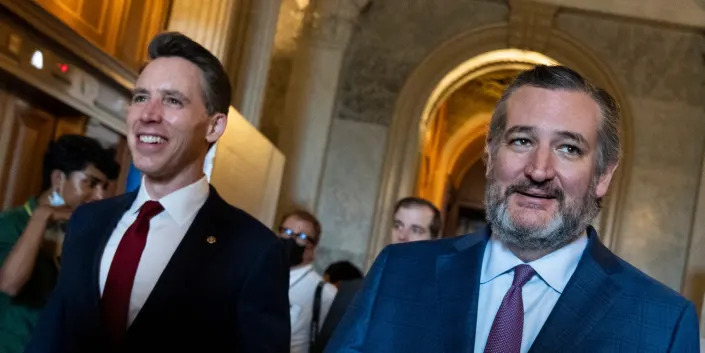
Republican Sens. Josh Hawley of Missouri and Ted Cruz of Texas walk to a GOP luncheon at the Senate on May 3, 2022.
Republican Sens. Josh Hawley of Missouri and Ted Cruz of Texas walk to a GOP luncheon at the Senate on May 3, 2022.Tom Williams/CQ-Roll Call via Getty Images
  • The Supreme Court's potential overturning of Roe v. Wade has Democrats warning that same-sex marriage is next.

  • But Republican senators told Insider they don't care to re-litigate it and are skeptical the court would go there.

  • Sen. Josh Hawley said marriage equality is "settled law" and he'd be "shocked" if it was overturned.

Following the leak of a draft majority Supreme Court opinion that would revoke the constitutional right to an abortion established by Roe v. Wade, Democrats and constitutional scholars alike are warning that other rights, including to same-sex marriage and contraception, could be at risk.

The high court's landmark 1973 abortion ruling is rooted in the rights to privacy and liberty. The Supreme Court's 2015 decision in Obergefell v. Hodges, which legalized same-sex marriage, is similarly rooted in these rights and — like abortion — isn't enumerated in the Constitution or historically accepted in American society. Furthermore, critics argue that overturning a 49-year-old decision undermines the Court's tradition of respecting precedent, particularly on more controversial issues like marriage equality.

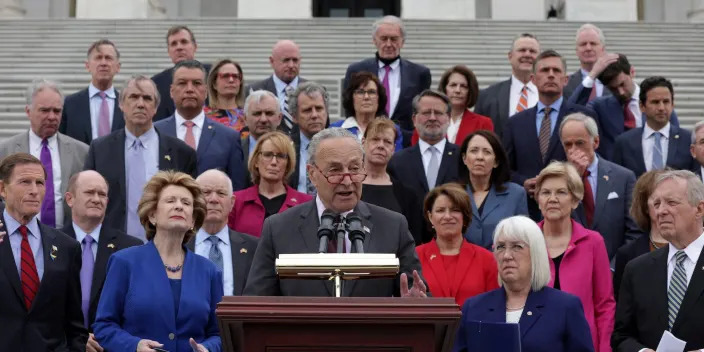
"Will they have the Supreme Court overrun Obergefell so that they can prevent same-sex marriage?" Senate Majority Leader Chuck Schumer asked rhetorically during a hastily-arranged press event on abortion rights on the steps of the Capitol on Tuesday.

"They may say, we wouldn't do that because of precedent," he added. "Why would anyone believe them?"

Schumer and Senate Democrats speak about the leaked Supreme Court draft decision at the Capitol on May 3, 2022.
Schumer and Senate Democrats speak about the leaked Supreme Court draft decision at the Capitol on May 3, 2022.Alex Wong/Getty Images

Insider spoke with nearly a dozen Republican senators at the Capitol on Tuesday, asking each of them whether they believed the draft opinion threatens marriage equality and whether they would support overturning Obergefell v. Hodges. None gave a clear yes or no answer, and several outright declined to comment.

Republican Sen. Mike Braun of Indiana, who recently faced criticism for telling reporters in Indiana that he believes interracial marriage should've been left up to the states instead of decided by the Supreme Court, told Insider that he had "no idea" whether Obergefell could be overturned. He argued the case was "a narrow consideration just on an issue that's been contested for like 49 years."

"I'm gonna not wade into any of that," he said with a laugh when asked whether he would support outlawing same-sex marriage.

But their answers reveal a political party that remains unsure of its stance on the issue nearly 7 years after the ruling. A June 2021 Gallup poll found that 70% of Americans support same-sex marriage, and a handful of Republicans indicated that they believe the issue is settled.

As Republican-controlled states pass laws targeting transgender people, the far-right levels accusations of "grooming" against LGBTQ Americans, and Florida forbids teaching children about sexual orientation and gender identity, Democrats are eyeing the conservative-dominated court with increasing consternation.

A 'uniquely divisive decision'

In his 98-page draft opinion, conservative Associate Justice Samuel Alito explicitly argues that the Court's decision to revoke the right to an abortion wouldn't impact other similarly-derived rights.

"Nothing in this opinion should be understood to cast doubt on precedents that do not concern abortion," Alito wrote.

But Alito argues that abortion isn't mentioned in the Constitution, nor traditionally accepted in the US, while invoking Washington v. Glucksberg, a 1994 ruling that determined assisted suicide is not protected by the Due Process Clause of the 14th amendment. That case gave rise to the "Glucksberg test," which holds that any right not specifically named in the Constitution must be "deeply rooted in this Nation's history and tradition."

But these arguments alarm proponents of same-sex marriage, including Democratic Sen. Tammy Baldwin of Wisconsin, the first openly LGBTQ person elected to the Senate and one of just two currently serving.

They point out that same-sex marriage is also neither enumerated in the Constitution, nor traditionally practiced. Both rights are derived from the 14th Amendment right to liberty and the 4th Amendment right to privacy. Same-sex marriage is also derived from the Equal Protection Clause.

"Yes, yes," Baldwin told Insider when asked whether she believed the Roe opinion puts Obergefell at risk. "The underlying rationale could apply equally to issues like contraception issues, like the freedom to marry for LGBTQ individuals."

Republican Sen. Josh Hawley of Missouri told reporters on Tuesday that the draft ruling was a "really good opinion," and specifically praised Alito's use of the Glucksberg test. "I think that's the standard the court should use going forward," he said.

Proponents of overturning Roe also argue that the constitutional right to an abortion isn't "settled law" because it's remained controversial among the American public since it was decided. But conservatives seem to believe that same-sex marriage is "settled" and thus protected from revocation because it isn't as fiercely debated in the public square.

Hawley said that he'd be "shocked" if Obergefell was also overturned because, unlike with abortion, there's little popular appetite to revoke same-sex marriage rights.

"I think that Obergefell was wrongly decided, but I also think that at this point it is also settled law," he said. "I'm not aware of any concerted effort to get Obergefell overturned, and I don't think that this opinion will result in that happening. I'd be shocked if that happened. I just don't see it."

Republican Sen. Ted Cruz of Texas echoed that argument, telling Insider that Roe v. Wade was a "uniquely divisive decision" in contrast to same-sex marriage, which enjoys broad support.

"Look, I've said multiple times, I think Obergefell was wrongly decided," said Cruz. "It's not clear to me that there are pending challenges in the legal system to overturn it, and by any measure, we have not seen the level of fundamental societal division that Roe has inculcated for 50 years."

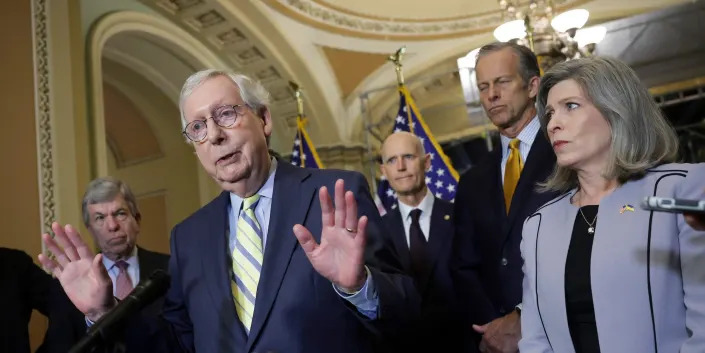
Senate Republicans speak to reporters after their weekly caucus launch on May 3, 2022.
Senate Republicans speak to reporters after their weekly caucus launch on May 3, 2022.Kevin Dietsch/Getty Images

And in a sign that same-sex marriage is increasingly in the rear-view mirror for conservatives, veteran Republican Sen. Roger Wicker of Mississippi initially did not even recall the Obergefell decision.

"I don't know that case," he told Insider. Once refreshed, he said he believed "that issue is over and done."

Republican Sen. Lindsey Graham of South Carolina told Insider that the right to same-sex marriage relies on "a different legal theory" than the right to an abortion, and he's "not so sure that the two relate to each other."

"I leave that up to the court," he said when asked whether he supports the overturning of Obergefell.

"I have no idea," said Republican Sen. Mitt Romney of Utah of the possibility that the court could also revoke marriage equality.

And Republican Sen. John Cornyn of Texas — who recently compared Obergefell to the 1896 Plessy v. Ferguson decision that permitted racial segregation laws and said the 2015 ruling created a "right that is not even mentioned in the Constitution" — told Insider that he doesn't think concerns about Obergefell's overturning are a "reasonable inference" based on the language of the leaked draft.

But Cornyn declined to say whether he'd support overturning Obergefell, walking away as Insider asked repeatedly.

'I'm not even going to entertain this whole thing'

A handful of other Republicans sought to dodge commenting on the implications of the potential ruling, focusing on the fact that the draft became public as the result of an unprecedented leak.

Senate Minority Leader Mitch McConnell led Republicans in claiming without evidence that the leak was perpetrated by the left as he sought to divert attention from the substance of the opinion.

"That's not the story for today," McConnell told reporters at his weekly press conference on Tuesday, arguing that the press should "concentrate on what the news is today; not a leaked draft, but the fact that the draft was leaked."

Republican Sen. Marco Rubio of Florida told Insider that he had "no idea" whether the draft opinion meant Obergefell could be overturned and said he was "not going to read a leaked document."

"Right now I'm not even going to entertain this whole thing about this leaked document," he said. "This is nothing but an effort to rile up a mob to go out with pitchforks in front of the Supreme Court and try to intimidate justices."

Sen. John Barrasso of Wyoming, the chair of the Senate Republican Conference, told Insider that he didn't want to "speculate" on the implications of the opinion and said the leak was "a huge violation of integrity of the court."

And Sen. Rand Paul of Kentucky told Insider that he'll "probably just wait until there's an official opinion to comment" and said he didn't "have anything new to say" on whether Obergefell should be overturned.

While the general disinterest by Republican senators in re-litigating Obergefell may have little bearing on whether the Court itself could overturn the ruling, it would ultimately fall to both chambers of Congress to pass a law codifying marriage equality into law, as Schumer has vowed to attempt with abortion rights. Asked whether she believes that enough votes could exist for such a bill, Baldwin simply offered that Democrats "will fight."

Perhaps the most candid response from a Republican senator on Tuesday came from Sen. Kevin Cramer of North Dakota, who said that while he has religious and cultural objections to same-sex marriage, he doesn't "know why the government ever got into the business, frankly." Cramer echoed Alito's argument that abortion and same-sex marriage are fundamentally different.

"It's not dangerous, like taking a life is," he said, referring to abortion. "So to me, the magnitude of the outcome is not the same."


The Chinese American cook whose Supreme Court case changed who gets to be a citizen

DeArbea Walker
Wed, May 4, 2022

Documentation that certified that Wong Kim Ark was able to leave the United States and return.National Archives

Born in San Francisco, Wong Kim Ark was detained trying to return to the US after visiting family in China.

His legal team argued that the "subject to the jurisdiction thereof" clause in the Fourteenth Amendment extended to children born on US soil.

His 1898 Supreme Court case set the precedent of birthright citizenship in the US.


In 1898, a Chinese American cook by the name of Wong Kim Ark challenged the Fourteenth Amendment, thereby forever changing who is entitled to citizenship in the United States.

The case Wong Kim Ark v. the United States made its way to the Supreme Court in March 1897, where Wong, who was born in San Francisco, challenged the substance of the Fourteenth Amendment.


The amendment was passed in 1868 after the Civil War to extend citizenship to newly emancipated Black people. Ark's legal team argued that the amendment applied to all children born on US soil, not just emancipated Black people.

In March 1898, the Supreme Court voted 6-2 in Ark's favor resulting in birthright citizenship in the US today.

An application submitted by Wong Kim Ark, addressed to the Commissioner of Immigration at San Francisco.National Archives


Wong Kim Ark was born in San Francisco to Chinese immigrants

Wong, a Chinese American born in San Francisco, had left the US in 1894 to visit his parents, who moved back to China. His parents were Chinese citizens living in the US, but they could not become US citizens because of the Naturalization Act of 1802, which limited naturalization to "free white" immigrants only.

Upon returning to the US in 1895, Ark was detained at the Port of San Francisco for months before the Chinese Six Companies, a Chinese American business advocacy group, picked up the case. From there, it went to the US District Court.

At the time, the US Appeals Court had just ruled in favor of Look Tin Eli in the case of Look Tin Sing. Similarly to Wong, Look Tin Eli was born in the US and denied entry back into the country after visiting China. This was in 1884, two years after the passage of the Chinese Exclusion Act which placed a 10-year ban on Chinese laborers immigrating to the US. This was the first major law restricting immigration in American history. Because of these new restrictions, Look was told he was required to carry a "necessary certificate of citizenship," which he lacked. He won his case in 1884, with Justice Stephen Field declaring that children born in the US are citizens regardless of ancestry.

The case of Look Tin Eli became an important decision that was cited in Wong Kim Ark's case in front of the Supreme Court four years later.


An application submitted by Wong Kim Ark, addressed to the Commissioner of Immigration at San Francisco.National Archives

According to the book "Laws Harsh as Tigers: Chinese Immigrants and the Shaping of Modern Immigration Law," by Lucy E. Salyer, attorneys like George Collins, who believed that people born of "alien parents" should not be considered citizens, were looking to bring a Chinese birthright citizen case to the Supreme Court. In the American Law Review in 1895, Collins criticized the Look Tin Sing ruling and the federal government's unwillingness to challenge it.

A few years later, Ark's counsel argued that the clause in Section One of the Fourteenth Amendment that reads, the "[a]ll persons born or naturalized in the United States and subject to the jurisdiction thereof" are citizens should also apply to children born in the US to parents who are not citizens. As argued, the amendment is written broadly and does not specify any race or ethnicity, with one jarring exception: Section Two of the amendment includes a clause that reads, "excluding Indians not taxed." Indigenous people who lived on tribal lands were therefore denied citizenship until the Indian Citizenship Act was passed in 1924.

Following the Wong Kim Ark case, the Supreme Court ruled that any child born on US soil is a US citizen unless they are born on a public ship, their parents are foreign diplomats, or are citizens of an enemy nation trying to take over the US.

Attorneys have said it was one of the most critical cases in US Constitutional law.

As far as what happened to Wong, his citizenship was still questioned after that case in 1898. He would frequently go back and forth to China, eventually getting married and having children. However, every time he returned to the US, he'd have to show extra documentation to prove his US citizenship, even having to show signatures of white citizens affirming his citizenship, according to Politico. It is believed that Wong returned to China where he eventually died.


Could a ban on abortion happen in Canada? 

'There's no way for it to get to the Supreme Court,' expert says


Action and reaction in America has been swift in response to a leaked draft of a document suggesting that the U.S. Supreme Court will vote to overturn Roe v. Wade, the 1973 landmark court case that legalized abortion in the country. On Tuesday, Chief Justice John Roberts confirmed the report’s authenticity and ordered an investigation, while President Joe Binder called the overturning of access to abortion a “fundamental shift in American jurisprudence.”

Meanwhile, social media was ablaze on both sides of the issue, with people opposing and encouraging such a decision.

When it comes to abortion in Canada, it’s a different landscape than the U.S. Here, abortion is a federal issue rather than a provincial or territorial one, whereas if the U.S. Supreme Court were to reverse the constitutional protection of abortion in that country, it becomes a matter for each individual state.

Canada's history with abortion laws

Canada’s present position on abortion came to in 1988, after the Supreme Court declared the criminal punishment of abortion to be unconstitutional, because it violates women's “security of the person”, according to Section 7 of the Charter of Rights. The question before then wasn’t whether abortion was constitutional, but rather whether our criminal law regarding abortion was being unfairly applied across the country.

Prior to that decision, there was a ban on abortion in the criminal code, but with one exception. A physician could provide an abortion if permission was received from a therapeutic abortion committee that was established at a hospital. In the years after that exception came into the criminal code, there were no requirements that all hospitals had to have such a committee, so many didn’t. There were also no criteria as to what basis permission was to be granted, so some committees would approve all abortions, while others had specific criteria like gestational limits or whether the person’s life was in danger.

The Supreme Court recognized that the federal criminal law had an exception that was uneven across the country. They determined that the right to have an abortion shouldn’t depend on where you live and whether a therapeutic abortion committee is friendly or not.

“It was the unfairness of the process that led them to say this criminal law has to be struck down as unconstitutional,” Daphne Gilbert, a law professor at the University of Ottawa, tells Yahoo Canada News.

Following the Supreme Court’s decision, legislation was proposed by Conservatives for a gestational limit on abortion, in which the House of Commons approved, though it eventually died at the Senate.

That was the last time there’s been any serious effort to re-criminalize abortion, though there’s since been private members bills and side door efforts. As a result, Canada is the only country in the world that doesn’t have criminal regulation of abortion.

Since 1988, there’s been a lot of changes to how the courts consider this section of the charter. Gilbert says it’s gotten to the point where she can’t imagine an argument that would allow for a ban on abortion in Canada.

They would have to go back on so many things that they’ve said since (the 1988 decision). Not about abortion, because we don’t have a law, so there’s no way for it to get to the Supreme Court to be challenged.Daphne Gilbert, Law professor, University of Ottawa

Bernard Dickens, co-author of the book Reproductive Health and Human Rights: Integrating Medicine, Ethics, and Law says it would take a total sea change in government to get to the point of criminalizing abortion.

There’s no legal right to abortion in Canada but politically it’s such a hot issue that no political party of any point of the political spectrum wants to deal with it. If there were a sudden rush of blood to the head and an extreme far right group wanted to enact criminal penalties, then they could.Bernard Dickens, co-author of the book Reproductive Health and Human Rights: Integrating Medicine, Ethics, and Law

Access to abortion in Canada is still a massive issue

Despite Canada’s constitutional position on abortion, many activists and legal experts stress that Canadians who believe in democracy shouldn’t get complacent, especially when it comes to access.

For example, New Brunswick currently only funds abortions done in hospitals, but not clinics, a restriction that’s being challenged by the Canadian Civil Liberties Association. In the past, the province required two doctor referrals to access abortion.

Meghan Doherty is director of global policy with Action Canada for Sexual Health and Rights. She says when it comes to abortion, people with the least access to resources are the ones who suffer the most, regardless of where they might live.

“While we have a much different context in Canada than the U.S., access to abortion remains an issue, particularly for people with low incomes, those who are undocumented, or they have less access to health care services to begin with,” she says.

Doherty points out that of the current sitting Members of Parliament, about 25 per cent of them have voted in favour of some type of abortion restriction.

“The important thing to remember is that we can’t be complacent and the focus needs to be on improving access,” she says. “We must be aware of the groups that are trying to restrict our bodily autonomy.”

Doherty says Canadian anti-abortion groups are sometimes part of a broader movement and receive donations and resources from U.S. based organizations.

Access to abortion is about democracy and human rights and racial justice,” she says. “They’re all interconnected. We need to be focusing on strengthening those pathways to the realization to our rights to abortion and also connected to economic justice and the right to health for all.Meghan Doherty, Director of Global Policy, Action Canada for Sexual Health and Rights

Undermining of abortion rights is extremely rare and 'goes hand-in-hand with creeping authoritarianism' experts warn

Supreme Court abortion
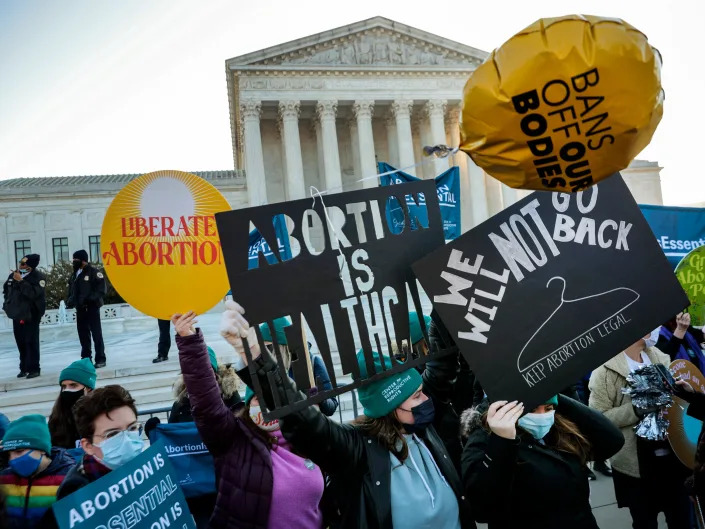
Protesters, demonstrators and activists gather in front of the U.S. Supreme Court as the justices hear arguments in Dobbs v. Jackson Women's Health, a case about a Mississippi law that bans most abortions after 15 weeks, on December 01, 2021.Chip Somodevilla/Getty Images
  • The Supreme Court appears poised to overturn Roe v. Wade and reduce abortion access nationwide.

  • The erosion of reproductive rights has only happened in a handful of countries in the 21st century.

  • Experts warn a rollback in abortion access is indicative of backsliding democracy and creeping authoritarianism.

As the Supreme Court appears poised to overturn precedent in Roe v. Wade and Planned Parenthood v. Casey, experts warn the rollback in abortion access is indicative of backsliding democracies.

"There is a trend to watch for in countries that have not necessarily successfully rolled it back, but are introducing legislation to roll it back," Rebecca Turkington, a University of Cambridge scholar, told The New York Times last year regarding abortion access. "[I]n that this is part of a broader crackdown on women's rights. And that goes hand in hand with creeping authoritarianism."

The US Supreme Court indicated in a draft opinion – according to reporting by Politico – that it may be preparing to similarly overturn abortion rights.

"We hold that Roe and Casey must be overruled," Justice Alito wrote in the document, labeled as the "Opinion of the Court," Politico reported. "It is time to heed the Constitution and return the issue of abortion to the people's elected representatives."

Few countries have eroded existing abortion access laws in the 21st century. Among them: PolandNicaragua, and the US. The changes in established law came at times of political turmoil, like that currently facing the United States.

In Nicaragua, President Daniel Ortega passed a total abortion ban in 2006 as part of an increasingly authoritarian platform. Poland's 2020 near-total abortion ban came at a moment after one of the country's top justices said the country was "moving fast" toward an authoritarian regime.

Poland's law is now one of the most restrictive bans on abortion in Europe and nine organizations have filed interventions with organizations like Amnesty International on behalf of women in the country.

"We don't necessarily always include reproductive freedom in that package of democracy," Anu Kumar, the head of Ipas, a global nonprofit for reproductive rights, told Foreign Policy. "But we should, because this is a place where authoritarian regimes often go, if not first, then pretty quickly afterward."

Matt Gaetz Lashes Out
At 
‘Over-Educated’ Women 

Protesting For Abortion Rights

Jack Crosbie

MAY 3,2022 

ROLLING STONE


Gaetz CPAC 2022 in Orlando -

Matt Gaetz is a model avatar for the Republican Party’s manic culture war. As a far-right reactionary currently under investigation for sex crimes, he checks several boxes of hypocrisy so often seen among the GOP’s moral crusaders. It makes sense, then, that he delivered the best encapsulation of the socially conservative right’s response to pro-choice protests now sweeping the country.

“How many of the women rallying against overturning Roe are over-educated, under-loved millennials who sadly return from protests to a lonely microwave dinner with their cats, and no bumble matches?” Gaetz asked on Twitter on Wednesday morning.


The core of the argument is familiar: feminists are unhappy shrews, and only conservative women are happy and have families. Conservatives looking for quick clout have been adopting this mantra for years in an effort to virtue-signal their support for “traditional” values and demean their political opponents. Early resistance to Donald Trump’s presidency, like the 2017 Women’s March, inspired a similar rash of boorish or sexist posts by GOP officials, likely inspired by the former president’s long history of misogynistic remarks. Sexism in the Republican Party isn’t new or particularly revelatory; the GOP made limiting the rights of women a de facto policy for years before Trump took power. But as the modern culture war intensifies, it’s clear that unvarnished sexism will be a common bedrock conservatives like Gaetz fall back on.

- My body!
- My choice!


Gaetz’s tweet hits several familiar notes. “Over-educated” invokes the specter of “Marxist” colleges. He references “millennials” to pander to boomers who think the generation they sabotaged is weak and pretentious. “Lonely microwave dinner with their cats” derisively refers to feminists as undesirable. It’s extremely basic stuff, but like most of the GOP’s other smooth-brained social platforms, it plays because it conveniently helps onlookers treat street protests like the irrational actions of an irrelevant minority, allowing them to discount the participants as human beings whose opinions and experiences matter.

The tweet has been roundly criticized since Gaetz fired it off Wednesday morning. The right has long been working to turn such criticism of their rampant sexism on its head. In an early-April rally in North Carolina, for instance, Trump claimed that a GOP-led Congress would “end the woke war on women and children,” using the right-wing’s current hobbyhorse of gender identity panic and concern over left-wing indoctrination in public schools to claim that it was the left, not the right, that was attacking the freedoms of women, characterized as “parental rights” and “parental choice.”

Gaetz’s tweet, then, is an easy gateway to all these issues. Social causes like abortion, LGBTQ rights, and racial justice are flattened into one bogeyman of “CRT-Marxism-Trans,” promoted by antifa witches and ugly, depressed feminists who don’t fit into the conservative family ideal. This will be the gameplan as a new protest movement takes to the streets: reduce what people are actually protesting for — safe access to abortions — into a familiar enemy their base is used to hating. It doesn’t matter that many of these causes are overwhelmingly popular in the U.S. Gaetz and the GOP know that the structural power swings their way, and that all they have to do is sneer at the people trying to change who’s in charge.