Thursday, January 12, 2023

PROVING COP IS A JOKE
Like oil and water? How will Sultan al-Jaber's 'shocking' COP28 presidency resonate?

Issued on: 12/01/2023 - 

04:37  Video by:Nadia MASSIH

The United Arab Emirates on Thursday named a veteran technocrat who both leads Abu Dhabi's state-run oil company and oversees its renewable energy efforts to be the president of the upcoming UN climate negotiations in Dubai. For more on this controversial move, FRANCE 24 is joined by Lola Vallejo, Climate Programme Director at the IDDRI. She says that it's the "first time that a serving CEO of an oil and gas company acts as a COP president."

UAE puts oil company boss in charge of Cop28 climate talks
Published on 12/01/2023

Campaigners called on Sultan Al Jaber to step down from the UAE’s state-owned oil company to avoid a conflict of interest
ROFLMAO


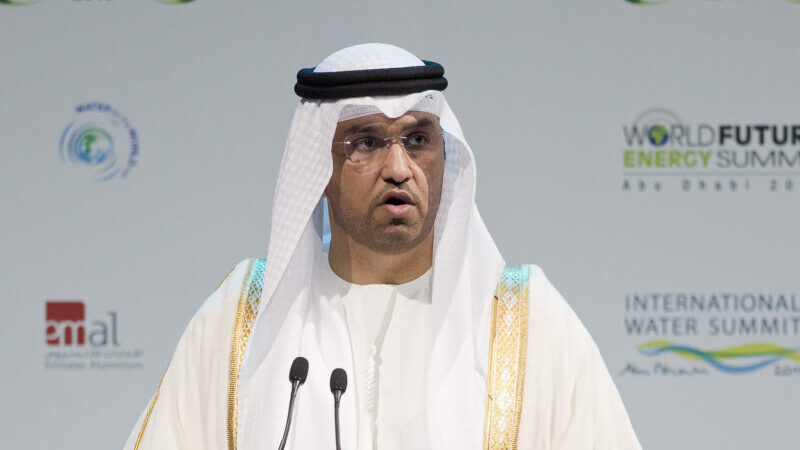
Sultan Al Jaber, oil and climate chief for the United Arab Emirates
 (Pic: Sammy Dallal / Crown Prince Court - Abu Dhabi/Flickr)

By Joe Lo

The United Arab Emirates (UAE) government has appointed Sultan Al-Jaber to be the president of the Cop28 climate talks in November.

Al Jaber heads the state-owned Abu Dhabi National Oil Company (Adnoc), the twelfth largest oil company in the world, and the emirates’ much smaller renewable energy firm Masdar.

He has been a key figure in national climate and energy policy for over a decade. While Al Jaber has promoted renewable energy, in November 2021 he called for increased global investment in oil and gas.

“The oil and gas industry will have to invest over $600bn every year until 2030 just to keep up with the expected demand,” he told an Abu Dhabi oil conference.

“Renewable energy is the fastest growing segment of the energy mix but oil and gas is still the biggest and will be for decades to come. The future is clean but it is not here yet. We must make progress with pragmatism,” he said.


The International Energy Agency (IEA) said in 2021 that, if the world is to limit global warming to 1.5C then there should be no investment in new fossil fuels. They calculated that the supply of oil should drop by three-quarters between 2020 and 2050.

In October 2022, the IEA projected that even under existing policies, global fossil fuel demand would peak and decline steadily from the mid‐2020s.


Mixed reception


Reaction to Al Jaber’s appointment was mixed. The head of the Climate Action Network campaign group, Tasneem Essop, said it was a conflict of interest to lead climate talks at the same time as heading an oil company.

She said: “If he does not step down as CEO, it will be tantamount to a full scale capture of the UN climate talks by a petrostate national oil company and its associated fossil fuel lobbyists. Cop26 in Glasgow had 500 fossil fuel lobbyists in attendance, the Cop [27] in Egypt saw a 25% increase in their presence, Cop28 now seems to be open season for vested interests who will no doubt use the climate talks to continue to undermine any progress on climate action. As civil society we demand that Al Jaber does the right thing and either stand aside or step down.”

The last hours of Cop27 were marked by fierce debate, in closed meetings, on whether governments should agree to “phase out fossil fuels”. Oil and gas producing states like Saudi Arabia opposed this language, but the argument is not going away.

Yvo De Boer, who led the UN’s climate body between 2006 and 2010, said that Al Jaber had been “instrumental” in bringing the International Renewable Energy Agency to the UAE and adopting “a sound green growth strategy” with renewable investments domestically and abroad.

“This equips him with the understanding, experience and responsibility to make Cop28 ambitious, innovative and future focussed,” De Boer said.

In 2010, the US ambassador to UAE Richard Olson described him as part of the “progressive group” on climate in the UAE government.

Another Man

Al Jaber will be the 23rd man to lead the Cop climate talks. Five women have had the presidency role.

The UAE’s female environment minister Mariam Al Mheiri was overlooked.

Similarly, Egypt promoted the male foreign minister Sameh Shoukry over female environment minister and climate scientist Yasmine Fouad.

The UK sacked female clean growth minister Claire Perry O’Neill, who lobbied to host Cop26, before the conference and put male energy minister Alok Sharma in charge.

Two women have been appointed to supporting roles. Razan Al Mubarak, one of the UAE’s leading nature conservationists, has been made “high level champion” and tasked with increasing the climate ambition of businesses and non-state actors.

Shamma Al Mazrui, aged 29, will be youth climate champion.

Read more on: UN climate talks


Oil boss as climate talks host: what's behind UAE's choice?


Dubai (AFP) – The United Arab Emirates has picked the head of its national oil company as president of this year's COP28 climate talks, prompting criticism from environmental activists.

Here we examine the UAE's reasons for choosing Sultan Al Jaber and what message it is sending ahead of the UN climate talks later this year.

Who is Sultan Al Jaber?


Al Jaber is the chief executive of the UAE's Abu Dhabi National Oil Company (ADNOC), which is one of the world's biggest oil firms.

The 49-year-old, who was educated in the United States and Britain, is also the UAE's Minister of Industry and Advanced Technology.

He was named the UAE's special climate envoy in 2020, a post he also previously held from 2010-2016.

He is also the founder of Masdar -- a multibillion-dollar, state-backed company that invests in renewable energy, backing projects in more than 40 countries since it was founded in 2006, according to UAE state media.


Global temperature anomalies © Julia Han JANICKI / AFP

Al Jaber, who has taken part in more than 10 COP meetings, headed the UAE's delegation to the last UN climate summit in Egypt. It was by far the biggest delegation to attend the talks, and one of the largest in COP history.

In 2009, he was appointed to the UN's Advisory Group on Energy and Climate Change by Ban Ki-Moon, the then secretary general.

"Sultan Al Jaber has been spearheading the UAE's climate action well before and during his tenure at ADNOC," said climate expert Karim Elgendy, Associate Fellow at Britain's Chatham House think tank.

Why the controversy?

Holding COP28 in a major oil-producing country has provoked concern from activists urging a shift away from oil, which produces the greenhouse gases that heat the planet.

Those worries were only stoked by the choice of a fossil fuel executive as the face of the talks.

Tasneem Essop, executive director of Climate Action Network International said it was a "conflict of interest" to choose a figure "heading an industry that is responsible for the crisis itself".

Jaber's nomination also heightened concerns that lobbyists looking to delay the phasing-out of fossil fuels will be given more sway.

Already, the COP26 in Scotland had 500 fossil fuel lobbyists in attendance -- a figure that only increased with COP27 in Egypt, with the UAE sending the highest number.

"COP28 needs to conclude with an uncompromised commitment to a just phase out all fossil fuels: coal, oil and gas," said Tracy Carty from Greenpeace International.

"There is no place for the fossil fuel industry in the global climate negotiations."

What's the message?

The UAE -- one of the world's biggest crude producers -- "sees no contradiction" in the selection of Al-Jaber, Elgendy said.

The Gulf nation has repeatedly maintained that oil and gas will be needed for decades to power the world economy, while generating revenues that could be invested in renewable energy sources.

"The choice of Dr Sultan is absolutely representative of the UAE's approach to climate action, which pledges to decarbonise its economy... but advocates for its moral right to export every molecule of fossil fuel," Elgendy said.

"It argues that the world will still need some fossil fuel supplies by 2050 and that these should come from the lowest cost and lowest carbon producers," namely Gulf Arab countries, Elgendy added.

The UAE is also a strong advocate for including oil executives in the climate conversation, arguing that their experience in the energy industry is helpful in tackling climate change.

"For Gulf countries, where oil wealth contributes significantly to the economy, a great deal of climate action will need to come from this exact sector," said Aisha Al-Sarihi, a research fellow at the National University of Singapore's Middle East Institute.

"Excluding the oil industry from the negotiating table might not serve the region," the Omani expert told AFP.

© 2023 AFP


‘I'll try my luck’: Haitians flock for passports hoping to reach US under new program


02:52  ‘I'll try my luck’: Haitians flock for passports hoping to reach US under new program (2023)

 © AFP / France 24
Video by:Juliette MONTILLY

Issued on: 12/01/2023 -

Haitians seeking to escape from poverty and uncertainty are flocking to the main migration office in the capital Port-au-Prince hoping to get a passport and perhaps their ticket to life in America under a new US immigration program. Under the policy announced by President Joe Biden, the United States will accept 30,000 people per month from Haiti and a handful of other countries mired in crisis, on the condition that they stay away from the overcrowded US border with Mexico and arrive by plane.
French union threatens refinery shutdowns, halt to oil deliveries to protest pension reform


Thu, 12 January 2023

© Thibault Camus, AP

Unions representing French oil workers on Thursday called for strikes against President Emmanuel Macron's pension reforms, threatening a repeat of the refinery and depot closures that caused chaos for motorists last year.

The walkouts planned for January 19 and 26 and February 6 would include "shutdowns of refinery installations if necessary," said Eric Sellini, national coordinator of the CGT union federation at energy giant TotalEnergies.

Strikes will mean "reductions in output" and "a halt to deliveries", he told AFP.

A walkout on January 19 will coincide with a national day of strikes and demonstrations, backed by all France's major trade union federations, against Macron's pension plans.

Worker representatives object to the government's proposed raising of the legal retirement age by two years, to 64, and faster increases in the minimum number of years of contributions required to receive a full pension.

A 24-hour strike by oil workers on January 19 could be followed up by 48 hours from January 26 and 72 hours from February 6.

Weeks of industrial action at refineries and depots in autumn caused biting fuel shortages for motorists, with huge queues forming at many petrol stations.

The oil workers' announcement follows Wednesday calls for walkouts in the transport sector, which hobbled activity during Macron's last pension reform bid in 2019-2020.

(AFP)

Read also:
French unions call for strikes as government presses ahead with pension reform
Macron’s pension reform: Necessary changes to an unsustainable system?
France's Macron says pension reform will be carried out in 2023

Panama says First Quantum misleading investors

Cecilia Jamasmie | January 11, 2023 

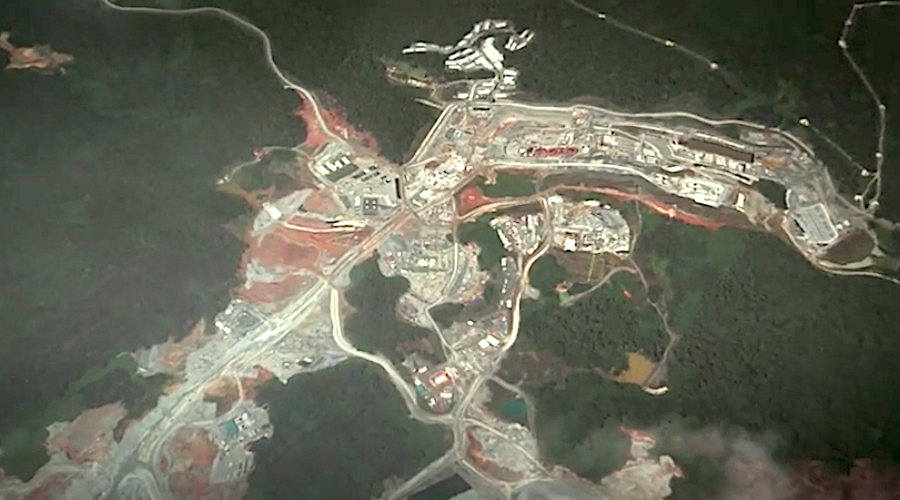
Aerial view of Cobre Panama. (Screenshot from First Quantum video | YouTube.)

The government of Panama expressed its discontent on Wednesday with the latest investor update given by First Quantum Minerals (TSX: FM) about the Cobre Panama contract negotiations, saying it contained several inaccuracies that could misguide investors.


The Canadian miner’s chief executive officer, Tristan Pascall, said in a Tuesday call with analysts that the parties had made significant progress in resolving the dispute over a new contract that would increase royalties paid by the company.


The country’s Minister of Commerce and Industry Federico Alfaro noted that the government believes that the company’s most recent contract proposals had done nothing but move the two sides further apart.

There are more than a “few disagreements”, the minister said, adding there were fundamental differences around issues such as royalties, deductions for depletion, international measures to mitigate tax avoidance, value added tax, scope of easements, material breach, termination, and others.

Alfaro highlighted key aspects of First Quantum’s narrative the government finds misleading.

Panama’s Supreme Court ruled in 2017 that contract governing the giant Cobre Panama copper mine was unconstitutional and annulled it. This meant a new contract was required to regularize First Quantum’s operations, the minister said. The Vancouver-based miner, however, believes the original contract remains in effect until a new contract is signed.

The government also dismissed First Quantum alleging economic benefits for Panama, stating the company had submitted proposals “that offer more upside benefit, when copper prices are high, and not just downside protections, when copper prices are low”.

It also noted the miner’s proposal on depletion shortens the number of years it will pay the guaranteed minimum sum, decreasing Panama’s fiscal take in high-copper-price and/or high-production scenarios.

 
Copper shipments. (Image courtesy of Cobre Panama.)

“This would make Panama’s fiscal take considerably lower than that of its comparator countries and results in an asymmetrical economic upside to the benefit of [First Quantum]”, Alfaro said.

The Ministry said the company is resisting customary termination rights and seeking an “unreasonably high payment for certain assets in the case of termination”, which it deems inconsistent with international best practices.

Pascall said earlier in the week the company was prepared to meet, and even exceed, the government objectives regarding revenues, environmental protections and labour standards.

These include a minimum of $375 million per year in government income from 2026 onwards, and a profit-based mineral royalty of 12 to 16%, with downside protections aligned with the government’s position.

The Ministry also took issue with the miner’s statement that putting the operation on care and maintenance was a “drastic and unnecessary step”.
Imminent halt?

Panamanian President Laurentino Cortizo ordered last month the halt of operations at Cobre Panama after the parties failed to agree on the terms for a new contract due to issues around taxes and royalties.

The mine hasn’t closed yet, but First Quantum is preparing for the scenario that would put thousands out of work. In the interim, the company has filed an appeal in an attempt to reverse the decision.

“Entering care and maintenance may be necessary because [First Quantum] has continued to operate the Cobre Panama mine without a contract, and the irregular status quo cannot continue indefinitely,” the ministry said. 

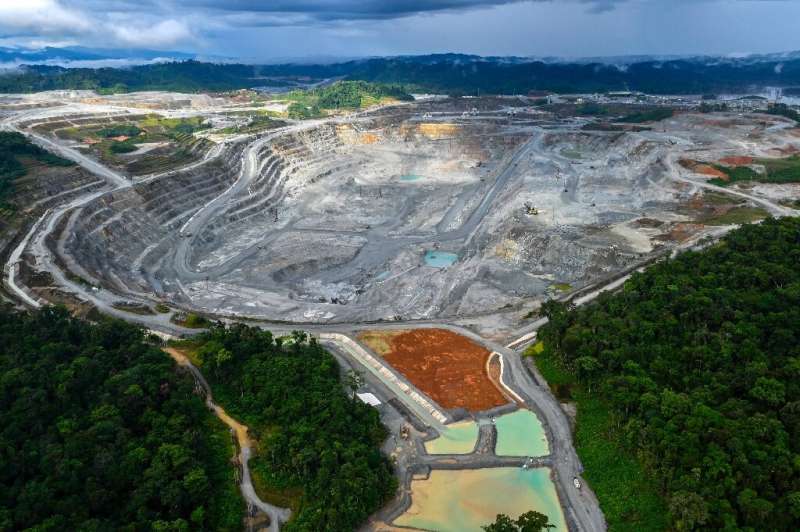
Cobre Panama is the biggest foreign investment in the Central American nation, supporting 40,000 jobs. (Image courtesy of Minera Panama.)

First Quantum is one of the world’s top copper miners and Canada’s largest producer of the metal. It produced 816,000 tonnes of copper in 2021, its highest ever, thanks mainly to record output at Cobre Panama.

The Cobre Panama mine complex, located about 120 km west of Panama City and 20 km from the Atlantic coast, contributes 3.5% of the Central American country’s gross domestic product, according to government figures.

The asset is estimated to hold 3.1 billion tonnes in proven and probable reserves and at full capacity can produce more than 300,000 tonnes of copper per year, or about 1.5% of global production of the metal.


Panama says First Quantum must pay $375m for 2022 amid contract row

Reuters | January 11, 2023 |

Aerial view of Cobre Panama mine. Credit: First Quantum Minerals

Canadian miner First Quantum Minerals must pay Panama a $375 million payment for its 2022 operations, the country’s commerce minister said on Wednesday, adding the government has hired advisors to assess options if no deal is reached on a contract.


Panama’s government and the firm have been negotiating a contract covering the country’s largest mine since late 2021, after a top court ruled that the previous contract was unconstitutional.

Commerce and Industry Minister Fernando Alfaro told Reuters the company has until Friday to appeal an order issued last month to halt operations at its massive Cobre Panama mine, the largest in the country. The order stems from a contractual dispute after First Quantum missed a deadline for a new contract due to disagreements over royalties and tax payments.

Alfaro added that the clock for the 10-day limit for the order issued on Dec. 19 for the company to present its stoppage plan has not yet started, but did not offer a specific deadline.

The minister also stressed that the government is prepared in the event no new deal is reached with the miner, noting that lawyers and other international experts have been proactively hired “to contemplate all options.”

(By Valentine Hilaire; Editing by David Alire Garcia)

Chinese Solar Company Plans To Open A Factory In The U.S.

A Chinese solar panel maker is planning to open a factory in the United States despite trade tensions between the two.

JA Solar Technology Co., one of the largest players in the Chinese solar panel field, has allocated $60 million for the facility, to be built in Phoenix, with completion slated for the fourth quarter of this year, according to Bloomberg.

The facility will have a production capacity of 2 GW annually, making a substantial addition to total U.S. solar panel production capacity, which currently stands at 4.5 GW.

A boost in the local production capacity for solar panels is instrumental for the Biden administration’s transition plans, which envisage a sizeable increase in both wind and solar generation capacity.

Earlier this week, another Asian company made a sizeable financial commitment to U.S. solar: South Korean Hanwha said it would invest $2.5 billion in expanding its solar equipment plant in Georgia.

However, the administration itself has created problems for the U.S. solar power industry by imposing tariffs on panel imports from China and other Asian countries on allegations that non-Chinese Asian solar panel manufacturers were using Chinese components, and Chinese components are subject to U.S. tariffs.

Local panel production, meanwhile, remains costlier than Chinese imports and has insufficient capacity. The Biden administration’s push against China in the solar department, which took the form of an investigation into the abovementioned allegations, led to delays and cancellations of more than 300 new solar projects.

Interestingly, the investigation was launched after a complaint from a U.S. solar panel manufacturer Auxin. According to its CEO, “When prices of finished panels from Southeast Asia come in below our bill of materials cost, American manufacturers cannot compete. If foreign producers are circumventing U.S. law and causing harm to U.S. producers like Auxin Solar, it needs to be addressed.”

Nuclear Boss Urges UK Government To Back Small Nuclear Reactor Technology

  • Chief executive of the UK Nuclear Industry Association Tom Greatrex: the UK govt. should pursue small modular reactors with “pace and urgency”.

  • Currently, the UK’s ageing nuclear fleet makes up around 15 per cent of the country’s energy generation.

  • Greatrex: the UK could become “a global leader” in SMRs.

The head of the UK’s leading nuclear body has urged the government to pursue small modular reactors (SMRs) with “pace and urgency”, amid reports of a funding delay with ministers squabbling over the cost of the country’s energy ambitions.

Tom Greatrex, chief executive of the Nuclear Industry Association (NIA), told City A.M. that the UK needed to develop a pipeline of projects to ramp up nuclear power in line with the government’s energy security projects.

He said: “Proceeding with pace and urgency will not only make power more reliably and predictably priced, but it will also mean that UK technology will create long term, high quality jobs and export opportunities from which the country will benefit.”

This would mean nuclear power generated 25 per cent of the UK’s energy demand, with former Prime Minister Boris Johnson establishing plans for the UK to build eight new reactors this decade.

Currently, the UK’s ageing nuclear fleet makes up around 15 per cent of the country’s energy generation, but the remaining five power plants are set to be shut down by the middle of the next decade.

With the UK needing to bump up capacity quickly, Greatrex was convinced the UK could become “a global leader” in SMRs.

He believed that they could supplement renewables and a larger nuclear fleet and strengthen the UK’s energy security.

Greatrex said: “There is no doubt that the UK can be a global leader in SMR. Working alongside larger reactors and renewables, they will provide a vital source of reliable, clean power, essential to reducing our reliance on burning volatile fossil gas for power, heat and transport – while simultaneously strengthening UK energy security.”

The industry boss has previously urged the government to speed up announcements for new projects, with Sizewell C still awaiting a final investment decision and Hinkley Point C’s completion delayed two years to 2027.

Nuclear projects stall as Government dithers

The industry chief’s latest comments follow reports – first covered in The Times – that ministers have so far not been able to agree a funding deal for small modular reactors.

The government is now not expected to confirm funding plans for at least another 12 months, with Whitehall concerned about the spiralling costs involved in Britain’s wider nuclear ambitions.

Its concerns come with growing expectations Hinkley Point C will come in over budget at £26bn – orginally projected at £18bn – while the fee for Sizewell C has been estimated between £20-35bn.

The government has previously announced the creation of Great British Nuclear (GBN) to deliver the next generation of reactors and SMRs.Related: Largest U.S. Refinery Back Up and Running

The body will be overseen by experienced nuclear specialist Simon Bowen and launch later this year.

So far, the government has failed to confirm any other future sites for nuclear projects – despite rumours linking to projects at sites in Wales such as Wylfa and Trawsfynydd.

Rolls-Royce, the potential leading player in domestic SMRs, announced its final shortlist its proposed nuclear pipeline of small modular reactors last month.

Its three sites include the International Advanced Manufacturing Park (IAMP) in South Tyneside, Teesworks in Teesside and Gateway in Deeside.

A decision on the location is expected to be made this year following final evaluations.

Its designs are for a 470MW plant at a cost of around £2bn – each site powering one million homes.

SMRs are constructed in factories and are transported to construction sites, making them cheaper and quicker to build.

Rolls-Royce confirmed to City A.M. it is progressing through the regulatory consent process for its designs, and believed it was making “strong progress” with its SMR plans.

A spokesperson said:“We are ready to enter into negotiations with the government and, If we can agree a route forward within a reasonable timeframe, we could start building British factories, commissioning supply chain contracts and agreeing export deals abroad before the next general election.”

Rolls-Royce could face SMR competition

The government is currently supporting the SMRs – which could be built at dozens of locations across the UK – with £210m in funding to back the first project.

However, further resources would be needed to build the 30 SMRs targeted by Rolls-Royce and its consortium of investors.

The Treasury is reportedly not prepared to sign off on any orders or significant funding until the technology had approval from the Office for Nuclear Regulation, which is not expected until 2024.

It is now looking at whether to boost competition by opening the bidding to rival plans from other companies such as GE Hitachi.

There are also proposals for thorium-based SMRs, proposed by Copenhagen Atomics, which has submitted its UK reactor design for approval.

Thomas Steenberg, chief executive, told City A.M.: “We are providing a radical different technology and that enables us to deliver at a price point of £40 MWh levelised cost energy, which is a very strong price for baseload energy supply”

The prospect of more competition has been welcomed by Andy Mayer, energy analyst at free market think tank The Institute for Economic Affairs.

He told City A.M. that if the government is truly concerned about costs – “it needs to remove the regulatory barriers delaying deployment, and encourage competition” rather than “pick winners through bespoke subsidy schemes for individual projects, technologies, and firms.”

Mayer said: “If the government wants a national nuclear champion on the French model, it will need to write vast blank cheques, now and forever, gambling that the investment will deliver a technology others wish to buy. This approach was tried in the 20th century. It failed, and we are still paying £3bn a year as a result.”

By CityAM

Snowless Winter Could Create Worse Energy Crisis For Europe

Demand for liquified natural gas (LNG) vessels has declined due to Europe’s war winter, but natural weather conditions could ground vessels completely, meteorologists warn in a Reuters report, citing lack of snow that will lead to lower river water levels in key waterways. 

While the uncommonly mild winter has reduced heating demand in Europe, saved storage volumes, and paved the way for the continent to avoid a energy crisis as a result of Russia’s war on Ukraine, looking further ahead, the same weather conditions could be disastrous for LNG. 

Meteorologists cited by Reuters warn that the region relying on the Rhine and Danube rivers in particular is at risk of drought, which would make it difficult for vessels to navigate later this year.

Average temperatures in Germany are 25% warmer than normal since September, based on Refinitiv data cited by Reuters. 

The combination of low snow and a drier 2022 has already hit hydro power production, with Refinitiv noting that France saw 41% lower hydro power production last year, based on long-term averages. France is also threatened this year (as it was in 2023) with higher river water temperatures that prevent it from access to cooling water for nuclear reactors–a main source of energy for the country. 

For power producers, the low snow totals come on the back of a drier-than-normal 2022, and leave hydropower production potential sharply below normal in several key countries. For Germany, Switzerland, Italy, Austria and the Danube region, a lack of rainfall is expected to hinder clean energy production this year.

In 2022, the Rhine and the Danube also experienced dry conditions at strategic points that prevented energy vessels from navigating them.  

According to Yale Environment360, last summer,the Danube was flowing at less than half its usual volume, with cargo barges grounded, waiting in line for a single channel that remained deep enough to traverse. 

Sweden Looks To Expand Its Nuclear Power Generation Capacity

Sweden’s government is proposing changes in the current legislation to allow the construction and operation of more nuclear reactors as it looks to strengthen its energy security, Swedish Prime Minister Ulf Kristersson said on Wednesday.

“We are now changing the legislation, making it possible to build more reactors in more places than is possible today,” Kristersson said.

Any changes to the current legislation, which limits the number of reactors to ten and doesn’t allow for new places to host nuclear reactors, need to be passed by the Swedish Parliament.  

Expanding nuclear power generation was a key campaign goal for Kristersson last year, and he has said that Sweden’s goal of “100% renewable” electricity generation would change to “100% fossil-free” power generation.   

Currently, Sweden has three nuclear plants with six operational reactors in total, while nuclear power provides around a third of its electricity.

Another 43% of Sweden’s electricity comes from hydropower, 16% from wind power, and around 9% of the power generation comes from combined heat and power (CHP) plants, which are mainly powered by biofuels.

Sweden is an EU leader in renewable power generation. In 2021, around 60% of Sweden’s electricity generation came from renewable sources.

Although Sweden has been much less affected by the turmoil in the energy markets since the Russian invasion of Ukraine than many other EU countries, many Western allies of the U.S. and the EU have stepped up efforts to ensure energy security and depend less on energy commodities.

Even Japan is bringing back nuclear power as a key energy source, looking to protect its energy security in the crisis that has led to surging fossil fuel prices. The Japanese government confirmed in December a new policy for nuclear energy, which the country had mostly abandoned since the Fukushima disaster in 2011.

A panel of experts under the Japanese Ministry of Industry decided that Japan would allow the development of new nuclear reactors and allow available reactors to operate after the current limit of 60 years.