Colombia's VP hears UN condemnation of attempt on her life
EDITH M. LEDERER
Wed, January 11, 2023
UNITED NATIONS (AP) — Colombia’s vice-president on Wednesday listened to many members of the Security Council condemn the recent attempt against her life and then thanked the U.N.’s most powerful body for their solidary against violence in the country, which she said is aimed at undermining the new government’s efforts “for peace, social justice and the development and deepening of democracy.”
Francia Marquez said she was addressing the Security Council as “the daughter of an ancestral land, as the spokesperson of the Colombian people and representative of a government that has come to power to change the history of my country.”
The government, she said, will “confront violence, social injustice and structural inequalities” with policies “to make Colombia a global power of life.”
Marquez, the first Black vice-president of Colombia, was pressed by reporters afterward about the seven kilograms of explosives her security team found buried next to a rural road leading to her home in the southwestern province of Cauca, which she described as an assassination attempt. She wouldn’t speculate on who was responsible for planting the explosives and said the incident is in the hands of the attorney general.
The vice president, who has previously faced death threats, said the new assassination attempt won’t stop her advocacy for peace and equality.
She was elected last September along with President Gustavo Petro, an economist and former guerilla fighter, who is attempting to raise taxes on the wealthy, increase government spending and start peace talks with the nation’s remaining rebel groups.
“Armed violence has affected our entire society,” the vice-president told the council, saying 10 million people, a fifth of Colombia’s population, are “direct victims of war” and “in every household of our country there are wounds and scars from what happened.” She added that “the fears, the hatred, the revenge, have been transmitted from generation to generation.”
Marquez said the government is seeking to overcome “the fragmented peace” in the country and achieve “total peace,” which will enable it to reach historically excluded and marginalized territories.
The Colombian government signed a peace agreement in 2016 with the country’s largest rebel group, the Revolutionary Armed Forces of Colombia movement, and asked the U.N. to establish a political mission to focus on reintegrating leftist rebels into society after more than 50 years of war that caused over 220,000 deaths and displaced nearly 6 million people.
Last month, the government and its largest remaining rebel group, the National Liberation Army, said they would continue to hold peace talks in Mexico following three weeks of negotiations in Venezuela’s capital, Caracas, that yielded only modest results.
Before the vice-president spoke, council members addressed the current situation in Colombia, many mentioning the threat against her.
Brazil’s U.N. Ambassador Ronaldo Costa Filho said his country strongly condemns “the unacceptable attempt” on the vice-president’s life and expresses “unshakeable trust that political extremism and attempts to block progress on policies of inclusion will not flourish on our continent.”
France’s deputy ambassador Nathalie Broadhurst also strongly condemned the attempt on her life. And Japan’s U.N. Ambassador Ishikane Kimihiro, the current council president, expressed “solidarity with the vice-president whose life came under threat.”
At the start of the council meeting, members unanimously adopted a resolution expanding the mandate of the U.N. Verification Mission in Colombia to include monitoring implementation of chapters in the peace agreement on rural reform and ethnic issues, a move vice-president Marquez called “clear testimony to the importance of this agreement for the world.”
She invited the Security Council to hold a meeting in Colombia “in order to express support for peace from our own territory” and to see firsthand some of the challenges the government is confronting.
Friday, January 13, 2023

JUST ANOTHER WEEKLY RAID
Israeli army kills 3 Palestinians during West Bank raids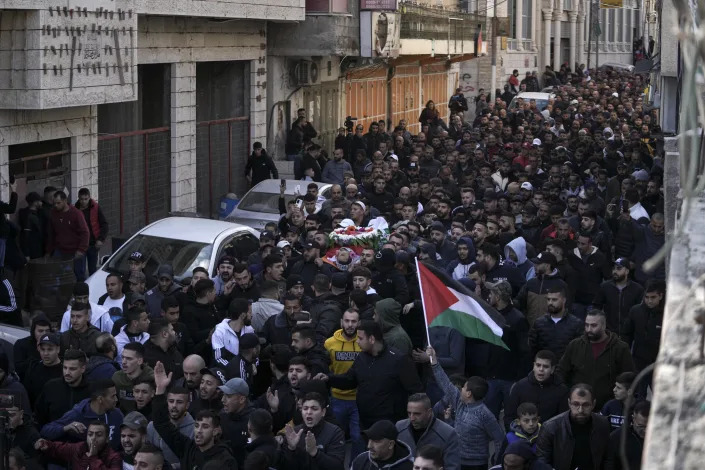

KILL SHOT
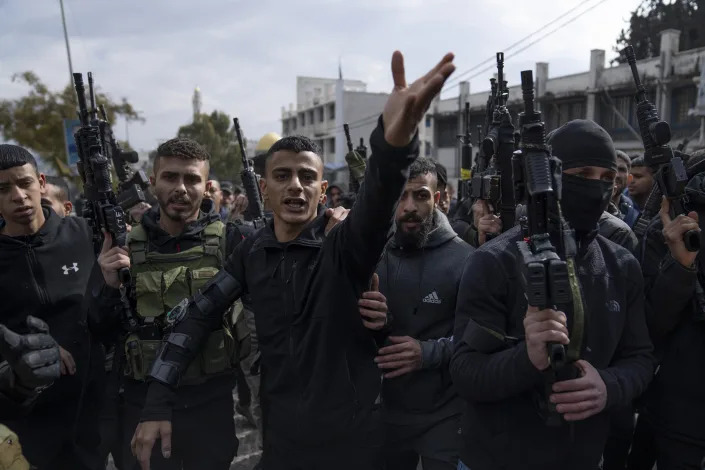
Palestinian gunmen take part in the funeral of Ahmed Abu Junaid, 21 in the West Bank refugee camp of Balata, Nablus, Thursday, Jan. 12, 2023. During a pre dawn Israeli military incursion into the hardscrabble Balata refugee camp, Israeli forces shot Abu Junaid in the head and he died several hours later, the Palestinian Health Ministry said.
(AP Photo/Nasser Nasser)
ISABEL DEBRE
Wed, January 11, 2023
JERUSALEM (AP) — The Israeli military shot and killed three Palestinians during arrest raids in the occupied West Bank on Thursday, Palestinian health officials said, the latest bloodshed in months of rising violence between Israelis and Palestinians.
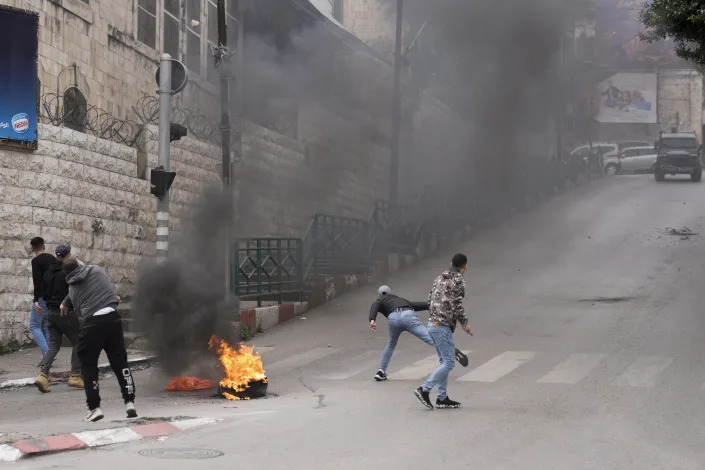
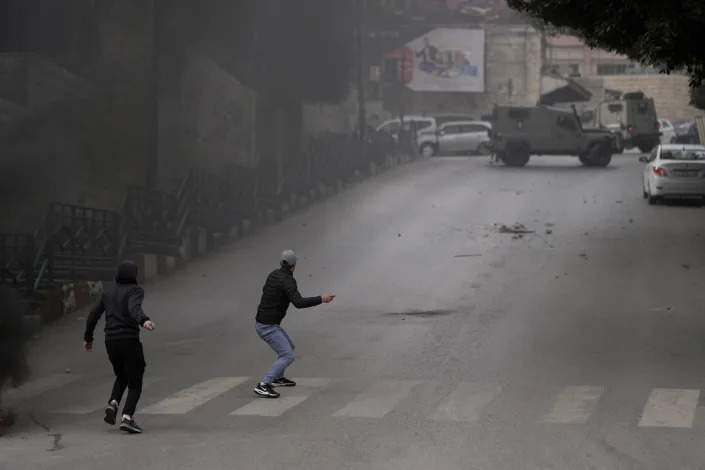
The military, which has been carrying out near-nightly raids in the territory since early last year, said soldiers who entered the Qalandia refugee camp before dawn were bombarded by rocks and cement blocks. In response, the military said troops opened fire at Palestinians throwing objects from rooftops. The Palestinian Health Ministry identified the man killed as Samir Aslan, 41.
Aslan's sister, Noura Aslan, said Israeli security forces broke into their house at 2:30 a.m. to arrest his 18-year-old son, Ramzi. As Ramzi was being hauled away, his father sprinted to the rooftop to see what was happening, she said. Within moments, an Israeli sniper shot him in the back.
Aslan's wife called an ambulance, but Noura said the army initially prevented medics from reaching the house. As Aslan was bleeding, his family dragged his body down the stairs and called for help. An ambulance picked him up some 20 minutes later, Noura said.
The Israeli army also raided the northern occupied West Bank on Thursday, entering the village of Qabatiya south of the flash point city of Jenin and surrounding a house in the town. The Palestinian Health Ministry reported that Israeli forces fatally shot 25-year-old Habib Kamil and 18-year-old Abdel Hadi Nazal.
The Israeli army said security forces entered Qabatiya to arrest Muhammad Alauna, a Palestinian suspected of planning militant attacks. The army said soldiers shot at a number of Palestinians during the raid, including a man who tried to flee the scene with Alauna, a gunman who fired at the forces from inside his car as well as a group of Palestinians throwing rocks at Israeli troops. It was not immediately clear what Kamil was doing when he was shot.
The deaths on Thursday bring the total number of Palestinians killed in the West Bank this year to nine, including two Palestinians killed Wednesday in separate incidents in the West Bank. One was killed during an Israeli military arrest raid in the territory’s north and another after stabbing and wounding an Israeli man in a southern settlement.
Israel ramped up its military raids last spring, after a spate of Palestinian attacks against Israelis killed 19 people. Israel says the operations are meant to dismantle militant networks and thwart future attacks. The Palestinians see them as further entrenchment of Israel's 55-year, open-ended occupation of land they seek for their future state.
The raids sharply escalated tensions and helped fuel another wave of Palestinian attacks in the fall that killed 10 Israelis. Nearly 150 Palestinians were killed by Israeli fire in the West Bank and east Jerusalem in 2022, Israeli rights group B'Tselem reported, making last year the deadliest since 2004.
The heightened violence comes as Israel's new ultranationalist and ultra-Orthodox government — it's most right-wing ever — is charting its legislative agenda, one that is expected to take a tough line against the Palestinians and drive up settlement construction in the West Bank.
Israel captured the West Bank in the 1967 Mideast war, along with the Gaza Strip and east Jerusalem, territories the Palestinians want for their future independent state. Israel has since settled 500,000 people in about 130 settlements across the West Bank, which the Palestinians and much of the international community view as an obstacle to peace.
ISABEL DEBRE
Wed, January 11, 2023
JERUSALEM (AP) — The Israeli military shot and killed three Palestinians during arrest raids in the occupied West Bank on Thursday, Palestinian health officials said, the latest bloodshed in months of rising violence between Israelis and Palestinians.
The military, which has been carrying out near-nightly raids in the territory since early last year, said soldiers who entered the Qalandia refugee camp before dawn were bombarded by rocks and cement blocks. In response, the military said troops opened fire at Palestinians throwing objects from rooftops. The Palestinian Health Ministry identified the man killed as Samir Aslan, 41.
Aslan's sister, Noura Aslan, said Israeli security forces broke into their house at 2:30 a.m. to arrest his 18-year-old son, Ramzi. As Ramzi was being hauled away, his father sprinted to the rooftop to see what was happening, she said. Within moments, an Israeli sniper shot him in the back.
Aslan's wife called an ambulance, but Noura said the army initially prevented medics from reaching the house. As Aslan was bleeding, his family dragged his body down the stairs and called for help. An ambulance picked him up some 20 minutes later, Noura said.
The Israeli army also raided the northern occupied West Bank on Thursday, entering the village of Qabatiya south of the flash point city of Jenin and surrounding a house in the town. The Palestinian Health Ministry reported that Israeli forces fatally shot 25-year-old Habib Kamil and 18-year-old Abdel Hadi Nazal.
The Israeli army said security forces entered Qabatiya to arrest Muhammad Alauna, a Palestinian suspected of planning militant attacks. The army said soldiers shot at a number of Palestinians during the raid, including a man who tried to flee the scene with Alauna, a gunman who fired at the forces from inside his car as well as a group of Palestinians throwing rocks at Israeli troops. It was not immediately clear what Kamil was doing when he was shot.
The deaths on Thursday bring the total number of Palestinians killed in the West Bank this year to nine, including two Palestinians killed Wednesday in separate incidents in the West Bank. One was killed during an Israeli military arrest raid in the territory’s north and another after stabbing and wounding an Israeli man in a southern settlement.
Israel ramped up its military raids last spring, after a spate of Palestinian attacks against Israelis killed 19 people. Israel says the operations are meant to dismantle militant networks and thwart future attacks. The Palestinians see them as further entrenchment of Israel's 55-year, open-ended occupation of land they seek for their future state.
The raids sharply escalated tensions and helped fuel another wave of Palestinian attacks in the fall that killed 10 Israelis. Nearly 150 Palestinians were killed by Israeli fire in the West Bank and east Jerusalem in 2022, Israeli rights group B'Tselem reported, making last year the deadliest since 2004.
The heightened violence comes as Israel's new ultranationalist and ultra-Orthodox government — it's most right-wing ever — is charting its legislative agenda, one that is expected to take a tough line against the Palestinians and drive up settlement construction in the West Bank.
Israel captured the West Bank in the 1967 Mideast war, along with the Gaza Strip and east Jerusalem, territories the Palestinians want for their future independent state. Israel has since settled 500,000 people in about 130 settlements across the West Bank, which the Palestinians and much of the international community view as an obstacle to peace.
In Ukraine, power plant workers fight to save their 'child'

The Ailing Power Plant
HANNA ARHIROVA
Thu, January 12, 2023
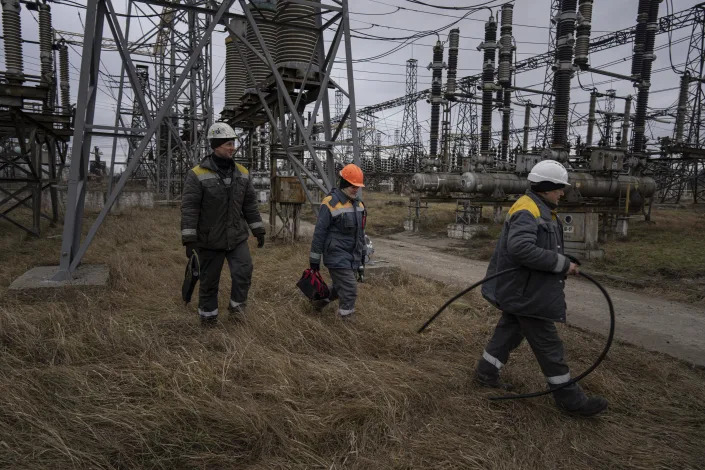
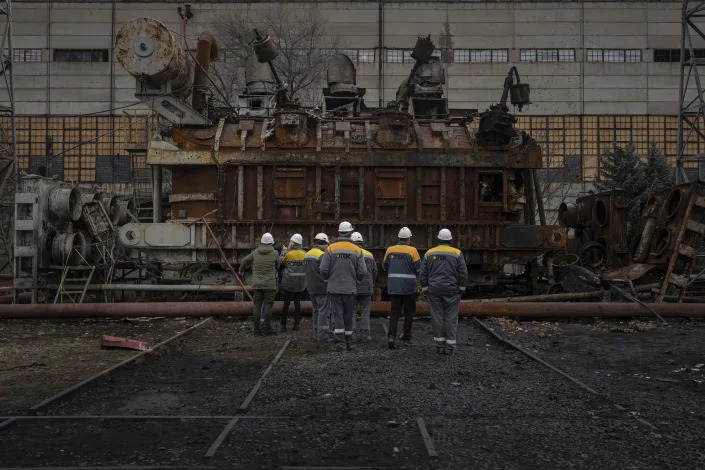
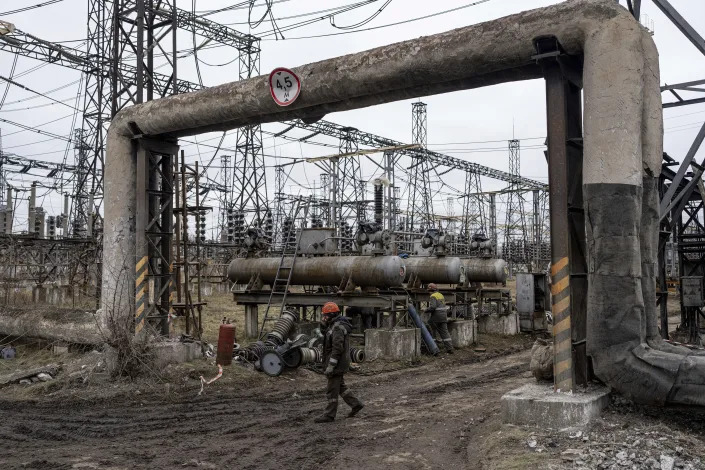
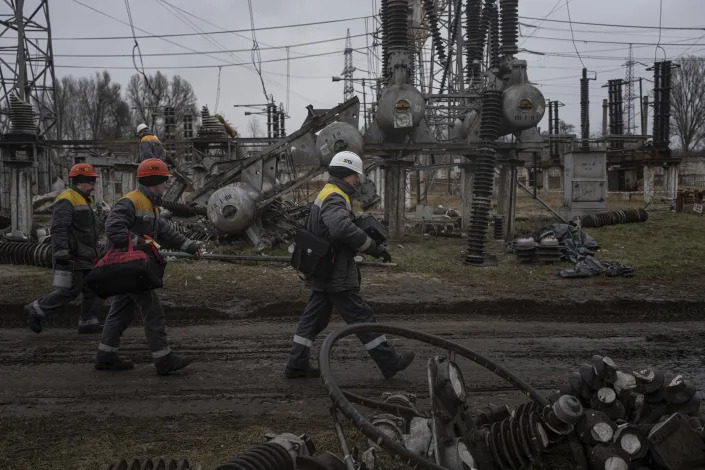
A POWER PLANT, Ukraine (AP) — Around some of their precious transformers — the ones that still work, buzzing with electricity — the power plant workers have built protective shields using giant concrete blocks, so they have a better chance of surviving the next Russian missile bombardment.
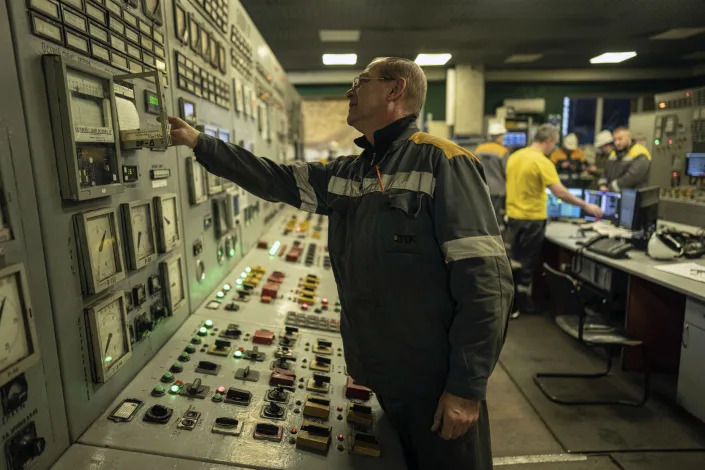
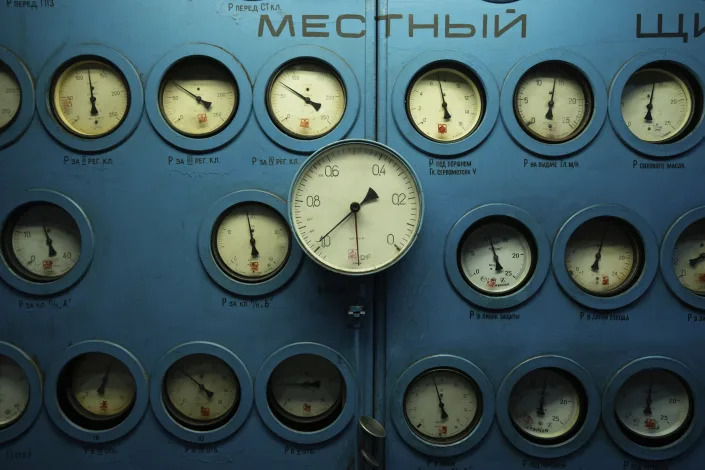
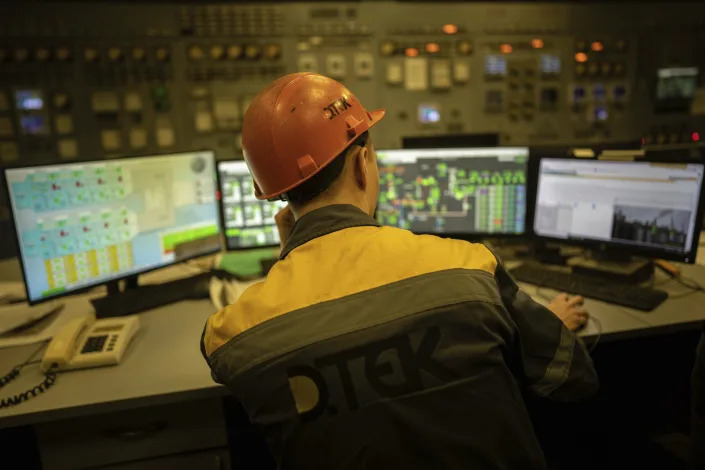
Blasted out windows in the power plant's control room are patched up with chipboard and piled-up sandbags, so the operators who man the desks 24/7, keeping watch over gauges, screens, lights and knobs, are less at risk of being killed or injured by murderous shrapnel.
“As long as there is equipment that can be repaired, we will work,” said the director of the plant that a team of Associated Press journalists got rare access to.
The AP is not identifying the plant nor giving its location, because Ukrainian officials said such details could help Russian military planners. The plant’s director and his workers also refused to be identified with their full names, for the same reason.
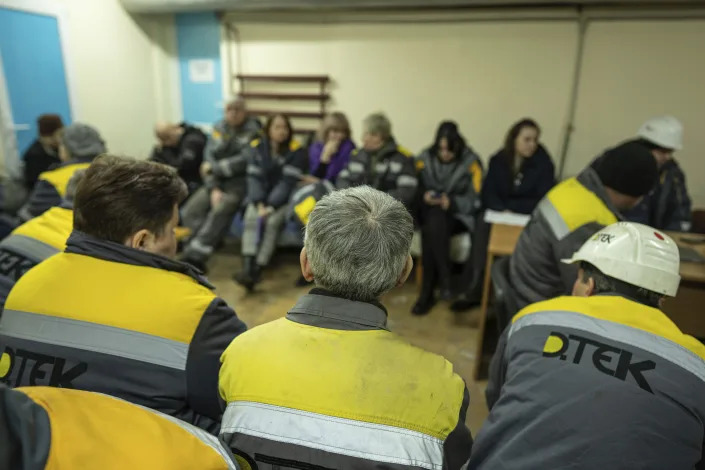
Because the plant can't function without them, the operators have readied armored vests and helmets to wear during the deadly hails of missiles, so they can stay at their posts and not join less essential workers in the bomb shelter.
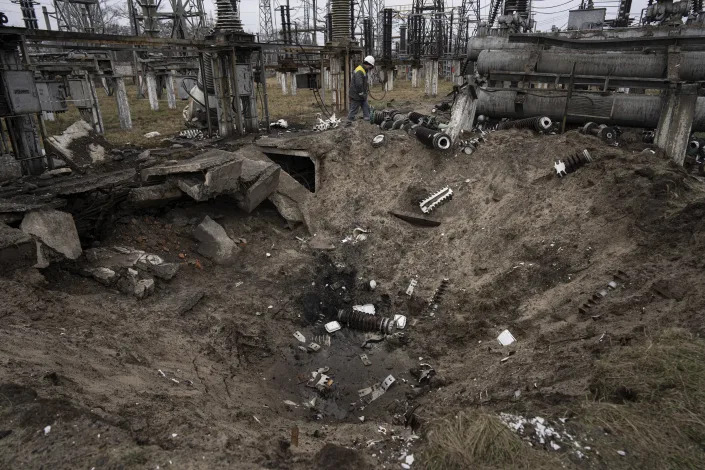
Each Russian aerial strike causes more damage, leaves more craters and more blast holes in the walls already pockmarked by explosions, and raises more questions about much longer Ukraine's energy workers will be able to keep homes powered, heated and lit in winter's subzero temperatures.
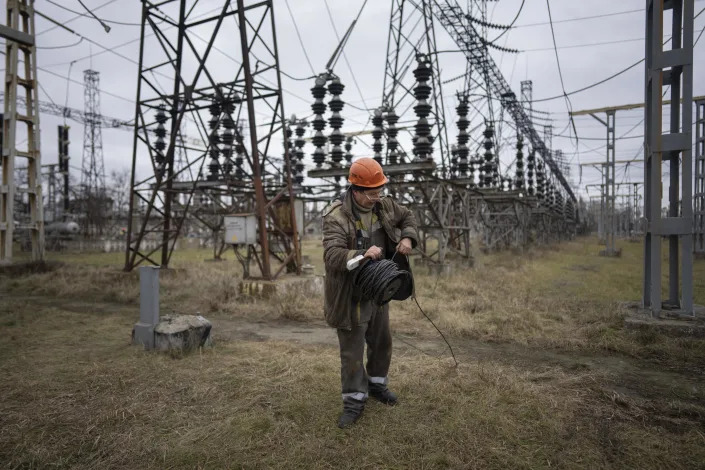
And yet, against the odds and sometimes at the cost of their lives, they keep power flowing. They're holding battered plants together with bravery, dedication, ingenuity and dwindling stocks of spare parts. Each additional watt of electricity they manage to wring into the power grid defies Russian President Vladimir Putin's nearly 11-month invasion and his military's efforts to weaponize winter by plunging Ukrainians into the cold and dark.
Power, in short, is hope in Ukraine and plant workers won't let hope die.
In their minds, the plant is more than just a place where power is made. Over decades of caring for its innards of whirring turbines, thick cables and humming pipes, it's become something they have come to love and that they desperately want to keep alive. Seeing it slowly but systematically wounded by repeated Russian attacks is painful for them.
“The station is like an organism, each organ in it has some significance. But too many organs are already damaged," said Oleh. He has worked at the plant for 23 years.
“It hurts me so much to watch all this. This is inhuman stress. We carried this station in our arms like a child,” he said.
Successive waves of Russian missile and exploding drone attacks since September have destroyed and damaged about half of Ukraine's energy system, the government says. Rolling power cuts have become the norm across the country, with tens of millions of people now getting by with only intermittent power, sometimes just a few hours each day. The bombardments have also forced Ukraine to stop exporting electricity to neighbors Slovakia, Romania, Hungary, Poland and Moldova.
Russia has said the strikes are aimed at weakening Ukraine's ability to defend itself. Western officials say the suffering the blackouts cause for civilians is a war crime.
The plant that AP’s team visited has been struck repeatedly and heavily damaged. It still powers thousands of homes and industries, but its output is down significantly from pre-invasion levels, its workers say.
All parts of the facility bear scars. Missile fragments are scattered around, left where they landed by workers too busy to clear up. Workers say their families send them off to their shifts with the words: “May God protect you.”
Mykola survived one of the strikes. He started work at the plant 36 years ago, when Ukraine was still part of the Soviet Union.
“The windows flew out instantly, and dust began to pour from the ceiling,” he recalled. So he could immediately assess the damage, he put on his armored vest and helmet and ventured outside rather than taking cover in the bomb shelter.
“We have no fear,” Mykola said. “We’re more scared for the equipment that is needed to provide light and heat.”
Russian missile targeters seem to be learning as they go along, adapting their tactics to cause more damage, Oleh said. Missiles used to detonate at ground level, blasting out craters, but now they explode in the air, causing damage over wider areas.
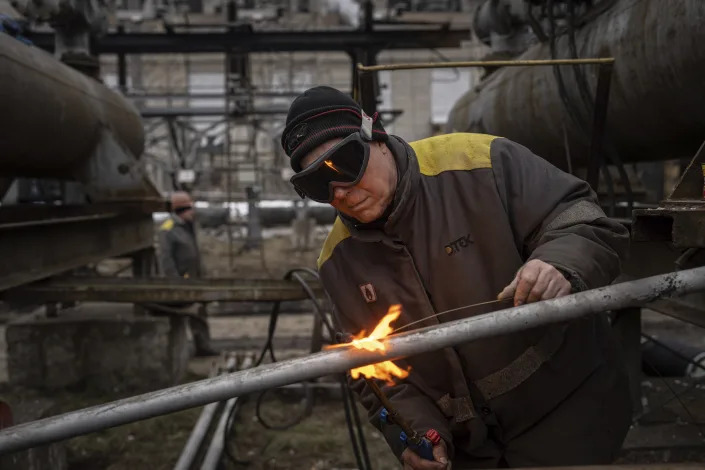
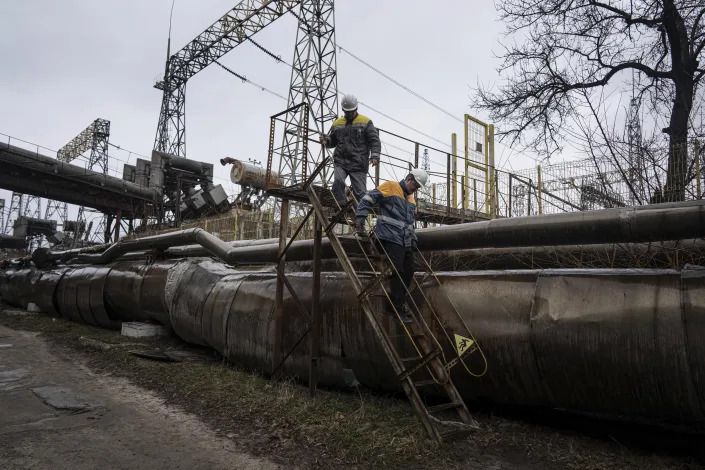
As soon as it's safe, the plant's repair teams scramble — a dispiriting cycle of destruction and rebirth.
“The Russians are bombing and we are rebuilding, and they are bombing again and we are rebuilding. We really need help. We can’t handle it here by ourselves,” Oleh said. “We will restore it as long as we have something to repair it with.”
Thu, January 12, 2023
A POWER PLANT, Ukraine (AP) — Around some of their precious transformers — the ones that still work, buzzing with electricity — the power plant workers have built protective shields using giant concrete blocks, so they have a better chance of surviving the next Russian missile bombardment.
Blasted out windows in the power plant's control room are patched up with chipboard and piled-up sandbags, so the operators who man the desks 24/7, keeping watch over gauges, screens, lights and knobs, are less at risk of being killed or injured by murderous shrapnel.
“As long as there is equipment that can be repaired, we will work,” said the director of the plant that a team of Associated Press journalists got rare access to.
The AP is not identifying the plant nor giving its location, because Ukrainian officials said such details could help Russian military planners. The plant’s director and his workers also refused to be identified with their full names, for the same reason.
Because the plant can't function without them, the operators have readied armored vests and helmets to wear during the deadly hails of missiles, so they can stay at their posts and not join less essential workers in the bomb shelter.
Each Russian aerial strike causes more damage, leaves more craters and more blast holes in the walls already pockmarked by explosions, and raises more questions about much longer Ukraine's energy workers will be able to keep homes powered, heated and lit in winter's subzero temperatures.
And yet, against the odds and sometimes at the cost of their lives, they keep power flowing. They're holding battered plants together with bravery, dedication, ingenuity and dwindling stocks of spare parts. Each additional watt of electricity they manage to wring into the power grid defies Russian President Vladimir Putin's nearly 11-month invasion and his military's efforts to weaponize winter by plunging Ukrainians into the cold and dark.
Power, in short, is hope in Ukraine and plant workers won't let hope die.
In their minds, the plant is more than just a place where power is made. Over decades of caring for its innards of whirring turbines, thick cables and humming pipes, it's become something they have come to love and that they desperately want to keep alive. Seeing it slowly but systematically wounded by repeated Russian attacks is painful for them.
“The station is like an organism, each organ in it has some significance. But too many organs are already damaged," said Oleh. He has worked at the plant for 23 years.
“It hurts me so much to watch all this. This is inhuman stress. We carried this station in our arms like a child,” he said.
Successive waves of Russian missile and exploding drone attacks since September have destroyed and damaged about half of Ukraine's energy system, the government says. Rolling power cuts have become the norm across the country, with tens of millions of people now getting by with only intermittent power, sometimes just a few hours each day. The bombardments have also forced Ukraine to stop exporting electricity to neighbors Slovakia, Romania, Hungary, Poland and Moldova.
Russia has said the strikes are aimed at weakening Ukraine's ability to defend itself. Western officials say the suffering the blackouts cause for civilians is a war crime.
The plant that AP’s team visited has been struck repeatedly and heavily damaged. It still powers thousands of homes and industries, but its output is down significantly from pre-invasion levels, its workers say.
All parts of the facility bear scars. Missile fragments are scattered around, left where they landed by workers too busy to clear up. Workers say their families send them off to their shifts with the words: “May God protect you.”
Mykola survived one of the strikes. He started work at the plant 36 years ago, when Ukraine was still part of the Soviet Union.
“The windows flew out instantly, and dust began to pour from the ceiling,” he recalled. So he could immediately assess the damage, he put on his armored vest and helmet and ventured outside rather than taking cover in the bomb shelter.
“We have no fear,” Mykola said. “We’re more scared for the equipment that is needed to provide light and heat.”
Russian missile targeters seem to be learning as they go along, adapting their tactics to cause more damage, Oleh said. Missiles used to detonate at ground level, blasting out craters, but now they explode in the air, causing damage over wider areas.
As soon as it's safe, the plant's repair teams scramble — a dispiriting cycle of destruction and rebirth.
“The Russians are bombing and we are rebuilding, and they are bombing again and we are rebuilding. We really need help. We can’t handle it here by ourselves,” Oleh said. “We will restore it as long as we have something to repair it with.”
The Ailing Power Plant
A worker transmits the parameters from the control panel of the power plant in central Ukraine, Thursday, Jan. 5, 2023. When Ukraine was at peace, its energy workers were largely unheralded. War made them heroes. They're proving to be Ukraine's line of defense against repeated Russian missile and drone strikes targeting the energy grid and inflicting the misery of blackouts in winter.
(AP Photo/Evgeniy Maloletka)
___
John Leicester in Paris contributed to this report.
___
Follow AP’s coverage of the war at https://apnews.com/hub/russia-ukraine
___
John Leicester in Paris contributed to this report.
___
Follow AP’s coverage of the war at https://apnews.com/hub/russia-ukraine
The Kremlin and elites in times of war
Adrián del Río, Humboldt postdoctoral fellow, WZB Berlin Social Science Center.
Heading break-ups off at the pass
With Russia’s military failures mounting, Putin has resorted to an ever-expanding menu of authoritarian control to ensure that regime elites follow his command.
Some of those who waver in their commitment are reappointed to prominent positions as a way to reward future cooperation. After the order to invade Ukraine, the discomfort of the central bank governor, Elvira Nabiullina, and of the chairman of the state bank VTB, Andrei Kostin, led to their renominations.
Discontent and defections of low-ranking personnel in the state propaganda apparatus triggered a wave of resignations by journalists and popular news readers. However, state media managers prevented these resignations from spreading further by offering bonuses or using disciplinary measures such as inspections or expulsions.
Meanwhile, Putin has eliminated credible challengers, such as Alexei Navalny, and resorted to blunt repression to crack down on societal dissent. Many opposition figures have left the country, and cases of treason have been punished. This discourages regime elites from joining the opposition camp.
Resources are finite
Of course, an influential faction of pro-war elites exists. The above examples clearly show that the Russian authorities are investing significant resources in order to maintain the loyalty of those who are central to the regime, and identify and punish disloyalty while fighting a war abroad.
But resources to keep elites cooperative are finite. These facts underscore the increasing medium and long-term costs of governance in times of growing discontent.
For example, Russia’s latest military failures have encouraged ferment at the top. Even among pro-war elites, this issue can serve as an opportunity to climb the political ladder at the expense of others, increasing dissatisfaction among those who are deprived of political positions and Putin’s attention or who find themselves in the spotlight of blame.
Moreover, since Russia’s elites have seen that the war has only made their future more precarious, it will be hard to convince them to embrace another round of escalation in exchange for appointments, economic benefits and other promises of privileges.
As the conflict continues, signals of weaknesses and uncertainty prompt splits among the Russian elites, forcing authoritarian leaders to change the ruling strategy. As of today, it is unclear whether this change will bring liberalising reforms, further repression or regime collapse. But it is clearer that divisions can put at stake sustaining the war and curbing classic domestic threats (e.g., protests, power struggles, lose elections). The Russian regime is battling on many fronts at home and abroad.
Este artículo fue publicado originalmente en The Conversation, un sitio de noticias sin fines de lucro dedicado a compartir ideas de expertos académicos.
Ukraine recap: Putin’s trip to Minsk fuels fears of a bleak and bloody new year
Poland dreams of building Europe’s largest army, against backdrop of Russia’s war against Ukraine
Adrián del Río, Humboldt postdoctoral fellow, WZB Berlin Social Science Center.
THE CONVERSATION
Thu, January 12, 2023
Since Russia’s invasion of Ukraine in February 2022, Russian president Vladimir Putin’s political strategy has underlined that economic, military and political power is in his hands. The most obvious demonstration of Putin’s authoritarian rule has consisted of extended meetings with his government’s security council, whose members seem to merely approve the president’s decisions.
Meanwhile, key regime elites within the law enforcement agencies, the Federal Security Service (FSB), oligarchs, the United Russia party, the National Guard and state-owned media are caught in the middle of a brutal war, economic pressures and societal discontent.
We are searching for signals that allow us to predict when and how the war will end. And, in doing so, it’s easy to ignore the role regime elites might play. Coups are acknowledged as unlikely, many business people’s wealth is deeply connected to the Kremlin and the presence of yes-men around Putin perpetuate the idea that regime elites merely rubber-stamp Putin’s decisions.
On the whole, this may be true. However, as research in authoritarian politics shows, no matter how much power is concentrated in a few hands, a regime’s survival depends on keeping its elites cooperative. Were Putin to lose their assistance tomorrow, he would be deprived of their resources, networks and supporters, which are needed to control the masses, win elections and implement policies.
Divisions within the elites and regime collapse
The scale and brutality of war, economic pressures and societal discontent can provide fertile ground for divisions in countries like Russia and Belarus. Elites begin to dissent from the official message and might not act as an seemingly united front anymore.
Some expressions of dissent, like the resignation of Putin adviser Anatolii Chubais, have given a fleeting glimpse into elite dynamics at play in Russia. However, their failure to trigger the breakdown of the regime might have turned wishful thinkers into pessimists.
We haven’t seen what happens when high level Kremlin insiders speak out against Putin or genuinely challenge him. While some splits among the elites may have no effect at all, it is also true that sometimes they can induce political change.
From a comparative perspective, we recently published a study that shows that in 40% of cases, major elite divisions in autocracies – that is, widespread disagreements over the government’s policy and leadership direction – trigger political liberalisation afterwards. These influential elites are current and former ministers, members of parliament or the party leadership, regional and municipal leaders, and opinion leaders who are not necessarily part of the ruling party. By breaking away, they expose regime weaknesses and force authoritarian leaders towards democratic reforms.
Many authoritarian governments try not to reach this point, preventing elite divisions from becoming public. But this requires constant management.
Thu, January 12, 2023
Since Russia’s invasion of Ukraine in February 2022, Russian president Vladimir Putin’s political strategy has underlined that economic, military and political power is in his hands. The most obvious demonstration of Putin’s authoritarian rule has consisted of extended meetings with his government’s security council, whose members seem to merely approve the president’s decisions.
Meanwhile, key regime elites within the law enforcement agencies, the Federal Security Service (FSB), oligarchs, the United Russia party, the National Guard and state-owned media are caught in the middle of a brutal war, economic pressures and societal discontent.
We are searching for signals that allow us to predict when and how the war will end. And, in doing so, it’s easy to ignore the role regime elites might play. Coups are acknowledged as unlikely, many business people’s wealth is deeply connected to the Kremlin and the presence of yes-men around Putin perpetuate the idea that regime elites merely rubber-stamp Putin’s decisions.
On the whole, this may be true. However, as research in authoritarian politics shows, no matter how much power is concentrated in a few hands, a regime’s survival depends on keeping its elites cooperative. Were Putin to lose their assistance tomorrow, he would be deprived of their resources, networks and supporters, which are needed to control the masses, win elections and implement policies.
Divisions within the elites and regime collapse
The scale and brutality of war, economic pressures and societal discontent can provide fertile ground for divisions in countries like Russia and Belarus. Elites begin to dissent from the official message and might not act as an seemingly united front anymore.
Some expressions of dissent, like the resignation of Putin adviser Anatolii Chubais, have given a fleeting glimpse into elite dynamics at play in Russia. However, their failure to trigger the breakdown of the regime might have turned wishful thinkers into pessimists.
We haven’t seen what happens when high level Kremlin insiders speak out against Putin or genuinely challenge him. While some splits among the elites may have no effect at all, it is also true that sometimes they can induce political change.
From a comparative perspective, we recently published a study that shows that in 40% of cases, major elite divisions in autocracies – that is, widespread disagreements over the government’s policy and leadership direction – trigger political liberalisation afterwards. These influential elites are current and former ministers, members of parliament or the party leadership, regional and municipal leaders, and opinion leaders who are not necessarily part of the ruling party. By breaking away, they expose regime weaknesses and force authoritarian leaders towards democratic reforms.
Many authoritarian governments try not to reach this point, preventing elite divisions from becoming public. But this requires constant management.
Heading break-ups off at the pass
With Russia’s military failures mounting, Putin has resorted to an ever-expanding menu of authoritarian control to ensure that regime elites follow his command.
Some of those who waver in their commitment are reappointed to prominent positions as a way to reward future cooperation. After the order to invade Ukraine, the discomfort of the central bank governor, Elvira Nabiullina, and of the chairman of the state bank VTB, Andrei Kostin, led to their renominations.
Discontent and defections of low-ranking personnel in the state propaganda apparatus triggered a wave of resignations by journalists and popular news readers. However, state media managers prevented these resignations from spreading further by offering bonuses or using disciplinary measures such as inspections or expulsions.
Meanwhile, Putin has eliminated credible challengers, such as Alexei Navalny, and resorted to blunt repression to crack down on societal dissent. Many opposition figures have left the country, and cases of treason have been punished. This discourages regime elites from joining the opposition camp.
Resources are finite
Of course, an influential faction of pro-war elites exists. The above examples clearly show that the Russian authorities are investing significant resources in order to maintain the loyalty of those who are central to the regime, and identify and punish disloyalty while fighting a war abroad.
But resources to keep elites cooperative are finite. These facts underscore the increasing medium and long-term costs of governance in times of growing discontent.
For example, Russia’s latest military failures have encouraged ferment at the top. Even among pro-war elites, this issue can serve as an opportunity to climb the political ladder at the expense of others, increasing dissatisfaction among those who are deprived of political positions and Putin’s attention or who find themselves in the spotlight of blame.
Moreover, since Russia’s elites have seen that the war has only made their future more precarious, it will be hard to convince them to embrace another round of escalation in exchange for appointments, economic benefits and other promises of privileges.
As the conflict continues, signals of weaknesses and uncertainty prompt splits among the Russian elites, forcing authoritarian leaders to change the ruling strategy. As of today, it is unclear whether this change will bring liberalising reforms, further repression or regime collapse. But it is clearer that divisions can put at stake sustaining the war and curbing classic domestic threats (e.g., protests, power struggles, lose elections). The Russian regime is battling on many fronts at home and abroad.
Este artículo fue publicado originalmente en The Conversation, un sitio de noticias sin fines de lucro dedicado a compartir ideas de expertos académicos.
Ukraine recap: Putin’s trip to Minsk fuels fears of a bleak and bloody new year
Poland dreams of building Europe’s largest army, against backdrop of Russia’s war against Ukraine
Senate Democrats urge Biden to investigate border paramilitary groups

Rafael Bernal
Thu, January 12, 2023
Three Senate Democrats are raising alarms about the growth of U.S.-based paramilitary groups along the border with Mexico, and the lack of federal government oversight to regulate them.
Sens. Ed Markey (D-Mass.), Elizabeth Warren (D-Mass.) and Cory Booker (D-N.J.) called on Attorney General Merrick Garland and Homeland Security Secretary Alejandro Mayorkas to “crack down on vigilante groups that undermine the rule of law, as well as the rights and safety of migrants,” according to a statement by the senators.
“For years, unlawful paramilitary organizations have engaged in unofficial border missions — reminiscent of Ku Klux Klan border patrols — intended to illegally detain and harass immigrants. These activities undermine legitimate government authority and threaten public safety,” wrote the senators in a letter to Garland and Mayorkas.
“Recently, many paramilitary groups have stepped up their efforts, creating an escalating crisis that must be a priority for both the U.S. Department of Homeland Security and the U.S. Department of Justice.”
The existence of paramilitary groups along the U.S.-Mexico border has been a headache for immigrant communities in that region ever since the two countries established a binational border, and more so since the annexation of Texas and the Mexican Cession, which established much of the current shared border.
The U.S. Border Patrol itself is a historical offshoot of the Chinese Inspectors, a mounted paramilitary group tasked with enforcing the racial immigration laws of the late 19th century, which often collaborated with local and state law enforcement to patrol the border.
The senators focused their concerns on two groups, Veterans on Patrol (VOP) and Patriots for America (PFA), both of which the senators say have been collaborating with authorities to capture migrants, despite not being legally authorized to do so.
“Since 2021, VOP has been intercepting unaccompanied minors near the border in Arizona, surveilling U.S.-based sponsors, and in some cases, confronting, or helping others confront, the sponsors at their homes. VOP has also disguised its desert campsites as water stations — meant to mimic those placed by faith-based organizations such as Humane Borders — in order to lure migrants; VOP then turns them over to CBP,” the lawmakers wrote.
The senators cited the Texas ACLU in saying PFA has collaborated with the Kinney County Sheriff’s Office and, at least on one occasion, with the Texas National Guard.
“Alarmingly, there is also evidence of open collaboration with federal agents. In May 2021, a video uploaded to Facebook depicted a Border Patrol agent meeting with VOP members and praising their activities before collecting drone footage from the group,” they wrote.
Modern border militias rose to prominence in the mid-2000s, as a group calling itself the Minuteman Project made headlines with both praise and criticism from politicians on both sides of the border, before essentially disappearing due to internal strife.
While militias and paramilitary groups have been present along the border for its entire history as a binational demarcation line, advocates worry that incensed rhetoric, coupled with heavy firepower in private hands and rising migration could end in tragedy.
“They’re a big issue when they apprehend people and actually carry out sort of citizens’ arrests, especially when those people are unaccompanied children,” said Adam Isacson, director for defense oversight at the Washington Office on Latin America.
“A lot of what they do just seems to be lurking around the desert and looking tough. The concern there is that they could hurt somebody,” he added, noting that there aren’t any real federal, state or local efforts to “control these guys or even keep a close eye on what they’re doing.”
“It’s a ‘so many things could go wrong’ kind of situation, but we’re lucky that they haven’t yet.”
Late last month, a man in El Paso threatened migrants with a gun, sending many into a panic.
The man, identified by police as Steven Driscoll, was later arrested and claimed he “was doing it for America,” according to a report by local station KTSM.
KTSM and The Hill are both owned by Nexstar.
Though organized armed groups have so far not openly attacked migrants, they have been known to sabotage water stations in the desert, and for decades migrant assistant programs have had to work around the groups’ presence to give aid to migrants.
And in 2019, a man claiming to be motivated by a “Hispanic invasion” killed 23 people at an El Paso Walmart and injured 23 more in the largest anti-Hispanic mass shooting of the 21st century.
The senators wrote a laundry list of requests to the administration, including asking for information on authorities collaborating with armed groups and militias.
“The official [Border Patrol] line in every sector, of course, is that ‘we don’t work with them, we’d rather not have them around, but they have a legal right to be where they are,” said Isacson.
“There are cases of individual agents maintaining contact with them and being very sort of friendly with them,” he added.
DHS did not immediately return a request for comment on this story.
The lawmakers wrote that absent federal action to curb and regulate any illicit action by the militias – and any federal agents who collaborate with them – the threat of violence against migrants will endure.
“Absent federal action cracking down on their unauthorized behavior, vigilante groups will continue to operate and weaken the government’s ability to maintain migrant safety, protect human rights, and defend the rule of law at the border.”
The Hill.
Rafael Bernal
Thu, January 12, 2023
Three Senate Democrats are raising alarms about the growth of U.S.-based paramilitary groups along the border with Mexico, and the lack of federal government oversight to regulate them.
Sens. Ed Markey (D-Mass.), Elizabeth Warren (D-Mass.) and Cory Booker (D-N.J.) called on Attorney General Merrick Garland and Homeland Security Secretary Alejandro Mayorkas to “crack down on vigilante groups that undermine the rule of law, as well as the rights and safety of migrants,” according to a statement by the senators.
“For years, unlawful paramilitary organizations have engaged in unofficial border missions — reminiscent of Ku Klux Klan border patrols — intended to illegally detain and harass immigrants. These activities undermine legitimate government authority and threaten public safety,” wrote the senators in a letter to Garland and Mayorkas.
“Recently, many paramilitary groups have stepped up their efforts, creating an escalating crisis that must be a priority for both the U.S. Department of Homeland Security and the U.S. Department of Justice.”
The existence of paramilitary groups along the U.S.-Mexico border has been a headache for immigrant communities in that region ever since the two countries established a binational border, and more so since the annexation of Texas and the Mexican Cession, which established much of the current shared border.
The U.S. Border Patrol itself is a historical offshoot of the Chinese Inspectors, a mounted paramilitary group tasked with enforcing the racial immigration laws of the late 19th century, which often collaborated with local and state law enforcement to patrol the border.
The senators focused their concerns on two groups, Veterans on Patrol (VOP) and Patriots for America (PFA), both of which the senators say have been collaborating with authorities to capture migrants, despite not being legally authorized to do so.
“Since 2021, VOP has been intercepting unaccompanied minors near the border in Arizona, surveilling U.S.-based sponsors, and in some cases, confronting, or helping others confront, the sponsors at their homes. VOP has also disguised its desert campsites as water stations — meant to mimic those placed by faith-based organizations such as Humane Borders — in order to lure migrants; VOP then turns them over to CBP,” the lawmakers wrote.
The senators cited the Texas ACLU in saying PFA has collaborated with the Kinney County Sheriff’s Office and, at least on one occasion, with the Texas National Guard.
“Alarmingly, there is also evidence of open collaboration with federal agents. In May 2021, a video uploaded to Facebook depicted a Border Patrol agent meeting with VOP members and praising their activities before collecting drone footage from the group,” they wrote.
Modern border militias rose to prominence in the mid-2000s, as a group calling itself the Minuteman Project made headlines with both praise and criticism from politicians on both sides of the border, before essentially disappearing due to internal strife.
While militias and paramilitary groups have been present along the border for its entire history as a binational demarcation line, advocates worry that incensed rhetoric, coupled with heavy firepower in private hands and rising migration could end in tragedy.
“They’re a big issue when they apprehend people and actually carry out sort of citizens’ arrests, especially when those people are unaccompanied children,” said Adam Isacson, director for defense oversight at the Washington Office on Latin America.
“A lot of what they do just seems to be lurking around the desert and looking tough. The concern there is that they could hurt somebody,” he added, noting that there aren’t any real federal, state or local efforts to “control these guys or even keep a close eye on what they’re doing.”
“It’s a ‘so many things could go wrong’ kind of situation, but we’re lucky that they haven’t yet.”
Late last month, a man in El Paso threatened migrants with a gun, sending many into a panic.
The man, identified by police as Steven Driscoll, was later arrested and claimed he “was doing it for America,” according to a report by local station KTSM.
KTSM and The Hill are both owned by Nexstar.
Though organized armed groups have so far not openly attacked migrants, they have been known to sabotage water stations in the desert, and for decades migrant assistant programs have had to work around the groups’ presence to give aid to migrants.
And in 2019, a man claiming to be motivated by a “Hispanic invasion” killed 23 people at an El Paso Walmart and injured 23 more in the largest anti-Hispanic mass shooting of the 21st century.
The senators wrote a laundry list of requests to the administration, including asking for information on authorities collaborating with armed groups and militias.
“The official [Border Patrol] line in every sector, of course, is that ‘we don’t work with them, we’d rather not have them around, but they have a legal right to be where they are,” said Isacson.
“There are cases of individual agents maintaining contact with them and being very sort of friendly with them,” he added.
DHS did not immediately return a request for comment on this story.
The lawmakers wrote that absent federal action to curb and regulate any illicit action by the militias – and any federal agents who collaborate with them – the threat of violence against migrants will endure.
“Absent federal action cracking down on their unauthorized behavior, vigilante groups will continue to operate and weaken the government’s ability to maintain migrant safety, protect human rights, and defend the rule of law at the border.”
The Hill.
U.S. grants temporary protected status to thousands of Somali immigrants

HASSAN ALI ELMI/AFP via Getty Images
Camilo Montoya-Galvez
Thu, January 12, 2023
Washington — The U.S. on Thursday made more than 2,000 Somali immigrants eligible for work permits and deportation deferrals under a humanitarian program President Biden has used to extend temporary legal status to hundreds of thousands of immigrants from countries beset by war, violence and other crises.
Homeland Security Secretary Alejandro Mayorkas said he was expanding and extending the Temporary Protection Status (TPS) program for Somali immigrants already living in the U.S. because of the "ongoing conflict and the continuing humanitarian crisis" in Somalia.
The easternmost country in Africa, Somalia has experienced decades of armed conflict, suffocating poverty and poor governance. In recent years, the Somali government has struggled to contain al-Shabab, a terrorist group aligned with al Qaeda that has carried out brutal attacks against civilians, including car bombings in October that killed more than 100 people. Millions of Somalis are also facing hunger fueled by droughts.
The Biden administration said those conditions prevent Somalis from "returning safely" to Somalia.
"Longstanding conflict, along with natural disasters and disease outbreaks, has worsened an already severe humanitarian crisis," the Department of Homeland Security (DHS) said in a statement Thursday. "Somalia continues to be affected by terrorism, violent crime, civil unrest, and fighting among clan militias."
DHS officials said Thursday's announcement will allow roughly 430 Somalis to renew their work permits and deportation protections and open the TPS program to an additional 2,200 Somali immigrants who have been in the U.S. since Jan. 11. The program is set to run through September 2024.
First established by Congress in 1990, TPS allows the federal government to shield certain immigrants from deportation and let them work in the country legally, if their home countries are plagued by armed conflict, natural disasters and other humanitarian crises.
While it allows immigrants to work and live in the U.S. legally for a determined period of time if they pass background checks, TPS does not make beneficiaries eligible for permanent legal status.
Departing from the policies of the Trump administration, which sought to end TPS programs, the Biden administration has used the authority broadly, invoking it to make hundreds of thousands of immigrants from Afghanistan, Cameroon, Ethiopia, Haiti, Myanmar, Ukraine, Venezuela and other countries eligible for the temporary deportation protection.
The Biden administration also recently agreed to extend the work permits and deportation protections of more than 300,000 immigrants from El Salvador, Nicaragua, Nepal and Honduras enrolled in TPS programs that the Trump administration moved to terminate.
While federal courts blocked the Trump administration from ending those programs, they could be discontinued as early as 2024 unless the Biden administration issues another extension or creates new TPS designations for the affected countries.
HASSAN ALI ELMI/AFP via Getty Images
Camilo Montoya-Galvez
Thu, January 12, 2023
Washington — The U.S. on Thursday made more than 2,000 Somali immigrants eligible for work permits and deportation deferrals under a humanitarian program President Biden has used to extend temporary legal status to hundreds of thousands of immigrants from countries beset by war, violence and other crises.
Homeland Security Secretary Alejandro Mayorkas said he was expanding and extending the Temporary Protection Status (TPS) program for Somali immigrants already living in the U.S. because of the "ongoing conflict and the continuing humanitarian crisis" in Somalia.
The easternmost country in Africa, Somalia has experienced decades of armed conflict, suffocating poverty and poor governance. In recent years, the Somali government has struggled to contain al-Shabab, a terrorist group aligned with al Qaeda that has carried out brutal attacks against civilians, including car bombings in October that killed more than 100 people. Millions of Somalis are also facing hunger fueled by droughts.
The Biden administration said those conditions prevent Somalis from "returning safely" to Somalia.
"Longstanding conflict, along with natural disasters and disease outbreaks, has worsened an already severe humanitarian crisis," the Department of Homeland Security (DHS) said in a statement Thursday. "Somalia continues to be affected by terrorism, violent crime, civil unrest, and fighting among clan militias."
DHS officials said Thursday's announcement will allow roughly 430 Somalis to renew their work permits and deportation protections and open the TPS program to an additional 2,200 Somali immigrants who have been in the U.S. since Jan. 11. The program is set to run through September 2024.
First established by Congress in 1990, TPS allows the federal government to shield certain immigrants from deportation and let them work in the country legally, if their home countries are plagued by armed conflict, natural disasters and other humanitarian crises.
While it allows immigrants to work and live in the U.S. legally for a determined period of time if they pass background checks, TPS does not make beneficiaries eligible for permanent legal status.
Departing from the policies of the Trump administration, which sought to end TPS programs, the Biden administration has used the authority broadly, invoking it to make hundreds of thousands of immigrants from Afghanistan, Cameroon, Ethiopia, Haiti, Myanmar, Ukraine, Venezuela and other countries eligible for the temporary deportation protection.
The Biden administration also recently agreed to extend the work permits and deportation protections of more than 300,000 immigrants from El Salvador, Nicaragua, Nepal and Honduras enrolled in TPS programs that the Trump administration moved to terminate.
While federal courts blocked the Trump administration from ending those programs, they could be discontinued as early as 2024 unless the Biden administration issues another extension or creates new TPS designations for the affected countries.
US military donates weapons, and military equipment to Somalia
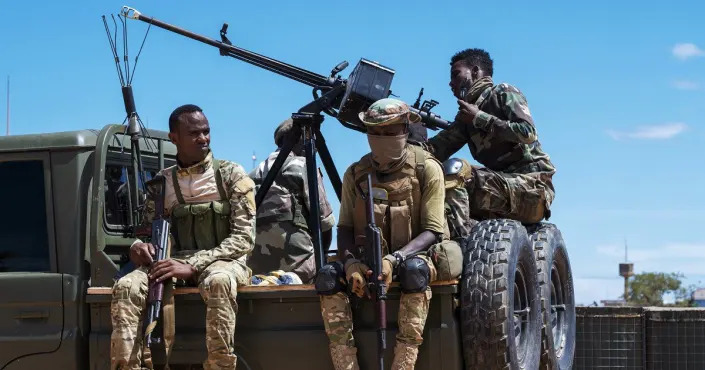
Staff Sgt. Zoe Russell
Zamone Perez
Wed, January 11, 2023
The United States government presented the Somali National Army with a $9 million donation of military equipment at a ceremony on Sunday, as the country’s military continues to fight against al-Shabab, an al-Qaeda linked group.
The donation included weapons, vehicles, medical supplies and other equipment for Somalia’s armed forces. The ceremony was attended by Somalia’s Minister of Defense and Chief of Defense Forces Forces Brig. Gen. Odowaa Yusuf Rageh, according to a U.S. Embassy in Somalia statement.
“Allow me to convey the appreciation of the Federal Government of Somalia to the Government of the United States of America for the continued support to Somalia’s peace-building process and the support for the fight against terrorism,” Somalia’s Minister of Defense Abdulkadir Mohamed Nur Jama said during the ceremony. “This support comes at a critical time for our forces as we boost their capabilities to combat al-Shabaab.”
Africa partners privately oppose Russian actions in Ukraine, says Pentagon chief
The weapons donation included light and heavy machine guns — and were purchased by Defense Department funds, according to the embassy. Other equipment provided included construction vehicles, explosive ordnance disposal kits and maintenance equipment for weapons and vehicles.
Danab Brigade, the SNA’s highly-trained commando force, will receive the weapons, including battalions currently executing operations in Hirshabelleand Galmudug, according to the embassy statement.
Somalia’s military forces have engaged in counterterrorism operations aided by U.S. Africa Command and the African Union. In 2022, the United States conducted 15 airstrikes against the terror group — an uptick compared to 2021. The Biden administration stationed a few hundred U.S. troops in the country to train Somali government forces — and conduct airstrikes on al-Shabab targets.
Aside from U.S. soldiers in the country, the African Union Mission to Somalia currently has more than 20,000 troops deployed there to increase government control over the country and curb al-Shabab’s influence.
Al-Shabab has between 5,000 and 10,000 fighters currently operating in the country. On Jan. 4, the Associated Press reported that 10 people were killed by suicide bombers attacking a military facility in the capital city of Mogadishu.
“We cheer the success achieved by Somali security forces in their historic fight to liberate Somali communities suffering under al-Shabaab,” Ambassador Larry André said. “This is a Somali-led and Somali-fought campaign. The United States reaffirms our commitment to support your effort.”
Staff Sgt. Zoe Russell
Zamone Perez
Wed, January 11, 2023
The United States government presented the Somali National Army with a $9 million donation of military equipment at a ceremony on Sunday, as the country’s military continues to fight against al-Shabab, an al-Qaeda linked group.
The donation included weapons, vehicles, medical supplies and other equipment for Somalia’s armed forces. The ceremony was attended by Somalia’s Minister of Defense and Chief of Defense Forces Forces Brig. Gen. Odowaa Yusuf Rageh, according to a U.S. Embassy in Somalia statement.
“Allow me to convey the appreciation of the Federal Government of Somalia to the Government of the United States of America for the continued support to Somalia’s peace-building process and the support for the fight against terrorism,” Somalia’s Minister of Defense Abdulkadir Mohamed Nur Jama said during the ceremony. “This support comes at a critical time for our forces as we boost their capabilities to combat al-Shabaab.”
Africa partners privately oppose Russian actions in Ukraine, says Pentagon chief
The weapons donation included light and heavy machine guns — and were purchased by Defense Department funds, according to the embassy. Other equipment provided included construction vehicles, explosive ordnance disposal kits and maintenance equipment for weapons and vehicles.
Danab Brigade, the SNA’s highly-trained commando force, will receive the weapons, including battalions currently executing operations in Hirshabelleand Galmudug, according to the embassy statement.
Somalia’s military forces have engaged in counterterrorism operations aided by U.S. Africa Command and the African Union. In 2022, the United States conducted 15 airstrikes against the terror group — an uptick compared to 2021. The Biden administration stationed a few hundred U.S. troops in the country to train Somali government forces — and conduct airstrikes on al-Shabab targets.
Aside from U.S. soldiers in the country, the African Union Mission to Somalia currently has more than 20,000 troops deployed there to increase government control over the country and curb al-Shabab’s influence.
Al-Shabab has between 5,000 and 10,000 fighters currently operating in the country. On Jan. 4, the Associated Press reported that 10 people were killed by suicide bombers attacking a military facility in the capital city of Mogadishu.
“We cheer the success achieved by Somali security forces in their historic fight to liberate Somali communities suffering under al-Shabaab,” Ambassador Larry André said. “This is a Somali-led and Somali-fought campaign. The United States reaffirms our commitment to support your effort.”
REMEMBER WHEN THE US WELCOMED CUBAN EXILES
US stops hundreds fleeing Cuba, Haiti by sea, returns most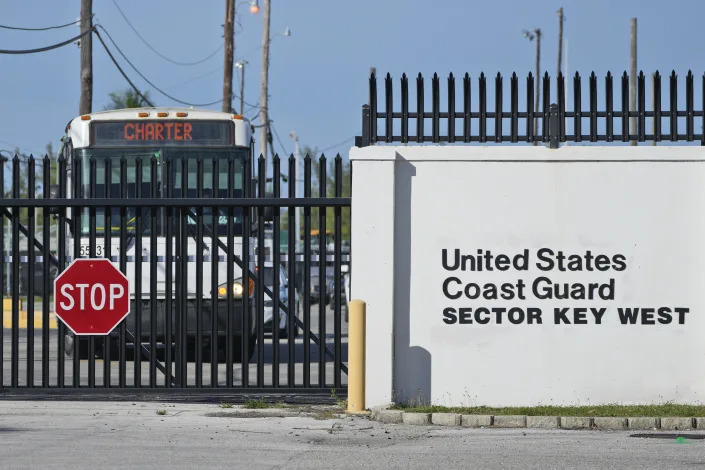


Migrants Florida U.S. Coast Guard members pull up alongside a sailboat carrying a large group of migrants off Virginia Key near Key Biscayne, Fla. on Thursday, Jan. 12, 2023.
(Al Diaz/Miami Herald via AP)
CURT ANDERSON and MARTA LAVANDIER
Thu, January 12, 2023
MIAMI (AP) — The Coast Guard returned another 177 Cuban migrants who were caught at sea off Florida to the island on Thursday, while a group of about two dozen Haitians swam ashore in Miami.
The Cuban migrants were all intercepted separately off the coast earlier this month, according to a Coast Guard news release. They were repatriated by two Coast Guard cutters.
Twenty-five Haitians who had traveled by sailboat from Port-de-Paix, Haiti, swam ashore at Virginia Key, a small island just southeast of downtown Miami, and were taken into the custody of U.S. Customs and Border Protection, agency spokesman Michael Selva said.
Good Samaritans among island beachgoers helped some of the migrants ashore with small boats and jet skis, Selva said.
Dozens of additional migrants still aboard the sailboat were being processed by federal officials at sea, which typically means they are returned to their home countries.
Increasing numbers of Cuban and Haitian migrants have attempted the risky Florida Straits crossing in recent months to illegally enter the Keys Island chain and other parts of the state as inflation soars and economic conditions deteriorate in their home countries.
The spike among Cubans has been especially pronounced. Since Oct. 1, 2022, the Coast Guard has interdicted more than 4,900 Cuban migrants at sea, as compared with more than 6,100 Cubans intercepted during all of fiscal 2022, which ended Sept. 30, according to the news release.
The latest returns and landings came just after President Joe Biden’s administration began a new policy to start turning back Cubans, Haitians and Nicaraguans at the Texas border, along with Venezuelans, who arrive illegally.
The administration also is offering humanitarian parole for up to 30,000 people a month from those four countries if they apply online, pay their airfare and find a financial sponsor.
Migrants who arrive illegally and don’t immediately return home will become ineligible for the new parole. U.S. officials are hoping this will deter sea arrivals by offering a safer alternative and a pathway to residency.
The U.S. Embassy in Havana, Cuba recently resumed processing migrant visas, and said Wednesday that some initial Cuban applicants already had been accepted under the new parole. In the Haitian capital, Port-au-Prince, would-be applicants have flocked an immigration office in recent days to apply for passports needed for the U.S. program.
Coast Guard Lt. Cmdr. Mark Cobb said in a statement that with the new legal pathways available for migrants “we urge all people to use the safe and legal means available to travel to the United States. Don't put your life at risk by taking to the sea when you don't have to.”
____
Curt Anderson reported from St. Petersburg, Fla.
CURT ANDERSON and MARTA LAVANDIER
Thu, January 12, 2023
MIAMI (AP) — The Coast Guard returned another 177 Cuban migrants who were caught at sea off Florida to the island on Thursday, while a group of about two dozen Haitians swam ashore in Miami.
The Cuban migrants were all intercepted separately off the coast earlier this month, according to a Coast Guard news release. They were repatriated by two Coast Guard cutters.
Twenty-five Haitians who had traveled by sailboat from Port-de-Paix, Haiti, swam ashore at Virginia Key, a small island just southeast of downtown Miami, and were taken into the custody of U.S. Customs and Border Protection, agency spokesman Michael Selva said.
Good Samaritans among island beachgoers helped some of the migrants ashore with small boats and jet skis, Selva said.
Dozens of additional migrants still aboard the sailboat were being processed by federal officials at sea, which typically means they are returned to their home countries.
Increasing numbers of Cuban and Haitian migrants have attempted the risky Florida Straits crossing in recent months to illegally enter the Keys Island chain and other parts of the state as inflation soars and economic conditions deteriorate in their home countries.
The spike among Cubans has been especially pronounced. Since Oct. 1, 2022, the Coast Guard has interdicted more than 4,900 Cuban migrants at sea, as compared with more than 6,100 Cubans intercepted during all of fiscal 2022, which ended Sept. 30, according to the news release.
The latest returns and landings came just after President Joe Biden’s administration began a new policy to start turning back Cubans, Haitians and Nicaraguans at the Texas border, along with Venezuelans, who arrive illegally.
The administration also is offering humanitarian parole for up to 30,000 people a month from those four countries if they apply online, pay their airfare and find a financial sponsor.
Migrants who arrive illegally and don’t immediately return home will become ineligible for the new parole. U.S. officials are hoping this will deter sea arrivals by offering a safer alternative and a pathway to residency.
The U.S. Embassy in Havana, Cuba recently resumed processing migrant visas, and said Wednesday that some initial Cuban applicants already had been accepted under the new parole. In the Haitian capital, Port-au-Prince, would-be applicants have flocked an immigration office in recent days to apply for passports needed for the U.S. program.
Coast Guard Lt. Cmdr. Mark Cobb said in a statement that with the new legal pathways available for migrants “we urge all people to use the safe and legal means available to travel to the United States. Don't put your life at risk by taking to the sea when you don't have to.”
____
Curt Anderson reported from St. Petersburg, Fla.
UN chief: Rule of law risks becoming `Rule of Lawlessness'


Hayashi Yoshimasa, Minister for Foreign Affairs of Japan, signs a guest book as he meets with United Nations Secretary General Antonio Guterres at United Nations headquarters, Thursday, Jan. 12, 2023. (AP Photo/John Minchillo)
EDITH M. LEDERER
Thu, January 12, 2023
UNITED NATIONS (AP) — Secretary-General Antonio Guterres warned Thursday that the rule of law is at grave risk of becoming “the Rule of Lawlessness,” pointing to a host of unlawful actions across the globe from Russia’s invasion of Ukraine and coups in Africa’s Sahel region to North Korea’s illegal nuclear weapons program and Afghanistan’s unprecedented attacks on women’s and girls’ rights.
The U.N. chief also cited as examples the breakdown of the rule of law in Myanmar since the military ousted the elected government of Aung San Suu Kyi in February 2021 leading to “a cycle of violence, repression and severe human rights violations,” and the weak rule of law in Haiti which is beset by widespread rights abuses, soaring crime rates, corruption and transnational crime.
“From the smallest village to the global stage, the rule of law is all that stands between peace and stability and a brutal struggle for power and resources,” Guterres told the U.N. Security Council.
The secretary-general lamented, however, that in every region of the world civilians are suffering the effects of conflicts, killings, rising poverty and hunger while countries continue “to flout international law with impunity” including by illegally using force and developing nuclear weapons.
As an example of the rule of law being violated, Guterres pointed first to Russia’s Feb. 24 invasion of Ukraine.
The Ukraine conflict has created “a humanitarian and human rights catastrophe, traumatized a generation of children, and accelerated the global food and energy crisis,” the secretary-general said. And referring to Russia’s annexation of four regions in Ukraine in late September as well as its 2014 annexation of Crimea, he said any annexation resulting from the threat or use of force is a violation of the U.N. Charter and international law.
The U.N. chief then condemned unlawful killings and extremist acts against Palestinians and Israelis in 2022, and said Israel’s expansion of settlements -- which the U.N. has repeatedly denounced as a violation of international law -- “are driving anger and despair.”
Guterres said he is “very concerned” by unilateral initiatives in recent days by Prime Minister Benjamin Netanyahu’s new conservative government, which is implementing an ultra-nationalist agenda that could threaten a two-state solution.
“The rule of law is at the heart of achieving a just and comprehensive peace, based on a two-state solution, in line with U.N. resolutions, international law and previous agreements,” he stressed.
More broadly, the secretary-general said the rule of law is the foundation of the United Nations, and key to its efforts to find peaceful solutions to these conflicts and other crises.
He urged all 193 U.N. member states to uphold “the vision and the values” of the U.N. Charter and the Universal Declaration of Human Rights, to abide by international law, and to settle disputes peacefully.
The council meeting on strengthening the rule of law, presided over by Japan’s Foreign Minister Yoshimasa Hayashi whose country decided on the topic, sparked clashes, especially over the war in Ukraine, between Russia and Western supporters of the Kyiv government. Nearly 80 countries spoke.
“Today, we are beset by the war of aggression in Europe and conflicts, violence, terrorism and geopolitical tensions, ranging from Africa to the Middle East to Latin America to Asia Pacific,” Hayashi said.
“We, the member states, should unite for the rule of law and cooperate with each other to stand up against violations of the Charter such as aggression” and “the acquisition of territory by force from a member state,” he said in a clear reference to the Russian invasion of Ukraine.
U.S. Ambassador Linda Thomas-Greenfield told the council “an ironclad commitment” for the U.S. and a fundamental principle of the United Nations is that “no person, no prime minister or president, no state or country is above the law.”
Despite “unparalleled” advancements toward peace and prosperity since the U.N. was founded on the ashes of World War II, she said some countries are failing in their commitment to the U.N. Charter’s principles -- “the most glaring example” Russia -- or are “enabling rule breakers to carry on without accountability.”
Thomas-Greenfield called for those who don’t respect sovereignty, territorial integrity, human rights and fundamental freedoms to be held accountable, naming Russia, North Korea, Iran, Syria, Myanmar, Belarus, Cuba, Sudan and Afghanistan’s Taliban rulers.
Russia’s U.N. Ambassador Vassily Nebenzia accused the West of using the council meeting “to sell the narrative about the apparent responsibility of Russia for causing threats to international peace and security, ignoring, however, their own egregious violations.”
He said that before last Feb. 24, “international law was repeatedly flouted,” claiming the roots of the current situation “lie in the astonishing desire of Washington to play a role of global policeman.”
Nebenzia pointed to numerous instances including NATO bombings in former Yugoslavia and Libya, the U.S.-led invasion of Iraq “using a false pretext” of the presence of weapons of mass destruction, of the “war on terror” in Afghanistan -- and he blamed the West for what Moscow calls the current “special military operation.”
Ukraine’s First Deputy Foreign Minister Emine Dzhaparova said “it’s very black and white" that Russia is responsible for the crimes in Ukraine and should be held accountable."
She also warned the Security Council: “The law of force that Russia has been barbarically practicing today over Ukraine gives a very clear signal to everyone in this room: No one is secure any more."
Hayashi Yoshimasa, Minister for Foreign Affairs of Japan, signs a guest book as he meets with United Nations Secretary General Antonio Guterres at United Nations headquarters, Thursday, Jan. 12, 2023. (AP Photo/John Minchillo)
EDITH M. LEDERER
Thu, January 12, 2023
UNITED NATIONS (AP) — Secretary-General Antonio Guterres warned Thursday that the rule of law is at grave risk of becoming “the Rule of Lawlessness,” pointing to a host of unlawful actions across the globe from Russia’s invasion of Ukraine and coups in Africa’s Sahel region to North Korea’s illegal nuclear weapons program and Afghanistan’s unprecedented attacks on women’s and girls’ rights.
The U.N. chief also cited as examples the breakdown of the rule of law in Myanmar since the military ousted the elected government of Aung San Suu Kyi in February 2021 leading to “a cycle of violence, repression and severe human rights violations,” and the weak rule of law in Haiti which is beset by widespread rights abuses, soaring crime rates, corruption and transnational crime.
“From the smallest village to the global stage, the rule of law is all that stands between peace and stability and a brutal struggle for power and resources,” Guterres told the U.N. Security Council.
The secretary-general lamented, however, that in every region of the world civilians are suffering the effects of conflicts, killings, rising poverty and hunger while countries continue “to flout international law with impunity” including by illegally using force and developing nuclear weapons.
As an example of the rule of law being violated, Guterres pointed first to Russia’s Feb. 24 invasion of Ukraine.
The Ukraine conflict has created “a humanitarian and human rights catastrophe, traumatized a generation of children, and accelerated the global food and energy crisis,” the secretary-general said. And referring to Russia’s annexation of four regions in Ukraine in late September as well as its 2014 annexation of Crimea, he said any annexation resulting from the threat or use of force is a violation of the U.N. Charter and international law.
The U.N. chief then condemned unlawful killings and extremist acts against Palestinians and Israelis in 2022, and said Israel’s expansion of settlements -- which the U.N. has repeatedly denounced as a violation of international law -- “are driving anger and despair.”
Guterres said he is “very concerned” by unilateral initiatives in recent days by Prime Minister Benjamin Netanyahu’s new conservative government, which is implementing an ultra-nationalist agenda that could threaten a two-state solution.
“The rule of law is at the heart of achieving a just and comprehensive peace, based on a two-state solution, in line with U.N. resolutions, international law and previous agreements,” he stressed.
More broadly, the secretary-general said the rule of law is the foundation of the United Nations, and key to its efforts to find peaceful solutions to these conflicts and other crises.
He urged all 193 U.N. member states to uphold “the vision and the values” of the U.N. Charter and the Universal Declaration of Human Rights, to abide by international law, and to settle disputes peacefully.
The council meeting on strengthening the rule of law, presided over by Japan’s Foreign Minister Yoshimasa Hayashi whose country decided on the topic, sparked clashes, especially over the war in Ukraine, between Russia and Western supporters of the Kyiv government. Nearly 80 countries spoke.
“Today, we are beset by the war of aggression in Europe and conflicts, violence, terrorism and geopolitical tensions, ranging from Africa to the Middle East to Latin America to Asia Pacific,” Hayashi said.
“We, the member states, should unite for the rule of law and cooperate with each other to stand up against violations of the Charter such as aggression” and “the acquisition of territory by force from a member state,” he said in a clear reference to the Russian invasion of Ukraine.
U.S. Ambassador Linda Thomas-Greenfield told the council “an ironclad commitment” for the U.S. and a fundamental principle of the United Nations is that “no person, no prime minister or president, no state or country is above the law.”
Despite “unparalleled” advancements toward peace and prosperity since the U.N. was founded on the ashes of World War II, she said some countries are failing in their commitment to the U.N. Charter’s principles -- “the most glaring example” Russia -- or are “enabling rule breakers to carry on without accountability.”
Thomas-Greenfield called for those who don’t respect sovereignty, territorial integrity, human rights and fundamental freedoms to be held accountable, naming Russia, North Korea, Iran, Syria, Myanmar, Belarus, Cuba, Sudan and Afghanistan’s Taliban rulers.
Russia’s U.N. Ambassador Vassily Nebenzia accused the West of using the council meeting “to sell the narrative about the apparent responsibility of Russia for causing threats to international peace and security, ignoring, however, their own egregious violations.”
He said that before last Feb. 24, “international law was repeatedly flouted,” claiming the roots of the current situation “lie in the astonishing desire of Washington to play a role of global policeman.”
Nebenzia pointed to numerous instances including NATO bombings in former Yugoslavia and Libya, the U.S.-led invasion of Iraq “using a false pretext” of the presence of weapons of mass destruction, of the “war on terror” in Afghanistan -- and he blamed the West for what Moscow calls the current “special military operation.”
Ukraine’s First Deputy Foreign Minister Emine Dzhaparova said “it’s very black and white" that Russia is responsible for the crimes in Ukraine and should be held accountable."
She also warned the Security Council: “The law of force that Russia has been barbarically practicing today over Ukraine gives a very clear signal to everyone in this room: No one is secure any more."
Even as NY nurses return to work, more strikes could follow
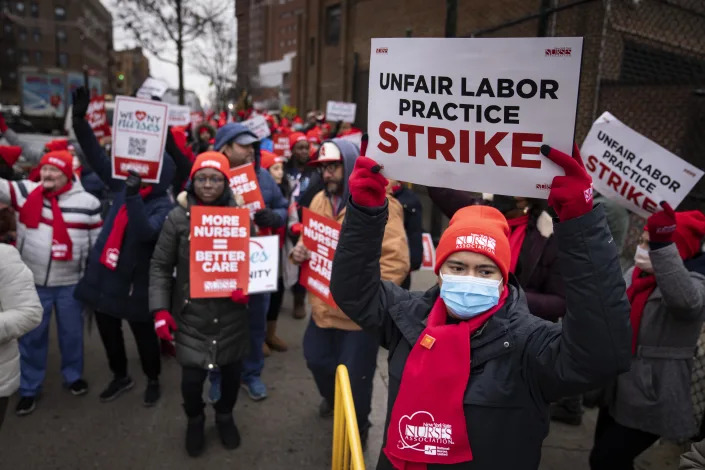
Protestors march on the streets around Montefiore Medical Center during a nursing strike, Wednesday, Jan. 11, 2023, in the Bronx borough of New York. A nursing strike that has disrupted patient care at two of New York City's largest hospitals has entered its third day.
Protestors march on the streets around Montefiore Medical Center during a nursing strike, Wednesday, Jan. 11, 2023, in the Bronx borough of New York. A nursing strike that has disrupted patient care at two of New York City's largest hospitals has entered its third day.
(AP Photo/John Minchillo)
AMANDA SEITZ
Thu, January 12, 2023
WASHINGTON (AP) — Even as 7,000 nurses return to work at two of New York’s busiest hospitals after a three-day strike, colleagues around the country say it’s just a matter of time before frontline workers at other hospitals begin walking the picket line.
Problems are mounting at hospitals across the nation as they try to deal with widespread staffing shortages, overworked nurses beaten down by the pandemic and a busted pipeline of new nurses.
That's led to nurses juggling dangerously high caseloads, said Michelle Collins, dean at the college of nursing and health at Loyola University New Orleans.
“There’s no place that’s immune from what’s happening with the nursing shortage,” Collins said. “It’s everywhere.”
Union leaders say the tentative contract agreement ending the strike by nurses at Mount Sinai Hospital and Montefiore Medical Center, each privately owned, nonprofit hospitals that hold over 1,000 beds in New York City, will relieve chronic short staffing and boost pay by 19% over three years.
The walkout, which ended Thursday, was just the latest dispute between nurses and their employers.
Last year, six unions representing a total of 32,000 nurses launched strikes outside of hospital systems around the country, according to the Bureau of Labor and Statistics. Those strikes represented about a quarter of all the major strikes in the U.S. last year, an increase from the year before.
Describing hospital environments where nurses are unable to take breaks because they are assigned too many patients — some of whom are pleading for care from frontline workers — the president of the American Nurses Association, Dr. Jennifer Mensik Kennedy, said some nurses may think their only option is to strike.
“Nurses don’t feel like their voices have been heard with this exact topic,” she told The Associated Press Wednesday. “Nurses are now feeling like they need to strike. That could continue.”
In California, nurse unions at two hospitals are likely to strike this year when their contract expires, said former nurse Peter Sidhu, who now works for the state union. Sidhu, who fields objections from nurses across the state who say their caseloads are unsafe, has received 7,000 such complaints in Los Angeles County hospitals since December. He said objections have at least doubled since before the pandemic began.
“What I’ve seen is that in areas where we’ve traditionally had good staffing, even they are getting bombarded with patients and a lack of resources,” Sidhu said.
Nurse shortages were plaguing some hospitals years before COVID-19 hit, and signs of a crisis loomed, with a large swath of the workforce nearing retirement age.
A policy brief from the Department of Health and Human Services last year found that over half of nurses were over the age of 50, a much higher percentage compared with the overall U.S. labor workforce, where only a quarter of people are 55 or older.
Aspiring nurses are lining up to replace those retirees but even that silver lining has hit a snag, with widespread faculty shortages at nursing colleges. In 2021, nearly 92,000 qualified nursing school applicants were denied entry into a program, largely because of a shortage of educators, according to the American Association of Colleges of Nursing.
The American Nurses Association asked Health and Human Services Secretary Xavier Becerra to declare the nursing shortage a national crisis in late 2021.
“Nurses have remained steadfast on the front lines since the beginning of the pandemic, while overcoming challenges, risks to their personal health and safety such as limited personal protective equipment and the physical, emotional and mental health burden of the COVID-19 virus,” the association’s president at the time wrote in a letter to the secretary.
Becerra hasn’t declared a crisis but has met with association and other health care leaders to discuss the shortage.
“This has been an ongoing issue for a while,” Mensik Kennedy said Wednesday. “We really need to work collaboratively with Congress and our health care system to address these issues. Nurses can’t solve these issues by ourselves.”
The federal agency has pumped more money into its National Health Service Corps program, which covers student tuition for health workers who serve in high-need communities. Since 2019, the program has nearly doubled the number of nurses and nurse faculty it sponsors.
The number of nurses working in the profession is starting to rebound to pre-pandemic levels, said Dave Auerbach, the director of research at the Massachusetts Health Policy Commission.
But hospitals, especially, are still struggling to lure those nurses back to working in their wards, he noted.
“That sounds like more of an issue of the attractiveness of the working conditions of the jobs,” Auerbach said. “Some of it is outside of the control of the hospitals in those jobs.”
Sidhu left his job as an ICU nurse last year when a third COVID surge struck, after being among the first to volunteer for the COVID unit when the pandemic hit.
He’s noticed a cultural shift in the profession. Fewer nurses want to work 12-hour shifts, multiple days a week. Many are taking jobs at clinics, where weekend or overnight shifts aren’t required. Others have moved to jobs in telehealth, working from the comfort of their home.
Some are simply burnt out from working in a hospital.
“Prior to the pandemic, I knew every once and a while, I’m going to have a bad night,” Sidhu said. “Now, every time you walk into the facility, you’re not just worried about what patients you’re going to have -- now you have four (patients) and you know you’re not going to have resources.”
Still, strong interest in the profession led Loyola University New Orleans to start an accelerated program this year aimed at second-career students who already have a bachelor’s degree.
April Hamilton, a 55-year-old food writer, cooking teacher and mother from Baton Rouge, La., will walk into her first class when that new nursing program starts Tuesday.
She’s read the headlines about staffing shortages and stressful working conditions in hospitals. She’s also seen the tough work nurses do firsthand: four years ago, she was in the hospital around-the-clock when her daughter spent 40 days in the intensive care unit, recovering from a fall that resulted in an amputated hand and 20 surgeries.
“Witnessing my daughter’s miracle fuels me,” Hamilton said. “I’m ready. I want to be part of the solution.”
AMANDA SEITZ
Thu, January 12, 2023
WASHINGTON (AP) — Even as 7,000 nurses return to work at two of New York’s busiest hospitals after a three-day strike, colleagues around the country say it’s just a matter of time before frontline workers at other hospitals begin walking the picket line.
Problems are mounting at hospitals across the nation as they try to deal with widespread staffing shortages, overworked nurses beaten down by the pandemic and a busted pipeline of new nurses.
That's led to nurses juggling dangerously high caseloads, said Michelle Collins, dean at the college of nursing and health at Loyola University New Orleans.
“There’s no place that’s immune from what’s happening with the nursing shortage,” Collins said. “It’s everywhere.”
Union leaders say the tentative contract agreement ending the strike by nurses at Mount Sinai Hospital and Montefiore Medical Center, each privately owned, nonprofit hospitals that hold over 1,000 beds in New York City, will relieve chronic short staffing and boost pay by 19% over three years.
The walkout, which ended Thursday, was just the latest dispute between nurses and their employers.
Last year, six unions representing a total of 32,000 nurses launched strikes outside of hospital systems around the country, according to the Bureau of Labor and Statistics. Those strikes represented about a quarter of all the major strikes in the U.S. last year, an increase from the year before.
Describing hospital environments where nurses are unable to take breaks because they are assigned too many patients — some of whom are pleading for care from frontline workers — the president of the American Nurses Association, Dr. Jennifer Mensik Kennedy, said some nurses may think their only option is to strike.
“Nurses don’t feel like their voices have been heard with this exact topic,” she told The Associated Press Wednesday. “Nurses are now feeling like they need to strike. That could continue.”
In California, nurse unions at two hospitals are likely to strike this year when their contract expires, said former nurse Peter Sidhu, who now works for the state union. Sidhu, who fields objections from nurses across the state who say their caseloads are unsafe, has received 7,000 such complaints in Los Angeles County hospitals since December. He said objections have at least doubled since before the pandemic began.
“What I’ve seen is that in areas where we’ve traditionally had good staffing, even they are getting bombarded with patients and a lack of resources,” Sidhu said.
Nurse shortages were plaguing some hospitals years before COVID-19 hit, and signs of a crisis loomed, with a large swath of the workforce nearing retirement age.
A policy brief from the Department of Health and Human Services last year found that over half of nurses were over the age of 50, a much higher percentage compared with the overall U.S. labor workforce, where only a quarter of people are 55 or older.
Aspiring nurses are lining up to replace those retirees but even that silver lining has hit a snag, with widespread faculty shortages at nursing colleges. In 2021, nearly 92,000 qualified nursing school applicants were denied entry into a program, largely because of a shortage of educators, according to the American Association of Colleges of Nursing.
The American Nurses Association asked Health and Human Services Secretary Xavier Becerra to declare the nursing shortage a national crisis in late 2021.
“Nurses have remained steadfast on the front lines since the beginning of the pandemic, while overcoming challenges, risks to their personal health and safety such as limited personal protective equipment and the physical, emotional and mental health burden of the COVID-19 virus,” the association’s president at the time wrote in a letter to the secretary.
Becerra hasn’t declared a crisis but has met with association and other health care leaders to discuss the shortage.
“This has been an ongoing issue for a while,” Mensik Kennedy said Wednesday. “We really need to work collaboratively with Congress and our health care system to address these issues. Nurses can’t solve these issues by ourselves.”
The federal agency has pumped more money into its National Health Service Corps program, which covers student tuition for health workers who serve in high-need communities. Since 2019, the program has nearly doubled the number of nurses and nurse faculty it sponsors.
The number of nurses working in the profession is starting to rebound to pre-pandemic levels, said Dave Auerbach, the director of research at the Massachusetts Health Policy Commission.
But hospitals, especially, are still struggling to lure those nurses back to working in their wards, he noted.
“That sounds like more of an issue of the attractiveness of the working conditions of the jobs,” Auerbach said. “Some of it is outside of the control of the hospitals in those jobs.”
Sidhu left his job as an ICU nurse last year when a third COVID surge struck, after being among the first to volunteer for the COVID unit when the pandemic hit.
He’s noticed a cultural shift in the profession. Fewer nurses want to work 12-hour shifts, multiple days a week. Many are taking jobs at clinics, where weekend or overnight shifts aren’t required. Others have moved to jobs in telehealth, working from the comfort of their home.
Some are simply burnt out from working in a hospital.
“Prior to the pandemic, I knew every once and a while, I’m going to have a bad night,” Sidhu said. “Now, every time you walk into the facility, you’re not just worried about what patients you’re going to have -- now you have four (patients) and you know you’re not going to have resources.”
Still, strong interest in the profession led Loyola University New Orleans to start an accelerated program this year aimed at second-career students who already have a bachelor’s degree.
April Hamilton, a 55-year-old food writer, cooking teacher and mother from Baton Rouge, La., will walk into her first class when that new nursing program starts Tuesday.
She’s read the headlines about staffing shortages and stressful working conditions in hospitals. She’s also seen the tough work nurses do firsthand: four years ago, she was in the hospital around-the-clock when her daughter spent 40 days in the intensive care unit, recovering from a fall that resulted in an amputated hand and 20 surgeries.
“Witnessing my daughter’s miracle fuels me,” Hamilton said. “I’m ready. I want to be part of the solution.”
Southwest Airlines Made an Unforced Error
The airline had a major meltdown that left passengers stranded. It didn't have to.
MICHAEL TEDDER
JAN 11, 2023
To people who know the aviation industry, Southwest’s (LUV) - holiday meltdown was as frustrating as it was predictable.
During the winter holidays, Southwest began canceling or massively delaying flights, including nearly 75% (or 4,000 domestic flights) on the day after Christmas alone. As the week between Christmas and New Year’s went on, more than 16,700 flights were impacted, which could end up costing Southwest $825 million, at least.
The primary culprit was, of course, the massive winter storms that tore through the country at the end of December. This affected every airline, but Southwest was very clearly not able to weather the storm as well as its competitors; it had far more outages and cancellations than any other airline.
Southwest’s Breakdown Was a Long Time Coming
Last year, Southwest’s employees began picketing and having demonstrations at public events where the company’s management had begun congregating, in order to bring attention to the airline’s need to update its flight programming software, which by many accounts was decades overdue for an overhaul.
Aviation experts have been warning Southwest about its outdated software for years. The exact cost of updating this software is unknown, but if it wasn’t expensive, the airline probably wouldn’t have put it off for years and years.
According to ZD Net Business, Southwest pilots allege that “the company’s technology is simply not up to the task of efficiently scheduling staffing. To such a degree that pilots often have their flights changed and find themselves out of position, sometimes not being able to immediately return home.”
Furthermore, Southwest’s employees have accused the company’s management, including CEO Robert Jordan (who took over in 2022), of not spending enough to recruit and train the pilots and staff necessary for the airline to run smoothly.
Instead, the company’s reputation for sterling customer service has taken a hit while, protestors allege, executives have decided to pay themselves large bonuses and pay shareholders dividends.
Of course, that’s how corporations and the stock market work, one could argue. But you could also argue there’s a time and place for that sort of payout, and when an airline is seen as badly under-resourced, it's just a bad look, and bonuses can wait for another time.
Robert Alexander/Getty Images
The Public Is Taking it Out on Southwest Employees
The result of Southwest's executive decisions were thousands of miserable and stranded travelers. Many of whom, unfortunately, took out their justified frustrations out on customer service representatives, who were not responsible for the problem.
It's easy to see where this could lead, and how Southwest's headaches could get much worse. At the moment, Southwest has a bad public image, because it doesn't have enough employees or a reliable infrastructure, and therefore can't function as well as its competitors.
It's not going to be easy for Southwest to repair its public image, or to regain the trust of its employees or customers. The company has announced plans to hire 8,000 more employees this year, but it remains to be seen if that's just lip service, of if management is willing to spend enough to recruit people who might be wary of coming onboard.
Southwest's clear first step is to hire more employees so the airline can function properly. But if you are known as a company where your employees get yelled at, well, who is going to want to take that job? And if no one wants to work for Southwest, how is this ever going to get turned around?
When you're in a hole, the saying goes, stop digging. But has Southwest dug itself in too deeply?
The airline had a major meltdown that left passengers stranded. It didn't have to.
MICHAEL TEDDER
JAN 11, 2023
To people who know the aviation industry, Southwest’s (LUV) - holiday meltdown was as frustrating as it was predictable.
During the winter holidays, Southwest began canceling or massively delaying flights, including nearly 75% (or 4,000 domestic flights) on the day after Christmas alone. As the week between Christmas and New Year’s went on, more than 16,700 flights were impacted, which could end up costing Southwest $825 million, at least.
The primary culprit was, of course, the massive winter storms that tore through the country at the end of December. This affected every airline, but Southwest was very clearly not able to weather the storm as well as its competitors; it had far more outages and cancellations than any other airline.
Southwest’s Breakdown Was a Long Time Coming
Last year, Southwest’s employees began picketing and having demonstrations at public events where the company’s management had begun congregating, in order to bring attention to the airline’s need to update its flight programming software, which by many accounts was decades overdue for an overhaul.
Aviation experts have been warning Southwest about its outdated software for years. The exact cost of updating this software is unknown, but if it wasn’t expensive, the airline probably wouldn’t have put it off for years and years.
According to ZD Net Business, Southwest pilots allege that “the company’s technology is simply not up to the task of efficiently scheduling staffing. To such a degree that pilots often have their flights changed and find themselves out of position, sometimes not being able to immediately return home.”
Furthermore, Southwest’s employees have accused the company’s management, including CEO Robert Jordan (who took over in 2022), of not spending enough to recruit and train the pilots and staff necessary for the airline to run smoothly.
Instead, the company’s reputation for sterling customer service has taken a hit while, protestors allege, executives have decided to pay themselves large bonuses and pay shareholders dividends.
Of course, that’s how corporations and the stock market work, one could argue. But you could also argue there’s a time and place for that sort of payout, and when an airline is seen as badly under-resourced, it's just a bad look, and bonuses can wait for another time.
Robert Alexander/Getty Images
The Public Is Taking it Out on Southwest Employees
The result of Southwest's executive decisions were thousands of miserable and stranded travelers. Many of whom, unfortunately, took out their justified frustrations out on customer service representatives, who were not responsible for the problem.
It's easy to see where this could lead, and how Southwest's headaches could get much worse. At the moment, Southwest has a bad public image, because it doesn't have enough employees or a reliable infrastructure, and therefore can't function as well as its competitors.
It's not going to be easy for Southwest to repair its public image, or to regain the trust of its employees or customers. The company has announced plans to hire 8,000 more employees this year, but it remains to be seen if that's just lip service, of if management is willing to spend enough to recruit people who might be wary of coming onboard.
Southwest's clear first step is to hire more employees so the airline can function properly. But if you are known as a company where your employees get yelled at, well, who is going to want to take that job? And if no one wants to work for Southwest, how is this ever going to get turned around?
When you're in a hole, the saying goes, stop digging. But has Southwest dug itself in too deeply?
Subscribe to:
Posts (Atom)