Sunday, February 12, 2023

Western Conservative Movements Could Hinder Gender Justice Campaigns in Africa

African feminists and their allies have a steep uphill battle to fight in the culture war waged by Western conservatives.


Representative image. Photo: GPA Photo Archive/Flickr CC BY NC 2.0

Joy Asasira
GENDERWORLD

Last year’s most notable decision affecting gender justice – the overturning of federal protection of the right to abortion in the US – happened more than 6,000 miles from Africa, but its impact was felt here too.

The US Supreme Court’s decision will affect legal, policy and public service spheres on the African continent. It will also intensify the ideological war to control women’s bodies and push LGBTIQ citizens further to the margins.

African states have diverse abortion policies. For example, in Cape Verde and South Africa, abortion is available on demand – in theory if not in practice, especially for poorer women. In Congo-Brazzaville, Egypt and Gabon, however, it is prohibited without any exceptions. Between those two poles are dozens of countries that allow terminations in some circumstances.

Following the US reversal of Roe v Wade, I was among the African gender justice advocates who feared a domino effect on the continent. That hasn’t happened. However, even though we haven’t seen any changes to the law to further restrict abortion access, the US decision has definitely re-energised anti-abortion narratives.

After all, the loudest and most active conservative voices and efforts in Africa are often closely linked to the far right in the US and Europe.

Big wins for US conservatives on the home front will no doubt free up funds to invest in frustrating progress elsewhere, including Africa. In the past, US conservatives have funded efforts in Malawi to dissuade the national parliament from expanding the circumstances in which abortion is permitted.

Looking forward to 2023 and beyond, Africa’s feminist movements will have to reinvest in their own defence of bodily autonomy, in accordance with the Maputo Protocol. Adopted by the African Union in 2003, this treaty obliges countries to legalise medical abortion in cases of sexual assault, rape, incest, and where the pregnancy endangers the health or life of the mother or the foetus isn’t viable. But the ideological war extends beyond the control of pregnant bodies.


The newly elected president of Kenya, William Ruto, is a controversial figure who has branded himself a Christian nationalist and spoken out against homosexuality. His first executive order restricted state recognition of a family to heterosexual couples. This policy has been a priority for conservative Western movements active in Kenya, such as Spain’s CitizenGo.


Kenyan President William Ruto. Photo: US Department of State/Wikimedia Commons

These movements and their powerful allies seek to protect a very colonial understanding of family in Africa over more expansive indigenous definitions of family. But Western conservatives’ ideas are at odds with modern African realities. Increasingly, other forms of family are emerging across the continent in households headed by single women or children, or communal homes shared by queer people ostracised by their birth families.

The emerging forms of families will need feminist movements to continue fighting for their equal recognition and protection under the law. This is especially so because conservative movements will work to tip the balance against them.

These fights are important because so often, they are a matter of life and death for Africa’s gender-oppressed peoples. In the last two years, at least two men are reported to have bludgeoned their wives to death after learning they were using contraception. Meanwhile, a man in Kenya has sued his former partner for denying him the “right” to be on “her pregnancy journey”, claiming that his desire to have children should take precedence over her feelings. LGBTIQ Africans can often be a target, too, as is suspected to have been the case for Kenya’s Sheila Lumumba and Uganda’s Matthew Kinono.

In isolation, these events may seem random but they are directly linked to the extremist conservative Western activism that the US reversal of Roe v Wade emboldened. This activism promotes false claims such as fetal personhood, spreads misinformation about contraceptives, pushes for women to be forced back into gendered family roles and stokes moral panic about LGBTIQ people. Consequently, African feminism is faced with a considerable challenge – pushing African governments to protect their citizens from these dangerous influences.

The role of Big Tech

Meanwhile, the disinformation and misinformation that propels these exclusivist movements is likely to get worse, especially as libertarian billionaires such as Elon Musk take over social media platforms like Twitter. A Mozilla report published ahead of Kenya’s general election in August showed how foreign groups can manipulate a country’s public discourse through Twitter. The report’s case study was CitizenGo’s disinformation campaign against Kenya’s 2020 Reproductive Health Bill, which was eventually defeated in parliament.

The failure and/or disinterest of Big Tech owners to regulate the abuse of their platforms will only embolden such bad faith campaigns, putting women, LGBTIQ and other marginalised communities at risk, just as in the offline world.

A recent report by the Center for Countering Digital Hate noted the increasing number of posts containing slurs since Musk took over at Twitter.

Meanwhile, national governments on the continent are increasingly intolerant of the speech of groups that hold them to account. They are passing laws such as Uganda’s Computer Misuse Amendment Act and arresting critics, as happened repeatedly in Nigeria this year.

Compounding these challenges for Africa’s feminists is the fact that local elites and leaders lean towards conservative policies. In the two years since the Trump administration joined Brazil, Egypt, Hungary, Indonesia and Uganda to co-sponsor the notorious Geneva Consensus Declaration (GCD), it has gained further signatories: 36 countries, 17 of them in Africa, now support the aims of the GCD, which declares that “there is no international right to abortion”. 2022 ended with the Ghanaian government seemingly inclined towards a revised version of “the harshest anti-gay law in the world”, which has been linked to US ultra-conservatives.

If the current trends do not decisively spell disaster, they are certainly a clear indication that African feminists and their allies have a steep uphill battle to fight in the culture war waged by Western conservatives.

Joy is an advocate and strategist for gender justice working predominantly in Uganda, and Kenya, with an Africa-wide footprint.

This article was originally published on Progressive International.
‘Business as unusual’: a new era in ties between China and Angola

Beijing was a key player in the African country’s reconstruction after decades of civil war

But the oil-backed loans that drove that recovery are ebbing as both nations look for other partners


Jevans Nyabiage
+ myNEWS
Published: 6:00pm, 12 Feb, 2023

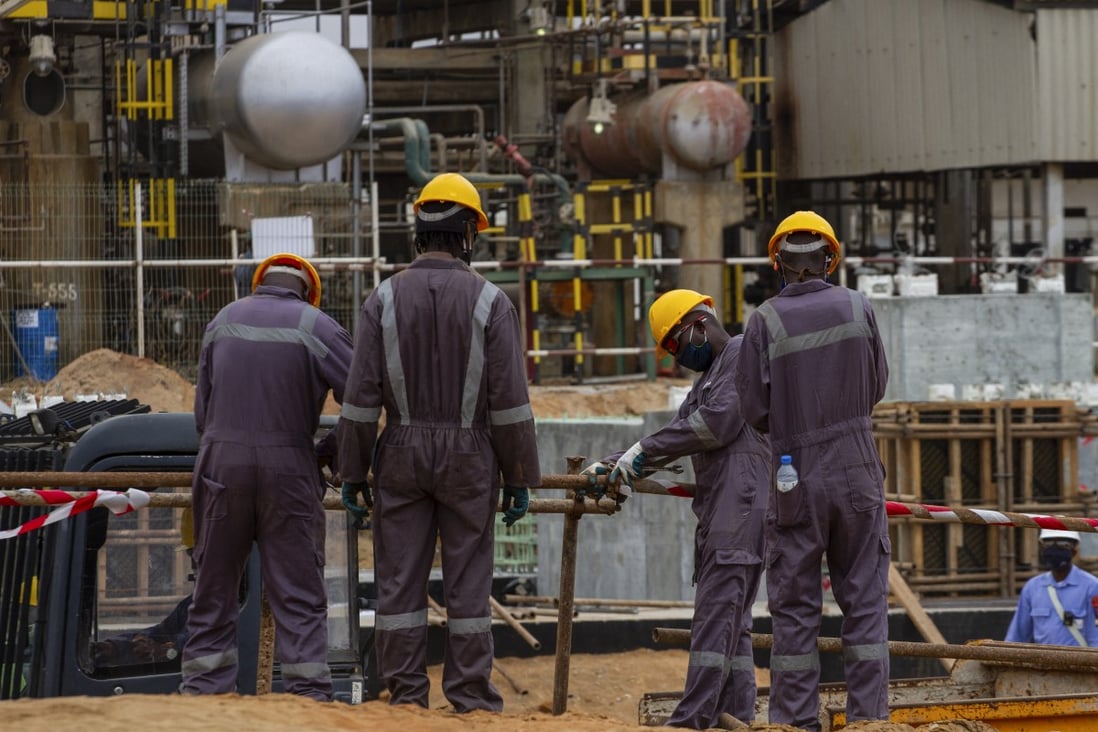
Angola’s dependence on oil leaves the country vulnerable whenever prices fall.
 Photo: AFP

When Angolan President João Lourenço met Chinese Foreign Minister Qin Gang in Luanda last month, he was all praise for a series of landmark projects – from airports to hydropower stations – funded and built by China.

China had played “an indispensable role in Angola’s post-war reconstruction and economic and social development”, Lourenço said as the two countries marked four decades of diplomatic ties.

“Chinese enterprises have made positive contributions to the improvement of infrastructure and people’s livelihood in Angola.”

But even as the tributes flowed, the Chinese financing boom was already over.

Last year, Angola, which had once been Africa’s top destination for Chinese capital, did not receive any funding from Beijing’s massive infrastructure programme, the Belt and Road Initiative.

The shift is a result of a combination of factors, including commodity prices and changes within China and Angola, observers say.

Angola looks at refinancing as it faces higher repayments on Chinese loans
11 Mar 2022


In 2002, as Angola emerged from a 27-year civil war, China was on hand to advance cheap money that the West was reluctant to give in exchange for oil – an approach that became known as the “Angola model”.

Between 2000 and 2020, Chinese lenders had advanced 254 loans worth US$42.6 billion to Angola – more than a quarter of China’s total lending to African countries, according to data compiled by the Boston University Global Development Policy Centre. The result was an infrastructure boom, especially in housing, roads and power plants.

Oil is central to the whole equation, making up 90 per cent of Luanda’s exports. In all, 70 per cent of Angola’s oil is exported to China and those sales are tied directly to debt repayments.

But in recent years, China has been buying more oil from the Middle East and less from Africa. For many years, Angola was neck and neck with Saudi Arabia as the main source of Chinese oil exports, but it has now been overtaken by Russia and Iraq.

Angola’s dependence on oil leaves the country vulnerable whenever prices fall – as they did in 2014, when prices plummeted to below US$50 per barrel from a high of US$115, pushing the economy into recession and a debt crisis from which it is still to emerge.

At the same time, Chinese policy lenders such as the Export-Import Bank of China have become more cautious in general as a growing number of African countries – from Zambia to Kenya – fell into debt troubles.

Dominik Kopinski, an associate professor at the University of Wroclaw in Poland who studies China’s dealings with Africa, said the low oil prices resulted in serious economic imbalances in Angola, weakening the currency, the kwanza, and plunging the country into economic recession.

“Then came Covid-19, China’s growing isolationism, and loans drying up,” he said.

Christoph Nedopil Wang, director of the Green Finance & Development Centre at the Shanghai-based Fudan University’s Fanhai International School of Finance, said Angola used to be one of the main partners in Africa for belt and road engagement, particularly in fossil fuel-related projects.

“[But] with more diversified sources of fossil fuels for China, such as the Middle Eastern countries or Russia, Chinese developers seem to spread these engagements also to other countries,” Wang said.

Why Angola struggles to end its economic dependence on China
8 Nov 2021


Since becoming president in 2017, Lourenço has been trying to diversify the economy away from oil and to reduce Angola’s dependence on China. He has tried wooing investors from the West, especially the United States, which has pledged US$2 billion to build solar energy projects in the country.

Tim Zajontz, Research Fellow, Centre for International and Comparative Politics, Stellenbosch University in South Africa, said Chinese economic presence had waned markedly under Angola’s current government which had actively tried to diversify Angola’s international partnerships.

However, Zajontz said a rebound in Chinese investments in Angola was expected in coming years in strategic sectors, such as energy, transport and information technology. He said that a few weeks ago the Angolan government signed a US$249 million loan for its national broadband internet project with its Chinese counterpart.

Export-Import Bank of China will provide the funding to support the Angolan national broadband network project under a concessional loan framework agreement. It will fund the building of a 2,000km (1,240-mile) terrestrial optical cable in Angola as well as a submarine line connecting the enclave of Cabinda, and an upgrade to the country’s telecommunications network.

The funding is seen as a response to the US, which is backing Africell, an American company, to compete with Huawei for the control of 5G technology in the country.

Kopinski said Gang’s visit in January was meant to reassure Angola that it continued to be a strategic partner of China on the continent. He said the timing was particularly important, as the famous marriage of convenience had “experienced a marital burnout of sorts in the past years”.

“Chinese loans have dried up, Chinese state-owned enterprises switched to a standby mode and many of them left, and the Chinese community has shrunk from 350,000 in the peak time to a mere 20,000-30,000,” Kopinski said.

He said within this “business as unusual”, the visit indicated an emergence of the new normal in the Sino-Angolan ties with a less intrusive role for Chinese state actors backed by credit lines, and a more dominant role for private investors answering to the logic of capitalism rather than state-to-state policy.

Kopinski said Lourenço had signalled that the “Angola model” and heavy dependence on China were not in the country’s best interest – “and rightly so”.

But despite decoupling from China being sometimes depicted as Angola’s new master plan and a calculated shift in foreign affairs, there were various factors at play.

“We need to remember that in October 2018, Lourenço returned from his trip to China disillusioned as his Chinese friends did want to play along and bluntly said no to more loans that he had requested,” he said.

“There is, therefore, a combination of things behind this new development – Angolan internal politics, China’s policy recalibration, and a host of external factors, rather than an elaborately executed plan by Angola – or China for that matter.”

Jan 28, 2021 — Since its independence in 1975, Angola has had a tumultuous journey: from being a war zone, to becoming a poster child for Chinese ...
by SF Jackson1995Cited by 124 — How do the Chinese organize their relations with Third World revolutionary organizations and their post-independence governments? This article
THE NEW OLD RIGHT
A Yale Professor Suggested Mass Suicide for Old People in Japan. What Did He Mean?

Yusuke Narita says he is mainly addressing a growing effort to revamp Japan’s age-based hierarchies. Still, he has pushed the country’s hottest button.


Yusuke Narita, wearing his signature eyeglasses with one round and one square lens. 
He said his comments about mass suicide and the elderly had been “taken out of context.”
Credit...Bea Oyster for The New York Times

By Motoko Rich and Hikari Hida
Reporting from Tokyo
Feb. 12, 2023,

His pronouncements could hardly sound more drastic.

In interviews and public appearances, Yusuke Narita, an assistant professor of economics at Yale, has taken on the question of how to deal with the burdens of Japan’s rapidly aging society.

“I feel like the only solution is pretty clear,” he said during one online news program in late 2021. “In the end, isn’t it mass suicide and mass ‘seppuku’ of the elderly?” Seppuku is an act of ritual disembowelment that was a code among dishonored samurai in the 19th century.

Last year, when asked by a school-age boy to elaborate on his mass seppuku theories, Dr. Narita graphically described to a group of assembled students a scene from “Midsommar,” a 2019 horror film in which a Swedish cult sends one of its oldest members to commit suicide by jumping off a cliff.

“Whether that’s a good thing or not, that’s a more difficult question to answer,” Dr. Narita told the questioner as he assiduously scribbled notes. “So if you think that’s good, then maybe you can work hard toward creating a society like that.”

At other times, he has broached the topic of euthanasia. “The possibility of making it mandatory in the future,” he said in one interview, will “come up in discussion.”

Dr. Narita, 37, said that his statements had been “taken out of context,” and that he was mainly addressing a growing effort to push the most senior people out of leadership positions in business and politics — to make room for younger generations. Nevertheless, with his comments on euthanasia and social security, he has pushed the hottest button in Japan.

A nursing home in Japan. The country is grappling with growing numbers of older people who suffer from dementia or die alone.
Credit...Ko Sasaki for The New York Times

While he is virtually unknown even in academic circles in the United States, his extreme positions have helped him gain hundreds of thousands of followers on social media in Japan among frustrated youths who believe their economic progress has been held back by a gerontocratic society.

Appearing frequently on Japanese online shows in T-shirts, hoodies or casual jackets, and wearing signature eyeglasses with one round and one square lens, Dr. Narita leans into his Ivy League pedigree as he fosters a nerdy shock jock impression. He is among a few Japanese provocateurs who have found an eager audience by gleefully breaching social taboos. His Twitter bio: “The things you’re told you’re not allowed to say are usually true.”

Last month, several commenters discovered Dr. Narita’s most incendiary remarks and began spreading them on social media. During a panel discussion on a respected internet talk show with scholars and journalists, Yuki Honda, a University of Tokyo sociologist, described his comments as “hatred toward the vulnerable.”

A growing group of critics warn that Dr. Narita’s popularity could unduly sway public policy and social norms. Given Japan’s low birthrate and the highest public debt in the developed world, policymakers increasingly worry about how to fund Japan’s expanding pension obligations. The country is also grappling with growing numbers of older people who suffer from dementia or die alone.

In written answers to emailed questions, Dr. Narita said he was “primarily concerned with the phenomenon in Japan, where the same tycoons continue to dominate the worlds of politics, traditional industries, and media/entertainment/journalism for many years.”

The phrases “mass suicide” and “mass seppuku,” he wrote, were “an abstract metaphor.”

“I should have been more careful about their potential negative connotations,” he added. “After some self-reflection, I stopped using the words last year.”


A book by Dr. Narita that is being translated into English.
Credit...Bea Oyster for The New York Times

His detractors say his repeated remarks on the subject have already spread dangerous ideas.

“It’s irresponsible,” said Masaki Kubota, a journalist who has written about Dr. Narita. People panicking about the burdens of an aging society “might think, ‘Oh, my grandparents are the ones who are living longer,’” Mr. Kubota said, “‘and we should just get rid of them.’”

Masato Fujisaki, a columnist, argued in Newsweek Japan that the professor’s remarks “should not be easily taken as a ‘metaphor.’” Dr. Narita’s fans, Mr. Fujisaki said, are people “who think that old people should just die already and social welfare should be cut.”

Despite a culture of deference to older generations, ideas about culling them have surfaced in Japan before. A decade ago, Taro Aso — the finance minister at the time and now a power broker in the governing Liberal Democratic Party — suggested that old people should “hurry up and die.”

Last year, “Plan 75,” a dystopian movie by the Japanese filmmaker Chie Hayakawa, imagined cheerful salespeople wooing retirees into government-sponsored euthanasia. In Japanese folklore, families carry older relatives to the top of mountains or remote corners of forests and leave them to die.

Dr. Narita’s language, particularly when he has mentioned “mass suicide,” arouses historical sensitivities in a country where young men were sent to their deaths as kamikaze pilots during World War II and Japanese soldiers ordered thousands of families in Okinawa to commit suicide rather than surrender.

Critics worry that his comments could summon the kinds of sentiments that led Japan to pass a eugenics law in 1948, under which doctors forcibly sterilized thousands of people with intellectual disabilities, mental illness or genetic disorders. In 2016, a man who believed those with disabilities should be euthanized murdered 19 people at a care home outside Tokyo.

In his day job, Dr. Narita conducts technical research of computerized algorithms used in education and health care policy. But as a regular presence across numerous internet platforms and on television in Japan, he has grown increasingly popular, appearing on magazine covers, comedy shows and in an advertisement for energy drinks. He has even spawned an imitator on TikTok.

He often appears with Gen X rabble-rousers like Hiroyuki Nishimura, a celebrity entrepreneur and owner of 4chan, the online message board where some of the internet’s most toxic ideas bloom, and Takafumi Horie, a trash-talking entrepreneur who once went to prison for securities fraud.

Hiroyuki Nishimura, center, who owns 4chan. He and Mr. Narita are part of a handful of Japanese provocateurs who seem to enjoy breaching social taboos.
Credit...Ko Sasaki for The New York Times

At times, he has pushed the boundaries of taste. At a panel hosted by Globis, a Japanese graduate business school, Dr. Narita told the audience that “if this can become a Japanese society where people like you all commit seppuku one after another, it wouldn’t be just a social security policy but it would be the best ‘Cool Japan’ policy.” Cool Japan is a government program promoting the country’s cultural products.

Shocking or not, some lawmakers say Dr. Narita’s ideas are opening the door to much-needed political conversations about pension reform and changes to social welfare. “There is criticism that older people are receiving too much pension money and the young people are supporting all the old people, even those who are wealthy,” said Shun Otokita, 39, a member of the upper house of Parliament with Nippon Ishin no Kai, a right-leaning party.

But detractors say Dr. Narita highlights the burdens of an aging population without suggesting realistic policies that could alleviate some of the pressures.

“He’s not focusing on helpful strategies such as better access to day care or broader inclusion of women in the work force or broader inclusion of immigrants,” said Alexis Dudden, a historian at the University of Connecticut who studies modern Japan. “Things that might actually invigorate Japanese society.”

In broaching euthanasia, Dr. Narita has spoken publicly of his mother, who had an aneurysm when he was 19. In an interview with a website where families can search for nursing homes, Dr. Narita described how even with insurance and government financing, his mother’s care cost him 100,000 yen — or about $760 — a month.

Dr. Narita at home in New Haven, Conn. His extreme positions have helped him gain hundreds of thousands of followers on social media in Japan.
Credit...Bea Oyster for The New York Times

Some surveys in Japan have indicated that a majority of the public supports legalizing voluntary euthanasia. But Mr. Narita’s reference to a mandatory practice spooks ethicists. Currently, every country that has legalized the practice only “allows it if the person wants it themselves,” said Fumika Yamamoto, a professor of philosophy at Tokyo City University.

In his emailed responses, Dr. Narita said that “euthanasia (either voluntary or involuntary) is a complex, nuanced issue.”

“I am not advocating its introduction,” he added. “I predict it to be more broadly discussed.”

At Yale, Dr. Narita sticks to courses on probability, statistics, econometrics and education and labor economics.

Neither Tony Smith, the department chair in economics, nor a spokesperson for Yale replied to requests for comment.

Josh Angrist, who has won the Nobel in economic science and was one of Dr. Narita’s doctoral supervisors at the Massachusetts Institute of Technology, said his former student was a “talented scholar” with an “offbeat sense of humor.”

“I would like to see Yusuke continue a very promising career as a scholar,” Dr. Angrist said. “So my main concern in a case like his is that he’s being distracted by other things, and that’s kind of a shame.”


Motoko Rich is the Tokyo bureau chief, where she covers Japanese politics, society, gender and the arts, as well as news and features on the Korean peninsula. She has covered a broad range of beats at The Times, including real estate, the economy, books and education. @motokorichFacebook

Hikari Hida reports from the Tokyo bureau, where she covers news and features in Japan. She joined The Times in 2020. @hikarimaehida

SRI  LANKA

TNPF MP Kajendren arrested alongside peaceful protesters

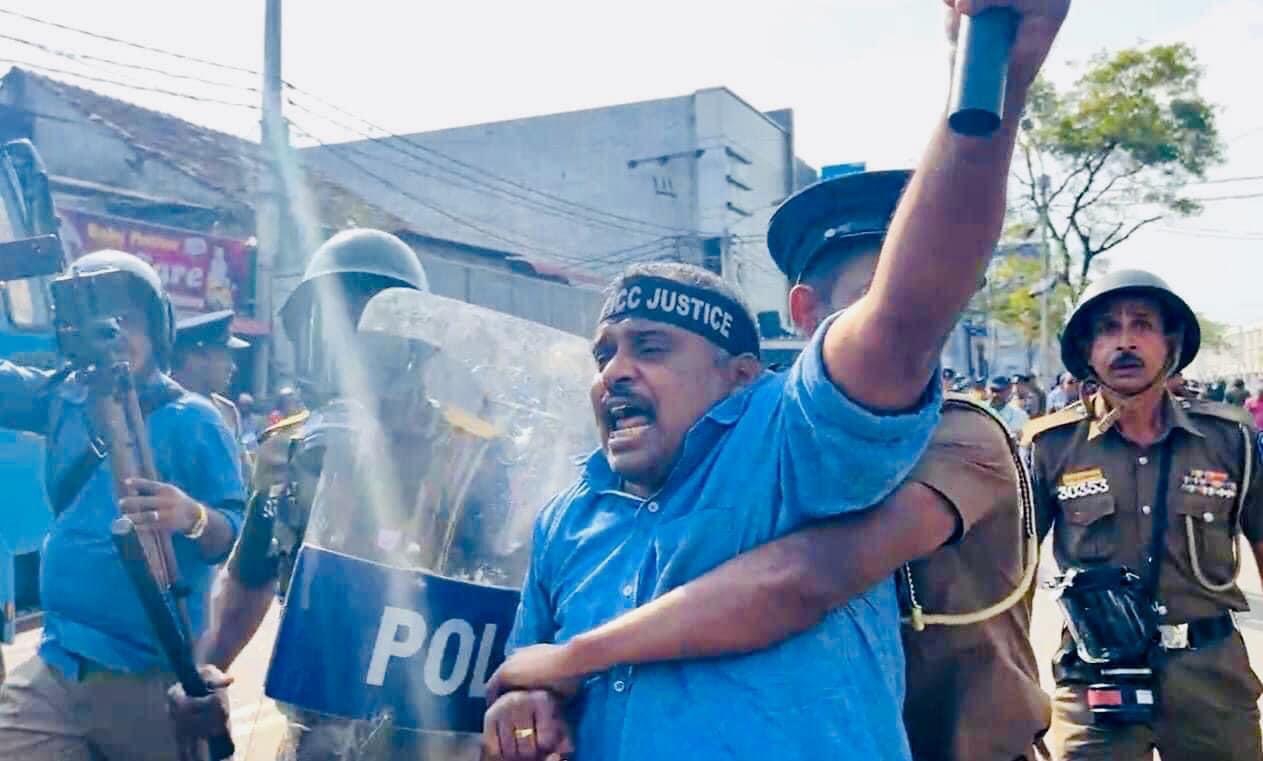
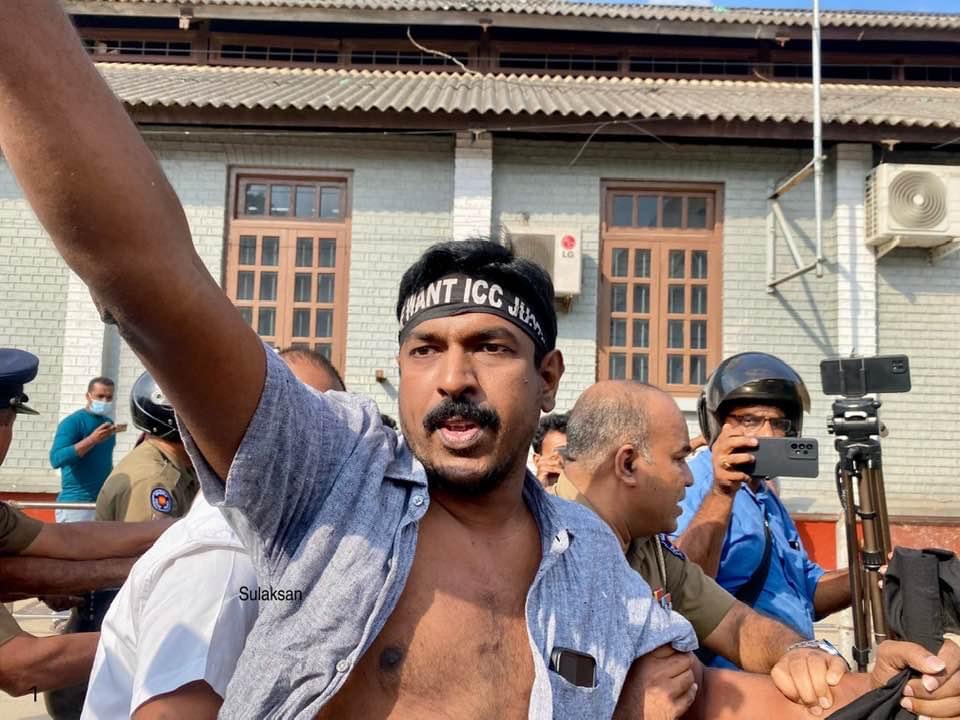
Sri Lankan police have arrested Tamil National People’s Front (TNPF), Selvarajah Kajendren, for his involvement in the black flag protests against the Sri Lankan president’s visit to Jaffna.

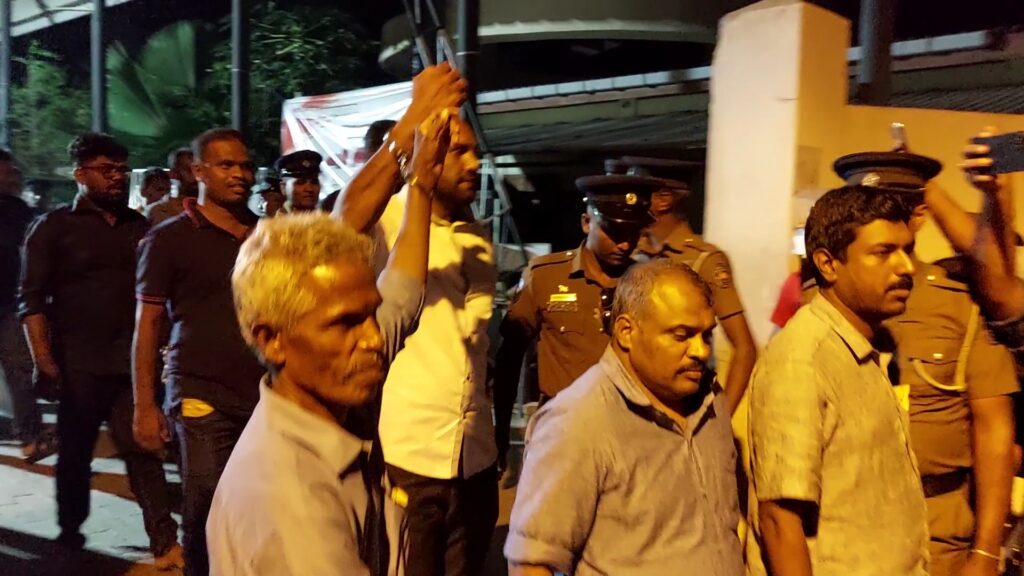
The senior TNPF MP was forcibly dragged by armed police and shoved into the back of their vehicle. He was arrested alongside 9 other protesters including TNPF media spokesperson kanagaratnam Sugas. The arrests took place at a bus stop in Jaffna.

During the demonstration, police were seen assaulting the peaceful demonstrators.

These demonstrations follow a four-day demonstration calling for an end to the military occupation of the Tamil homeland and for the right of Tamils to self-determination. The demonstrators also called for Sri Lanka to be referred to the International Criminal Court for the genocide it has committed against Eelam Tamils.  

TNPF MP released on bail after being arrested for protesting visit by Sri Lankan President

The Tamil National People's Front (TNPF) MP Selvarajah Kajendren was released on bail last night after being arrested for protesting against Ranil Wickremesinghe's visit to Jaffna. 

Kajendren was arrested alongside 17 others, including TNPF lawyer Kanagaratnam Sugash, for holding a black flag protest during the Sri Lankan President's visit to inaugurate the Jaffna Cultural Hall as a part of Sri Lanka's 75th Independence Day. The day is regarded as a 'black day' for the Tamil nation, as it continues to be occupied by the Sri Lankan state. 

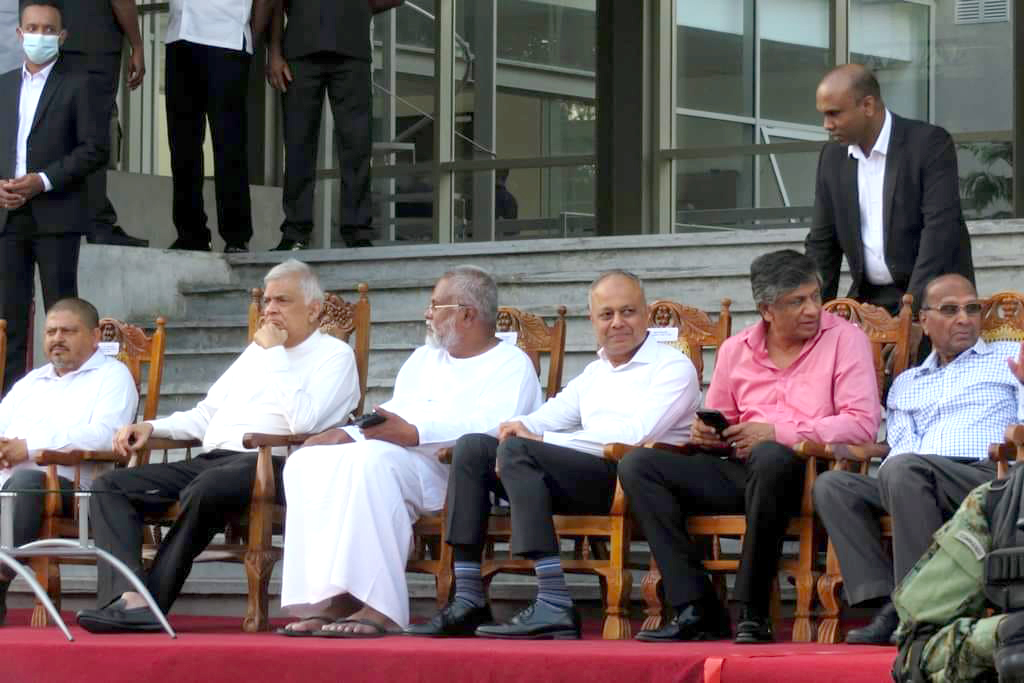
Ranil Wickremesinghe alongside EPDP leader Douglas Devananda at Jaffna Cultural Hall's inauguration event yesterday 

Those who were later produced at the Jaffna Magistrate's residence at 11 o'clock last night and were released on bail for 3 lakhs each. 

The police claimed that the 18 were arrested for holding a protest although they had obtained a court order to stop it from going ahead. 

Last weekend, black flag protests took place across the Tamil homeland to mark Sri Lanka's Independence Day. 

Scientists create model that predicts Earthquake whereabouts

QNA/WASHINGTONLAST EDITED FEBRUARY 12, 2023 

A team of seismologists and statisticians at Northwestern University has created a new model that can predict when and where the next earthquake might strike. The model takes into account the exact order and timing of previous quakes, rather than relying solely on the average time between past quakes.

The team's research focused on investigating plate boundary processes and deformation within the lithosphere using a range of techniques, including seismology and space geodesy (measuring the geometry, gravity, and spatial orientation of the Earth and other astronomical objects, such as planets), and marine geophysics.

Participating researcher James S. Neely said "Sometimes we see several large earthquakes occur over relatively short time frames and then long periods when nothing happens. The traditional models cant handle this behavior."

Neely added that earthquakes occur when the jigsaw puzzle-like pieces of rock that make up the Earth's surface (known as tectonic plates) suddenly move, and most earthquakes occur along fault lines where tectonic plates join and diverge.

The researchers see the new model as a useful tool for seismologists, as they can improve earthquake prediction and better prepare for future seismic events.

The US Geological Survey previously stated that scientists can only calculate the probability of an earthquake occurring within a certain number of years.
4.3 magnitude earthquake struck Al Hoceima northern Morocco

QNA/RABAT
LAST EDITED FEBRUARY 12, 2023 | 

An earthquake measuring 4.3 on the Richter scale struck on Sunday in the province of Al Hoceima in northern Morocco.
The National Institute of Geophysics in Morocco stated that the tremor occurred at a depth of 18 kilometres.
So far, no reports have been received about human or material losses as a result of the tremor.
A 5.3-magnitude earthquake struck the province of Al Hoceima last January, without causing any human or material losses.

GOT TUNNEL CARPEL FROM AUTOGRAPHS
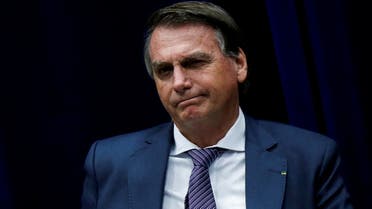
Former president Bolsonaro mulls return to Brazil in coming weeks from US


Reuters, Mexico City
Published: 12 February ,2023

Former Brazilian president Jair Bolsonaro said on Saturday he plans to return to Brazil “in the coming weeks,” after having spent more than a month in the United States.

Bolsonaro flew to Florida two days before incumbent Luiz Inacio Lula da Silva was sworn in as the new president on January 1, and later applied for a six-month tourist visa to continue his stay in the United States.

“There is no place like home ... We know Brazil is a fantastic country,” Bolsonaro told a gathering of Brazilians in Boca Raton, a video posted online by broadcaster CNN showed.

“I also want to return to Brazil. I intend to return to Brazil in the coming weeks.”

A swift return to Brazil could pose risks for Bolsonaro, who is accused of instigating a violent election denial movement in
his home country.

Brazil’s Supreme Court has agreed to open an investigation into Bolsonaro for allegedly encouraging anti-democratic protests that ended in the storming of government buildings by his supporters in Brasilia.

His plans to return were put in question after his lawyer told Reuters last month the former president would like to “enjoy being a tourist in the United States for a few months before deciding what his next step will be.”

Still, a US official with knowledge of the situation told Reuters this week that officials believe Bolsonaro will return to Brazil after the carnival festival, which ends on February 22.
Native Americans call for Super Bowl team to change name


Fans of the Kansas City Chiefs do the tomahawk chop in the second half of a game against the Tennessee Titans at Nissan Stadium on November 10, 2019 in Nashville, Tennessee.
Photo: WESLEY HITT / AFP

Native American groups are expected to protest the Kansas City Chiefs football team, calling for the team to drop their name and logo as they take on the Philadelphia Eagles in Super Bowl 57.

The Chiefs wear the arrowhead logo on their helmet and use a large drum to kick off their home games, as fans routinely engage in what's known as the "tomahawk chop" chant, all of which critics say draw on offensive and racist stereotypes.

This is their third trip to the NFL title game in four years and Kansas City fans can be heard throughout Phoenix singing the "tomahawk chop" chant. It is a jarring contrast to the displays of Native American culture and pride that Super Bowl hosts have invited to participate in the days leading up to the game, which will be Monday afternoon NZ time.

Dancers from Indigenous Enterprise performed at Monday's Opening Night festivities, becoming the first


 Native Americans to perform at the annual media mega event.


In a strange juxtaposition, they took the stage minutes after Kansas City fans in attendance at the Footprint Center joined together in a loud rendition of their "tomahawk chop" chant.

"What the NFL is doing inside Phoenix, by bringing in indigenous dancers and artists, that's celebrating the authentic, which is wonderful," said Cher Thomas, an artist, community organizer and member of the Gila River Community. She will be among those outside the game protesting.

"However, the NFL simultaneously condones Kansas City's team and their names and monikers and their derogatory traditions."

The NFL did not immediately respond to a request for comment.


Chiefs supporter Benny Blades, 55, of Albuquerque, New Mexico, said he admired the team for "sticking to their guns" as he stood in Scottsdale's Old Town, where fans broke out into spontaneous "tomahawk" chants on streets lined with shops selling Native American arts and crafts.

"We can't say anything now because you're gonna offend one or two percent of the people in the United States," he said.

Scottsdale is directly adjacent to the Salt River-Maricopa Indian Community of more than 7000 residents, one of Arizona's 22 federally recognized tribes.

At Sunday's preshow, when singer Babyface performs "America the Beautiful," Navajo Colin Denny will provide North American Indian Sign Language interpretation.

Chiefs fans are all but assured to perform the "tomahawk chop" cheer loudly in the minutes before kickoff, as they did prior to the game in their previous two Super Bowl appearances.

The Chiefs did not immediately respond to a request for comment.


Ak-Chin Indian Community, the Fort McDowell Yavapai Nation and the Tohono O'odham Nation, who are partners with the Super Bowl host committee, did not respond to multiple interview requests. Another partner, Gila River Indian Community, did not make leadership available.

It is far from the first time the Chiefs name and traditions have come under fire.

In 2019 the Kansas City Star called for an end to the chanting and chopping hand gestures.

Months later, in the days before the Chiefs' Super Bowl triumph over the San Francisco 49ers, the team told Reuters it had "engaged in meaningful discussions with a group comprised of individuals with diverse Native American backgrounds and experiences" over the previous six years.

But amid a nationwide reckoning over race propelled by the Black Lives Matter Movement, their name and the majority of their traditions remained intact, even as the Washington Redskins dropped their nickname in July 2020. The Washington team later replaced the nickname, widely seen as a racist slur, with the Commanders.

A month later the Chiefs announced they would ban the wearing of headdresses at Arrowhead Stadium, where the words "end racism" were painted in the end zone and emblazoned on helmets in a nod to racial justice.

"They use that hashtag #EndRacism and it's on their helmets. And it's tone deaf," said Rhonda LeValdo, an Acoma Pueblo journalist who founded the Not in our Honour coalition in 2005, to advocate against the use of Native American imagery in sports.

"I don't even understand what you guys are saying and you have the Chiefs logo and you guys are doing the chop."

- Reuters


Unidentified Man Open Fires In Pakistan Killing One Transperson, Injuring Two Of Them

“One of the trans people died on the spot while the other two sustained injuries,” said the police official. The injured were rushed to the hospital and admitted for treatment.


Gunmen Throw Eggs At Transgenders, Shoot Dead One In Pakistan Source: 

12 FEB 2023 

An unidentified gunman opened fire in Pakistan’s restive northwest region on Saturday night killing a trans person was killed and injuring two other trans people, police said.

The incident occurred on Saturday night when the three trans persons were on their way back home after attending a music event in Pak's Kohat district.

“One of the trans people died on the spot while the other two sustained injuries,” said the police official. The injured were rushed to the hospital and admitted for treatment.

Related Stories
Setu, Boston Based Theatre Group Stages A Hijra Drama And Holds A Panel Discussion On The Global Transgender Community


(With PTI inputs)


FUNDAMENTLIST FANATICS LIKE U$A

Bangladesh withdraws school books after anti-LGBTQ backlash

One section of the new history and social science book narrates the story of a child called Sharif who transitions, takes the female name Sharifa and goes to live with other transgender people.

12 February, 2023

I
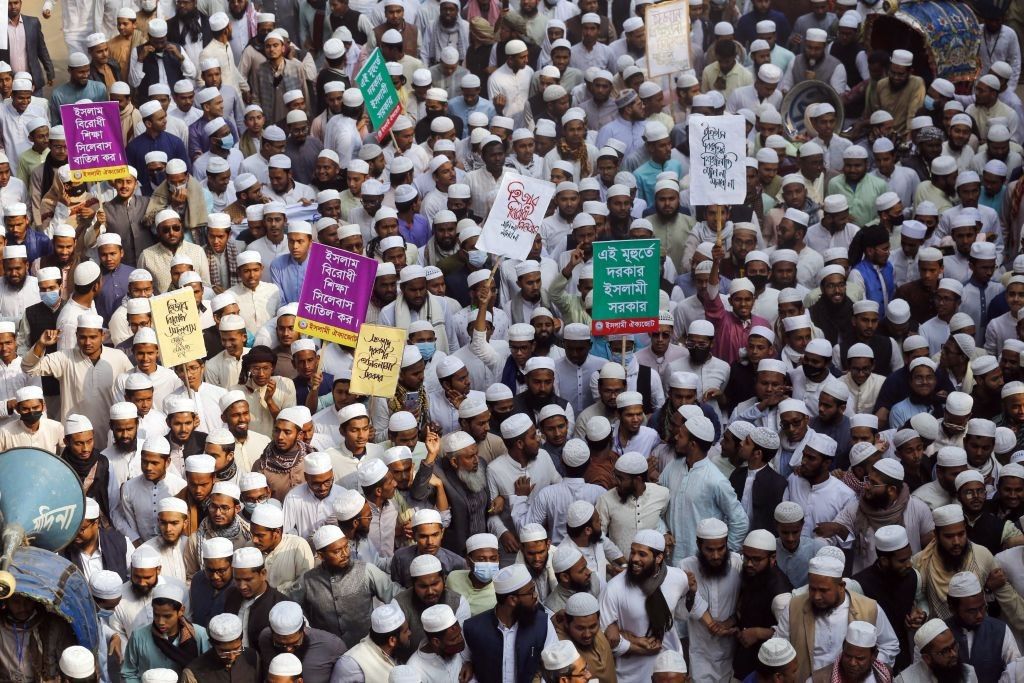
n this photograph taken on January 21, 2023, members of Islamist party ‘Islami Oikyojote’ demonstrate demanding the National Curriculum and Textbook Board (NCTB) scrap changes in the transgender inclusive books for schools in Dhaka. (Photo by REHMAN ASAD/AFP via Getty Images)

By: Pramod Thomas

Bangladesh said Saturday (11) it had withdrawn two new school textbooks after protests from Islamist groups incensed by a curriculum overhaul to recognise transgender identities, same-sex relationships and secular science.

Thousands have demonstrated in the capital Dhaka since last month demanding that the National Curriculum and Textbook Board (NCTB) scrap the changes to the books, published for students aged 11 to 13.

One section of the new history and social science book narrates the story of a child called Sharif who transitions, takes the female name Sharifa and goes to live with other transgender people.

The state-run NCTB said it took the decision to withdraw the books “due to some criticisms and to reduce reading load on students”.

“Many schools in our rural areas don’t have adequate resources to impart lessons from these books and the contents are a little heavy,” said spokesman Mohammad Mashiuzzaman.

“There are also debates over the contents of the books. So we decided to take them out for now so that no one can politicise the issue.”

In 2014, the Bangladeshi government allowed people to identify themselves as belonging to a third gender, and it has in recent years given “hijras” broader rights in areas such as housing and higher education.

Multiple Islamic clerics have even issued decrees declaring them part of the country’s Muslim mainstream.

Several trans people have contested and won local elections.

But the conservative Muslim-majority country’s roughly 1.5 million transgender people still face discrimination and violence, and are often forced into begging or the sex trade to earn money.

The NCTB will also modify the content of two other books, Mashiuzzaman said, referring to titles that Islamist groups claimed were “promoting homosexuality”, distorting Bangladeshi history and criticising the tradition of veil-wearing by Muslim women.

One of the withdrawn books included the theory of evolution pioneered by British naturalist Charles Darwin. The book enraged Islamist groups, who called the theory dangerous and demanded it be dropped from the curriculum.

(AFP)


Barcelona cuts ties with twin city Tel Aviv over Israeli 'apartheid'
Pro-Palestine advocates 'salute' the decision while Israel supporters call it 'antisemitic'

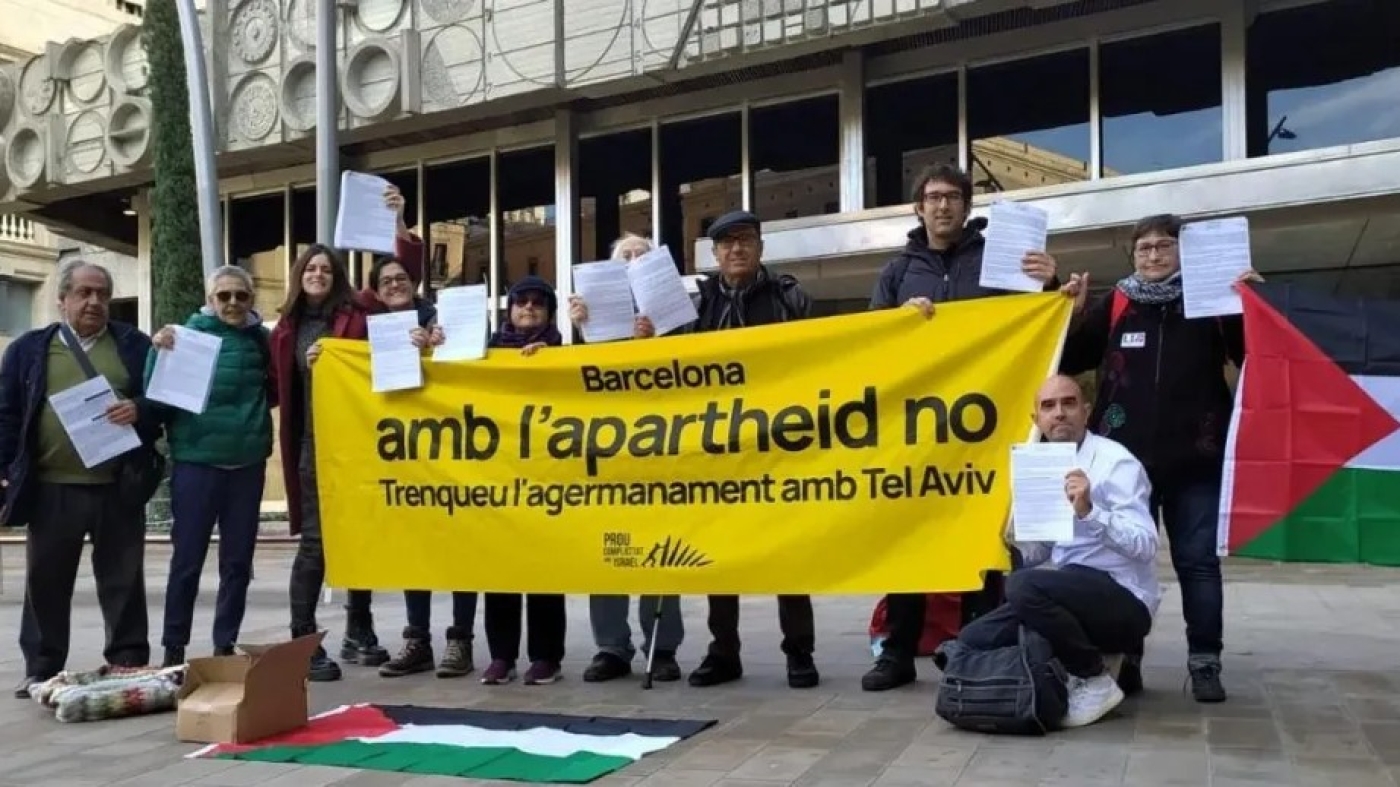
Pro-Palestinian activists presenting their petition to Barcelona's City Hall demanding the city cut ties with Tel Aviv (Twitter/Social Media)

By MEE staff
Published date: 9 February 2023

Barcelona will no longer be twinned with Tel Aviv due to Israel's "apartheid policy" towards Palestinians, the city's mayor announced on Wednesday.

Ada Colau said in a press conference that she wrote to Israeli Prime Minister Benjamin Netanyahu informing him relations between the Spanish city and Israel are severed until "Israeli authorities stop the systematic violation of human rights of the Palestinian people".

She said more than 100 organisations and over 4,000 citizens demanded the city "defends the human rights of Palestinians".

The decision followed a campaign by activists, resulting in an official petition run via Barcelona city hall which gathered more than 4,000 signatures urging the municipality to cut ties with Israel.

Last month, hundreds of pro-Palestine protesters gathered in front of Barcelona City Hall, urging politicians to suspend the twin city agreement with Tel Aviv.

Barcelona, Tel Aviv and Gaza City signed a friendship and cooperation agreement in 1998. Pro-Palestinian activists called for Barcelona's relationship with Gaza City to continue.
In her letter to Netanyahu, Colau said that voters had asked her to "condemn the crime of apartheid against the Palestinian people, support Palestinian and Israeli organisations working for peace and break off the twinning agreement between Barcelona and Tel Aviv."

Barcelona suspended a twinning relationship with the Russian city of St Petersburg last year following the invasion of Ukraine.
Mixed reactions

The decision was welcomed by pro-Palestine campaigners and condemned by Israel supporters and Jewish groups.

The Palestinian Boycott Divestment and Sanctions National Committee (BNC) said it "salutes" Colau and the grassroots groups who helped push the move.

"Barcelona has become the first city council to suspend ties with apartheid Tel Aviv in solidarity with the Palestinian people, a move that is reminiscent of the historic and courageous city councils that pioneered cutting links with apartheid South Africa," BNC said in a statement.


'[The] move is reminiscent of the historic and courageous city councils that pioneered cutting links with apartheid South Africa'
- Boycott Divestment and Sanctions National Committee

The Spanish pro-Israel group Action and Communication on the Middle East, ACOM, called the decision antisemitic and said it will take legal action against Colau.

"The Barcelona City Council has reached a new low by pushing Barcelona to the maximum expression of sectarianism and discrimination, becoming the most openly anti-semitic city in Europe," the group said in a statement.

Lior Haiat, a spokesperson of the Israeli foreign ministry, said on Twitter the the decision gives "support to extremists, terrorist organizations and anti-semitism".

The Federation of Jewish Communities of Spain echoed echoed similar criticism.

"It so happens that Israel is the only Jewish country in the world. Therefore, in our opinion, this decision has nothing to do with politics, human rights or peace. This has a name and is called 'Sophisticated anti-Semitism,'" the federation said.

Multiple leading rights groups - Palestinain, Israeli and international - have accused Israel of apartheid in recent years.

Apartheid is a legal term defined by international law that refers to systematic oppression by one racial group over another.


Mayor of Barcelona suspends all institutional ties with Israel

February 8, 2023 / By Palestinian BDS National Committee (BNC) /


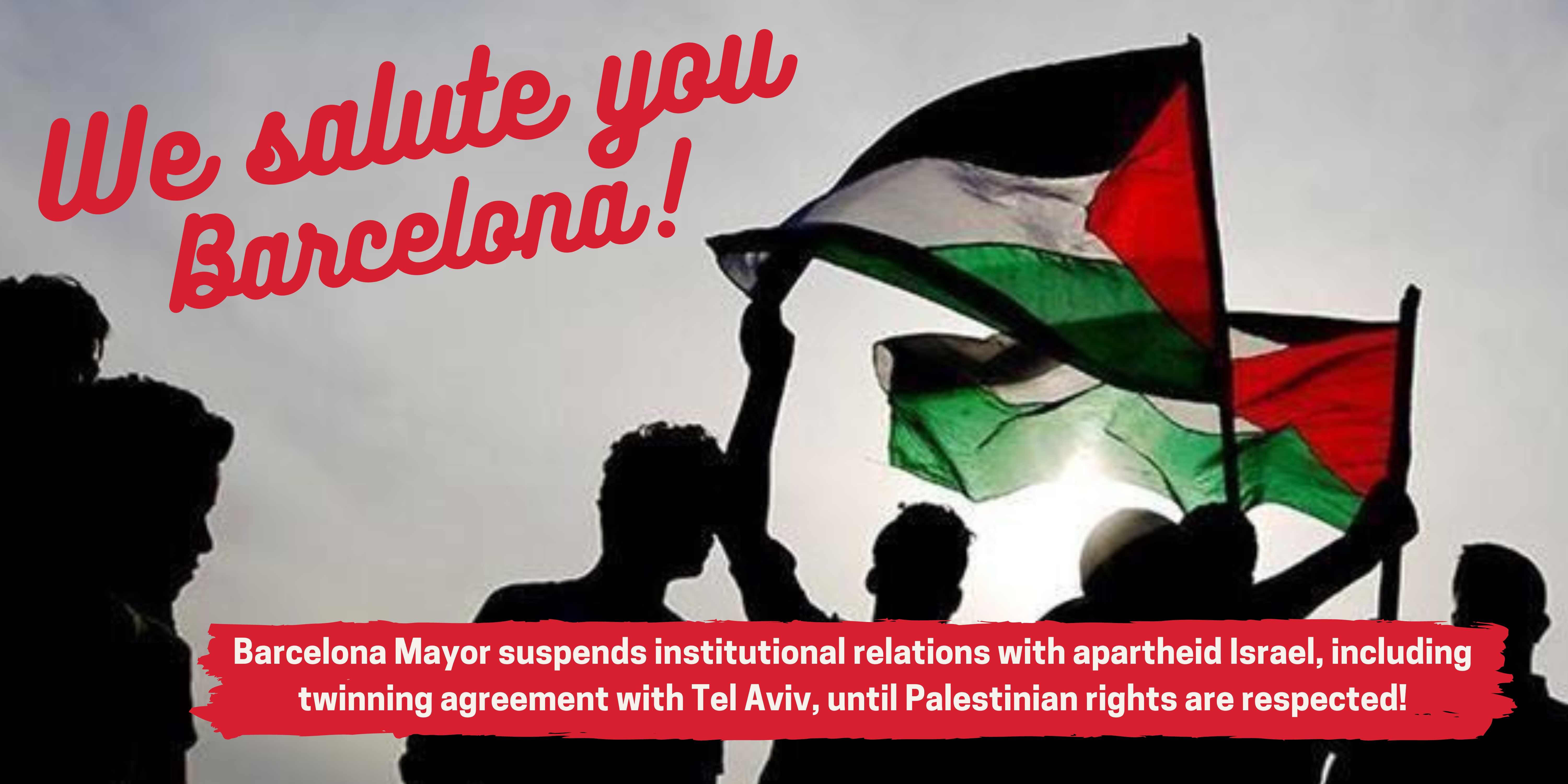
Barcelona Mayor suspends institutional relations with apartheid Israel, including twinning agreement with Tel Aviv, “until the Israeli authorities put an end to the system of violations of Palestinian human rights and fully comply with the obligations imposed on them by international law and the various United Nations resolutions.”

The Palestinian BDS National Committee (BNC), the largest Palestinian coalition leading the BDS movement for freedom, justice and equality, salutes the Mayor of Barcelona, Ada Colau, and the grassroots groups who helped end institutional links with apartheid Israel. Barcelona has become the first city council to suspend ties with apartheid Tel Aviv in solidarity with the Palestinian people, a move that is reminiscent of the historic and courageous city councils that pioneered cutting links with apartheid South Africa.

With the current Israeli government, the most far-right, racist, sexist and homophobic ever, accountability is more needed than ever to end its impunity and #DismantleApartheid. We call on institutions worldwide to follow in Barcelona’s footsteps and end their own involvement in sustaining Israeli crimes against humanity.