Thursday, February 16, 2023

UN launches $1 billion appeal to help Turkey earthquake victims

Issued on: 16/02/2023 - 

The United Nations launched an appeal for $1 billion Thursday to help victims in Turkey of last week's catastrophic earthquake that killed thousands of people and left millions more in desperate need of aid.

UN Secretary-General Antonio Guterres said in a statement that the funds would provide humanitarian relief for three months to 5.2 million people.

The money would "allow aid organizations to rapidly scale up vital support," including in the areas of food security, protection, education, water and shelter, he added.

"The needs are enormous, people are suffering and there's no time to lose," Guterres implored.

"I urge the international community to step up and fully fund this critical effort in response to one of the biggest natural disasters of our times."

The 7.8-magnitude tremor early on February 6 has killed more than 35,000 people in southeast Turkey, with several thousand more losing their lives across the border in Syria.

More than 9 million people in Turkey have been directly impacted by the disaster, according to Ankara.

Turkey's people have experienced "unspeakable heartache," the UN's Emergency Relief Coordinator Martin Griffiths said in a separate statement announcing the flash appeal.

"We must stand with them in their darkest hour and ensure they receive the support they need," added Griffiths, who heads the UN Office for the Coordination of Humanitarian Affairs (OCHA).

OCHA said in its statement that hundreds of thousands of people, including small children and elderly people, are without access to shelter, food, water, heaters and medical care in freezing temperatures.

It added that some 47,000 buildings have been destroyed or damaged across Turkey, with thousands of people having sought refuge in temporary shelters.

The UN is delivering hot meals, food, tents, warm winter clothing, blankets, mattresses, kitchen sets and medical supplies to affected areas, OCHA said.

On Tuesday, the UN launched a $397 million appeal to help quake victims in Syria.

The United Nations earlier provided $50 million to relief efforts through its central emergency response fund.

UN appeals for 1 billion dollars to help earthquake victims

Issued on: 16/02/2023 - 

01:56
Video by:Catherine VIETTE


The United Nations has launched a fund drive for the more than 5 million directly impacted by last week's earthquakes in Turkey and Syria. The world body calling for donors to deliver one billion dollars. The appeal coming as Nato's secretary general prepared to tour quake-stricken areas of southern Turkey. FRANCE 24's Catherine Viette tells us more.

Earthquake in Turkey, Syria: NATO's worst natural disaster

Issued on: 16/02/2023 - 

02:08© france 24
Video by:Shona BHATTACHARYYA

NATO Secretary-General Jens Stoltenberg has described the powerful earthquakes that struck Turkey ten days ago as the military alliance's worst natural disaster. The NATO chief added that the alliance will be setting up temporary housing for thousands of people displaced by the quake while also using its airlifting capabilities to transport tens of thousands of tents. Listen to his speech at a joint news conference with the Turkish Foreign Minister in Ankara and to FRANCE 24's correspondent Shona Bhattacharyya who reports from Istanbul.
Turkey quake tests Erdogan's all-powerful rule

Fulya Ozerkan with Burcin Gercek in Ankara
Thu, February 16, 2023 


When Turkish President Recep Tayyip Erdogan assumed sweeping powers in 2018, he swore the state would deliver more under a centralised system that his critics compare to one-man rule.

Five years on, an agonisingly slow response to a catastrophic quake has undermined that idea, boosting the opposition's case in polls planned for May, experts say.

Erdogan has acknowledged "shortcomings" in the government's handling of Turkey's deadliest disaster of its post-Ottoman history.

More than 36,000 people have died in Turkey and nearly 3,700 in neighbouring Syria. The toll is expected to keep climbing for days to come.

Under pressure like at few points in his two-decade rule, Erdogan blamed obstacles such as freezing temperatures and quake-damaged airports and roads.

No government in the world could have done better, Erdogan said.

The opposition counters that the February 6 quake underlines why Turkey must switch back to a parliamentary system under which agencies have more freedom to act on their own.

"You have centralisation in all Turkish institutions, which is reflected in institutions that specifically should not have it," such as the disaster agency, said Hetav Rojan, a disaster management expert who follows Turkey closely.

- 'Critical hours' -


Rojan argued that the system, which Erdogan secured through a constitutional referendum in 2017, had hamstrung disaster response agencies that need to make snap decisions on their own.

Help took days to arrive in many areas, with distressed residents forced to use their bare hands to try and pull relatives from the rubble.

Others were left without water, food or shelter in freezing temperatures.

Many volunteers who rushed to the region shared on social media how they were forced to wait for authorisations or how equipment was slow to arrive.

The government has since dispatched tens of thousands of soldiers to the scene, reinforcing support for millions of people left homeless by a 7.8-magnitude quake.

But many are still fuming at the initial delay.

The main opposition leader, who is running neck-and-neck with Erdogan in opinion polls, has spearheaded the criticism.

"There wasn't any coordination. They were late in the critical hours," Kemal Kilicdaroglu thundered this week.

"Their incompetence cost the lives of hundreds of thousands of our citizens."

- Unseemly arguments -

For example, it was impossible for crane operators -- who offered critical assistance to rescuers -- to be deployed without the disaster agency's approval.

This cost crucial time, Erdogan's critics say.

Others point to unseemly arguments between state agencies and independent rescue and relief workers on the ground.

AFP journalists witnessed disputes between volunteers and AFAD state disaster responders in Elbistan, near the epicentre of a huge aftershock in Turkey's southeast.

"We started working on this rubble even though the disaster agency discouraged us from it," a volunteer, who did not wish to be named for fear of retribution, told AFP.

"When we finally heard the voice of a survivor, AFAD teams pulled us away and took over our work," he added.

Murat, 48, waiting for news of his loved ones under the rubble in Kahramanmaras, witnessed similar scenes.

"When miners discovered a person alive under the rubble, they were pushed away and people who wanted to appear on camera took their place," he said, also fearing to disclose his last name.

- Controlling the narrative -

Even a non-profit group run by rock star Haluk Levent, as well as opposition-run municipalities that sent in their own rescue teams, have provoked the government's ire.

"The necessary actions will be taken against anyone that tries to rival the state," threatened Interior Minister Suleyman Soylu.

"The (ruling party) government and its institutions are really trying to control the narrative of the current rescue management," Rojan said.

An advertising campaign, called "disaster of the century", had been prepared by an agency close to the government, Turkish media reported.

The aim, critics say, was to convince Turks that any shortcoming is because of the gigantic size of the disaster -- that no one could handle such a catastrophe.

In the face of a public outcry, the campaign was withdrawn.

For Rojan, it's still "too soon" to see if the government's narrative will work.

"It is definitely a political test for Erdogan with upcoming elections," he said.

fo-bg/raz/zak/bp

‘A political quake as well’: Will Turkey’s calamity rattle Erdogan’s rule?

Issued on: 16/02/2023 - 
Text by: Pierre AYAD

Turkish President Recep Tayyip Erdogan has declared last week’s earthquake the deadliest catastrophe since the country’s inception a century ago. With elections on the horizon and anger at the government rising, FRANCE 24 spoke to political analyst Taha Ouda Oglo about the calamity’s possible implications for Turkish politics and the country’s longtime ruler.

Erdogan's Justice and Development Party (AKP) came to power on the heels of the 1999 quake that killed more than 17,000 people and displaced countless more. The new government pledged change, promising that Turkey would be ready for the next quake.

However, this was not the case.

Last week’s disaster exposed a collapse of Ankara’s response capabilities to a natural event of this magnitude. It also left in shambles Erdogan’s rhetoric following the 1999 quake, as promises to make the country quake-proof were not kept. With tens of thousands dead and millions more wounded, homeless or lacking basic facilities, coupled with a possible loss of 1% of the country’s GDP in a time of economic crisis, the calamity has proven to be the worst disaster to face Turkey in its modern history.

With general elections due in May and Erdogan's own future on the line, FRANCE 24 spoke to Turkish political analyst Taha Ouda Oglo about the political repercussions of Turkey's devastating earthquake.

FRANCE 24: The region stricken by the quake has traditionally favoured Erdogan's party at the polls. Is there a specific reason why?

There is a reason why people in this region vote for the AKP. On top of a large population of ethnic Turks, the region is also home to many Kurds who tend to have more conservative views than Kurds elsewhere. This has helped sustain support for the party even as tensions have risen between the government and the Kurdish community.

Erdogan and other government officials have made numerous trips to the area ahead of the elections. Lots of pro-AKP rallies were held there before the earthquake as the region has historically been a large reservoir of votes for the ruling party. That being said, the situation has changed dramatically since the earthquake as anger and despair grip the region. At the moment, supporting the AKP is the least of these people’s concerns.

FRANCE 24: How could the earthquake affect Erdogan's image and that of his party, both in stricken areas and the broader country?

Erdogan and his government benefited from a broadly positive image before the quake as several efforts were directed to improve the economy. This made Erdogan confident enough to seek an early general election in May. The AKP was hoping to capitalise on economic progress to ensure its re-election. However, after this unforeseeable calamity, all bets are off.

The people in quake-stricken areas are now resentful. They feel that money was used to revamp Istanbul’s infrastructure and make it quake-resistant but that nothing was allocated to the regions where the disaster actually hit.

Moreover, there is an admission of guilt by the government, which acknowledged failings in its response to the disaster. But there is more to it. The government did not hold people accountable over buildings with glaring code violations. At the moment, the authorities are arresting many contractors responsible for building deficient structures, but this isn’t enough.

Across Turkey, people are asking what happened to money that was earmarked to upgrading the country's infrastructure. They are asking why the authorities failed to enforce modern construction codes and turned a blind eye to code violations. (...) The fact that Turkey is now relying on international help, including from countries Ankara doesn't get along with, has only increased the people's anger and the country's sense of helplessness.

FRANCE 24: What impact could this have on the May elections, assuming they take place?

This is not just an earthquake; it's a political quake as well. The opposition will definitely use this as ammunition against the government. On the other hand, the authorities are now in a race against time to do what good they can ahead of the elections to ensure their political survival.

There is talk of postponing the elections until June – or even later if the government cannot get out of this situation. We have no idea, it is too soon to tell. What is certain is that the government is in a very tight spot not just because of the earthquake and the ensuing human tragedy, but also because of its electability. We will have a clearer picture within the coming weeks, when the full scope of this catastrophe becomes apparent. But at the moment, the people are angry and sad, and no one wants to think about the political implications.

Syria quake survivors battle cold in tents and vehicles

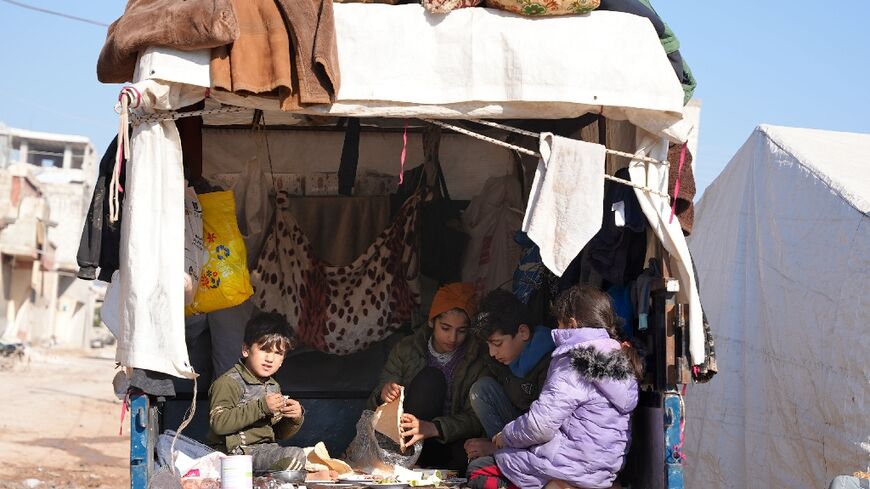
A Syrian family has sheltered inside a small truck since the deadly February 6 earthquake hit Turkey and Syria - Rami al SAYED

by RAMI AL-SAYED
February 16, 2023 — Jindayris (Syria) (AFP)

Since the earthquake destroyed her home, Syrian teacher Suzanne Abdallah has lived in a small truck crammed with her family members, just a stone's throw from where their house stood.

"Ten of us pile into this truck. We sleep sitting up," said the 42-year-old, wearing multiple layers of clothes and a wooled scarf wrapped around her head against the biting winter cold.

Her infant boy was sleeping in a makeshift hammock made from a blanket that was swinging from the packed vehicle's roof, as seven other children were sharing a basic breakfast inside.

"Conditions are difficult, especially as I have a toddler," said Abdallah. "I woke up this morning and found his hands were extremely cold, so I put him in the sun to warm him.

"We want a shelter; we need help for the sake of the little children."


Abdallah and her family are among several million Syrians made homeless, according to UN estimates, by the 7.8-magnitude quake that also devastated vast areas of Turkey.

More than 40,000 people were killed across the two countries by the February 6 disaster that flattened entire districts, including in Abdallah's home city of Jindayris on the Turkish border.

Syria's people have endured more than a decade of brutal civil war, and many fled to the rebel-held Idlib province from other regions now under the control of President Bashar al-Assad's forces.

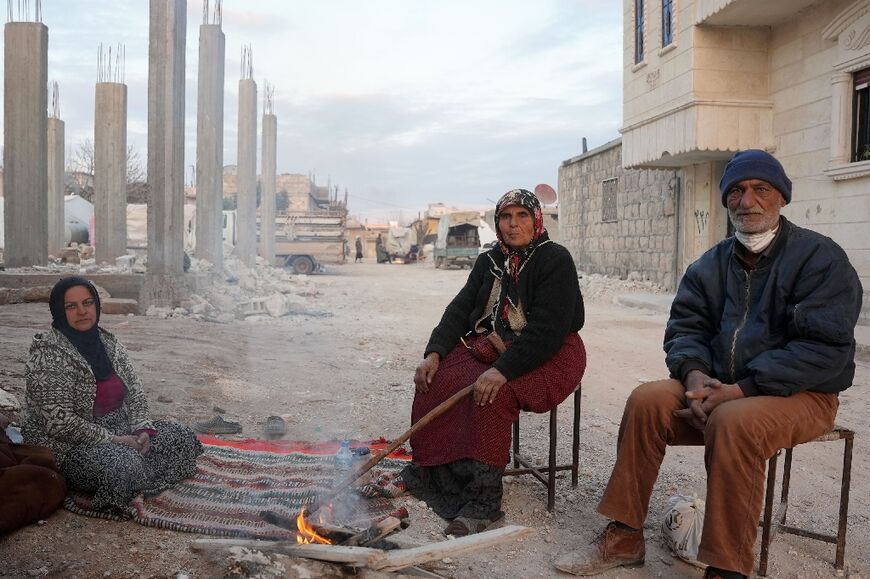
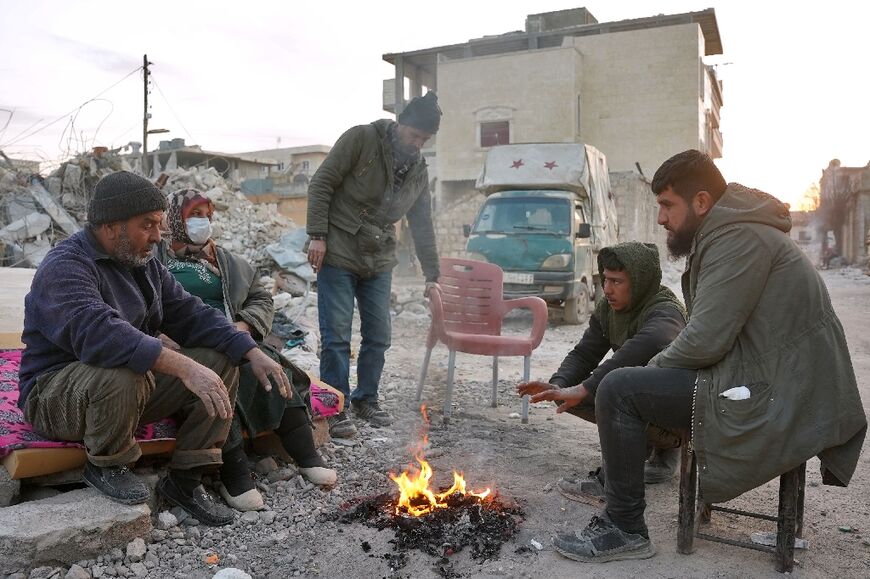
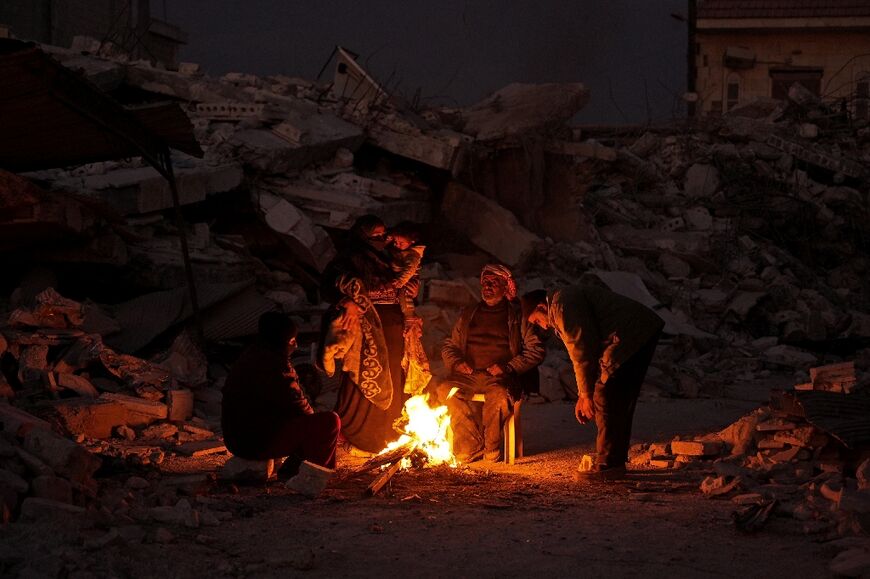
Survivors of the powerful quake have since huddled in whatever places they could find, many sleeping in tents and vehicles, others huddling around fires outside.

- 'Lives are tragic' -


Abdallah's father-in-law turned his vehicle into a makeshift home for his sons and their families, covering the top of the truck with blankets and rugs for added insulation.


"Living in a car is difficult; we are two households," Abdallah told AFP.

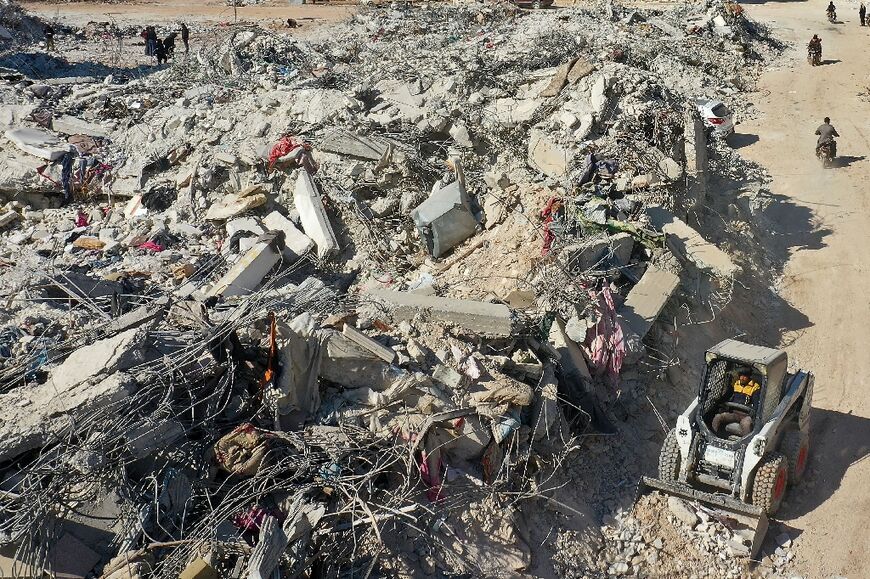
Around here, much of the district has been reduced to rubble, from which rescuers from the White Helmets group recovered more than 500 bodies.

Jindayris is among the cities worst-hit by the quake that killed more than 3,600 people across five Syrian provinces, claiming the highest death tolls in Idlib and Aleppo.

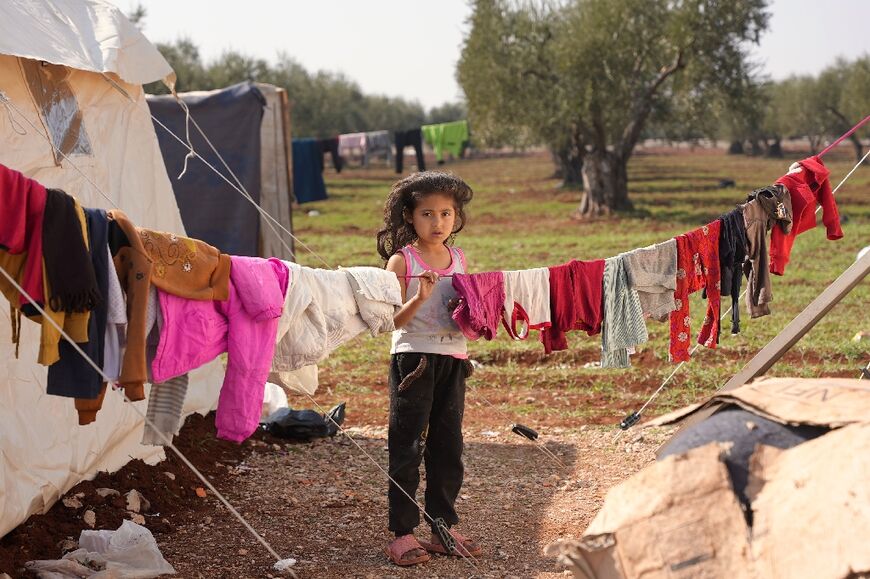
Families here have slept in schools, mosques and displacement camps or in basic shelters built in open spaces such as olive groves and public squares.

Across the town, the families of retired employee Abdelrahman Haji Ahmed and his neighbours now live in makeshift tents pitched in the middle of their demolished street.


At night, the women and children huddle inside them, under tattered plastic sheets and blankets, while Ahmed and the other men sleep under the stars.

"There is no electricity, no water, no sanitation," he told AFP, his ruined former home behind him. "The lives of all the families are tragic."

Ahmed held his little daughter, watched on by other children, and said that right now all his family needs is "one or two tents so that the families can rest.

"Then we will see what to do next, but this is what we ask for now," he added. "We are not thinking about the future. The situation we are in now does not allow it."

- 'No longer tolerable' -

Some international aid has arrived in the region, including in truck convoys that crossed the Turkish borders, but many here remain in desperate need.


The UN Office for the Coordination of Humanitarian Affairs says shelters are among the top priority needs, along with emergency food, heating and hygiene facilities.

The UN children's agency UNICEF stresses the urgent need for "access to safe drinking water and sanitation services, which are critical in preventing illness" following the quake.

In another camp, on the outskirts of Jindayris, 63-year-old Khawthar al-Shaqi now lives with her daughter and grandchildren after spending the first four nights in the open.

"We took refuge in the camp where we could find a shelter," said Shaqi, who years ago fled her home city of Homs and says she now lacks the means to meet even their most basic needs.


"We cannot afford to buy a bottle of water or clothes," she said as the little children played outside the tent. "If we want to go to the city, we do not have transportation or money."

"Conditions are no longer tolerable and we don't know what to do with the children. Here we are sitting in the cold... We have nothing but God's mercy."

Syria's Assad thanks 'Arab brothers' for quake aid

Issued on: 16/02/2023 - 20:50Modified: 16/02/2023 - 20:48


Damascus (AFP) – Syrian President Bashar al-Assad on Thursday thanked his "Arab brothers" for aid supplied following last week's deadly earthquake, that saw countries in the region break with years of diplomatic silence.

The 7.8-magnitude quake hit Turkey and Syria on February 6, leaving a combined death toll of nearly 40,000 people.

Since then, Assad has received calls from the leaders of several Arab countries, including those that cut off ties with Syria over a decade ago over bloodshed during its civil war.

Some 120 planes laden with assistance have also landed in the country's airports, about half of them from the United Arab Emirates, which restored ties with Syria in late 2018.

"We cannot overlook expressing thanks to all the countries that stood by us since the first hours of the disaster from among our Arab brothers and our friends," Assad said, during a televised speech Thursday.

"Their aid had a major impact on enhancing our ability to confront the difficult conditions at critical hours," he continued.

At least 3,600 Syrians died in the quake, which came nearly 12 years into the country's civil war -- that has devastated swathes of the country, killed nearly half a million people and displaced millions more.

"The size of the catastrophe and the tasks that fall upon us are much greater than the available capacities," Assad said, adding that the country would continue to face deep social and economic challenges for years to come.

Aid efforts to Syria have been led by the UAE, which has been at the forefront of moves to break Damascus's isolation and bring it back into the Arab fold.

But the disaster also saw Saudi Arabia send two planes carrying aid to Syria since Tuesday -- a first in more than a decade.

Assad has also met the foreign ministers of the UAE and Jordan in Damascus, as well as receiving calls from the leaders of Egypt, Bahrain and Jordan.

© 2023 AFP

Ten deadliest quakes of the past 100 years

Paris (AFP) – With the estimated death toll still mounting, the massive earthquake that struck Turkey and Syria on February 6 is among the 10 deadliest of the past 100 years, with over 41,000 dead as of Friday.

- 1976: 242,000 dead, China -

A quake measuring 7.8, according to the Chinee authorities, (7.5 according to the US Geological Survey), strikes near the industrial city of Tangshan in northeastern Hebei province. The official death toll is given as 242,000 but is believed to be significantly higher.

Western experts put the toll as high as 700,000, which would make it the second most deadly in the history of mankind, after the huge 1556 disaster that struck northern Shaanxi province, with estimates of the toll put at more than 830,000 people.

2004: 230,000 dead, southeast Asia

On December 26, 2004, a massive 9.1-magnitude earthquake strikes off the coast of Sumatra, triggering a tsunami that kills more than 230,000 people throughout the region, including 170,000 in Indonesia alone.

Waves 30 metres (100 feet) high, travelling at 700 kilometres per hour (435 miles per hour), swallow everything in their path.

2010: 200,000 dead, Haiti

A magnitude 7 quake on January 12, 2010, devastates the capital Port-au-Prince and the surrounding region.

The quake cuts the country off from the rest of the world for 24 hours, killing over 200,000 people, leaving 1.5 million homeless and shattering much of Haiti's frail infrastructure.

In October the same year, Haiti is also hit by a cholera epidemic introduced by Nepalese peacekeepers who arrived after the quake. It kills more than 10,000 people.

1923: 142,000 dead, Japan

On September 1, 1923, two minutes before noon, a 7.9-quake shakes Kanto in Japan. More than 142,000 people die in the earthquake and resulting fire, which destroys Tokyo.

1948: 110,000 dead, Turkmenistan

On October 5, 1948, at least 110,000 people are killed in a 7.3-quake in and around Ashgabat, the capital of Turkmenistan, which at the time was part of the Soviet Union.

2008: 87,000 dead, Sichuan

More than 87,000 people, including 5,335 school pupils, are left dead or missing when a 7.9-magnitude quake strikes China's southwestern Sichuan province on May 12, 2008.

The quake causes outrage after it emerges that 7,000 schools were badly damaged, triggering accusations of shoddy construction, corner-cutting and possible corruption, especially as many other buildings nearby held firm.

2005: 73,000 dead, Kashmir

An earthquake on October 8, 2005, kills more than 73,000 people, most in Pakistan's North-West Frontier Province and the Pakistani-administered zone of Kashmir.

A further 3.5 million are displaced.

1932: 70,000 dead, China

On December 25, 1932, a 7.9-magnitude quake kills around 70,000 in Gansu province, in northwest China.

1970: 67,000 dead, Peru

On May 31, 1970, a 7.9-magnitude quake off Peru's north coast leaves some 67,000 dead, many in the mountain city of Huaraz that was buried by a mudslide.

2023: already 41,000 dead, Turkey and Syria

On February 6, a 7.8-magnitude quake strikes near the Turkish city of Gaziantep, close to the Syrian border.

The biggest quake in Turkey in nearly a century, which is followed by a 7.5-magnitude tremor, reduces entire neighbourhoods of cities in southeastern Turkey and the north of war-ravaged Syria to rubble.

On February 17, officials and medics said 38,044 people had died in Turkey and 3,688 in Syria, bringing the confirmed total to 41,732.

Spanish lawmakers give final approval to Europe's first 'menstrual leave' law

Issued on: 16/02/2023 - 

01:36
Text by: NEWS WIRES|
Video by: Sarah MORRIS

Spanish lawmakers on Thursday gave final approval to a law granting paid medical leave to women suffering severe period pain, becoming the first European country to advance 

The law, which passed by 185 votes in favour to 154 against, is aimed at breaking a taboo on the subject, the government has said.

Menstrual leave is currently offered only in a small number of countries across the globe, among them Japan, Indonesia and Zambia.

"It is a historic day for feminist progress," Equality Minister Irene Montero tweeted ahead of the vote.

The legislation entitles workers experiencing period pain to as much time off as they need, with the state social security system – not employers – picking up the tab for the sick leave.

As with paid leave for other health reasons, a doctor must approve the temporary medical incapacity.

The length of sick leave that doctors will be able to grant to women suffering from painful periods has not been specified in the law.

About a third of women who menstruate suffer from severe pain, according to the Spanish Gynaecology and Obstetrics Society.

The measure has created divisions among both politicians and unions, with the UGT, one of Spain's largest trade unions, warning it could stigmatise women in the workplace and favour the recruitment of men.

The main opposition conservative Popular Party (PP) also warned the law risks "stigmatising" women and could have "negative consequences in the labour market" for them.

"Menstrual leave" is one of the key measures in the broader legislation, which also provides for increased access to abortion in public hospitals.

Less than 15 percent of abortions performed in the country take place in such institutions, mainly because of conscientious objections by doctors.

The new law also allows minors to have abortions without parental permission at 16 and 17 years of age, reversing a requirement introduced by a previous conservative government in 2015.

Spain, a European leader in women's rights, decriminalised abortion in 1985, and in 2010, it passed a law that allows women to opt freely for abortion during the first 14 weeks of pregnancy in most cases.

(AFP)
Iran uprising enters 'political phase' involving Mousavi & influential leaders across civil society

Issued on: 16/02/2023 - 
07:35

Iran has been rocked by a civil uprising since mid-September, sparked by the death of Mahsa Amini, 22, accused of breaching the Islamic republic's dress code for women. The movement gradually morphed from a push against repression into a movement calling for all-out regime change. While mass demonstrations have begun to subside, public displays of anger remain, political demands are multiplying across civil society, and a divided opposition, in and outside of the country, insist the endgame is regime change. For more on this new political phase of Iran's civil uprising, FRANCE 24 is joined by Chowra Makaremi, Anthropologist, Iran Specialist and Head of Research for the CNRS at The French Institute for International and Strategic Affairs (IRIS).


Iran anti-government protests: More than 520 protesters killed by security forces


01:43

Issued on: 16/02/2023 - 

It's now 5 months since in Iran, Mahsa Amini, died in police custody, shortly after being arrested for not adhering to the country's rules on how women should cover their heads in public. Her death sparked the biggest political unrest in Iran for years, with thousands of women and men taking to the streets. Many who demonstrated were either arrested or killed. FRANCE 2's team and FRANCE 24's Camille Knight report.


Gatland would not support Welsh players' strike ahead of Six Nations clash

Issued on: 16/02/2023 - 

London (AFP) – Wales head coach Warren Gatland would not support his players if they decided to strike ahead of their Six Nations clash with England.

Strike action is a possibility due to ongoing uncertainty caused by Welsh rugby's professional contracts freeze.

On Thursday the Welsh Rugby Players' Association (WRPA) said the delay was causing "unacceptable strain on mental health and overall wellbeing".

A new financial agreement between the four Welsh regions and the Welsh Rugby Union has still to be confirmed in writing.

That has sparked concern that a sizeable number of players whose contracts expire at the end of this season will head away from Wales due to the huge sense of uncertainty over their futures.

When asked if he would support a player strike, Gatland said: "No."

The New Zealander added: "I completely support the stance that they're taking in terms of wanting to get some resolution of the issues that they have, but I think there's a lot more involved, a lot of things at stake in terms of ensuring that that fixture does take place.

"Like I've said, I'm supportive of the players and the things that they're trying to do, and my role is just to prepare the team for next week."

Wales are due to host England in Cardiff on February 25.

Strike the 'last option'

Former captain Alun Wyn Jones said a strike was the "last option" available to players frustrated by their treatment over a long period of time.

"It's hard to deny, but it's the very last option," said Wyn Jones, the most capped international player of all time, about the possibility of a strike.

"There are people who are really impassioned. Ultimately, if you treat people badly for long enough, you get to where we find ourselves.

"We realise what we do and how fortunate we are to do it, but if this was any other line of work or any other industry for this period of time with this amount of uncertainty, you'd get the same reaction.

Gatland is in his second stint in charge of Wales after a hugely successful spell between 2007 and 2019.

But his return has so far failed to halt a poor run of results with heavy defeats to Ireland and Scotland to open the Six Nations.

"I'm in complete support of the players in terms of the WRPA, which to me in my time here has been incredibly weak as an organisation," said Gatland.

"I've stressed on a number of occasions to the players that they need to be stronger, they need to have more voices, they need to be around the table from a consultation point of view.

"From that regard, I think it's a huge positive for the players and that relationship with the union going forward because they need to be part of all the discussions that take place.

"I'm sure the players, like us, would like things resolved hopefully as quickly as possible."

Reports of a strike threat come at a time of turmoil for Welsh rugby both on and off the field.

Last month, then-WRU chief executive Steve Phillips resigned after a BBC documentary made allegations of sexism at the governing body.

© 2023 AFP
CRIMINAL CAPITALI$M
French company charged over baby milk salmonella scandal

Issued on: 16/02/2023 - 

Paris (AFP) – French food company Lactalis said Thursday it had been charged over a five-year-old global scandal in which dozens of babies fell sick from salmonella-contaminated powdered formula milk.

Prosecutors brought the criminal charges, also targeting the group's Celia Laiterie de Craon factory, for serious fraud, involuntarily bodily harm and a failure to carry out a recall order for the tainted milk, it said.


Lactalis, one of the world's biggest dairy groups, said it was cooperating with the investigation.

Several babies were diagnosed with salmonella poisoning at the end of 2017 in France after being given milk products, mostly Lactalis-owned Milumel and Picot brands, delivered by the Craon factory, in the northwest.

In France alone, 36 babies showed salmonella symptoms within three days of being given Lactalis products.

Spain and Greece also reported cases, with Lactalis admitting at the time that its powdered milk in more than 80 other countries was affected.

Salmonella poisoning symptoms can range from relatively benign gastroenteritis, to serious disease in very young children, old people and patients with weakened immunity.

Prosecutors accuse Lactalis of failing to promptly carry out a recall to limit the damage, and said they had identified several problems in its production chain leading to the contamination in the first place.

Lactalis in mid-January 2018 pulled all powdered milk produced by Craon from the shelves, more than 12 million packages.

The company and its reclusive chief executive, billionaire Emmanuel Besnier, were harshly criticised for failing to address the problem publicly for weeks.

In 2018, Lactalis still claimed the contamination had been caused by work done at the factory in the first half of 2017.

But France's leading bacteriology body, the Institut Pasteur, found the bacteria had been present in the site's production since 2005.

Several hundred people filed lawsuits against Lactalis, mostly for fraud, and investigators took dozens of witness statements.

Thursday's charges were "proof of the existence of serious and confirmed evidence in this case", Jade Dousselin, a lawyer for a consumer association of claimants in the case, told AFP.

She said the move was "the first step towards a conviction of those responsible for this big health scandal".

A spokeswoman for NGO Foodwatch, Ingrid Kragl, said she hoped for "exemplary sanctions" that would end what she called a "climate of impunity" for food companies.

A 2022 study of the case submitted to investigators and seen by AFP found Lactalis had shown a "lack of vigilance, or even blindness" concerning repeated signs that its production had become unsafe.

burs/jh/ah/bp
Boat carrying 71 Rohingya refugees lands in Indonesia


By Riska Munawarah and Yayan Zamzami | AP
February 16, 2023

ACEH BESAR, Indonesia — A boat carrying 71 weak and hungry Rohingya Muslims fleeing from refugee camps in Bangladesh landed Thursday in Indonesia’s northernmost province of Aceh, local officials said.

Fifteen-year-old Shorif Uddin, who was on the boat with his parents, said two or three people died while they were at sea because of a lack of food.

“We have been traveling so long and did not have any food to eat. We are really hungry,” he said.

He said the Rohingya had been unable to find work or achieve higher education in the refugee camps and decided to leave Bangladesh for Indonesia.

His parents paid money to board the boat along with other refugees, but the captain fled the vessel as it was passing India, Uddin said.

Miftach Cut Adek, the leader of the tribal fishing community in Lampanah Leungah village in Aceh Besar district, where the boat landed, said it was in good condition and the engine was working.

The 71 Rohingya on board included 21 women and 20 children.

More than 700,000 Rohingya Muslims fled from Buddhist-majority Myanmar to refugee camps in Bangladesh after an army-led crackdown in August 2017. Myanmar security forces have been accused of mass rapes, killings and the burning of thousands of Rohingya homes.

Most of the refugees who have left the camps by sea have attempted to reach Muslim-majority Malaysia, but many have ended up in Indonesia along the way.

More than 500 Rohingya landed in Aceh last year. The most recent group was in early January, when 184 people landed on Kuala Gigieng beach, also in Aceh Besar district.

___

Associated Press writer Edna Tarigan in Jakarta, Indonesia, contributed to this report.


Tensions brew in Germany over refugee arrivals

Femke COLBORNE
Thu, 16 February 2023 


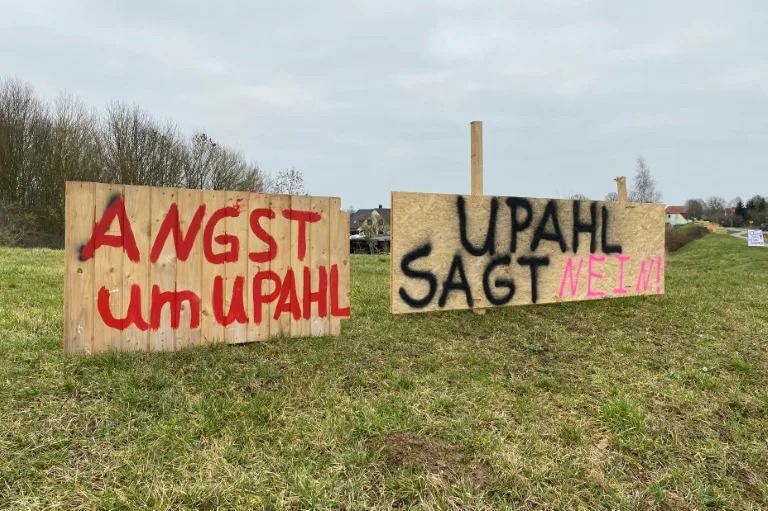
The main road through the northern German village of Upahl is lined with wooden placards, their bright letters standing out against the grey sky and muddy fields.

"Upahl says no", reads one. "Think of our children!" says another.

They are referring to a planned centre for 400 asylum seekers in the town, which itself has a population of just 500.

Like many communities across Germany, the district of Northwestern Mecklenburg, where Upahl is located, has witnessed an increase in arrivals of refugees and asylum seekers in recent months.

Almost 218,000 asylum applications were filed in Germany last year -- more than twice as many as in 2020 and the biggest number since the influx of 2015-16.

In 2022, the largest number of people seeking asylum hailed from war-torn Syria and Afghanistan, followed by Turkey and Iraq.

In addition, more than a million people arrived from Ukraine -- granted a special status that means they do not need to apply for asylum to be allowed to remain in Germany.

To cope with the arrivals, sports halls have been requisitioned in Northwestern Mecklenburg as temporary housing for newcomers.

- Quiet life -


But with current capacity exhausted and between 20 and 30 new arrivals every week, local officials have voted to set up a new centre in Upahl using converted transport containers. It is set to open in March.

"Due to the many people who have come to us (from Ukraine) plus the asylum seekers... we have a situation that we can no longer cope with," Tino Schomann, chief administrative officer for the district, told AFP.

"I need more places, more capacity," he said.

But some locals are opposed to the centre and have staged demonstrations against the plans.

"Life in Upahl is so beautiful because everything is very quiet," said Jan Achilles, 46, an environmental analyst who is also a community representative.

The container centre would change that, he says.

Retired truck driver Bernd Wien, 66, who has lived in Upahl since 1980, has been at all the demos.

"We just want to live here quietly, to enjoy our retirement," he said.

After months of pleading from local officials across Germany for more help to deal with new arrivals, Interior Minister Nancy Faeser on Thursday hosted a meeting to address the issue.

But despite a promise from Faeser that the government was "standing side by side" with local communities to "shoulder this great humanitarian feat", no concrete measures were agreed.

Reinhard Sager, head of the German Districts Association, called for Chancellor Olaf Scholz to take the matter into his own hands.

"The municipalities in Germany are really doing a great job and the willingness of private individuals to help is still great," Sager said.

But "we urgently need to relieve the pressure on (local authorities) -- the pressure is considerable and is increasing from day to day, from week to week."

- Far-right fears -

In 2015-16, the far-right Alternative for Germany (AfD) party harnessed anger at Germany's influx of asylum seekers to win votes and ultimately enter parliament for the first time.

Right-wing extremists have been spotted at recent protests in Upahl and elsewhere, and fears are growing that the current tensions could provide a further boost to the far-right party.

"The general situation is ultimately far more dramatic than in 2015 due to the war, inflation, economic crises and new refugees," Hajo Funke, a political scientist at the Free University of Berlin, told AFP.

According to a recent survey by pollster INSA, around half of Germans -- 51 percent -- believe the country is taking in too many refugees.

Upahl resident Anika Reisch, 38, has sympathy for people coming to the village "who are traumatised, who are worried about the future".

But the mother of two, who runs an insurance business around the corner from the planned new centre, still does not want it on her doorstep.

"It can't go well for the people who come here either. They have no privacy at all. They can't... come to terms with everything they have experienced. That can't go well for either side," she said.