It’s possible that I shall make an ass of myself. But in that case one can always get out of it with a little dialectic. I have, of course, so worded my proposition as to be right either way (K.Marx, Letter to F.Engels on the Indian Mutiny)
Thursday, February 16, 2023
CRYPTO CRIMINAL CAPITALI$M
Prosecutors urge tight limits on Bankman-Fried's internet use
FEBRUARY 15, 2023
Former FTX chief executive Sam Bankman-Fried leaves federal court
in New York City, US on Feb 9, 2023.
Reuters
NEW YORK - US prosecutors on Wednesday (Feb 15) urged a judge to impose tight restrictions on indicted FTX cryptocurrency exchange founder Sam Bankman-Fried's internet use, arguing existing conditions "leave too much room for inappropriate conduct."
Separately, court documents earlier on Wednesday revealed that a former Stanford University law school dean and a computer science researcher at the school co-signed Bankman-Fried's bond alongside his parents.
He is out on US$250 million (S$334 million) bond after pleading not guilty to fraud charges stemming from now-bankrupt FTX's collapse.
As conditions of his bail, US District Judge Lewis Kaplan has barred the 30-year-old former billionaire from contacting current or former employees at his exchange and Alameda Research hedge fund, and from using encrypted messaging apps such as Signal that let users auto-delete messages.
That ban came after federal prosecutors in Manhattan raised concerns Bankman-Fried may be trying to influence potential witnesses ahead of his October trial on charges of diverting billions of dollars in FTX customer funds to his hedge fund, Alameda Research.
On Wednesday, prosecutors said Bankman-Fried's use of a virtual private network (VPN) to access the internet after the ban was imposed raised further concerns.
They urged Kaplan to bar him altogether from using the internet except to review evidence against him or use email on his Gmail account.
"The defendant is a technologically sophisticated person with both the ability and the inclination to seek workarounds of more narrowly drawn bail conditions," prosecutors wrote.
He should be allowed to use voice calls and SMS messages on his cell phone, but should only be allowed to use Zoom to communicate with his lawyers, prosecutors wrote.
Bankman-Fried's lawyers said his efforts to contact FTX's current general counsel and chief executive were attempts to help, not to interfere.
They said he used a VPN to watch National Football League playoff games because he had purchased an international subscription while living in the Bahamas.
They nonetheless proposed adding a bail condition that barred him from using a VPN unless one was needed to access prosecutors' evidence so he could prepare his defence.
They proposed letting him communicate by phone, email, SMS text messaging and Twitter direct messaging, while disabling iMessage from his phone.
Kaplan is set to hold a hearing on Bankman-Fried's bail conditions on Thursday.
Bond guarantors
Earlier on Wednesday, Kaplan ordered the release of documents showing former Stanford Law School dean Larry Kramer signed a US$500,000 bond to ensure Bankman-Fried's return to court, and Stanford computer science researcher Andreas Paepcke signed a US$200,000 bond.
Bankman-Fried's parents Joseph Bankman and Barbara Fried, who are both Stanford law professors, had pledged their Palo Alto, California home as collateral as part of the US$250 million bail package ensuring their son's return to court.
The names of the two other sureties were redacted, but Kaplan later ruled in favour of media outlets including Reuters that argued the public had a right to know their identities.
Bankman-Fried argued the guarantors safety was at risk, but decided not to pursue an appeal of Kaplan's ruling, according to a person familiar with the matter.
In a statement, Kramer said he and his wife have been friends with Bankman and Fried for decades. He said they had been supportive in the past two years "while my family faced a harrowing battle with cancer".
"In turn, we have sought to support them as they face their own crisis," Kramer wrote. "My actions are in my personal capacity, and I have no business dealings or interest in this matter other than to help our loyal and steadfast friends."
Will Man Utd become football's latest Gulf-backed project?
Issued on: 16/02/2023
Manchester (United Kingdom) (AFP) – Prospective new owners of Manchester United have until Friday to reveal their interest in buying one of the world's biggest clubs, with the British press reporting a bid from Qatar which, if successful, will send shockwaves through European football.
United's current American owners, the Glazer family, opened the door to fresh investment in the English giants in November, either in the form of a minority stake or a full takeover.
Deeply unpopular with supporters since they saddled the club with huge debts in a £790 million ($961m) leveraged takeover in 2005, the Glazers are ready to cash out their chips at an enormous profit.
According to reports, they are seeking £6 billion for the three-time European champions, which would smash the record fee for a football club set by Chelsea last year.
A consortium led by LA Dodgers co-owner Todd Boehly and private equity firm Clearlake Capital paid £2.5 billion for the Blues with a further £1.75 billion promised in further investment in infrastructure and players.
To date only British billionaire Jim Ratcliffe, owner of petrochemicals giant Ineos which also controls French club Nice, has come forward publicly as a potential buyer for United.
But reports of a bid backed by Qatar's emir, Sheikh Tamim bin Hamad Al-Thani, refuse to go away.
PSG power and influence
Qatar already wields plenty of influence in European football's corridors of power.
Paris Saint-Germain have dominated French football since a takeover by Qatar Sports Investments -- a subsidiary of the state's sovereign wealth fund -- in 2011 and lured some of the game's biggest stars such as Lionel Messi, Kylian Mbappe and Neymar to the Parc des Princes.
Nasser al-Khelaifi, president of PSG, is also chairman of the powerful European Club Association.
Just months after hosting the 2022 World Cup, a successful Qatari bid would give the Gulf state pride of place in the Premier League -- the world's most-watched domestic competition.
"Qatar's investment into PSG has been tremendously successful but no other sporting league in the world has so much global exposure as the EPL (English Premier League)," said Danyel Reiche, associate professor of international relations at Georgetown University's Qatar campus.
"Therefore, acquiring Manchester United would totally make sense."
Ownership of United could also offer Qatar the chance to take bragging rights over gulf neighbours Abu Dhabi and Saudi Arabia's stakes in English football.
Abu Dhabi's investment in Manchester City has transformed them into the Premier League's dominant force, winning six titles in the last 11 seasons.
Newcastle United are flying high in fourth and into the League Cup final for the first time in 47 years just 16 months after a takeover from the Saudi sovereign wealth fund.
But neither City or Newcastle boast United's tradition of 20 English titles and a massive global fanbase.
"The Gulf investments into European football clubs cannot be seen in pure economic terms. They serve the purpose of nation branding and as an international relations tool," added Reiche.
"The rivalry between two countries in just one town, with Manchester City being owned by the UAE and Manchester United by Qatar, would be a new escalation in the rivalry between two countries with recently worsened relations."
Regulatory hurdles
A Qatari bid would have a series of regulatory hurdles to clear.
Amnesty International have called on the Premier League to tighten ownership rules to ensure they are "human rights-compliant and not an opportunity for more sportswashing."
But the precedent set in green-lighting investment from Abu Dhabi and Saudi Arabia make it highly unlikely the Premier League would block a takeover.
UEFA's rules that preclude two clubs being "directly or indirectly" controlled by the same entity from competing in the Champions League may be more troublesome.
A source with knowledge of the bid insisted to AFP that the bidders are not connected to the owners of PSG.
"The most important thing is that the potential bidder is neither QSI nor QIA (the Qatar Investment Authority sovereign wealth fund), it is a completely different fund," the source said.
Trying to draw a distinction between Qatari-based funds will be met with scepticism from rival clubs.
However, Germany's RB Leipzig and Austrian champions Salzburg have found a way around UEFA's rules and have been able to participate in the same competition despite both being backed by Red Bull.
United have been in the doldrums since former manager Alex Ferguson signed off at Old Trafford with the club's last league title a decade ago.
The Red Devils have not won any trophy for six years and failed to qualify for this season's Champions League.
Friday's deadline for bids to come forward could herald the start of a successful new era on the field fuelled by Qatar's oil and gas wealth.
It remains to be seen, however, how fans of the Old Trafford club would react if a Qatari bid got the green light.
TikTokers jailed as Iraq targets 'decadent content'
Issued on: 16/02/2023
Baghdad (AFP) – Dancing to Iraqi pop made TikTok personality Om Fahad a hit among tens of thousands of followers, but now she is in prison, caught up in a state campaign targeting "decadent content".
The young Iraqi woman using that pseudonym was sentenced early this month to half a year behind bars for the light-hearted video clips that show her in tight-fitting clothes.
A new government campaign aims to cleanse social media platforms of content that breaches Iraqi "mores and traditions", the interior ministry announced in January.
A specialised committee now scours TikTok, YouTube and other popular platforms for clips deemed offensive by many in the largely conservative and patriarchal society.
"This type of content is no less dangerous than organised crime," the ministry declared in a promotional video that asked the public to help by reporting such content.
"It is one of the causes of the destruction of the Iraqi family and society."
Days after Om Fahad's sentencing, another TikTok influencer who goes by the online name of Assal Hossam received an even harsher sentence of two years in prison.
Some of her videos showed her dressed in a tight military uniform.
In total, a dozen people have so far been arrested for "decadent content", said an interior ministry official who spoke to AFP on condition of anonymity.
'Vague terminology'
Many Iraqis embrace the campaign, and a platform set up by the authorities has received 96,000 reports from the general public, said the official.
Six verdicts have so far been handed down, according to a judge working on such cases quoted by the Iraqi news agency INA.
An investigative judge in the southern city of Amarah recently dealt with the cases of four minor social media celebrities accused of "offending public morals and indecent exposure", said the judiciary's Supreme Council.
Among the four, who have since been released, was Aboud Skeeba, with over 160,000 TikTok followers and known for humorous videos in which he makes incomprehensible remarks employing a pseudo-American accent.
There was also Hassan al-Shamri, whose skits see him play the female character Madiha, who is of humble origins and has a strong temper, and which has earned him three million fans on the online platform.
In a video published after his release, Shamri apologised and said he had deleted some material that had been deemed "offensive", although he added that he would continue producing content.
The Iraqi state bases its campaign on penal code articles "with vague and elastic terminology, such as public morals and indecent exposure", said Mustafa Saadun, of the Iraqi Observatory for Human Rights.
These, he said, are open to "interpretation" and mean that "someone who has done nothing wrong risks being arrested".
'Shoddy politicians'
Iraq, ravaged by years of war and sectarian conflict after the 2003 US invasion that overthrew Saddam Hussein, has returned to a semblance of normality despite ongoing political instability, corruption and sporadic violence.
But civil liberties -- of women, sexual minorities and other groups -- remain constrained in a conservative and male-dominated society strongly influenced by tribal culture.
Saadun -- who said he "can't stand" popular YouTubers and TikTokers -- nonetheless deplored the campaign against them. He said the authorities should instead "flex their muscles and punish those who publish fake news and hate speech".
The rights activist said he fears the government is now "taking the pulse" of society "before moving on to a more dangerous stage -- to hold accountable all those who criticise state institutions and politicians".
The Iraqi government denies any such agenda, with interior ministry spokesman Saad Maan arguing the morality campaign has "nothing to do with freedom of expression".
"We need a structure," he said on the Al-Rachid TV channel about the culture of youthful social media starlets. "These misguided personalities do not represent Iraqis, Iraqi women or Iraqi society."
Political commentator Ahmed Ayyash al-Samarrai, himself no fan of TikTok clips, argued on Twitter that Iraq has more pressing problems, listing "sectarian conflicts, racist discrimination, incitement to violence".
Even though he backs the crackdown on influencers, he argued that "their content is no more decadent" than that of many others, among them "shoddy politicians, political barons and those who call themselves men of religion".
On walls and park benches: Moscow's silent calls for peace
Issued on: 16/02/2023
Moscow (AFP) – Despite strict government censorship and the threat of jail, residents of Russia's capital are finding subtle ways to express alarm and dissent over the Kremlin's year-long offensive in Ukraine.
The messages are barely visible but omnipresent throughout Moscow -- scrawled on signposts, graffitied on walls, or pasted as stickers on drain pipes.
"Write. Speak. Don't be silent about the war!" is the plea of one Muscovite who carved the words into a wooden bench partially covered in snow in the centre of the capital.
'No to war' reads the inscription daubed on a wall in Moscow
And they are hardly a match for the loud and ostentatious government-approved signs around Moscow backing the conflict.
The Kremlin calls its intervention in Ukraine -- launched on February 24 -- a "special military operation" and other characterisations deemed unsuitable by authorities could be met with legal action. Green ribbons
After stamping out the political opposition, Russia's authorities are now seeking to control the domestic narrative around its decision to send troops to Ukraine.
'No to war' messages are barely visible but omnipresent throughout Moscow
Even a sticker with the words "peace for the world", such as one seen on the door to a Moscow metro station, could lead to problems with the law.
The smallest acts of resistance can have major consequences, like for artist Alexandra Skochilenko.
The 32-year-old was detained last April and faces up to 10 years in prison for replacing labels in a Saint Petersburg supermarket with messages protesting the Ukraine offensive.
(Reuters) - A Senate committee on Wednesday called for greater parliamentary oversight of the Bank of Canada and more transparency from the central bank as it battles to restore credibility lost during last year's fight to contain inflation.
The Bank of Canada has come under a rare attack from critics, including opposition Conservative leader Pierre Poilievre, for misjudging inflation, which led to renewed calls for it to release minutes and be more open about its decision-making process.
Last week, Bank of Canada finally released minutes from the policy-setting meeting and concluded that the central bank hiked rates last month rather than leaving them unchanged because of labor market tightness and stronger-than-expected growth.
"The Bank of Canada should be more transparent and periodically make public its assessment of the effect of its interventions on inflation and on the evolution of key economic indicators," the Senate committee on banking, commerce and the economy said.
In a report published on Wednesday, the Senate committee said the tightening of monetary policy was justified, while noting that rising interest rates had begun to slow economic growth and could worsen housing issues.
The central bank declined to comment on the Senate committee report.
On Jan. 25, the Bank of Canada hiked its key interest rate to 4.5%, the highest level in 15 years, and became the first major central bank to say it would likely hold off on further increases for now. (This story has been refiled to remove a repeated quote in paragraph 6)
(Reporting by Urvi Dugar in Bengaluru; Additional reporting by Akriti Sharma; Editing by Simon Cameron-Moore)
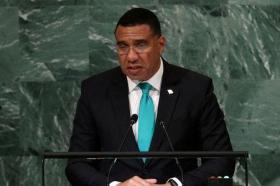
Prime Minister of Jamaica Andrew Holness addresses the 77th Session of the United Nations General Assembly at U.N. Headquarters in New York City, U.S., September 22, 2022.
February 16, 2023
KINGSTON (Reuters) - Jamaica's anti-corruption agency has referred the prime minister to its director of prosecutions over government contracts awarded to a construction company between 2006 and 2009.
The Integrity Commission released a report on Wednesday referring to an investigation into a recommendation made by Prime Minister Andrew Holness for contracts with Westcon Construction Limited, citing a potential "conflict of interest".
Holness said in a statement that he "strongly disagree(s) with the findings of the Integrity Commission regarding conflict of interest based on mere associations".
A spokesperson for Westcon was not available for comment outside business hours.
Holness previously presided over the Ministry of Education, which awarded 10 contracts totaling almost JMD$22m ($140,000) over a two-year period to Westcon.
The commission said in its 107-page report that Westcon directors Robert Garvin and Donavan Simpson were "known to" Holness for a period of more than 20 years and had business links with him.
The company was awarded contracts with other government agencies.
The commission said its director of corruption prosecution should consider whether Holness breached a Contractor General Act and the Public Sector Procurement Regulations 2008 and the Corruption (Prevention Act).
Jamaica has long suffered from corruption among public officials and it consistently ranks low on an annual Corruption Perception Index compiled by the anti-corruption group Transparency International.
(Reporting by Kate Chapell; Editing by Isabel Woodford and Robert Birsel)
S.Korean prosecutors seek to arrest opposition leader in graft probe South Korean prosecutors on Thursday requested an arrest warrant for the head of the main opposition Democratic Party, Lee Jae-myung, in an investigation into development projects and bribery allegations. — Reuters file pic
Thursday, 16 Feb 2023
SEOUL, Feb 16 — South Korean prosecutors on Thursday requested an arrest warrant for the head of the main opposition Democratic Party, Lee Jae-myung, in an investigation into development projects and bribery allegations.
Lee, a former Democratic presidential candidate, is accused of being in breach of his duty over losses of 489.5 billion won (RM1.68 billion) run up by Seongnam Development Corporation during his time as mayor of Seongnam city, prosecutors said.
Lee is also accused of demanding four companies to provide 13.3 billion won to Seongnam FC while he was serving as the head of the football club in return for unlawful administrative favours in what prosecutors described as bribery.
Lee, who was mayor of the city south of Seoul from 2010 to 2018, has denied any wrongdoing.
A Seoul court needs the 300-member parliament, where the Democrats hold a 169-seat majority, to waive Lee’s immunity from arrest to review the prosecution’s request.
The Democratic Party denounced prosecutors’ move, calling it an “unprecedented act of violence to incapacitate the opposition party and eliminate the president’s political enemy.”
Lee lost to President Yoon Suk-yeol, a former prosecutor-general, in the March presidential election by a margin of just 0.7 per cent.
— Reuters
ARMENIA/AZERBAIJAN
The Crisis of the Lachin Corridor: On the Verge of Another Humanitarian Catastrophe
It has been more than two months that the only road of life connecting Artsakh to the rest of the world remains closed. Since December 12, 2022, a group of Azerbaijanis claiming to be eco-activists has kept the humanitarian corridor of Lachin closed with signs and environmentalist appeals depriving the 120,000 citizens of Artsakh of their fundamental right to freedom of movement. Evidently, it is not a real grassroots environmentalist protest. Instead, it is funded and controlled by Ilham Aliyev’s regime. It is beyond any doubt that the actions of the so-called protesters serve as a consistent tool for Azerbaijan’s hybrid warfare tactics and systematic policy of ethnic cleansing of Armenians in Artsakh.
The situation remains unresolved on diplomatic platforms. Azerbaijan is defying calls by the international community to unblock the road. Today, the crisis of the Lachin Corridor swims in a pool of uncertainty and devastation. If not stopped immediately, it would leave long-term and irreversible consequences, not only to the future of Artsakh but also to the peace process between Armenia and Azerbaijan.
(Photo: Ani Balayan)
Cut off from the outside world, the 120,000-strong population of Artsakh is inching closer to an inevitable humanitarian catastrophe every single day. There are extreme shortages of food, medicine and other basic necessities. There is a lack of proper heating in harsh winter conditions. All energy infrastructures are located on the Lachin Corridor, hence, under the control of Azerbaijanis. They cut the gas supply whenever they desire. Electricity is provided through a small hydropower plant in Artsakh’s Sarsang reservoir. To prevent an overload, scheduled power outages occur several times a day. Children are deprived of their right to an education because it is impossible to provide heating. Kindergartens are closed for the same reason. The population also experiences periodic cuts to the internet and communication with the outside world, again manipulated by the enemy.
Photo: Artsakhuhi Babayan
The International Committee of the Red Cross (ICRC) has helped transport around 90 critically ill patients from Artsakh to Armenia to continue their treatment. ICRC also organized the transportation of several groups of people (including children) who were stuck in Armenia, unable to reunite with their families in Artsakh for weeks. Around 1,000 citizens of Artsakh still wait for their turn to return home.
“My biggest wish is peace for my homeland.”
Among those is Marine Hyusnunts, an accountant from the Martakert region of Artsakh. On December 1, 2022, Hyusnunts traveled to Yerevan with her family because of some health issues. The family learned that the road had closed on their way back home. Since then, they have been living in Goris. The Armenian government has provided her family with accommodations, but Hyusnunts is still in a tough psychological state. She says she is trying hard to stay strong. “I do not know. It is an uncertain situation, and it is quite possible that it will not end soon because our government will fight until the end in order not to make any concessions,” she says. “Nevertheless, I see a bright future for Artsakh despite the obstacles. In the end, it will be good for us. We will live freely and independently in Artsakh. My biggest wish is peace for my homeland.” Hyusnunts is also unsure whether she will still have a job after returning to Artsakh.
Yerazik Harutyunyan, a historian and a journalist, also came to Yerevan in early December with health issues. She needed surgery and has been stuck in Armenia’s capital ever since. Harutyunyan is now living with relatives in Yerevan, as her husband and two children wait for her homecoming. She is originally from the Martuni region of Artsakh, but for the past several years, she has been living in Stepanakert and working with the Water Committee of Artsakh.
A little boy in Artsakh reading by candlelight during rolling blackouts (Photo: Ani Balayan)
We met with Harutyunyan at a café in Yerevan. Barely holding back her emotions, Harutyunyan shared how painful it is to be away from family and to eat, knowing that her children, her loved ones and thousands of other compatriots are facing hunger and frostbite. “This disaster is taking place right in front of the eyes of the civilized world and will undoubtedly become a big stigma on humanity,” she said. “Azerbaijan seeks to discourage us and depopulate Artsakh. The blockade of the Lachin corridor, as well as many other preceding aggressive actions of Azerbaijan, once again prove that Artsakh cannot be a part of Azerbaijan. Artsakh is our historical homeland. So much blood has been spilled on this land. We have such deep roots there that we will not simply leave. Artsakh has the right of self-determination, and it is non-negotiable!”
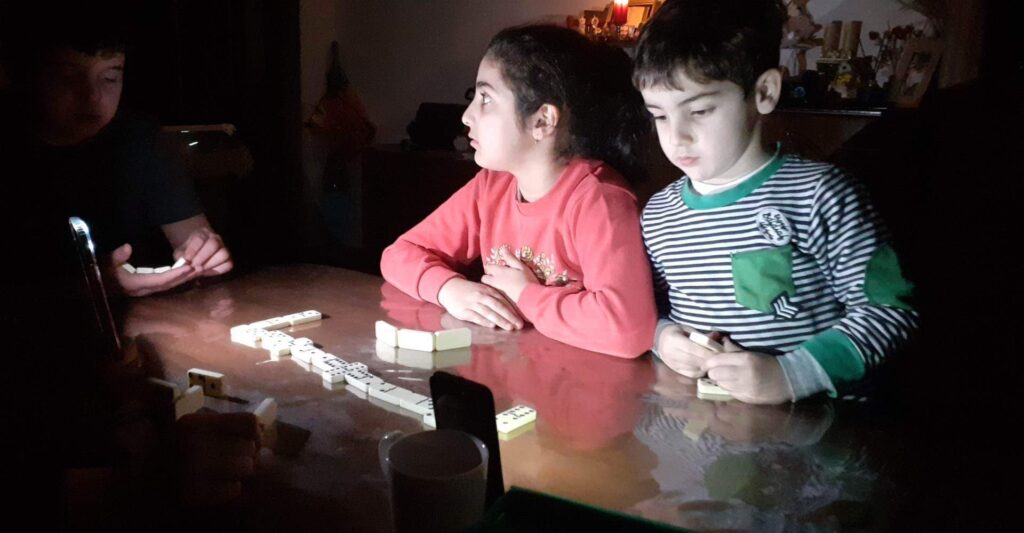
Children in Artsakh using the flashlight from mobile phones during a game of dominoes (Photo: Nara Voskanyan)
Harutyunyan believes that a peaceful coexistence as part of Azerbaijan is impossible right now, and the best proof is the blockade itself. “The two nations have witnessed a great tragedy due to this war, which will not be forgotten for a long time. If our older generation has at least some experience of coexistence with Azerbaijanis, it is absolutely unimaginable for the new generation. Many of them grew up in families where a father or brother either was killed or went missing during the war. So how can one convince them to live in Azerbaijan?”
Harutyunyan worked as a journalist for 20 years in Artsakh and is knowledgeable of the region’s domestic affairs. “The population’s nutritional needs are met with great difficulty,” she explains. “Because of the recent war, we lost the lion’s share of our agricultural lands. What has been left is almost impossible to cultivate as the Armed Forces of Azerbaijan target the farmers in the fields. In this situation, the Artsakh government has shown excellent self-organization, and the state reserves have been coordinated and provided to the population through a coupon system.”
Harutyunyan has applied to ICRC and cannot wait to return home to her family. She says that one of the employees of the Red Cross, who previously carried out humanitarian missions throughout the world, noticed with surprise that people usually request ICRC to help them move from a bad place to a good one. “However, in the case of Artsakh, it is the complete opposite…”.
Harutyunyan, whose first name Yerazik means “dream” in Armenian, says that her dream is to see her homeland free and independent so that the Armenians of Artsakh can preserve their national heritage. “I see my future only in Artsakh and have raised my children in the same spirit. Each of us owes a debt of gratitude to that holy land and the thousands of martyrs,” she emphasized. “The blockade has only fortified the willpower of our people.” Harutyunyan says it’s unfortunate that the world is guided by selective humanism. “The enthusiasm and support that Ukraine gets today in its war against Russia, unfortunately, is not there for Artsakh. It seems that Europe prioritizes the gas contract with Azerbaijan over the fate of 120,000 citizens of Artsakh.”
For members of the older generation, this is Artsakh’s second blockade in 30 years. Lida Aghabekyan currently lives in Stepanakert and works as a nurse in a military hospital. Before the blockade, she frequently traveled to Yerevan to visit her relatives. She hasn’t been to Yerevan since last fall. Her mother-in-law recently passed away, but she could not attend the funeral because of the blockade.
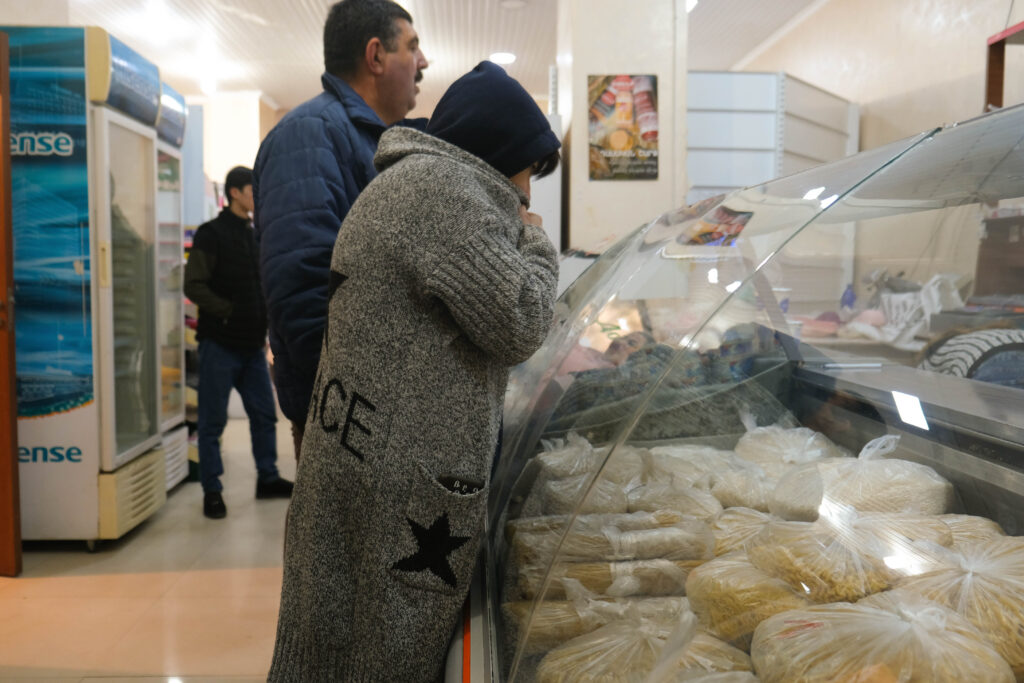
Long lines at grocery stores in Artsakh (Photo: Ani Balayan)
Aghabekyan says the biggest challenge has been complications caused by gas and electricity cuts. She often cannot find a car to go to work in the morning because there is no gas. Sometimes strangers give her a lift. Every summer, Aghabekyan’s family collects and stores winter food supplies. They typically do not stay hungry, but there is a shortage of fresh fruits and vegetables now. She tells her relatives in Yerevan that they are staying in Artsakh so that the Armenian government does not have to make any territorial or other concessions in favor of Azerbaijan.
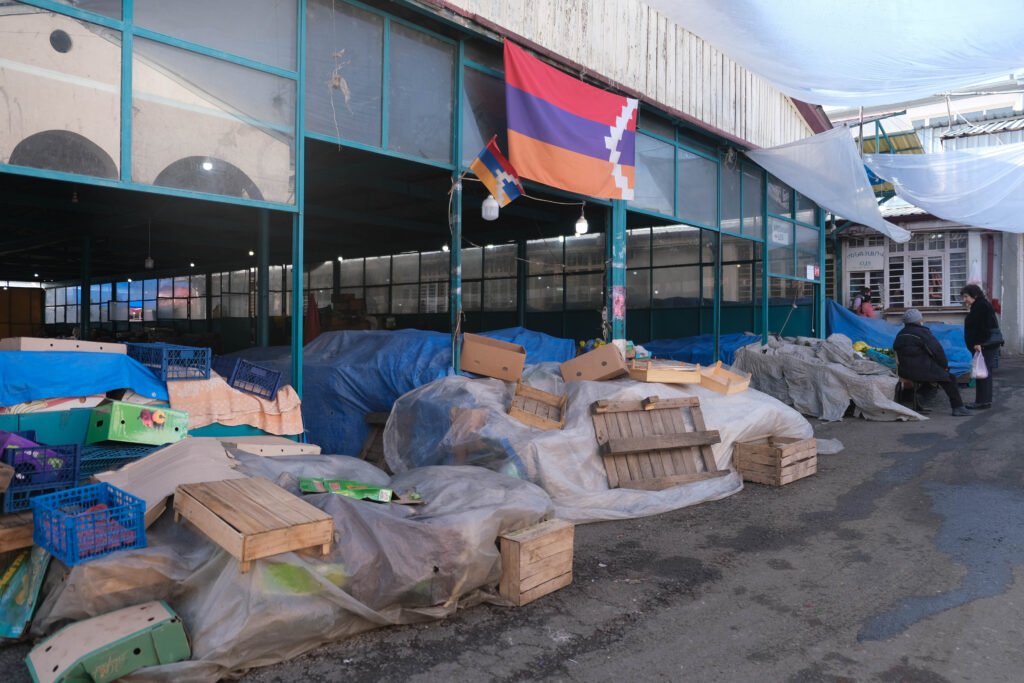
Emptied outdoor markets (Photo: Ani Balayan)
Aghabekyan has a 17-year-old son, a senior in high school. Due to the lack of heating, like many other children of Artsakh, he is deprived of his right to education. Aghabekyan’s son helps the family to take care of household needs. Sometimes he gets food from here and there, and it makes him happy. Aghabekyan says her son plans to study at a university in Yerevan. However, after graduation, he intends to return to Artsakh, serve in the army and build his own family there. All his friends feel the same way. “I love Stepanakert. Everyone loves it very much. It looks like heaven. No one I know is going to leave Artsakh after the blockade ends. I know some people from Yerevan who work here. Even they want to continue living in Artsakh,” says Aghabekyan. She firmly believes that the only way out of this uneasy situation is to put aside political views and unite. “If we are not united, they will break us like a broom. There should be consolidation in the family, at the workplace and in the state apparatus. Jealousy should disappear, and people should become more willing to share what they have.” Aghabekyan also believes that safe and peaceful coexistence within Azerbaijan is impossible. “My wish is for Artsakh to gain a status, to be independent and self-sufficient. To achieve that, we have to use all the levers. Perhaps a third-party intervention is also needed because the Armenian government alone cannot solve this conflict. Will it be Russia or another country? I want peace in all parts of the world, from Ukraine to Africa. The money used in the weapon industry should be directed to developing medicine. Yesterday there was an earthquake in Syria, but today Turkey is bombing it. The world has gone crazy.”
(Photo: Ani Balayan)
The crisis of the Lachin Corridor is alarming for its list of long-term impacts. If Azerbaijan achieves its ultimate goal and succeeds in establishing control over the mines in Artsakh, the Armenian population will lose its primary source of revenue. This is, however, the worst-case scenario, as controlling the mines means controlling Artsakh as a whole.
The Armenian population of Artsakh is already experiencing malnutrition because of the food shortage. If there are no changes in the status quo soon, it will be life-threatening for many. The chances of survival are almost zero without critical medicine, especially for people with chronic diseases.
The electricity situation is also critical. Sarsang hydropower plant, which serves as the main source of electricity, decreases its water by a significant amount daily. It means that very soon Artsakh will enter total darkness.
Thousands of people have lost their jobs as a result. Mass unemployment negatively affects the local economy by preventing cash flow and creating a serious financial crisis.
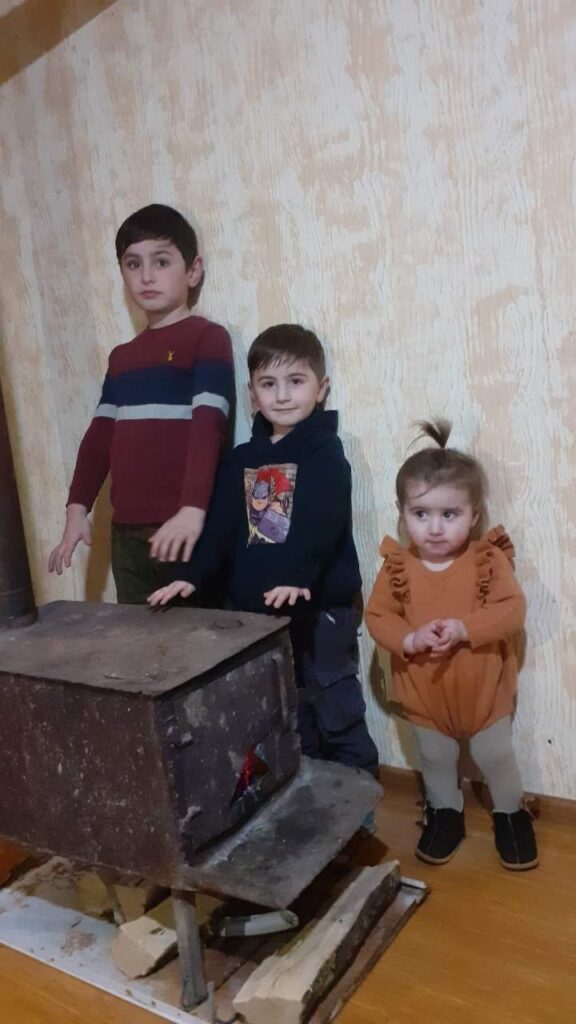
Ironically, the blockade imposed by Azerbaijani pseudo-environmentalists will soon create a real ecological disaster that threatens to affect the whole region. Because of the gas and electricity shortage, many citizens of Artsakh have to switch to wood stoves and cut local forests as a source.
This is an urgent matter for the international community to review its peacekeeping mechanisms making them more practical in order to prevent another humanitarian catastrophe. However impossible it may seem, all possible leverages should be exercised to achieve reconciliation and build a secure, guaranteed environment for the Armenian population in Artsakh where they will be able to perform their fundamental rights and freedoms.
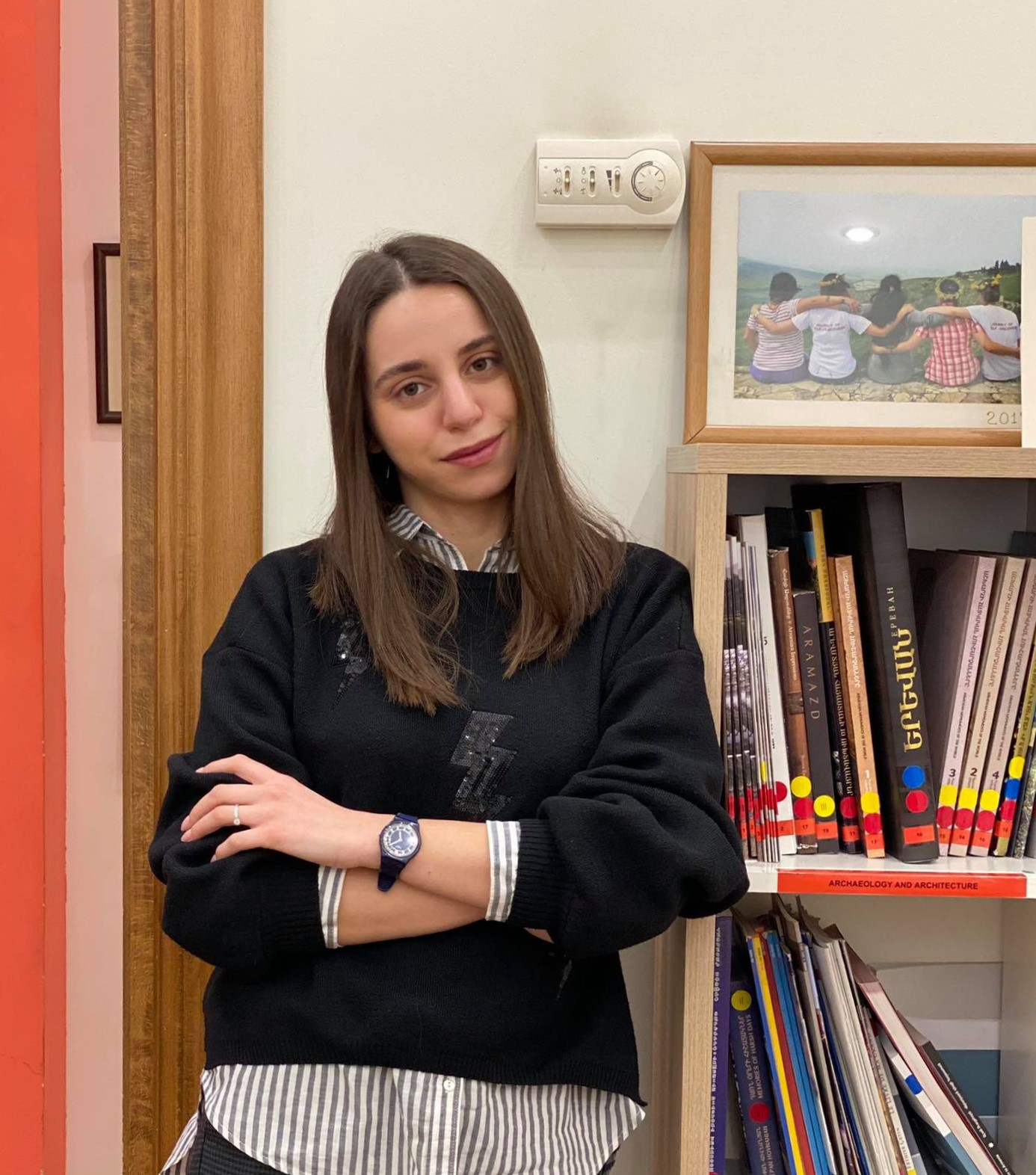
Mané Babajanyan is based in Yerevan, Armenia. Her primary expertise is in Caucasus affairs, specifically Armenia’s foreign relations with regional and extra-regional actors, as well as Armenia’s domestic affairs. She holds a bachelor’s degree in international relations and Diplomacy from Yerevan State University and a master’s degree in political science and international affairs from American University of Armenia. Mané is currently pursuing her career in journalism by covering various topics on regional issues.
Will Karachi’s pink bus finally break the glass ceiling or crash into it yet again?
This isn't Pakistan's first attempt at a women-only bus service. Will it be different this time?
It is nearing rush hour along the Wall Street of Pakistan, better known as II Chundrigar Road. The traffic is a mix of pedestrians, cycles, motorcycles, rickety rickshaws, shiny cars, an odd donkey cart and a few buses, all trying to snake their way past each other.
Tapping her feet on the walkway outside the Burns Garden, Saiqa Aslam waits patiently. “It should be here any minute now,” says the 25-year-old.
After several minutes of honking and abrupt braking, a bright pink bus pulls up next to her extended arm. It has breathing space, empty seats and it is only for women — a rather unfamiliar sight in Karachi.
Aslam rushes to the door, which slides open to welcome her, the cool air from the AC drowning out the chaos of II Chundrigar Road. She grabs the green-coloured window seat at the back, glancing over onto the road, where a throng of men are trying to get onto a red bus — part of the People’s Bus Service.
Both the red and pink buses are part of the Sindh government’s recently launched Peoples Intra District Bus Service project, comprising of 240 buses that will transport passengers across Karachi.
“It is the first time I am travelling completely alone … it feels so freeing,” says Aslam, who is currently training to be a chef. She travels daily from Model Colony to II Chundrigar Road to attend training sessions at the Pearl Continental hotel. Previously, her father would accompany her on the commute to and from the hotel using the People’s Bus Service, which was launched a few weeks prior to the pink bus.
“The red bus was good, but a bus occupied only by women gives me a sense of safety,” says Aslam.
Safety is one factor that has stopped many like Aslam from chasing their dreams in the past. The idea of traveling in packed buses, struggling for space in the limited enclosure designated for women and having to bear snide comments from ogling men seems to have put off thousands of young women from seeking employment outside the sanctuary of their homes. In fact, women hardly make up 20 per cent of the workforce in Pakistan, despite making up half of the country’s population.
“Finding a place to sit inside the six-seat women’s compartment in the minibus was seldom possible,” says Zulekha Abdul Majeed, 60, a domestic worker. She is referring to the colourful buses that have been Karachi’s primary mode of public transport for aeons past. “Even if I did find space, the seat covers were often torn and through those spaces, the men tried to reach through to touch,” she adds.
The lack of mobility not only hindered women’s economic activities but also limited their social lives. “If I had the choice, I would never use the minibus. I don’t let my daughter get a job for the same reason. We get by on my salary — we don’t need anymore,” says Majeed.
These mobility woes finally saw some redressal on February 1, when the Sindh government launched the ‘People’s Pink Bus Service for Women’.
The inauguration ceremony at Frere Hall was attended by the who’s who among women in the government, entertainment, and corporate sectors. All hailed the project as a groundbreaking move towards making Karachi accessible for women. Chronicles of the pink bus across Pakistan
This is not, however, Pakistan’s first attempt at setting up a dedicated bus service for women. Most have failed.
Dr Noman Ahmed, Dean of Architecture and Urban Planning at NED University, recalls that “the female-only bus initiative in 2004 failed because of two reasons primarily: low frequency and missed timeline.” He went on to explain that the buses were not available at peak hours — the time they are intended for. The women were often left waiting for long hours, which created a disconnect and eventually led to the closure of the operations.
In 2012, a local bus company in Lahore launched a female-only bus service. A public-private partnership venture comprising three buses, this scheme too shut down after a short run of two years. “The venture was not commercially viable, hence when the government pulled back funding, the company halted its operations,” explains Lahore-based journalist, Shiraz Hasnat.
Similarly, the Sakura Women-Only Bus Service was launched in Abbottabad and Mardan in 2019 by the KP government. The project was funded by the Japanese government and facilitated by the United Nations Office for Project Services (UNOPS) and UN Women Pakistan. It only lasted a year.
“The main reason behind the failure of this project was contract violations,” says Sadaf Kamil, who was serving as communications officer at UNOPS at the time. “Operators did not run the buses on certified routes … they boarded male passengers and ran over their limit of daily mileage,” she adds.
The contracts were cancelled and despite several attempts to revive the project, the provincial government was unable to attract operators.
Eventually, the buses were handed over to the provincial higher education department, which in turn distributed them among various colleges and universities. The buses are now being used to fulfil the transportation needs of female students.
Thus, Pakistan has seen its fair share of failures when it comes to the provision of gender-based segregation in transport. However, not all is lost.
In October 2022, the government of Gilgit-Baltistan (GB) launched a women-only public transport scheme in 10 districts. The project is funded by the government and passengers travel free of cost.
These women from Quetta had sat on a women-only bus for the first time and were quite enjoying the experience. Photo by author
“The facility has helped address the woes of women’s mobility in the region … the buses are filled to the brim each day,” Mohyuddin Ahmed Wani, GB’s Chief Secretary, told Dawn.com.
Wani explained that the buses run on a fixed route and operate only at peak hours, which has helped them limit the cost incurred to Rs20 million yearly. “This project has helped people reduce their [women’s] financial burden. We aim to run it free of cost for as long as we can.”
So is this the only way to make women-only buses a success? Keep them free or heavily subsidised?
Dr Ahmed advises against it. “It is just the same mistake repeated time and again,” he says. “The buses have been procured by the government and they’re running it on a subsidised cost. This is not a sustainable operational model … in the long term.” Karachi’s pink bus
Currently, a fleet of eight buses is operating on only one route — from Model Colony to Merewether Tower via Sharea Faisal.
In a press conference on Monday, Sindh Minister for Transport and Mass Transit Sharjeel Inam Memon announced the launch of two new routes for the pink bus, starting from February 20.
The first new route will take the bus from Power Chowrangi in North Karachi to Indus Hospital via Nagan Chowrangi, Shafiq Mor, Gulshan Chowrangi, Johar Mor, COD, Sharea Faisal, Shah Faisal Colony, Sangar Chowrangi and Korangi No. 5.
The second, also known as route 10, runs from Numaish Chowrangi to Clock Tower via MA Jinnah Road, Zaibunnisa street, Hotel Metropol, Teen Talwar, Do Talwar, Abdullah Shah Ghazi and Dolmen Mall.
Moreover, he added that the number of buses on the current route would also be increased, while a similar initiative will be launched in Hyderabad on February 17. “There are also plans to launch the initiative in Larkana and Sukkur,” he added.
According to Sindh Mass Transit Authority (SMTA) Managing Director Zubair Channa, the buses will run during peak rush hours — 7:30am to 10:30am and 4pm to 8pm. Each bus has a capacity of 50 passengers — 26 standing and 24 seats. Two of the seats are dedicated for women with special needs.
“At rush hour, the number of female travellers is much higher than the capacity of the female compartment in the red bus,” explains Channa. “The pink bus is thus an attempt at addressing that issue”.
Wajahat Fatima, a smartly dressed woman on her way home after a long day of work at the shipping company says, “I was hesitant about leaving my van service despite the burden it put on my budget because of my joint pain. These seats were a huge sigh of relief,” says as she settles down on a seat, dedicated for disabled, located near the doors.
Prior to the pink bus, Fatima complained that she was unable to access the special seat in the red buses because they were occupied by able-bodied men who refused to leave the seat.
“It’s much more affordable than the minibus,” says Kiran Javed, who works as a domestic help. “I used to pay Rs100 for each trip from Malir to II Chundrigar and back. Now, I pay Rs100 for both trips cumulatively,” she says, as she settles down on a seat at the front of the bus. “The subsidised cost has reduced my travelling costs by 50pc … these buses are a blessing,” she adds, the relief evident in her smile.
The pink bus is seen as a source of pride and a democratic space where women from all walks of life can sit together and reach their destinations in relative safety.
— Photo by author
The subsidised fares — Rs50 for a complete trip — have been a blessing for many of the women who use public transport in the city. However, the subsidy may be short lived as, according to Transport Secretary Abdul Haleem Sheikh, the government may have to increase the fares soon in view of the rising fuel prices.
For his part, Channa believes the project is sustainable, even if the subsidies must be removed. The provincial government has signed a 10-year contract with the operators, in which they have to generate enough revenue to sustain the bus’ operations, he tells Dawn.com.
“This can only be done if the operators maintain the quality, comfort and keep it cost-effective, because the women always have the alternative to choose a private mode of transport that will drop them off at their doorstep.” Seclusion in public spaces
Not everyone agrees, however, that the pink buses are the solution to women’s mobility woes in Karachi. Urban planner and researcher at Karachi’s Habib University, Sana Rizwan, cautions that while “the initiative may help increase female ridership and change household perception of public transport being unsafe for women”, all other factors such as policing, street lighting, safe bus stops, and changes in male mentality are vital for making public spaces and transport safer for women.
The researcher hopes that the change in perception will lead to an increased presence of women in the city’s public spaces, but what is required is a holistic system. “When it comes to transport, it’s not the segregated buses that matter, but the whole journey.”
Rizwan explained that that most women using the bus have to walk long distances to reach their offices and homes — some even have to hail a secondary ride to reach their destination. “The long walk to the bus stop causes mental and physical exhaustion.”
For this reason, Rizwan says, gender segregated services around the world have not worked, specially when it comes to public transit — none of them have reduced sexual harassment.
Ten-year-old Safia and her mother consider themselves lucky to have gotten seats on a bus in Karachi. — Photo by author
Some even see segregation of the sexes on public transport as regressive. “Female-only buses will not improve society, they will create a sense of fear,” stresses urban planner Mansoor Raza, adding that that the government needs to implement policies that strengthen the rule of law in public spaces. This would make coexistence of both genders possible and would be much better than introducing new buses on the already congested roads of Karachi.
Incomplete solution
For those traveling on the pink buses, however, the tangible gains far outweigh the hope for a long-term change. “When I travel in this bus, I feel at ease,” says Advocate Samia Ashraf.
The buses are seen as a source of pride and a democratic space where women from all walks of life can sit together and reach their destinations in relative safety. For 10-year-old Safia, who was traveling with her mother, simply getting a seat for herself on the bus was a blessing. “I actually got a seat for myself and I can see everything through the windows,” she says as she looks at the city’s sights passing by.
It’s a start, but it is incomplete.
The pink buses lack structure in terms of a reliable schedule and designated arrival and departure points. Women cannot identify where a bus stop is and often have to wait a long time before they can board a pink bus. The lack of street lighting too makes it a daunting task to wait for the bus.
According to a 2020 study, titled ‘Mobility from Lens of Gender’, by NGO Shehri-Citizens for a Better Environment, 58.3pc of blue-collar working women fear the long walk to the bus stop.
Aboard the pink buses, women also share horror stories of their encounters. “I was waiting for the bus yesterday, when two men came and stood behind me. I could feel their gaze on me,” says Faiza Ahmed. The bank employee said that she opted to use the red bus because waiting for the next pink one to arrive was not an option.
For engineering consultant, Ashar Lodhi, the pink bus is nothing more than a publicity project. “Women’s mobility with respect to sustainability should be more important than political mileage,” he says.
Meanwhile, the SMTA is “working on making bus stops,” says MD Channa. “The current route, however, passes through cantonment areas on which we can’t build without permission. We have asked the authorities and are waiting for approvals,” he adds.
How soon that happens remains to be seen. For now, the pink bus is being hailed by Karachi’s women as a welcome initiative. Only time will tell if it continues its journey or becomes yet another relic among Pakistan’s archives of failed attempts at improving mobility for its women.
The author is a KAS-Dawn.com media fellow, interested in development, governance and social issues. She tweets @Hawwa_Fazal




 'No to war' reads the inscription daubed on a wall in Moscow