Tuesday, July 25, 2023

TELL FORD TO SHARE THE WEALTH
In letter to Chow, Freeland puts Toronto budget bailout on province's shoulders


TORONTO — Deputy Prime Minister Chrystia Freeland says it's the Ontario government's responsibility to help backstop Toronto's pandemic-ravaged finances, offering no new federal dollars in a letter responding to Mayor Olivia Chow's request for help.

The two-page letter from Freeland to Chow says the province has the constitutional responsibility and fiscal capacity to support the city.

Freeland, who is also the federal finance minister, says it's the federal government's "firm expectation" that the province will do so.

The letter to the Chow comes as the newly-elected mayor inherits a nearly $1-billion-dollar pandemic-related shortfall in this year's budget, in large part tied to decreased transit revenues and increased shelter costs.

City staff have pegged the shortfall in next year's budget, absent further support, at up to an estimated $927 million.


Freeland says federal spending is "not infinite."

The Financial Accountability Office of Ontario has projected a provincial budget surplus of $10.6 billion by the 2025-2026 fiscal year, more than the government-forecasted $4.4-billion surplus.

"Mayor Chow, our government has been – and will continue to be – a committed partner for the City of Toronto," Freeland wrote in the letter Monday.

"However, the ability of our federal government is not infinite – and the emergency support we provided during the pandemic led directly to the excellent fiscal position that the Province of Ontario currently enjoys."

Freeland's letter says the federal government is slated to provide the city with $1.86 billion this fiscal year through various programs, such as funding for public transit, infrastructure and addictions programs.

This report by The Canadian Press was first published July 24, 2023.
There is a ‘gravity hole’ in the Indian Ocean, and scientists now think they know why


ESA/HPF/DLR

Jacopo Prisco
CNN
Mon, July 24, 2023

There is a “gravity hole” in the Indian Ocean — a spot where Earth’s gravitational pull is weaker, its mass is lower than normal, and the sea level dips by over 328 feet (100 meters).

This anomaly has puzzled geologists for a long time, but now researchers from the Indian Institute of Science in Bengaluru, India, have found what they believe is a credible explanation for its formation: plumes of magma coming from deep inside the planet, much like those that lead to the creation of volcanoes.

To come to this hypothesis, the team used supercomputers to simulate how the area could have formed, going as far back as 140 million years. The findings, detailed in a study published recently in the journal Geophysical Research Letters, center around an ancient ocean that no longer exists.

A disappearing ocean


Humans are used to thinking about Earth as a perfect sphere, but that’s far from the truth.

“The Earth is basically a lumpy potato,” said study coauthor Attreyee Ghosh, a geophysicist and associate professor at the Centre for Earth Sciences of the Indian Institute of Science. “So technically it’s not a sphere, but what we call an ellipsoid, because as the planet rotates the middle part bulges outward.”

Our planet is not homogeneous in its density and its properties, with some areas being more dense than others — that affects Earth’s surface and its gravity, Ghosh added. “If you pour water on the surface of the Earth, the level that the water takes is called a geoid — and that is controlled by these density differences in the material inside the planet, because they attract the surface in very different ways depending on how much mass there is underneath,” she said.

The “gravity hole” in the Indian Ocean — officially called the Indian Ocean geoid low
— is the lowest point in that geoid and its biggest gravitational anomaly, forming a circular depression that starts just off India’s southern tip and covers about 1.2 million square miles (3 million square kilometers). The anomaly was discovered by Dutch geophysicist Felix Andries Vening Meinesz in 1948, during a gravity survey from a ship, and has remained a mystery.

“It is by far the biggest low in the geoid, and it hasn’t been explained properly,” Ghosh said.

To find a potential answer, Ghosh and her colleagues used computer models to set the clock back 140 million years in order to see the big picture, geologically. “We have some information and some confidence about what the Earth looked like back then,” she said. “The continents and the oceans were in very different places, and the density structure was also very different.”

From that starting point, the team ran 19 simulations up to the present day, recreating the shifting of tectonic plates and the behavior of magma, or molten rock, inside the mantle — the thick layer of Earth’s interior that lies between the core and the crust. In six of the scenarios, a geoid low similar to the one in the Indian Ocean formed.

The distinguishing factor in all six of these models was the presence of plumes of magma around the geoid low, which along with mantle structure in the vicinity are believed to be responsible for the formation of the “gravity hole,” Ghosh explained. The simulations were run with different parameters of density for the magma, and in those in which the plumes were not present, the low did not form.

The plumes themselves originated from the disappearance of an ancient ocean as India’s landmass drifted and eventually collided with Asia tens of millions of years ago, Ghosh said.


“India was in a very different place 140 million years ago, and there was an ocean between the Indian plate and Asia. India started moving north and as it did, the ocean disappeared and the gap with Asia closed,” she explained. As the oceanic plate went down inside the mantle, it could have spurred the formation of the plumes, bringing low-density material closer to Earth’s surface.

The future of the geoid low

The geoid low formed around 20 million years ago, according to the team’s calculation. It’s hard to say whether it will ever disappear or shift away.

“That all depends on how these mass anomalies in the Earth move around,” Ghosh said. “It could be that it persists for a very long time. But it could also be that the plate movements will act in such a way to make it disappear — a few hundreds of millions of years in the future.”

Huw Davies, a professor in the School of Earth and Environmental Sciences at Cardiff University in the UK, said the research is “certainly interesting, and describes interesting hypotheses, which should encourage further work on this topic.” Davies was not involved with the study.

Dr. Alessandro Forte, a professor of geology at the University of Florida in Gainesville who was also not involved with the study, believes there is good reason to carry out computer simulations to determine the origin of the Indian Ocean geoid low, and that this study is an improvement over earlier ones. Past research only simulated the descent of cold material across the mantle, rather than including hot rising mantle plumes as well.

However, Forte said he found a couple flaws in the study’s execution.

“The most outstanding problem with the modeling strategy adopted by the authors is that it completely fails to reproduce the powerful mantle dynamic plume that erupted 65 million years ago under the present-day location of Réunion Island,” he said. “The eruption of lava flows that covered half of the Indian subcontinent at this time — producing the celebrated Deccan Traps, one of the largest volcanic features on Earth — have long been attributed to a powerful mantle plume that is completely absent from the model simulation.”

Another issue, Forte added, is the difference between the geoid, or surface shape, predicted by the computer simulation and the actual one: “These differences are especially noticeable in the Pacific Ocean, Africa and Eurasia. The authors mention that there is a moderate correlation, around 80%, between the predicted and observed geoids, but they don’t provide a more precise measure of how well they match numerically (in the study). This mismatch suggests that there may be some deficiencies in the computer simulation.”

Ghosh said that not every possible factor can be accounted for in the simulations.

“That’s because we do not know with absolute precision what the Earth looked like in the past. The farther back in time you go, the less confidence there is in the models. We cannot take into account each and every possible scenario and we also have to accept the fact that there may be some discrepancies on how the plates moved over time,” she said. “But we believe the overall reason for this low is quite clear.”
SCARIER THAN AI
Scientists Are Frighteningly Close to Achieving Synthetic Biological Intelligence


Tim Newcomb
Mon, July 24, 2023 


‘Synthetic Biological Intelligence’ is Close
Yulia Reznikov - Getty Images

A group of researchers have already grown brain cells on silicon chips and then taught them to perform tasks.


This merging of artificial intelligence and synthetic biology opens a new realm of continual machine learning.


A $600,000 AUD Australian national intelligence grant continues to the research into the “cyborg computing chips.”

Lab-grown synthetic brain cells can already learn tasks. Now, the same team that brought us 800,000 Pong-playing brain cells living in a dish has received $600,000 AUD from Australia’s National Intelligence and Security Discovery Research Grants Program to further push these lab-grown brain cells embedded onto silicon chips into the world of machine learning.

This entire project “merges the fields of artificial intelligence and synthetic biology to create programmable biological computing platforms,” Adeel Razi, associate professor at Monash University’s Turner Institute for Brain and Mental Health, says in a news release. “This new technology capability in future may eventually surpass the performance of existing, purely silicon-based hardware.”

The official language from Australian government’s Office of National Intelligence when listing the three-year research project spells it out: “The project aims to merge the fields of artificial intelligence and synthetic biology to create programmable cyborg computing chips.”

How’s that for a future?

As part of that previous Neuron article on the Pong-playing capabilities, the research team said that synthetic biological intelligence “previously confined to the realm of science fiction” is close.

While AI capabilities are one thing, Razi’s research looks to take machine learning to the next level. Real human brains are known for their ability to handle lifelong learning, while current AI systems suffer from “catastrophic forgetting,” Razi says, when adding new tasks to their repertoire. The continual lifelong learning abilities of these synthetic chip brains allow machines to acquire new skills without comprising old ones. The chips can also adapt to changes and apply previously learned knowledge to new tasks, all while conserving computing power, memory, and energy.

“The outcomes of such research would have significant implications across multiple fields such as, but not limited to, planning, robotics, advanced automation, brain-machine interfaces, and drug discovery,” Razzi says, “giving Australia a significant strategic advantage.”

The Monash University group, led by Razzi, has partnered with Cortical Labs of Melbourne to continue the research. Now, they hope to grow human brain cells in a lab dish called the DishBrain system to better understand the biological mechanisms that underpin this continual learning ability.

“We will be using this grant to develop better AI machines that replicate the learning capacity of these biological neural networks,” Razzi says. “This will help us scale up the hardware and methods capacity to the point where they become a viable replacement for in silico computing.”
ECOCIDE
A salvage team is set to begin siphoning oil out of rusting tanker moored off Yemen, UN says


Technical vessels are seen by the decrepit 'Safer' tanker on Monday, June 12, 2023, off the coast of Yemen. A senior United Nations official says a salvage team is set to begin siphoning oil out of the decaying tanker moored off the coast of Yemen.
 (AP Photo/Osamah Abdulrahman, File)


BY SAMY MAGDY
Sun, July 23, 2023 

CAIRO (AP) — An international team is set to begin siphoning oil out of the hull of a decrepit tanker moored off the coast of war-torn Yemen this week, a U.N. official said Sunday. It will mark the first concrete step in an operation years in the making aimed at preventing a massive oil spill in the Red Sea.

More than 1.1 million barrels of oil stored in the tanker, known as SOF Safer, will be transferred to another vessel the United Nations purchased as a replacement to the rusting storage tanker, said Achim Steiner, administrator of the U.N. development program.

“We have reached a critical stage in this salvage operation,” Steiner told The Associated Press hours after the salvage team on Saturday managed to moor the replacement vessel alongside the Safer tanker in the Red Sea. “This marks, in a sense, the completion of the month-long preparatory phase.”

The rusting tanker is a Japanese-made vessel built in the 1970s and sold to the Yemeni government in the 1980s to store up to 3 million barrels of export oil pumped from fields in Marib, a province in eastern Yemen. The ship is 360 meters (1,181 feet) long with 34 storage tanks.

The tanker is moored 6 kilometers (3.7 miles) from Yemen’s western Red Sea ports of Hodeida and Ras Issa, a strategic area controlled by the Iranian-backed Houthi rebels who are at war with the internationally recognized government.

The war in Yemen began in 2014 when the Houthi seized the capital, Sanaa, and much of the country’s north, forcing the government to flee to the south, then to Saudi Arabia. The following year, a Saudi-led coalition entered the war to fight the Houthis and try to restore the internationally recognized government to power.

The vessel has not been maintained for eight years, and its structural integrity is compromised, making it at risk of breaking up or exploding. Seawater had entered the engine compartment of the tanker, causing damage to the pipes and increasing the risk of sinking, according to internal documents obtained by the AP in June 2020.

For years, the U.N. and other governments as well as environmental groups have warned that a major oil spill — or explosion — could disrupt global commercial shipping through the vital Bab el-Mandeb and Suez Canal routes, causing untold damage to the global economy. The tanker carries four times as much as the oil that spilled in the 1989 Exxon Valdez disaster off Alaska, one of the world’s worst ecological catastrophes, according to the U.N.

The U.N. has for years campaigned to raise funds for the salvage operation which cost $143 million, including purchasing a new storage vessel to replace the rusting tanker, Steiner of the UNDP said.

“It is an extraordinarily complex operation in which, first of all, diplomacy was critical, then the logistical ability to mount such an operation and finally to actually be able to be on site with multiple vessels and put in place the conditions, but also the mitigation measures, the contingency plans, the security plans,” Steiner said.

The funding was a major challenge for the U.N. which resorted to crowd funding to help bridge the gap. But the operation still needs around $20 million to be completed, Steiner said. He criticized the oil and gas industry for not stepping up their contributions.

“One can sometimes wonder, you know, is it really up to a school class of children in Maryland to contribute to our crowd funding,” he said.

The replacement vessel, now named the Yemen, reached Yemen’s coast earlier this month and the salvage team managed to safely berth it alongside the Safer to start the ship-to-ship transfer of oil amid unprecedented measures, including a small flotilla of technical and supply vessels, to avoid missteps during the operation.

“Many thought it would never happen,” the UNDP administrator told the AP from New York, adding the salvage team has up to five weeks to complete the whole operation.

After transferring the oil, the replacement vessel would be connected to an under-sea pipeline that brings oil from the fields, he said.

“We will, I think, begin to breathe more easily when we see an empty Safer being towed away” to a scrapyard to be recycled, he said.
SPACE JUNK

A satellite will fall to Earth this week in a 1st-of-its-kind reentry. Here's what you need to know

Robert Lea
SPACE
Mon, July 24, 2023

An illustration shows the Aeolus wind satellite over Earth.

This week will see a first-of-its-kind operation to guide a dead and disused satellite back to Earth safely. The mission will pave the way for the safe return of other space-based equipment in the future.

The European Space Agency (ESA) plans to help its Aeolus spacecraft officially reenter Earth's atmosphere during the evening of Friday (July 28). The procedure to bring it back down to our planet, however, begins on Monday (July 24).

Aeolus has been orbiting Earth since 2018, when it became the first spacecraft to measure our planet's winds from space. The mission has far outlived its planned operational lifetime of one year, but was finally shut down after almost completely exhausting its fuel in early July 2023. Since then, the spacecraft has been falling toward Earth with gathering speed. By Monday, it should have reached an altitude of 174 miles (280 kilometers) over Earth, allowing ESA scientists to start the pioneering mission to bring Aeolus back down safely using a tiny bit of fuel that remains with the craft.

"This is quite unique, what we're doing. You don't find really examples of this in the history of spaceflight," head of ESA's Space Debris Office Holger Krag said during a press briefing on Wednesday, July 19. "This is the first time to our knowledge, we have done an assisted re-entry like this.

Related: Australian Space Agency investigating possible rocket debris found on beach

During the press briefing, ESA Spacecraft Operations Manager Isabel Rojo Escude-Cofiner explained precisely how the operation to bring Aeolus down to Earth will proceed.

"This will start with an initial set of maneuvers that will be executed on Monday to lower the altitude from 174 miles (280 km) which the spacecraft should have by then, to 155 miles (250 km) and to put it in an elliptical orbit," Escude-Cofiner said. "If everything goes according to plan, this will be then followed three days later by another set of maneuvers which is intended to lower it even further from 155 miles (250 km) to 93 miles (150 km) altitude."


A diagram showing the steps in the operation to bring the ESA wind safely down to Earth

All of this is preparation for the last day of operations on Friday, when ESA scientists will give Aeolus given its final commands. The craft will then perform maneuvers to bring its altitude down to around 62 miles (100 km) over Earth. Five hours later, the craft will reenter Earth's atmosphere, engaging in a flight descent corridor over the Atlantic Ocean with the ESA tracking it by radar as it falls.

The maneuvers intended to lower the craft will be retrograde in nature, meaning the thrusters on Aeolus will be firing in the opposite direction of its orbit around Earth.

The risk of clashing with other spacecraft during maneuvers is expected to be low because Aeolus orbits Earth in a sparsely populated zone. Still, if such an encounter appears to be a threat, plans are in place to divert Aeolus' descent.

"Before we do any sort of maneuvers, this is all taken into account, and any conjunction risks are evaluated at that point in time," Escude-Cofiner said. "So the deviation from the plan is possible. This is one of the multiple challenges that we will be facing."

Should the operation fail at any point, Aeolus will make the natural, unguided reentry it was originally destined for when it was created. The wind satellite was once dubbed the "impossible mission" because of several challenges ESA had to overcome to make it work in the first place.

RELATED STORIES:

Satellite will die by fire as 1st-of-its-kind operation sends it plummeting down to Earth

Here's how ISS astronauts jettison old space station hardware (video)

SpaceX Starlink satellites had to make 25,000 collision-avoidance maneuvers in just 6 months — and it will only get worse

A safe return but not for Aeolus itself

To be clear, even if the Aeolus return mission is a complete success, the satellite's safe descent to Earth doesn't exactly mean it returns to the planet in one piece.

At the press conference, ESA scientists explained they expect around 80% of Aeolus to be destroyed as the satellite falls through the atmosphere. The remaining 20% will splash down in the Atlantic and quickly sink, meaning there are no plans to recover any pieces of Aeolus at all.

Krag explained that an 80% to 20% survival ratio for a spacecraft entering the atmosphere is typical of natural descent, so the reentry procedure isn't intended to be "safe" for Aeolus or any of its pieces. Rather, the "safe" aspect of this mission refers to the fact it could help scientists build the groundwork for future missions that will bring other space equipment back to Earth with little risk to property or populations.

This is becoming increasingly important as use of the space environment around Earth burgeons.

"Today, we have 10,000 spacecraft in space, of which 2,000 are not functional. In terms of mass, we are speaking about 11,000 tons," Krag said at the press conference. The ESA scientist added that around 100 tons of human-made space debris reenter Earth's atmosphere each year, with large objects falling back to our planet at a rate of around one per week.

While there have been no major incidents of human-made space junk causing injuries or property damage as of yet, the growing use of orbital space means it could happen one day, and the ESA is taking such a threat very seriously.

Hence, the retired Aeolus satellite's final mission — to build a method of safely guiding other disused craft back to Earth in a controlled way.


2,300-year-old glass workshop littered with Celtic coins is oldest known north of the Alps


Jennifer Nalewicki
Mon, July 24, 2023 


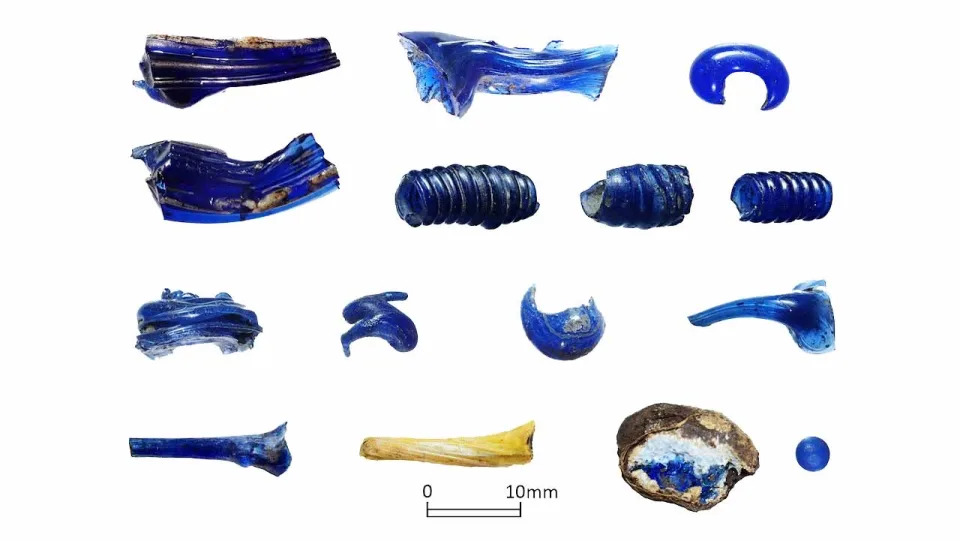
A dozen glass beads made of blue and yellow glass against a white background

Archaeologists in the Czech Republic have unearthed the oldest known glass workshop north of the Alps at a site that may have been used for ritualistic purposes.

The Iron Age workshop is part of an early settlement site known as Němčice that operated throughout the third and second centuries B.C., churning out a variety of exquisite glass bracelets and beads. During excavations, archaeologists also discovered more than 2,000 gold and silver coins minted by Celts who lived in continental Europe, indicating that the site was a trading hotspot. The team also unearthed a possible sanctuary, suggesting that Iron Age people performed rituals there, according to a study published June 29 in the journal Antiquity.

Researchers discovered Němčice while conducting excavations in 2002 and during subsequent surveys have discovered sunken huts, bronze amulets and coins scattered throughout the site. The coins are clues that Němčice was likely part of the "Amber Road," a large central European network that linked the Baltic coast to the Mediterranean region. However, more than 20 years would pass before they would find the glass workshop, according to a statement.

Related: Bronze Age gold belt with 'cosmological' designs unearthed in Czech beet field

While glassmaking tools were not found there, researchers discovered a mix of finished and incomplete glass and amber items, which could indicate that they were crafted onsite and not imported from elsewhere.

"No one yet knows how exactly the Celts made glass bracelets," lead author Ivan Čižmář, an archaeologist at the Institute of Archaeological Heritage Brno in the Czech Republic, said in the statement. "Therefore, we were interested in anything that tells us something about the technology of production."


An aerial image of a sanctuary

In addition to the artifacts, researchers discovered a square structure that resembled similar ancient buildings used for rituals, including a site called Sandberg in Austria that was once occupied by Celts, according to the study.

"The presence of these likely sacred features at Němčice indicates the character of the site not only as a trade and production center," Čižmář said, "but also as a seat of an elite and ritual center."
Teamsters Score “Historic” Agreement With UPS To Avoid Strike

Peter White
Tue, July 25, 2023 


The International Brotherhood of Teamsters has landed a “historic” tentative agreement with UPS to avert a major labor strike.

The Teamsters, who have been in solidarity with the striking writers and actors for the last few months, have secured a deal for its more than 340,000 UPS employees that includes “lucrative” contract raises for all workers, creates more full-time jobs and includes a slew of other workplace protections and improvements.

More from Deadline

Teamsters Leaders Slam Hollywood & Wall Street At Amazon Picket Line: “They Don’t Care About People”

Documentary In The Works About UPS And Its Union Workers As Company Braces For Potentially Devastating Strike

Strike Solidarity: WGA Turns Out For Teamsters Picket Line At Amazon In Santa Clarita


The five-year agreement still needs to be ratified but comes with the unanimous endorsement of the UPS Teamsters National Negotiating Committee.

In fact, Teamsters General President Sean O’Brien told Deadline last week that UPS had called him to talk after he and many of his members turned up to an Amazon picket line for the WGA and SAG-AFTRA that followed their own multi-union rally for UPS drivers in DTLA.

O’Brien said that the delivery company has put $30B of “new money” on the table as a direct result of the negotiations.

The deal includes existing full- and part-time UPS Teamsters getting $2.75 more per hour in 2023, and $7.50 more per hour over the length of the contract, existing part-timers will be raised up to no less than $21 per hour immediately, safety and health protections, including vehicle air conditioning and cargo ventilation, all UPS Teamsters would receive Martin Luther King Day as a full holiday for the first time and the creation of 7,500 new full-time Teamster jobs at UPS and the fulfillment of 22,500 open positions, establishing more opportunities through the life of the agreement for part-timers to transition to full-time work.

“Rank-and-file UPS Teamsters sacrificed everything to get this country through a pandemic and enabled UPS to reap record-setting profits. Teamster labor moves America. The union went into this fight committed to winning for our members. We demanded the best contract in the history of UPS, and we got it,” said Teamsters General President Sean M. O’Brien. “UPS has put $30 billion in new money on the table as a direct result of these negotiations. We’ve changed the game, battling it out day and night to make sure our members won an agreement that pays strong wages, rewards their labor, and doesn’t require a single concession. This contract sets a new standard in the labor movement and raises the bar for all workers.”

“UPS came dangerously close to putting itself on strike, but we kept firm on our demands. In my more than 40 years in Louisville representing members at Worldport — the largest UPS hub in the country — I have never seen a national contract that levels the playing field for workers so dramatically as this one. The agreement puts more money in our members’ pockets and establishes a full range of new protections for them on the job,” said Teamsters General Secretary-Treasurer Fred Zuckerman. “We stayed focused on our members and fought like hell to get everything that full-time and part-time UPS Teamsters deserve.”

“Together we reached a win-win-win agreement on the issues that are important to Teamsters leadership, our employees and to UPS and our customers,” said Carol Tomé, UPS chief executive officer. “This agreement continues to reward UPS’s full- and part-time employees with industry-leading pay and benefits while retaining the flexibility we need to stay competitive, serve our customers and keep our business strong.”

UPS, Teamsters reach agreement after threats of a strike: Here's what workers are getting


Olivia Evans and Matthew Glowicki, Louisville Courier Journal
Tue, July 25, 2023 

LOUISVILLE, Ky. − Just hours after resuming talks Tuesday, UPS and the Teamsters, the union representing roughly 340,000 UPS workers, have reached a tentative agreement on a new five-year contract.

This tentative contract consensus between the union and the company, which UPS CEO Carol Tomé described as a "win-win-win agreement," helped the company and the U.S. economy avoid a potentially crippling blow to the nation’s logistics network.

The tentative agreement features "more than 60 total changes and improvements to the National Master Agreement," Teamsters stated in a release. The union said there were "zero concessions from the rank-and-file."

The tentative agreement comes after months of intense negotiations and Teamsters threatening to enact what would have been the largest single employer strike in U.S. history.
What Teamsters, UPS are saying

"Teamster labor moves America. The union went into this fight committed to winning for our members. We demanded the best contract in the history of UPS, and we got it,” said International Brotherhood of Teamsters General President Sean M. O’Brien.

UPS is also enamored with the tentative agreement.

"This agreement continues to reward UPS’s full- and part-time employees with industry-leading pay and benefits while retaining the flexibility we need to stay competitive, serve our customers and keep our business strong,” Tomé said.

Teamsters hailed the tentative five-year contract as “overwhelmingly lucrative” and filled with dozens of workplace protections and improvements. Here are some of the highlights for union workers from the new national UPS Teamsters contract:

Wage increases for UPS employees


UPS workers rallied in front of the UPS Centennial Hub ahead of a potential strike on Aug. 1 on July 18. The strike has been averted.

Existing full- and part-time UPS Teamsters will get $2.75 more per hour in 2023, and $7.50 more per hour over the length of the contract, Teamsters shared in a news release.

Existing part-timers will be raised up to no less than $21 per hour immediately. Existing part-time workers will also receive a 48% average total wage increase over the next five years. Part-time seniority workers making more than this new base rate will also see general wage increases.

New part-time employees will start at $21 per hour and move up to $23 hourly.

Teamsters shared that part-time general wage increases will be double what they were in the previous contract. The 2022 general wage increase was $1 according to the previous national contract, under the new tentative agreement, this rate would jump to $2.


Wage bumps for full-time employees will bring the average top rate to $49 hourly.


Driver classification changes


Fred Zuckerman, General Secretary-Treasurer of the International Brotherhood of Teamsters, talked to UPS workers at rally on July 18 at UPS Worldport ahead of a potential strike on Aug. 1.

Drivers classified as “22.4s” − flexible drivers who do not work traditional Monday-Friday shifts − will be immediately reclassified as regular package car drivers and placed into seniority, ending what Teamsters said was an “unfair two-tier wage system.”

Days off and seasonal work


A UPS driver reaches to blow his truck's horn in support as fellow UPS union members hold a practice strike outside Worldport, the largest sorting and logistics facility in America on June 28 in Louisville, Ky. The Teamsters Local 89 represents around 10,000 members in Louisville. Teamsters General President Sean O'Brien called for practice pickets nationwide after claiming UPS presented an "appalling economic counterproposal" to the Teamsters during national negotiations for a new labor contract.

Martin Luther King Jr. Day becomes a full holiday for all Teamsters, a first for the union. Also, Teamster drivers won’t be forced to work overtime on their days off and will have a set driving schedule of one of two options.


Seasonal work will be limited to five weeks in November and December. Union part-time employees will have priority for seasonal work with a guaranteed eight hours of work.
Heat safety in vehicles


UPS worker Chris Wallace, right, waves at drivers as he and members of Teamsters Local 89 began a practice strike outside Worldport, the largest sorting and logistics facility in America on June 28 in Louisville, Ky. The International Brotherhood of Teamsters says UPS presented "an appalling economic counterproposal" during national negotiations for a new labor contract.


UPS will add air conditioning to all larger delivery vehicles, sprinter vans and package cars purchased after Jan. 1, 2024. All cars will get two fans and air induction vents.
UPS to add more jobs, fill open positions

UPS will add 7,500 new union jobs and fill 22,500 open positions.

This article originally appeared on USA TODAY: What's in UPS, Teamsters tentative contract? Here's what workers get
Russian paramilitaries to stay in Africa despite Wagner mutiny
PRIMITIVE ACCUMULATION OF CAPITAL

By AFP
Published July 25, 2023

Malian demonstrators hold up a banner reading 'Thank you, Wagner' in February 2022. Mali's junta brought in Russian paramilitaries to support the army in the fight against jihadists 

Didier LAURAS

Ever since Wagner founder Yevgeny Prigozhin staged a mutiny in Russia last month, questions have been raised over the future of his group in Africa, the cradle of its wealth and notoriety.

Prigozhin’s dramatic rebellion ended in a deal by which he was expected to move to neighbouring Belarus with some of his men.

Details about the accord remain sketchy, but as far as Africa is concerned, Wagner can count on its geopolitical and economic weight to survive in one shape or another.

“Let’s continue to train, improve our skills, and then off to the next adventure to Africa,” Prigozhin said last week, according to a video, not authenticated by AFP, posted on Telegram by a Wagner-linked account.

As African countries and Russia prepare for a summit in St. Petersburg, here is a snapshot of Wagner’s presence on the continent:

– Range of services –

Wagner is openly active in at least four countries in Africa, typically shoring up fragile regimes in exchange for minerals and other natural wealth.

In Mali, Wagner offers a full menu of services. Its paramilitaries protect the current regime, conduct military operations and training and advise on the revision of mining laws and even of the constitution.

In Sudan, Wagner has been accused by observers of being heavily involved in the flourishing and illegal gold trade.

It keeps in close contact with the Rapid Support Forces, a paramilitary unit locked in a bloody power struggle with army chief Abdel Fattah al-Burhan.

In the Central African Republic (CAR), Russian paramilitaries have been present since 2018, supporting President Faustin Archange Touadera in return for concessions to exploit gold, diamonds and other minerals.

In Libya, Wagner is close to Khalifa Haftar, a strongman based in the east of the country. According to Pauline Bax, Africa Program Deputy Director at the International Crisis Group, several hundred Wagner troops are deployed to protect military bases and oil installations there.

– Sanctions –

The group is frequently accused of atrocities and looting of natural resources in Africa, interfering in local politics in numerous conflicts and running anti-Western information campaigns, especially in francophone West Africa.

The United States has imposed sanctions on Prigozhin and labelled his group a transnational criminal organisation.

After an independent UN expert accused the CAR army and its Russian allies of acts of violence, the EU announced new sanctions against several Wagner leaders there.

Last week, Britain imposed sanctions on 13 people or businesses with alleged links to Wagner abuses, including torture and executions, in Mali and the CAR, and accused of threatening the peace in Sudan.

– Deniability –


Created in the early 2010s, Wagner quickly established itself as an African proxy army for Russia, allowing Moscow to officially deny any involvement in its operations.

“Wagner is neither an army unit nor an entirely private entity,” said Maxime Audinet, researcher at the French war college’s IRSEM institute.

“It serves the official interests of Moscow, but also Prigozhin’s personal ambitions. It’s a thin line,” he told AFP, in remarks that were made before the mutiny.

– Post-mutiny change? –


Wagner’s model will need to be reassessed in the light of the mutiny and the settlement, say analysts.

The group is self-financing, at least in terms of paying its, men but still needs logistics support from the Russian defence ministry, said Bax.

This could give Moscow leverage to impose a more loyal figure at Wagner’s helm, and perhaps order a name change or even replace the group with a different Russian outfit providing similar services.

Russian Foreign Minister Sergei Lavrov said Wagner’s future in Africa was “above all up to the governments of the countries concerned.”

But Aditya Pareek at Janes, a privately-owned British open-source intelligence company, said it was unlikely that Russia could ever control Wagner completely.

“Prigozhin’s faction is unlikely to prioritise furthering the Kremlin’s interests,” she said.

– Enduring business model –

Whatever happens to Wagner, its business concept is probably here to stay, said Bax.

“Wagner has introduced a model that seems to work for at least two countries,” she said, in reference to Mali and the CAR.

“Even if Wagner ceases to exist, other companies will try to fill the void.”

This theory is backed by African governments’ decades-long tradition of using mercenaries, often to compensate for their armies’ weakness.

The “ambiguous international legalese” defining what is a mercenary “makes Africa an all-too-attractive place to do business with flexible morals,” researcher Amanda Brooke Kadlec wrote in New Lines Magazine.

“If the Wagner Group or other Russian competitors are perceived as incompetent or unreliable because of the chaos at home, there are plenty of other options out there.”

Clearest-ever seafloor maps show deep-sea 'Grand Canyon' off US coast in stunning detail


Harry Baker
Mon, July 24, 2023 

A multicolor map of a depp-sea canyon

A close-up of the map with a crab on the seafloor

A massive deep-sea ravine in the Pacific Ocean has been mapped out in greater detail than any other part of the world's seafloor. The new maps of the "deep-sea Grand Canyon" have a "centimeter-scale resolution" and reveal exactly how the underwater valley is constantly changing.

The Monterey Canyon begins just off the coast in Monterey Bay, California. It extends more than 292 miles (470 kilometers) beneath the waves and is around 7.5 miles (12 km) across at its widest point. The underwater ravine has walls up to 5,580 feet (1,700 meters) tall, and at its deepest point the seafloor is around 2.5 miles (4 km) below the ocean's surface.

It is the biggest submarine canyon off the U.S. Pacific coast and has a topography comparable to the Grand Canyon, according to the Monterey Bay Aquarium Research Institute (MBARI).

Related: 'Factorian Deep,' the new deepest point in Antarctica's Southern Ocean, mapped for the first time

To better understand the vast underwater canyon, researchers from MBARI and other research institutes conducted a series of surveys between 2015 and 2017, capturing the valley's seafloor in "remarkable detail." The new surveys provide researchers with a "valuable new perspective to study the processes that sculpt the canyon," study lead author Monica Wolfson-Schwehr, an oceanographer at the University of New Hampshire and a former MBARI scientist, said in a statement.

The results were published April 6 in the Journal of Geophysical Research: Earth Surface.

Constantly changing

Researchers have long known that the Monterey Canyon's topography varies over time, but until now they have not been able to record these changes happening. Two devices were key to creating the new maps — the Low-Altitude Survey System (LASS), a modified remote underwater vehicle that scans the seafloor as it hovers above it; and the Seafloor Instrument Node (SIN), a recording device that sits on the seafloor and records the movements of currents overhead.

The combined data from LASS and SIN helped the team to track small-scale changes over time, enabling them to "observe a new level of complexity in the seabed" and create a "more complete picture" of what is going on, Wolfson-Schwehr said.

A remote underwater vehicle being lowered into the water.

One of the main features studied during the project was fast-moving turbidity currents, which are essentially underwater landslides. These landslides can slather sediment across the canyon floor, filling in troughs and eroding raised features, researchers wrote.

The new data revealed that turbidity currents can move between 2 mph and 7.4 mph (3.2 to 11.9 km/h), but their effects vary across the canyon: The currents appear to cause greater topographic changes in the upper part of the canyon, nearer the coast, and have a reduced impact on the valley floor further out to sea. The maps suggest that large boulders concealed beneath the seafloor in the lower canyon may be reducing the currents' effects.


A grainy image of the seafloor with arrows showing how currents impact it

The surveys also showed that tides can play a role in sculpting the seafloor. The ebb and flow of the daily tides carved "small, meter-sized scours" into the seafloor and altered sediment textures on a centimeter scale, which can add up to bigger changes over time, the researchers wrote.

The researchers say that none of the new findings would have been possible without their newly developed equipment. "We didn't realize how much of the picture we've been missing," Wolfson-Schwehr said.

The team believes LASS could also be used to study deep-sea ecosystems as the high resolution of its maps can even pick out individual animals on the seafloor. This could be particularly helpful in studying creatures that are threatened by deep-sea mining.
These nearly invisible organisms help clean Lake Tahoe’s water. Here’s how they do it

2023/07/23
Kayakers take in the snow-covered Sierra Nevada as the sun sets on Lake Tahoe on Jan. 11, 2021. 
- Luis Sinco/Los Angeles Times/TNS

Plankton are not just a diabolical mastermind on a Nickelodeon show about a sponge who lives under the sea. Lake Tahoe is filled with them — the good kind.

Tahoe native zooplankton are making a comeback in the more than 21-mile long lake, helping it look the clearest it has in 40 years. A comeback because until now, the microorganism’s population significantly decreased after it’s primary predator, the Mysis shrimp, was on the rise, according to previous Sacramento Bee reporting.

Here’s how zooplankton help make Lake Tahoe sparkle, and why they are important to the ecosystem:

—What are zooplankton?


The term “zooplankton” encompasses a large variety of microscopic animals that exist in almost all bodies of water, except rivers and streams, according to a report from Michael Paterson with the International Institute for Sustainable Development. The institute has a collection of more than 30,000 samples of zooplankton species.

Most lakes will have 40 or more species of zooplankton common to them, Paterson said.

Scientists with the University of California, Davis’ Tahoe Environmental Research Center released a 2023 Lake Tahoe Clarity report, which said when a large species of zooplankton in the lake collapsed because of a believed fungal infection, the Mysis shrimp (another species of zooplankton) may have starved and also collapsed.

This allowed two cladocerans species of zooplankton (Basmina and Dophnia) and the rotifier species to establish. Cladocerans are known to be able to clear water of fine particles at a high rate, according to UC Davis researchers.

—How zooplankton help make Lake Tahoe water clear

The almost invisible animals feed on bacteria and algae, affecting algal densities and water quality, according to the International Institute for Sustainable Development. Zooplankton also eat other species of zooplankton.

Since zooplankton eat unsightly algae, the Experimental Lakes Area of the institute tested whether reducing the number of zooplankton predators in lakes would increase the number of zooplankton and improve water clarity.

The experiment caused a dramatic increase in the Daphnia species of zooplankton, according to researchers, and considerable decreased algal densities.

Zooplankton also increase fish production, since minnows feed on zooplankton and other fish feed on minnows.

—What do you want to know about life in Modesto? Ask our service journalism team your top-of-mind questions in the module below or email servicejournalists@modbee.com.

© The Sacramento Bee