Tuesday, August 22, 2023

What harm could one coal mine do? 1.7 million Hiroshima bombs of heat for starters, says physicist
What harm could one coal mine do? Plenty—1.7 million Hiroshima bombs of heat for starters
It might not sound like a lot of extra warming –but on a planetary scale, it’s huge. 
Credit: Shutterstock

This year, the Australian government rejected Clive Palmer's coal mine proposal—but approved three others. Over 100 more fossil fuel projects are in the decision pipeline.

Why are we still approving  projects when  are intensifying? There is, as the International Energy Agency has pointed out, no place for new fossil fuels if we have a chance of holding global heating to 1.5℃ above pre-industrial levels. Our existing fossil fuel infrastructure is enough to blow our remaining carbon budget.

Unusually, Environment Minister Tanya Plibersek and her department were required to account for climate impacts in a recent decision.

They decided the climate effects did not have "relevant impact." One of the key reasons they gave for this was that the emissions from burning the coal from a single mine will, they claim, have a "very small" impact on warming—just 0.00024℃ over the lifetime of the mine.

As a physicist, this argument does not stack up. What seems like a minuscule amount of warming to a politician is, to scientists, very concerning. It's no wonder environmental organizations are filing lawsuits to try to stop these mines.

One new mine is the same as millions of nuclear bombs of heat

Right now, Plibersek and her department are weighing up final approval for the expansion of the Mount Pleasant coal mine in New South Wales' Hunter Valley. If approved, it would let the mine's owners MACH Energy Australia double its extraction rate to 21 million tons of coal per year.

So far, the project has breezed through environmental approvals. But how can Australia's environment minister reason that new coal mines won't do too much damage to the climate?

Plibersek gives two main arguments. One is the assumption that if we don't dig up fossil fuels, someone else will. Known as "the drug dealer's defense," this rationale has been rejected in a growing number of fossil fuel court cases, for example in in NSWQueensland and the United States.

The second—the "very small" impact on warming—is worth a closer look.

By the mining company's calculation, the expanded project will add 535 million tons of carbon dioxide equivalent (CO₂e) to our atmosphere over the lifetime of the mine. That's about a year's worth of Australia's entire domestic emissions.

The department took this CO₂e figure and estimated how much this would change Earth's global temperature. That's where they got the "very small" figure of 0.00024℃.

To a politician, this small number may seem insignificant. But to a physicist it is truly remarkable. What it actually means is we are able to alter an entire planet's temperature with this single mine extension.

Changing a planet's temperature takes an enormous amount of energy.

This NASA visualisation shows carbon dioxide being added to Earth’s atmosphere over the course of the year 2021, split into four major contributors: fossil fuels in orange, burning biomass in red, land ecosystems in green, and the ocean in blue. The dots on the surface also show how atmospheric carbon dioxide is also being absorbed by land ecosystems in green and the ocean in blue.

If it weren't for the greenhouse effect, Earth would be too cold for life. The problem is humans have been steadily increasing the amount of greenhouse gases in the atmosphere, causing Earth to retain more and more of the sun's vast energy, heating the planet to dangerous levels.

Burning  is responsible for most of this.

Our planet is now warming at a rate of 0.018℃ per year.

If we compare that to the department's figure of 0.00024℃, we see the total warming effect from the Mount Pleasant mine would be about 1.3% of one year's global warming.

Doesn't sound like much? Consider this. Human activity is causing about 7.8 zettajoules of extra heat to be added to the Earth's climate system every year. So, 1.3% of a year's global warming gives roughly 0.1 zettajoules worth of extra heat through burning the output of an expanded Mount Pleasant coal mine.

Now, a zettajoule is 1,000,000,000,000,000,000,000 joules of energy. This number is so large we can't relate to it. We can think of it instead as around 1.7 million Hiroshima bombs worth of extra heat. From one single mine extension.

So, it is not a "very small" amount of energy. And that's just one mine. If the 25 proposed new coal mines and three recently approved projects go ahead, they would add 12,600 million tons of CO₂ emissions to the atmosphere. That, in turn, would trap heat equivalent to roughly 43 million Hiroshima bombs. And this doesn't even count the planned gas and oil projects, or projects approved at the state level.

We can't claim we don't know

New fossil fuel project approvals at a time when global heating is accelerating seem like a remarkable disconnect.

It's for this reason we're seeing a spike in climate lawsuits. The Environment Council of Central Queensland is taking Plibersek to court, aided by Environmental Justice Australia.

Central to their case will be the claim the minister acted unlawfully when she "refused to accept the climate harm these projects are likely to cause, as outlined in thousands of scientific reports, including from the IPCC and her own department."

The lawsuit has stopped the Mount Pleasant extension and Whitehaven's Narrabri mine from proceeding further until the case has been heard.

We can't predict the outcome of the case—it could go either way.

But we can predict the outcome of new fossil fuel projects. Dig up coal, burn it, heat the planet. We can't argue our way out of the laws of physics.

This article is republished from The Conversation under a Creative Commons license. Read the original article.The Conversation


Australia's 116 new coal, oil and gas projects equate to 215 new coal power stations, says researcher


Victorian-era disease hits Scotland's poorest

Scotland

A disease linked to poverty and malnutrition that once crippled the crowded slums of 19th-century Britain is on the rise in Scotland, according to data published at the weekend.

A total of 442 cases of rickets—a skeletal disease caused by a sustained lack of Vitamin D—were recorded in 2022 compared to 354 in 2018, data from 13 of 14 Scottish health boards showed.

"Generally preventable conditions such as these are indicative of Scotland having the lowest life expectancy in the UK," Chris Williams, the joint chair of the Royal College of General Practitioners Scotland, told The Sunday Times newspaper.

He also suggested  such as a colder climate could be behind the increase.

Rickets, which can lead to skeletal deformities such as bowed legs or knock knees, has been linked to a lack of exposure to sunlight and Vitamin D which is found in foods like oily fish or eggs.

Some 482 cases of the disease, which largely disappeared from Britain more than half a century ago after efforts to improve diet and exposure to sunlight, were found across England.

Most of the cases in Scotland were recorded in the Greater Glasgow and Clyde area with 356 diagnoses.

Glasgow is one of the most deprived local authority areas in Scotland with 32 percent of all children in the city were estimated to be living in  in 2021-2022, according to Glasgow Centre for Population Health.

According to the latest data from 2019, men living in the most deprived areas of the city on average live 15.4 years less than those in the most affluent parts.

For women, the gap has increased from 8.6 to 11.6 years.

Health workers suggested an increase in diversity in the city plus  to more sedentary, indoor activities and cheaper, unhealthy food may have contributed to the increase in rickets.

Other so-called Victorian-era diseases such as tuberculosis and  are also increasing in Scotland.

Data collated by The Times showed 112 cases of tuberculosis in 2022 and a sharp rise in scarlet fever diagnosis, with 223 cases in 2022 compared with 39 the year before.

In England there had been 171 cases of scurvy in 2022, with three recorded in Scotland.

"Victorian diseases are diseases of poverty and they are common in parts of the world where people are poor," Stephen Baker, a molecular microbiologist at the University of Cambridge, told the paper.

"Rickets is associated with a poor diet and the likelihood of a poor diet may be encouraged by the cost of living."

© 2023 AFP


Study shines light on 'low-value' vitamin D tests

Dismantling the myth that ancient slavery 'wasn't that bad'

SLAVERY IS NOT APPRENTICESHIP

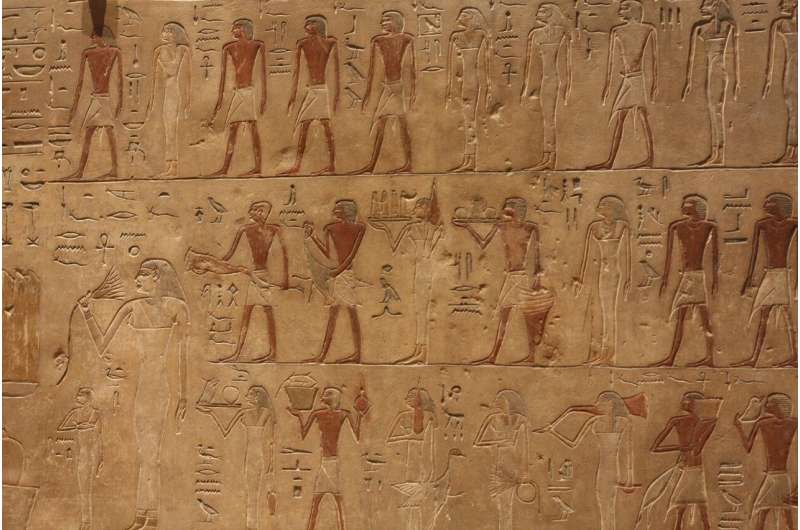
egyptian carving
Credit: Pixabay/CC0 Public Domain

As someone who researches slavery in the ancient Mediterranean world, especially in the Bible, I often hear remarks like, "Slavery was totally different back then, right?" "Well, it couldn't have been that bad." "Couldn't slaves buy their freedom?"

Most people in the United States or Europe in the 21st century are more knowledgeable about the transatlantic slave trade, and live in societies deeply shaped by it. People can see the effects of modern enslavement everywhere from mass incarceration and housing segregation to voting habits.

The effects of ancient , on the other hand, aren't as tangible today—and most Americans have only a vague idea of what it looked like. Some people might think of biblical stories, such as Joseph's jealous brothers selling him into slavery. Others might picture movies like "Spartacus," or the myth that enslaved people built the Egyptian pyramids.

Because these kinds of slavery took place so long ago and weren't based on modern racism, some people have the impression that they weren't as harsh or violent. That impression makes room for public figures like Christian theologian and analytic philosopher William Lane Craig to argue that ancient slavery was actually beneficial for enslaved people.

Modern factors like capitalism and racist pseudoscience did shape the transatlantic slave trade in uniquely harrowing and enduring ways. Enslaved labor, for example, shaped economists' theories about the "free market" and global trade.

But to understand slavery from that era—or to combat slavery today—we also need to understand the longer history of involuntary labor. As a scholar of ancient slavery and early Christian history, I often encounter three myths that stand in the way of understanding ancient slavery and how systems of enslavement have evolved over time.

Myth No. 1: There is one kind of 'biblical slavery'

The collection of texts that ended up in the Bible represent centuries of different writers from across the Mediterranean and Mesopotamia, often in very different circumstances, making it hard to generalize about how slavery worked in "biblical" societies. Most importantly, the Hebrew Bible—what Christians call "the Old Testament"—emerged primarily in the ancient Near East, while the New Testament emerged in the early Roman Empire.

Forms of enslavement and involuntary labor in the ancient Near East, for example—areas such as Egypt, Syria and Iran—were not always chattel slavery, in which enslaved people were considered property. Rather, some people were temporarily enslaved to pay off their debts.

However, this was not the case for all people enslaved in the ancient Near East, and certainly not under the late Roman Republic and early Roman Empire, where millions were trafficked and forced to labor in domestic, urban and agricultural settings.

Because of the range of periods and cultures involved in the production of biblical literature, there is no such thing as a single "biblical slavery."

Nor is there a single "biblical perspective" on slavery. The most anyone can say is that no biblical texts or writers explicitly condemn the institution of enslavement or the practice of chattel slavery. More robust challenges to slavery by Christians started to emerge in the fourth century C.E., in the writings of figures like St. Gregory of Nyssa, a theologian who lived in Cappadocia, in present-day Turkey.

Myth No. 2: Ancient slavery was not as cruel

Like Myth No. 1, this myth often comes from conflating some Near Eastern and Egyptian practices of involuntary labor, such as debt slavery, with Greek and Roman chattel slavery. By focusing on other forms of involuntary labor in specific ancient cultures, it is easy to overlook the widespread practice of chattel slavery and its harshness.

However, across the ancient Mediterranean, there is evidence of a variety of horrific practices: branding, whipping, bodily disfiguration, sexual assault, torture during legal trials, incarceration, crucifixion and more. In fact, a Latin inscription from Puteoli, an ancient city near Naples, Italy, recounts what enslavers could pay undertakers to whip or crucify enslaved people.

Christians were not exempt from participating in this cruelty. Archaeologists have found collars from Italy and North Africa that enslavers placed upon their enslaved people, offering a price for their return if they fled. Some of these collars bear Christian symbols like the chi-rho (☧), which combines the first two letters of Jesus' name in Greek. One collar mentions that the enslaved person needs to be returned to their enslaver, "Felix the archdeacon."

It's difficult to apply contemporary moral standards to earlier eras, not least societies thousands of years ago. But even in an ancient world in which slavery was ever present, it is clear not everyone bought into the ideology of the elite enslavers. There are records of multiple slave rebellions in Greece and Italy—most famously, that of the escaped gladiator Spartacus.

Myth No. 3: Ancient slavery wasn't discriminatory

Slavery in the ancient Mediterranean wasn't based on race or skin color in the same way as the , but this doesn't mean ancient systems of enslavement weren't discriminatory.

Much of the history of Greek and Roman slavery involves enslaving people from other groups: Athenians enslaving non-Athenians, Spartans enslaving non-Spartans, Romans enslaving non-Romans. Often captured or defeated through warfare, such enslaved people were either forcibly migrated to a new area or were kept on their ancestral land and compelled to do farmwork or be domestic workers for their conquerors. Roman law required a slave's "natio," or place of origin, to be announced during auctions.

Ancient Mediterranean enslavers prioritized the purchase of people from different parts of the world on account of stereotypes about their various characteristics. Varro, a scholar who wrote about the management of agriculture, argued that an enslaver shouldn't have too many enslaved people who were from the same nation or who could speak the same language, because they might organize and rebel.

Ancient slavery still depended on categorizing some groups of people as "others," treating them as though they were wholly different from those who enslaved them.

The picture of slavery that most Americans are familiar with was deeply shaped by its time, particularly modern racism and capitalism. But other forms of slavery throughout human history were no less "real." Understanding them and their causes may help challenge slavery today and in the future—especially at a time when some politicians are again claiming transatlantic slavery actually benefited enslaved people.

This article is republished from The Conversation under a Creative Commons license. Read the original article.The Conversation


Slavery and trafficking occurs in 90% of recent wars and conflicts, new research shows

ENTERED APPRENTICESHIP IN TRADES CRAFTS SUCH AS CARPENTERS, PLUMBERS, ELECTRICIANS ETC. ARE CALLED INDENTURED, FOR THE FACT THAT IN THE PAST THE APPRENTICE WAS 'OWNED' LIKE HIS TOOLS BY HIS 'MASTER' OF THE TRADE. HE WAS FREED WHEN HE COMPLETED THE APPRENTICESHIP BY PAYING HIS DEBT, OR BECAME A JOURNEYMAN. HE WAS AS HE IS TODAY SUPERVISED BY HIS JOURNEYMAN. I USE HIS BECAUSE MOST TRADESMEN WERE AND REMAIN MEN.


New research finds way to reduce bias in children

children online
Credit: Pixabay/CC0 Public Domain

Children's views of inequality may be influenced by how its causes are explained to them, finds a new study by a team of psychology researchers. The work offers insights into the factors that affect how larger social issues are perceived at a young age and points to new ways to reduce bias toward lower-status economic groups.

"When making sense of social inequalities, adults may consider the structural forces at play—for example, people may cite policies related to legacy admissions when thinking about how disparities first arise," says Rachel Leshin, a New York University doctoral student and the lead author of the study, which appears in the Proceedings of the National Academy of Sciences (PNAS). "But  don't necessarily see differences in status in this way—and when children are prompted to consider the structural forces, they tend to interpret these structures differently from how adults do."

"However, our work shows that children can think about these matters in a similar manner as adults do if the structures driving inequality are explained to them in specific ways," she adds. "Such approaches, we found, also reduced the extent of bias children felt against a lower-income group relative to a higher-income group."

It's long been shown that children become aware of inequality from a young age and quickly develop status-related biases as a result. For example, they often view more positively those from high-status groups (e.g., those with more material resources or those who belong to groups that they associate with greater wealth) and, moreover, willingly accept group disparities.

In the PNAS study, Leshin and Marjorie Rhodes, a professor in NYU's Department of Psychology, examined how children reason about  in order to understand how the explanations provided for an inequality shaped children's responses to it, such as how they feel about a low-status group or whether they want to rectify the inequality. In doing so, the work sought to understand how these explanations could be used to reduce biased views against lower-status groups.

To do so, Leshin and Rhodes recruited more than 200 children, aged five to 10, to participate in an online study. In the study, children learned about two fictional groups—"Toogits" (a high-status group) and "Flurps" (a low-status group). The authors note that fictional groups are often used in testing children's attitudes in order to diminish bias linked to "real-world" social categories.

These groups were described as differing in wealth and resources, such as: "See this Flurp? This Flurp lives in this house. And you know what else? Grown-up Flurps have jobs that only pay them a little money. Because Flurps don't have that much money, this Flurp only got a pair of socks for his/her birthday, and he/she didn't get to have a birthday party at all."

The children were also shown images that represented where the two groups lived, with the Toogit shown in a nice, polished house and the Flurp shown in a less attractive house.

In order to unpack how the "causes" provided to explain the inequality shaped children's responses to it, the researchers gave children one of three explanations for the inequality shown through the two fictional groups: one attributed it to structural causes and cited the "high-status group" as the structures' creators (i.e., "… because of rules that [the high-status group] made up a long time ago"); another attributed it to structural causes but did not identify their creator (i.e., "… because of rules that were made up a long time ago"); and one, the control condition, didn't provide an explanation at all (i.e., "... it's been like that for a long time").

The researchers sought to understand whether and to what extent these explanations would shape children's responses to the inequality, including their level of bias against the low-status economic group.

The results showed that only the "structural explanation" that identified the high-status group as the "catalyst responsible" for the different circumstances of the two groups produced notable effects. Children in this condition reported lower levels of bias toward these fictional groups, perceived the status hierarchy as less fair, and opted to give more resources to the low-status group relative to those in the other two conditions.

By contrast, children who heard a structural explanation that did not cite the high-status group as a cause for these differences (instead citing a third-party—i.e., "the person who got to make the rules") responded no differently than did those in the control condition who heard no explanation at all.

"In engaging with children about inequality, whether it's linked to wealth or , it's important to not only identify a structural cause underlying a disparity, such as legacy admissions, but to also identify the group influential in the implementation of those structures," explains Leshin. "We think these findings can be used to better understand how we can meaningfully engage with children about ."

More information: Leshin, Rachel A., Structural explanations for inequality reduce children's biases and promote rectification only if they implicate the high-status group, Proceedings of the National Academy of Sciences (2023). DOI: 10.1073/pnas.2310573120doi.org/10.1073/pnas.2310573120

Monday, August 21, 2023


Europe's wild bird species are on the brink, but there are ways to bring them back

Europe's wild bird species are on the brink—but there are ways to bring them back
A flock of puffins on a cliff in Northumberland, England.
 Credit: Riska Parakeet/Shutterstock

Almost two out of every five species of wild bird are of conservation concern across Europe, according to an updated and comprehensive assessment of their population status. That means these species are declining and becoming more scarce across the continent. Among the birds of conservation concern are some familiar species, including dunnockgoldcrest and meadow pipit.

Since the first assessment, which was carried out in 1994, the number of European  that are of global conservation concern has trebled. Snowy owlnorthern lapwingEurasian curlewsteppe eagle and bearded vulture have all been unlucky enough to make this list.

The assessment used data collected on 546 bird  to estimate population sizes and trends throughout Europe. Species were then assigned one of five categories depending on their extinction risk, considering whether a species is of global or European conservation concern and whether its distribution is concentrated within Europe.

The number of species that are of conservation concern across the continent is worrying, but sadly not particularly surprising. Many of the species that are declining have been doing so for at least the past three decades—and this study highlights that not much has changed.

Which species are at risk?

Birds around the world are facing a multitude of threats. These include changes both to the climate and how land is used, but also over-exploitation, competition with invasive species and pollution. Habitat destruction and degradation, a key driver of bird population decline, affects 93% of globally threatened species.

Certain bird groups are being hit particularly hard. In the assessment, migratory birds, raptors, waders and duck species were noted as being of high conservation concern.

The recent assessment, along with many others, found that farmland birds are among those of highest concern. In fact, almost 60% of the species in the highest conservation concern category were associated with farmland habitats. These species include many that, in the not-too-distant past, were common.

The gentle coo of the European turtle dove, for example, was once a familiar sound across Europe's countryside. But since 1980, the species has declined by almost 80% across Europe. This decline is even more dire in the UK, where turtle doves have suffered a staggering 98% reduction in their population since the 1970s.

Research reveals that agricultural intensification, including the  and inorganic fertilizers, is one of the key drivers of population decline in farmland birds across Europe.

The outlook is equally worrying for Europe's seabirds. Petrelsshearwaterskittiwakes and—perhaps the most well-loved and recognizable seabird—puffins, are among the species that are noted as being of global conservation concern in the assessment.

Climate change is altering environmental conditions and industrial fishing practices are depleting stocks of the fish that these seabirds rely on. This means that , quantity and availability are all changing, which carries serious consequences for the breeding performance and survival of these top predators.

Europe's wild bird species are on the brink—but there are ways to bring them back
The European turtle dove. Credit: Neil Bowman/Shutterstock

A lack of prey near puffin colonies in the north-east Atlantic, for example, means adults are being forced to travel further to find food for their chicks. This comes with  for adult puffins and also means that the chicks are fed less often.

The new strain of avian flu that is killing birds worldwide adds further and very urgent threats to this already vulnerable group.

What can be done?

The assessment suggests that current efforts to halt and reverse the loss of Europe's bird species are not sufficient. More and  is needed if we want nature to have a fighting chance. But there are some promising measures that can be implemented both nationally and internationally.

In recent decades, there has been a focus on protecting sites for important bird populations. Natura 2000, for example, are designated areas within the EU that contain rare habitats and important breeding and resting sites. Currently, 18% of the EU's land surface area is designated as a Natura 2000 site, and the aim is to create a network of connected protected sites right across the continent.

Evidence on the effectiveness of protected areas is clear: when implemented appropriately, they work. Globally, the number of species is 10.6% higher within protected areas compared with unprotected areas.

But protecting existing habitats is not enough to reverse declines alone. Habitats need to be restored.

A compelling case emerges from Hungary's Hortobágy National Park, where areas of cropland have been converted into restored grassland. Over a three-year period after grassland restoration, the abundance and diversity of farmland bird species increased by 35% and 40% respectively.

We also need to consider the way we produce our food and fuel. Enforcing legislation on what kinds of chemicals, and how much of them, we use to control agricultural pests and diseases is crucial.

In 2018, EU member states banned the use of certain neonicotinoids (a class of insecticide) after mounting evidence of their widespread impact on insects—an important source of food for birds.

This is a promising start, but it will only be effective if implemented widely and not reversed. Unfortunately, the UK government has authorized the emergency application of neonicotinoids in each of the past three years.

There are ways to stop Europe's bird species from disappearing. We just need to make sure these ideas are put into action widely and in the right way.

Provided by The Conversation 

This article is republished from The Conversation under a Creative Commons license. Read the original article.The Conversation


Bird study shows Europe's nature in 'dire straits'


Why researchers think that some extinct giant flying reptiles cared for their young

Why we think that some extinct giant flying reptiles cared for their young
Pteranodon was a large-bodied pterosaur. Credit: YuRi Photolife / Shutterstock

Our understanding of animal behavior depends on observation. Researchers can study how animals are born, grow and develop. We can gather evidence of how they interact with each other and their environment.But how do we do this for extinct animals? In a recent scientific paper, paleontologist Zixiao Yang and colleagues compared the growth of small and giant pterosaurs.

These were flying reptiles that were alive between about 228 million years ago and 66 million years ago—sharing the Earth with dinosaurs. Yang and colleagues wanted to understand what, if anything, was different about how the giant animals got so big.

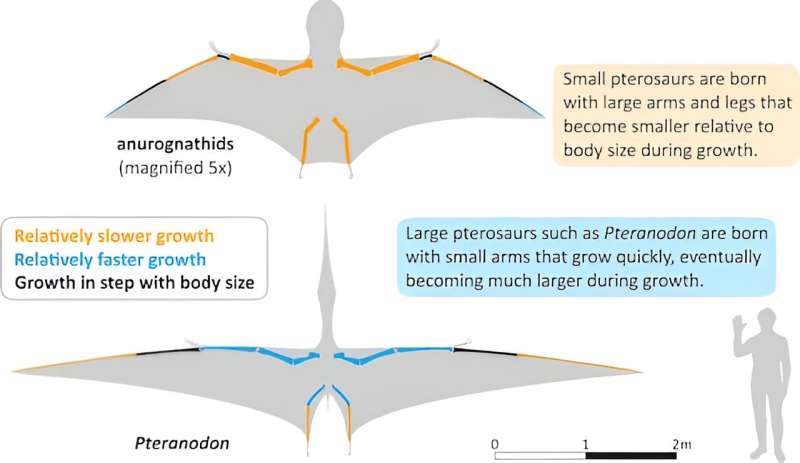
They looked at the limb bones, which are critical to locomotion: the forelimbs to flight, the hindlimbs to movement on the ground. With the smaller-bodied pterosaurs (the smallest in the study had a wingspan of 0.19–0.74 meters), they discovered that the limb bones that lay closest to the body—the "proximal" ones—grew more slowly relative to their total body size as the animals aged after hatching.

For large-bodied pterosaur , such as Pteranodon, with a wingspan range of 3.91–6.37 meters, the  that lay closest to the body grew faster than other elements of their skeleton after hatching.

In bird and  alive today, this pattern is associated with particular developmental strategies. Present-day species showing a developmental pattern most similar to the smaller pterosaurs tend to move around independently from an early age.

While not necessarily lacking in parental care, such species tend to be less dependent on or demanding of their parents. By contrast, living species showing the developmental pattern seen in the larger Pteranodon tend to have young that are not capable of independent movement. In these animals, intensive parental care—including feeding the young—is the norm.

Why we think that some extinct giant flying reptiles cared for their young
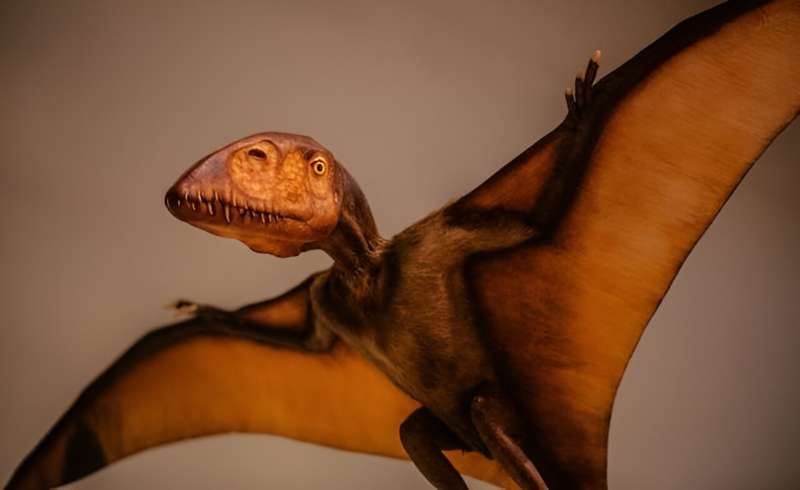
Model pterosaur, Dimorphodon macronyx (reconstruction).
 Photographed at the National Museum of Scotland. Credit: Jason Gilchrist

Wing development

Using data from fossils, Yang and colleagues used computers to model the body measurements of different pterosaur species as they grew.

Pteranodon's wing aspect ratio (the wing length relative to wing area) increased as the species grew, allowing it to develop a long, narrow wing, associated with soaring in modern birds. The smaller pterosaurs, however, showed a consistent or decreasing wing aspect ratio during growth, allowing more maneuverability.

These developmental differences between larger and smaller species of pterosaur indicate that Pteranodon's relatively greater proximal limb growth shortly after hatching, along with—perhaps—enhanced parental care, may have helped it reach a large adult size. Pterosaurs as a group encompassed the largest flying animals of all time. Hatzegopteryx thambema may have been the biggest, with a wingspan of up to 12 meters. But all pterosaurs started small.

Pterosaur hatchlings' size was limited by ultimately the size of their eggs, which was constrained by the size of the pelvic opening of female pterosaurs, and by the soft eggshell produced by pterosaurs. Compared to hard-shelled bird eggs, soft eggs are weaker and cannot support larger sizes. To grow big, pterosaurs had to do most of their growing after they hatched.

Why we think that some extinct giant flying reptiles cared for their young
Infographic showing different growth patterns in large and small pterosaurs. Credit: Yang Z, Jiang B, Benton MJ, Xu X, McNamara ME, Hone DWE

Parental care

A key difference between the small and large species may have been parental care. This may have released large pterosaurs from growth and size constraints. An extended maturation period where parents protected their young and fed them may have allowed a bending of developmental physics, resulting in a larger body size, a lighter skeleton and more robust joints. In contrast, small pterosaur species by the nature of their slower proximal limb growth may have been locked into maturity at smaller sizes.

It's also possible that baby pterosaurs from larger species with parental care were not capable of flight, whereas smaller species were flight-ready upon hatching.

To grow to such a large body size, the giant pterosaurs also needed two things from their environment: space and updrafts. Big pterosaurs would principally have been soarers, meaning that they used updrafts to stay aloft and economized on energy by minimizing flapping. Giant pterosaurs also needed a  to support their large size and fuel their metabolic requirements.

While competitors for food were likely in short supply for large adult pterosaurs, youngsters—being smaller—would be more likely to overlap in terms of food sources and habitats with smaller pterosaur species. Young giant pterosaurs probably did not compete for food with adult pterosaurs of the same species.

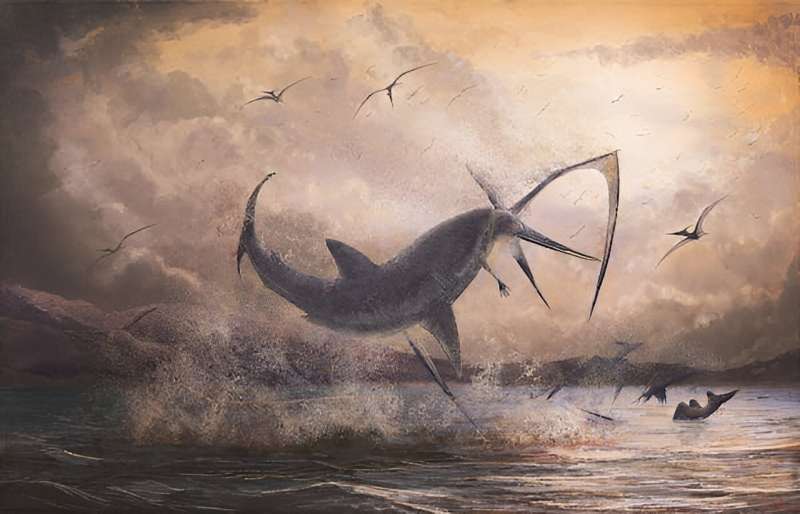
Predation on adult giant pterosaurs by other animals would have been limited. What dinosaurs (or other creatures) would have been big and hard enough to take on such an imposing sharp-beaked monster?

Why we think that some extinct giant flying reptiles cared for their young
Large pterosaurs like Pteranodon probably had only a handful of predators, such as this large shark. Credit: Mark Witton, Author provided

Future fossils

Incredible as it seems, we can infer the presence of parental care—and lack thereof—in long-dead species of flying reptile. The odds of a pterosaur being preserved in the act of unambiguous parental care seem incredibly slim. So evidence from fossils and understanding patterns from contemporary species are critical to our understanding.

At some point, someone will hopefully find juvenile giant pterosaurs, and their hatchlings, eggs and embryos. Otherwise, questions will remain regarding the development of baby pterosaurs.

These questions include: what was the nature of the parental care? Did parents keep eggs and young warm by sitting over them? Did they defend juveniles against predators, providing food for pterosaur babies? Did males and females share  equally? Did they care for young that were not their own?

To more fully re-imagine the early lives and parental behavior of giant pterosaurs, we need more fossils. Let's find them.

Provided by The Conversation 

This article is republished from The Conversation under a Creative Commons license. Read the original article.The Conversation