Saturday, January 20, 2024

Gold miners bring fresh wave of suffering to Brazil’s Yanomami

Reuters | January 18, 2024 

President Luiz Inacio Lula da Silva has pledged to restore law and order. Credit: Wikimedia Commons

Brazil is losing the upper hand in its battle to save the Yanomami Indigenous people, who are dying from flu, malaria and malnutrition brought into their vast, isolated Amazon rainforest reservation by resurgent illegal miners.


A year after President Luiz Inacio Lula da Silva declared a humanitarian crisis among the Yanomami and vowed zero tolerance for illegal mining, environmental enforcers warn that Brazil is jeopardizing last year’s hard-won progress, when about 80% of roughly 20,000 wildcatters were ousted from the Portugal-sized reservation.

As the Brazilian military has rolled back its support for the government crackdown, the gold-seeking miners have come back, they say, making fresh incursions into Yanomami land.

According to Brazil’s health ministry, 308 Yanomami died of disease, malnutrition and violence last year, with 50% of the deaths being children under four. Deaths from malaria, which is introduced by the miners, doubled in 2023 from 2022.

The presence of armed miners has also scared the Yanomami from planting manioc, their staple along with river fish, and reduced the game they can hunt.

During a Reuters visit to the Yanomami territory in December and January, agents of environmental protection agency Ibama said they are now flying solo in the battle against the miners after crucial military support was scaled down.

The Brazilian military reduced operations in mid-2023 and stopped transporting fuel for Ibama’s helicopters to forward bases inside the reservation, limiting their range across the giant territory. The Air Force has not enforced a no-fly zone, despite being ordered to do so by Lula in April, while the Navy is not doing enough to blockade rivers that are the miners’ main access for machinery and supplies, three Ibama officials said.

How wildcat mining is behind the Yanomami crisis in Brazil

Brazil’s Army, Navy and Air Force did not reply to requests for comment.

The ineffective no-fly zone has led to growing numbers of unregistered pilots flying miners into Yanomami land, and then crossing the border to safety in Venezuela when intercepted by Ibama helicopters, said Ibama pilot Carlos Alberto Hoffmann. Venezuela’s government did not reply to a request for comment.

“The state is not effectively present today in Yanomami territory, and we are seeing the return of illegal mining,” said Hugo Loss, Ibama’s head of enforcement operations. Without more military support, he added, “we will lose all this year’s work.”

A Reuters photographer spent a week on Yanomami land, embedding with an elite Ibama unit as they swooped down by helicopter into mining camps to destroy dredging pumps, airplanes and other mining supplies. Miners fled at the sound of approaching helicopters, and the armed Ibama officers chased stragglers into the jungle to arrest them.

The photographer also visited the Auaris medical station near the Venezuelan border, where naked Yanomami children, their bellies swollen by malnutrition, were nursed back to health.

“Most of the miners had gone, but they are coming back,” Yanomami shaman Davi Kopenawa, whose activism helped create the government-protected Yanomami territory in 1992, told Reuters. “Illegal mining is so bad for us.”

Along with poisoning rivers and spreading disease, the return of the gold miners boosts criminal groups that traffic drugs and timber across the Amazon, undermining Lula’s pledge to restore law and order there and end deforestation by 2030.

Miners arrested and handcuffed by Ibama special forces said they were poor and needed an income from gold prospecting to feed their families. Most were removed from the reservation and freed, and police said they are now seeking the backers who financed the gold digs.

The destruction of the rainforest was evident from gaping pits some five meters (16 ft) deep in mining sites cleared of trees, along with dozens of ponds where dredged sludge was pumped into rivers, turning pristine waters a bright orange from the mud.

“This is war because people are dying. Hundreds of Yanomami have died in the humanitarian crisis, and they are Brazilians too,” said Felipe Finger, head of the Ibama special forces unit.

According to the 2022 census, there are 30,000 people from the Yanomami and related Ye’kwana people on the reservation, including groups with little or no contact with outsiders.

Ibama chief Rodrigo Agostinho said in a statement to Reuters that the environmental agency will not give up fighting the illegal mining on Yanomami land despite the challenges.

“We are aware of the existing adversities and we recognize the persistent presence of illegal miners in the area,” he said.

Lula held a Dec. 22 cabinet meeting that included commanders of the armed forces, where he emphasized that removing illegal miners was a government priority, according to the head of the Indigenous protection agency Funai, Joenia Wapichana.

Last week, Lula’s government pledged 1.2 billion reais ($245 million) on security and assistance efforts for the Yanomami, and Federal Police Director General Andrei Rodrigues said Brazil’s government must throw its full weight into defending the Indigenous people.

On Wednesday, Federal Police announced the start of a new operation against illegal mining in Yanomami territory and said in a statement they will have the support of the armed forces.

Sydney Possuelo, Brazil’s top expert on isolated Indigenous tribes, helped create the Yanomami reservation and expel some 40,000 gold miners in 1992 when he headed Funai. The government must do more, he said in an interview.

“Ibama and the police simply do not have enough personnel there to get rid of the miners. The government is just saying this to show that it is doing something.

“The Air Force is not enforcing the no-fly zone. The Army and the Navy are doing nothing.”

(By Ueslei Marcelino and Anthony Boadle; Editing by Rosalba O’Brien)


Allow CSIS to share intelligence on security threats, business council asks Ottawa

A group representing key Canadian businesses wants legislative changes that would allow Canada's spy agency to share threat intelligence with companies to help them take timely protective measures.

The Business Council of Canada is also urging the federal government to borrow a U.S. idea and create a new body that would ensure the intelligence is securely and broadly shared across the Canadian economy.

Business council president and CEO Goldy Hyder argues for the new approach in a submission to a federal consultation on possible changes to the legislation governing the Canadian Security Intelligence Service.

The government says the CSIS Act does not provide the spy service with sufficient authority to disclose classified intelligence to provinces, territories, Indigenous governments or municipalities.

It says the prohibitions on disclosure also limit how CSIS can share relevant information with private sector and academic institutions.

Proposed revisions would allow CSIS to share information on threats to the security of Canada beyond the federal sphere, with the aim of increasing awareness and resiliency.

The idea may be gaining support in government and business circles, but it is also stirring concern among civil libertarians who fear inappropriate disclosure of sensitive information about people under CSIS scrutiny.

The government says any broader authority for CSIS to disclose information would be accompanied by measures to safeguard privacy protections.

In his letter to Public Safety Minister Dominic LeBlanc, Hyder says council members increasingly find themselves in the crosshairs of malicious actors seeking to undermine Canadian livelihoods through sabotage of critical infrastructure, disruption of vital supply chains or theft of proprietary information. 

"The nefarious methods employed by these actors are wide-ranging, from the use of foreign intelligence officers and corporate insiders to state-affiliated hackers and seemingly benign joint ventures," says the letter, which the council shared with The Canadian Press.

The consequences are diminished economic growth and competitiveness, leading to the loss of well-paying jobs, foregone tax revenues and weakened competitive advantage in advanced industries, adds the council, composed of chief executives and entrepreneurs of leading Canadian enterprises.

"Government-produced threat intelligence is of increasing value to companies combating malicious actors," says the letter.

Hyder notes that CSIS can share information in specific circumstances, under its threat reduction mandate, to alert a targeted company about a security event.

"This means of communication — a legislative workaround not designed for sharing threat intelligence with the private sector — is deeply flawed," the letter says. "The restrictive nature of the regime means that these authorities are rarely used."

In addition, such an alert arrives only after a threat has materialized, it adds.

"With new threat intelligence sharing authorities, CSIS could communicate more specific and tangible information with Canadian companies," Hyder writes. "This would give business leaders a clearer understanding of the threat's nature, as well as the protective measures that could be taken to better safeguard their employees, customers, and the communities in which they operate."

Hyder contends it would also help CSIS build greater trust with the private sector, and encourage business leaders to share more with the government about the threats they are seeing.

The business council calls for creation of a formal threat intelligence exchange akin to the U.S. government's Domestic Security Alliance Council, a partnership between 700 strategically important American corporations, the Federal Bureau of Investigation and the Department of Homeland Security.

The business council says member companies in the U.S. alliance benefit from direct engagement with senior FBI and DHS leaders, tailored threat intelligence from these agencies and access to a members-only network where private-sector and government officials collaborate, resolve problems, and exchange best practices. 

CSIS, Public Safety Canada, and the Canadian private sector are well placed to build and operate a similar threat intelligence exchange, the business council says.

There is value in ensuring security threats are addressed promptly rather than in a reactive way, said Tim McSorley, national co-ordinator of the Ottawa-based International Civil Liberties Monitoring Group, which brings together unions, professional associations, faith groups, environmental organizations and human rights advocates.

"There needs to be a broader debate about this," McSorley said.

However, the group is not persuaded that allowing access to classified information in private briefings "is the best way to go."

Indigenous and environmental activists have come under the lens of security agencies while organizing to protecting natural spaces and treaty rights, McSorley said. As a result, allowing CSIS to share information with the private sector could lead to more such targeting of communities that have legitimate concerns.

In addition, he said, some intelligence about alleged terrorists has turned out to be wrong over the years — more in service of security agencies' concerns than the goal of "protecting the rights of Canadians and ensuring their safety."

This report by The Canadian Press was first published Jan. 19, 2024.


Microsoft says exec email breached in

Russia-backed hack


Agence France-Presse
January 20, 2024

Hacker over a screen with binary code. (Shutterstock)

Hackers linked to Russia's intelligence service broke into email accounts of senior Microsoft executives, according to a regulatory filing available Friday.

Microsoft identified the cyber attacker as a group referred to as "Midnight Blizzard," which it said has been connected to Russia's Foreign Intelligence Service by US and British governments.

"This threat actor is known to primarily target governments, diplomatic entities, non-government organizations, and IT service providers primarily in the US and Europe," Microsoft said in a blog post in August last year detailing an earlier cyberattack.

"Their focus is to collect intelligence through longstanding and dedicated espionage of foreign interests."

Activity by Midnight Blizzard, also known as "Nobelium", has been traced to early 2018, according to Microsoft.

Microsoft's security team detected the latest attack on January 12, triggering defenses that blocked further access by the hackers, the company said.

The attack began in November of last year, with the hackers trying a password on an array of accounts and getting it right on an old test account, according to Microsoft.

The hackers then used that "foothold" to access some Microsoft corporate email accounts including those of senior leaders and security team members, taking emails and attached documents.

"The investigation indicates they were initially targeting email accounts for information related to Midnight Blizzard itself," Microsoft said.

There was no evidence the hackers accessed customer accounts, production systems, source code, or artificial intelligence software at Microsoft, according to the company.

"Given the reality of threat actors that are resourced and funded by nation states, we are shifting the balance we need to strike between security and business risk," Microsoft said.

"We will act immediately to apply our current security standards to Microsoft-owned legacy systems and internal business processes, even when these changes might cause disruption to existing business processes."


Honeywell suffers court defeat in Canada in fight With Bombardier

Aircraft maker Bombardier Inc. won a significant victory in a legal tussle with Honeywell International Inc. over the cost of engines the Canadian company purchased for business jets. 

A Superior Court judge in the province of Quebec ruled that Honeywell has an obligation to negotiate with Bombardier on potential cost reductions for an engine system used in the latter’s Challenger jet line. The judge also ordered Honeywell to disclose a range of customer information, sales records and other documents to an independent expert. 

Bombardier is seeking hundreds of millions of dollars in the case, arguing that it paid too much for HTF7000 turbofan engines. 

The roots of the dispute go back to the 1990s, when Bombardier began developing a so-called “super midsize” private jet with a longer range, capable of carrying passengers non-stop across North America. 

Honeywell initially developed and manufactured the HTF7000 engines solely for Bombardier, but later began selling similar engines to Bombardier rivals Gulfstream Aerospace Corp., Embraer SA and Textron Inc., according to the court judgment released last month. 

Two sections of the contracts state that Honeywell must work to increase engine performance for Bombardier while reducing costs, and that the Canadian company should always get the best price. 

Bombardier claims it has good reason to believe Honeywell sold its engines at a lower price to other customers. 

“With the arrival of competitors, Bombardier’s relationship with Honeywell became strained,” wrote Justice David R. Collier of the Superior Court of Quebec. 

Bombardier claims $447 million in damages from Honeywell for what it believes it overpaid between 2012 and 2017, in addition to an undetermined amount of compensation for engines it bought the years after. The court hasn’t ruled on liability or damages. 

Honeywell is appealing the decision, company spokesperson Caitlin Leopold said in an email. The request was made on Jan. 11, and the Court of Appeal of Quebec has stayed Collier’s judgment for now.

Bombardier is contesting the motion to appeal, spokesperson Mark Masluch said, adding that it “will continue to pursue the matter, seeking appropriate compensation per the contracts in question.”

With assistance from Thomas Black.


At Davos, leaders talked big on rebuilding trust. Can the World Economic Forum make a difference?

Business and political elites descended on the Swiss Alpine snows of Davos to suss out “rebuilding trust” in a splintering world. If there’s any takeaway from the World Economic Forum's annual meeting — boldly touting that theme — it’s that we still have a long way to go.

From full-blown wars in Ukraine and the Middle East to suspicions that corporate chiefs and tech whizzes are out to make a buck off of displacing workers with artificial intelligence, trust is clearly in short supply.

The Davos gathering wrapped up Friday after a yearly pulse-taking of leading decision-makers. The idea is getting people together, and big announcements are often just a byproduct — not the aim. That's if they come at all.

“It’s unrealistic to think that Davos — or any meeting, anywhere in the world — in one meeting can rebuild trust when it’s fragmented on so many dimensions," said Rich Lesser, chairman of Boston Consulting Group.

But thousands of conversations between the social, private and public sectors help create "a starting point for rebuilding trust,” he said.

A big artistic wall headlined “Rebuilding Trust” that greeted bigwigs from Bill Gates to the Iranian foreign minister was full of phrases like “Growth and Jobs,” “Climate Nature Energy” and “Cooperation and Security” — buzzwords that, to some, smack of empty talk.

Critics say the annual meeting, which started more than half a century ago, are a preserve of business chieftains who covet greater wealth and politicians who want to stay in power. The event is hard-wired to foster can-do optimism, but geopolitical gloom weighs heavy.

“What is striking, if not shocking, for me at Davos is this weird commitment on the part of the participants to adopt an optimistic mindset,” said Agnès Callamard, secretary-general of Amnesty International. “But optimism for the purpose of maintaining the status quo and keeping my privilege. That’s not optimism.”

“That’s craziness, frankly, and it’s battering our poor world,” she added.

The general conclusion, attendees said, was that the global economic picture is a bit brighter than might have been thought — interest rates and inflation seem to have peaked in the richest markets — but it’s still anybody’s guess where intractable wars and looming elections in places like the U.S., India, the European Union and South Africa will redirect the world.

Here are some takeaways from Davos and the work that still lies ahead:

UKRAINE NEEDS MORE MONEY

Long before Russia's war, Ukraine staked out prime real estate on the Davos Promenade main drag to promote its development and efforts to turn westward. Over the last two years, authorities in Kyiv have used the event to call for more support for their fight.

In 2022, months after Russia's invasion, that was an easier ask. This year, Ukraine war fatigue in Europe and the U.S. have set in.

President Volodymyr Zelenskyy headlined Tuesday's action, pleading for more support from Western allies as billions in new funding from the United States and European Union remain locked up by homegrown political squabbles.

“Please, strengthen our economy, and we will strengthen your security,” Zelenskyy urged.

Britain, for its part, played up its recent 2.5-billion pound (US$3.2 billion) contribution to Kyiv and urged allies to follow suit.

AI: THE FUTURE AND THE RISK

Concerns about the economy that dominated last year have given way to hope — at least from business execs — that generative AI could boost productivity and cut down on rote tasks.

But naysayers fear explosive growth of the technology is going too fast for regulators, threatens to push people out of their jobs and could foment greater misinformation than is already found on social media.

Some say humans have to maintain control, not allow technology to make crucial decisions on its own.

“No matter how much AI can do, humans are still the deciding factor. So we have to focus on the training of human resources, especially the highly skilled workers,” Pham Minh Chinh, Vietnam's prime minister, said on a Davos panel.

THE CLIMATE OF FEAR ...

The plight of Israeli hostages held by Hamas and fears about Israel’s long-term security were on people's lips, as was what some critics of Israel call genocide in Gaza — an accusation that Israeli leaders, whose people were massacred in the Holocaust, vociferously deny.

Renewed talk of the creation of a Palestinian state — an idea rejected by Israeli Prime Minister Benjamin Netanyahu again this week — animated discussions with U.S. Secretary of State Antony Blinken and others, as did hopes for a normalization of Israel’s ties with the Arab world, especially Saudi Arabia. Both seem unlikely in the near future.

Fears raged about how many more Palestinians will die or be injured, whether Israeli hostages will survive captivity and whether the conflict will spill over to even more of the Middle East.

Iran and its proxies, for instance, have stepped up military action in several parts of the region, and it's triggered retaliatory strikes from the likes of Pakistan, the U.S. and Britain.

... AND FEAR ABOUT THE CLIMATE

An unusually rainy Thursday — snow is far more often the norm in Davos this time of year — sent tongues wagging about another possible, if temporary, sign of climate change that future-minded CEOs and political leaders want to address.

The gabfest at the Swiss ski resort, just a month after the latest U.N. climate conference, wasn't likely to push forward the effort to battle global warming. But corporate leaders shared ideas about how they're trying to help.

The U.N. chief, citing the hottest year on record in 2023 and fears that it could be hotter still in coming years, said countries are not doing enough.

“In the face of the serious — even existential threats — posed by runaway climate chaos and the runaway development of artificial intelligence without guardrails, we seem powerless to act together,” Secretary-General Antonio Guterres said in Davos. "As climate breakdown begins, countries remain hellbent on raising emissions.”

But “the phaseout of fossil fuels is essential and inevitable" he added. “No amount of spin or scare tactics will change that.”

___

AP journalists Masha Macpherson and David Keyton in Davos and Courtney Bonnell and Kelvin Chan in London contributed.


Affordability, U.S. election to top agenda as federal cabinet meets in Montreal

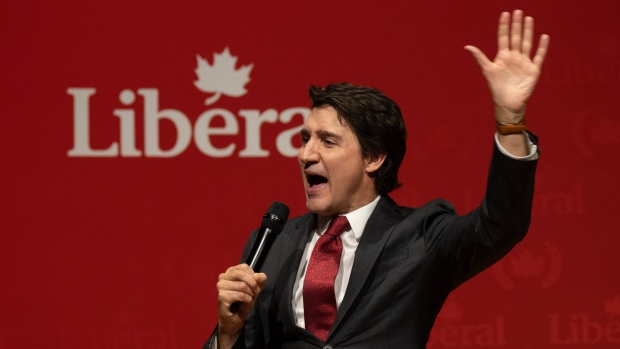
Liberal Party Leader Justin Trudeau

The federal cabinet will hear from a range of experts on housing, economics and Canada-U.S. relations over three days of meetings in Montreal next week. 

Prime Minister Justin Trudeau and his governing team are set to kick off their winter cabinet retreat Sunday night as they prepare for Parliament to return in the last week of January. 

Cost of living has dominated government discussions for more than a year now and will top the agenda again in Montreal as the Liberals seek a path back to favour among voters.

Canadians watching their spending power diminish in the face of higher interest rates, ballooning housing costs and bigger grocery bills have significantly shifted support away from the Liberals over the last six months. 

The cabinet will hear Monday from top economists and housing experts including Frances Donald, the chief economist at Manulife Financial, and Tim Richter, the president and CEO of the Canadian Alliance to End Homelessness.

On Tuesday, the focus will shift slightly to global affairs, the Israel-Hamas conflict and the upcoming presidential election in the United States.

This report by The Canadian Press was first published Jan. 19, 2024.


Birchcliff CEO explains 50% dividend cut as

shares tank

The president and CEO of Birchcliff Energy says a drop in commodity prices has led the company to cut its dividend and alter its output projections for 2024.

On Wednesday evening, the company announced it cut its quarterly dividend in half. It also lowered its average output expectations to a range of 74,000 to 77,000 barrels of oil equivalent per day and dropped its cash flow projections for the year to $340 million.

The changes had Birchcliff trading as the worst-performing stock on the TSX as of Thursday morning.

Chris Carlsen, president and CEO of Birchcliff, said the old projections were made in 2021 and 2022 when commodity prices were high, but now that they have come down, the company has had to adjust.

“Looking forward into 2024, our real concern is that commodity prices have significantly weakened off and what we’re not going to do is take on a significant amount of debt that puts the company at risk,” he told BNN Bloomberg during a television interview on Thursday.

“We’re just not going to do that.”

Carlsen said the dividend cut puts makes the payouts “sustainable for the long term.”

“At 40 cents a share, we think we can pay that dividend -- $100 million a year – for the longevity,” he said. “We’re not making dividend decisions quarter to quarter.”

DEFERRED WELLS DUE TO NATURAL GAS PRICES

In August 2022, natural gas was trading at US$9.33 metric million British thermal units (MMBtu).

The price has since fallen to $2.75 as of Thursday morning, according to Trading Economics.

At the time of the high, Carlsen said his company focused on cutting its debt.

“Commodity prices were in great shape and Birchcliff itself was able to pay almost $900 million of debt including our preferred shares,” he said.

Now, Carlsen said the company is focused on cutting its production during this period of low prices, with plans to ramp back up once commodity prices climb.

“We differed 13 wells that were supposed to be drilled in Q2 and come on in weak commodity prices in the summer of 2024,” he said. “We’ll now drill those wells in Q3 and bring those wells on to strong prices into Q4 … we think that’s prudent for 2024.”


20% of Canadians mostly working from home: StatCan

A new report suggests the pandemic-induced shift to remote work is on a downward trend, with the percentage of Canadians working from home now half of what it was during the early days of COVID-19.

The report from Statistics Canada, released on Thursday, showed 20 per cent of Canadian workers were mostly working from home as of November 2023, down from the 40 per cent recorded during the early COVID-19 restrictions of April 2020.

This comes as more people are returning to work as companies mandate more in-office days.

However, there are still more Canadians working from home now than there were pre-pandemic. Statistics Canada said just 7.1 per cent of workers were mostly teleworking in May 2016.

The federal agency said this shift has wide-reaching implications.

“This increase in telework has potentially important implications for numerous aspects of the economy and society such as the housing market, office rental space and economic activity in downtown areas, productivity, wage growth, worker turnover, family-work balance, childcare, commuting, public transit, and greenhouse gas emissions,” the report states.

Statistics Canada found that the increase in remote work has put financial pressures on public transit systems, due to the reduced number of people using the service, but has “likely” helped with greenhouse gas emissions, as fewer people commute to the office.

“If all Canadians whose job could be done from home in 2015 and who worked onsite that year had started working exclusively from home, greenhouse gas emissions due to transportation could have fallen by 9.5 megatons of carbon dioxide equivalent on an annual basis,” the report states.


CANADA

Home price declines in big cities drag down

Teranet-National Bank index

An index looking at home prices in Canada declined in December as major cities notched price decreases.

The monthly Teranet-National Bank Composite House Price Index, which looks at Canada’s 11 biggest cities, declined 0.5 per cent month-over-month in December.

Seasonally adjusted housing prices declined in just four of the 11 cities, with the steepest decline coming out of Victoria, where prices came down 3.9 per cent.

The other three cities with price declines – Vancouver, Toronto and Ottawa-Gatineau, with decreases of 1.5 per cent, 0.8 per cent and 0.3 per cent, respectively – carried enough weight to bring the total average down for the third straight month, according to a Thursday press release on the figures.

“Persistent affordability issues, combined with a less buoyant job market, have contributed to the decline in property prices,” a statement reads. “Despite a less vigorous economy, we are not yet witnessing a wave of additional supply on the real estate market.”

“For the months ahead, prices should continue to decline despite the support of historical population growth and the shortage of housing supply, as the deterioration in the labour market is set to continue.”

Meanwhile, prices climbed the most in Calgary, where home prices hiked 2.3 per cent, while Halifax (2.3 per cent), Quebec City (0.9 per cent) and Hamilton (0.9 per cent) also saw significant price hikes.

YEAR-OVER-YEAR INCREASES

The index rose three per cent year-over-year.

Halifax’s housing prices climbed a whopping 10.3 per cent in the year.

Only Edmonton (1.6 per cent) saw housing prices decline year-over-year, while Victoria remained stable.

The report follows other recent data on the housing market in Toronto that found prices fell in the month, but could climb soon. 

“Relief seems to be on the horizon,” a statement from the Toronto Regional Real Estate Board

“Borrowing costs are expected to trend lower in 2024. Lower mortgage rates coupled with a relatively resilient economy should see a rebound in home sales this year."

A similar report from the Real Estate Board of Greater Vancouver found housing prices declined 1.4 per cent in December compared to November.


Sports Illustrated employees left in limbo as publisher faces money troubles


The jobs of people who produce Sports Illustrated were in limbo Friday after the company that paid to maintain the iconic brand's print and digital products told staff that its license was revoked.

In an email to employees Friday morning, the Arena Group, which operates Sports Illustrated and related properties, said that because of the revocation, "we will be laying off staff that work on the SI brand.”

Authentic later said in a statement it intends to keep Sports Illustrated going. The company is negotiating with Arena and other publishing entities to determine who will do that, according to a person with knowledge of the talks who spoke to The Associated Press on condition of anonymity because the person was not authorized to speak publicly about them.

Until those negotiations are resolved, it's unclear which journalists would actually do the work of making Sports Illustrated. It was not clear how many jobs were affected.

Sports Illustrated's employee union said in a statement that the layoffs initially announced by Arena would be a significant number and possibly all, of the NewsGuild workers represented.

“We have fought together as a union to maintain the standard of this storied publication that we love, and to make sure our workers are treated fairly for the value they bring to this company. It is a fight we will continue,” Mitch Goldich, NFL editor and unit chair, said in a statement.

The guild's statement also called for Authentic Brands Group to “ensure the continued publication of SI and allow it to serve our audience in the way it has for nearly 70 years.”

Authentic said it would do so, and that "we are confident that going forward the brand will continue to evolve and grow in a way that serves sports news readers, sports fans and consumers. We are committed to ensuring that the traditional ad-supported Sports Illustrated media pillar has best-in-class stewardship to preserve the complete integrity of the brand’s legacy.”

In a statement on Friday, the Arena Group said it was negotiating with Authentic about the license, “with plans to sustain our commitment to delivering quality content throughout the ongoing discussions.”

Arena admitted that it had failed to make a quarterly payment of US$3.75 million and Authentic had put it on notice that it intended to end the licensing agreement. As a result, Arena announced Thursday it would make a “significant reduction” in its workforce of more than 100 people.

The Arena Group acquired publishing rights from Authentic in 2019 for at least 10 years. The group’s stewardship of Sports Illustrated has had many hurdles since then. In December, it fired chief executive officer Ross Levinsohn when the magazine’s alleged use of AI-generated stories drew public backlash.

Sports Illustrated has had a rough six years. It was acquired by Meredith Publishing in 2018 as part of the purchase of Time Inc., which started the magazine in 1954.

Less than a year later, Meredith sold the magazine's intellectual property to Authentic for $110 million. Authentic owns the intellectual property of many brands and stars, including Marilyn Monroe, Elvis Presley, Muhammad Ali and Reebok.

Once a weekly publication, Sports Illustrated was reduced to biweekly publishing in 2018 and became a monthly in 2020.

CANADA


'Deep recession territory': Economists react to November retail sales dip

Canadian retail sales came in lower than expected in November, according to Statistics Canada, and economists say the figure demonstrates the strain high interest rates are putting on consumers.

“It’s a continuation of that story of consumers really being hard hit,” Pedro Antunes, chief economist with the Conference Board of Canada, told BNN Bloomberg following the Friday data release.

Sales saw a 0.2 per cent decrease in November, which missed the median estimate of a flat reading in a Bloomberg survey. In volume terms, retail sales also edged down 0.2 per cent that month, StatCan said.

Antunes said the figures show the Bank of Canada’s rate-tightening policy approach is having its “intended effect” by slowing economic activity to allow supply to catch up with demand.

He added that on a per capita basis, consumer spending was “hammered” in October and November, approaching levels seen during recessions, and this was only partially offset by population growth.


“We're in very deep recession territory,” he said. “There’s a lot of pain here being felt by a lot of households and it's showing up in these numbers.”

Despite the lower-than-expected November figures, StatCan’s early estimate for December suggested sales increased by 0.8 per cent that month, though the agency noted that the figure would be revised.

CIBC Capital Markets senior economist Katherine Judge said in a Friday note that the estimated rebound in sales last month is likely “fleeting” given a weakening labour market and the continued impact of high interest rates on household budgets.

Interest rate outlook

Antunes said that the Bank of Canada’s monetary policies have helped to decrease inflationary pressures, despite the strain they’ve put on consumers, and he sees inflation “heading in the right direction.”

Antunes said he expects the central bank will be watching wage growth closely in the coming months, as wages have been growing at a higher rate than the rate of inflation in recent months.

The Conference Board of Canada is calling for an interest rate cut in the late spring or early summer of this year, Antunes said. The Bank of Canada is set to make its next interest rate decision on Jan. 24.

With its trend-setting rate currently set at five per cent, economists are watching closely for signs indicating when the central bank will start to cut rates, now that inflation has come down significantly and the economy is showing signs of slowing.

Expecting 'very weak growth'

The pinch being felt by Canadian consumers is something people in most of the world’s economies are dealing with, Antunes added– and he expects a weaker global economy will weigh on Canada’s trade sector for most of this year.

“We're expecting very weak growth overall in Canada for this year,” Antunes said.

“The good news is that most of that pain and that impact has already been felt, and we're hopeful that we will see the economy starting to pick up in the second half of this year as interest rates come down.”

With files from Bloomberg News and the Canadian Press


Canada retail sales rebound in December after

 spending slowdown

Canadian consumers went on a holiday shopping spree at the end of last year, after reining in their spending just a month earlier.

Receipts for retailers jumped 0.8 per cent in December, the biggest increase since April, according to an advance estimate from Statistics Canada released Friday. That followed a 0.2 per cent decrease in November, which missed the median estimate of a flat reading in a Bloomberg survey. In volume terms, retail sales also edged down 0.2 per cent that month.

Sales declined in four of the nine subsectors in November, while motor vehicle and parts dealers saw the largest increase, up for a third straight month. Excluding autos, retail sales fell 0.5 per cent, versus expectations for a 0.1 per cent decline.

Core retail sales, which exclude gas stations and car dealers, were down 0.6 per cent, led by lower receipts at supermarkets, grocery retailers and liquor stores.

While sales rose sharply in December, the pullback in November still highlights some spending weakness for consumers, who are facing higher interest rates and many of whom are due to renew their mortgages this year. Friday’s report, combined with accelerating core inflation and worse-than-expected job gains in December, point to the Bank of Canada holding policy rates steady at five per cent next week.

Regionally, sales were down in five provinces in November. Quebec saw the largest provincial decrease of 1.4 per cent and sales in its biggest city, Montreal, decreased 0.9 per cent.

The statistics agency didn’t provide details on the December estimate, which was based on responses from 49.4 per cent of companies surveyed