It’s possible that I shall make an ass of myself. But in that case one can always get out of it with a little dialectic. I have, of course, so worded my proposition as to be right either way (K.Marx, Letter to F.Engels on the Indian Mutiny)
Saturday, March 09, 2024
EVs Are at a Turning Point, It May Not Be What You Think
March 7, 2024 | UNION OF CONCERNED SCIENTISTS
There’s been a lot of nay-saying around EVs lately, including, amongst other things, worries that EV sales are stalling out now that all the early adopters have already made the switch and mainstream buyers aren’t ready to dive in. I wouldn’t blame you if you thought nobody was buying EVs or that sales were about to plummet. While there are some near term headwinds, I’ve never had as much confidence in the ability to zero out tailpipe emissions from our cars and trucks. Here’s why I’m optimistic:
Americans are interested in EVs, and they are buying them!!!
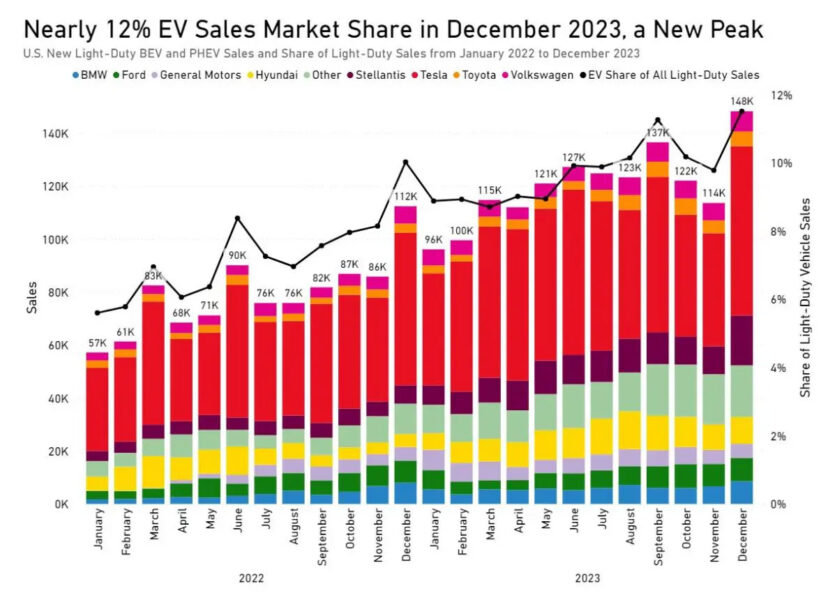
2023 was a milestone year for electric car sales in the US. For the first time ever, annual sales surpassed one million vehicles, accounting for more than seven percent of new vehicles sold. That is A LOT of EVs and A LOT less oil use, air pollution and climate emissions. In December alone, sales hit a new monthly high approaching 12 percent nationally (see figure).
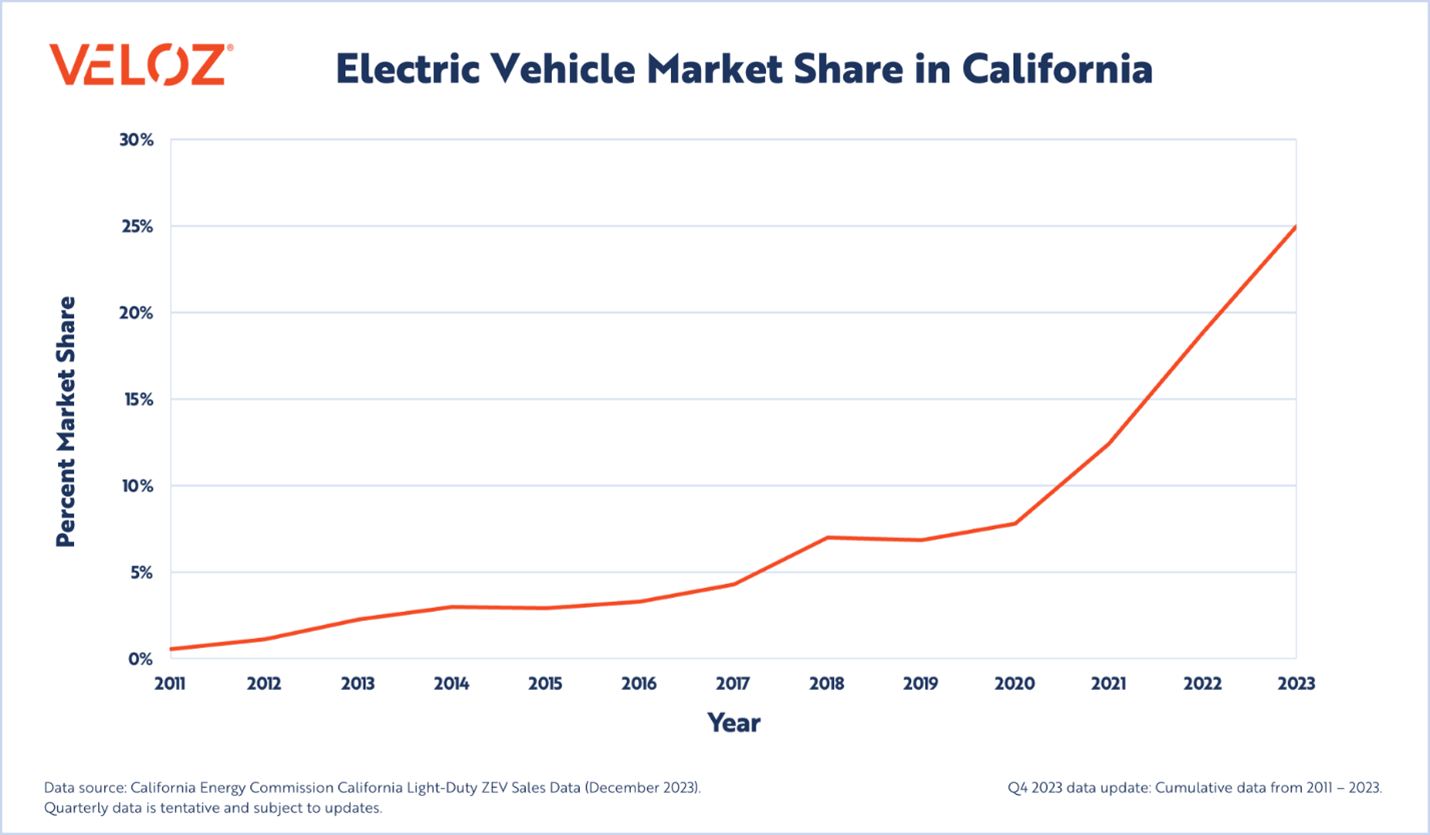
In California, nearly half a million EVs were purchased in 2023 reaching a whopping one in four new vehicles.
The top selling passenger car AND top selling light truck in CA in 2023, according to California New Car Dealers Association, were both electric vehicles with the Tesla Model 3 and the Tesla Model Y taking the top spots…as they also did in 2022.
We are witnessing something the auto industry has never seen in its 100+ year history. A proven, viable alternative to the internal combustion engine has arrived—and millions of drivers are already using these vehicles every day across America.
Despite all these major milestones, there’s been a lot of focus lately on signs the recent rapid growth in EV sales may be slowing. California, where the market is more mature, saw annual EV sales increase 29% year over year, but fourth quarter year-over-year sales grew only about 8% (Veloz). Some manufacturers have had to readjust their overly optimistic EV sales targets and layoffs at some manufacturers (Rivian for one) has added to the gloomy news. But it shouldn’t be surprising that the transition to electric vehicles might not be a straight line up, up and up. Even in California, the sales of EVs over the last 10 years have ebbed and flowed, slowing for a while and then ramping up again as new, more capable and better priced models become available and charging infrastructure has been built out. In 2021 and 2022, if you wanted to buy an EV you might be on a waiting list for many months or even years which in turn drove aggressive projections by automakers for future years sales. Manufacturers have always had to make adjustments when overly rosy projections about their next amazing product are undermined by their competition, which isn’t standing still, or broader market forces (like higher interest rates) and the cyclical nature of the auto industry.)
EV charging infrastructure is about to get super charged
A ribbon cutting for EVgos chargers in Denver, CO.
Three BIG things are happening in the charging space that are going to super charge EVs: (1) agreement on a charging standard, (2) Tesla opening up its supercharger network, and (3) billions of private and public investment which is just starting to deliver more chargers.
In every survey I’ve seen over the past decade, access to charging has always been at or near the top of the list of potential EV buyers’ concerns. The vast majority of time, charging happens at home. But when you buy a car, you want to be able to drive it wherever you need to go, so a widespread public charging network is important.
Tesla made charging infrastructure a priority and it has paid dividends for them. If you want a reliable, extensive and easy to use network of fast chargers, Tesla has been the only game in town. But to use it, you had to buy a Tesla. If you didn’t buy a Tesla, you had to choose between two different charging standards and hope you picked right one. Finally, the VHS vs BETA Max moment for EV charging in the US has arrived. And the winner is (Tesla’s) North American Charging Standard.
This is a game changer, the benefits of which will play out over the next few years, as manufacturers make their cars compatible with a single standard AND the Tesla network of chargers is opened up to other manufacturer’s vehicles—which started with Ford this month with others soon to follow.
In addition to moving beyond the uncertainty of charging standards that has weighed on the market for years, there is a huge amount of investment happening to build out a more reliable, and extensive public charging network.
The bipartisan infrastructure law provided up to $7.5 billion in investments to support the buildout of a nationwide charging network through the Charging and Fueling Infrastructure Grant Program and the National EV Infrastructure (NEVI) program. This federal investment is building upon billions of private investments as well. Billions of dollars have been invested as a result of the VW settlement in 2015 which established Electrify America. Many other automakers are investing in charging as well. Rivian is building out a network of chargers and announced plans to open it up to other vehicles, seven automakers announced a partnership with EVGo last summer to build out 30,000 fast chargers, Volvo is partnering with Starbucks to build chargers at that popular beverage chain, and even Walmart is getting in on it, just to name a few.
Many of these announced investments are just starting to result in available chargers. The Joint Office of Energy and Transportation for example just recently announced the first charging stations being opened under the NEVI program. Tens of thousands of more chargers will be deployed in the coming years supported by this program alongside additional state investments, utility investments, and private investment.
There are still some speed bumps in the road; charging reliability remains a concern, and efforts to ensure charging accessibility in lower income communities and in multiunit dwellings must continue. But there is strong momentum moving in the right direction to support the growing market for EVs.
Increasing EV options, easier access to incentives will spur more buyers to make the switch
Yes—there are a lot of EV models out there. But in practical terms, options are still pretty limited and it shows up in the sales data. Tesla dominates the U.S. market with only 2 models—the Model 3 and Model Y—making up more than 40% of all EV sales in 2023, and all of Tesla’s vehicles claiming 45% market share (inclusive of PHEVs). This is not a sign of a mature, competitive market. But that has already started showed signs of changing. Tesla market share used to be even higher (60% in 2020 vs 45% in 2023), and they’ve been trying to maintain it with lower pricing—to the benefit of prospective buyers but the chagrin of competing manufacturers and Hertz (declining prices on new Teslas was a key factor for downsizing their EV fleet). With growing confidence in access to charging and new models on the horizon (for those buyers looking for seven seaters for example, the Kia EV9 was recently released and the VW Buzz and Volvo EX90 are on the horizon), consumers will have more viable options that go beyond the current crop of 250+ mile range 5-seat SUVs that currently represent the bulk of EV models available.
The other BIG game changer is the recent change to the federal incentive for EVs. In the past, buyers could either access up to a $7500 credit only after filing their taxes or indirectly by leasing an EV (where the dealers nominally would pass on the credit through a lower lease price). That all changed starting in January. EV buyers who meet income limits can now access the credit right at the dealership, immediately knocking off up to $7,500. As of early February 11,000 dealers had already signed up for this program and reported 25,000 vehicle sales including both new EV purchases as well as used EV sales—which are now eligible for up to a $4,000 credit.
Requirements for vehicles and batteries to be manufactured or assembled in the US, as well as for mineral sourcing, are currently limiting the vehicle models which can get the full amount of credits which is likely cutting into potential sales (List of eligible vehicles). But as manufacturers invest in their domestic supply chains, more vehicles will be eligible for the credit (and more US jobs will be created to boot.)
Innovation doesn’t stop
EVs today are not the same as the ones from a decade ago, and the ones ten years from now won’t be the same as today. They will be better. They will be less impacted by extreme cold (already something that is manageable). They will have longer ranges or greater towing capacity for those drivers that really need it. They will come in more shapes and sizes. They will charge faster. And they will be even more cost competitive with their internal combustion vehicle counterparts.
I don’t feel like I’m sticking my neck out here. Just look at the past 10+ years. In January 2012, at a hearing of the California Air Resources Board I attended, the board considered updates to the Zero Emission Vehicle standards through model year 2025. There was robust debate about the feasibility of EVs reaching 15 percent market share in CA by 2025. The market at the time (all of 6,743 California sales in 2011) was dominated by the 73-mile range Nissan Leaf, the plug-in hybrid Chevy Volt (with a 35-mile electric range). Automakers pushed back, concerned the rules were too stringent. CARB mostly stuck to their guns, but provided lots of flexibility for how the standards could be met. Today, sales in California not only far exceed these targets, but ahead of schedule, because regulators in part underestimated how fast technology would improve. ).
If there’s one thing that’s been tough for regulators to predict in setting industry-wide vehicle standards, it’s the pace and extent of innovation. But one thing is absolutely certain, innovation will continue and it goes a faster when there are binding standards that require industry-wide investment.
Innovation is hard to predict, auto industry behavior is not.
Automakers love to talk about innovation—heck, they’ve even formed the Alliance for Automotive Innovation. But when push comes to shove, bullish statements on transitioning to EVs and commitments to reducing emissions don’t translate to support for strong industry-wide vehicle standards —standards that have proven critical in the past to move the whole industry forward.
The history of industry resistance is well documented in UCS’s Time for a U-Turn report. The latest stance by the industry—with respect to emissions standards—is a repeat of the can’t do attitude they turned to for decades when fighting fuel economy standards, then claiming the technology didn’t exist, it was too expensive, and consumers didn’t want it (they were wrong). Now the auto industry is dragging its feet once again, this time trying to use China’s progress on EVs as an excuse to slow down on U.S. standards. Really? When you’re falling behind, is slowing down really the right answer?
Luckily, Congress didn’t think so when it passed the Bipartisan Infrastructure Law (BIL) and the Inflation Reduction Act (IRA). Congress understood that we need to ensure that the next generation of vehicle technology is made domestically to be competitive globally. By making historic investments in the U.S. auto industry, supporting EV infrastructure, domestic manufacturing and supply chain development, battery recycling efforts, manufacturing incentives, and consumer incentives, we support a just transition to zero emissions transportation, and move beyond the fossilized fossil fuel stance automakers are clinging to.
Federal vehicle standards are needed to keep us on track
We’re likely to see the next round of vehicle standards finalized by the Environmental Protection Agency (EPA) in the coming weeks. This latest round builds on decades of federal and state vehicle performance standards that have eliminated billions of tons of pollution from the air we breathe, saved consumers trillions (no joke) at the gas pump, and helped to keep climate changing emissions in-check. The stakes frankly have never been higher. We have little more than 25 years to meet critical “mid-century” emissions targets to get climate change under control. The vehicle rules would be in effect through model year 2032 – many of the vehicles built in that year will likely still be on the road in 2050 when global climate emissions need to be near zero to avoid dangerous warming. The rules set declining average pollution levels which help ensure automakers deliver cleaner cars in the form of lower emission gasoline vehicles and zero-tailpipe emission electric vehicles.
Now it’s time for the EPA to set the north star for the auto industry for the next decade to keep us on track. On track toward a strong, globally competitive auto sector in the US that supports good jobs. On track to delivering more clean, affordable options for consumers. And on track toward zeroing out pollution from our cars and trucks.
How a historic lack of ice cover on the Great Lakes could affect ecosystems
RACINE, Wis. (AP) — Michigan Tech University biologists have been observing a remote Lake Superior island’s fragile wolf population every winter since 1958, but they had to cut this season’s planned seven-week survey short after just two weeks.
The ski plane they study the wolves from uses the frozen lake as a landing strip because there’s nowhere to touch down on the island. But this weirdly warm winter left the Great Lakes nearly devoid of ice.
As climate change accelerates, scientists are scrambling to understand how iceless winters could affect the world’s largest freshwater system. Most of the effects are still theoretical since the lakes are generally too treacherous for data-gathering expeditions during the coldest months and biologists have long thought that little ecological activity takes place under the ice anyway. But they say the changes could have serious environmental, economic and cultural impacts, including by harming certain fish species, eroding beaches, fueling algae blooms and clogging shipping channels.
“This year really drives home the point that we need to collect more data,” said Trista Vick-Majors, an assistant biology professor who studies aquatic ecosystems at Michigan Tech. “There’s just no way you can predict how an ecosystem is going to respond to the large-scale changes we’re looking at.”
The planet experienced record heat for an eighth-straight month in January, according to the European climate agency. The upper Midwest has been no exception, with Chicago enjoying temperatures of around 70 degrees (21 degrees Celsius) late last month and Wisconsin getting its first February tornadoes.
Ice coverage on the lakes, which have a combined surface area roughly the size of the U.K., has generally peaked in mid-February over the last 50 years, with as much as 91% of the lakes covered at times, according to the Great Lakes Ice Tracker website. As of mid-February this year, only 3% of the lakes was covered, which was the lowest figure since at least 1973, when the site’s records begin.
Researchers don’t have much data about how years of iceless winters could change the lakes, but they have plenty of theories.
Iceless lakes could absorb sunlight faster and warm up sooner in the spring. Some biologists speculate that this could lead to earlier and larger blue-green algae blooms, which can be toxic to humans and put a damper on summer tourism.
Without ice, the lakes’ upper levels will likely warm even more quickly than usual, contributing to thermal stratification, in which layers of colder and warmer water form. Less oxygen would make it into the lower, colder and denser levels, which could cause plankton and other organisms to die, some scientists believe. Whitefish and lake trout typically hatch in the spring and feed on plankton, so less plankton would likely cause fish populations to shrink, potentially leading to tighter fishing quotas and higher prices at grocery stores and restaurants.
Less ice could translate to longer fishing seasons, but winter storms could wreck nets and traps and destroy whitefish eggs that rely on the ice for protection, said Titus Seilheimer, a University of Wisconsin-Madison fisheries specialist.
Charlie Henrikson runs a small commercial fishing operation off Wisconsin’s Door County peninsula. He said his boats have been setting nets in February when they typically don’t start the season until late March. He said he’s most concerned about the lack of ice leading to more evaporation, which would cause lake levels to drop and make it harder to get his boats into port.
“I’m 71 years old, so I of course like it warmer. I like being able to walk out on the dock here and not have icy conditions. Whatever you want to call it, the weather’s changing. And we’re getting more extreme conditions. It will change our strategy and we’ll be able to figure out ways to make use of it. You always have to adapt.”
Less ice also could lead to a longer lake shipping season. But without ice blanketing the lakes, powerful winter storms could erode shorelines more than usual, which could push more sediment into harbors and make them shallower and trickier to navigate, said Eric Peace, vice president of the Lake Carriers Association, a trade group. Coupled with lower lake levels due to increased evaporation, ships might have to carry less cargo so they would sit higher in the water, he said.
This year’s lack of ice enabled Michigan Tech’s Vick-Majors to launch a project to gather winter-specific data that scientists can compare to summer data. Researchers from around the Great Lakes are participating in sampling this month.
On a recent day, Madeline Magee and Rae-Ann Eifert, lake monitors for the Wisconsin Department of Natural Resources, braved sub-freezing temperatures to gather buckets of lake water off a Racine breakwater as part of Vick-Majors’ project.
The lake was completely open, an emerald expanse stretching to the horizon, and the wind was howling. High swells pounded the beach and showered Eifert as she stood on the breakwater, leaving her ski pants coated with beads of ice. Magee said the project is worth it.
“Continuing the data collection moving forward will only further inform what we know about the Great Lakes and how we might be able to manage the lakes more efficiently. … If we lose ice cover, we really are changing the fundamental ecosystem of the Great Lakes in ways that we don’t really understand right now,” she said.
Brands faced consumer backlash over Black Lives Matter support, study finds
In an era where the lines between corporate identity and social activism blur, brands increasingly find themselves navigating the treacherous waters of public opinion on social media. At the heart of this phenomenon is the question: What happens to brands that align themselves with movements like Black Lives Matter (BLM)?
A recent study published in the INFORMS journal Marketing Science offers an answer, revealing that companies endorsing BLM have faced a backlash from consumers. This backlash manifests as a decline in social media engagement, measured by followers and likes, alongside an uptick in negative commentary.
The study was spurred by the observation that while brands are increasingly expected to take stands on social issues, the actual impact of such endorsements on consumer behavior, especially in the context of racial justice movements, remains underexplored. The researchers sought to fill this gap by examining whether brands’ support for BLM positively or negatively influenced consumer engagement on social media platforms.
The researchers programmatically collected data from two major social media platforms: Instagram and Twitter. Their dataset included information from 435 brands spanning multiple industries such as automotive, clothing, food, high-tech, jewelry, and sporting goods. This broad sample was chosen based on the availability of data concerning foot traffic (from Safegraph) and social media accounts on both platforms.
The study period covered posts from June 1, 2019, to October 31, 2020, which allowed for the analysis of over 396,988 social media posts, including the period before, during, and after Blackout Tuesday — a key event in the BLM movement. For each post, the researchers gathered details such as the timestamp, captions, content, likes, and follower growth metrics.
A cornerstone of the study’s methodology was its use of Blackout Tuesday as a natural experiment. Blackout Tuesday, which occurred on June 2, 2020, was a day when individuals and organizations posted black squares on Instagram to show solidarity with the BLM movement. This event provided a unique opportunity to compare the effects of BLM support on consumer engagement in a quasi-experimental setup.
Instagram, where the black square posting was prevalent, served as the treatment group, while Twitter, which did not experience the same level of participation in the event, served as the control group. This allowed the researchers to isolate the impact of BLM support from other factors that might influence social media engagement.
To analyze the vast amount of textual data in the social media posts, the researchers employed machine learning methods, specifically natural language processing (NLP) and deep learning tools. These tools enabled them to categorize posts into different topics, such as prosocial (e.g., supporting societal causes) and self-promotional content.
They used guided Latent Dirichlet Allocation (LDA) and a bidirectional Long Short-Term Memory (LSTM) model with attention mechanisms to predict the probability that each post related to specific topics. This sophisticated analysis allowed them to examine the nuances of how different types of content influenced consumer responses to brands’ BLM support.
The researchers found that brands that publicly supported BLM on social media generally saw a decrease in follower growth. The comparison of follower growth rates on Instagram (where Blackout Tuesday participation was widespread) with Twitter (used as a control group where the event was not mirrored) revealed a significant decline in follower growth on Instagram. This decline suggests that, contrary to the expectations that aligning with social justice causes might bolster a brand’s social media presence, public endorsements of BLM often led to a backlash among consumers.
Apart from the slowdown in follower growth, brands supporting BLM also faced an uptick in negative commentary on their social media posts. This backlash was not uniform but varied depending on the nature of the brands’ posts and their audience’s political leanings.
The study highlighted that the negative sentiment was particularly strong among consumers with Republican political affiliations who opposed the BLM movement. However, a segment of Democratic consumers also contributed to the negative commentary, criticizing brands for engaging in what they perceived as “slacktivism” – showing support for a cause without accompanying their words with actions or financial contributions.
An intriguing aspect of the study’s findings was the moderating effect of self-promotional content posted by brands alongside their BLM support messages. When brands continued to post self-promotional content in close proximity to their BLM endorsements, the negative impact on consumer engagement was exacerbated. This suggests that consumers may view the juxtaposition of social justice support with commercial promotions as inauthentic or as an attempt to capitalize on the social movement for commercial gain.
“One of the interesting findings is that negative associations were stronger when more brands posted in support of BLM, while concurrently posting self-promotional messages,” explained study author Yang Wang. “This suggests that large-scale BLM allyship programs that also included self-promotional posts created a ‘bandwagon effect’ that had a negative impact on those brands.”
“Brands that sought to capitalize by jumping on the bandwagon by allying with salient racial justice movements should have heeded caution,” added study author Xueming Luo. “And they should not have been too quick to resume business as usual with their product promotions while at the same time supporting BLM.”
The study also found that the negative repercussions of BLM support were not uniform across all brands. Brands with a history of engaging in social activism or those with mission statements emphasizing social causes experienced less severe declines in consumer engagement. In some cases, these brands may have even benefited from their support of BLM, suggesting that a consistent track record of social activism can mitigate potential backlash.
“Some brands with more historical prosocial posting on social media and with socially oriented missions suffered less from the negative effects and may even benefit from supporting BLM,” Luo said.
Moreover, the political affiliation of a brand’s consumer base played a significant role in moderating the impact of BLM support. Brands primarily followed by Republican consumers faced more significant negative effects, highlighting the polarized nature of political and social issues in consumer behavior.
But the researchers acknowledged that their focus on social media engagement metrics might not fully capture the broader impact of BLM support on a brand’s reputation or financial performance. Future research could extend this work by linking social media activism to tangible business outcomes or exploring consumer responses to brand activism across other social issues.
More Chinese women choosing singledom as economy stutters
Many of the women interviewed cited a desire for self-exploration, disillusionment with patriarchal Chinese family dynamics and a lack of
By Laurie Chen, Reuters
XIAN, China - Freelance copywriter Chai Wanrou thinks marriage is an unfair institution. Like many young women in China, she is part of a growing movement that envisions a future with no husband and no children, presenting the government with a challenge it could do without.
"Regardless of whether you're extremely successful or just ordinary, women still make the biggest sacrifices at home," the 28-year-old feminist said at a cafe in the northwestern city of Xian.
"Many who got married in previous generations, especially women, sacrificed themselves and their career development, and didn't get the happy life they were promised. Living my own life well is difficult enough nowadays," she told Reuters.
President Xi Jinping last year stressed the need to "cultivate a new culture of marriage and childbearing" as China's population fell for a second consecutive year and new births reached historic lows.
Chinese Premier Li Qiang also vowed to "work towards a birth-friendly society" and boost childcare services in this year's government work report
The Communist Party views the nuclear family as the bedrock of social stability, with unmarried mothers stigmatized and largely denied benefits. But a growing number of educated women, facing unprecedented insecurity amid record youth unemployment and an economic downturn, are espousing "singleism" instead.
China's single population aged over 15 hit a record 239 million in 2021, according to official data.
Marriage registrations rebounded slightly last year due to a pandemic backlog, after reaching historic lows in 2022. A 2021 Communist Youth League survey of some 2,900 unmarried urban young people found that 44% of women do not plan to marry.
Marriage, however, is still regarded as a milestone of adulthood in China and the proportion of adults who never marry remains low. But in another sign of its declining popularity, many Chinese are delaying tying the knot, with the average age of first marriage rising to 28.67 in 2020 from 24.89 in 2010, according to census data.
In Shanghai, this figure reached 30.6 for men and 29.2 for women last year, according to city statistics.
"Feminist activism is basically not allowed (in China), but refusing marriage and childbirth can be said to be ... a form of non-violent disobedience towards the patriarchal state," said Lü Pin, a Chinese feminist activist based in the United States.
No apologies
After decades of improving women's education levels, workforce participation and social mobility, Chinese authorities now face a dilemma as the same group of women have become increasingly resistant to their propaganda.
Long-term single lifestyles are gradually becoming more widespread in China, giving rise to online communities of mostly single women who seek solidarity from like-minded people.
Posts with the hashtags "No marriage, no children" from female influencers often in their thirties or forties on Xiaohongshu, China's Instagram, regularly gain thousands of likes.
One anti-marriage forum on Douban, another social media platform, has 9,200 members, while another dedicated to "singleism" has 3,600 members who discuss collective retirement plans, among other topics.
Liao Yueyi, a 24-year-old unemployed graduate in the southern city of Nanning, recently declared to her mother that she "wakes up from nightmares about having children".
"No marriage or kids is a decision I've made after deep consideration. I don't owe anyone an apology, my parents have accepted it," she posted on WeChat.
Instead she has decided to "lie flat" - a Chinese expression that means doing just enough to get by - and save money for future travels.
"I think it's okay to date or cohabit, but children are a huge asset investment with minimal returns," she said, adding that she has discussed renting a house with some female friends when they all retire.
Many of the women interviewed cited a desire for self-exploration, disillusionment with patriarchal Chinese family dynamics and a lack of "enlightened" male partners as the main factors behind their decision to stay single and childless.
Gender equality also plays a role: all the women said it was difficult to find a man who valued their autonomy and believed in equal division of household labor.
"There's an oversupply of highly educated women and not enough highly educated men," said Xiaoling Shu, professor of sociology at the University of California, Davis. Decades of the one-child policy have led to 32.3 million more men than women in 2022, according to official data.
"College-educated women become stronger believers in advocating for their rights and status in society," Shu said. "Well-educated women in search of supportive life partners find fewer suitable men who also endorse women's rights."
While not all the women interviewed identified as feminist or viewed themselves as deliberately defying the government, their actions reflect a broader trend of Chinese female empowerment expressed through personal choices.
And even though some analysts believe that the number of people who remain single for life will not grow exponentially in the future, delayed marriages and falling fertility are likely to pose a threat to China's demographic goals.
"In the long run, women's enthusiasm for marriage and childbirth will only continue to decrease," said feminist Lü.
"I believe this is the most important long-term crisis that China will face." — Reuters
Mar 7, 2024 SEC Chair Gary Gensler attends a meeting of the Financial Stability Oversight Council at the U.S. Department of Treasury on December 14, 2023 in Washington, DC. Photo by Drew Angerer/Getty Images
A landmark climate disclosure rule adopted by the US Securities and Exchange Commission (SEC) yesterday is already facing mounting legal and legislative challenges. Ten states filed suit yesterday shortly after the rule was finalized. Environmental advocates also say they’re considering challenging the rule.
If implemented, the SEC’s new rule would force large, public companies to disclose risks they face due to climate change and share partial information about their greenhouse gas emissions. It would lead to dramatically more transparency than there’s been in the past, but would still paint an incomplete picture of a company’s environmental footprint since companies would only be mandated to divulge a portion of their emissions.
Instead of placating everyone with a weaker rule, the SEC seems to have picked a fight with both Republicans and climate activists
The final rule is a watered-down version of a proposal the SEC put forth in 2022 that sparked a flood of opposition from industry groups and anti-ESG Republicans. But instead of placating everyone with a weaker rule, the SEC seems to have picked a fight with both Republicans and climate activists.
The coalition of ten states suing the SEC allege that “the final rule exceeds the agency’s statutory authority and otherwise is arbitrary, capricious, an abuse of discretion, and not in accordance with law.” It includes West Virginia, Virginia, Georgia, Alabama, Alaska, Indiana, New Hampshire, Oklahoma, South Carolina, and Wyoming.
Congressional Republicans are also working to overturn the SEC’s new rule, Bloomberg Law reports. Representative Bill Huizenga (R-MI) and Senator Tim Scott (R-SC) aim to use a Congressional Review Act, an oversight tool that allows Congress to overrule federal agency actions.
“Investors should realize this overreach by the SEC will significantly hurt our economy while serving as boon for special interests and far-left activists,” Huizenga said in a statement yesterday.
Many environmental activists, however, are also unhappy with the rule, saying it doesn’t go far enough to address climate-related risks. The most contentious piece is whether companies should have to divulge how much pollution they cause through their supply chains and the end-use of their products. While these are considered indirect emissions, they also typically represent the largest chunk of a company’s carbon footprint. Trade groups, particularly in banking and agriculture, fiercely opposed that provision in the SEC’s initial proposal. The SEC ultimately dropped it, upsetting environmental groups. SEC says companies must disclose their greenhouse gas emissions — but not all of them
The Sierra Club said it is also disappointed that the SEC’s final rule “eliminates key requirements for companies to quantify climate-related impacts to their assets and expenditures in financial statements.” The group, represented by nonprofit environmental law organization Earthjustice, said in a statement yesterday that it’s “considering challenging the SEC’s arbitrary removal of key provisions from the final rule, while also taking action to defend the SEC’s authority to implement such a rule.”
“As an investor, we expect full transparency about a company’s fundamentals, especially climate-related risks that pose serious negative financial consequences. Without higher accountability standards, companies can withhold critical information that prevents us from making informed investment decisions rooted in full due diligence,” Dan Chu, Sierra Club Foundation executive director, said in a statement.
SEC Chair Gary Gensler stands by the compromises made in the new rule. “I think today’s action is an important step for our U.S. capital markets,” he said in a statement yesterday. “These rules will enhance the disclosures that investors have been relying on to make their investment decisions.”
Justine Calma, a senior science reporter covering climate change, clean energy, and environmental justice with more than a decade of experience. She is also the host of Hell or High Water: When Disaster Hits Home, a podcast from Vox Media and Audible Originals.
How sacked whistle-blower Susanne Täuber’s career fared after she spoke out
Denied promotion, Täuber describes what happened to her after she publicly
A district court judge ruled on Susanne Täuber’s dismissal on International Women’s Day last year.Credit: Susanne Täuber
I began a position as a gender-equality researcher at the University of Groningen in the Netherlands in 2009, achieving tenure in 2015. I was studying factors that undermine the effective implementation of policy into practice. In 2018, after being passed over for promotion, I lodged an official complaint about gender bias. The following year, I argued that the university’s gender-equity policy jarred with my actual experiences at work1.
I was dismissed on 7 October 2022. On 8 March last year — International Women’s Day — a district court judge ruled that my dismissal was justified. The ruling referred to a “permanently disturbed working relationship”, but also stated that the university “played an important, if not a decisive role” in creating it.
My Court of Appeal hearing was in November 2023, and I found out in January that I had lost. For me, the appeal was important in getting clarity, for thousands of academics in the Netherlands, as to whether or not they can safely publish their research, especially if it is critical of their institutions.
Sadly, the verdict provides no closure on the protection of academic freedom. But, because my case drew so much attention at the time — including a sit-in by students and a petition signed by more than 3,600 academics around the world calling for my reinstatement — I can now draw on a global network of colleagues who have gone through similar experiences. A fundraiser organized on my behalf by Stichting Inclusive Action North, a Groningen-based social-justice alliance, was an immense relief. I wish that every person affected by bullying had access to such a financial lifeline.
Raising awareness
I have worked with academics from around the world to conceive of ways to tackle the censorship and related problems that are increasingly faced by academics. I participated in the Academic Freedom Under Attack webinar series last September, organized by higher-education researcher Carlos Azevedo at the Open University in Milton Keynes, UK, and critical-management scholar Ronald Hartz at Ilmenau University of Technology, Germany. Hartz was among a group of academics made redundant in 2021 by the University of Leicester, UK. I have also been invited by the Radboud Gender & Diversity Studies and the Radboud Women Professors Network in Nijmegen, the Netherlands, to deliver the keynote speech for International Women’s Day this year. Alongside such public events, I regularly meet with people who have been targets of discrimination, harassment and power abuse in academia, and I try to support others who are going through similar experiences.
Academia is a system that desperately clings onto preserving the power and privilege of a happy few. Since my dismissal, I have not done paid work. I doubt that moving to another European country to seek employment would do the trick. All over Europe, academics face the same problems. The factors that undermine academic freedom are present everywhere: the steep hierarchy and power differentials, the dearth of tenured positions, the structural workload being handed down to precariously employed, underpaid and undervalued academics, the intellectual and labour exploitation of the most-vulnerable academics and the push by universities to silence criticism.
Some movements over the past few years reflect the widespread nature of these problems. The German #IchBinHanna (‘I am Hanna’) movement fought against precarious-employment laws for scientists. The Danish #PleaseDontStealMyWork initiative exposed the intellectual extractivism faced by scholars, especially younger and dependent ones. And the 21 Group in the United Kingdom fights widespread bullying in academia.
The aftermath
At the time of my Court of Appeal hearing, I was recognized as an official whistle-blower by the Dutch Whistleblowers Authority, an independent administrative body based in The Hague. Questions concerning my case have already been raised by members of the Dutch House of Representatives, and I expect more to come. At the hearing, I was given a round of applause by supporters. It made me realize that I feel weirdly liberated by my experiences. What happened to me taught me more about my area of expertise than any amount of books and articles could ever have. My case was also mentioned last month when the European Parliament published its 2023 Academic Freedom Monitor of European Union Member States. The monitor notes “concerns for a potential chilling effect on academics wishing to address issues of management or other controversial issues”.
My advice for others would be to take a long hard look at the academic environment they’re in and to trust their gut feeling. I doubted my experiences and the accounts of other victims for years, always thinking, “it cannot be that bad, it cannot be that biased”. This self-doubt was more taxing than what came after — the crystal-clear realization that this is a rigged system. So, if you can: don’t waste time doubting yourself. Walk away and take your bright mind to a place where it will be valued.
doi: https://doi.org/10.1038/d41586-024-00700-w
This is an article from the Nature Careers Community, a place for Nature readers to share their professional experiences and advice. Guest posts are encouraged.

A ribbon cutting for EVgos chargers in Denver, CO.



:format(webp)/cdn.vox-cdn.com/uploads/chorus_asset/file/25323041/1848359560.jpg)
